# Dwarkesh Patel
> Source: https://aiwiki.ai/wiki/dwarkesh_patel
> Updated: 2026-11-18
> Fact-checked: 2026-11-18
> Categories: AI History, Artificial Intelligence, People
> License: CC BY 4.0 (https://creativecommons.org/licenses/by/4.0/) - attribute to "AI Wiki (aiwiki.ai)"
> Cite as: AI Wiki. "Dwarkesh Patel." aiwiki.ai, 18 Nov 2026. https://aiwiki.ai/wiki/dwarkesh_patel
> From AI Wiki (https://aiwiki.ai), the free encyclopedia of artificial intelligence. Reuse freely with attribution.
**Dwarkesh Patel** (born August 19, 2000) is an Indian-born podcaster and writer, based in San Francisco, who hosts the Dwarkesh Podcast, a long-form interview show that began in 2020 as The Lunar Society and is best known for its prepared, technical conversations about [artificial intelligence](https://aiwiki.ai/wiki/artificial_intelligence).[1][4][6] His guests have included [Mark Zuckerberg](https://aiwiki.ai/wiki/mark_zuckerberg), [Satya Nadella](https://aiwiki.ai/wiki/satya_nadella), [Elon Musk](https://aiwiki.ai/wiki/elon_musk), [Jensen Huang](https://aiwiki.ai/wiki/jensen_huang), [Dario Amodei](https://aiwiki.ai/wiki/dario_amodei), [Ilya Sutskever](https://aiwiki.ai/wiki/ilya_sutskever) and [Andrej Karpathy](https://aiwiki.ai/wiki/andrej_karpathy), alongside historians, economists and scientists.[1][4][7][20] With Gavin Leech he wrote *The Scaling Era: An Oral History of AI, 2019-2025* (Stripe Press, 2025), a book assembled from the show's AI interviews.[8][25] TIME placed him on its TIME100 AI list in 2024 and its TIME100 Creators list in 2026.[3][4]
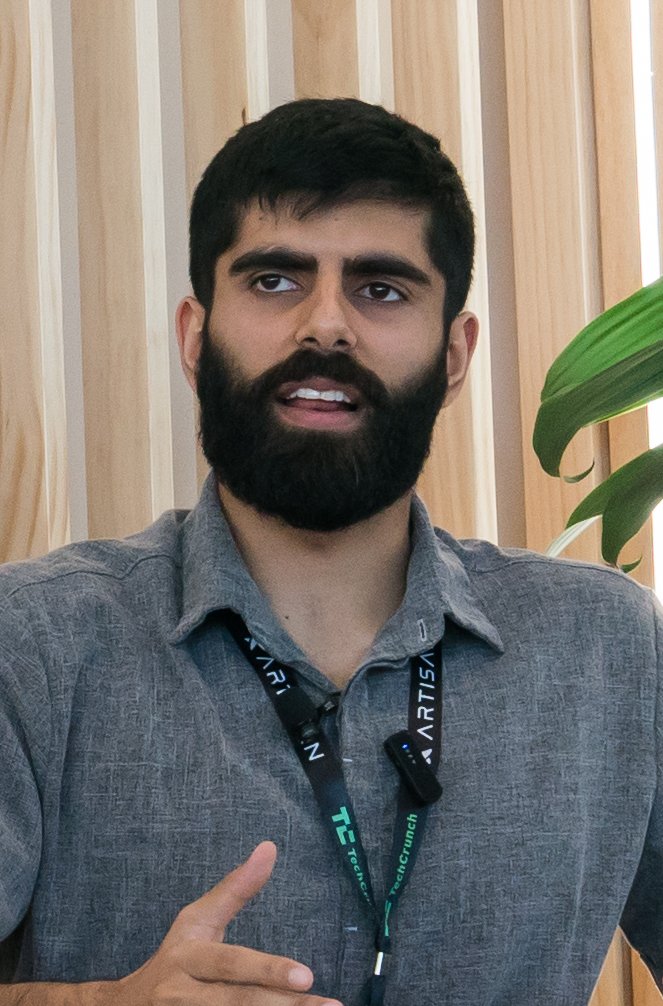
Dwarkesh Patel at TechCrunch Disrupt 2025. TechCrunch, via Wikimedia Commons, CC BY 4.0.
## Early life and education
Patel was born in Vadodara, Gujarat, India.[1] His family moved to the United States when he was a child, for the work of his father, a physician; The Global Indian puts the move in 2008, when he was eight, while a 2024 profile published by the financial technology company Mercury gives his age as about nine.[1][2] His father held an H-1B visa and was often placed in rural areas that needed doctors, and during Patel's teens the family lived in North Dakota, West Virginia, Maryland and Texas.[2] Because the family's green card application took years, Patel feared ageing out of his status as a dependant; he has written that COVID-era travel restrictions "cleared out the lines" and let him obtain his green card months before that deadline, and that without it he would not be hosting the podcast.[1]
He studied computer science at the University of Texas at Austin, where his professors included Scott Aaronson, and graduated in December 2021.[2]
"Why I don't think AGI is right around the corner", official video from Dwarkesh Patel, published August 1, 2025. Watch on YouTube.
## Dwarkesh Podcast
### Origins as The Lunar Society
Patel started the show from his dorm room at UT Austin during the COVID-19 pandemic.[2] After reading economist Bryan Caplan's book *The Case Against Education*, he cold-emailed Caplan, who agreed to record an episode before the show even had a name.[2] That conversation, "Bryan Caplan - Nurturing Orphaned Ideas", is the earliest episode in the podcast's feed, dated May 22, 2020.[7] Caplan then recommended the show to the economist Tyler Cowen, who appeared soon afterwards, and the show's growth from there was, in Mercury's words, "completely organic".[2][1] In August 2020 the progress-studies writer Jason Crawford described The Lunar Society as a "new podcast" run by a computer science student at UT Austin, after Patel interviewed him for it.[5]
The show was later renamed the Dwarkesh Podcast; its site describes it as "Deeply researched interviews".[6] Early guests were mostly economists, writers and technologists.[5][7] A 2026 review of Patel's book notes that the show turned heavily toward AI after the launch of [ChatGPT](https://aiwiki.ai/wiki/chatgpt).[8]
### Format and preparation
Many episodes run well over an hour, and some exceed four hours.[7][10] They are released as audio, as video on [YouTube](https://aiwiki.ai/wiki/youtube), and with transcripts on the show's Substack site.[6][12][15] Patel is known for heavy preparation. Mercury reported in 2024 that he spends a week or more preparing for each episode, reads a guest's relevant work, talks to researchers beforehand, and implemented a transformer himself before interviewing Ilya Sutskever; he described his goal as being to "80/20 an undergrad course on the topic" before each interview.[2] Gavin Leech, his co-author on *The Scaling Era*, is a former head of research for the podcast.[27] In 2024 Patel lived in a group house in San Francisco and said he was supported by grants such as Emergent Ventures; later episodes carry sponsor messages from companies including Labelbox, Mercury and Jane Street.[2][15][18]
TIME's 2024 profile quoted him as saying his aim was "to produce the highest quality intellectual content out there."[3] In a July 2026 profile, TIME reported that episodes averaged more than 1.8 million listens each and that his audience was largely made up of tech executives, engineers and researchers.[4]
### Notable AI interviews
Several of the show's AI episodes became reference points in wider debates. The table lists a selection, with dates taken from each episode page.
| Date | Guest(s) | Subject |
| --- | --- | --- |
| 2023-03-27 | [Ilya Sutskever](https://aiwiki.ai/wiki/ilya_sutskever) | Recorded at [OpenAI](https://aiwiki.ai/wiki/openai)'s offices; time to AGI, alignment, what comes after generative models[9] |
| 2024-02-28 | [Demis Hassabis](https://aiwiki.ai/wiki/demis_hassabis) | Scaling, search and planning on top of LLMs, security of model weights[19] |
| 2024-04-18 | [Mark Zuckerberg](https://aiwiki.ai/wiki/mark_zuckerberg) | [Llama 3](https://aiwiki.ai/wiki/llama_3), open-sourcing, energy limits on scaling[12] |
| 2024-06-04 | [Leopold Aschenbrenner](https://aiwiki.ai/wiki/leopold_aschenbrenner) | Released the day his essay series [Situational Awareness](https://aiwiki.ai/wiki/situational_awareness) appeared; 2027 AGI, US-China race[10] |
| 2024-06-11 | [Francois Chollet](https://aiwiki.ai/wiki/francois_chollet) and [Mike Knoop](https://aiwiki.ai/wiki/mike_knoop) | Launch of the $1 million [ARC Prize](https://aiwiki.ai/wiki/arc_agi)[11] |
| 2025-04-03 | Scott Alexander and [Daniel Kokotajlo](https://aiwiki.ai/wiki/daniel_kokotajlo) | The [AI 2027](https://aiwiki.ai/wiki/ai_2027) scenario[13] |
| 2025-09-26 | [Richard Sutton](https://aiwiki.ai/wiki/richard_sutton) | Sutton's view that LLMs are a dead end[14] |
| 2025-10-17 | [Andrej Karpathy](https://aiwiki.ai/wiki/andrej_karpathy) | "AGI is still a decade away"; why [reinforcement learning](https://aiwiki.ai/wiki/reinforcement_learning) is "terrible"[15] |
| 2025-11-12 | [Satya Nadella](https://aiwiki.ai/wiki/satya_nadella), with [Dylan Patel](https://aiwiki.ai/wiki/dylan_patel) | Tour of Microsoft's [Fairwater](https://aiwiki.ai/wiki/microsoft_fairwater) 2 data center; Microsoft's AGI plans[16] |
| 2025-11-25 | [Ilya Sutskever](https://aiwiki.ai/wiki/ilya_sutskever) | [Safe Superintelligence](https://aiwiki.ai/wiki/safe_superintelligence)'s strategy; "from the age of scaling to the age of research"[17] |
| 2026-02-05 | [Elon Musk](https://aiwiki.ai/wiki/elon_musk), with John Collison | Orbital data centers, [xAI](https://aiwiki.ai/wiki/xai), humanoid manufacturing[18] |
| 2026-02-13 | [Dario Amodei](https://aiwiki.ai/wiki/dario_amodei) | Scaling under RL, [Anthropic](https://aiwiki.ai/wiki/anthropic)'s revenue and compute[20] |
| 2026-04-15 | [Jensen Huang](https://aiwiki.ai/wiki/jensen_huang) | TPU competition, chip sales to China, [Nvidia](https://aiwiki.ai/wiki/nvidia)'s supply chain[21] |
| 2026-11-16 | [Paul Christiano](https://aiwiki.ai/wiki/paul_christiano) | Risk of superintelligence able to overthrow a government; securing lab weights[22] |
Aschenbrenner's appearance was a conversation of about four and a half hours that Patel introduced as a talk with "my friend Leopold Aschenbrenner".[10] The Chollet episode was recorded with Knoop on the day they launched the ARC Prize, which offered a $500,000 grand prize for the first team to reach 85% on the [ARC-AGI](https://aiwiki.ai/wiki/arc_agi) benchmark.[11] The Sutton interview turned on whether [large language models](https://aiwiki.ai/wiki/large_language_model) can learn on the job; Patel summarised Sutton's position as needing a new architecture for continual learning, and afterwards published a follow-up essay concluding that "If the LLMs do get to AGI first, the successor systems they build will almost certainly be based on Richard's vision."[14][23] The Nadella episode was recorded jointly with Dylan Patel, founder of [SemiAnalysis](https://aiwiki.ai/wiki/semianalysis), and Nadella showed both of them around Fairwater 2.[16]
### Other subjects
The show has never been limited to AI. Its feed includes repeated lecture-and-interview episodes with the historian Sarah Paine on the Second World War, the Cold War and modern China, interviews with the geneticist David Reich, the economist Tyler Cowen and the former UK prime minister Tony Blair, and an October 2026 interview with Robert Caro, the biographer of Lyndon Johnson.[7][24] It has also covered semiconductors in depth, including two 2026 episodes with Reiner Pope on chip design and LLM serving.[7]
## Views on AI progress
Patel's essays and narrated episodes set out his own views, which have shifted publicly. In "Why I don't think AGI is right around the corner" (June 2025), he argued that the main obstacle to near-term economic impact was that "LLMs don't get better over time the way a human would", calling the lack of [continual learning](https://aiwiki.ai/wiki/continual_learning) "a huge huge problem".[26] In that essay he gave about 2028 as his 50/50 date for an AI that can do a small business's taxes end to end, and about 2032 for AI that learns on the job as easily as a human across white-collar work.[26]
By July 2026, TIME reported, Patel described himself as "moderately bearish in the short term and explosively bullish in the long term" on AI progress.[4] In November 2026 he published "The avalanche that hit math is coming for AI development", subtitled "Why I now expect superintelligence by 2030".[28] In it he wrote that he had "updated my views a ton" over the previous three months, that he no longer thought a continual-learning breakthrough was required to automate AI research, and that his median guess for automated AI researchers as good as the best humans was 2028, with a 25% chance it would not happen until after 2032.[28] He cited the rapid progress of AI on well-defined mathematics problems and a [METR](https://aiwiki.ai/wiki/metr) finding about Anthropic's rate of progress as reasons for the update.[28]
## The Scaling Era
*The Scaling Era: An Oral History of AI, 2019-2025* was published by Stripe Press (ISBN 9781953953551), credited to Patel with Gavin Leech.[25][8] The publisher describes it as a series of interviews with leading AI researchers and founders, among them Dario Amodei, Demis Hassabis and Ilya Sutskever, about how large language models were built and what a world with billions of human-level or smarter AIs might look like.[25] Patel announced in March 2025 that the digital edition was available and that preorders for the print edition had opened.[29]
The book draws on more than 100 of the show's conversations.[8] It opens with a primer on machine learning and is organised into eight thematic chapters covering scaling, evaluations, model internals, safety, inputs, impact, the intelligence explosion and timelines; each chapter starts with background for non-specialists, and margin notes define jargon.[27][8] An appendix reprints Richard Sutton's essay "The Bitter Lesson".[27]
Reviewers treated the book as a record of insider thinking. Neha Desaraju, writing in Arena, called it "an honest portrait of uncertainty at the frontier of human knowledge", while noting that its November 2024 knowledge cutoff was a weakness for a book meant to cover its subject comprehensively.[27] Sophia Brown-Heidenreich, in American Affairs, described it as "a primary source document of a founding moment" but criticised the absence of prominent dissenters such as [Yann LeCun](https://aiwiki.ai/wiki/yann_lecun) and [Gary Marcus](https://aiwiki.ai/wiki/gary_marcus), calling the result "history with a perspective".[8]
## Other activities
In August 2025 Patel announced on the show that he would match up to $250,000 in listener donations to FarmKind, an organisation that distributes money to charities working against factory farming. Vox reported that the fundraiser, with donors including [Stripe](https://aiwiki.ai/wiki/stripe) chief executive Patrick Collison, poker player Liv Boeree and writer Noah Smith, raised more than $2 million.[30] Patel announced the match alongside an August 2025 episode with Lewis Bollard, then the farm animal welfare program director at [Open Philanthropy](https://aiwiki.ai/wiki/open_philanthropy), saying he had decided to give $250,000 after learning about the cause.[33]
Patel also ran an essay contest on big questions about AI. The winners, announced on July 1, 2026, were chosen from more than 600 submissions; first place went to Jassi Pannu of Johns Hopkins University for an essay on using the OpenAI Foundation to end airborne disease transmission.[31]
In November 2026 he published an [AI benchmark](https://aiwiki.ai/wiki/benchmark) of his own built on *Blood on the Clocktower*, a social deduction game in which the evil team must lie to win. He wrote that he built it with AI models doing most of the coding, at a cost of about $20,000 in API credits, and that across 386 games OpenAI's [GPT-6 Astra](https://aiwiki.ai/wiki/gpt_6_astra) was the strongest model, about 430 Elo points ahead of [Claude Opus 4.6](https://aiwiki.ai/wiki/claude_opus_4_6).[32]
## Reception
The Economist described Patel in 2025 as Silicon Valley's favourite podcaster.[1] TIME's 2024 profile, written when he was 23, said his work had been praised by Jeff Bezos and Mark Zuckerberg, and also noted criticism that podcasts like his are too friendly to the technology leaders they interview.[3] Tyler Cowen called him "highly rated but still underrated!"[2] In 2024 he was named to the TIME100 AI list, and in July 2026 to the TIME100 Creators list.[3][4]
Patel has described the podcast's purpose in terms of the debates it hosts: "Whatever happens next. I want the debates to have happened on this podcast, and to have happened well."[1]
## See also
- [Podcasts](https://aiwiki.ai/wiki/podcasts)
- [Situational Awareness](https://aiwiki.ai/wiki/situational_awareness)
- [ARC-AGI](https://aiwiki.ai/wiki/arc_agi)
- [Scaling laws](https://aiwiki.ai/wiki/scaling_laws)
- [Artificial general intelligence](https://aiwiki.ai/wiki/artificial_general_intelligence)
## References
1. Priya, Amrita. "Dwarkesh Patel: Silicon Valley's Favourite Podcaster". The Global Indian, October 19, 2026. https://www.globalindian.com/story/cover-story/dwarkesh-patel-silicon-valley-podcaster/
2. Segan, Shreeda. "The future belongs to those who prepare like Dwarkesh Patel". Mercury, February 29, 2024. https://mercury.com/blog/dwarkesh-patel
3. Pillay, Tharin. "Dwarkesh Patel: The 100 Most Influential People in AI 2024". TIME, September 5, 2024. https://time.com/7012877/dwarkesh-patel/
4. Pillay, Tharin. "Dwarkesh Patel Is on the 2026 TIME100 Creators List". TIME, July 14, 2026. https://time.com/collection/time100-creators/2026/dwarkesh-patel/
5. Crawford, Jason. "Interview: The Lunar Society with Dwarkesh Patel". The Roots of Progress, August 28, 2020. https://blog.rootsofprogress.org/interview-the-lunar-society-with-dwarkesh-patel
6. Patel, Dwarkesh. "About". Dwarkesh Podcast. https://www.dwarkesh.com/about
7. Patel, Dwarkesh. "Dwarkesh Podcast" (episode feed). Substack, accessed November 18, 2026. https://api.substack.com/feed/podcast/69345.rss
8. Brown-Heidenreich, Sophia. "Between Hype and History: Conversations with the AI Elite". American Affairs Journal, February 20, 2026. https://americanaffairsjournal.org/2026/02/between-hype-and-history-conversations-with-the-ai-elite/
9. Patel, Dwarkesh. "Ilya Sutskever (OpenAI Chief Scientist) - Why next-token prediction could surpass human intelligence". Dwarkesh Podcast, March 27, 2023. https://www.dwarkesh.com/p/ilya-sutskever
10. Patel, Dwarkesh. "Leopold Aschenbrenner - 2027 AGI, China/US super-intelligence race, & the return of history". Dwarkesh Podcast, June 4, 2024. https://www.dwarkesh.com/p/leopold-aschenbrenner
11. Patel, Dwarkesh. "Francois Chollet - Why the biggest AI models can't solve simple puzzles". Dwarkesh Podcast, June 11, 2024. https://www.dwarkesh.com/p/francois-chollet
12. Patel, Dwarkesh. "Mark Zuckerberg - Llama 3, $10B models, Caesar Augustus, & 1 GW datacenters". Dwarkesh Podcast, April 18, 2024. https://www.dwarkesh.com/p/mark-zuckerberg
13. Patel, Dwarkesh. "AI 2027: month-by-month model of intelligence explosion - Scott Alexander & Daniel Kokotajlo". Dwarkesh Podcast, April 3, 2025. https://www.dwarkesh.com/p/scott-daniel
14. Patel, Dwarkesh. "Richard Sutton - Father of RL thinks LLMs are a dead end". Dwarkesh Podcast, September 26, 2025. https://www.dwarkesh.com/p/richard-sutton
15. Patel, Dwarkesh. "Andrej Karpathy - AGI is still a decade away". Dwarkesh Podcast, October 17, 2025. https://www.dwarkesh.com/p/andrej-karpathy
16. Patel, Dwarkesh. "Satya Nadella - How Microsoft is preparing for AGI". Dwarkesh Podcast, November 12, 2025. https://www.dwarkesh.com/p/satya-nadella-2
17. Patel, Dwarkesh. "Ilya Sutskever - We're moving from the age of scaling to the age of research". Dwarkesh Podcast, November 25, 2025. https://www.dwarkesh.com/p/ilya-sutskever-2
18. Patel, Dwarkesh. "Elon Musk - In 36 months, the cheapest place to put AI will be space". Dwarkesh Podcast, February 5, 2026. https://www.dwarkesh.com/p/elon-musk
19. Patel, Dwarkesh. "Demis Hassabis - Scaling, superhuman AIs, AlphaZero atop LLMs, AlphaFold". Dwarkesh Podcast, February 28, 2024. https://www.dwarkesh.com/p/demis-hassabis
20. Patel, Dwarkesh. "Dario Amodei - We are near the end of the exponential". Dwarkesh Podcast, February 13, 2026. https://www.dwarkesh.com/p/dario-amodei-2
21. Patel, Dwarkesh. "Jensen Huang - TPU competition, why we should sell chips to China, & Nvidia's supply chain moat". Dwarkesh Podcast, April 15, 2026. https://www.dwarkesh.com/p/jensen-huang
22. Patel, Dwarkesh. "Paul Christiano - We could be 12 months away from AIs that can overthrow the government". Dwarkesh Podcast, November 16, 2026. https://www.dwarkesh.com/p/paul-christiano-2
23. Patel, Dwarkesh. "Some thoughts on the Sutton interview". Dwarkesh Podcast, October 4, 2025. https://www.dwarkesh.com/p/thoughts-on-sutton
24. Patel, Dwarkesh. "What Robert Caro learned about power after studying it for 50 years". Dwarkesh Podcast, October 30, 2026. https://www.dwarkesh.com/p/robert-caro
25. Stripe Press. "The Scaling Era: An Oral History of AI, 2019-2025". Stripe Press. https://stripe.press/scaling
26. Patel, Dwarkesh. "Why I don't think AGI is right around the corner". Dwarkesh Podcast, June 2, 2025. https://www.dwarkesh.com/p/timelines-june-2025
27. Desaraju, Neha. "Dwarkesh Patel's Chronicle of Intelligence". Arena Magazine, November 10, 2025. https://arenamag.com/articles/dwarkesh-patel-s-chronicle-of-intelligence
28. Patel, Dwarkesh. "The avalanche that hit math is coming for AI development". Dwarkesh Podcast, November 13, 2026. https://www.dwarkesh.com/p/rsi
29. Patel, Dwarkesh. "AMA: career advice given AGI, how I research ft. Sholto & Trenton". Dwarkesh Podcast, March 25, 2025. https://www.dwarkesh.com/p/scaling-ama
30. Torrella, Kenny. "An unorthodox idea for solving one of the world's most underrated problems". Vox, August 21, 2025. https://www.vox.com/future-perfect/458607/meat-moral-offsets-factory-farming-dwarkesh-patel-podcast
31. Patel, Dwarkesh. "The Winning Essays for the Big Questions About AI". Dwarkesh Podcast, July 1, 2026. https://www.dwarkesh.com/p/blog-prize-winners
32. Patel, Dwarkesh. "The benchmark where AIs have to lie to win". Dwarkesh Podcast, November 5, 2026. https://www.dwarkesh.com/p/clocktower
33. Patel, Dwarkesh. "Artificial meat is harder than artificial intelligence - Lewis Bollard". Dwarkesh Podcast, August 7, 2025. https://www.dwarkesh.com/p/lewis-bollard