# iCub
> Source: https://aiwiki.ai/wiki/icub
> Updated: 2026-11-18
> Fact-checked: 2026-11-18
> Categories: Humanoid Robots, Robotics
> License: CC BY 4.0 (https://creativecommons.org/licenses/by/4.0/) - attribute to "AI Wiki (aiwiki.ai)"
> Cite as: AI Wiki. "iCub." aiwiki.ai, 18 Nov 2026. https://aiwiki.ai/wiki/icub
> From AI Wiki (https://aiwiki.ai), the free encyclopedia of artificial intelligence. Reuse freely with attribution.
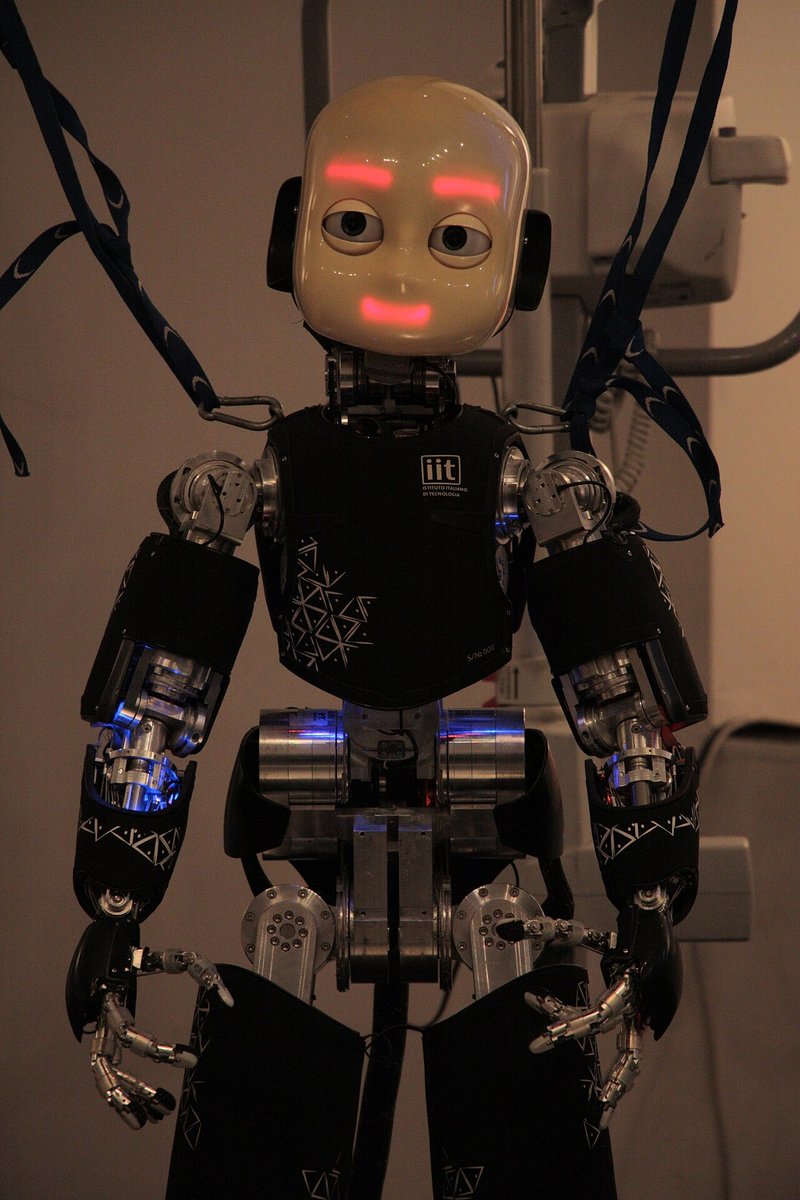
**iCub** is an open-source [humanoid robot](https://aiwiki.ai/wiki/humanoid_robot) the size of a small child, built for research in [embodied AI](https://aiwiki.ai/wiki/embodied_ai) and cognition. It was designed during RobotCub, a European Union project that ran from 2004 to 2010, and has since been developed, built and distributed by the Istituto Italiano di Tecnologia (IIT) in Genoa, Italy.[1][2] The standard robot stands about 104 cm tall, has 53 degrees of freedom and carries cameras, microphones, force/torque sensors, inertial sensors and a capacitive tactile skin over much of its body.[3][4] Its mechanical drawings, electronics and software were released under open licences so that laboratories could share one platform and reuse each other's code.[5][6][7] IIT's product page says that more than 40 iCubs have been built, for laboratories in Europe, the United States and Asia.[3]
The iCub is mainly a scientific instrument rather than a product. Researchers use it to study crawling and walking, vision, touch, manipulation, whole-body control, learning and [human-robot interaction](https://aiwiki.ai/wiki/human_robot_interaction).[1][7] Its later versions also led to several other IIT robots, including the R1 service robot, the ergoCub industrial humanoid and the jet-powered iRonCub, and to the spin-off company [Generative Bionics](https://aiwiki.ai/wiki/generative_bionics).[1][14][16][18]
An iCub humanoid robot with its facial LEDs lit, photographed in October 2015. Festival della Scienza from Genova, via Wikimedia Commons, CC BY-SA 2.0.
## Overview
| Item | Detail |
|------|--------|
| Developer | RobotCub consortium (2004 to 2010), then Istituto Italiano di Tecnologia[1] |
| Conceived by | Giorgio Metta, Giulio Sandini and David Vernon[1] |
| Original funding | EU Sixth Framework Programme (FP6), Integrated Project RobotCub[2] |
| Height | About 104 cm (standard iCub); 125 cm (iCub3)[3][15] |
| Weight | 33 kg with battery pack (2019 technical sheet); 52 kg (iCub3)[4][15] |
| Degrees of freedom | 53 (standard iCub); 54 (iCub3)[4][15] |
| Middleware | YARP[4][10] |
| Licences | GPL/FDL at release (2008); main software repository GPL 2.0 or later[6][11] |
| Indicative price (full robot) | 250,000 euros[9] |
| Robots built | More than 40[3] |
"iCub - Humanoid Platform", official video from iCub HumanoidRobot, published December 6, 2011. Watch on YouTube.
## History
### RobotCub (2004 to 2010)
According to IIT's account, the iCub project began in 2004 with an idea of Giorgio Metta, Giulio Sandini and David Vernon to build a platform for research in embodied artificial intelligence.[1] The money came from RobotCub (ROBotic Open-architecture Technology for Cognition, Understanding and Behaviors), an Integrated Project in the cognitive systems area of the EU's Sixth Framework Programme. The project ran from 1 September 2004 to 31 January 2010, had a total cost of 9,580,360 euros and received 8,500,000 euros from the EU; its coordinator was the University of Genoa.[2] The project description on CORDIS set out two aims: to build an open physical platform for research on embodied cognition, and to use it to study cognitive abilities, with a robot modelled on a human child in both body and mind. About a quarter of the budget was reserved for supporting other laboratories, through a training and support site, extra copies of the robot and a competitive call for research proposals.[2]
IIT's history lists the initial partners as the University of Genoa, the University of Salford (where Nikos Tsagarakis and Darwin Caldwell worked before moving to IIT), the Scuola Superiore Sant'Anna in Pisa, the University of Sheffield (which, according to the icub-main copyright notice, took part in 2009 and 2010, after Salford's 2005 to 2008 participation), the University of Hertfordshire, EPFL in Lausanne, the University of Zurich, the Genoa company Telerobot, the University of Ferrara, Uppsala University and the Instituto Superior Tecnico in Lisbon.[1][11] A 2007 paper on the mechanical design set targets of a height of 90 cm and a mass under 23 kg, matching a child of about two and a half years, and said the robot would be open in its hardware and mechanical design as well as its software, for use by researchers in fields from developmental psychology to epigenetic robotics.[5] By the 2008 description, the iCub was 104 cm tall, "the size of a three and half year old child", and was distributed under the GPL and FDL licences with its design available for download.[6]
The first version was designed around manipulation and crawling on all fours, which was easier to control than walking, so the arms and legs were built to bear the robot's weight while crawling. The design target for its weight was about 20 to 25 kg, and most structural parts were machined from aluminium alloys.[7] IIT says the design took about three and a half years.[1]
Within RobotCub, 10 copies of the robot were built: 3 for project partners and 7 for winners of the project's open call. Another 7 were built for the EU projects ITALK and IM-CLeVeR.[7] IIT's history counts at least 15 robots built for laboratories by the time RobotCub ended in 2010.[1]
### Development at IIT
IIT joined the project in 2007 and set up a laboratory dedicated to the iCub, bringing industry-grade engineering, skilled staff and support personnel that a standard research project rarely has.[1] From 2009 IIT worked on series-elastic actuators, neuromorphic cameras, new legs, revised hands, batteries and Wi-Fi, and the results went into later releases of the robot.[1] The RoboSKIN project made possible the whole-body tactile skin, which was completed in 2012.[1] Later EU projects at IIT continued to use the iCub as a standard platform; the European Commission credits the CoDyCo (FP7) and An.Dy (Horizon 2020) projects with adding stable walking, balancing and safe physical interaction with people.[19]
IIT's history says that the iCubs and components built over these years reached 36 units in 2017, and the Springer chapter by Natale and colleagues likewise gave the number of robots worldwide as 36.[1][7] A December 2017 IIT release published with a review in *Science Robotics* said that more than 100 researchers worked on the platform worldwide and that more than 160 developers had contributed to its software in the previous year.[8] IIT's product page later gave the total as more than 40 robots, in laboratories in Europe, the US, Korea, Singapore, China and Japan.[3] When the Czech Technical University in Prague received an iCub in 2021, the faculty reported that the robot carried serial number 47 and cost about 250,000 euros.[20]
Speaking about Generative Bionics in December 2025, IIT Scientific Director Giorgio Metta said that "Twenty years have passed since we launched the iCub project, IIT's flagship platform", and that the project had trained hundreds of researchers and transferred technology to industry.[18]
## Design
### Mechanics and degrees of freedom
The iCub's mechanical design began with the hands. Getting enough dexterity into a child-sized hand meant placing the finger motors in the forearm, the elbow motor in the upper arm and the shoulder motors in the chest, with steel tendons carrying motion to the joints. The designers wrote later that tendon drives gave a lean design but were "difficult to manage especially for non-experts".[7] Link lengths and joint ranges were then taken from anthropometric tables, and the larger joints use frameless brushless motors with Harmonic Drive gears built into the structure.[7]
IIT's 2019 technical specification lists the following degrees of freedom:[4]
| Body part | Degrees of freedom | Notes |
|-----------|-------------------|-------|
| Eyes | 3 | Independent vergence, common tilt |
| Head (neck) | 3 | Tilt, swing and pan |
| Torso | 3 | Tilt, swing and pan |
| Arm | 7 each | 3 at the shoulder, 1 at the elbow, 3 at the wrist |
| Hand | 9 each | 19 joints coupled in groups; thumb, index and middle finger independent |
| Leg | 6 each | Described as sufficient for walking |
| Total | 53 | |
The same sheet gives a height of about 105 cm, a width of 36.5 cm and a weight of 33 kg (30 kg plus a 3 kg battery backpack).[4] Each hand has five fingers driven by nine motors through tendons; the ring and little fingers share a motor.[9]
### Sensors
The iCub was given sensors that roughly match human senses. Its designers deliberately left out RGB-D cameras and laser scanners.[7] The 2019 specification lists:[4]
| Sensor | Number | Notes |
|--------|--------|-------|
| Cameras | 2 | In the eyes, Point Grey Dragonfly 2, 640x480 |
| Microphones | 2 | Stereo, omnidirectional |
| Inertial unit | 1 | Three-axis gyroscope, accelerometer and magnetometer (Bosch BNO055) in the head |
| Joint encoders | Every joint | Absolute magnetic encoders at the joints, plus motor-side encoders |
| Force/torque sensors | 6 | Six-axis sensors in the upper arms and legs, plus 2 near the ankles |
| Tactile sensors | More than 3,000 | Capacitive, on fingertips, palms, arms, chest and optionally legs |
### Tactile skin
The iCub's skin is built from small triangular printed-circuit modules, each carrying capacitive pressure-sensing pads, which are joined into patches that can wrap around curved parts of the body. Each module reads its own sensors and sends the data over a shared serial bus, which keeps the number of wires low.[12] In the first version, a silicone layer served as the dielectric and was covered with conductive Lycra; the second version replaced these layers with a sandwich of three fabric layers glued with industrial techniques, which made production automated and more reliable. On the fingertips, replacing the silicone foam with fabric gave, according to the IIT team, larger sensitivity, lower hysteresis and better mechanical robustness.[7] A 2011 paper describing the system reported that it had been fitted to three humanoid robots and that the iCub could use it to grasp fragile objects it had no model of.[12] The chapter by Natale and colleagues puts the total in the latest versions at 4,488 tactile sensors.[7] IIT also sells the skin as a separate component.[9]
### Electronics and computing
The first version ran its motors from microcontroller boards on a CAN bus connected to a PC104 computer.[7] Later versions moved to Ethernet-based electronics.[7] The 2019 technical specification lists an Intel Core i7 computer with 4 GB of RAM running Ubuntu in the robot, 802.11ac Wi-Fi and Bluetooth (the listed 36 V battery was marked as not yet available), and notes that all source code is published on GitHub "down to the level of the microcontroller code".[4]
## Versions
The iCub has been revised several times. IIT's own sources use slightly different version names: the 2017 press release speaks of iCub 1.0, 2.0 and 3.0, while the Springer chapter by Natale and colleagues describes the later 2.x robots as iCub 2.5.[7][8]
| Version | Main features |
|---------|---------------|
| 1.x | RobotCub design; tendon-driven joints, built for manipulation and crawling. IIT no longer builds it but upgrades existing robots.[7][9] |
| 2.5 | Compliant legs derived from IIT's COMAN robot, battery backpack, redesigned head and hands, Ethernet electronics, full skin.[7][9] |
| 2.7 | RGB LED facial expressions, skin boards with nine-axis inertial units and an extra inertial unit in the waist.[9] |
| 3 (iCub3) | About 20 cm taller than iCub 2.5; fewer tendon drives; legs with twice the power per joint; battery and Wi-Fi for untethered operation.[7] |
Many of the changes in iCub 2.5 followed problems reported by the user community. As research interest moved from crawling to walking on two legs, IIT redesigned the legs, and because stereo vision needed more accurate eye and head movements, the eyes moved to zero-backlash Harmonic Drive gears.[7] The 2017 IIT release described the third version as having improved legs for more natural steps and two event-driven cameras.[8] IIT also dedicated one iCub to event-driven vision, replacing its standard cameras with two Dynamic Vision Sensors, a type of [event camera](https://aiwiki.ai/wiki/event_camera).[7]
The iCub3 described in a 2024 *Science Robotics* paper is 125 cm tall, weighs 52 kg and has 54 degrees of freedom, with 4 joints for the eyes and eyelids, 3 in the neck, 7 in each arm, 9 in each hand, 3 in the torso and 6 in each leg.[15] It carries an 11th-generation Intel Core i7 computer with 16 GB of RAM in its head and a custom 600 Wh battery.[15] The authors write that earlier versions, from v1.0 to v2.9, had kept the same basic morphology, height, joint layout and actuation, and that removing tendons from the legs and shoulders made iCub3 much easier to maintain.[15]
## Software
### YARP
The iCub's software runs on YARP (Yet Another Robot Platform), middleware that Metta, Paul Fitzpatrick and Lorenzo Natale described in 2006 as a way to reduce the time researchers spent writing infrastructure code. Its main features were inter-process communication, image processing and a class hierarchy that made code portable across hardware; it then ran on Windows, Linux and QNX6.[10] IIT dates YARP to 2002, before the iCub itself.[1] The 2019 technical specification lists YARP 3 with an interface to the [Robot Operating System](https://aiwiki.ai/wiki/robot_operating_system) (ROS), along with libraries for kinematics and dynamics, force and impedance control, reaching and grasping, attention, online object learning and recognition, and speech, and bindings for Python, Java and C#.[4]
### Open-source repositories
The iCub code is published on GitHub under the robotology organisation.[4] The COPYING file of the main software repository, icub-main, says the package is distributed under the GPL 2.0 or later and lists the RobotCub Consortium and IIT as the main copyright holders.[11] In 2017 IIT reported that YARP had about 400,000 lines of code and that the iCub repositories together held more than 4 million.[8]
### Simulator
An open-source iCub simulator was presented in 2008. It was developed together with the EU ITALK project, which studied the integration and transfer of action and language knowledge in cognitive robots, and was made available to researchers who wanted to run cognitive robotics experiments without the physical robot.[13]
## Research use
Because many laboratories use the same robot, iCub results and code can be shared and compared across groups, which was one of RobotCub's stated aims.[7] The Natale chapter summarises IIT's own work in several areas:[7]
- **Visual perception and object recognition**: low-level vision (saliency, motion, depth), and learning to recognise objects, supported by datasets collected on the robot.
- **Event-driven sensing**: attention, optical flow and object recognition using neuromorphic cameras, which report changes in a scene rather than full frames.
- **Force control and whole-body control**: estimating joint torques and external contact forces from the force/torque sensors and the skin, and using them for [whole-body control](https://aiwiki.ai/wiki/whole_body_control), balancing and walking.
- **Touch**: using the skin for safer physical interaction and grasping.
Other groups have used the iCub for [human-robot interaction](https://aiwiki.ai/wiki/human_robot_interaction) and social cognition studies. A 2018 paper introduced iCub-HRI, a software library that wraps perception, manipulation and social-interaction components for the robot, and demonstrated it in a scenario involving language learning and a spoken account of the robot's experiences.[22] Serena Marchesi, Agnieszka Wykowska and colleagues published a questionnaire in 2019 that asks people to choose between mentalistic and mechanistic explanations of the iCub's behaviour shown in photo sequences; in the first study, explanations leaned towards the mechanistic but a substantial number were mentalistic.[21] In Prague, a Czech Technical University group acquired an iCub to study how touch shapes an agent's model of its own body, drawing on how children learn their bodies.[20]
### Telepresence and the ANA Avatar XPRIZE
IIT's iCub3 avatar system lets a remote operator control the robot's walking, manipulation, voice and facial expressions. The operator wears lightweight devices, including IIT's iFeel wearables for motion and force tracking, and receives visual, auditory and haptic feedback (weight and touch) from the robot.[15] In one demonstration, an operator in Genoa used the robot to visit the Venice Biennale, about 290 km away; in another, the robot walked on stage at the We Make Future festival in Rimini, about 300 km from the operator, in front of roughly 2,000 spectators.[15]
The iCub team entered the system in the ANA Avatar XPRIZE. In the semifinals, held on 21 March 2022 with the judges visiting IIT, it scored 95 out of 100 and placed second among the 38 qualified teams. At the finals in Long Beach, California, on 1 to 5 November 2022, 17 teams competed; the authors write that theirs was the only avatar system to complete tasks in the final stage using walking on two legs together with a lightweight set of operator devices.[15] The team's own list of shortcomings from the finals included the heavy cognitive load on the operator, lag in the video feed and Wi-Fi problems, which it traced partly to antennas on the robot that were too small.[15]
## Successor robots and spin-off
| Robot | Year | Relation to iCub |
|-------|------|------------------|
| R1 | 2015 (project start) | Started to cut the cost of humanoids by replacing CNC-machined metal with plastics, carbon fibre and sheet metal; wheeled base and extensible torso.[1][9] |
| ergoCub | 2023 | Developed by IIT with INAIL; 150 cm and 55.7 kg; iCub was the reference platform.[16][17] |
| iRonCub3 | 2025 | Jet-powered flying humanoid based on iCub3.[14] |
**ergoCub** was presented at IIT's 20th anniversary celebrations in September 2023. IIT described it as a robot meant to assess and reduce physical risks for workers in industry and hospitals, and said its name joins "ergo" (for ergonomics) with "Cub" (from iCub).[16] A 2022 conference paper used the iCub as the starting point for optimising a robot's hardware parameters, including its kinematics and dynamics, for lifting loads together with a person. The optimised design could handle loads at heights of 0.8 to 1.5 m, against 0.8 to 1.2 m for the iCub, while using about 33% less energy.[17] A fuller description of ergoCub appeared in *Nature Machine Intelligence* in July 2026.[23]
**iRonCub3** has four jet engines, two on the arms and two in a jetpack, with more than 1,000 N of combined maximum thrust, and weighs about 70 kg with the engines. In June 2025 IIT reported that it had lifted about 50 cm off the ground while staying stable, together with a paper in *Communications Engineering* on learning aerodynamic models for its control.[14]
**Generative Bionics** is a 2024 IIT spin-off whose funding round in December 2025 The Robot Report put at $81 million. The Robot Report described its humanoids as built on technology from IIT's robotics programmes, including a sensor network derived from the iCub.[18] The European Commission presented the company in July 2026 as an outcome of the EU-funded research that began with RobotCub, and reported that it had released its first humanoid, [GENE.01](https://aiwiki.ai/wiki/generative_bionics_gene_01), that month, together with an open-source URDF description of the robot that the Commission said echoed the open-platform model of the iCub.[19]
## Limitations
The iCub's developers have written about its drawbacks. In the Springer chapter they say that the robot "is not always easy" to work with, that software only partly hides the quirks of the hardware, and that this limits its use where no technical support is available; removing tendon drives in iCub 3.0 was partly a response.[7] They also describe the iCub as a compromise among many requirements: it can walk but is not the best walking robot, and its hand is dexterous but not the most complex.[7] Cost is another limit. IIT says it sells the robot without profit, but its indicative price for a full iCub is 250,000 euros, 200,000 euros for an upper body without legs and 40,000 euros for a head.[9] In 2008 the iCub was 104 cm tall, but descriptions of the child it resembles have varied over the years, from two and a half years old in the 2007 design targets to five years old on IIT's current product page.[3][5][6]
## See also
- [Humanoid robot](https://aiwiki.ai/wiki/humanoid_robot)
- [History of humanoid robots](https://aiwiki.ai/wiki/humanoid_robot_history)
- [Generative Bionics](https://aiwiki.ai/wiki/generative_bionics)
- [Robot skin](https://aiwiki.ai/wiki/robot_skin)
- [Tactile sensing](https://aiwiki.ai/wiki/tactile_sensing)
- [Embodied AI](https://aiwiki.ai/wiki/embodied_ai)
- [Teleoperation](https://aiwiki.ai/wiki/teleoperation)
## References
1. Istituto Italiano di Tecnologia. "iCub history". iCub, IIT. https://icub.iit.it/about-us/icub-history
2. CORDIS, European Commission. "ROBotic Open-architecture Technology for Cognition, Understanding and Behaviors" (ROBOT-CUB, project 004370). CORDIS. https://cordis.europa.eu/project/id/004370
3. Istituto Italiano di Tecnologia. "iCub robot". iCub, IIT. https://icub.iit.it/products/icub-robot
4. Maggiali, M., Fiorio, L., Pattacini, U., Derito, A. "Technical Specifications of the iCub Platform" (revision 2.5). Istituto Italiano di Tecnologia, iCub Facility, 2019. https://www.iit.it/documents/175012/528824/Technical-specs_iCub_robot_Rev_2.3_05082019+%281%29.pdf/44d1e600-7a09-12e0-5eeb-5e3a2444e78c
5. Tsagarakis, N. G., Metta, G., Sandini, G., Vernon, D., Beira, R., Becchi, F., Righetti, L., Santos-Victor, J., Ijspeert, A. J., Carrozza, M. C., Caldwell, D. G. "iCub: the design and realization of an open humanoid platform for cognitive and neuroscience research". Advanced Robotics 21(10), 1151-1175, 2007. https://doi.org/10.1163/156855307781389419
6. Metta, G., Sandini, G., Vernon, D., Natale, L., Nori, F. "The iCub humanoid robot: an open platform for research in embodied cognition". Proceedings of the 8th Workshop on Performance Metrics for Intelligent Systems (PerMIS '08), 50-56, 2008. https://doi.org/10.1145/1774674.1774683
7. Natale, L., Bartolozzi, C., Nori, F., Sandini, G., Metta, G. "iCub". In Humanoid Robotics: A Reference, Springer, 2019 (chapter online 2018; preprint arXiv:2105.02313). https://arxiv.org/abs/2105.02313
8. Istituto Italiano di Tecnologia. "The importance of iCub as a standard robotic research platform for embodied AI". Phys.org, 2017-12-20. https://phys.org/news/2017-12-importance-icub-standard-robotic-platform.html
9. Istituto Italiano di Tecnologia. "Product catalog". iCub, IIT. https://icub.iit.it/products/product-catalog
10. Metta, G., Fitzpatrick, P., Natale, L. "YARP: Yet Another Robot Platform". International Journal of Advanced Robotic Systems 3(1), 2006. https://doi.org/10.5772/5761
11. robotology. "icub-main: The iCub Main Software Repository" (COPYING file). GitHub. https://github.com/robotology/icub-main
12. Schmitz, A., Maiolino, P., Maggiali, M., Natale, L., Cannata, G., Metta, G. "Methods and Technologies for the Implementation of Large-Scale Robot Tactile Sensors". IEEE Transactions on Robotics 27(3), 389-400, 2011. https://doi.org/10.1109/TRO.2011.2132930
13. Tikhanoff, V., Cangelosi, A., Fitzpatrick, P., Metta, G., Natale, L., Nori, F. "An open-source simulator for cognitive robotics research: the prototype of the iCub humanoid robot simulator". Proceedings of the 8th Workshop on Performance Metrics for Intelligent Systems (PerMIS '08), 57-61, 2008. https://doi.org/10.1145/1774674.1774684
14. Istituto Italiano di Tecnologia. "Researchers at IIT have demonstrated that a humanoid robot can fly". EurekAlert!, 2025-06-18. https://www.eurekalert.org/news-releases/1088012
15. Dafarra, S., Pattacini, U., Romualdi, G., et al. "iCub3 avatar system: Enabling remote fully immersive embodiment of humanoid robots". Science Robotics 9(86), 2024-01-24 (accepted version arXiv:2203.06972). https://arxiv.org/abs/2203.06972
16. Istituto Italiano di Tecnologia. "A new robot for the first 20 years of IIT". OpenTalk IIT, 2023-09-21. https://opentalk.iit.it/en/a-new-robot-for-the-first-20-years-of-iit/
17. Sartore, C., Rapetti, L., Pucci, D. "Optimization of Humanoid Robot Designs for Human-Robot Ergonomic Payload Lifting". 2022 IEEE-RAS 21st International Conference on Humanoid Robots (Humanoids), 722-729, 2022. https://doi.org/10.1109/Humanoids53995.2022.10000222
18. Wessling, B. "From iCub to humanoids: Generative Bionics raises $81M". The Robot Report, 2025-12-10. https://www.therobotreport.com/from-icub-to-humanoids-generative-bionics-raises-81m/
19. European Commission. "From EU-funded robotics research to industrial innovation: the Generative Bionics success story". Shaping Europe's digital future, 2026-07-22. https://digital-strategy.ec.europa.eu/en/library/eu-funded-robotics-research-industrial-innovation-generative-bionics-success-story
20. Czech Technical University in Prague, Faculty of Electrical Engineering. "Faculty of Electrical Engineering researchers apply brain-inspired algorithms to enable robots to move more safely and autonomously among humans". CTU FEL, 2021. https://intranet.fel.cvut.cz/en/aktuality/2021/iCub
21. Marchesi, S., Ghiglino, D., Ciardo, F., Perez-Osorio, J., Baykara, E., Wykowska, A. "Do We Adopt the Intentional Stance Toward Humanoid Robots?". Frontiers in Psychology 10, 2019. https://doi.org/10.3389/fpsyg.2019.00450
22. Fischer, T., Puigbò, J.-Y., Camilleri, D., Nguyen, P. D. H., et al. "iCub-HRI: A Software Framework for Complex Human-Robot Interaction Scenarios on the iCub Humanoid Robot". Frontiers in Robotics and AI 5, 2018. https://doi.org/10.3389/frobt.2018.00022
23. Sartore, C., Elobaid, M., Rapetti, L., Romualdi, G., et al. "Towards shared embodied intelligence in humanoid robots through optimization, development and testing of the human-aware ergoCub robot". Nature Machine Intelligence 8, 1221-1237, 2026. https://doi.org/10.1038/s42256-026-01272-2