# MIT CSAIL
> Source: https://aiwiki.ai/wiki/mit_csail
> Updated: 2026-11-18
> Fact-checked: 2026-11-18
> Categories: AI History, AI Research, Research Organizations
> License: CC BY 4.0 (https://creativecommons.org/licenses/by/4.0/) - attribute to "AI Wiki (aiwiki.ai)"
> Cite as: AI Wiki. "MIT CSAIL." aiwiki.ai, 18 Nov 2026. https://aiwiki.ai/wiki/mit_csail
> From AI Wiki (https://aiwiki.ai), the free encyclopedia of artificial intelligence. Reuse freely with attribution.
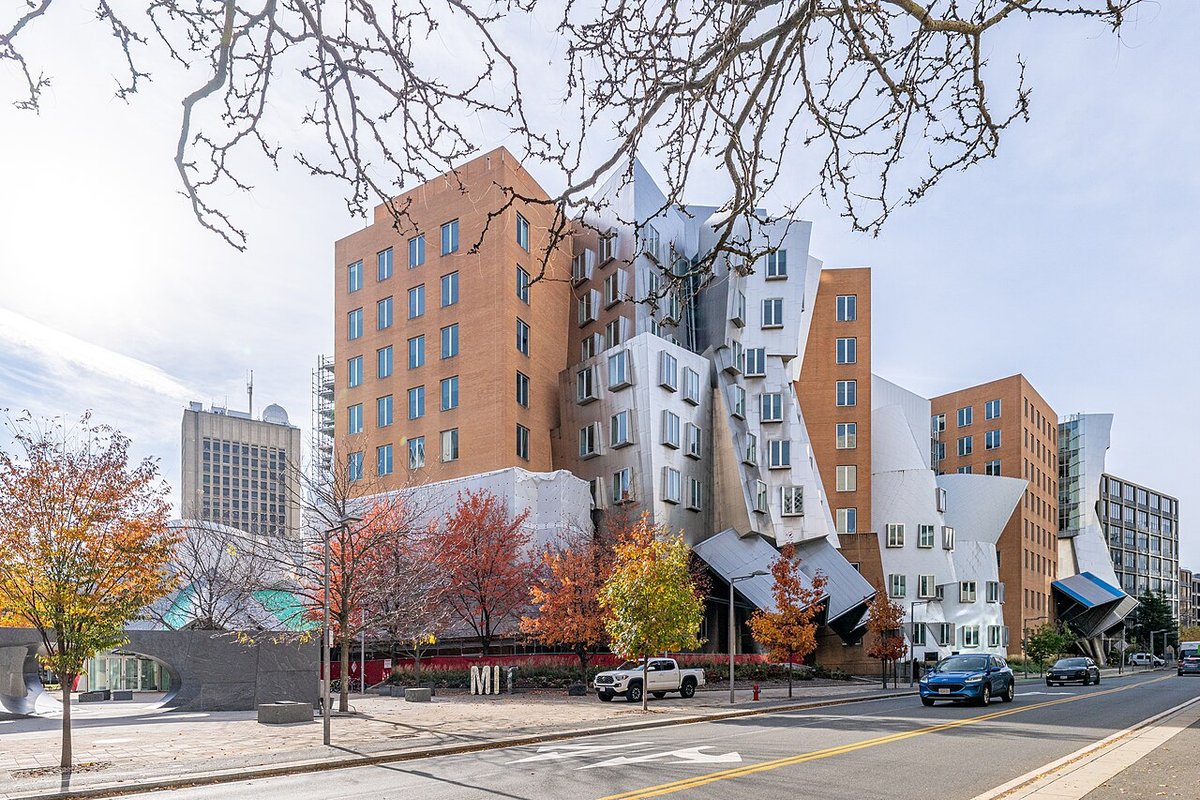
The **MIT Computer Science and Artificial Intelligence Laboratory** (**CSAIL**) is a research laboratory at the [Massachusetts Institute of Technology](https://aiwiki.ai/wiki/mit) in Cambridge, Massachusetts. It was formed on July 1, 2003, when MIT merged the Laboratory for Computer Science (LCS) with the Artificial Intelligence Laboratory (AI Lab), two units whose roots went back to the late 1950s and early 1960s.[1][2] CSAIL describes itself as the largest laboratory at MIT; its published figures list more than 1,700 members, more than 130 principal researchers, about 1,200 graduate students and more than 60 research groups.[1][4] The laboratory is housed in the Ray and Maria Stata Center, a Frank Gehry building that opened in 2004, and has been directed by roboticist Daniela Rus since 2012.[5][3][18]
CSAIL dates its own history to 1963, the year Project MAC was founded, while its AI side goes back to the MIT Artificial Intelligence Project that [John McCarthy](https://aiwiki.ai/wiki/john_mccarthy) and [Marvin Minsky](https://aiwiki.ai/wiki/marvin_minsky) started in 1958-1959.[1][6] Work done in the laboratory and its predecessors includes the Multics time-sharing system, the ELIZA program, the [Scheme](https://aiwiki.ai/wiki/scheme) language, the MIT Lisp Machine, behavior-based robotics, and the founding of the World Wide Web Consortium.[1][11][12][13][14][17] Researchers associated with CSAIL and its predecessors have received the [Turing Award](https://aiwiki.ai/wiki/turing_award) ten times, according to the laboratory's list of honors, and the lab names Akamai, [Boston Dynamics](https://aiwiki.ai/wiki/boston_dynamics), Dropbox and [iRobot](https://aiwiki.ai/wiki/irobot) among the companies that spun out of it.[20][19]
The Ray and Maria Stata Center in Cambridge, Massachusetts, home of MIT CSAIL, photographed in November 2025. ajay_suresh, via Wikimedia Commons, CC BY 4.0.
## History
### MIT Artificial Intelligence Project (1958-1963)
In his history of [Lisp](https://aiwiki.ai/wiki/lisp), McCarthy wrote that he and Minsky started the M.I.T. Artificial Intelligence Project in the fall of 1958, when he had become an assistant professor of communication sciences in the electrical engineering department and Minsky was an assistant professor of mathematics.[6] The project was supported by MIT's Research Laboratory of Electronics, whose director, Jerome Wiesner, had a military contract that allowed him to start new projects freely. McCarthy recalled that no written proposal was ever made: asked what they needed, he and Minsky requested a room, two programmers, a secretary and a keypunch, and Wiesner also asked them to supervise some of the laboratory's mathematics graduate students.[6] CSAIL's own history gives 1959 as the founding year of the "AI project."[1][8]
Lisp came out of this group. McCarthy described the period from fall 1958 through 1962 as the one in which the language was implemented at MIT, and a National Research Council history of federally funded computing states that a team he led at MIT, with government support, began implementing LISP in 1958.[6][7]
### Project MAC (1963-1975)
Project MAC was founded on July 1, 1963, with a grant from the Advanced Research Projects Agency (later [DARPA](https://aiwiki.ai/wiki/darpa)), and was later funded by both DARPA and the National Science Foundation.[8] Its name was read as Multiple Access Computer and as Machine-Aided Cognition; the project's 1971 progress report adds Men and Computers, saying that "MAC" was an acronym for each of these goals.[8][10] In a 2004 MIT News article, Fernando Corbató recalled that Fano's goal was to bring MIT's scattered computer science research "under a common roof," and Fano said that he decided to start Project MAC on Thanksgiving Day 1962.[9] The National Research Council history says that the project was started by ARPA's Information Processing Techniques Office, that J. C. R. Licklider chose MIT as its site, that Project MAC received $25 million in total between 1963 and 1970, and that MIT's Artificial Intelligence Laboratory received $1 million through it for work on interactive computing and intelligent assistance.[7]
The project's best-known systems work was in time-sharing. It first used the Compatible Time-Sharing System (CTSS), developed at the MIT Computation Center, and then built Multics with General Electric and Bell Labs; CSAIL credits the two systems with inspiring Unix.[1][7] Project MAC's time-sharing system also ran early language programs: Joseph Weizenbaum's 1966 paper on ELIZA states that the program's implementation was "on the MAC time-sharing system at MIT," that it was written in MAD-SLIP for an IBM 7094, and that the work was supported in part by Project MAC.[11]
Project MAC worked from 545 Technology Square in Cambridge. It started on the eighth and ninth floors and eventually filled the building.[9] Its progress report for July 1970 to July 1971 counted 320 people associated with the project, including 21 faculty members, 105 staff, 182 students and 12 guests.[10] Fano directed Project MAC from 1963 to 1968, followed by Licklider from 1968 to 1971.[3] The same progress report records that Licklider stepped down in May 1971 and that Edward Fredkin took over.[10]
### The Artificial Intelligence Laboratory (1970-2003)
The AI group separated from Project MAC in 1970. Project MAC's 1970-1971 progress report states that "In December, 1970 the Artificial Intelligence group became an independent MIT laboratory," with Minsky and Seymour Papert as co-directors, and that collaboration between the two organizations was continuing.[10] At Technology Square, the AI Lab took the top three floors of the building and the computer science group kept the first six.[9] CSAIL's list of past directors gives Minsky (1970-1972), Patrick Winston (1972-1997) and Rodney Brooks (1997 until the merger) as heads of the AI Lab.[3]
The AI Lab's research memos record several influential projects:
| Year | Work | Authors | Source |
|---|---|---|---|
| 1975 | Scheme, "an interpreter for extended lambda calculus," AI Memo 349 | [Gerald Jay Sussman](https://aiwiki.ai/wiki/gerald_sussman), Guy L. Steele Jr. | [12] |
| 1977 | Lisp Machine Progress Report, AI Memo 444 | Alan Bawden, Richard Greenblatt, Jack Holloway, Thomas Knight, David Moon, Daniel Weinreb | [13] |
| 1985 | A Robust Layered Control System for a Mobile Robot, AI Memo 864 | Rodney A. Brooks | [14] |
The Scheme memo described a Lisp-like language based on the lambda calculus, extended for side effects, multiprocessing and process synchronization, and said its purpose was "tutorial."[12] The 1977 Lisp Machine report introduced a computer designed to run Lisp as its system language and covered its storage organization, garbage collection and editor.[13] Brooks's 1985 memo proposed layers of asynchronous control modules in which higher layers could subsume lower ones by suppressing their outputs while the lower layers kept working; a version of the paper was published in the *IEEE Journal on Robotics and Automation* in 1986.[14][15] All three memos acknowledge support from ARPA through Office of Naval Research contracts.[12][13][14]
CSAIL's history credits the AI Lab with methods for image-guided surgery, haptic interfaces and behavior-based robots, and its anniversary timeline lists the "Silver Arm" robot for small-parts assembly (1974), Danny Hillis's work on parallel computers as an MIT doctoral student, which the timeline places in 1981 and links to his later leadership of Thinking Machines Corporation, and the autonomous underwater robot "Sea Squirt" (1988).[1][8] When the merger was announced in 2003, MIT News named Imagen, iRobot, SensAble Technologies and Thinking Machines among the companies spun out of the AI Lab.[2]
### Laboratory for Computer Science (1975-2003)
The non-AI side of Project MAC continued under the Project MAC name until 1975, when, according to MIT News, it was renamed the Laboratory for Computer Science.[9] A 1975 LCS brochure describes it as an interdepartmental laboratory "formerly Project Mac" at 545 Technology Square, directed by Michael Dertouzos, with research grouped around knowledge-based programs, the cost and ease of use of computing systems, and the theory of computation.[16] CSAIL's list of directors gives Fredkin (1971-1974), Dertouzos (1974-2001) and Victor Zue (from 2001) as the laboratory's heads.[3]
In October 1994, Tim Berners-Lee founded the World Wide Web Consortium (W3C) at MIT's Laboratory for Computer Science, in collaboration with CERN.[17] MIT was the first of the consortium's host institutions under what W3C calls its "hosted model" of 1994-2022; the consortium began 2023 by forming a public-interest non-profit organization.[17] The consortium's headquarters occupied the third floor of the Technology Square building.[9] MIT News wrote in 2003 that LCS members and alumni had contributed to the ARPANET, the Internet, Ethernet and the World Wide Web, that more than 4,000 researchers and students had worked in the laboratory, and that its members had founded more than four dozen companies, including 3Com, Lotus and Akamai.[2]
### Merger and the new laboratory (2003)
Thomas L. Magnanti, dean of the MIT School of Engineering, announced the merger on May 23, 2003, at a symposium marking the centennial of the Department of Electrical Engineering and Computer Science.[2] MIT News said the joint laboratory, at first to be called the "New Laboratory for Computer Science and Artificial Intelligence," would be "the largest laboratory on the MIT campus in terms of research volume," with only the off-campus Lincoln Laboratory larger, and that it had more than 750 students, faculty and staff.[2] (CSAIL's later anniversary timeline puts the merged laboratory at over 600 personnel.)[8] The merger took effect on July 1, 2003, forty years to the day after Project MAC was founded, with Brooks as director and Zue as co-director.[2][8] The announcement cited growing collaboration between the two laboratories, including the Oxygen project on human-centered computing that they had launched with six companies, and Magnanti said that "the lab members felt that the benefits of the merger outweigh any costs."[2] CSAIL's timeline describes the merger as a reuniting of the parts of Project MAC.[8]
### Stata Center
In March 2004, close to 1,000 people began moving from Technology Square to the Ray and Maria Stata Center, which MIT News called the Stata Center for Computer, Information and Intelligence Sciences.[9] The building was designed by Frank Gehry and opened in 2004 on the site of MIT's Building 20.[5] CSAIL gives its size as 720,000 square feet; it also houses MIT's Laboratory for Information and Decision Systems (LIDS) and the Department of Linguistics and Philosophy.[5] CSAIL states that the building received the American Council of Engineering Companies' Grand Award for Engineering Excellence in 2005.[5]
### Leadership since 2003
Brooks led CSAIL until 2007 and Zue until 2011. Anant Agarwal was director from 2011 to 2012.[3] On May 22, 2012, MIT announced that Daniela Rus, a professor of electrical engineering and computer science, would succeed Agarwal as director effective the next day; Agarwal had been named president of edX, the online learning initiative of MIT and Harvard. MIT News described Rus as the first woman to serve as director of CSAIL and the laboratory as MIT's largest interdepartmental laboratory, with 900 members and more than 100 principal investigators from eight departments.[18] Rus had been CSAIL's associate director from 2008 to 2011 and at the time directed its Distributed Robotics Laboratory.[18] In fiscal year 2020, when CSAIL moved into the newly formed MIT Schwarzman College of Computing, Rus was also named the college's deputy dean of research, according to the laboratory's report to the MIT president for that year.[25] An MIT News item from July 2026 still identified her as CSAIL's director.[24]
| Director | Unit | Years |
|---|---|---|
| Robert Fano | Project MAC | 1963-1968 |
| J. C. R. Licklider | Project MAC | 1968-1971 |
| Marvin Minsky | AI Lab | 1970-1972 |
| Edward Fredkin | LCS | 1971-1974 |
| Patrick Winston | AI Lab | 1972-1997 |
| Michael L. Dertouzos | LCS | 1974-2001 |
| Rodney Brooks | AI Lab and CSAIL | 1997-2007 |
| Victor Zue | LCS and CSAIL | 2001-2011 |
| Anant Agarwal | CSAIL | 2011-2012 |
| Daniela Rus | CSAIL | 2012-present |
*Source: CSAIL's published list of laboratory directors, which lists Fredkin's role under LCS although Project MAC's 1970-1971 report describes him as Project MAC director.*[3][10]
CSAIL marked the 50th anniversary of Project MAC and the 10th anniversary of its own formation in 2014, and published a "20/60" timeline for the twentieth and sixtieth anniversaries in 2023.[1][8]
"This is MIT CSAIL: 2026", official video from MIT CSAIL, published February 25, 2026. Watch on YouTube.
## Organization
As of November 2026, CSAIL's leadership page lists Rus as director, Daniel Jackson as associate director, and Armando Solar-Lezama as associate director and chief operating officer.[3] The laboratory's research is organized into eight Communities of Research, its largest research units, each grouping principal investigators by broad technical interest; investigators have a primary membership in one community and may join others as affiliates.[3] The communities were launched on January 1, 2020, when there were nine of them.[25] Below that level are more than sixty research groups and centers, each led by one or more principal investigators.[3]
| Community of Research | Leader |
|---|---|
| Cognitive AI | Gerald Sussman |
| Computing and Society | Daniel Weitzner |
| Embodied Intelligence | Nick Roy |
| Human-Computer Interaction | David Karger |
| Systems | Michael Cafarella |
| Theory of Computation | Yael Kalai |
| Vertical AI | Martin Rinard |
| Visual Computing | Jonathan Ragan-Kelley |
*Source: CSAIL leadership page, as of November 2026.*[3]
CSAIL is an interdepartmental laboratory rather than an academic department.[18] The laboratory's industry-relations site says its principal researchers hold departmental appointments in all five MIT schools and lists departments that range from electrical engineering and computer science to aeronautics and astronautics, brain and cognitive sciences, and mathematics.[4] It lists the laboratory's main research areas as algorithms and theory, AI and [machine learning](https://aiwiki.ai/wiki/machine_learning), computational biology, computer architecture, graphics and vision, human-computer interaction, programming languages and software engineering, [robotics](https://aiwiki.ai/wiki/robotics), security and cryptography, and systems and networking.[4]
The laboratory's size figures are self-reported and vary between its own pages. The CSAIL Alliances page gives more than 1,700 members, more than 130 principal researchers, about 1,200 graduate students, 119 postdocs, 60 research groups and more than 900 active projects; CSAIL's mission page gives more than 1,800 researchers and an annual research budget of $65 million.[4][1] Its industry program, CSAIL Alliances, offers member organizations a way to connect with the laboratory's research.[4]
## Research in artificial intelligence
Two of CSAIL's eight research communities carry "AI" in their names (Cognitive AI and Vertical AI).[3] The laboratory's industry pages describe its AI and machine learning work as covering [natural language processing](https://aiwiki.ai/wiki/natural_language_processing), [deep learning](https://aiwiki.ai/wiki/deep_learning) and [computer vision](https://aiwiki.ai/wiki/computer_vision).[4]
One line of work from Rus's group shows how the laboratory's research has moved into companies. In 2020, Ramin Hasani, Mathias Lechner, Alexander Amini, Rus and Radu Grosu posted "Liquid Time-constant Networks," a class of time-continuous [recurrent neural network](https://aiwiki.ai/wiki/recurrent_neural_network) models whose time constants vary with the hidden state; the paper was accepted to the AAAI-21 conference.[21] Hasani told TechCrunch in December 2023 that the idea was invented at the Vienna University of Technology, in Grosu's laboratory, and that the work "got refined and scaled at Rus' lab at MIT CSAIL." Rus co-founded the spin-off [Liquid AI](https://aiwiki.ai/wiki/liquid_ai), with Hasani as chief executive, Lechner as chief technology officer and Amini as chief scientific officer, and the company had raised a $37.5 million seed round.[22]
## Spin-off companies
CSAIL says that hundreds of companies have spun out of the laboratory and its predecessors; its industry site gives a figure of more than 500 startups.[19][4] The laboratory's own spin-off page highlights the following examples, with the founding details it gives:[19]
| Company | Connection described by CSAIL |
|---|---|
| Akamai | Founded by CSAIL graduate student Danny Lewin and professor Tom Leighton |
| Boston Dynamics | Created by former MIT professor Marc Raibert |
| Cambridge Mobile Telematics | Founded by MIT professors Hari Balakrishnan and Sam Madden |
| Dropbox | Started by graduate student Drew Houston |
| iRobot | Founded by Rodney Brooks and his then-students Colin Angle and Helen Greiner |
| ITA Software | Co-founded by CSAIL computer scientist Jeremy Wertheimer in 1996 |
| Meraki | Founded by MIT alumni and based partly on CSAIL's Roofnet mesh network |
| RSA Security | Named for the RSA public-key cryptosystem of Rivest, Shamir and Adleman, which CSAIL dates to the 1970s at MIT |
The page presents these as a selection of a few examples. A company's place on the list records a link to the laboratory's people or research, not that the laboratory alone built its products.[19]
## Awards
CSAIL's honors page lists ten Turing Award recipients from the laboratory and its predecessors:[20]
| Year | Recipient |
|---|---|
| 1969 | Marvin Minsky |
| 1990 | Fernando Corbató |
| 1992 | Butler Lampson |
| 2002 | Ron Rivest |
| 2008 | Barbara Liskov |
| 2012 | Shafi Goldwasser |
| 2012 | Silvio Micali |
| 2014 | Michael Stonebraker |
| 2016 | Tim Berners-Lee |
| 2022 | Robert Metcalfe |
The same page lists MacArthur Fellowships for researchers including Richard Stallman (1990), Peter Shor (1999), Daniela Rus (2002), Dina Katabi (2013), Regina Barzilay (2017) and Josh Tenenbaum (2019), and Nevanlinna Prizes for Peter Shor (1998), Madhu Sudan (2002) and Constantinos Daskalakis (2018).[20] CSAIL's own pages are not consistent on the count: the mission page and the Alliances page say nine Turing Award winners, while the Alliances page's award tally says ten.[1][4]
## Controversy
In September 2019, Richard Stallman, then a visiting scientist at CSAIL, resigned from the laboratory and from the presidency of the Free Software Foundation after an email he sent to a CSAIL mailing list on September 12 about the Jeffrey Epstein case.[23] The student newspaper *The Tech* reported that in the email he questioned whether Minsky knew that Virginia Giuffre had been coerced, and that he called "sexual assault" a "slippery" term. Stallman's resignation statement cited "pressure on MIT and me over a series of misunderstandings and mischaracterizations."[23]
## See also
- [Massachusetts Institute of Technology](https://aiwiki.ai/wiki/mit)
- [Marvin Minsky](https://aiwiki.ai/wiki/marvin_minsky)
- [John McCarthy](https://aiwiki.ai/wiki/john_mccarthy)
- [Gerald Jay Sussman](https://aiwiki.ai/wiki/gerald_sussman)
- [History of artificial intelligence](https://aiwiki.ai/wiki/history_of_artificial_intelligence)
- [Symbolic AI](https://aiwiki.ai/wiki/symbolic_ai)
- [Liquid AI](https://aiwiki.ai/wiki/liquid_ai)
## References
1. MIT Computer Science and Artificial Intelligence Laboratory. "Mission & History". MIT CSAIL. https://www.csail.mit.edu/about/mission-history
2. MIT News. "MIT's computer science, AI labs merge". Massachusetts Institute of Technology, May 28, 2003. https://news.mit.edu/2003/mits-computer-science-ai-labs-merge
3. MIT Computer Science and Artificial Intelligence Laboratory. "Leadership". MIT CSAIL. https://www.csail.mit.edu/about/leadership
4. CSAIL Alliances. "CSAIL by the Numbers". MIT CSAIL. https://cap.csail.mit.edu/engage/why-csail-alliances/csail-numbers
5. MIT Computer Science and Artificial Intelligence Laboratory. "Stata Center". MIT CSAIL. https://www.csail.mit.edu/about/stata-center
6. McCarthy, John. "History of Lisp". Artificial Intelligence Laboratory, Stanford University, February 12, 1979. http://jmc.stanford.edu/articles/lisp/lisp.pdf
7. National Research Council. "The Organization of Federal Support: A Historical Review". Funding a Revolution: Government Support for Computing Research, National Academies Press, 1999. https://www.nationalacademies.org/read/6323/chapter/6
8. MIT Computer Science and Artificial Intelligence Laboratory. "CSAIL 20/60 Timeline". MIT CSAIL, 2023. https://www.csail.mit.edu/CSAIL_20_60/timeline
9. MIT News. "MIT leaves behind a rich history in Tech Square". Massachusetts Institute of Technology, March 17, 2004. https://news.mit.edu/2004/techsquare-0317
10. Massachusetts Institute of Technology. "Project MAC Progress Report VIII, July 1970 to July 1971". Project MAC, 1971. https://bitsavers.org/pdf/mit/lcs/progress_reports/DTIC_AD0735148_Project_MAC_Progress_Report_08_197007-197107.pdf
11. Weizenbaum, Joseph. "ELIZA - A Computer Program For the Study of Natural Language Communication Between Man and Machine". Communications of the ACM 9(1): 36-45, January 1966. https://doi.org/10.1145/365153.365168
12. Sussman, Gerald Jay; Steele, Guy Lewis Jr. "SCHEME: An Interpreter for Extended Lambda Calculus". MIT Artificial Intelligence Laboratory, AI Memo No. 349, December 1975. https://bitsavers.org/pdf/mit/ai/aim/AIM-349.pdf
13. Bawden, Alan; Greenblatt, Richard; Holloway, Jack; Knight, Thomas; Moon, David; Weinreb, Daniel. "LISP Machine Progress Report". MIT Artificial Intelligence Laboratory, Memo No. 444, August 1977. https://bitsavers.org/pdf/mit/ai/aim/AIM-444.pdf
14. Brooks, Rodney A. "A Robust Layered Control System for a Mobile Robot". MIT Artificial Intelligence Laboratory, A.I. Memo 864, September 1985. https://bitsavers.org/pdf/mit/ai/aim/AIM-864.pdf
15. Brooks, R. "A robust layered control system for a mobile robot". IEEE Journal on Robotics and Automation 2(1): 14-23, 1986. https://doi.org/10.1109/JRA.1986.1087032
16. MIT Laboratory for Computer Science. "Laboratory for Computer Science (formerly Project Mac)". Brochure, 1975. https://people.csail.mit.edu/psz/web/LCS-75/Brochure.html
17. World Wide Web Consortium. "History". W3C. https://www.w3.org/about/history/
18. MIT News. "Daniela Rus named CSAIL director". Massachusetts Institute of Technology, May 22, 2012. https://news.mit.edu/2012/rus-named-csail-director-0522
19. MIT Computer Science and Artificial Intelligence Laboratory. "Spin-offs". MIT CSAIL. https://www.csail.mit.edu/about/spin-offs
20. MIT Computer Science and Artificial Intelligence Laboratory. "Notable Awards". MIT CSAIL. https://www.csail.mit.edu/about/notable-awards
21. Hasani, Ramin; Lechner, Mathias; Amini, Alexander; Rus, Daniela; Grosu, Radu. "Liquid Time-constant Networks". arXiv:2006.04439, June 2020 (AAAI-21). https://arxiv.org/abs/2006.04439
22. Wiggers, Kyle. "Liquid AI, a new MIT spinoff, wants to build an entirely new type of AI". TechCrunch, December 6, 2023. https://techcrunch.com/2023/12/06/liquid-ai-a-new-mit-spinoff-wants-to-build-an-entirely-new-type-of-ai/
23. Karpoor, Shreya. "Richard Stallman resigns from MIT after facing backlash over Minsky comments". The Tech, September 19, 2019. https://thetech.com/2019/09/19/richard-stallman-resigns
24. MIT News. "Daniela Rus receives Bavarian Minister-President's High-Tech Prize". Massachusetts Institute of Technology, July 30, 2026. https://news.mit.edu/2026/daniela-rus-receives-bavarian-minister-presidents-high-tech-prize-0730
25. MIT Computer Science and Artificial Intelligence Laboratory. "Report to the President for year ended June 30, 2020, Computer Science and Artificial Intelligence Laboratory". MIT Reports to the President, 2020. https://hdl.handle.net/1721.1/159570