

Jetson Thor
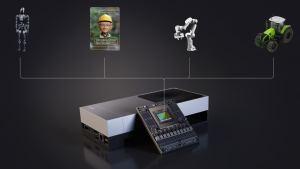
NVIDIA Jetson Thor (also marketed as Jetson AGX Thor) is a Blackwell architecture edge AI computing module developed by NVIDIA that delivers up to 2,070 FP4 teraflops of AI compute in a 40 to 130 watt power envelope to act as an on-robot "brain" for humanoid systems, autonomous machines, and "physical AI" workloads. The flagship Jetson T5000 module pairs the Blackwell GPU with a 14-core Arm Neoverse-V3AE CPU and 128 GB of LPDDR5X memory, and NVIDIA reports it provides 7.5 times the AI performance and 3.5 times the energy efficiency of the previous Jetson Orin AGX generation. [1][2] The platform was previewed by NVIDIA CEO Jensen Huang at GTC 2024 alongside Project GR00T and reached general availability on August 25, 2025, with a developer kit starting at US$3,499. [1] At launch Huang said: "With unmatched performance and energy efficiency, and the ability to run multiple generative AI models at the edge, Jetson Thor is the ultimate supercomputer to drive the age of physical AI and general robotics." [1] Jetson Thor sits at the top of the Jetson product family and is intended to bring data center class generative AI workloads, including large language models, vision language models, and vision language action policies, onto autonomous machines such as humanoid robots, autonomous mobile robots, drones, surgical robots, and inspection systems. [2] NVIDIA expanded the family on July 15, 2026 by announcing the smaller Jetson T3000 and T2000. The T3000 is rated at 865 sparse FP4 TFLOPS with 32 GB of memory, while the T2000 is rated at 400 sparse FP4 TFLOPS with 16 GB. Both remained in development, with availability scheduled for the first quarter of 2027. [22][23]
Background and strategic context
The Jetson Thor series belongs to NVIDIA's Jetson family of embedded AI computing platforms, which has been used since 2014 to bring GPU acceleration to autonomous machines, edge servers, and research robotics. By the mid 2020s, the rise of large multimodal models and generalist humanoid robotics created a need for far more on-device compute than the Ampere based Jetson Orin family could provide. NVIDIA framed this transition as the "physical AI" era, in which robots reason about the physical world using foundation models rather than purely deterministic perception and control stacks. [2]
When was Jetson Thor announced and released?
Thor was first unveiled on March 18, 2024 at GTC 2024 in San Jose. During his keynote, Jensen Huang introduced Project GR00T, a general purpose foundation model for humanoid robots, and announced that Thor would serve as the on-robot compute platform for next generation humanoids. [5] NVIDIA initially described Thor as a system on a chip incorporating a next generation Blackwell GPU with a transformer engine, an integrated functional safety processor, and 100 Gb networking, delivering 800 teraflops of 8-bit floating point performance to run multimodal generative AI models like GR00T. [5] Over the following 17 months NVIDIA refined the product into an initial two-module lineup and a developer kit, with revised peak figures based on the FP4 sparse format introduced by Blackwell, raising the headline number from 800 FP8 TFLOPS to 2,070 FP4 sparse TFLOPS. The shipping lineup began with T5000 and T4000; NVIDIA added the lower-memory T3000 and T2000 to its development roadmap in July 2026. [22][23]
General availability arrived on August 25, 2025, when NVIDIA announced that the Jetson AGX Thor Developer Kit and Jetson T5000 production module were shipping through authorized distributors worldwide. [1] The launch was positioned as the foundation for what NVIDIA called "the age of general robotics," with early adopters spanning humanoid developers, industrial OEMs, surveying firms, and medical device makers. [1] At the time of the launch, NVIDIA reported more than 2 million developers active on its robotics stack, over 7,000 customers already using Jetson Orin hardware, and more than 150 hardware, software, and sensor partners offering production ready solutions. [1] A second module, the Jetson T4000, was disclosed for release in 2026 at a lower price and reduced power envelope. [1]
Announcement timeline
| Date | Event |
|---|---|
| March 18, 2024 | Jensen Huang previews Jetson Thor and Project GR00T at GTC 2024; initial spec cited 800 FP8 TFLOPS |
| March 2025 | NVIDIA confirms timing and additional robotics partners at GTC 2025 |
| August 25, 2025 | General availability announced; Jetson AGX Thor Developer Kit at $3,499 and Jetson T5000 module shipping |
| Q3 2025 | First developer kits delivered to early adopters and resellers |
| September 2025 | DRIVE AGX Thor developer kits (automotive sibling) begin shipping |
| October 2025 | CoRL 2025 demonstrations of GR00T N1.5 and N1.6 running on Jetson Thor |
| Q1 2026 | Jetson T4000 module enters the released lineup for cost-sensitive applications |
| July 15, 2026 | NVIDIA announces the in-development T3000 and T2000 modules [22][23] |
| Late July 2026 (planned) | NVIDIA plans T3000 emulation in JetPack 7.2.1 on the existing Jetson AGX Thor Developer Kit [22] |
| August 2026 | JetPack 7.2.1 with Jetson Linux 39.2.1 reaches general availability; its release notes list support for Jetson T3000 emulation [41][42] |
| August 19, 2026 | NVIDIA publishes its Cosmos 3 Edge on-device robot control tutorial, with action-chunk timing measured on the Jetson AGX Thor T5000 [36] |
| September 4, 2026 | NVIDIA Technical Blog publishes deployment guidance for running Nemotron 3.5 Lightning and Qwen3.8-27B with NVFP4 and speculative decoding on Jetson AGX Thor and Jetson AGX Orin [44] |
| Q1 2027 (scheduled) | T3000 and T2000 module availability [22][23] |
Hardware architecture
The released Jetson T5000 and T4000 are implemented as 87 by 100 mm systems on module (SoMs) with 699-pin board-to-board connectors. [3][6] The SoM is not pin compatible with Jetson AGX Orin because Thor uses a different connector, a higher peak power budget (up to 130 W versus 60 W for AGX Orin), and additional high speed interfaces such as PCIe Gen5 and 25 GbE. [4] NVIDIA publishes a dedicated Orin to Thor migration application note (DA-11926-001) to help integrators move existing carriers to the new platform. [4]
GPU subsystem
The GPU is based on NVIDIA's Blackwell architecture, the same family used in data center products such as the B100 and B200 but configured for an embedded power envelope. [2] Key GPU traits on the T5000 module include:
- 2,560 CUDA cores running at up to 1.57 GHz
- 96 fifth generation Tensor Cores
- 10 Texture Processing Clusters (TPCs)
- Multi-Instance GPU (MIG) capability that allows the single GPU to be partitioned into isolated instances for mixed criticality robotics workloads
- A second generation Transformer Engine with dynamic precision switching between FP4 and FP8
- Native FP4 quantization, which is the precision behind the headline 2,070 TFLOPS rating
At the T4000 tier the GPU is cut down to 1,536 CUDA cores, 64 Tensor Cores, and 6 TPCs, with a lower 1.53 GHz peak clock. [3]
Peak AI performance
NVIDIA publishes peak AI throughput at multiple precisions. The numbers below are taken from the Jetson Thor Series Modules datasheet (DS-11945-001) and the Jetson Thor launch technical blog. [2][3]
| Precision | T5000 peak | T4000 peak |
|---|---|---|
| FP4 sparse | 2,070 TFLOPS | 1,200 TFLOPS |
| FP4 dense or FP8 sparse or INT8 sparse | 1,035 TFLOPS or TOPS | preliminary |
| FP8 dense or FP16 sparse | 517 TFLOPS | preliminary |
| FP16 dense | 258 TFLOPS | preliminary |
| FP32 | 8.064 TFLOPS | preliminary |
| DLA INT8 (PVA assisted vision pipeline) | up to 105 TOPS | preliminary |
The 7.5 times improvement over Jetson AGX Orin that NVIDIA quotes is calculated using FP4 sparse on Thor against INT8 sparse on Orin, the highest published precision for each generation respectively. [2]
CPU subsystem
Thor switches from the Arm Cortex-A78AE used in Orin to the Arm Neoverse-V3AE, an automotive enhanced variant of the Neoverse V3 server class core. [8] The T5000 ships with 14 Neoverse-V3AE cores; the T4000 has 12. [3] Each core has 1 MB of L2 cache and the cluster shares 16 MB of L3 cache, with a peak frequency of 2.6 GHz. [3] The use of Neoverse means that JetPack 7 software aligns with the Arm Server Base System Architecture (SBSA), the same firmware and interface specification used on Arm based server silicon. [8] This alignment lets the same CUDA 13 binaries run on Arm servers and on Jetson Thor without recompilation, which is a deliberate move toward unifying the data center and edge developer experience. [8]
Memory and storage
The T5000 carries 128 GB of unified LPDDR5X memory on a 256-bit bus at 4,266 MHz, delivering approximately 273 GB/s of bandwidth between the CPU, GPU, and accelerators. [3] The T4000 drops to 64 GB on the same 256-bit bus and the same bandwidth. [3] Storage is provided externally through an M.2 Key M slot for NVMe SSDs (the developer kit includes a 1 TB drive) and through USB 3.2 mass storage. The 128 GB pool is large enough to keep models up to roughly 100 billion parameters resident with INT4 or FP4 quantization, which is why NVIDIA markets Thor as bringing "frontier scale" inference to the edge. [2]
Accelerators and media engines
In addition to the GPU, Thor integrates the following on-die accelerators:
- Third generation Programmable Vision Accelerator (PVA 3.0) for traditional computer vision tasks such as feature tracking and stereo correspondence
- Optical flow accelerator
- Always on DSP for low power audio and sensor preprocessing
- Two NVENC video encoders and matching NVDEC decoders on the T5000
Unlike Jetson AGX Orin, which paired the GPU with two dedicated NVIDIA Deep Learning Accelerators (NVDLA v2), the Jetson Thor SoC moves the heavy lifting onto the much larger Blackwell GPU plus the PVA. [4] NVIDIA's developer documentation treats the PVA and Tensor Cores as the primary inference paths on Thor, and the public datasheet lists deep learning acceleration in terms of GPU TOPS and a separate PVA pipeline rather than a discrete NVDLA block. [3] Developers migrating NVDLA workloads from Orin are directed to run them on the GPU or PVA on Thor. [4]
Multimedia and display
- Video decode: up to four 8K at 30 fps streams, or up to ten 4K at 60 fps streams; H.265, H.264, AV1, VP9, and VP8 are supported
- Video encode: up to six 4K at 60 fps streams; H.265 and H.264
- Camera input: up to 32 simultaneous virtual channels through MIPI CSI-2 or Holoscan Sensor Bridge
- Display: up to four independent displays at resolutions up to 7,680 by 4,320 at 30 Hz via HDMI 2.1 and DisplayPort 1.4a
I/O, networking, and sensor bridge
Networking is a central upgrade. The T5000 exposes four 25 GbE interfaces (aggregated via a QSFP28 connector for 100 Gb total) plus a 5 GbE RJ45 port, while the developer kit adds Wi-Fi 6E and Bluetooth via an M.2 Key E module. [11] PCIe Gen5 lanes are configurable up to x8 plus x4 plus x2, supporting NVMe SSDs, accelerator cards, and FPGA peripherals. [3]
Industrial interfaces include CAN bus, multiple UARTs, SPI, I2C, I2S, and dozens of GPIO pins. The platform also introduces the Holoscan Sensor Bridge, an Ethernet based time synchronized sensor input path originally developed for the Holoscan medical imaging SDK. [13] Sensor Bridge lets cameras and lidar units stream raw pixel and point cloud data over 10 Gb or 25 Gb Ethernet with low and deterministic latency, decoupling the sensor head from the compute module and enabling longer cable runs than MIPI CSI-2 supports. [13]
Module variants and developer kit
The Jetson Thor family launched with two production modules and one developer kit. The T5000 is the flagship; the T4000 is a lower cost and lower power option targeted at workloads that do not need full Blackwell scale. [3] The announced T3000 and T2000 extend the roadmap below those two shipping variants, with smaller memory capacities and lower peak compute. [22][23]
| Component | Jetson T5000 | Jetson T4000 |
|---|---|---|
| GPU | 2,560 CUDA cores, 96 Tensor Cores, 10 TPCs, MIG | 1,536 CUDA cores, 64 Tensor Cores, 6 TPCs, MIG |
| GPU clock | 1.57 GHz | 1.53 GHz |
| FP4 sparse peak | 2,070 TFLOPS | 1,200 TFLOPS |
| CPU | 14-core Arm Neoverse-V3AE @ 2.6 GHz | 12-core Arm Neoverse-V3AE |
| Memory | 128 GB LPDDR5X, 256-bit, 273 GB/s | 64 GB LPDDR5X, 256-bit, 273 GB/s |
| Power profile | 40 to 130 W configurable | 40 to 70 W configurable |
| 25 GbE links | 4 (via QSFP28) | 3 |
| Video encoders | 2 NVENC | 1 NVENC |
| Form factor | 87 by 100 mm SoM, 699-pin | 87 by 100 mm SoM, 699-pin |
| Module SKU | 900-13834-0080-000 | preliminary |
| Module price (1K units) | $2,999 | $1,999 |
The Jetson AGX Thor Developer Kit packages a Jetson T5000 module on a reference carrier with active cooling, a 1 TB NVMe SSD in an M.2 Key M slot, a Wi-Fi 6E plus Bluetooth M.2 Key E module, HDMI 2.0b, DisplayPort 1.4a, 5 GbE, four 25 GbE via QSFP28, multiple USB 3.2 Type-A and Type-C ports, CAN, UART, I2S audio headers, JTAG, and a 140 W power adapter. [11] The assembled kit measures roughly 243 by 112 by 57 mm. NVIDIA published the developer kit price at US$3,499, with preorders opening in August 2025 and shipments starting in Q3 2025 and continuing into November 2025 through resellers such as Arrow, RS Components, and Seeed Studio. [1][11]
T3000 and T2000 modules
NVIDIA announced Jetson T3000 and T2000 on July 15, 2026 as in-development Thor modules for robotics and edge AI systems that do not need the memory capacity or peak compute of T5000 and T4000. The announcement tied the smaller configurations to both system size and memory cost. Only T3000 was explicitly described by NVIDIA as roughly half the size and power of T5000. [22] NVIDIA's official roadmap places both modules in a mainstream tier, below the released T5000 and T4000, and marks them for Q1 2027. [23]
The table below separates specifications published directly by NVIDIA from preliminary details supplied by launch partners and technical publications. [26][27][28][29][30] NVIDIA had not released full module datasheets, design guides, connector pinouts, ordering part numbers, or prices for T3000 and T2000 when it announced them. NVIDIA forum staff said the engineering documents would be published closer to release. [28][35]
| Item | Jetson T3000 | Jetson T2000 |
|---|---|---|
| Status | In development; Q1 2027 availability scheduled | In development; Q1 2027 availability scheduled |
| Peak AI compute | 865 sparse FP4 TFLOPS | 400 sparse FP4 TFLOPS |
| GPU | Blackwell; 1,536 CUDA cores in partner specifications | Blackwell; 1,024 CUDA cores in partner specifications |
| CPU | 8-core Arm Neoverse; launch partners identify Neoverse-V3AE | 6-core Arm Neoverse-V3AE in preliminary partner specifications |
| Memory | 32 GB LPDDR5X, 273 GB/s | 16 GB LPDDR5X, 137 GB/s in preliminary partner specifications |
| Networking | 25 GbE connectivity | 10 GbE in preliminary technical specifications |
| Power | NVIDIA says roughly half T5000 power; partners list 70 W | Partners list 40 W |
| NVIDIA-targeted workloads | Humanoid robotics, LLMs, VLMs, VLA models, and world foundation models | Visual AI agents, autonomous mobile robots, industrial manipulators, and other edge systems |
| Development path | T3000 emulation planned in JetPack 7.2.1 on the existing Jetson AGX Thor Developer Kit | Emulation support planned for a later, undated release |
| Announced price | Not announced | Not announced |
The T3000 retains the 273 GB/s memory bandwidth NVIDIA publishes for T4000 and T5000, but its 32 GB capacity is one quarter of T5000's and its 865 sparse FP4 TFLOPS rating is below the 1,200 and 2,070 TFLOPS ratings of T4000 and T5000. [22][27] NVIDIA said T3000 could nevertheless approach T5000 inference performance on selected multimodal workloads. Its launch graphic reported the following normalized results, all produced through emulation and explicitly marked subject to change. [22]
| Emulated workload | T3000 result, normalized to T5000 = 1 |
|---|---|
| Nemotron 3 Nano 4B | 0.87 |
| Gemma 4 E4B | 0.91 |
| Qwen3.5 4B | 0.93 |
| Qwen3 32B | 0.92 |
| Cosmos 3 Nano | 0.88 |
| Cosmos Reason 2 8B | 0.93 |
| GR00T 1.6 | 0.89 |
These figures describe seven selected model workloads under NVIDIA's emulation setup. The published chart gives normalized ratios rather than absolute throughput and does not turn the result into a general equivalence between T3000 and T5000. The lower memory capacity also limits which model sizes and concurrent workloads can fit without additional quantization, offloading, or memory optimization. Independent measurements on production T3000 or T2000 hardware were not possible because the modules were not yet available. [22][29]
NVIDIA directed developers to use the T5000-based Jetson AGX Thor Developer Kit to start software work. The company scheduled T3000 emulation for later July 2026 with JetPack 7.2.1, while saying T2000 emulation would follow in a future release. This is an emulation and migration path, not a statement that either lower-tier module can be installed in the existing developer-kit carrier. Hardware compatibility cannot be established until NVIDIA publishes the production mechanical and interface documentation. [22][28][35]
JetPack 7.2.1 with Jetson Linux 39.2.1 subsequently shipped. NVIDIA's JetPack download page presents it as the current release, with CUDA 13.2.1 and TensorRT 10.16.2, and the Jetson Linux 39.2.1 release notes, dated August 2026 and labeled a General Availability release that can be used for production, list "Support for Jetson T3000 emulation" and agent skills for video pipelines among the highlights. [41][42] The same document's step-by-step emulation section covers only T4000 emulation on the Jetson AGX Thor Developer Kit, done by appending a mem=64G kernel parameter and switching nvpmodel to the 90 W or 70 W mode, and it states that this emulation covers CPU, GPU and memory performance but not engines such as NVDEC and NVENC. The notes do not mention T2000 emulation. [41]
The announcement also identified Cosmos 3 Edge, a 4-billion-parameter model built on Nemotron, as an on-device model for T2000 and T3000. NVIDIA said developers could adapt it for specific robots and sensors and deploy it for vision reasoning and robot-policy workloads. [24] NVIDIA paired the launch with open-source Jetson agent skills for device diagnostics, memory auditing, inference tuning, model serving, and board-support-package customization across Thor and Orin systems. [22][25]
How does Jetson Thor compare with Jetson AGX Orin?
Thor is the direct successor to the Jetson AGX Orin family, which itself replaced Jetson AGX Xavier in 2022. The table below summarizes the principal differences between the highest end Orin and Thor SKUs. [16]
| Feature | Jetson AGX Orin 64 GB | Jetson AGX Thor (T5000) |
|---|---|---|
| GPU architecture | Ampere | Blackwell |
| CUDA cores | 2,048 | 2,560 |
| Tensor Cores | 64 (3rd gen) | 96 (5th gen) |
| Peak AI throughput | 275 INT8 sparse TOPS | 2,070 FP4 sparse TFLOPS |
| Transformer engine | No | Yes (FP4 and FP8) |
| Multi-Instance GPU | No | Yes |
| Deep learning accelerator | 2x NVDLA v2 | None (workload moves to GPU and PVA) |
| CPU | 12-core Arm Cortex-A78AE | 14-core Arm Neoverse-V3AE |
| CPU peak clock | ~2.2 GHz | 2.6 GHz |
| Memory | 64 GB LPDDR5 at 204.8 GB/s | 128 GB LPDDR5X at 273 GB/s |
| Networking | 10 GbE | 4 by 25 GbE plus 5 GbE |
| PCIe | Gen4 | Gen5 |
| Power envelope | 15 to 60 W | 40 to 130 W |
| Form factor | SoM, 699-pin | SoM, 699-pin (not pin compatible) |
| Pin compatibility | n/a | Requires new carrier |
NVIDIA reports public benchmark speedups for generative AI workloads on the Jetson Thor launch blog. The figures below compare Thor against AGX Orin 64 GB using the latest available kernels at launch. [2]
| Benchmark | Speedup on Thor |
|---|---|
| Llama 3.3 70B inference | 1.71x |
| Qwen3-32B inference | 4.70x |
| DeepSeek-R1-Distill-Qwen-32B | 4.87x |
| Qwen2.5-VL-7B with FP4 plus speculative decoding | 3.5x |
| GR00T N1.5 vision language action model | 2.74x |
| Aggregate generative AI inference | up to 5x |
In multimodal serving tests with Qwen2.5-VL-3B and Llama 3.2 3B handling 16 simultaneous requests, NVIDIA reported time to first token below 200 milliseconds and time per output token below 50 milliseconds, which it positions as the threshold for natural human and robot interaction. [2]
Software stack
Thor uses JetPack 7.0 (and later releases such as 7.2 with CUDA 13.2, and the August 2026 JetPack 7.2.1 with Jetson Linux 39.2.1) as its base software stack. [7][41][42] JetPack 7 is built on the Linux kernel 6.8 and Ubuntu 24.04 LTS, includes a preemptable real time patch set for deterministic execution, and aligns Jetson firmware and bootloaders with the Arm SBSA specification used on Arm based servers. [7][12] The result is that the same Arm CUDA 13.0 binaries used on data center Arm Grace systems will run on Jetson Thor, which simplifies sim to real workflows. [8]
Key software components for Jetson Thor include:
- JetPack 7.0: Ubuntu 24.04 LTS, Linux kernel 6.8, real time scheduling, U-Boot, secure boot, and UEFI consistent with SBSA
- CUDA 13.0 unified across Arm targets and Jetson
- TensorRT 10.13 for high performance inference, including FP4 calibration
- cuDNN 9.12 and cuBLAS updated for Blackwell
- VPI 4.0 Vision Programming Interface for accelerated computer vision
- Holoscan SDK for real time sensor pipelines with the Holoscan Sensor Bridge
- CUDA-accelerated ROS 2 packages and the Isaac ROS collection
- DeepStream for multi-stream video analytics
- Native containers via NVIDIA Container Toolkit and prebuilt Triton inference server images
On the model and robotics side, NVIDIA pairs Jetson Thor with several platforms in its Physical AI stack:
- NVIDIA Isaac: A robotics platform that includes Isaac Sim for physics accurate simulation built on NVIDIA Omniverse, Isaac Lab for reinforcement learning and imitation learning, and Isaac ROS for hardware accelerated ROS 2 packages
- Isaac GR00T: A line of open foundation models for humanoid robots; GR00T N1, N1.5, N1.6, and N1.7 were released across 2024 to 2026, each targeting whole body control, manipulation, and vision language action behaviors. GR00T N1.6 integrates Cosmos Reason as its long horizon reasoning brain
- NVIDIA Cosmos: A family of world foundation models for physical AI, including Cosmos Predict for synthetic data, Cosmos Transfer for domain adaptation, and Cosmos Reason, a 7B reasoning vision language model that NVIDIA supports on Jetson Thor for converting vague instructions into step by step plans [15]; the July 2026 Cosmos 3 Edge omnimodel is the family's first member sized to run a robot policy on the Thor module itself, covered in its own section below [36]
- NVIDIA Newton: An open source physics engine built with DeepMind and Disney Research, used inside Isaac Sim and announced at CoRL 2025 [14]
- NVIDIA Metropolis: Visual AI for smart spaces and industrial sites, with multimodal agents that can run on Thor for on premise inference
- NVIDIA Holoscan: Real time sensor and medical imaging pipelines used in fields such as surgical robotics and medical devices
Jetson Thor supports the major open ecosystem frameworks, including PyTorch, TensorFlow, ONNX Runtime, vLLM, Hugging Face Transformers, llama.cpp, and the Triton inference server, plus model families from Meta (Llama 3 and 4), Alibaba (Qwen 2.5 and Qwen 3), DeepSeek, Google Gemma, and Mistral. [2]
Generative AI metrics targeted by NVIDIA
| Metric | Target performance |
|---|---|
| Time to first token (TTFT) | under 200 ms for 7B class multimodal models |
| Time per output token (TPOT) | under 50 ms for 7B class multimodal models |
| Generative AI speedup vs Orin | up to 5x aggregate; 7.5x for FP4 quantized inference |
| Speculative decoding speedup | up to 2x additional |
Cosmos 3 Edge as an on-device policy workload
The most detailed public measurement of a foundation-model robot policy running on Jetson Thor comes from NVIDIA's own Cosmos 3 Edge work. Cosmos 3 Edge is the 4-billion-parameter member of NVIDIA's Cosmos 3 family of open world foundation models, announced with the T3000 and T2000 on July 15, 2026 and released as open weights on July 20, 2026 under the OpenMDW-1.1 license. NVIDIA positions it as the Cosmos tier small enough to live on the robot: the policy checkpoint's BF16 weights occupy roughly 9 GB, which is what lets both a policy server and its control client run on a T5000 or T4000 with no data center GPU in the loop. [22][36][39] The wider Jetson lineup, the JetPack releases and the Jetson agent skills that accompany them are covered in the NVIDIA Jetson article; this section covers only what NVIDIA has published about running Edge on Thor hardware.
NVIDIA's August 19, 2026 technical blog post walks through post-training Edge into a robot manipulation policy for the DROID platform, a Franka Panda arm with a Robotiq gripper, serving it on Jetson Thor, running it inside a receding-horizon control loop and evaluating it in closed-loop simulation. The released checkpoint is nvidia/Cosmos3-Edge-Policy-DROID. The policy takes a language instruction, three camera views (a wrist camera over two exterior views, composed into a 540 by 640 canvas) and the arm's measured joint and gripper positions, and returns a chunk of 32 future actions at 15 Hz, each an 8-dimensional absolute joint-position command covering seven joints and the gripper. It is served by a WebSocket policy server speaking the OpenPI protocol used across the DROID policy ecosystem; on Thor the server runs natively on the module, so a request to localhost never leaves the robot. The tutorial's Thor commands set TORCHDYNAMO_DISABLE=1 for eager execution, and its prerequisites name CUDA 13.0 and NVIDIA's 26.06 container release. The post-training itself is not an edge job: NVIDIA describes the validated run as 64 nodes of four GB200 GPUs for about 68 hours. [36][37]
The headline figures come from that post. On a Jetson AGX Thor T5000, NVIDIA says, the policy generates each action chunk in about 1.53 seconds at 640 by 540 resolution and 15 Hz, while a single chunk covers roughly 2.13 seconds of robot motion; because the next chunk is ready before the current one finishes, the arm moves continuously, and the policy replans after each inference cycle rather than after every observation. [36] NVIDIA Robotics restated the pair on September 2, 2026, writing that post-trained Cosmos 3 Edge on a T5000 "generates roughly 2.13 seconds of robot motion in about 1.53 seconds, then replans from fresh camera and robot-state observations," and that developers can test the same policy in closed-loop RoboLab simulation across 120 language-conditioned manipulation tasks before evaluating on hardware. [38] The tutorial's example loop predicts 32 actions, executes the first 16 at 15 Hz (about 1.07 seconds of motion), reads fresh cameras and joint state, and queries again, so each replan starts from where the arm actually is rather than where the previous chunk assumed it would be. [36]
The underlying measurements are on the policy's model card, which times one request at a time over a persistent loopback connection with four UniPC denoising steps, guidance 3.0 and a 640 by 540 observation mapped to a 544 by 736 processing bucket. The card defines its real-time factor as the 2.133-second span of a 32-action chunk at 15 Hz divided by measured end-to-end latency. [37]
| Module | Configuration | Median end-to-end latency | Observed range | Timed requests | Real-time factor at 15 Hz |
|---|---|---|---|---|---|
| Jetson AGX Thor T5000 | 128 GB, MAXN, 1575 MHz | 1.528 s | 1.503 to 1.673 s | 16 | 1.40 |
| Jetson AGX Thor T4000 | 64 GB class, MAXN, 1530 MHz | 2.208 s | 2.148 to 2.425 s | 9 | 0.97 |
| Jetson Thor T3000 (emulated) | 32 GB, 1100 MHz | 2.632 s | 2.595 to 2.687 s | 4 | 0.81 |
| Jetson Thor T2000 | 16 GB, 765 MHz, THOR_NANO | 5.195 s | 5.176 to 5.224 s | 9 | 0.41 |
Only the T5000 meets the 15 Hz budget in this configuration; the T4000 median is about 3.5 percent over it, and even its fastest request was 0.7 percent over. The T3000 figures come from an emulated configuration with a 32 GB memory limit, 12 SMs, a 1100 MHz GPU clock cap and CPU caps but no cap on DRAM bandwidth, so NVIDIA warns that production T3000 hardware may be slower. The T2000 run used expandable-segment memory allocation and 2.6 GB of swap with other Cosmos containers stopped, although the card says no swap-out occurred during the timed calls. [37] The same card reports a separate vLLM-Omni configuration with 320 by 192 observations, 30 denoising steps, guidance 1.0 and a 5 Hz control rate, where the 32-action budget is 6.4 seconds: the T5000 took 2.59 seconds end to end, the T4000 3.24 seconds, the emulated T3000 4.05 seconds and the T2000 7.63 seconds, so every module except the T2000 met that looser budget. A third, canonical request with a 16-action chunk and one input image took 6.32 seconds of vLLM-Omni end-to-end latency on the T5000 and 8.63 seconds on the T3000 row. NVIDIA says the PyTorch and vLLM-Omni figures should not be compared with each other because the inputs, denoising settings, runtime stacks and timing protocols differ. [37]
These are NVIDIA's loopback measurements of a policy server, taken with one request in flight at a time. The 1.53-second median being shorter than the 2.13-second chunk is a throughput-budget result; the published tutorial loop waits for inference before executing its prefix, so the figures do not by themselves show that inference overlaps execution on a physical arm, and they exclude a deployed robot's sensor, safety-controller and actuator path. [36][37] The model card also warns that Cosmos 3 outputs can show action-state drift and are not safety-certified decisions, so a Thor deployment still needs use-case validation, external constraints and system-level safety analysis. [37]
The simulation route runs through RoboLab, the Isaac Lab-Arena benchmark behind NVIDIA's RoboLab leaderboard. Its client connects to the same policy server, executes each action chunk in physics and streams rendered observations back, giving a true closed loop across 120 language-conditioned manipulation tasks; NVIDIA recommends this pass before evaluating on a physical robot, and each run produces viewport and robot-camera videos plus a success log. [36][43] In that evaluation the post-trained Edge policy reaches 22.9 percent overall success with the benchmark's default instructions, against 36.8 percent for the 16-billion-parameter Cosmos 3 Nano policy; the Edge figure moves to 15.4 percent with vague instructions and 28.8 percent with specific ones, and drops to 11.8 percent on the benchmark's complex tasks. NVIDIA presents the trade as real-time, fully on-robot autonomy at a fraction of the larger model's inference compute. These are simulation success rates reported by NVIDIA, not real-robot results. [36][37]
The reasoner half of the same 4B checkpoint, the tower that answers questions about camera input, has its own Jetson numbers. The Edge model card publishes preliminary eager-mode Hugging Face Transformers measurements in which a 1,705-token text prompt decodes at 37.3 tokens per second on the T5000 (3.60 seconds end to end), 34.1 on the T4000, 29.7 on the T3000 row, 15.7 on the T2000 row and 12.3 on a 64 GB Jetson AGX Orin. [39] NVIDIA's Jetson AI Lab page for the model, which serves the reasoner through vLLM, reports faster single-stream decode of 68.2 tokens per second on the T5000, 63.9 on the T4000 and 44.1 on the AGX Orin 64GB (BF16, batch 1, up to 128 output tokens), notes that single-stream decode is memory-bandwidth-bound so the two Thor modules land close together, and says the same server sustains about 293 tokens per second aggregate on the T5000 at eight concurrent streams. [40]
Open reasoning models on Thor (September 2026)
On September 4, 2026, NVIDIA's Technical Blog published "Frontier Reasoning Reaches the Edge," by Khalil BenKhaled, Aditya Sahu, and Chitoku Yato, a deployment guide that names Jetson AGX Thor and Jetson AGX Orin as the modules for running two 2026 open reasoning models locally: Nemotron 3.5 Lightning, a 30-billion-parameter mixture-of-experts model that activates 3 billion parameters per token, and the dense Qwen3.8-27B. Its serving commands run vLLM v0.28.0 on JetPack 7.2 and pair NVFP4 checkpoints with speculative decoding drafts, which NVIDIA reports lifted decode throughput over BF16 by 3.37x for Lightning with DSpark and 6.28x for Qwen3.8-27B with DFlash2; the post does not say which of the two modules produced those figures. [44] The Jetson AI Lab pages that accompany it are module-specific: the Nemotron 3.5 Lightning page lists Jetson AGX Thor T4000 and the T5000 Developer Kit alongside AGX Orin 64GB, says the best performance NVIDIA saw "averaged 115 tokens/sec on Jetson AGX Thor and 89 tokens/sec on Jetson AGX Orin across multi-step agentic workloads involving reasoning and tool calls," and describes a TensorRT Edge-LLM NVFP4 path as experimental and Thor-only, while NVIDIA's speculative decoding tutorial reports Qwen3.8 27B decode on Jetson AGX Thor rising "from roughly 13 tokens/s to 35 tokens/s" with multi-token prediction at depth 3. [45][46] The model-choice guidance, the optimization and workload tables, and NVIDIA's chart of the models it says run in real time on Jetson are covered in the section on running 2026 open reasoning models on Jetson in the NVIDIA Jetson article.
Power profiles
Thor exposes a wide range of power and thermal modes that integrators can pick using the nvpmodel tool. NVIDIA describes the envelope from low power deployment to peak compute, with corresponding clock and core configurations. [3]
| Profile (T5000) | Approximate power | Target use case |
|---|---|---|
| Low | 40 W | Battery operated robots, drones, evaluation on passive cooling |
| Mid | 60 to 80 W | Standard humanoid and AMR workloads, sustained inference |
| Performance | 100 W | Multi-model multimodal serving, generative AI with FP4 |
| Maximum | 130 W | Peak burst performance for VLA, LLM, and large VLM workloads |
The T4000 caps at roughly 70 W, suiting passively cooled and battery powered systems where the smaller GPU and memory pool are sufficient. [3] Launch partners list preliminary 70 W and 40 W figures for T3000 and T2000, respectively. NVIDIA itself describes T3000 as operating at roughly half T5000 power but has not yet published the complete power-mode tables for either new module. [22][27][30]
What is Jetson Thor used for?
NVIDIA positions Jetson Thor as a single platform spanning several robotics and edge AI segments. Highlighted applications include: [1]
- Humanoid robots: Whole body control, manipulation, and language conditioned task execution using GR00T and Cosmos Reason
- Autonomous mobile robots (AMRs): Warehouse logistics, last mile delivery, and inspection robots that run perception, planning, and language models locally
- Industrial automation: Collaborative robots (cobots), pick and place cells, and quality inspection systems with on-device large model inference
- Drones and aerial robotics: Higher autonomy levels in beyond visual line of sight inspection, search and rescue, and agriculture
- Surgical and medical robotics: Real time imaging, augmentation, and assistance using the Holoscan SDK and Holoscan Sensor Bridge
- Autonomous vehicles and off road platforms: Construction, mining, and agriculture equipment using Thor in conjunction with the automotive grade DRIVE AGX Thor variant
- Edge AI servers and digital twins: On-premise inference for vision language models, large language models, and agentic systems where data residency or latency rules out the cloud
- Space and harsh environment compute: Several aerospace integrators are evaluating Thor for satellite and rover payloads due to its single SoM packaging and unified memory architecture
A recurring theme in NVIDIA's launch material is the ability to run multiple AI models concurrently on one device. Thor can simultaneously execute a vision language action policy, a higher level reasoning model, a perception network, and a safety classifier through MIG partitions, an architecture NVIDIA refers to as a "multi-model robot brain." [18]
Research deployments
Academic evidence for Jetson Thor currently concerns the shipping generation, not T2000 or T3000. Neither of the new modules was available for independent experiments when announced. Several 2026 preprints nevertheless document the existing platform in on-robot perception and action pipelines:
| Work | Reported Jetson Thor deployment |
|---|---|
| VGGT-SLAM 2.0 | The authors report real-time online dense scene reconstruction on a ground robot using Jetson Thor. [31] |
| Shallow-pi | The authors report inference experiments on Jetson Orin and Jetson Thor, using Thor with the RB-Y1 robot platform for their compressed flow-based vision-language-action model. [32] |
| FOUND-IT | The authors mounted Jetson Thor on a Boston Dynamics Spot and reported that their task-driven 3D scene-graph system ran at 4 Hz with Depth Anything DA3-LARGE-1.1. [33] |
| xperception | The authors report testing their zero-shot 6D object-pose pipeline on industrial edge hardware including Jetson Thor. [34] |
These papers demonstrate workloads that researchers have run on released Jetson Thor hardware. They do not validate NVIDIA's emulated T3000 ratios or establish T2000 performance.
Industry adoption
NVIDIA disclosed a broad list of early Jetson Thor adopters at GA. The roster spans humanoid developers, industrial OEMs, surveying and inspection firms, and medical device makers. [1]
| Adopter | Sector | Application |
|---|---|---|
| Agility Robotics | Humanoid robots | Sixth generation Digit humanoid for logistics |
| Amazon Robotics | Warehouse robotics | Internal robotics fleet for fulfillment |
| Apptronik | Humanoid robots | Apollo humanoid platform |
| Boston Dynamics | Legged and humanoid robots | Atlas humanoid, expanded GR00T integration |
| Caterpillar | Heavy equipment | Autonomous construction and mining vehicles |
| Figure | Humanoid robots | Figure 02 and successors |
| Hexagon | Surveying and metrology | Reality capture and inspection robots |
| Medtronic | Medical robotics | Surgical and imaging systems |
| Meta | AI research | Physical AI and humanoid research |
| 1X Technologies | Humanoid robots | EVE and NEO platforms (evaluating) |
| John Deere | Agriculture | Autonomous farm equipment (evaluating) |
| OpenAI | AI research | Robotics research (evaluating) |
| Physical Intelligence | Robotics foundation models | VLA model deployment (evaluating) |
| Fourier Intelligence | Humanoid robots | GR1 and successors via GR00T |
| Sanctuary AI | Humanoid robots | Phoenix humanoid via GR00T |
| Unitree Robotics | Quadrupeds and humanoids | H1 and G1 platforms via GR00T |
| XPENG Robotics | Humanoid robots | Iron humanoid via GR00T |
In aggregate, NVIDIA reported more than 7,000 customers deploying Jetson Orin hardware by 2025, over 150 hardware partners offering production ready solutions, and more than 2 million developers active on its robotics platforms. [1] Agility Robotics integrated Jetson into the fifth generation of its Digit humanoid and plans to adopt Jetson Thor as the onboard compute platform for the sixth generation of Digit, while Boston Dynamics is integrating Jetson Thor into its Atlas humanoid. [1] Explaining the appeal of the module, Figure CEO Brett Adcock said: "NVIDIA Jetson Thor's server-class performance, delivered within a compact and power-efficient design, allows us to deploy the large-scale generative AI models necessary for our humanoids to perceive, reason and act in complex, unstructured environments." [1]
How does Jetson Thor differ from DRIVE AGX Thor?
NVIDIA uses the Thor brand for two distinct but related products. Jetson Thor is the robotics and physical AI variant, while DRIVE AGX Thor is the automotive variant introduced for advanced driver assistance and autonomous driving. [8] Both products share the underlying Thor SoC: a Blackwell GPU with the Transformer Engine, Arm Neoverse-V3AE CPU cores, the same memory subsystem, and similar peak compute around 2,000 FP4 TFLOPS. [8] They diverge on packaging and software:
- Jetson Thor runs JetPack 7 and the Isaac, Metropolis, Holoscan, and Cosmos stacks. It is optimized for robotics carriers and embedded deployments.
- DRIVE AGX Thor runs NVIDIA DriveOS 7 and adds automotive grade software, deterministic real time scheduling, and certification readiness for ISO 26262 functional safety. Developer kits for DRIVE AGX Thor began shipping in September 2025. [9]
NVIDIA's product positioning is that vehicles and robots increasingly share the same software stack, so unifying compute across the two domains lowers cost for OEMs that build both autonomous vehicles and robots. [8]
NVIDIA IGX Thor and Halos for Robotics
While Jetson Thor is NVIDIA's robotics edge AI module, NVIDIA also ships a separate industrial grade platform on the same Thor generation called NVIDIA IGX Thor. The two products share the Blackwell based Thor compute foundation but are positioned differently. The Jetson family spans entry to mid range and high end embedded modules for general robotics and autonomous machines, whereas IGX is an industrial grade, enterprise edge AI platform purpose built for industrial, robotics, and medical environments where functional safety and long term enterprise support are required. [19] IGX Thor is not the same product as the Jetson Thor module; instead it builds on the Thor SoC and adds dedicated hardware safety features so it can be deployed in safety critical applications. [19] The July 2026 roadmap expansion followed the same distinction: NVIDIA announced both Jetson T3000 and a separate IGX T3000. The IGX variant carries the integrated functional-safety features and runs the Halos for Robotics safety stack, while the Jetson variant is the general robotics and edge AI module. [22]
The distinguishing feature of IGX Thor is its functional safety architecture. NVIDIA describes IGX Thor as delivering up to 2,070 FP4 TFLOPS of AI compute, with 14 Arm Neoverse cores and 128 GB of memory at 273 GB/s of bandwidth, matching the Thor generation compute envelope, while adding an IEC 61508 SIL 3 capable functional safety island with up to 12,000 DMIPS plus dedicated I/O, power, and clocks. [20] NVIDIA states that the IGX Thor SoC includes more than 22,000 safety mechanisms providing diagnostic coverage across the chip, along with logic and memory in system test (IST) for latent fault coverage. [20] A separate safety microcontroller (MCU) on the carrier board complements the on SoC safety island, and NVIDIA positions the platform to meet ISO 26262 and IEC 61508 standards. [19] This functional safety capability is the central difference between IGX Thor and the standard Jetson Thor robotics module.
Role in NVIDIA Halos for Robotics
On June 22, 2026, NVIDIA announced NVIDIA Halos for Robotics, which it describes as the industry's first full stack, comprehensive functional safety system for robotics and physical AI. [20][21] Halos extends safety research and engineering originally developed for autonomous vehicles to industrial robots, humanoids, and autonomous mobile robots. NVIDIA states that the effort draws on more than 18,000 engineering years of autonomous vehicle safety work, the assessment of billions of safety transistors, and millions of lines of safety assessed code. [20][21]
IGX Thor serves as the compute layer of the Halos for Robotics stack. NVIDIA organizes Halos into three layers: [20][21]
- Platform safety (hardware): NVIDIA IGX Thor paired with the NVIDIA Holoscan Sensor Bridge, providing industrial grade AI compute with built in functional safety and real time, time synchronized sensor connectivity.
- Halos OS (software): Halos Core, a base safety operating layer for safety related functions, together with safety blueprints including the Halos Outside In Safety Blueprint for external camera perception and dynamic robot behavior control.
- Ecosystem safety (certification): the NVIDIA Halos AI Systems Inspection Lab, which NVIDIA describes as the first ANSI/ANAB accredited (ISO/IEC 17020) program for functional and AI safety assessment.
Halos references functional safety standards including IEC 61508, ISO 13849, and ISO/IEC TR 5469, and NVIDIA lists safety certification and inspection bodies such as TUV Rheinland, UL Solutions, TUV SUD, exida, SGS, and CertX as participants. [21] Deepu Talla, NVIDIA's vice president of robotics and edge AI, framed the launch around the shift to physical AI in factories, warehouses, and logistics. [21] Agility Robotics was named as an early adopter, incorporating Halos elements into its Digit humanoid for industrial logistics and manufacturing customers including Amazon, GXO, Schaeffler, and Toyota Motor Manufacturing Canada. [21] Agility chief executive Peggy Johnson said that for humanoids to deliver value at scale, safety has to be built into the robot. [21]
In summary, the Jetson Thor module and IGX Thor are distinct products on the shared Thor compute generation. Jetson Thor targets general robotics and physical AI deployments, while IGX Thor adds a certifiable hardware safety island and serves as the functional safety compute foundation underneath NVIDIA Halos for Robotics. [19][20]
Comparison with other edge AI silicon
Jetson Thor competes with a range of edge and embedded accelerators, though no other vendor matches its combination of Blackwell class GPU, 128 GB memory, and integrated Arm server class CPU. The table below sketches the broader market context as of late 2025 and early 2026. [17]
| Platform | Peak AI throughput | Memory | Power | Notable traits |
|---|---|---|---|---|
| NVIDIA Jetson AGX Thor (T5000) | 2,070 FP4 sparse TFLOPS | 128 GB LPDDR5X | 40 to 130 W | Full Blackwell GPU plus Arm Neoverse, JetPack 7, Isaac and GR00T |
| NVIDIA Jetson AGX Orin 64 GB | 275 INT8 sparse TOPS | 64 GB LPDDR5 | 15 to 60 W | Ampere GPU, NVDLA, mature ecosystem |
| Qualcomm Robotics RB6 | ~200 INT8 TOPS (combined) | up to 16 GB LPDDR5 | ~30 W | 5G connectivity, Adreno GPU, lower compute density |
| Qualcomm Dragonwing IQ10 | tens of INT8 TOPS | LPDDR5 | low watts | Power efficient alternative for non-frontier robotics |
| Hailo-15 | 20 TOPS at sub-3 W | shared host memory | ~3 W | Dedicated dataflow accelerator, low power vision |
| Hailo-10 | up to 40 INT8 TOPS | host memory | ~3.5 W | Designed for client devices and small robots |
| Mythic M1076 | up to 25 TOPS analog | analog in-memory | ~3 to 4 W | Analog compute in memory, niche deployments |
| Google Edge TPU (Coral) | 4 INT8 TOPS | host memory | ~2 W | Small models only, very low power |
| AMD Versal AI Edge | tens of TOPS | DDR4 or LPDDR4 | ~30 W | FPGA fabric plus AI engines, deterministic latency |
In practice, Thor competes most directly with high end Jetson Orin and DRIVE platforms rather than with low power accelerators like Hailo or Coral. The closer comparisons are NVIDIA's own AGX Orin Industrial and the broader Arm server market, where Thor's SBSA alignment means workloads can move between Grace based servers and the edge module without code changes. [8]
Development, security, and lifecycle
NVIDIA provides a 10-year production lifecycle for Jetson Thor modules, matching the long support windows expected by industrial and automotive integrators. [3] Secure boot, A or B firmware updates, and a hardware root of trust are standard. JetPack 7 introduces a stronger SBSA-aligned firmware model, with UEFI and ACPI tables on the SoC, which simplifies long term operating system support and field updates. [7]
For developers, NVIDIA offers a remote provisioning workflow using NVIDIA Mission Control style tools, a containerized application layer based on the NVIDIA Container Toolkit, and prebuilt model containers in the NGC registry. The Jetson Thor developer kit boots into a desktop Ubuntu environment with CUDA, TensorRT, and Isaac libraries preinstalled, and is intended to act as a "robot brain" out of the box. [10]
Reception
Industry coverage at launch focused on three themes. First, Thor's headline 7.5 times AI compute improvement over Jetson AGX Orin was widely cited as a generational leap rather than an incremental upgrade, although several reviewers noted that the comparison mixes FP4 sparse on Thor against INT8 sparse on Orin. [10] Second, the introduction of MIG to an embedded platform was seen as a significant step toward multi model robotics, where perception, planning, language reasoning, and safety can coexist on a single SoC. [18] Third, the price of US$3,499 for the developer kit and US$2,999 for the bulk module was noted as high by hobbyist standards but competitive against discrete GPU plus host CPU solutions targeted at humanoid robots. [11]
Reviews from HotHardware and ServeTheHome highlighted hands-on demonstrations of GR00T N1 running inference on Thor while controlling a simulated robot performing precision tasks, with NVIDIA generating over 750,000 simulated trajectories in roughly 11 hours and reporting 40 percent performance improvements from synthetic data augmentation. [10] CNX Software and the Edge AI and Vision Alliance focused on the new networking stack (4 by 25 GbE plus 5 GbE plus Wi-Fi 6E) and the Holoscan Sensor Bridge as a clean fit for camera and lidar heavy robots. [11][13]
Coverage of the July 2026 T3000 and T2000 announcement emphasized the lower memory capacities, smaller form factor, and delayed Q1 2027 availability. CNX Software labeled its specification comparison preliminary because NVIDIA had not published full module documents. ServeTheHome noted that NVIDIA's T3000 comparison depends on selected, often memory-bandwidth-sensitive workloads and that pricing was not announced. [28][29] These constraints make the official emulation graph useful for development planning but insufficient for judging sustained power, thermals, sensor I/O, or application-level performance on production modules.
See also
- NVIDIA Jetson
- NVIDIA Blackwell
- NVIDIA Isaac
- GR00T
- Cosmos world models
- NVIDIA Omniverse
- Vision language model
- Large language model
- Reinforcement learning
- GPU
- Humanoid robot
- Physical AI
- Edge computing
- Multi-Instance GPU
External links
- Official NVIDIA Jetson Thor page
- Jetson Developer Kits
- Introducing NVIDIA Jetson Thor (NVIDIA Technical Blog)
- NVIDIA Isaac Platform
- NVIDIA Cosmos
- NVIDIA Developer Forums - Jetson
References
- ^1 ^2 ^3 ^4 ^5 ^6 ^7 ^8 ^9 ^10 ^11 ^12 ^13NVIDIA, "NVIDIA Blackwell-Powered Jetson Thor Now Available, Accelerating the Age of General Robotics," press release, August 25, 2025. nvidianews.nvidia.com/...e-age-of-general-robotics
- ^1 ^2 ^3 ^4 ^5 ^6 ^7 ^8 ^9 ^10NVIDIA Developer Blog, "Introducing NVIDIA Jetson Thor, the Ultimate Platform for Physical AI," August 25, 2025. developer.nvidia.com/...e-platform-for-physical-ai
- ^1 ^2 ^3 ^4 ^5 ^6 ^7 ^8 ^9 ^10 ^11 ^12 ^13NVIDIA, "Jetson Thor Series Modules Datasheet," DS-11945-001, v1.4, February 2026. developer.nvidia.com/...downloads
- ^1 ^2 ^3 ^4NVIDIA, "Jetson AGX Orin to Jetson Thor Migration Application Note," DA-11926-001, v1.2, September 2025. developer.nvidia.com/...on-application-note_da.pdf
- ^1 ^2NVIDIA, "NVIDIA Announces Project GR00T Foundation Model for Humanoid Robots and Major Isaac Robotics Platform Update," press release, March 18, 2024. nvidianews.nvidia.com/...l-isaac-robotics-platform
- ^NVIDIA, "Jetson Thor product page," nvidia.com/...jetson-thor
- ^1 ^2 ^3NVIDIA, "JetPack 7.0 Release Notes," 2025. developer.nvidia.com/...jetpack
- ^1 ^2 ^3 ^4 ^5 ^6 ^7 ^8Arm Newsroom, "Arm and NVIDIA Enabling Intelligent Solutions For Roads and Robots," 2025. newsroom.arm.com/...e-agx-jetson-thor-arm-neoverse
- ^NVIDIA Blogs, "Take It for a Spin: NVIDIA Rolls Out DRIVE AGX Thor Developer Kit," September 2025. blogs.nvidia.com/...loper-kit-general-availability
- ^1 ^2 ^3HotHardware, "NVIDIA Jetson AGX Thor Tested: Blackwell Brings Physical AI to Life," 2025. hothardware.com/...agx-thor-developer-kit-hands-on
- ^1 ^2 ^3 ^4 ^5CNX Software, "$3499 NVIDIA Jetson AGX Thor Developer Kit features 2070 TOPS Jetson T5000 SoM for robotics and edge AI," August 19, 2025. cnx-software.com/...0-som-for-robotics-and-edge-ai
- ^Canonical, "Canonical's Ubuntu to be supported on NVIDIA Jetson Thor," 2025. canonical.com/...nvidia-jetson-thor-ubuntu-support
- ^1 ^2 ^3Edge AI and Vision Alliance, "NVIDIA Blackwell-powered Jetson Thor Now Available," August 2025. edge-ai-vision.com/...-the-age-of-general-robotics
- ^The Robot Report, "NVIDIA launches Newton physics engine and GR00T AI at CoRL 2025," October 2025. therobotreport.com/...cs-engine-gr00t-ai-corl-2025
- ^NVIDIA, "NVIDIA Cosmos: World Foundation Models Powering Physical AI," nvidia.com/...cosmos
- ^Forecr, "NVIDIA Jetson AGX Thor vs Orin: Full Series Comparison," 2025. forecr.io/...-family-vs-thor-what-you-need-to-know
- ^Acrosser, "NVIDIA Jetson AGX Thor vs NVIDIA Jetson AGX Orin," 2025. acrosser.com/nvidia-jetson-thor-vs-orin
- ^1 ^2ARC Advisory Group, "NVIDIA Jetson Thor Ushers in the Age of Agentic AI-Powered Robotics," 2025. arcweb.com/...hers-age-agentic-ai-powered-robotics
- ^1 ^2 ^3 ^4NVIDIA, "NVIDIA IGX Platform," product page. nvidia.com/...igx
- ^1 ^2 ^3 ^4 ^5 ^6NVIDIA Developer Blog, "Inside NVIDIA Halos for Robotics: A Full-Stack Functional Safety System for Physical AI," June 22, 2026. developer.nvidia.com/...ety-system-for-physical-ai
- ^1 ^2 ^3 ^4 ^5 ^6 ^7NVIDIA, "NVIDIA Announces Halos for Robotics, the Industry's First Full-Stack Safety System for Physical AI," press release, June 22, 2026. nvidianews.nvidia.com/...ty-system-for-physical-ai
- ^1 ^2 ^3 ^4 ^5 ^6 ^7 ^8 ^9 ^10 ^11 ^12 ^13 ^14 ^15NVIDIA Blog, "NVIDIA Introduces New Jetson Thor Computers to Advance Mainstream Robotics and Edge AI," July 15, 2026. blogs.nvidia.com/...on-thor-robotics-edge-ai-agent
- ^1 ^2 ^3 ^4 ^5 ^6NVIDIA Developer, "NVIDIA Jetson Roadmap," accessed July 25, 2026. developer.nvidia.com/...roadmap
- ^NVIDIA, "Japan's Robotics and Manufacturing Leaders Build on NVIDIA Cosmos to Advance Physical AI Frontier," press release, July 15, 2026. nvidianews.nvidia.com/...ance-physical-ai-frontier
- ^NVIDIA Developer Forums, "Jetson Agent Skills: AI-Assisted Workflows for Device & BSP Customization," June 22, 2026. forums.developer.nvidia.com/...374150
- ^AAEON, "AAEON Outlines Plans for Embedded AI Box PCs Featuring the New NVIDIA Jetson T2000 and T3000 Modules," July 16, 2026. aaeon.com/..._t2000_and_t3000_modules_announcement
- ^1 ^2 ^3Aetina, "Aetina Extends NVIDIA Jetson Thor Momentum with Support for New NVIDIA Jetson T3000 and T2000 Modules," July 2026. aetina.com/about-news-detail
- ^1 ^2 ^3 ^4CNX Software, "NVIDIA launches smaller, mainstream Jetson T2000 and T3000 modules for Edge AI and robotics applications," July 16, 2026. cnx-software.com/...e-ai-and-robotics-applications
- ^1 ^2 ^3ServeTheHome, "NVIDIA Announces Expanded Jetson Thor Lineup with Mid-Range T3000 and T2000 Modules," July 2026. servethehome.com/...-range-t3000-and-t2000-modules
- ^1 ^2RidgeRun, "RidgeRun Announces Support for NVIDIA Jetson T2000 and T3000: Scalable AI for Robotics and Edge Applications," July 2026. ridgerun.com/...orts-nvidia-jetson-t2000-and-t3000
- ^Dominic Maggio and Luca Carlone, "VGGT-SLAM 2.0: Real time Dense Feed-forward Scene Reconstruction," arXiv:2601.19887, January 27, 2026. arxiv.org/...2601.19887
- ^Boseong Jeon, Yunho Choi, and Taehan Kim, "Shallow-pi: Knowledge Distillation for Flow-based VLAs," arXiv:2601.20262, January 28, 2026. arxiv.org/...2601.20262
- ^Dominic Maggio, Nicolas Gorlo, and Luca Carlone, "FOUND-IT: Foundation-model-first Task-driven 3D Scene Graphs with Granularity on Demand," arXiv:2605.25371, May 25, 2026. arxiv.org/...2605.25371
- ^Matteo Bortolon, Andrea Caraffa, Alice Fasoli, and Fabio Poiesi, "xperception: Making Robotic Grasping Easier," arXiv:2607.16312, July 14, 2026. arxiv.org/...2607.16312
- ^1 ^2NVIDIA Developer Forums, "New Thor T3000/T2000 SoM roll out," July 20, 2026. forums.developer.nvidia.com/...377467
- ^1 ^2 ^3 ^4 ^5 ^6 ^7 ^8 ^9NVIDIA Technical Blog, "Post-Train NVIDIA Cosmos 3 Edge for On-Device Robot Control," August 19, 2026. developer.nvidia.com/...or-on-device-robot-control
- ^1 ^2 ^3 ^4 ^5 ^6 ^7Hugging Face, "nvidia/Cosmos3-Edge-Policy-DROID" model card, accessed September 4, 2026. huggingface.co/...Cosmos3-Edge-Policy-DROID
- ^NVIDIA Robotics, "A robot policy can be compact enough to run onboard and fast enough to keep the arm moving continuously," X, September 2, 2026. x.com/...2095179991650644018
- ^1 ^2Hugging Face, "nvidia/Cosmos3-Edge" model card, accessed September 4, 2026. huggingface.co/...Cosmos3-Edge
- ^NVIDIA Jetson AI Lab, "Cosmos3 Edge," accessed September 4, 2026. jetson-ai-lab.com/...cosmos3-edge
- ^1 ^2 ^3 ^4NVIDIA, "NVIDIA Jetson Linux Release Notes, Version 39.2.1 GA," RN_10698-r39.2.1, August 2026. docs.nvidia.com/...Linux_Release_Notes_r39.2.1.pdf
- ^1 ^2 ^3NVIDIA Developer, "JetPack 7.2.1 with Jetson Linux 39.2.1" (JetPack SDK downloads page), accessed September 4, 2026. developer.nvidia.com/...downloads
- ^NVIDIA Research, "NVlabs/RoboLab" repository, accessed September 4, 2026. github.com/...RoboLab
- ^1 ^2NVIDIA Technical Blog, Khalil BenKhaled, Aditya Sahu, and Chitoku Yato, "Frontier Reasoning Reaches the Edge: How to Deploy and Optimize Models on NVIDIA Jetson," September 4, 2026. developer.nvidia.com/...ze-models-on-nvidia-jetson
- ^NVIDIA Jetson AI Lab, "Nemotron 3.5 Lightning," model page, accessed September 6, 2026. jetson-ai-lab.com/...nemotron3-5-lightning
- ^NVIDIA Jetson AI Lab, "Speculative Decoding on Jetson: MTP, DFlash, and DSpark," tutorial, accessed September 6, 2026. jetson-ai-lab.com/...speculative-decoding
Improve this article
Add missing citations, update stale details, or suggest a clearer explanation. Every suggestion is reviewed for sourcing before it goes live.
12 revisions · v12 · 9,211 words · full history
Fact-checks are independent of edits: a reviewer re-verifies the article against its sources and stamps the date. How we verify
Research and drafting on this wiki are AI-assisted, under named human editorial standards. How AI is used here
Reviewer note: Independent verification on Sep 6, 2026 of the new September 2026 subsection; no errors found.
Cite this page: AI Wiki. "Jetson Thor." aiwiki.ai, updated 7 Sept 2026, fact-checked 7 Sept 2026. CC BY 4.0. https://aiwiki.ai/wiki/jetson_thor