

NVIDIA Omniverse
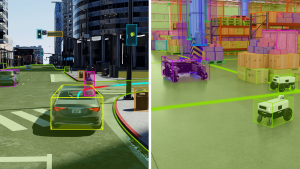
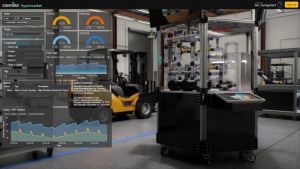
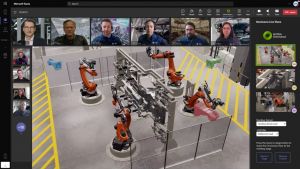
NVIDIA Omniverse is a scalable, multi-GPU real-time 3D graphics collaboration and simulation platform developed by NVIDIA for building and operating industrial digital twins and physical AI applications.[1] It is a modular development platform of SDKs, APIs, and microservices for building 3D applications and services powered by Universal Scene Description (OpenUSD) and NVIDIA RTX rendering technologies.[2] The platform enables designers, artists, and engineers to work together in a shared virtual space to create and simulate complex 3D scenes and worlds in real time, with high fidelity and physical accuracy.[3]
Initially positioned as a foundational tool for building the metaverse, Omniverse has since pivoted to focus on high-value enterprise and industrial applications, such as creating digital twins of factories and data centers, generating synthetic data for AI training, and simulating robotics and autonomous systems.[4] Since 2024 NVIDIA has rebranded Omniverse as an "operating system for physical ai," combining the platform with the nvidia cosmos world foundation models, the isaac gr00t humanoid robot foundation model, and an expanding library of Omniverse Blueprints to give industrial customers a unified stack for simulating robots, factories, and AI data centers.[5][6]
By August 2025 NVIDIA reported that Omniverse had surpassed 300,000 downloads and was being used by more than 252 companies, and NVIDIA CEO Jensen Huang has framed the platform as the operating system for a "$50 trillion" physical AI and industrial-digitalization opportunity spanning the world's manufacturing and logistics industries.[4][72][73] Rev Lebaredian, NVIDIA's vice president for Omniverse and simulation technology, describes it as "an operating system that connects the world's physical data to the realm of physical AI."[5]
History
When was NVIDIA Omniverse released? (2019-2020)
NVIDIA first unveiled Omniverse on March 18, 2019, at the GPU Technology Conference (GTC) 2019 in San Jose, California. CEO Jensen Huang introduced the platform as an "open collaboration platform" for real-time graphics and studio workflows, demonstrating live collaboration between Autodesk Maya, Adobe Substance 3D Painter, and Unreal Engine.[7]
Following the announcement, NVIDIA conducted an 18-month "lighthouse program" of closed testing with over 40 companies including Industrial Light & Magic, Ericsson, and Foster + Partners. On May 14, 2020, NVIDIA launched an early access program targeting the architecture, engineering, and construction (AEC) market, showcasing connections to Autodesk Revit, McNeel Rhino, and Trimble SketchUp.[8]
NVIDIA officially announced Omniverse's open beta phase on October 5, 2020, at its GPU Technology Conference.[3] The open beta became publicly available for download in December 2020, including the first Omniverse applications such as Omniverse View for visualization and Omniverse Create for scene composition. NVIDIA also announced that additional applications, such as Omniverse Audio2Face and Omniverse Machinima, would be released in early 2021.[9]
Enterprise launch and expansion (2021-2022)
NVIDIA announced Omniverse Enterprise on April 12, 2021, at GTC 2021. By this time, nearly 17,000 users had downloaded the open beta.[10] Early enterprise adopters included BMW Group, which became the first car manufacturer to create a digital twin of an entire factory, along with Foster + Partners, WPP, Ericsson, and Activision.
In August 2021, at the SIGGRAPH conference, NVIDIA announced an expansion of Omniverse's capabilities and ecosystem, including new integrations with Blender and Adobe Substance 3D.[11] By that time, over 50,000 individual creators had downloaded the Omniverse open beta, and professionals at more than 500 companies were actively evaluating the platform.
On November 9, 2021, NVIDIA launched Omniverse Enterprise, a paid subscription version of the platform aimed at businesses and professional teams, with pricing starting at $9,000 per year for subscription packages.[12]
In January 2022, at CES, NVIDIA announced that Omniverse was moving out of beta and would be available for free to millions of individual creators with compatible GeForce RTX and NVIDIA RTX GPUs.[13] By early 2022, the Omniverse user base had grown to over 100,000 creators.
At GTC March 2022, NVIDIA introduced the OVX computing system, a data-center-scale design for running large-scale Omniverse digital twins, with a server template based on dual CPUs and eight NVIDIA A40 GPUs, scalable into OVX SuperPODs of 32 servers connected by NVIDIA Spectrum-3 switch fabric.[14] A second generation introduced at Computex 2022 added the L40 GPU on the Ada Lovelace architecture, and a third generation expanded networking via ConnectX-7 SmartNICs and BlueField-3 data processing units.[15]
Strategic pivot to industrial digitalization (2022-2024)
While the underlying technology remained consistent, Omniverse's messaging shifted decisively away from the general-purpose "metaverse" towards concrete, high-value industrial applications. This shift focused on "physical AI," "industrial digitalization," and the concept of "AI factories."[4]
In mid-2022, NVIDIA and Siemens announced a partnership to connect Omniverse with the Siemens Xcelerator portfolio for industrial automation, enabling live digital twins of industrial facilities.[16]
On August 1, 2023, Pixar, Adobe, Apple, Autodesk, and NVIDIA jointly formed the Alliance for OpenUSD (AOUSD), hosted by the Joint Development Foundation, to promote the standardization and development of USD technology for 3D ecosystems.[17] Additional members later joined, including Cesium, Epic Games, Foundry, hexagon, IKEA, SideFX, and Unity, and the alliance opened a liaison with the Khronos Group to align OpenUSD with glTF.[18]
At CES 2024 NVIDIA introduced production microservices for the Avatar Cloud Engine (ACE), which lets developers wire together Audio2Face, Riva speech models, and NeMo language models inside Omniverse to drive interactive digital humans.[19] At GTC 2024 in March, NVIDIA opened Omniverse Cloud APIs and demonstrated streaming a fully interactive vehicle digital twin into the Apple Vision Pro headset through NVIDIA's Graphics Delivery Network, signalling closer alignment with Apple's spatial computing platform.[20]
The NVIDIA Omniverse Launcher was officially deprecated on October 1, 2025, transitioning the platform to direct distribution of components via GitHub, the NGC catalog, vendor web pages, and the NVIDIA Documentation Hub. The Launcher application continues to run after deprecation, but installers and the Exchange are no longer available, and the Nucleus Workstation package can no longer be reinstalled.[21]
How does NVIDIA Omniverse work? Core architecture and technologies
NVIDIA Omniverse is a multi-layered platform built on several core technologies that enable its collaborative and simulation capabilities. Its architecture is modular, allowing developers to use its components to build custom tools and workflows.
What is OpenUSD and why does Omniverse use it?
The entire Omniverse platform is built on Universal Scene Description (OpenUSD), an open and extensible framework for describing, composing, simulating, and collaborating within 3D worlds.[1] OpenUSD is more than a file format; it is a scene description system with a rich set of data structures and APIs.[22]
OpenUSD organizes 3D data into a hierarchical namespace of primitives known as prims, which are the fundamental building blocks of a scene. The framework's power lies in its system of non-destructive editing through layers. Different artists or processes can work on separate layers, which are then combined through a set of rules called Composition Arcs (such as sublayers, references, and variants). The final, resolved view of all these combined layers is called a stage.[22]
A feature of OpenUSD is its extensibility via custom schemas, which let developers define new data types and properties, extending the framework to represent domain-specific information beyond standard geometry and materials. NVIDIA has been a major contributor to this ecosystem, developing schemas for physics (in collaboration with Pixar and Apple), geospatial coordinates, and international character support.[23]
Omniverse Nucleus: the collaboration engine
At the heart of Omniverse's collaborative capabilities is Omniverse Nucleus, which functions as the platform's database and real-time collaboration engine.[24] Nucleus manages the storage and exchange of USD assets and scenes, enabling the platform's signature live-sync feature, known as OmniLive.[24]
Nucleus operates on a publish-subscribe model. When a user makes a change to a USD scene in a connected application, that application "publishes" the modification to the Nucleus server. Nucleus then transmits this change to all other "subscribed" applications and users who are viewing the same scene, ensuring that everyone sees the updates in real-time.[24]
Architecturally, Nucleus is composed of a set of services, including:
-
Nucleus Core, the central service for storing and retrieving file data
-
Discovery Service, which allows other services and clients to find and connect to Nucleus
-
Authentication and User Management, which handles user access, permissions using Access Control Lists (ACLs), and supports SSO
-
Version Control, which automatically versions files through a system of "checkpoints," preserving change history
-
Nucleus Navigator, a web-based interface for browsing and managing assets stored in Nucleus
Rendering technologies: the RTX renderer
Omniverse leverages NVIDIA's real-time graphics work with the NVIDIA Omniverse RTX Renderer, a scalable, physically-based renderer built specifically for NVIDIA RTX GPUs.[25] The renderer offers two primary, path-tracing-based modes:
-
RTX Real-Time 2.0: physically-based path tracing combined with AI-powered DLSS upscaling, enabling real-time frame rates
-
RTX Interactive (Path Tracing): a mode designed for maximum visual accuracy, more closely simulating the real-world behavior of light, materials, and optics
The RTX Renderer supports multi-GPU configurations for near-linear performance scaling, streaming of large-scale geometry and textures to manage memory usage, and physically-based materials defined using Material Definition Language (MDL) or the USD Preview Surface standard.[25]
Simulation engines
A core capability of Omniverse is high-fidelity, physically accurate simulation, powered by a suite of integrated NVIDIA physics engines:[26]
-
PhysX 5, the primary multi-physics engine within Omniverse, providing rigid and soft body dynamics, vehicle physics, cloth simulation, and character control
-
NVIDIA Flow, a sparse voxel fluid simulation library optimized for real-time performance, used to create realistic fire, smoke, and combustible fluid effects
-
NVIDIA Blast, a destruction and fracture library used for creating destructible assets and environments
In 2025 NVIDIA, google deepmind, and Disney Research announced Newton, an open-source, GPU-accelerated physics engine for robotics, built on NVIDIA Warp and OpenUSD and managed by the Linux Foundation starting September 29, 2025. Newton is purpose-built for contact-rich tasks such as walking on rough terrain or manipulating delicate objects, and ships as a beta inside NVIDIA Isaac Lab while also interoperating with the MuJoCo Playground learning framework.[27][28]
The tight integration of these simulation engines is fundamental to Omniverse's role in physical AI development, enabling the generation of large amounts of high-quality, perfectly labeled synthetic data for training AI models.[26]
Omniverse Kit SDK and APIs
Omniverse is an extensible development platform, with the Omniverse Kit SDK serving as its foundational framework.[29] This SDK allows developers to build their own Omniverse-native applications, extensions, and microservices using Python and C++. All of NVIDIA's own Omniverse applications are built as collections of extensions running on the Kit SDK.[29]
Recent Kit SDK milestones include version 106.0 (July 2024), which dramatically reduced extension dependencies and shipped the lightweight Kit Base Editor; version 106.5 (December 2024), which added USDz export from the File menu and updated the Kit App Template flow; and version 107.0 (March 2025), which brought Fabric Scene Delegate support for omni.replicator.core, UTF-8 prim renaming, a dedicated NVCF Streaming configuration for Omniverse Cloud, and a C++ with Python Bindings extension template.[30]
| API | Function |
|---|---|
| USD Search API | For locating and organizing 3D data across projects |
| USD Code API | For scripting and automating USD content creation and pipeline tasks |
| Kit App Streaming API | For streaming interactive, GPU-accelerated Omniverse applications to web browsers |
| Omniverse Cloud Sensor RTX | For rendering camera, lidar, and radar sensor data at scale for autonomous machines[31] |
Platform ecosystem
NVIDIA Omniverse applications
NVIDIA provides several reference applications built on the Omniverse Kit SDK, each tailored for specific workflows:
-
Omniverse USD Composer (formerly Omniverse Create), the primary application for world-building, scene assembly, and lighting. It serves as a central hub where users can aggregate USD assets from various sources and compose complex scenes.[9]
-
Omniverse USD Explorer (formerly Omniverse View), a lightweight application designed for non-technical users to visualize, review, and collaborate on 3D projects. It includes specialized viewing modes for VR and AR devices.[9]
-
Omniverse Machinima, an application for creating animated films and cinematic sequences, providing tools for manipulating characters, cameras, and environments to produce animated content.[32]
-
Omniverse Audio2Face, an AI-powered application that generates realistic facial animation from an audio file. The underlying neural network analyzes the audio input's acoustic features (phonemes and intonation) to generate accurate lip-sync and corresponding emotional expressions. On September 24, 2025 NVIDIA released the Audio2Face models, SDK, training framework, and Maya and Unreal Engine 5 plug-ins under an MIT open-source license, with regression (v2.2) and diffusion (v3.0) lip-sync models plus Audio2Emotion v2.2 and v3.0 models.[33]
-
nvidia isaac sim, an Omniverse-based application for robotics simulation, providing a virtual laboratory to develop and test robots using realistic physics and sensors. Built on Omniverse, it benefits from photorealistic rendering and accurate physics to model how robots perceive and interact with the environment.[34]
-
NVIDIA Drive Sim, an automotive simulator built on Omniverse for developing and testing autonomous vehicle systems. Drive Sim creates virtual environments including roads, traffic scenarios, weather conditions, and sensor models, enabling car makers and researchers to validate self-driving algorithms safely in simulation.[35]
Third-party connectors
A strength of the Omniverse ecosystem is its interoperability with industry-standard Digital Content Creation (DCC) tools through Omniverse Connectors, plugins that enable a live, bidirectional link between third-party applications and the Omniverse Nucleus server.[36] At GTC 2024 NVIDIA reported that connections through the extended Omniverse ecosystem had grown roughly 10x in one year, reaching 82 connections.[37]
| Category | Applications | Developer |
|---|---|---|
| 3D Modeling/Animation | Autodesk 3ds Max, Autodesk Maya, Blender, SideFX Houdini | Autodesk, Blender Foundation, SideFX |
| CAD | Autodesk Alias, Autodesk Revit, PTC Creo, Rhino, SketchUp | Autodesk, PTC, McNeel, Trimble |
| Game Engines | Unreal Engine, Unity | Epic Games, Unity Technologies |
| Industrial Software | Siemens Teamcenter, NX, Process Simulate | Siemens |
| Geospatial | Cesium, Esri ArcGIS CityEngine | Cesium, Esri |
What is NVIDIA Omniverse used for? Applications and use cases
Omniverse is being applied across many industries that work with 3D content:
Industrial digital twins
This is the platform's primary and most impactful application. Companies use Omniverse to build and operate physically accurate, real-time virtual replicas of their physical assets and environments.[2]
BMW Group has deployed Omniverse across 31 factories, achieving:
-
30% increase in efficiency from optimized planning processes
-
Digital twins spanning over 1 million square meters
-
Virtual factory design and testing two years before physical construction, saving significant time and resources[38]
Jensen Huang participated in a virtual factory opening with BMW at a GTC keynote, with the Debrecen, Hungary plant achieving "virtual start of production" more than two years before its scheduled 2025 opening, where it produces the Neue Klasse all-electric models at a planned rate of about 150,000 cars per year. BMW Group's FactoryExplorer application, built on the Omniverse Kit SDK and OpenUSD, allows planners to collaborate in real time and is projected to deliver up to 30% savings from optimized factory planning and reduce change orders.[38][39]
Amazon Robotics has used Omniverse Enterprise to build AI-enabled digital twins of warehouses to optimize warehouse design and train robotic systems.[40]
foxconn uses physically accurate digital twins integrating Omniverse libraries and OpenUSD to design, deploy, and manage complex production facilities, including those producing NVIDIA GB200 Grace Blackwell Superchip systems. Foxconn's FODT platform uses standardized USD assets so that production lines can be migrated and duplicated between global sites, accelerating factory bring-up.[41]
Mercedes-Benz is using Omniverse for its "Digital First" production strategy, with the Kecskemét plant in Hungary becoming the first to receive a full factory digital twin. Mercedes-Benz reports reducing supplier coordination processes by 50% and doubling the speed of converting or constructing an assembly hall while using Omniverse Blueprints to simulate apptronik Apollo humanoid robots for vehicle assembly tasks.[42][43]
Architecture, engineering, and construction
Foster + Partners implemented Omniverse Enterprise to enable collaborative design and visualization among teams across 14 countries.[44]
Woods Bagot, an early Omniverse adopter, integrated the platform into design pipelines for real-time collaboration across applications and explored hybrid-cloud workflows for complex building models.[45]
Telecommunications and smart cities
Ericsson collaborated with NVIDIA to use Omniverse for simulating 5G radio signal propagation in urban settings. By importing 3D city models into Omniverse and using the platform's physics and ray tracing, engineers can visualize how radio waves from proposed cell towers would bounce off structures or be obstructed, allowing them to find optimal sites for antennas and predict coverage and signal quality.[46]
Robotics and automation
Omniverse is the foundation for NVIDIA's robotics simulation platforms, including nvidia isaac sim and Isaac Lab. These tools allow robotics engineers to train, test, and validate robots in realistic, physics-based virtual environments. Companies working on autonomous mobile robots, drones, and warehouse automation use Omniverse to test their systems safely in simulation, iterating faster than would be possible using physical prototypes alone.[34]
Media and entertainment
In film and animation, Omniverse is used to streamline visual effects and animation workflows. Industrial Light & Magic (ILM) has tested Omniverse to connect its internal and external pipelines, allowing artists at different locations using different tools to collaborate on the same scene in real time. ILM reported that Omniverse's real-time RTX rendering could allow them to render final-quality VFX shots interactively.[47]
Earth science and aerospace
In collaboration with Lockheed Martin, NVIDIA used Omniverse Nucleus to build an AI-driven Earth Observations Digital Twin for the National Oceanic and Atmospheric Administration. The twin ingests current satellite and ground-based observations through Lockheed Martin's OpenRosetta3D platform, converts the data into USD, and renders it through the Agatha visualization environment, with sea surface temperature as the first variable to be integrated.[48]
2025-2026 developments
The 2025-2026 period was decisive for NVIDIA's repositioning of Omniverse as the operating system for physical AI, with announcements concentrated around CES 2025, GTC 2025, Computex 2025, and GTC 2026.
NVIDIA Cosmos world foundation models
On January 6, 2025, at CES, nvidia cosmos was announced as a platform of generative world foundation models (WFMs), advanced tokenizers, guardrails, and a video curation pipeline aimed at physical AI development.[49] The accompanying research paper, "Cosmos World Foundation Model Platform for Physical AI," was posted to arXiv on January 7, 2025 (arXiv:2501.03575). The paper describes a dataset of 20 million hours of video (approximately 2.5 billion clips, around 45 PB in raw form, equivalent to roughly 9 quadrillion tokens) and a tokenizer that achieves spatial compression rates of 8x or 16x and temporal compression of 4x or 8x, for a total compression factor up to 2048x while running up to 12x faster than competing state-of-the-art tokenizers.[50] The initial Cosmos family included an autoregressive 5B-parameter model and a 7B-parameter diffusion model, released under an open model license through Hugging Face, the NVIDIA NGC catalog, and the NVIDIA API catalog, with early adopters including 1X, Agile Robots, Agility Robotics, Figure AI, Foretellix, Uber, Waabi, and XPENG.[49]
Cosmos expanded across 2025 into three product lines:
-
Cosmos Predict, which generates physics-aware video futures of a scene given text, image, video, or motion inputs. Cosmos Predict 2.5, released on October 6, 2025, unified the earlier Text2World, Image2World, and Video2World models into a single architecture capable of generating up to 30-second sequences and delivering up to 10x higher accuracy after post-training on proprietary data.[51]
-
Cosmos Transfer, a world-to-world transfer model that bridges simulated and real-world data. Cosmos Transfer 2.5 (October 2025) is a multi-ControlNet that accepts structured inputs across modalities including RGB, depth, and segmentation, enabling photorealistic simulation under diverse environments and lighting.[51]
-
Cosmos Reason, an open reasoning vision language model for embodied decision-making. The first version, Cosmos Reason 1, was unveiled at GTC 2025. Cosmos Reason 2, released in December 2025 with 2B and 8B parameter checkpoints on Hugging Face, topped the Physical Reasoning leaderboard and added long chain-of-thought reasoning for spatiotemporal understanding, object localization, and motion prediction.[52][53]
Isaac GR00T humanoid robot foundation model
On March 18, 2025, at GTC 2025, NVIDIA announced isaac gr00t N1, billed as the world's first open, fully customizable foundation model for generalized humanoid reasoning and skills.[54] GR00T N1 follows a dual-system architecture inspired by human cognition: a "System 2" vision-language module interprets the environment and plans actions, and a "System 1" diffusion-transformer policy generates fluid motor actions in real time, with the two modules jointly trained end-to-end.[55] The model was trained on a mixture of real-robot trajectories, internet-scale human videos, and synthetic data, with 780,000 synthetic trajectories (the equivalent of roughly 6,500 hours of human demonstrations) generated in 11 hours using the NVIDIA Isaac GR00T Blueprint; combining synthetic and real data improved performance by about 40% over real-data-only training.[54]
GR00T N1.5, released on June 11, 2025, was the first update, employing an NVIDIA Eagle vision-language model (2.1B parameters) frozen during pretraining and finetuning, a simplified adapter MLP with layer normalization, and a FLARE (Future LAtent Representation Alignment) loss alongside flow matching. The model was trained for 250,000 steps on 1,024 H100 GPUs with a global batch size of 16,384. Reported gains include a jump from 52.8% to 93.2% on the Language Table benchmark, 46.6% to 93.3% on Real GR-1 language-following, and 44.0% to 98.8% on the Unitree G1 task suite.[56] GR00T N1.6, announced in late 2025 and posted to Hugging Face, integrates Cosmos Reason as the "deep-thinking brain" that turns vague instructions into step-by-step plans grounded in physics and common sense.[57]
Early access partners for GR00T include 1X Technologies, Agility Robotics, boston dynamics, Mentee Robotics, and NEURA Robotics. NVIDIA's Project GR00T integration is also being used with the apptronik Apollo humanoid, which Mercedes-Benz is piloting for parts handling on automotive assembly lines.[54][43]
Mega and other Omniverse Blueprints
Also announced at CES 2025, the Mega Omniverse Blueprint provides a framework for testing multi-robot fleets at scale in industrial digital twins.[58] Mega uses the Omniverse Cloud Sensor RTX APIs to render camera, lidar, and other sensor data for every robot in the facility simultaneously, then drives a world simulator that coordinates the robots and exchanges synthetic data with nvidia isaac sim and Isaac ROS in a software-in-the-loop pipeline.[58] KION Group was the first adopter, working with Accenture to optimize warehouse operations for retail, consumer packaged goods, and parcel services. KION CEO Rob Smith described the project as reinventing warehouse automation by combining NVIDIA's AI leadership with Accenture's digital integration capabilities, while Accenture integrated Mega into its AI Refinery for Simulation and Robotics.[58]
The Omniverse Blueprint catalog expanded throughout 2025 to include:
-
Mega, for multi-robot fleet testing
-
AI Factory Digital Twins, for data center design and simulation
-
Isaac GR00T Blueprint, for synthetic manipulation motion generation
-
Video Search and Summarization, powered by NVIDIA Metropolis, for AI agents that monitor facility activity[6]
Vera Rubin DSX AI Factory and the Omniverse DSX Blueprint
At GTC 2026 on March 16, 2026, NVIDIA released the Vera Rubin DSX AI Factory reference design alongside the general availability of the Omniverse DSX Blueprint for designing and operating large-scale AI factories.[59] The reference design covers a full stack of compute, networking, and storage for NVIDIA's next-generation Vera Rubin CPU-GPU racks together with software libraries DSX Max-Q (optimizing performance within power limits), DSX Flex (grid services), DSX Exchange (system signals), and DSX Sim (digital-twin validation). The Omniverse DSX Blueprint, available on build.nvidia.com, allows operators to model entire AI factories virtually, simulating power distribution, thermal behavior, networking, and operational policies before construction begins.[59] Industry partners contributing to the design include Cadence, Dassault Systèmes, Eaton, Jacobs, NScale, Phaidra, Procore Technologies, PTC, Schneider Electric, Siemens, Switch, Trane Technologies, and Vertiv, with energy partners Emerald AI, GE Vernova, Hitachi, and Siemens Energy.[59]
Industrial expansion: GTC 2025 and beyond
At GTC 2025 NVIDIA framed Omniverse as the "physical AI operating system" and announced wide-ranging industry expansion. Software and service providers Accenture, Ansys, Cadence, Databricks, Dematic, hexagon, Omron, SAP, Schneider Electric (with ETAP), and Siemens are integrating Omniverse data interoperability and visualization into their solutions. New manufacturing adopters announced at GTC 2025 included foxconn, General Motors, Hyundai Motor Group, KION Group, Mercedes-Benz, Pegatron, Schaeffler, and Unilever.[6] Rev Lebaredian, NVIDIA's vice president for Omniverse and simulation technology, described the platform as "an operating system that connects the world's physical data to the realm of physical AI."[6]
Specific GTC 2025 collaborations included Schaeffler and Accenture using Mega to test apptronik Apollo humanoids for material handling, Hyundai Motor Group simulating boston dynamics Atlas robots on assembly lines, Mercedes-Benz optimizing assembly with Apollo, Foxconn testing humanoids and manipulators for next-generation factories producing Blackwell systems, and Pegatron developing video analytics agents for factory operations.[6] Toyota uses idealworks' iw.sim, which incorporates tools from the Mega Omniverse Blueprint, to build a digital twin of its Georgetown, Kentucky plant. Caterpillar and Lucid Motors are also among GTC 2025 announced adopters.[60]
On June 11, 2025, at NVIDIA GTC Paris during VivaTech, siemens and NVIDIA expanded their partnership, integrating Omniverse libraries into Siemens Xcelerator and optimizing the Siemens Industrial Copilot for Operations to run on NVIDIA RTX PRO 6000 Blackwell Server Edition GPUs on premises. The companies reported that the Copilot, paired with NeMo microservices and AI Blueprints for video search and summarization, cuts reactive maintenance time by 30%. The expanded partnership also covers the Teamcenter Digital Reality Viewer, which brings real-time ray tracing to product lifecycle management visualization, and includes HD Hyundai cutting hydrogen and ammonia vessel design iterations from days to hours and BMW achieving a reported 30x speedup for aerodynamics simulations using Simcenter Star-CCM+ on Blackwell GPUs.[61]
In August 2025 Ansys signed an agreement with NVIDIA to license, sell, and support Omniverse technology embedded inside Ansys simulation tools, beginning with CFD and autonomous solutions, with the aim of accelerating digital twin and physical AI workflows.[62] Synopsys completed its acquisition of Ansys in July 2025, so the agreement now sits within the Synopsys organization.[62]
Isaac Sim 5.0 and Isaac Lab 2.2
At Computex 2025 NVIDIA announced nvidia isaac sim 5.0 and Isaac Lab 2.2 as fully open and customizable releases under an Apache 2.0 license, available on GitHub with Q2 2025 availability. Isaac Sim 5.0 added neural reconstruction and rendering, advanced synthetic data generation pipelines including MobilityGen for mobile robots, quadrupeds, and humanoids, new robot models, and improved sensor simulation with an OmniSensor USD schema. Isaac Lab 2.2 added benchmarking scripts for GR00T N1 models, synthetic motion data generation with GR00T-Mimic, and improved suction-cup gripper modeling.[63][64] In September 2025 NVIDIA published the Isaac Lab research paper "Isaac Lab: A GPU-Accelerated Simulation Framework for Multi-Modal Robot Learning," detailing batched rendering, actuator and domain randomization managers, and demonstration-collection pipelines.[65]
Reindustrialization push and government
At GTC Washington, D.C. in October 2025, NVIDIA highlighted U.S. manufacturing and robotics leaders, including Belden, apptronik, Amazon Robotics, boston dynamics, Caterpillar, Figure, foxconn, Lucid Motors, Skild AI, Toyota, TSMC, and Wistron, building Omniverse factory digital twins as part of an "America's reindustrialization with physical AI" initiative.[60] At the same event NVIDIA introduced the OpenUSD Asset Structure Pipeline for Robotics with Disney Research and Intrinsic (an Alphabet company), providing a common language across robotics data sources.[60]
GTC 2026 demonstrations
At GTC 2026 NVIDIA expanded its industrial ISV collaboration with Cadence, Dassault Systèmes, PTC, Siemens, and Synopsys to bring NVIDIA CUDA-X, Omniverse, and GPU-accelerated tools to manufacturing customers including FANUC, HD Hyundai, Honda, JLR, KION, Mercedes-Benz, MediaTek, PepsiCo, Samsung, SK hynix, and TSMC.[66] Industrial robot makers FANUC, ABB Robotics, YASKAWA, and KUKA announced they would integrate Omniverse libraries and Isaac Sim into their virtual commissioning workflows for robot applications and production validation.[66] In a stage demonstration, Disney Research showed Olaf from "Frozen" as a physical robot trained entirely in NVIDIA Omniverse using the Newton physics solver, walking onstage and holding a conversation with Huang.[66] In his keynote Huang stated that AI infrastructure orders for Blackwell and Vera Rubin systems through 2027 would reach roughly $1 trillion, underscoring the scale at which Omniverse-based digital twins are being applied to data-center construction.[67]
SIGGRAPH 2026: Omniverse libraries and the NVIDIA Agent Toolkit
At SIGGRAPH 2026 in Los Angeles on July 20, 2026, NVIDIA extended the Omniverse-libraries story into agentic territory, announcing that it had folded a set of new Omniverse libraries into the NVIDIA Agent Toolkit so that AI agents can build, inspect, and prepare "simulation-ready" (SimReady) 3D worlds.[74] NVIDIA describes the Omniverse libraries as a collection of software components that give agents tools and skills to add physical AI capabilities to existing applications and to prepare 3D content for simulation. Where earlier Omniverse libraries and Blueprints were wired into applications by developers, the SIGGRAPH release exposes simulation capabilities as callable tools and skills that an agentic AI system can use in a host application's workflow.[74][75]
Three components anchored the announcement:
-
ovrtx is a C and Python library for embedding Omniverse RTX sensor simulation and visualization in an application. It loads OpenUSD scenes and can generate camera, lidar, radar, and other sensor outputs while leaving the host application in control. NVIDIA's repository labels ovrtx prerelease software, lists Windows and Linux packages, and requires a compatible NVIDIA RTX GPU and driver.[76][78]
-
ovphysx is a self-contained USD physics library with a C API and Python bindings. It wraps PhysX, can load and simulate USD scenes without an Omniverse Kit installation, exchanges simulation state through DLPack tensors, and supports CPU-only operation as well as NVIDIA GPU acceleration. The repository lists ovphysx 0.5.9 with PhysX 5.10.0 and calls it prerelease and not yet mature, with APIs that may change before 1.0.[79]
-
CAD-to-SimReady is an NVIDIA-verified agent skill that coordinates conversion, material and physics assignment, SimReady conformance, validation, and optional packaging. It is an orchestration guide rather than one monolithic converter. Conversion-only can run without Content Agents, while property-assignment stages require additional services and, for a managed local deployment, Docker, NVIDIA Container Toolkit, an NVIDIA GPU, and NVIDIA credentials.[74][80]
Public Omniverse skill catalog
NVIDIA had announced a broader collection of physical-AI agent skills on May 31, 2026, describing skills as repeatable instructions that tell coding agents which tools to call, which outputs to produce, and how to validate the result.[87] At the repository snapshot pinned to commit 20bb6aa, the NVIDIA/skills tree contained exactly three top-level skill directories with the omniverse- prefix: CAD-to-SimReady, Realtime Viewer, and USD Performance Tuning. NVIDIA's August 18 video presented the same set as three Omniverse skills.[89][92]
- CAD-to-SimReady remains the asset-conversion and enrichment workflow described above.[80]
- Realtime Viewer, version 0.1.0, is an Apache-2.0 orchestration package for building local, native, or browser-streamed USD viewers. It requires ovrtx for rendering and routes an agent through scene loading, camera and selection behavior, user-interface construction, streaming or local delivery, and validation. Runtime needs vary by route and can include an NVIDIA GPU, ovstream, OpenUSD, Python, web or desktop frameworks, and cloud access.[76][90]
- USD Performance Tuning, version 0.1.0 and Apache-2.0, routes diagnosis and optimization work through runtime preflight, baseline profiling, structure assessment, validation, guarded mutation, post-change profiling, and a report. Its instructions prohibit invented performance gains and require review gates for some lossy changes.[91]
These are versioned instruction and reference bundles, not hosted Omniverse services or guarantees that an agent will produce a safe, correct, or faster application. NVIDIA's verification process catalogs, scans, evaluates, signs, and documents the skill artifacts; those controls establish provenance for the bundle rather than independent validation of every downstream result.[88][89] The video's description expressly labels it informational and not an official product or company announcement.[92]
Public GitHub availability does not give the three components a single license or maturity level. ovrtx uses NVIDIA software and product-specific terms and is not open to external contributions. The ovphysx source is BSD-3-Clause, but its prebuilt SDK packages and Python wheels use the NVIDIA Omniverse License. The CAD-to-SimReady skill identifies Apache-2.0 in its metadata.[78][79][80]
The libraries can be exposed to agents through the Agent Toolkit, but NVIDIA's local stack comprises several distinct layers. At SIGGRAPH, NVIDIA described a DGX Station setup that combined the Agent Toolkit, Omniverse libraries as agent-accessible tools, NVIDIA NemoClaw, Nemotron 3 Ultra, and NVIDIA OpenShell.[75] NemoClaw is an open-source reference stack for running supported agents inside OpenShell sandboxes; OpenShell is the separate policy-controlled runtime. OpenShell's repository described it as alpha, single-player software at the time of the announcement.[82][83]
The flagship demonstration was "SimReady" Blender, a sample workflow built with the libraries and NemoClaw. NVIDIA released the integration code as a public blueprint, but the repository narrows its scope: it is a Blender 5.1 example for supported RTX workstations, not a supported production renderer or a substitute for every Cycles, EEVEE, or Blender feature. Its OVPhysX path is a focused check for supported SimReady rigid-body props, not a general Blender physics replacement, robot-authoring environment, or full Isaac Sim workflow.[74][81]
NVIDIA said the demonstration previewed local operation from systems with RTX Spark to GB300-based NVIDIA DGX Station. Those endpoints did not have the same availability on July 20: RTX Spark systems were scheduled for fall 2026, while DGX Station systems were available to order. The claim demonstrates a planned range of local configurations, not equal support or performance for every model, library, and workflow on every RTX system.[74][77]
Partner statements also describe different stages of adoption. SideFX said it was exploring how ovrtx and ovphysx could support Houdini workflows.[84] PTC's Onshape team reported early results while exploring ovrtx and directed interested users to its Onshape Labs early-access program, rather than announcing a production Onshape release.[85] NVIDIA said Palatial was using CAD-to-SimReady skills at scale and said Lightwheel was using Omniverse Content Agents in SimReadyGen; Lightwheel's own launch page confirms that Content Agents integration for material assignment, physics classification, texture generation, and validation.[74][86] NVIDIA described ForgeCAD and Moonlake AI as exploring agent-driven 3D workflows, not as production deployments.[74] NVIDIA framed the broader move as the next step in Omniverse's positioning as an operating system for physical AI, with CEO Jensen Huang saying that "the physical AI era will be built in simulation first."[74]
Competitive landscape
Assessing NVIDIA Omniverse's competitive position requires understanding that it is not designed to replace traditional 3D modeling software and game engines but rather to act as a foundational platform that unifies them.[68]
User sentiment data from platforms like G2 often shows that established tools such as Blender, Unity, and Autodesk Maya are rated more favorably on metrics like "meeting requirements" and "usability."[68] This reflects the fact that these applications are highly specialized and mature tools for specific tasks like modeling, animation, or game development.
| Competitor | Better at Meeting Requirements | More Usable | Better Support |
|---|---|---|---|
| Unity | |||
| Blender | |||
| Unreal Engine | |||
| Maya |
The more accurate view of Omniverse's competitive landscape places it in an emerging category of platforms for industrial simulation and collaboration. Its core value proposition is not in feature-for-feature parity with any single DCC tool, but in its ability to provide:
-
Data interoperability, through its native implementation of OpenUSD
-
Real-time collaboration, enabled by the Nucleus database engine
-
High-fidelity, physically accurate simulation, powered by the RTX renderer, the PhysX suite, and Newton
Omniverse's primary strength lies in its full-stack integration, combining the open standard of USD with NVIDIA's proprietary hardware (RTX GPUs, OVX systems, DGX systems) and AI software, creating a cohesive platform for industrial digitalization.
System requirements
Hardware requirements
| Component | Minimum | Recommended | Advanced/Professional |
|---|---|---|---|
| GPU | RTX-enabled GPU 10GB VRAM | RTX-enabled GPU 24GB VRAM | Multiple RTX GPUs 48GB VRAM each |
| CPU | 8 cores @ 3.5 GHz | 12 cores @ 4.0 GHz | 16+ cores @ 4.5+ GHz |
| RAM | 16 GB | 32 GB | 64 GB |
| Storage | 50 GB to 1 TB SSD (varies by application) | 1 TB NVMe SSD | 4+ TB NVMe SSD |
| Operating System | Windows 10/11, Ubuntu 20.04/22.04/24.04 | Windows 11, Ubuntu 24.04 | Windows 11 Pro, Ubuntu 24.04 LTS |
Supported GPU architectures include:
-
Turing (Compute Capability 7.5)
-
Ampere RTX (8.6)
-
Ada Lovelace (8.9)
-
nvidia blackwell (12.0)
The platform supports multi-GPU configurations with up to 16 GPUs.[69]
How much does NVIDIA Omniverse cost? Pricing and licensing
Is NVIDIA Omniverse free? Individual and free options
-
Omniverse for Individuals: Free for individual users (announced January 2022)
-
90-day Enterprise Trial: Free evaluation with community support
-
Education Pricing: Free subscriptions for teaching and research institutions[13]
Enterprise licensing
As of 2025:
-
Omniverse Enterprise per-GPU subscription: $4,500 per GPU per year
-
Omniverse Enterprise Creator subscription: $2,000 per floating concurrent-user license per year (minimum two licenses)
-
Omniverse Enterprise Reviewer subscription: $100 per floating concurrent-user license per year (minimum ten licenses)
-
Omniverse Enterprise Nucleus subscription: $1,000 per named user per year
-
Licensing now bundles NVIDIA AI Enterprise access for on-premises and cloud deployments[70]
Partnerships and ecosystem
Major partners
| Category | Partners |
|---|---|
| Software | Adobe, Autodesk, Epic Games, Pixar, Bentley Systems, Trimble, Esri |
| Industrial | Siemens, Ansys, Cadence, Dassault Systèmes, hexagon, Rockwell Automation, PTC |
| Cloud Providers | AWS, Microsoft Azure, Google Cloud Platform, Oracle Cloud |
| Hardware | Dell Technologies, HP, Lenovo, Supermicro, ASUS, Cisco |
| Automotive | BMW, Mercedes-Benz, General Motors, Toyota, Hyundai, foxconn |
| Robotics | 1X Technologies, Agility Robotics, apptronik, boston dynamics, Figure, NEURA Robotics, Mentee Robotics, Skild AI |
In a key industrial partnership, Siemens became one of the first companies to integrate support for NVIDIA's Mega Omniverse Blueprint into its Xcelerator platform, allowing customers to build large-scale, high-fidelity factory digital twins that combine 3D models from Omniverse with live operational data from Siemens' industrial software.[16][61]
Market metrics
Key milestones and metrics:
-
50,000+ downloads by August 2021[11]
-
100,000+ creators by January 2022[13]
-
700+ companies using Omniverse (2022 to 2023)[71]
-
300,000+ individual downloads and 252+ companies actively using the platform reported by August 2025[72]
-
Ecosystem connections grew approximately 10x in one year to 82 by GTC 2024[37]
-
Target market: $50 trillion manufacturing and logistics industries, as framed by NVIDIA CEO Jensen Huang[4][73]
See also
-
Universal Scene Description
-
PhysX
-
Computer-aided design
-
3D computer graphics
-
Metaverse
-
Industry 4.0
References
- ^1 ^2NVIDIA, "Develop Physical AI Applications With NVIDIA Omniverse", NVIDIA, 2025. nvidia.com/...omniverse. Accessed 2026-05-24.
- ^1 ^2NVIDIA, "NVIDIA Omniverse Documentation", NVIDIA Docs, 2025. docs.nvidia.com/omniverse. Accessed 2026-05-24.
- ^1 ^2NVIDIA, "Omniverse Libraries", NVIDIA Developer, 2025. developer.nvidia.com/omniverse. Accessed 2026-05-24.
- ^1 ^2 ^3 ^4NVIDIA, "NVIDIA Launches Cosmos World Foundation Model Platform to Accelerate Physical AI Development", NVIDIA Newsroom, 2025-01-06. nvidianews.nvidia.com/...e-physical-ai-development. Accessed 2026-05-24.
- ^1 ^2Rev Lebaredian, "Omniverse is an operating system that connects the world's physical data to the realm of physical AI", in NVIDIA, "NVIDIA Omniverse Physical AI Operating System Expands to More Industries and Partners", NVIDIA Newsroom, 2025-03-18. nvidianews.nvidia.com/...e-industries-and-partners. Accessed 2026-05-24.
- ^1 ^2 ^3 ^4 ^5NVIDIA, "NVIDIA Omniverse Physical AI Operating System Expands to More Industries and Partners", NVIDIA Newsroom, 2025-03-18. nvidianews.nvidia.com/...e-industries-and-partners. Accessed 2026-05-24.
- ^NVIDIA, "NVIDIA Announces Omniverse Open Beta", NVIDIA Newsroom, 2020-10-05. nvidianews.nvidia.com/...unces-omniverse-open-beta. Accessed 2026-05-24.
- ^NVIDIA, "NVIDIA Omniverse Available for Early Access Customers", NVIDIA Technical Blog, 2020-05-15. developer.nvidia.com/blog. Accessed 2026-05-24.
- ^1 ^2 ^3NVIDIA, "Omniverse Reference Applications: USD Composer and USD Explorer", NVIDIA Developer, 2024. developer.nvidia.com/omniverse. Accessed 2026-05-24.
- ^NVIDIA, "NVIDIA Releases Omniverse Enterprise to Enable Global 3D Design Teams", NVIDIA Newsroom, 2021-04-12. nvidianews.nvidia.com/...verse-enterprise-gtc-2021. Accessed 2026-05-24.
- ^1 ^2NVIDIA, "NVIDIA Expands Omniverse Ecosystem at SIGGRAPH 2021", NVIDIA Newsroom, 2021-08-10. nvidianews.nvidia.com/...a-omniverse-siggraph-2021. Accessed 2026-05-24.
- ^NVIDIA, "NVIDIA Releases Omniverse Enterprise to Enable Designers and Engineers Worldwide to Collaborate in Virtual Worlds", NVIDIA Newsroom, 2021-11-09. nvidianews.nvidia.com/...e-enterprise-availability. Accessed 2026-05-24.
- ^1 ^2 ^3NVIDIA, "NVIDIA Makes Omniverse Available Free to Millions of Individual Creators", NVIDIA Newsroom, 2022-01-04. nvidianews.nvidia.com/...ns-of-individual-creators. Accessed 2026-05-24.
- ^NVIDIA, "NVIDIA Launches Data-Center-Scale Omniverse Computing System for Industrial Digital Twins", NVIDIA Newsroom, 2022-03-22. nvidianews.nvidia.com/...-industrial-digital-twins. Accessed 2026-05-24.
- ^NVIDIA, "Omniverse at Scale: NVIDIA Announces Third-Generation OVX Computing Systems", NVIDIA Blog, 2023-03-21. blogs.nvidia.com/...neration-ovx-computing-systems. Accessed 2026-05-24.
- ^1 ^2NVIDIA, "Siemens, NVIDIA to Enable Industrial Metaverse with Omniverse and Xcelerator", NVIDIA Newsroom, 2022-06-29. nvidianews.nvidia.com/...able-industrial-metaverse. Accessed 2026-05-24.
- ^Khronos Group, "Pixar, Adobe, Apple, Autodesk, and NVIDIA Form Alliance for OpenUSD to Drive Open Standards for 3D Content", The Khronos Group, 2023-08-01. khronos.org/...drive-open-standards-for-3d-content. Accessed 2026-05-24.
- ^NVIDIA, "NVIDIA Helps Forge Forum to Set OpenUSD Standard for 3D Worlds", NVIDIA Blog, 2023-08-01. blogs.nvidia.com/...openusd-alliance-3d-standard. Accessed 2026-05-24.
- ^NVIDIA, "NVIDIA and Developers Pioneer Lifelike Digital Characters for Games and Applications With NVIDIA Avatar Cloud Engine", NVIDIA Newsroom, 2024-01-08. nvidianews.nvidia.com/...loud-engine-microservices. Accessed 2026-05-24.
- ^NVIDIA, "NVIDIA Brings Omniverse-Powered Spatial Computing to Apple Vision Pro Through Omniverse Cloud APIs", NVIDIA Newsroom, 2024-03-18. nvidianews.nvidia.com/...mniverse-apple-vision-pro. Accessed 2026-05-24.
- ^NVIDIA, "NVIDIA Omniverse Launcher Deprecation on Oct 1st: What You Need to Know", NVIDIA Developer Forums, 2025-09. forums.developer.nvidia.com/...321325. Accessed 2026-05-24.
- ^1 ^2AOUSD, "Universal Scene Description Overview", Alliance for OpenUSD, 2024. aousd.org. Accessed 2026-05-24.
- ^NVIDIA, "USD Schemas and Extensions in Omniverse", NVIDIA Developer Documentation, 2024. docs.omniverse.nvidia.com/...schemas. Accessed 2026-05-24.
- ^1 ^2 ^3NVIDIA, "Omniverse Nucleus Documentation", NVIDIA Omniverse Docs, 2024. docs.omniverse.nvidia.com/...latest. Accessed 2026-05-24.
- ^1 ^2NVIDIA, "Omniverse RTX Renderer Documentation", NVIDIA Omniverse Docs, 2024. docs.omniverse.nvidia.com/...rtx-renderer. Accessed 2026-05-24.
- ^1 ^2NVIDIA, "PhysX 5 SDK Documentation", NVIDIA Developer, 2024. developer.nvidia.com/physx-sdk. Accessed 2026-05-24.
- ^NVIDIA, "Announcing Newton, an Open-Source Physics Engine for Robotics Simulation", NVIDIA Technical Blog, 2025-09-29. developer.nvidia.com/...ne-for-robotics-simulation. Accessed 2026-05-24.
- ^Linux Foundation, "Linux Foundation Announces Contribution of Newton by Disney Research, Google DeepMind and NVIDIA to Accelerate Open Robot Learning", The Linux Foundation, 2025-09-29. linuxfoundation.org/...elerate-open-robot-learning. Accessed 2026-05-24.
- ^1 ^2NVIDIA, "Omniverse Kit SDK Overview", NVIDIA Omniverse Docs, 2024. docs.omniverse.nvidia.com/...kit_overview. Accessed 2026-05-24.
- ^NVIDIA, "Omniverse Kit SDK Release Notes (106.0, 106.5, 107.0)", NVIDIA Omniverse Developer Guide, 2025-03. docs.omniverse.nvidia.com/...release-notes. Accessed 2026-05-24.
- ^NVIDIA, "NVIDIA Announces Omniverse Microservices to Supercharge Physical AI", NVIDIA Newsroom, 2024-06-17. nvidianews.nvidia.com/...microservices-physical-ai. Accessed 2026-05-24.
- ^NVIDIA, "Omniverse Machinima Overview", NVIDIA Omniverse Documentation, 2024. docs.omniverse.nvidia.com/...ext_machinima. Accessed 2026-05-24.
- ^NVIDIA, "NVIDIA Open Sources Audio2Face Animation Model", NVIDIA Technical Blog, 2025-09-24. developer.nvidia.com/...audio2face-animation-model. Accessed 2026-05-24.
- ^1 ^2NVIDIA, "Isaac Sim: Robotics Simulation and Synthetic Data Generation", NVIDIA Developer, 2025. developer.nvidia.com/...sim. Accessed 2026-05-24.
- ^NVIDIA, "NVIDIA DRIVE Sim Overview", NVIDIA Developer, 2024. developer.nvidia.com/...simulation. Accessed 2026-05-24.
- ^NVIDIA, "USD Connections Overview", NVIDIA Omniverse Documentation. docs.omniverse.nvidia.com/...latest. Accessed 2026-05-24.
- ^1 ^2NVIDIA, "NVIDIA Omniverse Ecosystem Expands 10x, Amid New Features and Services for Developers, Enterprises and Creators", NVIDIA Blog, 2024-03-18. blogs.nvidia.com/...omniverse-ecosystem-expands. Accessed 2026-05-24.
- ^1 ^2NVIDIA, "BMW Group Starts Global Rollout of NVIDIA Omniverse", NVIDIA Blog, 2023-03-21. blogs.nvidia.com/...bmw-group-nvidia-omniverse. Accessed 2026-05-24.
- ^BMW Group, "Revolution in factory planning: NVIDIA Omniverse enables virtual production in Plant Debrecen more than two years before actual series production is launched", BMW Group Press, 2023-03-21. press.bmwgroup.com/...T0411467EN. Accessed 2026-05-24.
- ^NVIDIA, "NVIDIA Announces Financial Results for First Quarter Fiscal 2023", NVIDIA Newsroom, 2022-05-25. nvidianews.nvidia.com/...first-quarter-fiscal-2023. Accessed 2026-05-24.
- ^NVIDIA, "Foxconn Develops Physical AI-Enabled Smart Factories with Digital Twins", NVIDIA Case Studies, 2025. nvidia.com/...d-smart-factories-with-digital-twins. Accessed 2026-05-24.
- ^NVIDIA, "Manufactured in the Metaverse: Mercedes-Benz Assembles Next-Gen Factories With NVIDIA Omniverse", NVIDIA Blog, 2024-10. blogs.nvidia.com/...z-next-gen-factories-omniverse. Accessed 2026-05-24.
- ^1 ^2NVIDIA, "Virtually Incredible: Mercedes-Benz Prepares Its Digital Production System for Next-Gen Platform With NVIDIA Omniverse, MB.OS and Generative AI", NVIDIA Blog, 2024. blogs.nvidia.com/...nvidia-omniverse-generative-ai. Accessed 2026-05-24.
- ^NVIDIA, "NVIDIA Launches Omniverse Design Collaboration and Simulation Platform for Enterprises", NVIDIA Newsroom, 2021-04-12. nvidianews.nvidia.com/...-platform-for-enterprises. Accessed 2026-05-24.
- ^NVIDIA, "Advancing Architectural Simulations and Real-Time Collaboration", NVIDIA Case Study. nvidia.com/...ulations-and-real-time-collaboration. Accessed 2026-05-24.
- ^NVIDIA, "Ericsson Builds Digital Twins for 5G Networks in NVIDIA Omniverse", NVIDIA Blog, 2021-11-09. blogs.nvidia.com/...ericsson-digital-twins-omniverse. Accessed 2026-05-24.
- ^Industrial Light & Magic, "ILM Tests NVIDIA Omniverse for Real-Time VFX Pipelines", NVIDIA Blog, 2021. blogs.nvidia.com/...ilm-omniverse. Accessed 2026-05-24.
- ^Lockheed Martin and NVIDIA, "Lockheed Martin, NVIDIA to Build Digital Twin of Current Global Weather Conditions for the National Oceanic and Atmospheric Administration", NVIDIA Newsroom, 2022-11-17. nvidianews.nvidia.com/...dia-digital-twin-for-noaa. Accessed 2026-05-24.
- ^1 ^2NVIDIA, "NVIDIA Makes Cosmos World Foundation Models Openly Available to Physical AI Developer Community", NVIDIA Blog, 2025-01-06. blogs.nvidia.com/...cosmos-world-foundation-models. Accessed 2026-05-24.
- ^NVIDIA, "Cosmos World Foundation Model Platform for Physical AI", arXiv:2501.03575, 2025-01-07. arxiv.org/...2501.03575. Accessed 2026-05-24.
- ^1 ^2NVIDIA, "Cosmos Predict 2.5 and Transfer 2.5: Evolving the World Foundation Models for Physical AI", Hugging Face blog, 2025-10-06. huggingface.co/...cosmos-predict-and-transfer2-5. Accessed 2026-05-24.
- ^NVIDIA, "Scale Synthetic Data and Physical AI Reasoning with NVIDIA Cosmos World Foundation Models", NVIDIA Technical Blog, 2025-03-18. developer.nvidia.com/...os-world-foundation-models. Accessed 2026-05-24.
- ^NVIDIA, "NVIDIA Cosmos Reason 2 Brings Advanced Reasoning To Physical AI", Hugging Face blog, 2025-12. huggingface.co/...ason-2-brings-advanced-reasoning. Accessed 2026-05-24.
- ^1 ^2 ^3NVIDIA, "NVIDIA Announces Isaac GR00T N1 the World's First Open Humanoid Robot Foundation Model and Simulation Frameworks to Speed Robot Development", NVIDIA Newsroom, 2025-03-18. nvidianews.nvidia.com/...del-simulation-frameworks. Accessed 2026-05-24.
- ^NVIDIA Research, "GR00T N1: An Open Foundation Model for Generalist Humanoid Robots", arXiv:2503.14734, 2025-03-18. arxiv.org/...2503.14734. Accessed 2026-05-24.
- ^NVIDIA Research, "GR00T N1.5", NVIDIA GEAR Lab, 2025-06-11. research.nvidia.com/...gr00t-n1_5. Accessed 2026-05-24.
- ^NVIDIA, "NVIDIA Releases New Physical AI Models as Global Partners Unveil Next-Generation Robots", NVIDIA Newsroom, 2026. nvidianews.nvidia.com/...il-next-generation-robots. Accessed 2026-05-24.
- ^1 ^2 ^3NVIDIA, "NVIDIA Unveils 'Mega' Omniverse Blueprint for Building Industrial Robot Fleet Digital Twins", NVIDIA Blog, 2025-01-06. blogs.nvidia.com/...mega-omniverse-blueprint. Accessed 2026-05-24.
- ^1 ^2 ^3NVIDIA, "NVIDIA Releases Vera Rubin DSX AI Factory Reference Design and Omniverse DSX Digital Twin Blueprint With Broad Industry Support", NVIDIA Newsroom, 2026-03-16. nvidianews.nvidia.com/...th-broad-industry-support. Accessed 2026-05-24.
- ^1 ^2 ^3NVIDIA, "NVIDIA and US Manufacturing and Robotics Leaders Drive America's Reindustrialization With Physical AI", NVIDIA Newsroom, 2025-10. nvidianews.nvidia.com/...ring-robotics-physical-ai. Accessed 2026-05-24.
- ^1 ^2NVIDIA, "Siemens and NVIDIA Expand Partnership to Accelerate AI Capabilities in Manufacturing", NVIDIA Newsroom, 2025-06-11. nvidianews.nvidia.com/...bilities-in-manufacturing. Accessed 2026-05-24.
- ^1 ^2Ansys, "Ansys Announces Agreement to Offer Access to NVIDIA Omniverse Technology from within Simulation Solutions", Ansys Investor Relations, 2025-08-12. ansys.com/...8-12-25-ansys-oems-omniverse. Accessed 2026-05-24.
- ^NVIDIA, "Advanced Sensor Physics, Customization, and Model Benchmarking Coming to NVIDIA Isaac Sim and NVIDIA Isaac Lab", NVIDIA Technical Blog, 2025-05. developer.nvidia.com/...c-sim-and-nvidia-isaac-lab. Accessed 2026-05-24.
- ^NVIDIA, "Announcing General Availability for NVIDIA Isaac Sim 5.0 and NVIDIA Isaac Lab 2.2", NVIDIA Technical Blog, 2025-07. developer.nvidia.com/...or-early-developer-preview. Accessed 2026-05-24.
- ^NVIDIA Research, "Isaac Lab: A GPU-Accelerated Simulation Framework for Multi-Modal Robot Learning", NVIDIA Research Publications, 2025-09. research.nvidia.com/...-multi-modal-robot-learning. Accessed 2026-05-24.
- ^1 ^2 ^3NVIDIA, "NVIDIA and Global Industrial Software Giants Bring Design, Engineering and Manufacturing Into the AI Era", NVIDIA Newsroom, 2026-03-16. nvidianews.nvidia.com/...facturing-into-the-ai-era. Accessed 2026-05-24.
- ^Tom's Hardware, "Nvidia GTC 2026 keynote live blog: Vera Rubin GPUs and CPUs, DLSS 5, and the 'future of technology'", Tom's Hardware, 2026-03-16. tomshardware.com/...keynote-live-blog-jensen-huang. Accessed 2026-05-24.
- ^1 ^2G2, "NVIDIA Omniverse Reviews and Competitive Analysis", G2.com, 2024. g2.com/...reviews. Accessed 2026-05-24.
- ^NVIDIA, "NVIDIA Omniverse System Requirements and Supported GPUs", NVIDIA Documentation, 2025. docs.omniverse.nvidia.com/...technical-requirements. Accessed 2026-05-24.
- ^NVIDIA, "Omniverse Enterprise Pricing", NVIDIA Enterprise Licensing Guide, 2025. docs.nvidia.com/...pricing. Accessed 2026-05-24.
- ^NVIDIA, "Omniverse Adoption Update: 700+ Companies Use NVIDIA Omniverse", NVIDIA GTC Keynote Highlights, 2023. nvidianews.nvidia.com/...nvidia-omniverse-gtc-2023. Accessed 2026-05-24.
- ^1 ^2Introl, "NVIDIA Omniverse: $50T Physical AI Operating System", Introl Blog, 2025. introl.com/...cal-ai-and-industrial-digitalization. Accessed 2026-06-21.
- ^1 ^2NVIDIA, "NVIDIA Opens Portals to World of Robotics With New Omniverse Libraries, Cosmos Physical AI Models and AI Computing Infrastructure", NVIDIA Newsroom, 2025-01-06. nvidianews.nvidia.com/...-computing-infrastructure. Accessed 2026-05-24.
- ^1 ^2 ^3 ^4 ^5 ^6 ^7 ^8NVIDIA, "NVIDIA Agent Toolkit Expands With New Omniverse Libraries, Putting AI Agents to Work Building Simulation-Ready Worlds", NVIDIA Newsroom, 2026-07-20. nvidianews.nvidia.com/...g-simulation-ready-worlds. Accessed 2026-07-23.
- ^1 ^2NVIDIA, "At SIGGRAPH, NVIDIA Advances Graphics and Simulation With Agentic and Physical AI", NVIDIA Blog, 2026-07-20. blogs.nvidia.com/...siggraph-news-2026. Accessed 2026-07-23.
- ^1 ^2NVIDIA, "Integrate NVIDIA Omniverse RTX Sensor Simulation Into Existing Apps", NVIDIA Technical Blog, 2026-07-20. developer.nvidia.com/...ulation-into-existing-apps. Accessed 2026-07-23.
- ^StorageReview, "NVIDIA Omniverse Libraries Put AI Agents to Work Prepping 3D Content for Simulation", StorageReview, 2026-07-20. storagereview.com/...ing-3d-content-for-simulation. Accessed 2026-07-23.
- ^1 ^2NVIDIA, "NVIDIA ovrtx", GitHub, 2026. github.com/...ovrtx. Accessed 2026-07-25.
- ^1 ^2NVIDIA, "ovphysx", GitHub, 2026. github.com/...ovphysx. Accessed 2026-07-25.
- ^1 ^2 ^3NVIDIA, "CAD to SimReady", NVIDIA Agent Skills, 2026. github.com/...SKILL.md. Accessed 2026-07-25.
- ^NVIDIA, "ovrtx Blender Example", GitHub, 2026. github.com/...ov-blender-example. Accessed 2026-07-25.
- ^NVIDIA, "NVIDIA NemoClaw: Reference Stack for Sandboxed AI Agents in OpenShell", GitHub, 2026. github.com/...NemoClaw. Accessed 2026-07-25.
- ^NVIDIA, "NVIDIA OpenShell", GitHub, 2026. github.com/...OpenShell. Accessed 2026-07-25.
- ^SideFX, "SideFX Explores NVIDIA Omniverse Libraries for Houdini", SideFX, 2026-07-20. sidefx.com/...idia-omniverse-libraries-for-houdini. Accessed 2026-07-25.
- ^Dan Kane, "Exploring NVIDIA Omniverse Library Integration within Onshape's Cloud-Native Design Workflow", Onshape, 2026-07-20. onshape.com/...tive-cad-render-studio-nvidia-ovrtx. Accessed 2026-07-25.
- ^Lightwheel, "Introducing SimReadyGen", Lightwheel, 2026-07-20. lightwheel.ai/...simreadygen. Accessed 2026-07-25.
- ^NVIDIA, "NVIDIA Releases Major Collection of Open Source Agent Tools and Skills for Physical AI", NVIDIA Newsroom, 2026-05-31. nvidianews.nvidia.com/...nd-skills-for-physical-ai. Accessed 2026-08-19.
- ^NVIDIA, "NVIDIA-Verified Agent Skills", NVIDIA Documentation, 2026. docs.nvidia.com/skills. Accessed 2026-08-19.
- ^1 ^2NVIDIA, "NVIDIA Agent Skills", GitHub, repository snapshot 20bb6aa, 2026-08-17. github.com/...6aaea832ba254dca639c5e8cbfb3e6de0baa. Accessed 2026-08-19.
- ^NVIDIA, "Omniverse Realtime Viewer", NVIDIA Agent Skills, version 0.1.0, repository snapshot 20bb6aa, 2026. github.com/...SKILL.md. Accessed 2026-08-19.
- ^NVIDIA, "Omniverse USD Performance Tuning", NVIDIA Agent Skills, version 0.1.0, repository snapshot 20bb6aa, 2026. github.com/...SKILL.md. Accessed 2026-08-19.
- ^1 ^2NVIDIA Omniverse, "Build Agent-Ready Physical AI Workflows with NVIDIA Omniverse Libraries", YouTube, 2026-08-18. youtube.com/watch. Accessed 2026-08-19.
External links
Improve this article
Add missing citations, update stale details, or suggest a clearer explanation. Every suggestion is reviewed for sourcing before it goes live.
13 revisions · v14 · 8,074 words · full history
Fact-checks are independent of edits: a reviewer re-verifies the article against its sources and stamps the date. How we verify
Research and drafting on this wiki are AI-assisted, under named human editorial standards. How AI is used here
Reviewer note: Independently checked against primary, technical, academic, and corroborating sources through 2026-08-19.
Cite this page: AI Wiki. "NVIDIA Omniverse." aiwiki.ai, updated 28 Sept 2026, fact-checked 20 Aug 2026. CC BY 4.0. https://aiwiki.ai/wiki/nvidia_omniverse