

Mirokai
| Mirokai | |
|---|---|
 | |
| General information | |
| Manufacturer | Enchanted Tools |
| Country of origin | France |
| Year revealed | 2022 |
| Status | In production |
| Price | ~$30,000 USD (~30,000 EUR) |
| Type | Social logistics robot |
| Website | enchanted.tools |
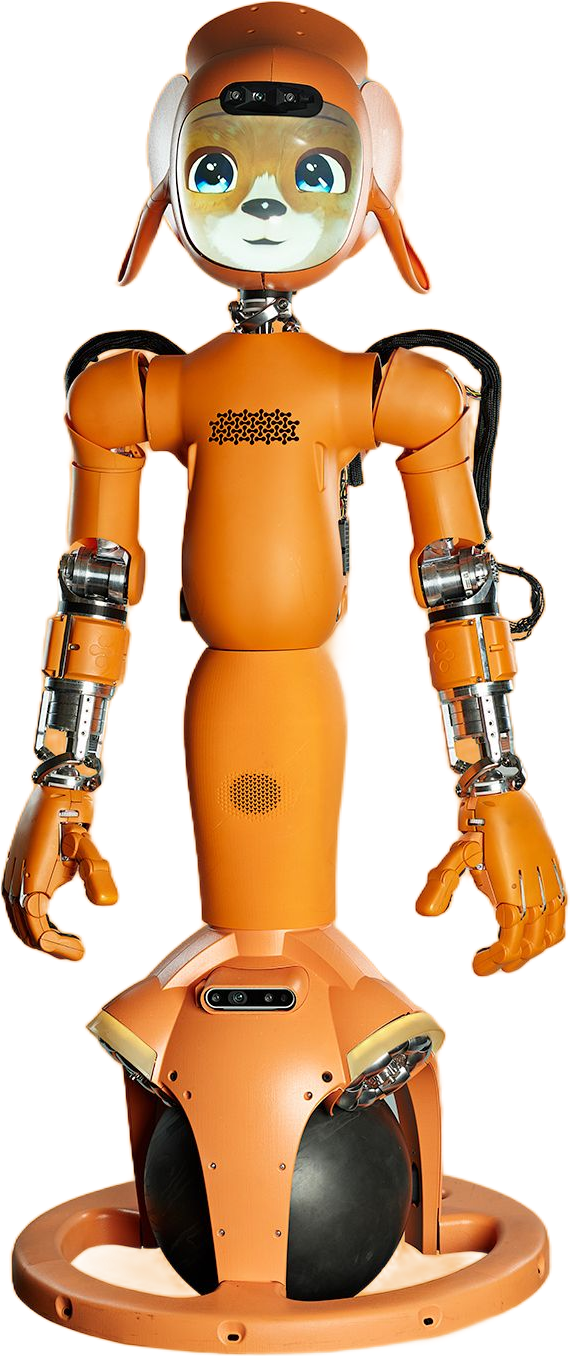
Mirokai is a character-driven service robot developed by Enchanted Tools, a Paris-based robotics startup founded in 2021 by Jerome Monceaux, a co-creator of the NAO and Pepper robots. Standing roughly 123 cm (about 4 feet) tall and weighing about 28 kg, Mirokai is distinctive because it does not walk on legs: it balances and rolls on a single self-balancing sphere (a ball-bot base), moving omnidirectionally with a smooth, gliding motion. It pairs this locomotion with an animated, projected face, two dexterous arms, and multi-modal artificial intelligence to serve hospitality and healthcare settings such as hospitals, hotels, airports, and retail, handling both physical logistics tasks and emotionally engaging interactions with people.[5][12][15]
Unlike conventional humanoid robots that walk on two legs, Mirokai's rolling-sphere base gives it a silhouette that resembles a character from an animated film rather than an industrial machine. Enchanted Tools calls the result a "social logistics" platform. Monceaux previously co-founded Aldebaran Robotics and led the creation of NAO and Pepper; Enchanted Tools raised approximately 15 to 17 million euros in seed funding, reported as the largest early-stage robotics investment in French history at the time. Mirokai's first prototype was demonstrated after just 12 months of research and development, and the robot has since been exhibited at CES in 2023, 2024, and 2025, as well as at IREX Japan 2025. Pilot deployments have taken place in French hospitals, and the company began delivering units to research institutions and commercial customers in 2024.[2][6][8][11]
History and development
Founding of Enchanted Tools
Enchanted Tools was established in October 2021 by Jerome Monceaux and Samuel Benveniste in Paris, France. Monceaux brought decades of experience in social robotics. After co-founding Aldebaran Robotics in 2005, he served as Executive Vice President and Chief Creative Officer through 2015, overseeing the development of the NAO educational robot and the Pepper emotional companion robot. By the time SoftBank acquired Aldebaran in 2012, the company had produced roughly 3,000 NAO units deployed in research labs and schools worldwide. Pepper, unveiled in Tokyo in June 2014, was marketed as the world's first robot capable of reading human emotions.[1][2]
After departing Aldebaran in 2015, Monceaux founded SPooN.ai, a company focused on empathetic human-machine interfaces and interactive virtual characters for retail, automotive, and other applications. The experience with SPooN reinforced his belief that character-driven design, rather than purely functional engineering, was the key to widespread robot adoption.[3]
Samuel Benveniste brought a complementary background. He holds a Ph.D. in Computer Science from Mines Paris (PSL Research University), earned between 2007 and 2010. Before co-founding Enchanted Tools, he served as Deputy Head and Chief Technology Officer of the Centre d'Expertise National en Stimulation Cognitive (CEN STIMCO) from 2013 to 2021, a French national center of excellence focused on cognitive stimulation technologies for elderly and vulnerable populations. His expertise in human cognition and therapeutic technology informed Mirokai's design for healthcare settings.[4]
The company's name reflects its core philosophy: that robots should "re-enchant" everyday environments rather than dehumanize them. Monceaux has described the goal as creating "synthetic alterities," meaning robots that simulate intelligent and emotional behaviors to establish natural human-machine connections.[5]
How was Enchanted Tools funded?
Enchanted Tools closed a seed funding round of approximately 15 to 17 million euros (the range reflects currency conversion and reporting variations across sources), marking the largest early-stage robotics investment in French history at the time. The funding enabled the company to assemble a team of over 50 engineers and designers to begin developing the Mirokai platform.[6] Notable investors include Arion Venture Capital. The company earned the "Deeptech" label from Bpifrance (the French public investment bank) and was selected as one of 125 startups for the French Tech 2030 program, a government initiative supporting deep-technology companies with strategic importance to France.[7]
Prototype and early milestones
Enchanted Tools presented its first working Mirokai prototype after just 12 months of research and development. The company debuted the robot publicly at CES 2023 in Las Vegas, where it drew attention for its Pixar-like character design and unusual ball-based locomotion. The demonstration showed Mirokai navigating a show floor, responding to voice commands, and displaying expressive facial animations.[8]
At CES 2024, the company showcased an updated version and introduced a second character variant. The exhibit attracted significant industry attention, including a visit from Microsoft CEO Satya Nadella, who stopped by the Enchanted Tools booth at Eureka Park.[9] CES 2025 featured the "Mirokai Explorer Suit," a major hardware and software revision in which approximately 80 percent of the robot's components were redesigned from the previous year's model.[10]
In July 2024, Enchanted Tools completed its first commercial delivery, sending a Mirokai unit to the Institut des Systemes Intelligents et de Robotique (ISIR), a research institute under the auspices of Sorbonne University, CNRS, and INSERM. CEO Jerome Monceaux stated: "We are proud to announce the delivery of our first robot to ISIR, a milestone for Enchanted Tools. This moment symbolizes not only the maturity of our prototype, but also the strength of our partnership with ISIR, a pillar of innovation in robotics."[11][20] The company produced approximately 50 robots through a pilot production line in 2024.[12]
What is the design philosophy behind Mirokai?
Character-driven robotics
Mirokai represents a deliberate departure from the design conventions that dominate both industrial and consumer robotics. Rather than building a machine that looks like a human or a piece of equipment, Enchanted Tools designed Mirokai to feel like a character from an animated film. The company pooled the creativity of animation experts, industrial designers, and engineers to develop a robot with personality and emotional depth. Monceaux has described Mirokai as an "interactive companion" intended to inspire trust and goodwill through thoughtful design and intuitive interactions.[5]
The design draws heavily from traditions in animation and cinematic character creation. Enchanted Tools collaborated with Gaumont Animation, the oldest film company in the world, to develop the Mirokai fictional universe and produce animated content featuring the characters. This partnership extends the robot's identity beyond its physical form into storytelling and media.[13]
Monceaux has explained the reasoning behind this approach by reflecting on the limitations of his earlier creations. While NAO and Pepper achieved commercial success and became the first humanoid robots to gain widespread popularity, they ultimately failed to become part of everyday human life because they were not "useful" enough and lacked the character depth needed to sustain long-term engagement. Mirokai was conceived to address both shortcomings simultaneously: it performs practical logistics tasks while maintaining the emotional appeal of an animated character.[2]
Fictional backstory
Enchanted Tools created an elaborate fictional universe for the Mirokai. According to the company's narrative, the Mirokai are a species of benevolent luminous beings from a distant planet who have watched over humanity since ancient times. Their influence is said to be visible in cave paintings, sculptures, melodies, and writings throughout human history. The name "Mirokai" embodies the concept of embracing the wonders of the unfamiliar; one source notes it derives from Japanese words meaning "seeing the beauty in the other."[10][13]
In this backstory, two Mirokai have crossed a portal between their world and ours to assist humanity directly. These two characters are Miroki (a yellow male character) and Miroka (an orange female character). While both variants share the same hardware platform and capabilities, they have distinct visual appearances and personality traits, giving operators and customers a choice of character for different deployment contexts.[14]
Technical design
How does the ball-balancing base work?
The most distinctive technical feature of the Mirokai is its patented ball-bot mobile base. Instead of walking on legs, rolling on wheels, or gliding on tracks, the robot balances atop a single sphere that is driven by three motorized wheels inside the base. This holonomic system allows the robot to move omnidirectionally (forward, backward, sideways, and diagonally) with smooth, continuous motion, navigating tight spaces and crowded environments with agility comparable to a briskly walking human.[15]
The ball-bot approach was a deliberate and risky engineering choice. Enchanted Tools selected it for several practical and social reasons. First, the omnidirectional movement allows Mirokai to navigate human environments (hospital corridors, hotel lobbies, airport terminals) without the awkward turning maneuvers required by wheeled platforms. Second, the design makes the robot inherently non-threatening: if Mirokai is in someone's way, a gentle push causes it to roll aside, whereas a legged or track-mounted robot would need to be lifted or manually repositioned. Third, the smooth gliding motion reinforces the character-like quality of the robot's movement, making it appear to float rather than march.[2][15]
Enchanted Tools claims that Mirokai is the first commercially available robot built on a ball-bot platform. The omnidirectional wheels used in the Explorer Suit version have been tested for over 5,000 kilometers of continuous operation.[16]
| Technical Specifications |
|---|
| Category |
| Height |
| Weight |
| Degrees of freedom |
| Locomotion |
| Maximum speed |
| Payload per hand |
| Total payload (carry) |
| Towing capacity |
| Grasping success rate |
| Battery life |
| Charging time |
| Actuator type |
| Computing |
| Operating system |
| External shell |
| Internal structure |
| Connectivity |
Degrees of freedom and actuation
Mirokai features 26 degrees of freedom distributed across multiple body segments: three in the neck, four in each arm (two arms total), two in each hand, one in each ear, three in each wrist, and three in the ball-bot mobile base. The actuation system uses precision brushless DC motors manufactured by maxon, a Swiss motor company. The ball-bot drive employs ECi 40 motors with planetary gearboxes, chosen for their high power density and suitability for the demanding dynamic balancing required by the spherical base. The remaining axes use 22-millimeter-diameter ECX Torque brushless motors.[12][17]
The Explorer Suit version introduced high-speed, torque-controlled actuators that are twice as fast as the previous generation, with improved torque density. These compliant actuators were designed in-house by Enchanted Tools, enabling precise manipulation and safe physical interaction with humans. The robot's arms are torque-controlled, meaning they can detect and respond to external forces, making them inherently safer in close proximity to people.[16]
Sensor suite
Mirokai is equipped with an extensive array of sensors for environmental perception and human interaction.
| Sensor Suite |
|---|
| Sensor type |
| RGBD cameras |
| Infrared cameras |
| Time-of-flight cameras |
| Ultrasound sensors |
| Microphones |
| Torque sensors |
| Inertial measurement units (IMUs) |
| Hall effect sensors |
| Contact sensors |
The sensor array provides comprehensive 360-degree environmental awareness, enabling autonomous navigation and safe operation around people. The Explorer Suit version upgraded the perception system with new 3D cameras and improved time-of-flight and ultrasonic sensors for more accurate spatial awareness.[16]
What is Mirokai's face made of?
One of Mirokai's most striking features is its animated face, which is not a screen but rather a projection system. A video projector inside the robot's head works with a 3D animation engine similar to those used in modern video games to create vivid, real-time facial expressions. The face reacts dynamically to environmental inputs, people's voices, and touch, giving the robot a lifelike quality that distinguishes it from robots with static faces or simple LCD screens.[5][12]
The robot's ears also move independently (one degree of freedom each), indicating states such as focused listening, curiosity, or attentiveness. Together with the projected face, head tilts, and body posture, these elements create an expressive vocabulary of micro-interactions that simulate personality and emotional engagement.[18]
Computing and AI
Mirokai runs on dual NVIDIA Jetson modules with GPU acceleration for AI processing, using a custom Linux operating system built on the Robot Operating System (ROS) framework. Enchanted Tools' proprietary software stack manages navigation, perception, manipulation, and social interaction.
The Explorer Suit version introduced a multi-large language model (multi-LLM) integration approach, using multiple LLMs in an agnostic configuration rather than relying on a single AI model. This enables natural, fluid conversation with real-time speech recognition and synthesis, multilingual capability with emotional prosody, and context-aware responses. Advanced vision-language models (VLMs) provide context-aware visual understanding, allowing the robot to perceive and interpret its environment semantically.[16]
Navigation uses Visual Simultaneous Localization and Mapping (VSLAM), which enables the robot to build and update maps of its environment in real time while tracking its own position. The navigation system incorporates social awareness algorithms, allowing Mirokai to move through crowded spaces while respecting personal boundaries and social norms.[16]
Face tracking is implemented as a GDPR-compliant feature, meaning the robot can identify and follow faces for natural social interaction without storing biometric data or violating European privacy regulations.[16]
How does Mirokai pick things up?
Mirokai's hands are designed for a specialized grasping approach rather than general-purpose dexterity. Each hand has two degrees of freedom and four fingers. Instead of attempting to grip arbitrary objects (a problem that remains unsolved in general robotics), Enchanted Tools developed a system of universal grip handles called "runes" that attach to everyday objects. When objects are fitted with these standardized handles, Mirokai achieves a 97% grasping success rate, far above the roughly 60% success rate typical of conventional robotic grippers attempting arbitrary object manipulation.[5][12]
Each hand can carry up to 1.5 kg, giving the robot a total carrying capacity of 3 kg. Mirokai can also tow items weighing up to 15 kg, making it suitable for transporting meal trays, medical supplies, linens, and other logistics items in hospital and hospitality settings.[12]
What is Mirokai used for?
Healthcare
Healthcare has been the primary target market for Mirokai from the outset. The robot is designed to handle logistics tasks that consume a significant portion of hospital staff time, such as delivering medication, transporting meal trays to patient rooms, moving medical supplies between departments, and providing wayfinding information.
Enchanted Tools established an early partnership with AP-HP (Assistance Publique-Hopitaux de Paris), the largest hospital system in Europe. Mirokai robots were tested at AP-HP Broca hospital, which specializes in geriatric medicine. The pilot demonstrated the robots' capability in material transport and logistical assistance within a clinical environment.[9][19]
In 2025, Enchanted Tools announced a partnership with the Institut du Cancer de Montpellier (ICM) and SIRIC Montpellier Cancer for pediatric oncology support. In this deployment, Mirokai accompanies children to radiotherapy sessions, where adults are not permitted due to radiation exposure. The robot provides emotional support and companionship, helping to reduce the stress and loneliness experienced by young patients undergoing cancer treatment. This application highlights Mirokai's dual nature as both a logistics tool and an emotional companion.[10][20]
The company envisions Mirokai being used in nursing homes for incident prevention and in various clinical departments for contextual information delivery to caregivers.[5]
Hospitality and service
Beyond healthcare, Enchanted Tools targets the hospitality industry, including hotels, airports, restaurants, and retail environments. In these contexts, Mirokai can serve as a concierge, greeting guests, providing directions, answering questions in multiple languages, and delivering items to rooms or tables. The robot's character-driven design is intended to create memorable guest experiences rather than simply automating tasks.[18]
The company exhibited Mirokai at IREX Japan 2025, the world's largest robot exhibition, demonstrating its capabilities in greeting, wayfinding, and customer engagement for hospitality and retail applications.[18]
Research
The delivery to ISIR (Institut des Systemes Intelligents et de Robotique) at Sorbonne University in July 2024 marked Enchanted Tools' entry into the research market. The partnership with ISIR focuses on three research areas: interactive programming (enabling non-technical users to program robots through demonstration), low-level control (optimizing synchronization of the robot's 22 actuators using whole-body control principles), and human-robot interaction (developing adaptive interactive behaviors for natural engagement). Guillaume Morel, who heads the Miroka project at ISIR, described it as a "win-win partnership" that advances fundamental research while accelerating product development.[11]
Production and commercialization
Manufacturing timeline
Enchanted Tools has followed a structured prototyping methodology, categorizing development into A, B, and C prototype stages. Each stage tests the robot against functional, design, service life, and regulatory constraints. This approach is designed to ensure robustness for eventual mass production while mitigating risks at each step.[12]
The company produced approximately 50 robots through a pilot production line in 2024. Production targets call for 200 to 300 units in 2025, scaling to over 1,000 units annually by 2026. The long-term goal, repeatedly stated by Monceaux, is 100,000 robots over ten years (by approximately 2032).[12]
| Production Timeline |
|---|
| Year |
| 2024 |
| 2025 |
| 2026+ |
| 2032 (10-year goal) |
How much does Mirokai cost?
Mirokai is priced at approximately 30,000 euros (roughly $30,000 USD) per unit. This price point positions it significantly below most full-size humanoid robots while remaining in the premium segment of the service robot market. Enchanted Tools has stated that broader public accessibility is targeted for 2029 at reduced costs as manufacturing scales.[5][20]
The company pursues a business-to-business (B2B) model, selling or leasing robots to hospitals, hotel chains, airports, and retail organizations rather than directly to consumers. An Early Access Program launched in 2025 seeks organizations in healthcare, retail, and hospitality willing to serve as early deployment partners, with a goal of placing 100 additional robots in the field that year.[18]
International expansion
Enchanted Tools' initial deployments have been concentrated in France, but the company has signaled expansion plans. U.S. market entry was planned for 2025, with exhibition appearances at CES serving as a springboard for building relationships with American partners. The company's presence at IREX Japan 2025 indicates interest in the Asian market as well. Full B2B deployment is targeted to begin in 2026.[18][20]
How does Mirokai compare to other social and service robots?
Mirokai occupies a unique position in the robotics landscape, distinct from both the traditional bipedal humanoid category and the simpler service robot category.
| Comparison with Notable Social and Service Robots |
|---|
| Feature |
| Manufacturer |
| Height |
| Locomotion |
| Arms/Hands |
| Face display |
| Payload capacity |
| Primary use |
| AI capabilities |
| Approximate price |
Compared to Pepper, Mirokai offers substantially greater physical utility through its carrying and towing capabilities, more advanced AI with multi-LLM integration, and a more emotionally engaging face projection system. However, Pepper achieved broader initial market penetration before its European operations were scaled back.
Compared to simple delivery robots like Savioke's Relay, Mirokai adds social interaction capabilities, expressive character design, and manipulation with arms, making it suitable for a wider range of tasks beyond point-to-point delivery.
The ball-bot locomotion system differentiates Mirokai from virtually all competitors. While bipedal robots face ongoing challenges with stability, speed, and energy efficiency, and wheeled robots can feel mechanical, the rolling sphere gives Mirokai a fluid, approachable quality of movement that aligns with its character-driven design philosophy.[2]
Recognition and awards
Enchanted Tools has received several forms of institutional recognition in France. The company was awarded the "Deeptech" label by Bpifrance, recognizing its work as deep technology with significant scientific and engineering complexity. It was also selected as one of 125 startups for the French Tech 2030 program, a government initiative that provides selected companies with facilitated access to public funding and strategic support.[7]
The robot attracted significant media attention at each of its CES appearances, particularly at CES 2024 where Microsoft CEO Satya Nadella visited the Enchanted Tools booth.[9] At CES 2025, technology publications listed Mirokai among the most notable robots at the show.[10]
Company overview
As of late 2025, Enchanted Tools employs over 140 people at its headquarters at 4 Rue de la Bourse in the 2nd arrondissement of Paris. The team spans robotics engineering, AI research, industrial design, animation, and business development, reflecting the company's multidisciplinary approach to robot creation.[21]
Key leadership includes:
| Leadership Team |
|---|
| Name |
| Jerome Monceaux |
| Samuel Benveniste |
| Laurent Vasse |
| Richard Malterre |
ELI5: Mirokai in simple terms
Imagine a friendly robot the size of a child that does not walk on legs. Instead, it sits on top of a big ball and rolls around in any direction, a bit like a person balancing on a giant exercise ball without ever falling off. Its face is not a screen with a fixed picture: a tiny projector inside its head paints a cartoon face that smiles, blinks, and looks around, so it feels like a character from an animated movie. It has two arms that can carry trays of food or medicine, and it can chat with you and answer questions. Hospitals and hotels use it to bring things to people and to keep them company, especially children and elderly patients who might feel lonely or scared.
See also
- Humanoid robots
- Service robot
- Social robot
- Pepper (robot)
- NAO
- Aldebaran Robotics
- Human-robot interaction
- Robot Operating System
References
- ^"The End of Aldebaran Robotics (RIP NAO and Pepper)." Mike Kalil, 2023.
- ^1 ^2 ^3 ^4 ^5"Enchanted Tools: The Art of Re-enchanting the World with Humanoid Robots." MerciSF, November 15, 2024.
- ^"Jerome Monceaux." SXSW 2025 Speaker Profile.
- ^"Samuel Benveniste - Co-Founder and Vice-President at Enchanted Tools." The Org.
- ^1 ^2 ^3 ^4 ^5 ^6 ^7"Enchanted Tools: Revolutionizing Robotics with Mirokai." Medical Design Briefs, 2024.
- ^1 ^2"Enchanted Tools company information, funding & investors." Dealroom.co.
- ^1 ^2"French Tech 2030: The Rising Stars to Watch." Auris Finance.
- ^1 ^2"Enchanted Tools Shows at CES 2023 Humanoid Robot Designed for Hospitals, Hotels." Robotics 24/7.
- ^1 ^2 ^3"Mirokai, le robot francais deploye a l'hopital." L'Essentiel de l'Eco.
- ^1 ^2 ^3 ^4"New-look Mirokai robot assists hospital patients, serves as concierge." Interesting Engineering, January 2025.
- ^1 ^2 ^3"Enchanted Tools delivers its first robot to ISIR." ISIR, Sorbonne University, July 2024.
- ^1 ^2 ^3 ^4 ^5 ^6 ^7 ^8"Building a humanoid robot in under a year." Wevolver, 2023.
- ^1 ^2"Enchanted Tools: The First robot-character." Enchanted Tools official website.
- ^"Mirokai AI Robot Comes with a Backstory." Mike Kalil.
- ^1 ^2 ^3"Mirokai: a bot on a self-balancing ball." The bLife Movement.
- ^1 ^2 ^3 ^4 ^5 ^6"Enchanted Tools Introduces Mirokai Explorer Suit." Mike Kalil, 2025.
- ^"Mirokai, a revolution in robotics." maxon Group.
- ^1 ^2 ^3 ^4 ^5"Mirokai by Enchanted Tools Overview: IREX Japan 2025." RoboPhil.
- ^"Meet the Mirokai, AI robots from another galaxy set to lend a helping hand in Paris hospitals." Euronews, June 19, 2023.
- ^1 ^2 ^3 ^4"Enchanted Tools delivers Mirokai social robot to first customer." The Robot Report, 2024.
- ^"About Enchanted Tools." Enchanted Tools official website.
Improve this article
Add missing citations, update stale details, or suggest a clearer explanation. Every suggestion is reviewed for sourcing before it goes live.
7 revisions · v8 · 4,173 words · full history
Fact-checks are independent of edits: a reviewer re-verifies the article against its sources and stamps the date. How we verify
Research and drafting on this wiki are AI-assisted, under named human editorial standards. How AI is used here
Cite this page: AI Wiki. "Mirokai." aiwiki.ai, updated 27 Jun 2026. CC BY 4.0. https://aiwiki.ai/wiki/enchanted_tools_mirokai