

Sundar Pichai
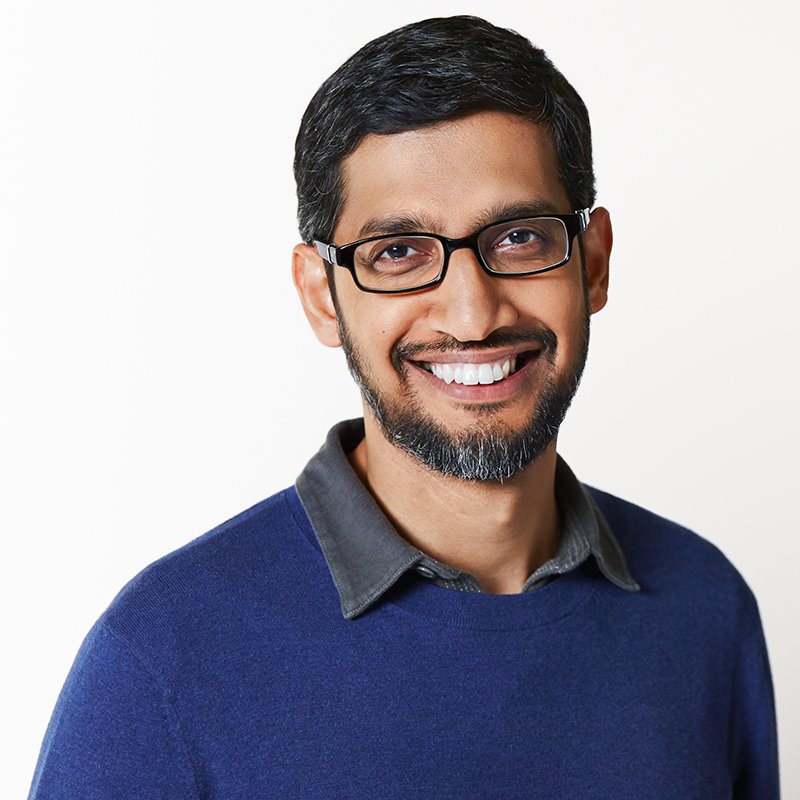
Sundar Pichai (Pichai Sundararajan, born June 10, 1972) is the chief executive officer of Google and its parent holding company Alphabet Inc., and the executive who led Google's pivot from a "mobile-first" to an "AI-first" company. He has run Google since August 10, 2015, when the Alphabet restructuring elevated him from senior vice president of products to CEO of the renamed operating subsidiary, and he added the Alphabet CEO title on December 3, 2019, after co-founders Larry Page and Sergey Brin stepped back from day-to-day operations[1][2][3]. Pichai's tenure has been defined by the development of custom AI accelerators, the DeepMind integration, the Gemini family of models, and the "Code Red" response to OpenAI's ChatGPT[4][5][6].
Before joining Google in April 2004 he worked at Applied Materials in semiconductor process engineering and at McKinsey & Company in management consulting. Inside Google he led the launch of the Chrome browser in 2008, took over Chrome OS, then absorbed Android responsibility from Andy Rubin in March 2013 and the broader product portfolio in October 2014. As CEO he has presided over the scaling of Google Cloud under Thomas Kurian, the launch of the Gemini app and Gemini 3 Pro, the August 5, 2024 antitrust verdict in United States v. Google LLC, and the $32 billion all-cash agreement to acquire the cloud-security firm Wiz announced on March 18, 2025[7][8][9][10][11][12].
Pichai received India's Padma Bhushan, the country's third-highest civilian award, in 2022, and was named to TIME's 100 Most Influential People in 2016 and 2020 and to TIME 100 AI in 2024[1][13]. His 2022 compensation totalled approximately $226 million, driven by a triennial stock award[14]. Under his leadership Alphabet guided 2026 capital expenditure to $180 billion to $190 billion, the largest such figure ever disclosed by a US technology company, with first-quarter 2026 spending of $35.7 billion, a 107 percent year-over-year increase[49][50].
Early life and education
Sundar Pichai was born on June 10, 1972 in Madurai, Tamil Nadu, into a Tamil-speaking family. His father Regunatha Pichai was an electrical engineer and factory manager at the British conglomerate GEC; his mother Lakshmi worked as a stenographer. The family lived in a two-room apartment in Ashok Nagar, Chennai, without a refrigerator, telephone, or car for most of his childhood; the arrival of a rotary telephone when he was twelve has been recounted in his speeches as the moment he first understood how technology could compress distance[1][15][16].
He attended Jawahar Vidyalaya Senior Secondary School and completed Class XII at the Vana Vani school on the campus of IIT Madras. He enrolled at the Indian Institute of Technology Kharagpur, where he earned a Bachelor of Technology in metallurgical engineering in 1993 and was awarded the institute's silver medal for being the top student in his department[1][15][17].
In 1993 Pichai moved to the United States on a Sloan Fellowship and completed a Master of Science in materials science and engineering at Stanford University in 1995, where he was named a Siebel Scholar[1][15]. He joined Applied Materials in Santa Clara in roles spanning process engineering, R&D, and product management, then returned to school and completed an MBA at the Wharton School of the University of Pennsylvania in 2002, where he was a Palmer Scholar (an honour given to the top five percent of the class)[1][15][16]. Between Wharton and Google he worked as a consultant at McKinsey & Company.
Pichai married Anjali Pichai (née Haryani), whom he met as an undergraduate at IIT Kharagpur. They have two children. The family lives in Los Altos Hills, California[1].
Career timeline
| Year | Role | Notes |
|---|---|---|
| 1995 to 2000 | Engineer and product manager, Applied Materials | Semiconductor manufacturing equipment, Santa Clara |
| 2002 to 2004 | Consultant, McKinsey & Company | Joined after completing his Wharton MBA |
| April 2004 | Joined Google as product management lead | Worked on Google Toolbar for Internet Explorer and Firefox |
| 2006 to 2008 | VP of product management | Pushed the case for Google to build its own browser |
| September 2, 2008 | Public launch of Google Chrome | The launch made him a recognised senior leader |
| 2008 to 2013 | SVP, Chrome and Apps | Added Chrome OS, Google Drive, Gmail, and Google Maps oversight |
| March 13, 2013 | Took over Android | Replaced Andy Rubin while keeping Chrome and Apps |
| October 24, 2014 | SVP of products | Took on research, search, maps, Google+, commerce and ads, and infrastructure |
| August 10, 2015 | Named CEO of Google | Announced as part of the Alphabet restructuring; took office October 2, 2015 |
| July 2017 | Joined the Alphabet board of directors | First operating-subsidiary CEO on the holding-company board |
| December 3, 2019 | Named CEO of Alphabet Inc. | Added to Google CEO role after Page and Brin stepped down |
What did Pichai do at Google before becoming CEO?
Toolbar, the case for Chrome, and Chrome OS
Pichai joined Google on April 1, 2004 and was assigned to the Google Toolbar team, the company's main mechanism for getting search distribution onto Microsoft Internet Explorer and Mozilla Firefox. The Mozilla deal that made Google the default search engine inside Firefox became the template for the search-default agreements later challenged in United States v. Google LLC[15][18].
By 2006 Pichai was lobbying Larry Page and Sergey Brin to build a Google browser, arguing that Microsoft could throttle Google's growth by changing defaults in Internet Explorer; the only way to guarantee an open path to web search was to control the browser. Eric Schmidt initially resisted but eventually relented[15][18]. Pichai's team built Chrome on WebKit with the V8 JavaScript engine, and Google launched the browser on September 2, 2008. By 2012 Chrome had passed Internet Explorer as the world's most used browser.
Chrome became the foundation for Chrome OS, the lightweight operating system for Chromebooks that Pichai unveiled in November 2009 and shipped commercially in 2011. He added Google Drive (launched April 2012), Gmail, Google Maps, and the Google Apps for Business portfolio to his portfolio. In 2011 he turned down an offer to become CEO of Twitter; the Google counter-offer was reportedly a stock package worth about $50 million[1][15].
Android and the products role
On March 13, 2013 Larry Page announced that Andy Rubin would step down as Android lead and that Pichai would take over while keeping Chrome and Apps. Android Auto, Android Wear, and Android One were announced at Google I/O 2014. In October 2014 Page promoted Pichai to senior vice president of products, with responsibility for nearly all of Google's consumer-facing products: a chief-operating-officer role in everything but title.
How did Pichai become CEO of Google and Alphabet?
Alphabet restructuring (August 2015)
On August 10, 2015, Larry Page announced in a blog post titled "G is for Google" that Google would be restructured under a new holding company called Alphabet Inc. Page would become Alphabet CEO, Sergey Brin would become Alphabet president, Eric Schmidt would chair the new entity, and Pichai would become CEO of the renamed Google subsidiary, which contained search, advertising, Android, Chrome, YouTube, Maps, and consumer hardware. Other Bets including Waymo, Verily, and DeepMind were set up as separate subsidiaries reporting to Page. The transition closed on October 2, 2015[2][19].
Becoming Alphabet CEO (December 2019)
On December 3, 2019, Larry Page and Sergey Brin announced in a joint letter that they were stepping down from their executive roles. Page wrote that "Alphabet and Google no longer need two CEOs and a President. Going forward, Sundar will be the CEO of both Google and Alphabet." Both founders retained their Class B shares and seats on the Alphabet board[2][3][20]. The move completed Pichai's rise from Toolbar product manager to chief executive of one of the world's most valuable companies in just under sixteen years.
What is Pichai's AI-first strategy?
Google I/O 2016 and the AI-first announcement
At Google I/O 2016, his first keynote as CEO, Pichai declared that Google was shifting from being a "mobile-first" company to an "AI-first" company: "In an AI-first world, we are rethinking all our products and applying machine learning and AI to solve user problems." The same keynote announced the Tensor Processing Unit (TPU), Google's first custom AI accelerator, which had been in production use inside Google data centres for over a year[4][21]. Subsequent TPU generations through TPU v5e and Trillium continue to anchor Google's training and serving infrastructure for Gemini and other models[22]. The AI-first message was reinforced at every subsequent I/O: the 2017 keynote introduced Google Lens and AutoML, the 2018 keynote demonstrated Google Duplex, and the 2023 keynote was rebuilt around generative AI products including Bard, PaLM 2, and AI in Google Search.
DeepMind, Brain, and the merger into Google DeepMind
Google had acquired DeepMind in January 2014 for around $500 million, before Pichai's promotion to CEO. As CEO he managed the integration of DeepMind into Google's broader research portfolio while preserving its scientific independence. After AlphaGo's win against Lee Sedol in March 2016 and AlphaFold 2 in 2020, Pichai approved a reorganisation announced on April 20, 2023 that merged DeepMind with Google Brain into Google DeepMind, led by Demis Hassabis, with Jeff Dean becoming chief scientist across Google Research and Google DeepMind[5][6][51]. Pichai wrote that the new unit would "help us build more capable systems more safely and responsibly." The merger consolidated Google's AI research under a single technical lead and was widely read as a response to OpenAI's lead in generative AI[5][6][51].
Gemini and the Bard rebrand
Google DeepMind's flagship multimodal model, Gemini, was unveiled on December 6, 2023 in three sizes (Ultra, Pro, and Nano) by Pichai and Hassabis[7][23]. Gemini Pro was integrated into Bard the same day; Gemini Nano shipped in the Pixel 8 Pro; Gemini Ultra was held back for further safety testing.
On February 8, 2024, Google rebranded Bard as Gemini, launched a paid Gemini Advanced tier powered by Ultra 1.0, and released a dedicated Gemini app on Android and iOS[24][25]. "Gemini is our approach overall in terms of how we are building our most capable and safe AI model, and Bard was the most direct way that people could interact with our models so it made sense just to evolve it to be Gemini," Pichai told MIT Technology Review[6].
Gemini 1.5 Pro followed with a one-million-token context window, and Pichai announced Gemini 2.0 in December 2024, Gemini 2.5 Pro in 2025, and Gemini 3 Pro on November 18, 2025. The 3 Pro release positioned Gemini against OpenAI's GPT-5 and Anthropic's Claude family[8][26]. On the April 2026 earnings call Pichai reported that since the Gemini 3 launch, hardware and engineering improvements had reduced the cost of core AI responses by more than 30 percent, and that Gemini Enterprise paid monthly active users grew 40 percent quarter over quarter[49][52].
Cloud, hardware, and chip strategy
Google Cloud was refocused under Pichai. Diane Greene led the unit from 2015 to early 2019, when Thomas Kurian joined from Oracle in November 2018 and became Google Cloud CEO in January 2019. Under Pichai and Kurian, Google Cloud grew from roughly $5 billion in annual revenue in 2018 to over $40 billion in 2024, became Alphabet's fastest-growing segment, and crossed into operating profitability in 2023[27][28]. By the first quarter of 2026, Google Cloud revenue reached $20.0 billion, a 63 percent year-over-year increase, with cloud backlog nearly doubling quarter over quarter to over $460 billion[49][50].
On hardware, Pichai oversaw the expansion of the Pixel phone line and the Google Tensor mobile system on chip, first shipped in the Pixel 6 in October 2021[29]. He has linked the Tensor strategy directly to AI-first thinking: Google needs to control silicon, the operating system, and system hardware to ship AI features that depend on hardware-accelerated on-device inference.
Wiz and the cybersecurity expansion
On March 18, 2025, Google announced a definitive agreement to acquire the New York-based cloud-security company Wiz for $32 billion in cash, the largest deal in Google's twenty-six-year history. Pichai framed the deal as a multicloud bet rather than a Google-Cloud-only acquisition[12][30][31]. An earlier $23 billion offer in 2024 had been rejected by Wiz CEO Assaf Rappaport in favour of an IPO. The deal is expected to close in 2026 subject to regulatory approval.
Antitrust and government engagement
United States v. Google LLC (search case, 2020 to 2025)
The US Department of Justice filed United States v. Google LLC in October 2020, alleging that Google had illegally maintained a monopoly in general search services and search advertising through default-search distribution agreements with Apple, Samsung, Mozilla, and others. Pichai testified at the bench trial in October 2023 in front of Judge Amit P. Mehta, arguing that sharing search data with rivals would amount to a "de facto divestiture"[9][32]. On August 5, 2024 Mehta found that Google held a monopoly in general search services and general text advertising; Google held nearly 90 percent of the search market on desktop and around 95 percent on mobile[9][33]. In September 2025 Mehta ruled that Google would not be required to divest Chrome or Android, but would have to share certain search-index and user-interaction data with qualified competitors and would be barred from exclusive default-search payments[34]. A separate ad-tech antitrust case in the Eastern District of Virginia produced a liability finding against Google in April 2025.
Congressional testimony and global engagement
Pichai has appeared as a witness before the US Congress several times, including the House Judiciary Committee on December 11, 2018 (focused on bias allegations, Project Dragonfly, and data practices) and the House Judiciary Subcommittee on Antitrust on July 29, 2020 (the joint Big Tech CEO hearing with Jeff Bezos, Mark Zuckerberg, and Tim Cook)[35][36]. He is a regular attendee of the World Economic Forum in Davos and the Code Conference. In February 2025 he met Indian Prime Minister Narendra Modi on the sidelines of the AI Action Summit in Paris[37].
Workforce and operational decisions
Project Maven and Project Dragonfly
In 2018, after several thousand Google employees signed an open letter objecting to Google's involvement in Project Maven, a US Department of Defense computer-vision contract for analysing drone footage, Pichai allowed the contract to lapse and published a set of AI Principles in June 2018 committing Google not to build weapons or AI for surveillance violating internationally accepted norms[38][39]. The episode set the template for later employee activism inside the company.
Project Dragonfly, a prototype censored search engine for the Chinese market, leaked in August 2018. Hundreds of employees signed an open letter demanding more transparency, and Pichai was questioned about it during his December 2018 House Judiciary appearance. He stated that there were "no current plans" to launch a search product in China; the project was effectively shut down through 2019[35].
January 2023 layoffs
On January 20, 2023 Pichai announced in a memo titled "A difficult decision to set us up for the future" that Alphabet would cut about 12,000 jobs, roughly 6 percent of its global workforce, the largest layoffs in Google's history. He took "full responsibility for the decisions that led us here"[40]. US employees received sixteen weeks of severance plus two weeks per year of service. In a December 2023 interview Pichai conceded that the rollout had damaged morale: "Clearly it's not the right way to do it. I think it's something we could have done differently for sure"[41]. Smaller layoffs followed in 2024 and 2025.
Code Red, Bard demo, and Gemini image-generation incident
The release of ChatGPT on November 30, 2022 caught Google off guard. The New York Times reported in late December that Pichai had declared an internal "Code Red" and reassigned teams across Google Research, Trust and Safety, and the Bard project to accelerate generative AI launches by Google I/O 2023[45]. The Code Red response reoriented Google's priorities and produced the rapid sequence of Bard, PaLM 2, Gemini, Gemini Advanced, and the Gemini-powered overhaul of Search.
The first launch did not go smoothly. On February 6, 2023, Pichai unveiled Bard. A promotional GIF showed Bard incorrectly stating that the James Webb Space Telescope had taken "the very first pictures of a planet outside our own solar system"; the European Southern Observatory's Very Large Telescope had captured the first direct exoplanet image in 2004. Alphabet shares fell roughly 9 percent on February 8, wiping out about $100 billion in market value[42][43].
A second incident came a year later. On February 22, 2024, Google paused image generation of people in Gemini after users circulated examples of historically inaccurate images, including racially diverse depictions of Nazi-era German soldiers and US founding fathers. In an internal memo on February 27 Pichai called the outputs "completely unacceptable"[44]. Image generation of people stayed disabled for several months while the model was retrained.
How much is Sundar Pichai paid?
Pichai is consistently among the highest-paid CEOs of any US public company. His total compensation in fiscal 2022 was approximately $226 million, of which roughly $218 million was a triennial stock award. His base salary was $2 million and Alphabet spent about $5.94 million on personal security for him that year. The 2022 package was more than 800 times the median Alphabet employee's compensation[14]. The triennial stock-grant cycle means reported pay oscillates between low (non-grant) and high (grant) years; his 2023 compensation was about $8.8 million.
What has Pichai said about AI?
Pichai is one of the most quoted technology executives on the trajectory of AI. The most-cited line is from his January 2018 Davos appearance:
"AI is one of the most important things humanity is working on. It is more profound than, I dunno, electricity or fire."
He repeated the comparison at Davos 2020 and in interviews around the Gemini launch[46][47]. His talking points are consistent: AI is the most important technology shift Google will work on in his lifetime, capability and safety should be developed together, and governments need to set rules sooner rather than later. In a 2023 60 Minutes interview he said he lost sleep over how quickly AI was being deployed. On the first-quarter 2026 earnings call he summarised the supply picture bluntly: "We are compute constrained in the near term," adding that cloud revenue would have been higher if Google could have met demand[49][52].
Pichai has been cautiously supportive of regulation, including the EU AI Act and the US executive orders on AI in 2023 and 2024. He has argued that AI regulation should be principles-based and outcome-focused rather than prescriptive about training methods.
Awards and honours
| Year | Honour | Awarding body |
|---|---|---|
| 2022 | Padma Bhushan, Trade and Industry | Government of India |
| 2024 | TIME 100 AI | TIME magazine |
| 2020, 2016 | TIME 100 Most Influential People | TIME magazine |
| 2021 | Asia Society Asia Game Changer Award | Asia Society |
| 2024 | Honorary doctorate | IIT Kharagpur |
| 2017 onwards | Most Powerful People (multiple appearances) | Forbes |
| 2019 | Global Leadership Award | US-India Business Council |
| 2026 | Commencement Speaker | Stanford University |
The Padma Bhushan, instituted in 1954, is India's third-highest civilian award after the Bharat Ratna and Padma Vibhushan. Pichai received the medal from India's ambassador to the United States in San Francisco in December 2022[1][13].
Management style and personal philosophy
Reporters who have profiled Pichai converge on a few descriptions: deliberate, low-ego, consensus-seeking, technically literate, and careful with public statements. He is rarely the loudest voice in a room and almost never engages in public feuding. The New York Times, Wired, and the Financial Times have all described him as the "steady hand" of Big Tech, contrasting his manner with the more confrontational styles of Steve Jobs, Jeff Bezos, Mark Zuckerberg, or Elon Musk[15][16].
The style has costs as well as benefits. Critics argue that consensus delayed Google's response to the rise of generative AI in 2022 and 2023 and that the Bard launch was rushed because internal alignment had broken down. Defenders argue that the same caution kept Google focused on infrastructure and research investments while other companies chased trends. Former Google product managers have told reporters that Pichai personally reviews demos for major products and asks engineering-level questions.
Why does Pichai matter to the AI industry?
Pichai is one of a small group of executives who have carried a major US technology company across the transition from the consumer internet to AI. He inherited a company built around search and ads, and over a decade reorganised it around AI infrastructure (TPUs, data centres), AI research (the Google DeepMind merger), AI products (Gemini, AI Overviews, AI Mode), AI-native devices (Pixel and Tensor), and AI-driven cloud services. In 2025 Alphabet projected $175 to $185 billion in AI-related capital expenditure across the year, and in early 2026 raised the figure to $180 to $190 billion, the largest such number ever disclosed by a US technology company[49][50].
He is also one of the most prominent in a cohort of Indian-origin chief executives running US technology companies at scale, alongside Satya Nadella at Microsoft, Arvind Krishna at IBM, Shantanu Narayen at Adobe, and Nikesh Arora at Palo Alto Networks.
Critiques and controversies
The major criticisms of Pichai's tenure cluster around five themes. The antitrust verdict in United States v. Google LLC, with its August 2024 liability finding and the 2025 remedies order, marks the first time since the Microsoft case of the late 1990s that a US tech company has been ruled an illegal monopolist; Pichai has been the public face of Google's defence. The Bard demo error in February 2023 and the Gemini image-generation incident in February 2024 are cited as examples of products being shipped before they were ready, with internal critics arguing that Code Red pressure produced launch decisions the company would not have made in calmer times. The 2023 layoffs drew sharp criticism, particularly given the simultaneous disclosure of his $226 million compensation package. The Project Maven walkout and Project Dragonfly disclosures showed the limits of Pichai's consensus style when employee values clash with commercial opportunities. His public statements on AI safety have been criticised as both too hawkish by accelerationists and too soft by safety researchers.
Recent context (2024 to 2026)
Google's product cadence under Pichai has been intensive. Gemini 1.5 Pro, Gemini 2.0, Gemini 2.5 Pro, and Gemini 3 Pro released between February 2024 and November 2025. AI Mode in Search rolled out across the US through 2025. Project Astra, a real-time multimodal assistant prototype, was announced at I/O 2024 and progressively shipped through Gemini Live. The Google Tensor G5 chip in the Pixel 10 generation moved Google to an in-house TSMC-fabricated SoC, and the Wiz deal, expected to close in 2026, has reshaped the cloud-security landscape. In the first quarter of 2026 Alphabet reported $109.9 billion in revenue, up 20 percent year over year, its fastest quarterly growth since 2022, with Pichai telling analysts that enterprise AI had become the primary growth driver for cloud for the first time[49][52]. In parallel the company is contending with the remedies phase of the search-monopoly ruling, a separate ad-tech case, and ongoing UK CMA and EU Digital Markets Act investigations.
In April 2026 Stanford University announced that Pichai would deliver its 2026 commencement address[48].
See also
- Alphabet Inc.
- Gemini
- Gemini 3 Pro
- Gemini app
- Google DeepMind
- Google Brain
- Google Cloud
- Tensor Processing Unit
- Stanford University
References
- ^1 ^2 ^3 ^4 ^5 ^6 ^7 ^8 ^9Wikipedia contributors, "Sundar Pichai", Wikipedia, en.wikipedia.org/...Sundar_Pichai
- ^1 ^2 ^3Larry Page, "G is for Google", Alphabet, August 10, 2015, abc.xyz/...2015-google-alphabet
- ^1 ^2Larry Page and Sergey Brin, "A letter from Larry and Sergey", Alphabet, December 3, 2019, blog.google/...letter-from-larry-and-sergey
- ^1 ^2Sundar Pichai, "Google I/O 2016 keynote", Google blog, May 18, 2016, blog.google/...-rethinking-products-ai-first-world
- ^1 ^2 ^3Sundar Pichai, "Announcing Google DeepMind", Google blog, April 20, 2023, blog.google/...april-ai-update
- ^1 ^2 ^3 ^4Will Douglas Heaven, "Google CEO Sundar Pichai on Gemini and the coming age of AI", MIT Technology Review, December 6, 2023, technologyreview.com/...i-and-the-coming-age-of-ai
- ^1 ^2Sundar Pichai and Demis Hassabis, "Introducing Gemini", Google blog, December 6, 2023, blog.google/...google-gemini-ai
- ^1 ^2"Gemini 3", Google blog, November 18, 2025, blog.google/...gemini-3
- ^1 ^2 ^3Cecilia Kang and David McCabe, "Google Loses D.O.J. Antitrust Suit Over Online Search", The New York Times, August 5, 2024; *United States v. Google LLC*, No. 1:20-cv-03010 (D.D.C. August 5, 2024)
- ^Tripp Mickle, "Sundar Pichai's Calmness Tested by Antitrust Trial", The New York Times, October 2023
- ^"Google to acquire cloud security startup Wiz for $32 billion", CNBC, March 18, 2025, cnbc.com/...ud-security-startup-wiz-for-32-billion
- ^1 ^2Alphabet Inc., "Google Announces Agreement to Acquire Wiz", SEC filing 8-K, March 18, 2025, sec.gov/...googexhibit99131825
- ^1 ^2"Padma Awards 2022", Ministry of Home Affairs, Government of India, January 25, 2022
- ^1 ^2Tripp Mickle, "Google CEO Sundar Pichai's pay package was $226 million", The New York Times, April 21, 2023; Bloomberg, "Alphabet CEO's Pay Soars to $226 Million", April 21, 2023
- ^1 ^2 ^3 ^4 ^5 ^6 ^7 ^8Britannica Money, "Sundar Pichai", britannica.com/...Sundar-Pichai
- ^1 ^2 ^3Adi Ignatius, "How Sundar Pichai sees Google", Harvard Business Review, January-February 2020
- ^IIT Kharagpur Alumni Foundation, "Sundar Pichai (B.Tech/MetE/1993)", iitkgpalumnifoundation.in/newsroom
- ^1 ^2Steven Levy, *In the Plex: How Google Thinks, Works, and Shapes Our Lives*, Simon and Schuster, 2011
- ^Conor Dougherty, "Google to Reorganize as Alphabet", The New York Times, August 10, 2015
- ^Cecilia Kang, "Google Co-Founders Step Back From Alphabet", The New York Times, December 3, 2019
- ^Norman P. Jouppi et al., "In-Datacenter Performance Analysis of a Tensor Processing Unit", ISCA 2017
- ^Wikipedia contributors, "Tensor Processing Unit", en.wikipedia.org/...Tensor_Processing_Unit
- ^Wikipedia contributors, "Gemini (language model)", en.wikipedia.org/...Gemini_(language_model)
- ^Sissie Hsiao, "Bard becomes Gemini", Google blog, February 8, 2024, blog.google/...bard-gemini-advanced-app
- ^Sundar Pichai, "Our next-generation model: Gemini 1.5", Google blog, February 15, 2024
- ^Hayden Field, "Google announces Gemini 3", CNBC, November 18, 2025, cnbc.com/...ni-3-as-battle-with-openai-intensifies
- ^Alphabet Inc., Form 10-K for fiscal years 2022 through 2024, abc.xyz/investor
- ^Ben Thompson, "An Interview with Google Cloud CEO Thomas Kurian", Stratechery, 2026
- ^Sundar Pichai, post on X, August 2, 2021, x.com/...1422228336533676035
- ^PBS NewsHour, "Google to buy cybersecurity firm Wiz for $32 billion", March 18, 2025
- ^Sundar Pichai and Thomas Kurian, "Google announces agreement to acquire Wiz", Google blog, March 18, 2025, blog.google/...google-agreement-acquire-wiz
- ^Megan Stacy and Owen Hughes, "Google's DOJ Antitrust Trial: 'De Facto Divestiture'", TechRepublic, October 30, 2023
- ^Wikipedia contributors, "United States v. Google LLC (2020)", en.wikipedia.org/...ed_States_v._Google_LLC_(2020)
- ^"A judge lets Google keep Chrome but levies other penalties", Associated Press via OPB, September 3, 2025
- ^1 ^2"Google CEO Says He Leads 'Without Political Bias' In Congressional Testimony", NPR, December 11, 2018
- ^"Witness Bio: Sundar Pichai", US House Committee on the Judiciary, July 29, 2020, congress.gov/...-116-JU05-Bio-PichaiS-20200729.pdf
- ^"Discussed 'incredible' opportunities AI will bring to India", DD News, February 2025
- ^Sundar Pichai, "AI at Google: our principles", Google blog, June 7, 2018, blog.google/...ai-principles
- ^Scott Shane and Daisuke Wakabayashi, "The Business of War", The New York Times, April 4, 2018
- ^Sundar Pichai, "A difficult decision to set us up for the future", Google blog, January 20, 2023, blog.google/...january-update
- ^"Not the right way: Google CEO on layoffs", Business Today, December 16, 2023
- ^Bobby Allyn, "Google's AI chatbot, Bard, sparks a $100 billion loss", NPR, February 9, 2023
- ^Trevor Mogg, "Google sheds market value after Bard chatbot inaccuracy", Fortune, February 8, 2023
- ^Bobby Allyn, "Pichai says Gemini's AI image results 'offended our users'", NPR, February 28, 2024
- ^Nico Grant, "A New Chat Bot Is a 'Code Red' for Google's Search Business", The New York Times, December 21, 2022
- ^Catherine Clifford, "Sundar Pichai: AI more 'profound than electricity or fire'", CNN Business, January 24, 2018
- ^Sundar Pichai, "Why Google thinks we need to regulate AI", Financial Times, January 19, 2020
- ^"Sundar Pichai will be Stanford's 2026 Commencement speaker", Stanford News, April 2026
- ^1 ^2 ^3 ^4 ^5 ^6"Alphabet (GOOGL) Q1 2026 earnings", CNBC, April 29, 2026, cnbc.com/...alphabet-googl-q1-2026-earnings
- ^1 ^2 ^3"Alphabet Q1 2026 slides: Cloud surges 63%, AI investments accelerate", Investing.com, April 29, 2026, investing.com/...vestments-accelerate-93CH-4654872
- ^1 ^2"Announcing Google DeepMind", Google DeepMind, April 20, 2023, deepmind.google/...announcing-google-deepmind
- ^1 ^2 ^3"Alphabet earnings call, Q1 2026: Sundar Pichai's remarks", Google blog, April 29, 2026, blog.google/...alphabet-earnings-q1-2026
- ^Google. "Sundar Pichai (Google Image Library)". Google Image Library publication permission. Original official raster, unchanged.
Improve this article
Add missing citations, update stale details, or suggest a clearer explanation. Every suggestion is reviewed for sourcing before it goes live.
7 revisions · v7 · 4,746 words · full history
Fact-checks are independent of edits: a reviewer re-verifies the article against its sources and stamps the date. How we verify
Research and drafting on this wiki are AI-assisted, under named human editorial standards. How AI is used here
Cite this page: AI Wiki. "Sundar Pichai." aiwiki.ai, updated 23 Jun 2026. CC BY 4.0. https://aiwiki.ai/wiki/sundar_pichai