

Booster T1
| Booster T1 | |
|---|---|
 | |
| General information | |
| Manufacturer | Booster Robotics |
| Country of origin | China |
| Release year | 2024 |
| Status | In production |
| Price | $29,800 - $33,949 USD |
| Website | booster.tech |
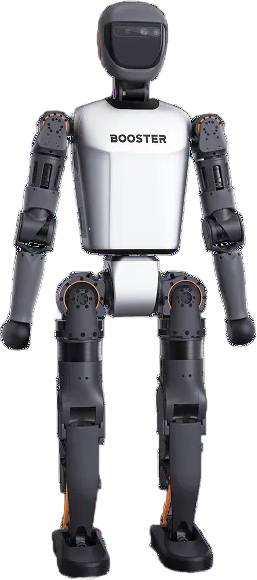
The Booster T1 is a lightweight, open-source humanoid robot developed by Booster Robotics (北京加速进化科技有限公司), a Beijing-based Chinese robotics startup founded in 2023 by Cheng Hao, a Tsinghua University automation graduate. Marketed under the tagline "Made for Developers," the T1 stands 118 cm (about 3 feet 10 inches) tall, weighs roughly 30 kg, offers up to 41 degrees of freedom, and sells for approximately $29,800 to $33,949, positioning it as a research-and-education development platform rather than an industrial robot.[1][2][3]
The T1 is powered by an NVIDIA Jetson AGX Orin GPU delivering 200 TOPS of AI computing performance, and supports full ROS 2 compatibility, a comprehensive open-source SDK, and multiple simulation environments. It gained international recognition in July 2025 when it powered Tsinghua University's Hephaestus team to the championship in the AdultSize category at RoboCup 2025 in Salvador, Brazil, the first time a Chinese team won that division. Booster Robotics describes the T1 as the "preferred choice of 50+ top global robotics teams and research institutes," and as of early 2026 had shipped over 700 humanoid robots to more than 200 customers across 20 countries.[1][2]
What is the Booster T1?
The Booster T1 is a compact, fall-resistant humanoid robot designed from the ground up as a developer-friendly platform for research, education, and competitive robotics, most notably humanoid robot soccer. Booster Robotics markets it with the slogan "Lightweight, Flexible, Durable" and as a "2025 RoboCup AdultSize Category Champion Model," emphasizing real-world locomotion performance and ease of secondary development over the heavy, high-cost designs aimed at factory work.[2]
Unlike full-size industrial humanoids such as Boston Dynamics' Atlas, Figure AI's Figure 02, or Tesla Optimus, the T1 is built to be handled and deployed by a single person and to be programmed quickly by academic teams. Its core value proposition is a fully open development ecosystem layered on competition-proven hardware, making it a physical platform for reinforcement learning, locomotion control, perception, and embodied AI research.[2][11]
Who makes the Booster T1?
The Booster T1 is made by Booster Robotics (北京加速进化科技有限公司), a Chinese robotics startup headquartered in Beijing's Haidian district, near the Zhongguancun technology ecosystem. The company was founded in 2023 by Cheng Hao (程昊), who holds both bachelor's and master's degrees from the Department of Automation at Tsinghua University, where he studied under Professor Mingguo Zhao.[3]
Before founding Booster Robotics, Cheng Hao created Zhaoxi Calendar, a productivity application. After that company was acquired by ByteDance, he served as Vice President of Product for Lark, ByteDance's enterprise collaboration platform. In 2023, Cheng returned to his robotics roots and established Booster Robotics with the stated mission, in the company's own words, to "promote productivity change by creating humanoid robot products and uniting global developers."[3]
The company's core technical team graduated from the Tsinghua Robot Control Lab and the Tsinghua Hephaestus RoboCup Team, bringing more than two decades of accumulated experience in humanoid robotics development. This heritage in competitive robotics has shaped the company's product philosophy and its emphasis on robust, fall-resistant locomotion. The company has benefited from local policy support and investment from Zhongguancun Science City among other investors.[3][4]
How is Booster Robotics funded?
Booster Robotics has raised a total of approximately $27.9 million across three funding rounds as of mid-2025.[5]
| Round | Date | Amount | Lead Investor(s) | Other Investors |
|---|---|---|---|---|
| Pre-A | September 2024 | Over 100 million RMB (~$14M) | Source Code Capital | Innoangel Fund |
| Series A | June 2025 | ~$13.9M | Shenzhen Capital Group | Jinding Capital, Source Code Capital, Innoangel Fund |
| Series A+ | July 2025 | Undisclosed | Beijing Robot Industry Investment Fund | Beijing AI Industry Investment Fund |
The company generates revenue through hardware sales, competition-related intellectual property, sponsorships, and educational course offerings.[5][6]
What is the development history of the T1?
BR002 Prototype (April 2024)
Booster Robotics first attracted widespread attention in April 2024 when it unveiled the BR002 prototype. The BR002 replicated the rotating stand-up motion demonstrated by Boston Dynamics' new-generation Atlas robot, and Booster claimed to have achieved this replication in just three days. A video of the BR002 performing the motion went viral, garnering over two million views online. The BR002 featured three 360-degree rotating joints at the hip, enabling the robot to perform complex movements including horizontal and vertical splits.[7]
T1 Launch (August 2024)
The production-ready T1 was officially unveiled at the World Robot Conference in Beijing in August 2024. Unlike the BR002, which served primarily as a technology demonstrator, the T1 was designed from the ground up as a commercially available development platform for the research and education market. Booster Robotics achieved mass production by October 2024 and delivered its first 100 units by March 2025.[7][8]
K1 Launch (Late 2025)
Following the T1's success, Booster introduced the K1, a smaller and more affordable humanoid robot priced at approximately $5,999. The K1 targets the education, STEM, and entry-level developer markets. Standing at roughly 96 cm (38 inches) tall, it won the KidSize category at RoboCup 2025. Together, the T1 and K1 form Booster's two-tier product lineup, covering both advanced research and introductory education applications.[9]
What are the specifications of the Booster T1?
The Booster T1 is available in three configurations: Basic, Standard, and variants with grippers or dexterous hands. The following tables summarize the key technical specifications across configurations.
Physical Specifications
| Parameter | Value |
|---|---|
| Height (standing) | 1,200 mm (118 cm) |
| Width | 230 mm |
| Depth | 470 mm |
| Leg length | 570 mm |
| Arm length | 450 mm |
| Weight (with battery) | ~30 kg |
| Materials | High-resistance metal and engineering plastic chassis |
How many degrees of freedom does the T1 have?
The T1's degrees of freedom (DOF) depend on the configuration, ranging from 23 in the base model to 41 with dexterous hands.
| Configuration | Total DOF | Breakdown |
|---|---|---|
| Basic / Standard | 23 DOF | 2 head, 4 per arm (x2), 1 waist, 6 per leg (x2) |
| With Grippers | 31 DOF | 7 DOF per arm (instead of 4) plus 1 DOF per gripper |
| With Dexterous Hands | 41 DOF | 7 DOF per arm plus 6 DOF per hand (x2) |
Joint Specifications
| Joint | Range of Motion |
|---|---|
| Waist (Z-axis) | +/- 58 degrees |
| Hip pitch | +/- 118 degrees |
| Hip roll | -21 to +88 degrees |
| Hip yaw | +/- 58 degrees |
| Knee | 0 to 123 degrees |
| Ankle pitch | -50 to +20 degrees |
| Ankle roll | +/- 25 degrees |
| Parameter | Value |
|---|---|
| Maximum peak torque (knee) | 130 N*m |
| Joint encoders | Dual encoder per joint |
| Joint control modes | Mixed torque, velocity, and position control |
What computing hardware does the T1 use?
| Component | Basic Model | Standard Model |
|---|---|---|
| GPU | NVIDIA Jetson AGX Orin 32GB (200 TOPS) | NVIDIA Jetson AGX Orin 32GB (200 TOPS) |
| CPU | Not included | Intel Core i7-1370P (14-core, 4.8 GHz max) |
| AI computing power | 200 TOPS | 200 TOPS |
The Standard model's addition of the Intel i7-1370P CPU provides enhanced processing capability for tasks that benefit from general-purpose computing alongside the Orin's AI inference power. The 200 TOPS figure significantly exceeds the 100 TOPS offered by the Unitree G1 EDU configuration, giving the T1 a meaningful advantage for compute-intensive deep learning and perception workloads.[8][10]
Sensors and Perception
| Sensor | Details |
|---|---|
| Depth camera | Intel RealSense D455 (RGBD) |
| IMU | 9-axis inertial measurement unit |
| Microphone array | Circular 6-microphone array |
| Speaker | Integrated audio output |
| Optional sensors | Laser radar (LiDAR), wrist cameras, pressure sensors |
The Intel RealSense D455 provides both RGB color data and depth information, enabling the robot to perceive its environment in three dimensions. The 9-axis IMU provides orientation and acceleration data for balance control. The circular six-microphone array enables sound source localization and voice input, while the integrated speaker supports audio output for human-robot interaction scenarios.[8]
Power and Battery
| Parameter | Value |
|---|---|
| Battery capacity | 10.5 Ah |
| Runtime (walking) | Approximately 2 hours |
| Runtime (standing) | Approximately 4 hours |
Connectivity
| Interface | Specification |
|---|---|
| WiFi | WiFi 6 (2.4 GHz and 5 GHz) |
| Bluetooth | Bluetooth 5.2 |
| Wired | USB and Ethernet expansion ports |
A mobile application for iOS and Android provides Bluetooth-based real-time robot control and configuration.[11]
How fast and stable is the T1?
| Capability | Value |
|---|---|
| Maximum walking speed | 0.5+ m/s |
| Locomotion | Omnidirectional (forward, backward, sideways, turning) |
| Stand-up from prone | Under 1 second |
| Push recovery | Recovers from 10 kg ball impact; stable with 13 kg load |
| Terrain handling | Uneven surfaces, obstacles |
The T1 supports omnidirectional walking, meaning it can move forward, backward, sideways, and rotate in place. In testing, the robot has demonstrated the ability to recover a stable gait within a few steps after being struck by a 10 kg ball during stepping-in-place, and it can maintain stability even while carrying a 13 kg load on its body. The robot can also autonomously transition from a prone position to standing in under one second.[12]
What software and developer tools does the T1 include?
The T1's core value proposition centers on its open development ecosystem. Booster Robotics positions the robot as a "100% open-source development platform" with comprehensive tooling for researchers and developers.[11]
SDK and API
The Booster Robotics SDK provides both high-level motion control interfaces and low-level hardware control APIs. Developers can choose between two levels of access:
The high-level API provides pre-built motion commands for walking, turning, standing, and other common behaviors. These allow researchers to focus on perception, planning, and decision-making without needing to implement low-level motor control.
The low-level API offers direct joint-level and sensor-level access for researchers working on custom locomotion controllers, novel gait patterns, or full-body manipulation algorithms.
The SDK supports both C++ and Python, with the C++ implementation comprising roughly 95% of the codebase and Python bindings available through pybind11. Python installation is available via pip (pip install booster_robotics_sdk_python), making it straightforward for researchers accustomed to Python-based machine learning workflows. The system requires Ubuntu 22.04 LTS and supports both aarch64 and x86_64 CPU architectures.[13]
The SDK is licensed under the Apache License 2.0 and hosted on GitHub under the BoosterRobotics organization. As of early 2026, the repository has accumulated approximately 98 stars and 34 forks, reflecting growing community engagement.[13]
Does the T1 support ROS 2?
Yes. The T1 supports ROS 2 Humble, the widely used open-source robotics middleware. Booster provides a dedicated ROS 2 SDK (booster_robotics_sdk_ros2) that exposes the robot's joint states, sensor data, and motion commands as standard ROS 2 topics and services. This compatibility allows researchers to integrate the T1 into existing ROS 2 workflows, leverage the broad ROS 2 package ecosystem for navigation, planning, and perception, and interoperate with other ROS 2-compatible hardware.[11][13]
ROS 2 support is particularly important for the T1's target audience of academic researchers and competition teams, many of whom have existing codebases and toolchains built on the ROS ecosystem. The ROS 2 integration means that algorithms developed for other ROS 2-compatible platforms can be ported to the T1 with minimal modification.
Simulation Support
The T1 is compatible with three major robotics simulation platforms:
| Simulator | Developer | Use Case |
|---|---|---|
| NVIDIA Isaac Sim | NVIDIA | High-fidelity physics simulation with GPU acceleration; ideal for large-scale reinforcement learning training |
| MuJoCo | Google DeepMind | Fast, accurate physics simulation widely used in locomotion research |
| Webots | Cyberbotics | Open-source simulator with realistic rendering; popular in education |
The simulation support enables a sim-to-real workflow where locomotion policies are first trained and validated in simulation before being deployed on the physical robot. This approach is standard practice in modern robotics research and significantly reduces the risk of damaging hardware during the development of new control algorithms.[11]
Booster Gym
Booster Gym is an open-source, end-to-end reinforcement learning framework specifically designed for humanoid robot locomotion on the T1. Published as an academic paper on arXiv in June 2025, the framework covers the entire training-to-deployment pipeline, including:
- Customizable RL algorithm configurations
- Domain randomization techniques for robust policy transfer
- Reward function design for locomotion tasks
- Solutions for handling parallel mechanical structures common in humanoid robots
- Sim-to-real and sim-to-sim transfer capabilities
Booster Gym uses NVIDIA Isaac Gym as its primary training environment and has demonstrated successful policy transfer to real T1 hardware, enabling omnidirectional walking, disturbance resistance, and terrain adaptation. The framework is significant because it provides a complete, validated pipeline that researchers can use as a starting point, rather than requiring each team to build their own reinforcement learning infrastructure from scratch.[14]
Booster Train and Booster Deploy
Complementing Booster Gym, the company provides two additional open-source frameworks:
Booster Train is an Isaac Lab-based RL training framework that extends the reinforcement learning capabilities to NVIDIA's newer simulation platform. It provides a set of reinforcement learning tasks specifically designed for Booster robots using Isaac Lab.
Booster Deploy is a lightweight deployment framework that enables running the same policy code in both simulation and on real robots, simplifying the sim-to-real transfer process. This framework supports both Sim2Real and Sim2Sim workflows, allowing developers to validate their policies across different simulation environments before committing to hardware deployment.[11]
Booster Assets
The Booster Assets repository on GitHub contains robot model files (URDF/MJCF) and datasets that researchers can use in their own simulation environments. These assets ensure that third-party simulators and custom research tools can accurately model the T1's kinematics and dynamics.[11]
AI and Multimodal Interaction
The T1 platform supports optional integration with several AI capabilities:
- Large language models (LLMs) running on the edge for natural language interaction
- Text-to-speech (TTS) and automatic speech recognition (ASR) systems
- Object recognition algorithms such as YOLO
- VR teleoperation for remote control scenarios
These capabilities transform the T1 from a pure locomotion platform into a multimodal research tool for embodied AI and human-robot interaction studies.[8]
RoboCup Demo
Booster provides a complete, open-source RoboCup demonstration codebase on GitHub (BoosterRobotics/robocup_demo). This demo allows the T1 and K1 robots to make autonomous decisions for kicking a ball and completing a full RoboCup match. It includes three core programs: a vision system for perception, a brain module for decision-making, and a game controller interface. The RoboCup demo converts game control data packets into ROS 2 topic messages, enabling the brain module to process game state information and make tactical decisions in real time.[13]
How much does the Booster T1 cost?
The Booster T1 is available in multiple configurations at different price points, with the Basic model starting around $29,800 and the Standard model listed at $33,949.
| Configuration | Price (USD) | Key Difference |
|---|---|---|
| T1 Basic | ~$29,800 | NVIDIA AGX Orin GPU only (200 TOPS); 23 DOF |
| T1 Standard | ~$33,949 | Adds Intel i7-1370P CPU alongside AGX Orin; 23 DOF |
| T1 with Grippers | Contact for pricing | 31 DOF; adds gripper end effectors for pick-and-place tasks |
| T1 with Dexterous Hands | Contact for pricing | 41 DOF; adds 6-DOF dexterous hands for fine manipulation |
All configurations include the robot, a 10.5 Ah battery and charger, Intel RealSense D455 depth camera, microphone array, speaker, 9-axis IMU, WiFi 6 and Bluetooth 5.2 connectivity, the full open-source SDK with ROS 2 compatibility, a mobile app, and simulation support. The standard warranty is 12 months.[10][15]
The robot is available for worldwide shipping through authorized distributors, including Generation Robots (European exclusive distributor, pricing from 32,500 euros excluding VAT), RobotShop, AltHumans, and K-Robotics. Delivery typically takes four to six weeks.[8][10]
How does the T1 compare to the Unitree G1?
The Booster T1's most direct competitor is the Unitree G1, another Chinese-made compact humanoid targeting the developer and research market. Both robots occupy a similar size category and share the goal of making humanoid robotics accessible to researchers and educational institutions.
| Feature | Booster T1 (Standard) | Unitree G1 (EDU) |
|---|---|---|
| Height | 118 cm | 127-132 cm |
| Weight | ~30 kg | 35-47 kg |
| DOF (base) | 23 | 23 |
| DOF (max) | 41 (dexterous hands) | 43 (EDU Ultimate) |
| AI computing | 200 TOPS (AGX Orin) | 100 TOPS (EDU) |
| Max knee torque | 130 N*m | 120 N*m |
| Walking speed | 0.5+ m/s | Up to 2 m/s |
| Battery life (walking) | ~2 hours | ~2 hours |
| Starting price | ~$29,800 (Basic) | ~$16,000 |
| ROS 2 support | Yes (Humble) | Yes (EDU variants) |
| Simulation support | Isaac Sim, MuJoCo, Webots | Isaac Sim, MuJoCo |
| Microphone array | Yes (6-mic circular) | No (base model) |
| Stand-up time | Under 1 second | Several seconds |
The T1 holds advantages in AI computing power (200 vs. 100 TOPS), weight (30 vs. 35+ kg for easier portability), knee torque (130 vs. 120 N*m), and integrated audio hardware. The Unitree G1, on the other hand, offers significantly higher walking speed (up to 2 m/s vs. 0.5+ m/s) and a substantially lower starting price ($16,000 vs. ~$29,800). The G1's price advantage has made it the volume leader in the affordable humanoid segment, while the T1 has carved out a niche among teams and institutions that prioritize computing headroom and the specific competition-proven platform validated at RoboCup.[7][8]
Where does the T1 sit in the broader market?
The T1 sits in the mid-range of the humanoid robot market. It is significantly more affordable than full-size humanoid platforms like Boston Dynamics' Atlas, Figure AI's Figure 02, or Tesla Optimus, which target industrial and commercial applications at much higher price points. At the same time, it is substantially more capable and more expensive than entry-level educational platforms.
Booster Robotics' two-product strategy (T1 for advanced research, K1 for education) allows it to address multiple segments of the market. The K1 at approximately $5,999 competes more directly with platforms like Aldebaran's NAO and the lower-tier Unitree G1 configurations, while the T1 targets serious research laboratories and well-funded competition teams.[9]
The T1's pricing places it in what some industry analysts describe as the "prosumer" segment of humanoid robotics: more capable than hobby or education-grade platforms, but accessible enough for university research budgets that cannot justify six-figure industrial robots.
What competitions has the Booster T1 won?
The Booster T1 has accumulated a notable record in international robotics competitions, which has become a central element of the company's marketing and credibility strategy.
RoboCup 2025 (Salvador, Brazil)
At RoboCup 2025, held in July 2025, the T1 powered the Tsinghua Hephaestus team to the championship title in the Humanoid League's AdultSize category. This marked the first time a Chinese team won the AdultSize championship at RoboCup. The China Agricultural University Mountain and Sea Team, also using the T1, claimed the runner-up position. In the KidSize category, the Booster K1 helped Germany's HTWK team and Tsinghua's TH-MOS team secure first and second place, respectively.[1][2]
These results demonstrated the viability of the T1 as a competition-grade platform and established Booster's robots as the dominant hardware choice across multiple categories of the RoboCup Humanoid League.
IEEE-RAS Humanoids 2024 (Nancy, France)
At the IEEE-RAS International Conference on Humanoid Robots, held from November 22 to 24, 2024, in Nancy, France, the Booster T1 claimed first place in both the Speed Competition and the Obstacle Avoidance and Door Opening Challenge. These were the T1's first major international competition victories, established just months after the robot entered mass production.[3]
Forbes China Recognition
Booster Robotics was selected for the Forbes China AI Tech TOP 50 list, recognizing the company as one of China's most promising artificial intelligence technology companies.[3]
What is the RoboCup Federation partnership?
On December 10, 2024, the RoboCup Federation (RCF) announced an official partnership with Booster Robotics, Fourier Intelligence, and Unitree Robotics. This collaboration represented a historic milestone, as the three companies became the first Chinese robotics firms to enter the RoboCup ecosystem as official league partners.[16]
The partnership has several dimensions:
Research promotion. The three companies pledged to utilize their business networks and commercialization capabilities to promote and fund RoboCup-linked research, technology development, and products.
Competition access. The RoboCup Federation partnered with the manufacturers to offer exclusive access to cutting-edge humanoid robots at discounted rates for participating teams, lowering the barrier to entry for competition.
Communication and awareness. The companies committed to sharing their communication platforms and resources to build greater awareness of robotic research and its real-world applications.
RoboCup 2026 preparation. The partnership specifically targets increased participation in RoboCup 2026, to be held in Incheon, South Korea.
The partnership aligns with RoboCup's long-term goal, first articulated at the federation's founding: by the middle of the 21st century, a team of fully autonomous humanoid robot soccer players should be able to win a soccer game against the human World Cup champion team, complying with the official rules of FIFA.[16]
Who uses the Booster T1?
As of early 2026, Booster Robotics has shipped over 700 humanoid robots to more than 200 clients across over 20 countries. The customer base includes 70 or more universities and research institutions globally.[2]
Academic and Research Use
The T1 has been adopted by research groups at prominent institutions, where it serves as a physical platform for reinforcement learning, locomotion control, perception, and embodied AI research. The open SDK, ROS 2 compatibility, and simulation support make it straightforward for researchers to develop and test algorithms in simulation before deploying them on the physical robot.
The availability of the Booster Gym reinforcement learning framework further lowers the barrier to entry for locomotion research, providing a complete training pipeline that researchers can modify and extend rather than building from scratch.
Education
Booster Robotics has announced the "Hundred Cities, Ten Thousand Schools" initiative, which targets partnerships with over ten thousand educational institutions globally within three years to promote the widespread adoption of robotics education. The company has launched robot soccer courses that have been adopted by Chinese high schools and universities, using competitive robotics as a vehicle for teaching programming, control theory, and computer vision.[2][6]
Exhibition and Demonstration
The T1 has been showcased at major technology events worldwide:
| Event | Location | Date | Notable Activities |
|---|---|---|---|
| World Robot Conference 2024 | Beijing, China | August 2024 | Official T1 launch |
| IEEE-RAS Humanoids 2024 | Nancy, France | November 2024 | Won Speed and Obstacle Avoidance competitions |
| CES 2025 | Las Vegas, USA | January 2025 | Hands-on demos; walking, push-ups, dancing demonstrations |
| RoboCup 2025 | Salvador, Brazil | July 2025 | Won AdultSize championship |
| IREX 2025 | Tokyo, Japan | 2025 | Product showcase at world's largest robotics exhibition |
| CES 2026 | Las Vegas, USA | January 2026 | Multitasking demos; K1 Geek at Qualcomm booth |
At CES 2025, the T1 drew large crowds in the exhibition showroom by demonstrating its ability to walk, bend over, perform push-ups, dance, kick a soccer ball, and execute kung fu movements.[17]
What design choices define the T1?
Booster Robotics' approach to the T1 reflects several deliberate design choices that differentiate it from both large industrial humanoids and simpler educational robots.
Portability
At 30 kg and 118 cm tall, the T1 is designed to be handled by a single person. This is a practical consideration for research laboratories and classrooms where moving and setting up the robot should not require a team of people or specialized lifting equipment. By comparison, full-size humanoids like the Unitree H1 (47 kg, 180 cm) or Boston Dynamics' Atlas require multiple handlers.[8]
Modularity
The three-tier configuration system (Basic/Standard, Gripper, Dexterous Hands) allows customers to select the level of manipulation capability they need. A research group focused purely on locomotion can purchase the 23-DOF Basic model at the lowest price point, while a team working on manipulation tasks can opt for the 41-DOF dexterous hand variant. This modularity keeps the entry price lower for teams that do not need manipulation capabilities and avoids forcing customers to pay for hardware they will not use.[15]
Open-Source Commitment
Booster's open-source strategy extends beyond the SDK to include:
- The full RoboCup demo code (covering perception, localization, and decision-making for 3v3 matches)
- The Booster Gym reinforcement learning framework
- Isaac Lab-based training tools (Booster Train)
- Deployment frameworks (Booster Deploy)
- Robot model files and datasets (Booster Assets)
All of these are publicly available on the company's GitHub organization under permissive open-source licenses. This breadth of open-source tooling is intended to reduce the time researchers spend on infrastructure and accelerate the development of novel algorithms. The approach contrasts with some competitors that provide hardware but leave software development largely to the end user.[11][13]
Competition-Driven Validation
Booster's roots in the Tsinghua Hephaestus RoboCup team mean that the T1 was designed with competitive robotics as a primary use case from the start. Competition environments impose demanding requirements: robots must walk reliably on varied surfaces, recover from falls and collisions, make autonomous decisions, and operate for extended periods without intervention. The T1's success at IEEE-RAS Humanoids 2024 and RoboCup 2025 serves as real-world validation that the platform meets these requirements, giving potential customers confidence that the robot can handle the rigors of active research use.[3]
See Also
- Unitree Robotics
- Boston Dynamics
- Fourier Intelligence
- Humanoid Robots
- ROS
- Reinforcement Learning
- Embodied AI
- RoboCup
- MuJoCo
- NVIDIA
References
- ^1 ^2 ^3"Chinese team wins RoboCup Humanoid League in AdultSize category." China Daily, July 25, 2025. global.chinadaily.com.cn/...82e633a310ad07b5d91f03
- ^1 ^2 ^3 ^4 ^5 ^6 ^7"Booster T1: Made for Developers." Booster Robotics Official Website. booster.tech/booster-t1
- ^1 ^2 ^3 ^4 ^5 ^6 ^7"About Us." Booster Robotics Official Website. booster.tech/about-us
- ^"Booster Robotics cites local policy support for success." China.org.cn, April 3, 2025. china.org.cn/...content_117804677
- ^1 ^2"Booster Robotics Funding Rounds and Investors." Tracxn, 2025. tracxn.com/...booster-robotics
- ^1 ^2"China's Booster Robotics Lands New Funding as it Hits a Winning Streak." Caixin Global, July 25, 2025. caixinglobal.com/...its-a-winning-streak-102344904
- ^1 ^2 ^3"Booster, Noetix Disrupt Humanoid Market with Low-Cost Robots." Mike Kalil Blog. mikekalil.com/...ster-noetix-cheap-humanoid-robots
- ^1 ^2 ^3 ^4 ^5 ^6 ^7"Booster T1: the humanoid development platform for researchers and developers." Generation Robots Blog. generationrobots.com/...researchers-and-developers
- ^1 ^2"K1 from Booster Robotics: the small humanoid that challenges Unitree and Nao." Generation Robots Blog. generationrobots.com/...challenges-unitree-and-nao
- ^1 ^2 ^3"Booster T1 humanoid robot." Generation Robots Product Page. generationrobots.com/...-booster-t1-humanoid-robot
- ^1 ^2 ^3 ^4 ^5 ^6 ^7 ^8"Official Open Source." Booster Robotics. booster.tech/open-source
- ^"Booster T1 Can Stand Up In 1 Second." Robotic Gizmos. roboticgizmos.com/booster-t1
- ^1 ^2 ^3 ^4 ^5"Booster Robotics SDK." GitHub. github.com/...booster_robotics_sdk
- ^"Booster Gym: An End-to-End Reinforcement Learning Framework for Humanoid Robot Locomotion." arXiv, June 2025. arxiv.org/...2506.15132v1
- ^1 ^2"Booster Robotics T1 Humanoid Robot (Basic)." AltHumans. althumans.com/...-robotics-t1-humanoid-robot-basic
- ^1 ^2"RoboCup Federation teams up with Booster Robotics, Fourier and Unitree Robotics." RoboCup Federation, December 10, 2024. robocup.org/...172
- ^"CES: Booster Robotics brings RoboCup champs to Vegas." Florida Politics. floridapolitics.com/...ngs-robocup-champs-to-vegas
Improve this article
Add missing citations, update stale details, or suggest a clearer explanation. Every suggestion is reviewed for sourcing before it goes live.
7 revisions · v8 · 4,634 words · full history
Fact-checks are independent of edits: a reviewer re-verifies the article against its sources and stamps the date. How we verify
Research and drafting on this wiki are AI-assisted, under named human editorial standards. How AI is used here
Cite this page: AI Wiki. "Booster T1." aiwiki.ai, updated 25 Jun 2026. CC BY 4.0. https://aiwiki.ai/wiki/booster_robotics_t1