

Toyota Human Support Robot (HSR)
The Human Support Robot (often abbreviated HSR) is a compact, single-armed mobile manipulation robot built by Toyota Motor Corporation as a standardised research platform for domestic and assistive robotics. Roughly 1 m tall and 37 kg, with one telescoping arm, a two-finger gripper, an omnidirectional wheeled base and a sensor-laden head, it is designed so that an elderly or mobility-impaired person at home can ask it, by voice or tablet, to fetch a dropped pen, pick up a TV remote, or open a curtain [1][26]. The original goal was modest and very Japanese in flavour: build a low-cost helper for someone with limited limb mobility. What started as a single 2012 prototype shown at a Tokyo home-care exhibition turned, over the next decade, into one of the most widely shared standardised research platforms in academic mobile manipulation, mainly because Toyota loaned it to dozens of universities and because the RoboCup Federation chose it as the official robot of the @Home Domestic Standard Platform League in 2017 [7]. By 30 November 2018 the canonical platform paper reported HSR in use at 44 sites in 12 countries [1].
HSR is a roughly 1 m tall, 37 kg cylindrical mobile robot with one telescoping arm, a two-finger gripper, an omnidirectional wheeled base, and a head that carries a microphone array, an RGB-D camera, a wide-angle camera and a stereo RGB camera [26]. It is designed to drive into a normal Japanese living room, see the person and the objects, and pick up small things from the floor or hand them to a seated user. In Toyota's own framing it sits inside the older Toyota Partner Robot family, which also produced the trumpet-, drum- and violin-playing humanoids shown at Expo 2005 in Aichi and Expo 2010 Shanghai [17].
The platform paper by Takashi Yamamoto, Koji Terada, Akiyoshi Ochiai, Fuminori Saito, Yoshiaki Asahara and Kazuto Murase ("Development of Human Support Robot as the research platform of a domestic mobile manipulator", ROBOMECH Journal, published 2019) is the canonical hardware reference [1]. In its own product materials Toyota describes HSR as "a compact mobile manipulator for the disabled and elderly" that "can move around the house, keep watch over family members, and fetch objects," adding: "Our goal is to make HSR beneficial to all people in the near future." [26] Most numbers in this article come from that paper, the Toyota Global press releases, the Toyota datasheet and the independent ROBOTS guide entry [1][2][11][26].
How did the Human Support Robot originate?
The direct ancestor of HSR is the Toyota Welfare Vehicle programme, started inside Toyota in 1981 to develop wheelchair-accessible cars and lift-equipped vans. That programme gave Toyota three decades of contact with assistive-equipment users and rehabilitation hospitals before it ever built a humanoid. The lessons fed into the Toyota Partner Robot project announced in 2004, which Toyota positioned as a long-term answer to Japan's ageing society [17]. Early Partner Robot outputs were demonstration humanoids: a bipedal trumpet player and other instrument-playing robots at the 2005 World Expo in Aichi, a violin-playing version with seventeen joints in the arms and hands shown in 2007, the i-Foot mountable two-legged transporter, and the wire-actuated "Version 4" robot [17].
The HSR prototype was the first public attempt at the home-living concept. Toyota unveiled it on 22 September 2012 and showed it from 26 to 28 September at the 39th International Home Care and Rehabilitation Exhibition at Tokyo Big Sight [2][10]. The prototype already had the cylindrical body, the folding arm, the two-finger gripper, omnidirectional wheels and a head full of cameras (a Kinect-class depth sensor plus stereo RGB) [10]. It was demonstrated with a top speed of roughly 3 km/h and the ability to clear 9 mm obstacles and 5-degree slopes [10]; the later production research version was made slower and more conservative, capped at 0.8 km/h and 5 mm steps, as safety around frail users took priority [26]. Toyota had been running in-home trials with disabled users at the Foundation for Yokohama Rehabilitation Service since 2011 and had developed the design with input from the Japan Service Dog Association: the brief was, in effect, to do what a service dog does for someone with limited limb mobility, but with a suction tip and a gripper instead of a mouth [2].
In July 2015 Toyota launched a revised version (often referred to as HSR R1 in academic papers) and founded the HSR Developers' Community, a programme that loans the robot to selected universities in exchange for shared software and research [3]. The canonical platform paper later reported the robot in use at 44 sites in 12 countries as of 30 November 2018 [1]; Toyota has continued to expand the community since, supporting labs across Europe including Germany, the United Kingdom, France and the Netherlands [21].
The RoboCup Federation adopted HSR as the official platform of the new Domestic Standard Platform League (DSPL) in 2017 [7]. The first competition with the standard platforms was held at RoboCup 2017 in Nagoya, Japan (27-31 July 2017), where the @Home league was split into the Open Platform League (no hardware restrictions), the Domestic Standard Platform League (Toyota HSR), and the Social Standard Platform League (SoftBank Robotics Pepper, owned at the time by SoftBank) [7][29]. HSR was also picked as the platform for the Partner Robot Challenge (Real Space) at the World Robot Summit, Japan's METI and NEDO sponsored international competition that ran in 2018 and 2020 [8].
While HSR continued as the standard academic platform, research interest at Toyota itself shifted toward foundation-model robotics inside Toyota Research Institute, founded in January 2016 with a $1 billion, five-year commitment and headquartered in Los Altos, California (with offices in Cambridge, Massachusetts, and Ann Arbor, Michigan) [16]. TRI's 2023 announcement of Diffusion Policy with Shuran Song's group at Columbia University, and its Punyo soft-bodied torso for whole-body manipulation, became the public face of the lab's robotics work, but HSR remained one of the platforms TRI and its partners actually run experiments on [12][14].
| Year | Event |
|---|---|
| 1981 | Toyota Welfare Vehicle programme launched, the start of Toyota's accessibility R&D |
| 2004 | Toyota Partner Robot project formally announced |
| 2005 | Trumpet- and drum-playing Partner Robots debut at World Expo in Aichi |
| 2007 | Violin-playing Partner Robot unveiled with 17 joints in arms and hands |
| 2010 | Violin-playing robot featured in the Japan Pavilion at Expo Shanghai |
| Sept 2012 | HSR prototype unveiled at the 39th International Home Care and Rehabilitation Exhibition, Tokyo Big Sight |
| 2011-2012 | In-home trials with disabled users at Foundation for Yokohama Rehabilitation Service, in cooperation with the Japan Service Dog Association |
| July 2015 | Revised HSR (R1) launched; HSR Developers' Community founded |
| Jan 2016 | Toyota Research Institute (TRI) founded; HSR becomes one of TRI's standard platforms |
| 2017 | HSR adopted as the official platform of the RoboCup@Home Domestic Standard Platform League at RoboCup Nagoya |
| 2018 | World Robot Summit Partner Robot Challenge (Real Space) held in Tokyo with HSR |
| 2018 | Platform paper counts HSR in use at 44 sites across 12 countries (as of 30 Nov 2018) |
| 2019 | Yamamoto et al. publish the canonical platform paper in ROBOMECH Journal |
| 2020 | World Robot Summit 2020 Partner Robot Challenge runs again on HSR |
| 2021 | Toyota's "Co-Creation" update profiles the global HSR Developers' Community |
| 2023 | TRI and Columbia announce Diffusion Policy at RSS 2023; TRI introduces the Punyo soft-bodied torso |
| Oct 2024 | Boston Dynamics and TRI announce a humanoid research partnership (electric Atlas plus Large Behavior Models) |
| 2024-2026 | HSR continues as the standard DSPL platform; Toyota's robotics work expands to general-purpose humanoids with Boston Dynamics |
What are the HSR's hardware specifications?
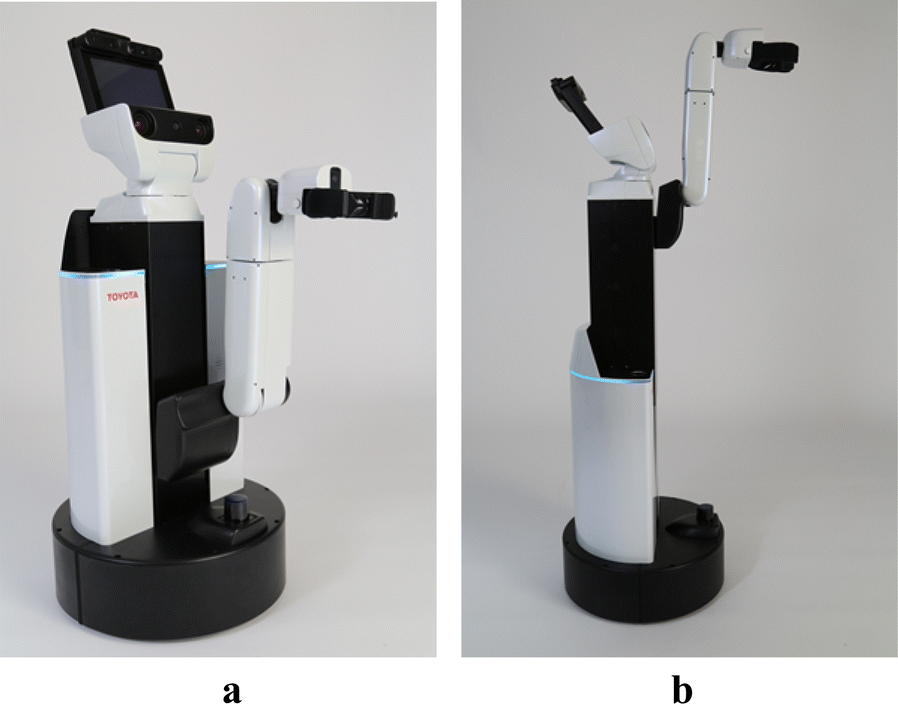
Toyota HSR in normal (a) and extended (b) postures, as illustrated in the 2019 platform paper.[30] Figure: Takashi Yamamoto, Koji Terada, Akiyoshi Ochiai, Fuminori Saito, Yoshiaki Asahara and Kazuto Murase; Toyota Motor Corporation. CC BY 4.0.
Headline numbers for HSR come from Toyota's own datasheet and from the Yamamoto et al. paper [1][26]. The robot is intentionally short so that it can drive under a Japanese dining table and look up at a seated user. The arm is intentionally weak so that an unexpected collision does not cause injury, with the maximum payload capped at 1.2 kg in arbitrary posture [26]. The base is omnidirectional so that the robot can sidestep around furniture in tight apartments without re-orienting its body or head camera. Yamamoto et al. frame the whole design around a safety-first premise, writing that "three features are considered essential for successfully integrating robots into the home environment: safe interaction, a compact and lightweight body, and a simple interface." [1]
| Spec | Value |
|---|---|
| Manufacturer | Toyota Motor Corporation |
| First prototype | September 2012 (Tokyo Big Sight) |
| Production research version | HSR R1, July 2015 |
| Body type | Cylindrical, telescoping torso |
| Body diameter | 430 mm (about 14.5 in) |
| Body height | 1,005-1,350 mm (telescoping) |
| Shoulder height | 340-1,030 mm |
| Weight | ~37 kg |
| Mobile base | Omnidirectional wheeled base, 3-DoF |
| Maximum speed | 0.8 km/h |
| Floor obstacles handled | Up to 5 mm bumps, slopes up to 5° |
| Total body DoF | 8-DoF body plus pan-tilt head (per Yamamoto et al.) |
| Base | 3-DoF |
| Torso (lift) | 1-DoF |
| Arm | 4-DoF lift arm |
| Head | Pan-tilt (320° pan, 120° tilt) |
| Gripper | Two-finger parallel gripper |
| Gripper opening | Up to 130-135 mm |
| Gripping force | 40 N |
| Max payload (in arbitrary posture) | 1.2 kg |
| Arm reach | Floor to 1.35 m height; ~0.45 m forward |
| Head sensors | Microphone array (4 capsules), RGB-D camera, wide-angle camera, stereo RGB camera |
| Hand sensors | Hand-mounted camera, force-torque sensor, vacuum (suction) pad |
| Body sensors | Inertial measurement unit, laser rangefinder (LiDAR) at the base |
| Display | Front-facing screen used for face/UI |
| Power | Removable battery + dock charger |
| Operating system | Linux + ROS-based stack |
The Yamamoto paper frames the design choices as deliberate trade-offs against a target user scenario [1]. The 1.35 m target arm height is roughly the top shelf of a typical Japanese kitchen cabinet; the 1.2 kg payload covers the kind of representative household objects the platform is meant to handle, such as cups, bottles, remote controls, books and small bags. The omnidirectional base, the suction-pad (vacuum) option on the gripper and the low maximum speed all flow from the same brief [26].
What software does the HSR run?
HSR runs a Linux-based onboard computer with a ROS (Robot Operating System) software stack that Toyota provides to community members as the HSRB ROS package family [1][26]. The Yamamoto paper splits the software into four layers: a device-control subsystem that talks to the motors and sensors, a real-time motion-control subsystem on the robot computer, a higher-level functional subsystem made of ROS nodes (perception, navigation, manipulation, dialogue), and a user-interface subsystem that runs on the front display and any tablet client [1].
On top of the Toyota stack, the community has built and shared open-source tools, including MATLAB/Simulink integrations from MathWorks, ROS# bridges to Microsoft HoloLens for mixed-reality teleoperation, and competition-specific behaviour packages used by RoboCup@Home DSPL teams. The standardised API is what makes the DSPL meaningful: every team runs the same hardware and the same low-level drivers, so the score reflects perception and planning algorithms, not how good a team's mechanical engineers are [5]. Most teams use the ROS Navigation Stack and MoveIt for base motion and arm planning, with custom perception pipelines on top. HSR is also one of the standard platforms in graduate ROS and mobile-manipulation courses [11].
What is the HSR used for?
HSR spans a spectrum from its original assistive purpose to its dominant role as a shared academic testbed [4]. The main use cases:
| Use case | Description |
|---|---|
| Domestic fetch-and-carry assistance | The original Toyota brief: bring objects to elderly or mobility-impaired users, open curtains, suction up thin items |
| Mobile manipulation benchmarks | Standardised benchmark for academic mobile-manipulation papers |
| Elderly-care research | Field studies in rehabilitation centres and care homes, particularly in Japan |
| Robot-mediated learning | Used in studies of medically homebound children attending classrooms remotely (Ahumada-Newhart et al., 2023) [9] |
| RoboCup@Home Domestic Standard Platform League | Official competition platform since 2017 |
| World Robot Summit Partner Robot Challenge | Official platform for the Real Space track (2018, 2020) |
| Graduate teaching | Standard platform for ROS, navigation and mobile-manipulation courses |
| Foundation-model robotics | Running visuomotor imitation learning policies, including TRI's Diffusion Policy work |
| Human-robot interaction studies | Speech, gaze and gesture experiments using the head display and microphone array |
| Mixed-reality teleoperation | Bridged to HoloLens via ROS# for immersive operator interfaces |
What is the RoboCup@Home Domestic Standard Platform League?
The RoboCup@Home league was created in 2006 to push robotics teams toward useful behaviour in real domestic environments [6]. For its first decade, teams entered with their own custom robots, which made cross-team comparison hard: a team that finished second might just have built the better robot, not the better algorithm. In 2017 the league was split into three sub-leagues [7]. The Open Platform League kept the no-hardware-restrictions format. The Social Standard Platform League adopted SoftBank Robotics' humanoid Pepper. The Domestic Standard Platform League picked Toyota's HSR [5][7].
A DSPL competition typically includes tasks like "go to the kitchen, find the milk, bring it to the person on the sofa," "clean up a table by sorting objects into the right bins," "open the fridge, retrieve the requested item, close the fridge," and "follow this person and remember who they are." Teams are scored on how many tasks they complete autonomously and how robust their behaviour is to noise and to changes in the environment [6]. Because every team uses the same HSR, success or failure is essentially a software story. At the inaugural DSPL in Nagoya in 2017, the Hibikino-Musashi@Home team from the Kyushu Institute of Technology took first place, followed by eR@sers from Tamagawa University [29].
The DSPL has been a steady draw for international student teams since 2017. RoboCup has since been held in Montreal (2018), Sydney (2019), online (2021, after the 2020 Bordeaux event was cancelled because of COVID-19), Bangkok (2022), Bordeaux (2023) and Eindhoven (2024), with the DSPL and HSR on the programme throughout [29].
The World Robot Summit Partner Robot Challenge (Real Space) uses HSR as its designated Standard Platform Robot as well [8]. Built around a "4S" theme (Speed, Smooth/Smart, Stable and Safe), the challenge asks teams to tidy up a room, avoid obstacles and bring requested objects to a person, with an emphasis on human-robot collaboration rather than the robot working alone [8]. It ran with both a Real Space and a Virtual Space track in 2018 and as Real Space only in 2020 [24][25].
What notable research uses the HSR?
HSR's role in academic robotics is more about volume than any single landmark paper. Toyota's loaner programme has put HSRs into dozens of universities, and at this point many papers per year at conferences such as ICRA, IROS, RSS and HRI use the platform. Representative work:
- Diffusion Policy (Cheng Chi, Zhenjia Xu, Siyuan Feng, Eric Cousineau, Yilun Du, Benjamin Burchfiel, Russ Tedrake and Shuran Song; RSS 2023, Daegu, South Korea). A visuomotor imitation learning method developed by TRI, Columbia University and MIT that represents a robot's action policy as a conditional denoising diffusion process and reported an average improvement of 46.9% over prior state-of-the-art methods [12][13]. The flagship demos were on dual-arm benchmarks and TRI's custom platform, but the technique is closely associated with the broader TRI robotics push that uses HSR as one of its standard testbeds.
- Solution of World Robot Challenge 2020 Partner Robot Challenge (Real Space) (Advanced Robotics, 2022). Documents an HSR-based system that solves the WRS 2020 tidy-up-the-room task end-to-end [24].
- Towards general purpose service robots: World Robot Summit Partner Robot Challenge (Advanced Robotics, 2022). Surveys the WRS competition and the role of the standard HSR platform [25].
- Evaluation of the Toyota Human Support Robot (HSR) for Social Interaction and Learning (Ahumada-Newhart et al., 2023). Studies HSR as a robot-mediated learning device for medically homebound children [9].
- Development of 3D viewer based teleoperation interface for Human Support Robot HSR (ROBOMECH Journal). An early teleoperation paper using HSR.
- Human Support Robot (HSR) (ACM SIGGRAPH 2018 Emerging Technologies). A demonstration that introduced the platform to the graphics and HCI community.
How does the HSR relate to Toyota Research Institute?
Toyota Research Institute (TRI) was founded in January 2016 with a $1 billion, five-year commitment from Toyota. It is headquartered in Los Altos, California, with offices in Cambridge, Massachusetts and Ann Arbor, Michigan, led from launch by Gill Pratt, formerly of DARPA [16]. TRI's stated focus areas are autonomous driving, robotics, materials science and human-amplification AI. Its robotics group runs HSR as one of its main mobile-manipulation platforms and has published extensively on visuomotor learning [12].
TRI's most-discussed robotics work in 2023-2024 was the Diffusion Policy paper with Columbia and the Punyo soft-bodied torso, a tactile-skinned upper body designed for whole-body manipulation tasks like lifting boxes, moving furniture and bundling laundry [13][14][15]. Punyo and HSR are different platforms with different goals (Punyo is a contact-rich whole-body tactile platform with no mobile base; HSR is a single-arm mobile manipulator), but they sit inside the same TRI programme [14]. On 16 October 2024, TRI announced a partnership with Boston Dynamics to combine TRI's Large Behavior Models with Boston Dynamics' new electric Atlas humanoid, co-led by Scott Kuindersma of Boston Dynamics and Russ Tedrake of TRI [27]. In August 2025 the two teams demonstrated a single Large Behavior Model directly controlling the Atlas humanoid, treating its hands and feet almost identically [27]. The partnership signals that the next generation of Toyota's robotics work will run on a general-purpose humanoid rather than the specialised HSR form factor, although HSR remains in active use across the academic community.
How does the HSR compare with other mobile manipulators?
| Platform | Manufacturer | Form factor | Approximate price | DoF | Year | Focus |
|---|---|---|---|---|---|---|
| Toyota HSR | Toyota / TRI | Single-arm cylindrical mobile base, 1.0-1.35 m | Loaner only (research partner programme) | 8-DoF body + pan-tilt head | 2012 prototype, 2015 R1 | Domestic assistance, RoboCup@Home DSPL, academic research |
| TIAGo | PAL Robotics | Single-arm humanoid torso on differential base | Approximately $58,000 | Modular (typically 7-DoF arm) | 2015 | General service robotics, ROS research |
| Stretch (1, 2, 3) | Hello Robot | Telescoping single arm on a small differential base | From $24,950 (Stretch 3, 2024) | Lift + telescoping arm + wrist | 2020 | Affordable accessible mobile manipulation |
| Fetch | Fetch Robotics | Single-arm mobile manipulator | Around $100,000 (when sold) | 7-DoF arm + base | 2015 | Logistics + research; discontinued after Zebra Technologies acquisition (2021) |
| PR2 | Willow Garage | Two-arm humanoid mobile manipulator | $400,000 (historical) | 7+7 arms | 2010 | Influential research platform; Willow Garage closed 2014 |
| Boston Dynamics Spot | Boston Dynamics | Quadruped, with optional Spot Arm | $74,500 (base, 2020) | Quadruped + 6-DoF arm option | 2019 commercial | Industrial inspection; not domestic |
| Punyo | TRI | Soft-bodied torso, no mobile base | Internal research only | Custom (whole-body tactile) | 2023 | Contact-rich whole-body manipulation |
| 1X NEO Beta | 1X Technologies | Humanoid biped | Not commercially priced | Full humanoid | 2024 | Home humanoid prototype |
| Apptronik Apollo | Apptronik | Humanoid biped | Not yet broadly sold | Full humanoid | 2023 | General-purpose humanoid |
| Unitree H1 / G1 | Unitree Robotics | Humanoid biped | From ~$16,000 (G1) | Full humanoid | 2023-2024 | Lower-cost humanoid research and demo |
| Tesla Optimus | Tesla | Humanoid biped | Target ~$20-30k (announced) | Full humanoid | 2022 prototype | General-purpose humanoid |
In this comparison HSR sits closest to TIAGo and Fetch: a single-arm wheeled service robot with a head-mounted sensor stack and a research-focused price point [18]. Stretch is the cheaper, simpler descendant of the same idea; Hello Robot's Stretch 3, launched on 15 February 2024, is priced at $24,950, well below the implied cost of a research platform like HSR [19][28]. Spot is in a different category because it is legged and aimed at industrial inspection rather than home assistance, and Boston Dynamics began selling it in 2020 for $74,500 [20]. The new wave of humanoid robots from Tesla, 1X, Apptronik, Unitree and others represents a different bet: more general but more expensive and far less safety-validated than HSR for use around frail people.
Why is the HSR significant?
HSR is not the most capable mobile manipulator that has ever existed. Willow Garage's PR2 had two arms and far more dexterity, and TRI's own dual-arm research rigs are more flexible. What HSR did that mattered was to be standardised, available to research labs through Toyota's loaner programme, and supported with a maintained ROS stack and a competition ecosystem [1][21]. That combination is rare. PR2 was discontinued when Willow Garage shut in 2014; Fetch was discontinued after Zebra Technologies acquired Fetch Robotics in 2021. HSR has now been in continuous use as an academic platform for roughly a decade, longer than any other mobile manipulator with comparable adoption [1].
The RoboCup@Home Domestic Standard Platform League is the cleanest example of the impact: because every team runs the same HSR, the league actually measures algorithmic progress year over year [6]. Without a standardised platform, you cannot compare a 2018 navigation stack to a 2024 one in any honest way. The same is true of the World Robot Summit Partner Robot Challenge [25].
HSR also sits at the centre of Toyota's broader Partner Robot vision, which is explicitly about Japan's demographic challenge [17]. Japan has the oldest population in the world; the country has talked openly about robotics as part of the response to its shortage of care workers. HSR is the most concrete artefact of that policy direction so far.
What are the HSR's limitations?
HSR has a single, low-payload arm. The 1.2 kg cap is enough for a bottle of soy sauce or a small kettle but not for picking up a chair or lifting a heavy laundry basket [26]. Many tasks that humans assume "a household robot" can do are bimanual (folding sheets, carrying a tray of dishes); HSR cannot do them.
The robot is also slow. Top speed is 0.8 km/h, well below a brisk human walking pace, and the arm motion is similarly conservative [26]. This is intentional, since safety around frail users is one of the design priorities, but it also means HSR is not a useful platform for studying fast or contact-rich manipulation. TRI's separate Punyo platform exists in part because HSR is the wrong shape and the wrong stiffness for whole-body tactile work [14].
The loaner programme is generous but it is still gated. HSR is not for sale to individual researchers and the partnership process selects mostly established institutions [21]. That contrasts with Hello Robot Stretch, which can be ordered directly for $24,950 (Stretch 3), well below the implied research-platform cost of HSR [28]. For a graduate student who wants their own mobile manipulator without a Toyota relationship, Stretch is the realistic option.
Finally, the new wave of humanoid robots (Apptronik Apollo, 1X NEO, Tesla Optimus, Unitree H1 and G1, Boston Dynamics electric Atlas) is starting to make HSR feel like older-generation hardware [27]. Humanoids have more degrees of freedom, two arms, and a body that fits human-shaped environments. They are also much more expensive (other than the lower-cost Unitree platforms), much less safety-validated, and at the time of writing none of them have a mature equivalent of the RoboCup@Home DSPL ecosystem behind them. Whether the next standardised academic mobile-manipulation platform will be a humanoid or another HSR-style purpose-built robot is genuinely an open question.
What is the status of the HSR in 2024-2026?
HSR is still the standard platform of the RoboCup@Home Domestic Standard Platform League and is still actively used by the partner labs in Toyota's HSR Developers' Community [5][21]. Toyota's Frontier Research Center continues to publish HSR-based work, including a 2024 sketch-based teleoperation interface that lets a remote operator draw on a tablet to direct the robot [22], and an exhibition demonstration at the World Robot Summit 2025 in Aichi [23]. Toyota Research Institute's robotics group has been more public about its foundation-model work, including the Punyo soft torso and the partnership with Boston Dynamics on the new electric Atlas [14][27]. As of 2025-2026, HSR is therefore in a curious position: it is one of the longest-running standardised mobile-manipulator research platforms still in use, but the centre of gravity of Toyota's own robotics R&D is moving toward general-purpose humanoids and toward foundation-model behaviour learning that can in principle run on whatever hardware comes next.
References
- ^1 ^2 ^3 ^4 ^5 ^6 ^7 ^8 ^9 ^10 ^11 ^12Yamamoto, T., Terada, K., Ochiai, A., Saito, F., Asahara, Y., & Murase, K. (2019). "Development of Human Support Robot as the research platform of a domestic mobile manipulator." *ROBOMECH Journal*, 6:4. link.springer.com/...s40648-019-0132-3
- ^1 ^2 ^3Toyota Motor Corporation. "TMC Develops Independent Home-living-assistance Robot Prototype." 22 September 2012. global.toyota/...125275
- ^Toyota Motor Corporation. "Toyota Shifts Home Helper Robot R&D into High Gear with New Developer Community and Upgraded Prototype." 2015. global.toyota/...8709541
- ^Toyota UK Magazine. "Toyota Human Support Robot: What is it and how can it be used?" mag.toyota.co.uk/toyota-human-support-robot
- ^1 ^2 ^3RoboCup Federation. "Domestic Standard Platform League." robocup.org/...34
- ^1 ^2 ^3RoboCup@Home. "RoboCup@Home Domestic Standard Platform League." athome.robocup.org/robocuphome-spl
- ^1 ^2 ^3 ^4 ^5RoboCup. "Toyota and SoftBank Robotics are selected for @Home Standard Platform." robocup.org/...11
- ^1 ^2 ^3World Robot Summit. "Partner Robot Challenge (Real Space)." wrs.nedo.go.jp/...partner
- ^1 ^2Ahumada-Newhart, V., et al. (2023). "Evaluation of the Toyota Human Support Robot (HSR) for Social Interaction and Learning." PubMed Central. pmc.ncbi.nlm.nih.gov/...PMC10237621
- ^1 ^2 ^3New Atlas. "Toyota unveils helpful Human Support Robot." 2012. newatlas.com/...24246
- ^1 ^2ROBOTS guide. "Human Support Robot." robotsguide.com/...hsr
- ^1 ^2 ^3Chi, C., Xu, Z., Feng, S., Cousineau, E., Du, Y., Burchfiel, B., Tedrake, R., & Song, S. (2023). "Diffusion Policy: Visuomotor Policy Learning via Action Diffusion." *Robotics: Science and Systems (RSS) 2023*. diffusion-policy.cs.columbia.edu
- ^1 ^2Toyota Research Institute. "Diffusion Policy: Visuomotor Policy Learning via Action Diffusion." tri.global/...tor-policy-learning-action-diffusion
- ^1 ^2 ^3 ^4 ^5Toyota Research Institute. "Meet Punyo, TRI's Soft Robot for Whole-Body Manipulation Research." Medium. medium.com/...y-manipulation-research-949c934ac3d8
- ^The Robot Report. "Punyo is a soft robot from TRI designed for whole-body manipulation." therobotreport.com/...-for-whole-body-manipulation
- ^1 ^2Wikipedia. "Toyota Research Institute." en.wikipedia.org/...Toyota_Research_Institute
- ^1 ^2 ^3 ^4Wikipedia. "Toyota Partner Robot." en.wikipedia.org/...Toyota_Partner_Robot
- ^PAL Robotics. "TIAGo Mobile Manipulator Robot." pal-robotics.com/...tiago
- ^Hello Robot. "Stretch 3." hello-robot.com/stretch-3-product
- ^VentureBeat. "Boston Dynamics starts selling its Spot robot for $74,500." 2020. venturebeat.com/...n-dynamics-buy-spot-robot-74500
- ^1 ^2 ^3 ^4Toyota Global. "Engaging in Co-Creation Robot Research with Researchers around the World." March 2021. toyota-global.com/...20210323_01
- ^Toyota Global. "Controlling Robots Remotely with Sketches!?" Frontier Research. global.toyota/...40518791
- ^Toyota Global. "Regarding the Frontier Research Center's Exhibition at World Robot Summit 2025 AICHI." global.toyota/...43588128
- ^1 ^2Advanced Robotics. "Solution of World Robot Challenge 2020 Partner Robot Challenge (Real Space)." 2022. tandfonline.com/...01691864.2022.2115315
- ^1 ^2 ^3Advanced Robotics. "Towards general purpose service robots: World Robot Summit Partner Robot Challenge." Vol. 36, No. 17-18. tandfonline.com/...01691864.2022.2109428
- ^1 ^2 ^3 ^4 ^5 ^6 ^7 ^8 ^9 ^10 ^11Toyota Partner Robot. "HSR: Human Support Robot" (product datasheet). toyota-global.com/...HSR_EN.pdf
- ^1 ^2 ^3 ^4Boston Dynamics / Toyota Research Institute. "Boston Dynamics and Toyota Research Institute Announce Partnership to Advance Robotics Research." 16 October 2024. bostondynamics.com/...to-advance-robotics-research
- ^1 ^2The Robot Report. "Stretch 3 from Hello Robot designed for open-source mobile manipulation." 15 February 2024. therobotreport.com/...gned-open-source-development
- ^1 ^2 ^3Wikipedia. "RoboCup." en.wikipedia.org/...RoboCup
- ^Takashi Yamamoto, Koji Terada, Akiyoshi Ochiai, Fuminori Saito, Yoshiaki Asahara and Kazuto Murase. Figure 2, "Development of Human Support Robot as the research platform of a domestic mobile manipulator". ROBOMECH Journal 6, 4, April 18, 2019. Toyota Motor Corporation. CC BY 4.0. Original publisher figure; no changes.
Improve this article
Add missing citations, update stale details, or suggest a clearer explanation. Every suggestion is reviewed for sourcing before it goes live.
4 revisions · v5 · 4,765 words · full history
Fact-checks are independent of edits: a reviewer re-verifies the article against its sources and stamps the date. How we verify
Research and drafting on this wiki are AI-assisted, under named human editorial standards. How AI is used here
Cite this page: AI Wiki. "Toyota Human Support Robot (HSR)." aiwiki.ai, updated 7 Jul 2026. CC BY 4.0. https://aiwiki.ai/wiki/human_support_robot