

MATRIX-3
| MATRIX-3 | |
|---|---|
 | |
| General information | |
| Manufacturer | Matrix Robotics |
| Country of origin | China |
| Year unveiled | January 2026 (mass-production version May 2026) |
| Status | Mass-production-ready; pilot deployments mid-2026, volume production H2 2026 |
| Height | ~170 cm |
| Weight | ~65 kg |
| AI model | WAVE physical foundation model |
| Price | ~$85,000 USD base (PRO from $99,000) |
| CEO | Zhang Haixing (Allen Zhang) |
| Headquarters | Shanghai, China |
| Website | matrixrobotics.ai |
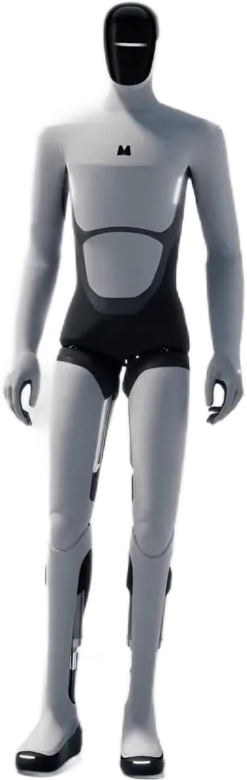
MATRIX-3 is a third-generation general-purpose humanoid robot developed by Matrix Robotics (formally Shanghai Matrix Superintelligent System Integration Co., Ltd.), a robotics and artificial intelligence company headquartered in Shanghai, China. First unveiled on January 10, 2026 and shown as a mass-production-ready platform at the company's AI Day in May 2026, MATRIX-3 stands about 170 cm tall, weighs roughly 65 kg, and runs on a self-developed physical AI model called WAVE. [1][2][15][16] Its most distinctive feature is a pair of 27-degree-of-freedom (DOF) cable-driven dexterous hands, called the "Lingxi Hand" (marketed in English as the "Intuitive Hand"), which match the approximate degrees of freedom found in a human hand and rank among the highest hand-DOF counts of any commercially targeted humanoid robot as of 2026. [1][3]
Built on the WAVE physical foundation model developed by Matrix Super Intelligence, MATRIX-3 is designed to achieve zero-shot neural generalization, meaning it can understand basic physical principles and execute novel tasks from natural language instructions without requiring task-specific training data. [15][16] Matrix Robotics has positioned MATRIX-3 as a platform for transitioning humanoid robots from scripted industrial machines into truly autonomous, general-purpose physical intelligence agents. CEO Zhang Haixing (Allen Zhang) framed the goal in stark terms at the robot's mass-production reveal: "We are not trying to replicate humans, but to create a new species that extends human capabilities and handles repetitive labor." [15]
Background and Company History
Matrix Robotics was founded by Zhang Haixing, who also goes by Allen Zhang in English-language communications. Zhang served as the founding leader of the Tesla China Design and Research Center, where he contributed to the development of the Tesla Optimus humanoid robot program, the autonomous robotaxi initiative, electric vehicles, and smart charging infrastructure. [2][3] He brings over 20 years of experience in product research and development, design, and technology entrepreneurship spanning consumer electronics, electric vehicles, and AI. As of its 2026 mass-production announcement, Matrix Robotics was a roughly two-year-old startup registered as Shanghai Matrix Superintelligent System Integration Co., Ltd. [15]
Before his tenure at Tesla, Zhang founded Crazybaby, a consumer electronics company that gained recognition for its innovative magnetic levitation Bluetooth speakers. The company's Mars speaker, which featured a flying saucer-shaped disc that levitated above a subwoofer column using patented magnetic technology, raised over $750,000 on Indiegogo in 2014. Crazybaby went on to win multiple design awards, including the German Red Dot Award for Product Design (2017), the Japan Good Design Award, and the CES Innovation Award for Best of Innovation. [13][14] Zhang holds over 100 patents and has received multiple international design accolades.
Applying lessons from both Tesla's robotics program and his consumer electronics background, Zhang founded Matrix Robotics with the stated mission of building humanoids capable of handling heavy, dangerous, and repetitive tasks in unstructured, real-world environments. The company's team includes specialists in AI, humanoid robotics, and autonomous driving.
Matrix Robotics also has a partnership with Star Dynamics Technology Co., Ltd., a joint venture established in September 2025 by Hongrun Construction Group (60% stake) and Matrix Super Intelligence (40% stake). Star Dynamics focuses on the research, development, production, and commercialization of humanoid robots, with plans for mass production of its Star-1 humanoid beginning in 2026. [9][10]
How does MATRIX-3 differ from Matrix-1?
The Matrix-1 was Matrix Robotics' first-generation humanoid robot, debuted in mid-2025. Standing 180 cm tall and weighing 67 kg, the Matrix-1 featured 22 DOF per hand, a 2.28 kWh custom battery enabling 5 hours of operation, walking speeds up to 7.6 km/h (1.2 m/s), and 10 kg payload capacity per arm. It was equipped with 8 onboard RGB cameras, LiDAR, and ultrasonic sensors for perception, along with an 8-core processor with integrated GPU running a real-time operating system. The Matrix-1 introduced the company's embodied manipulation model (MLM2.0) and vision language model integration for autonomous operation. [7][8]
MATRIX-3 represents a systematic reconstruction of both hardware and software compared to its predecessor. Key differences include:
- More compact form factor: MATRIX-3 eliminates the protruding rear enclosure that characterized the Matrix-1, resulting in a sleeker, more human-proportioned silhouette with a futuristic industrial design aesthetic.
- Higher hand dexterity: Hand DOF increased from 22 (Matrix-1) to 27 (MATRIX-3), with a transition to fully cable-driven actuation.
- Biomimetic skin: A new three-dimensional woven flexible fabric covers the chassis, integrating distributed sensing that was absent in the first generation.
- Enhanced AI architecture: The WAVE physical foundation model replaces the earlier MLM2.0 system, enabling zero-shot generalization rather than requiring environment-specific training. [15][16]
- Improved actuators: New integrated linear actuators (the "Bionic Super Joint" system) replace the prior generation's motor system, providing higher power density with lower noise output.
| Feature | Matrix-1 | MATRIX-3 |
|---|---|---|
| Height | 180 cm | ~170 cm |
| Weight | 67 kg | ~65 kg |
| Total DOF | Not disclosed | 37 |
| Hand DOF (per hand) | 22 | 27 |
| Hand actuation | Force-position hybrid | Cable-driven (tendon) |
| Biomimetic skin | No | Yes (3D woven fabric) |
| Tactile sensing | Fingertip only | Full-body distributed + fingertip |
| AI model | MLM2.0 (task-specific) | WAVE (zero-shot generalization) |
| Walking speed | 7.6 km/h | 3.9 km/h (max) |
| Battery | 2.28 kWh, 5 hr runtime | ~4 hr runtime |
| Payload | 10 kg per arm | 15-30 kg (dual arms, sources vary) |
| Status | Prototype/demo | Mass-production-ready (pilots mid-2026) |
Technical Specifications
Physical Design
MATRIX-3 stands approximately 170 cm tall and weighs about 65 kg, with a total of 37 degrees of freedom across its body. [15][16] The robot's exterior features a streamlined, futuristic design intended for safe operation alongside humans in shared spaces. The compact body eliminates the bulky rear battery enclosure of the Matrix-1, distributing components more evenly throughout the frame. In continuous operation the robot walks at up to 3.9 km/h and runs for about 4 hours on a single charge. [15][16] Reported payload figures vary between sources: the company's BEYOND Expo Macao materials cite a capacity of up to 15 kg using both arms, while coverage of the robot's AI Day reveal reported a 30 kg payload. [15][16] Matrix Robotics describes MATRIX-3 as integrating four core technologies: the WAVE physical foundation model, high-performance biomimetic linear joints, the 27-DOF dexterous hand, and 3D-woven biomimetic safety skin. [16]
Lingxi Hand: 27-DOF Dexterous Manipulation
The centerpiece of MATRIX-3's hardware is the Lingxi Hand, a five-fingered dexterous hand with 27 degrees of freedom per hand. [3] The joint architecture closely mirrors human hand anatomy, and the hand uses advanced cable-driven (tendon-driven) actuation to achieve an extremely lightweight profile while maintaining high-speed precision. In English-language materials Matrix Robotics markets the same hand as the "Intuitive Hand" and, in its premium configuration, as the "MATRIX HAND" package. [1][15][17]
Cable-driven hand designs route actuators to the forearm and transmit force through tendons to the finger joints, similar to how human hands work. This approach offers several advantages over motor-in-joint designs: it reduces the weight and bulk of the hand itself, allows for more degrees of freedom in a compact space, and enables more natural finger movements. The Lingxi Hand's 27 DOF matches the approximate degrees of freedom of a human hand, which is generally considered to have 27 independent DOFs across the fingers and thumb.
The hand is designed to perform a wide range of tasks, including:
- Operating standard tools (screwdrivers, wrenches, and other handheld instruments)
- Handling delicate instruments requiring precision grip
- Manipulating soft and deformable objects such as fabrics, paper, and food items
- Grasping fragile objects that require careful force regulation
Each fingertip integrates ultra-sensitive tactile sensor arrays capable of detecting pressure changes as low as 0.1 newtons. [2][3] This sensitivity enables the robot to perceive micro-force variations during contact, making it possible to interact safely with humans and handle fragile objects without damage. At BEYOND Expo Macao in May 2026, Matrix Robotics demonstrated the hand performing manipulation with what it described as micron-level accuracy. [16]
Hand DOF Comparison with Competing Humanoids
The 27-DOF Lingxi Hand places MATRIX-3 at or near the top of commercially targeted humanoid robots in terms of hand dexterity. For reference, the human hand has approximately 27 independent degrees of freedom. As of early 2026, the landscape of humanoid hand dexterity includes:
| Robot | Manufacturer | Hand DOF (per hand) | Actuation Type |
|---|---|---|---|
| MATRIX-3 | Matrix Robotics | 27 | Cable-driven (tendon) |
| Tesla Optimus Gen 3 | Tesla | 22 | Electric motor |
| 1X NEO | 1X Technologies | 20 | Electric motor |
| Figure 02 | Figure AI | 16 | Electric motor |
| Shadow Dexterous Hand | Shadow Robot Company | 24 | Pneumatic/electric |
| Robonaut 2 | NASA/GM | 22 | Tendon-driven |
| Human hand | N/A | ~27 | Tendon (biological) |
The Lingxi Hand's 27 DOF is notable because it achieves near-human-level articulation in a commercially targeted humanoid platform, rather than in a standalone research hand. [12] Most production humanoid robots sacrifice hand DOF to reduce cost and complexity, typically offering between 12 and 22 DOF per hand.
Bionic Super Joint System
The MATRIX-3's locomotion and upper-body movement are powered by a proprietary set of integrated linear actuators that Matrix Robotics calls the "Bionic Super Joint" system, described by the company as high-performance biomimetic linear joints. [16] These actuators combine high power density with low-noise operation, providing a stable and agile foundation for full-body coordination. The linear actuator design differs from the rotary motors used in many competing humanoids, offering advantages in certain types of linear motion and force application.
The joint system supports the robot's humanoid gait, which was trained on extensive human motion-capture datasets. According to Matrix Robotics, the resulting walking and navigation behavior is intended to be indistinguishable from human movement, with natural stride patterns, balance adjustments, and turning behavior. [1]
Biomimetic Skin and Tactile Sensing
MATRIX-3 introduces a pioneering approach to robot surface design through its three-dimensional woven biomimetic skin. This flexible fabric covers the robot's chassis and serves multiple functions:
- Physical protection and safety: The soft exterior cushions physical contact, reducing the risk of injury during human-robot interaction compared to hard-shelled robots.
- Distributed sensing network: Embedded beneath the skin surface is a network of sensors that detect impact force in real-time across the entire body, not just at the fingertips.
- Aesthetic and approachability: The soft, fabric-like surface gives MATRIX-3 a more approachable appearance compared to the exposed metal and plastic typical of most humanoid robots.
This is the first time biomimetic skin textures and high-dimensional tactile sensing have been deeply integrated in a Matrix Robotics product. [2] The combination of full-body distributed sensing with fingertip precision (0.1 N sensitivity) creates a layered perception system that provides what the company describes as "physical interaction intuition comparable to human touch." [2]
Perception System
MATRIX-3 uses a multimodal perception system that combines visual and tactile inputs:
- Vision system: Powered by a large-scale spatial perception foundation model, the visual system handles object detection, scene understanding, obstacle avoidance, and spatial mapping.
- Visual-tactile feedback loop: The system fuses visual data with tactile sensor inputs to assess material properties, object geometry, and grip stability in real-time. [15] This allows the robot to make judgments about how to grasp and manipulate objects based on both what it sees and what it feels.
- Depth estimation: Spatial perception capabilities enable three-dimensional environment mapping for navigation and task planning.
AI and Cognitive Architecture
WAVE Physical Foundation Model
The cognitive core of MATRIX-3 is WAVE, a self-developed physical foundation model created by Matrix Super Intelligence and, according to Humanoids Daily, paired with a proprietary computing architecture the company calls CAAI. [15] WAVE links perception, planning, and task execution into a unified system that Matrix Robotics refers to as its "embodied reasoning" framework. [16] Rather than treating perception, decision-making, and motor control as separate modules, the system integrates these functions to enable more fluid and adaptive behavior. WAVE replaces the MLM2.0 embodied manipulation model used in the first-generation Matrix-1.
Zero-Shot Neural Generalization
The most significant AI capability claimed for MATRIX-3 is zero-shot neural generalization. In the context of robotics, zero-shot generalization refers to a system's ability to perform tasks it has never been specifically trained on, by applying an understanding of general physical principles and transferring knowledge from related tasks. According to Matrix Robotics, WAVE "enables zero-shot generalization so the Matrix-3 humanoid can understand basic physical principles, interpret natural-language instructions, plan actions, and adapt to novel tasks in unstructured environments without extensive finetuning." [15]
Traditional industrial robots and many current humanoid platforms require specific programming or training data for each task they perform. If a robot is trained to pick up a cup, it may fail when presented with a differently shaped container. MATRIX-3's neural architecture is designed to overcome this limitation by:
- Understanding physical principles: The system models basic physics (gravity, friction, material deformation) to predict how objects will behave when manipulated.
- Following natural language instructions: Users can describe tasks in plain language, and the system translates these instructions into action plans without requiring pre-programmed routines.
- Autonomously planning grasping strategies: The robot can assess an unfamiliar object's properties through vision and touch, then determine an appropriate grasp type and force level.
- Dynamic adjustment: During task execution, MATRIX-3 continuously adjusts force and posture in real-time based on sensory feedback.
This capability, if fully realized, would represent a significant step toward general-purpose robot learning, where a single platform can handle diverse, unpredictable tasks in unstructured environments like homes, hospitals, and retail spaces.
Natural Language Interface
MATRIX-3 accepts natural language instructions, bridging the gap between human intent and robot action. Rather than requiring specialized programming or teach-pendant operation, users can communicate tasks conversationally. The system interprets these instructions through the WAVE model and generates corresponding motion plans. This approach builds on broader trends in large language model integration with robotic systems, where language understanding serves as an interface layer between human operators and physical agents. At its AI Day 2026, Matrix Robotics demonstrated natural-language task guidance and coordinated dual-robot operation. [15][18]
What is MATRIX-3 used for?
Matrix Robotics has identified several sectors for MATRIX-3 deployment:
- Manufacturing and logistics: Handling repetitive, physically demanding, or dangerous tasks on production lines and in warehouses.
- Commercial services: Operating in retail, hospitality, and customer-facing roles where safe human interaction is essential.
- Medical assistance: Supporting healthcare workers in clinical environments where gentle, precise manipulation is required.
- Home environments: Performing domestic tasks that require the flexibility and dexterity to operate in unstructured spaces designed for humans.
The combination of soft biomimetic skin, sensitive touch, and zero-shot task generalization is specifically intended to make MATRIX-3 suitable for environments where close human contact is unavoidable, a domain where traditional hard-shelled industrial robots with rigid programming are poorly suited. [3]
Availability, Pricing, and Mass Production (2026)
When was MATRIX-3 released and when will it ship?
Matrix Robotics first unveiled MATRIX-3 on January 10, 2026, and launched an Early Access Program in early 2026, inviting select industry partners to participate in evaluation and pilot deployment. [2][3] Initial pilot deployments are scheduled to begin in mid-2026. Zhang Haixing has stated that the company intends to control the per-unit price of its robots at a level affordable to the general public within two to three years, with the goal of bringing humanoid robots to consumer end-users. [10] Large-scale manufacturing of MATRIX-3 is expected to begin in the second half of 2026, though the timeline is contingent on the results of the early access program and further technical validation.
How much does MATRIX-3 cost?
MATRIX-3 is priced at approximately $85,000 USD for the base configuration. [4][11] The premium MATRIX-3 PRO, which bundles the dexterous MATRIX HAND package, starts at $99,000 USD according to Humanoids Daily. [15] Alongside outright sales, Matrix Robotics has introduced a Robot-as-a-Service (RaaS) ecosystem, allowing customers to access the platform through a service model rather than an upfront purchase. [15]
Matrix AI Day 2026 and the MFH factory
At its AI Day held in Shanghai in May 2026, Matrix Robotics unveiled a mass-production-ready iteration of MATRIX-3, publicly introducing the WAVE physical foundation model and commissioning its own manufacturing facility. [15][18] The Matrix Fabrication Hall (MFH), located in the Zhangjiang area of Pudong, Shanghai, is designed for end-to-end in-house production of the robot. [15][16] Matrix Robotics has said the MFH factory is capable of delivering 5,000 units during 2026 and targets an output of 100,000 units by 2027; Humanoids Daily reported a planned annual production capacity of around 10,000 units. [15][16] These figures place Matrix Robotics among the Chinese humanoid developers, alongside firms such as Agibot and 1X, pursuing aggressive early-volume manufacturing.
BEYOND Expo Macao 2026
Matrix Robotics presented MATRIX-3 at the BEYOND Expo held May 27-30, 2026 at The Venetian Macao Cotai Expo, one of Asia's largest technology exhibitions. [16] At the event the company highlighted the robot's four core technologies and demonstrated its motion performance and dexterous manipulation to industry visitors, who praised its "design, motion performance, operational accuracy and interaction safety." [16] The showcase followed the AI Day reveal and marked one of MATRIX-3's higher-profile public appearances outside mainland China.
Is MATRIX-3 real hardware or CGI?
The January 2026 unveiling of MATRIX-3 attracted both excitement and skepticism within the robotics community. The announcement relied heavily on computer-generated imagery (CGI) rather than live demonstrations of physical hardware. RoboHorizon, a robotics-focused publication, noted that the presentation "remains just that, a vision, rendered in glorious CGI until a physical prototype proves otherwise," adding that the publication would "keep enthusiasm on standby until we see actual hardware moving with the grace promised in the animation." [5]
This skepticism reflects a broader pattern in the humanoid robotics industry, where promotional materials and rendered videos frequently outpace demonstrated physical capabilities. Several Chinese and international humanoid robotics companies have faced similar criticism for marketing robots through cinematic CGI before showing real-world performance. The gap between CGI promises and hardware reality remains one of the key challenges for evaluating claims made by humanoid robot developers. [6]
By May 2026, Matrix Robotics moved to address these doubts, presenting what it described as a mass-production-ready MATRIX-3 at its AI Day in Shanghai and at BEYOND Expo Macao, where visitors observed the robot's motion and manipulation firsthand rather than in rendered video. [16][18] CEO Allen Zhang has acknowledged the importance of physical validation, stating: "The philosophy of MATRIX-3 is to integrate machine intelligence into human physical spaces as naturally and safely as possible." [1] The mid-2026 pilot deployments will serve as the first opportunity for independent, at-scale evaluation of MATRIX-3's real-world capabilities.
Competitive Context
MATRIX-3 enters an increasingly crowded humanoid robotics market. As of 2026, major competitors include:
- Tesla Optimus: Tesla's Gen 3 Optimus features 22-DOF hands and 50 total DOF across its body, with plans for factory deployment and eventual consumer sales.
- Figure AI Figure 02: Backed by significant venture funding, Figure 02 offers 16-DOF hands with human-equivalent load capacity of up to 25 kg.
- 1X Technologies NEO: Funded in part by OpenAI, the NEO features 20-DOF hands and targets household applications.
- Unitree Robotics: Known for agile quadrupeds, Unitree's humanoid entries emphasize speed and athletic performance.
- Boston Dynamics: The Atlas platform remains a benchmark for dynamic mobility, though it is positioned primarily as a research platform.
MATRIX-3 differentiates itself primarily through hand dexterity (27 DOF, the highest among these competitors), biomimetic tactile skin, and its claimed zero-shot generalization. However, the robot's lack of extensive publicly demonstrated hardware performance at its January launch, and its reliance on CGI marketing at that stage, placed it behind competitors like Tesla and Figure AI that have shown extensive real-world video demonstrations; the May 2026 AI Day and BEYOND Expo appearances narrowed that gap. [16][18]
The Chinese humanoid robotics ecosystem has grown rapidly, with local governments committing significant funding to humanoid robotics development. Matrix Robotics operates within this ecosystem alongside companies such as Unitree Robotics, Agibot, Galbot, and others racing to deliver commercially viable humanoid platforms.
Technical Specifications Summary
| Category | Specification | Value |
|---|---|---|
| Physical | Height | ~170 cm |
| Physical | Weight | ~65 kg |
| Physical | Form factor | Compact (no rear protrusion) |
| Mobility | Total degrees of freedom | 37 |
| Mobility | Walking speed | Up to 3.9 km/h |
| Power | Battery runtime | ~4 hours per charge |
| Manipulation | DOF per hand | 27 |
| Manipulation | Hand name | Lingxi Hand (English: Intuitive Hand) |
| Manipulation | Fingers per hand | 5 |
| Manipulation | Hand actuation | Cable-driven (tendon) |
| Manipulation | Payload | 15-30 kg (dual arms, sources vary) |
| Sensing | Fingertip tactile sensitivity | 0.1 N |
| Sensing | Body tactile sensing | Distributed (biomimetic skin) |
| Sensing | Vision | Spatial perception foundation model |
| Actuators | Type | Integrated linear (Bionic Super Joint) |
| Computing | AI model | WAVE physical foundation model |
| Computing | LLM integration | Yes |
| Computing | Generalization | Zero-shot |
| Availability | Price (base) | ~$85,000 USD |
| Availability | Price (PRO with MATRIX HAND) | From $99,000 USD |
| Availability | Status | Mass-production-ready |
| Availability | Factory | MFH, Zhangjiang, Shanghai |
| Availability | Production target | 5,000 units (2026); 100,000 (by 2027) |
| Availability | Pilot deployment | Mid-2026 |
| Availability | Target markets | Manufacturing, logistics, healthcare, service, home |
Videos
See Also
- Matrix Robotics
- Matrix-1
- Humanoid robot
- Embodied AI
- Physical AI
- Robot learning
- Robot-as-a-Service
- Tesla Optimus
- Figure AI
References
- ^1 ^2 ^3 ^4 ^5Matrix Robotics official MATRIX-3 page
- ^1 ^2 ^3 ^4 ^5 ^6"China's new humanoid robot senses delicate touch with soft skin tech" - Interesting Engineering, January 13, 2026
- ^1 ^2 ^3 ^4 ^5 ^6"Matrix Robotics Unveils MATRIX-3, Next-Generation Humanoid Robot with Advanced Physical AI" - TMTPOST, January 13, 2026
- ^MATRIX-3 Humanoid Robot specifications - Aparobot
- ^"MATRIX-M3 Humanoid Debuts With Impressive CGI and Big Promises" - RoboHorizon, January 10, 2026
- ^CyberRobo commentary on MATRIX-3 design improvements - X (formerly Twitter)
- ^Matrix Robotics official MATRIX-1 page
- ^Matrix-1 specifications - Aparobot
- ^"China's Star Dynamics Unveils First Humanoid Robot" - Yicai Global
- ^1 ^2Zhang Haixing on Star Dynamics mass production plans - Webull News
- ^MATRIX-3 product listing - Humanoid.guide
- ^"Tesla Introduces More Lifelike Optimus Robot Hand With 22 Degrees of Freedom" - AI News
- ^Crazybaby official about page
- ^"Air by crazybaby triumphs in Red Dot Award: Product Design 2017" - Crazybaby Press
- ^1 ^2 ^3 ^4 ^5 ^6 ^7 ^8 ^9 ^10 ^11 ^12 ^13 ^14 ^15 ^16 ^17 ^18"Matrix Robotics Enters the Mass Production Race with the $99,000 MATRIX-3" - Humanoids Daily, May 19, 2026
- ^1 ^2 ^3 ^4 ^5 ^6 ^7 ^8 ^9 ^10 ^11 ^12 ^13 ^14 ^15 ^16"Matrix Robotics Presents MATRIX-3 at BEYOND Expo Macao" - Media OutReach Newswire via The Manila Times, May 28, 2026
- ^Matrix Robotics official website (WAVE model and Intuitive Hand)
- ^1 ^2 ^3 ^4MATRIX AI DAY 2026 Highlights - YouTube
Improve this article
Add missing citations, update stale details, or suggest a clearer explanation. Every suggestion is reviewed for sourcing before it goes live.
4 revisions · v5 · 3,980 words · full history
Fact-checks are independent of edits: a reviewer re-verifies the article against its sources and stamps the date. How we verify
Research and drafting on this wiki are AI-assisted, under named human editorial standards. How AI is used here
Cite this page: AI Wiki. "MATRIX-3." aiwiki.ai, updated 7 Jul 2026. CC BY 4.0. https://aiwiki.ai/wiki/matrix_robotics_matrix_3