

Rainbow Robotics RB-Y1
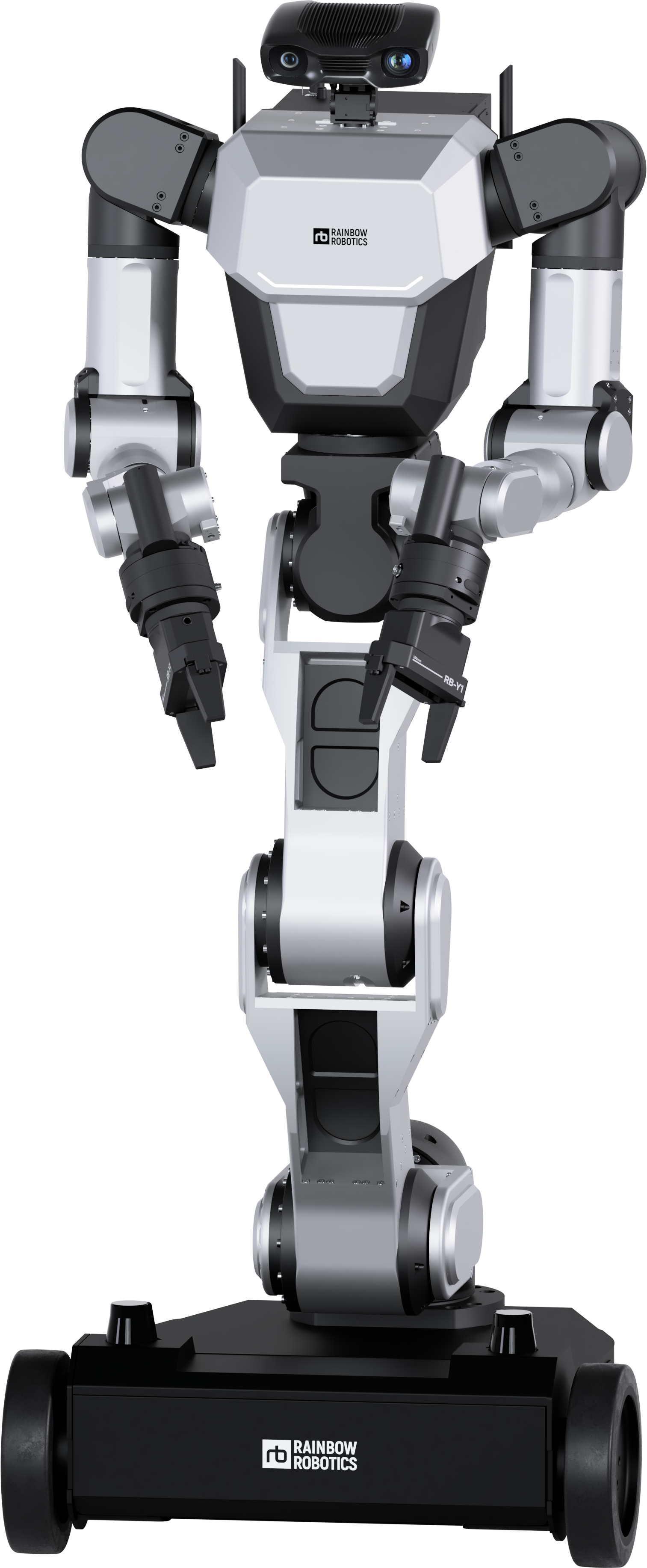
The Rainbow Robotics RB-Y1 is a dual-arm wheeled mobile manipulator built by Rainbow Robotics, the Samsung-backed South Korean robot maker spun out of KAIST's HUBO humanoid program. Unveiled in March 2024 and marketed as "the world's first research platform for AI experts," the RB-Y1 pairs a humanoid upper body of two 7-degree-of-freedom (DOF) arms on a 6-axis torso with a high-speed wheeled base, totaling 24 degrees of freedom, and sells for $80,000 in its research configuration.[1][2][3] Rather than walk on two legs, it rolls at up to 2.5 m/s, a deliberate choice to deliver dexterous bimanual manipulation for industrial automation and AI manipulation research at a lower cost and higher reliability than full bipedal humanoid robots.[2][3]
| RB-Y1 | |
|---|---|
 | |
| General information | |
| Manufacturer | Rainbow Robotics |
| Country of origin | South Korea |
| Year unveiled | March 2024 |
| Status | Production |
| Price | $80,000 (Research) / $120,000 (Commercial) |
| Availability | Shipping (pre-order backlog) |
| Website | rainbow-robotics.com |
Rainbow Robotics positioned the RB-Y1 explicitly for the generative-AI era. At the launch the company stated: "These days, when Generative AI such as ChatGPT and Figure is a hot topic in the robot industry, we have developed a bimanual mobile manipulator in line with the AI era," adding that it hoped the platform would "overcome the limitations of existing industrial robots and be used in many industrial sites."[2] The robot was first shown at the 2024 Smart Factory Automation Industry Exhibition (SF+AW 2024) in South Korea, with pre-orders opening on May 8, 2024 and deliveries beginning that October. Leading research institutions including MIT, UC Berkeley, the University of Washington, and Georgia Tech have adopted the platform.[2][3] Its development reflects Rainbow Robotics' heritage as a spin-off from KAIST (Korea Advanced Institute of Science and Technology), the institution whose team won the DARPA Robotics Challenge in 2015 with the DRC-HUBO humanoid robot.[4]
What is the Rainbow Robotics RB-Y1?
The RB-Y1 is a semi-humanoid, or wheeled bimanual, mobile manipulator: a humanoid torso and two arms mounted on a mobile base with wheels instead of legs. It is described by Rainbow Robotics as South Korea's first bimanual mobile manipulator and the world's first such platform sold commercially as a standardized research tool for AI roboticists.[2][3] The design bridges the gap between traditional industrial collaborative robots (cobots) and fully bipedal humanoid robots, offering 24 total degrees of freedom across its arms, torso, grippers, and wheels.[1][2]
Background: Rainbow Robotics and HUBO Heritage
Origins at KAIST
Rainbow Robotics was founded on February 10, 2011, by Professor Oh Jun-ho and a team of researchers from KAIST's Humanoid Robot Research Center in Daejeon, South Korea.[5] Professor Oh, who has served on the KAIST faculty in the Department of Mechanical Engineering since 1985, led the university's humanoid robotics program from its inception in 2000. He earned his Ph.D. from the University of California, Berkeley, and previously worked at the Korea Atomic Energy Research Institute before joining KAIST.[6]
The KAIST robotics team produced a series of increasingly capable humanoid prototypes before founding Rainbow Robotics. The first prototype, KHR-0, was a pair of walking legs without an upper body, completed in 2001. KHR-1 followed in 2003 as a more complete humanoid lacking a head and hands. KHR-2, finished in 2004, represented the first fully complete humanoid from the lab. The culmination of this early work was KHR-3, publicly known as HUBO, which was released on January 6, 2005. Standing 125 cm tall and weighing 56 kg, HUBO featured 66 degrees of freedom, voice recognition, independent eye movement, and finger dexterity sufficient for playing rock-paper-scissors.[7]
Commercializing HUBO
The impetus for founding Rainbow Robotics came in 2010, when the KAIST team received purchase inquiries from American universities and the Singapore government for HUBO robots. To handle production and support, the researchers established Rainbow Robotics in February 2011. The company produced 15 units of the HUBO-2 Plus by 2012, distributing them to research institutions in the United States, Japan, Singapore, and China. Notable early exports included six HUBO II units to MIT in December 2011 (supported by the U.S. National Science Foundation) and two HUBO II units to Google in September 2013.[5]
How did Rainbow Robotics win the DARPA Robotics Challenge?
The defining moment for both KAIST's robotics program and Rainbow Robotics came on June 6, 2015, when Team KAIST's DRC-HUBO won the DARPA Robotics Challenge Finals in Pomona, California. The robot completed all eight disaster-response tasks in 44 minutes and 28 seconds, defeating 22 other robots from five countries and claiming the $2 million grand prize.[4][8]
The DRC-HUBO's key innovation was its "transformer" capability: the robot could switch between bipedal walking and rolling on four wheels using knee-mounted wheels. This dual-mode locomotion proved faster and more stable than pure bipedal walking, significantly reducing the risk of falls that plagued many competing robots during the challenge. The eight tasks included driving a vehicle, exiting a vehicle, opening a door, turning a valve, drilling a hole in a wall, completing a surprise manipulation task, traversing rubble, and climbing stairs.[8][9]
This victory established KAIST and its commercial arm, Rainbow Robotics, as world-class leaders in humanoid robotics, providing the technical foundation and international reputation that would later inform the RB-Y1's development.
Company Profile: Rainbow Robotics
Collaborative Robot Product Line
Before developing the RB-Y1, Rainbow Robotics built a substantial business around collaborative robots (cobots). The company's RB series cobots are six-axis robotic arms designed for safe human-robot collaboration in industrial settings. Rainbow Robotics develops essential cobot components in-house, including actuators, encoders, brakes, and controllers. All RB series products carry NRTL, CE, and KCs certifications, verified by TUV SUD.[10]
The RB series cobot lineup includes:
| Model | Payload | Reach | Weight | Repeatability |
|---|---|---|---|---|
| RB3-730 | 3 kg | 730 mm | ~22 kg | +/-0.05 mm |
| RB3-1200 | 3 kg | 1,200 mm | 22.4 kg | +/-0.05 mm |
| RB5-850 | 5 kg | 927.7 mm | 22 kg | +/-0.05 mm |
| RB10-1300 | 10 kg | 1,300 mm | 37 kg | +/-0.05 mm |
| RB16-900 | 16 kg | 900 mm | 32 kg | +/-0.05 mm |
The RB series runs on a custom Linux-based real-time operating system developed by Rainbow Robotics. Control is handled through Android-based tablets, with Windows operation also supported. Safety functions such as collision detection enable the cobots to work directly alongside human operators in applications including welding, grinding, CNC machine tending, palletizing, and packaging.[10]
Broader Product Portfolio
Beyond cobots, Rainbow Robotics offers a diverse range of products. The company produces an autonomous mobile robot (AMR) using grid-free SLAM (Simultaneous Localization and Mapping) technology for autonomous navigation. Other products include a quadruped robot, barista and cocktail robots (including the Milk Tea Barista developed jointly with ROBA ROBO), a medical laser toning system, media service robots, and astronomy mount systems.[5]
KOSDAQ Listing and Financial Milestones
Rainbow Robotics went public on the KOSDAQ exchange on February 3, 2021, trading under the ticker symbol 277810. The listing made Rainbow Robotics one of the first dedicated humanoid robotics companies to trade on a public stock exchange in South Korea, establishing a benchmark for the country's growing robotics startup ecosystem.[11] KAIST has since been recognized as a "cradle of Korean robotics," with Rainbow Robotics' successful IPO paving the way for other robotics startups from the university, such as Angel Robotics (specializing in rehabilitation and medical robots), to attract investment and pursue public listings.[12]
Why did Samsung acquire Rainbow Robotics?
The most significant corporate development for Rainbow Robotics came through a series of investments by Samsung Electronics. In January 2023, Samsung acquired a 14.7% stake in Rainbow Robotics for approximately KRW 86.8 billion (roughly $59 million USD). Then, on December 30, 2024 (announced December 31, 2024), Samsung said it would exercise a call option to increase its stake to 35%, paying an additional KRW 267 billion (approximately $181 million USD) to become the company's largest shareholder.[13][14]
As part of this expanded investment, Samsung established a Future Robotics Office reporting directly to its CEO. Dr. Oh Jun-ho, Rainbow Robotics' co-founder and honorary professor at KAIST, was appointed as an advisor to Samsung and head of the Future Robotics Office after stepping back from his role at Rainbow Robotics. Samsung stated that combining its capabilities with Rainbow Robotics "will accelerate the development of intelligent advanced humanoids," with plans to deploy the RB series cobots, the RB-Y1 dual-arm mobile manipulator, and AMRs to automate manufacturing and logistics tasks while AI algorithms let the robots learn from situational data.[14][15]
Rainbow Robotics was incorporated as a subsidiary under Samsung Electronics' consolidated financial statements, with the deal completed in early 2025. The acquisition placed Samsung in direct competition with Hyundai Motor Group, which acquired an 80% controlling stake in Boston Dynamics in December 2020, in what has become a strategic race between South Korea's largest conglomerates to lead the global humanoid robotics and physical-AI market.[15][16]
U.S. Operations
In 2023, Rainbow Robotics established a local corporation in Schaumburg, Illinois, with a dedicated collaborative robot sales and customer management organization, followed by a branch office in the United States to support its growing North American customer base.[5]
RB-Y1 Design and Technical Specifications
Why is the RB-Y1 wheeled instead of bipedal?
The RB-Y1 was conceived as a platform that bridges the gap between traditional industrial cobots and fully bipedal humanoid robots. Rather than pursuing the technically challenging and energy-intensive approach of bipedal locomotion, Rainbow Robotics opted for a wheeled mobile base combined with a highly dexterous humanoid upper body. This design choice prioritizes practical utility, reliability, and deployment readiness for real-world industrial and research environments over the spectacle of human-like walking.[2]
The robot draws directly on Rainbow Robotics' proven cobot technology. The electric actuators and harmonic drive reducers used in the RB-Y1's arms are the same industrial-grade components found in the company's RB series collaborative robots, ensuring precision and durability already validated through years of industrial deployment.[1]
What are the RB-Y1's specifications?
The RB-Y1 is a semi-humanoid platform consisting of three main sections: an upper body (38 kg), a lower body with the torso mechanism (42 kg), and a mobile base (51 kg), for a total weight of 131 kg. The overall dimensions are 600 mm wide, 690 mm deep, and 1,400 mm tall.[1][2]
| Category | Specification | Value |
|---|---|---|
| Dimensions | Width x Depth x Height | 600 x 690 x 1,400 mm |
| Weight | Upper body | 38 kg |
| Weight | Lower body | 42 kg |
| Weight | Mobile base | 51 kg |
| Weight | Total | 131 kg (289 lbs) |
| DOF | Arms (each) | 7 DOF |
| DOF | Torso/leg | 6 DOF |
| DOF | Grippers (each) | 1 DOF |
| DOF | Wheels (each) | 1 DOF |
| DOF | Total | 24 DOF |
| DOF | Axes excluding wheels | 22 axes |
| Payload | Per arm | 3 kg (6.6 lbs) |
| Payload | Combined | 6 kg (13.2 lbs) |
| Mobility | Max speed | 2.5 m/s (9.0 km/h / 5.6 mph) |
| Mobility | Operational velocity | 1.5 m/s |
| Power | Battery | 50V, 25Ah (1,270 Wh) |
| Power | Runtime | Approximately 3 to 4 hours |
Arm and Torso System
Each of the RB-Y1's two arms features 7 degrees of freedom, providing the kinematic flexibility needed for complex bimanual manipulation tasks. The 7-DOF configuration allows the arms to reach around obstacles and approach objects from multiple angles, closely mimicking the range of motion of a human arm. Each arm can lift a payload of 3 kg.[1][2]
The torso is mounted on a 6-axis single-leg mechanism that provides over 50 cm of vertical height adjustment. This allows the robot to raise or lower its working height to interact with objects at different elevations, from floor level to tabletop height and above. The 6-DOF torso also contributes to whole-body coordination, enabling the robot to shift its center of gravity during dynamic operations for stability; Rainbow Robotics notes the robot can accelerate quickly and turn at higher speeds by leaning the body into the turn.[2]
Rainbow Robotics employs a 20-axis whole-body control system (the two 7-DOF arms plus the 6-DOF torso) that manages gravity compensation and ensures safe, coordinated movement across all upper-body joints simultaneously. This whole-body control enables smooth, high-speed turns and rapid acceleration without losing balance on the wheeled platform.[1][2]
Mobile Base
The RB-Y1's lower section is a wheel-type high-speed mobile platform capable of a maximum driving speed of 2.5 m/s (approximately 5.6 mph). The standard configuration uses differential-drive wheels, though Rainbow Robotics announced an optional Mecanum Wheel System at ICRA 2025 that enables full 360-degree omnidirectional movement for improved maneuverability in tight environments.[3][17]
The mobile base houses a 50V, 25Ah lithium battery pack with a total capacity of 1,270 Wh, providing an estimated runtime of 3 to 4 hours depending on the intensity of operation.[1]
Sensor and Perception Capabilities
The RB-Y1 SDK supports integration with a variety of sensor modules, including an inertial measurement unit (IMU), various gripper types, and LiDAR for environmental mapping and navigation. The modular sensor architecture allows researchers and integrators to customize the robot's perception stack to suit their specific application requirements.[3][17]
Software and Development Platform
Is the RB-Y1 SDK open source?
Rainbow Robotics provides an open-source software development kit (SDK) for the RB-Y1, released under the Apache 2.0 license. The SDK is available on GitHub at RainbowRobotics/rby1-sdk and can also be installed via pip (pip install rby1-sdk). It supports both Python and C++ programming interfaces.[18]
The Python API provides command builders, feedback handlers, and utility modules suited for rapid prototyping and AI research workflows. The C++ API is designed for real-time control applications requiring deterministic communication. Cross-platform serialization is handled through Protocol Buffers (Protobuf) definitions.[18]
Key SDK capabilities include:
- Joint position, velocity, and impedance control
- Cartesian space control commands
- Gravity compensation mode
- Optimal control
- SE2 velocity commands for mobile base navigation
- Real-time command streaming and state feedback
- Gripper integration and Dynamixel bus utilities
- Battery monitoring, WiFi configuration, LED control, and fault diagnostics
- Log streaming for debugging
How do you teach and train the RB-Y1?
The RB-Y1 supports multiple control interfaces for programming and training. The primary method is master-slave teaching, where a data arm (master) is physically linked to the robot's arm (slave), allowing operators to demonstrate desired movements that the robot records and reproduces. The system includes built-in self-collision prevention that defines safe zones for both arms during the teaching process.[1][2]
At ICRA 2025, Rainbow Robotics demonstrated additional control interfaces including a touchpad and joystick interface, VR device-based teleoperation, and an enhanced master arm control system, broadening the range of interaction modalities available to researchers.[17]
The platform also includes an established simulation environment designed for AI training integration, enabling researchers to develop and test control policies in simulation before deploying them on the physical robot.[2]
Pricing, Availability, and Adoption
How much does the RB-Y1 cost?
Rainbow Robotics opened pre-orders for the RB-Y1 on May 8, 2024. The platform is offered in two configurations: a research platform priced at $80,000 USD and a commercial platform priced at $120,000 USD, both excluding VAT. Deliveries began in October 2024.[3][19]
Since its debut, the RB-Y1 has attracted pre-orders from institutions worldwide. Notable early adopters include MIT, UC Berkeley, the University of Washington, and Georgia Tech, as well as companies across various industries. The platform is positioned as a research tool for AI-driven manipulation studies, flexible industrial automation prototyping, and government laboratory operations.[3][17]
How does the RB-Y1 compare to other humanoid platforms?
Compared to other platforms in the emerging humanoid robot market, the RB-Y1 occupies a distinct niche. It prioritizes manipulation precision and research accessibility over dynamic bipedal locomotion. At $80,000 for the research configuration, it is less expensive than platforms like the Fourier Intelligence GR-1 (estimated at $150,000 to $170,000) but more expensive than some legged platforms. The trade-off is that the RB-Y1's wheeled base cannot navigate stairs or unstructured terrain, while its 3 kg per-arm payload is lower than heavy-duty humanoids designed for logistics applications.[20]
Role in South Korea's Robotics Ecosystem
The RB-Y1 is part of a broader wave of humanoid robotics development in South Korea, driven by both private investment and government support. South Korea's Ministry of Trade, Industry and Energy (MOTIE) allocated approximately KRW 200 billion ($150 million USD) in 2025 to support R&D, infrastructure, and testing initiatives for humanoid robot development. The government launched the K-Humanoid Alliance to coordinate efforts across the industry.[16][21]
The competitive landscape among South Korea's conglomerates illustrates the strategic importance placed on humanoid robotics. Samsung's acquisition of Rainbow Robotics directly parallels Hyundai's earlier acquisition of Boston Dynamics. Other major Korean technology companies, including LG and Naver, have also entered the AI robotics space with their own initiatives. KAIST continues to serve as a primary incubator for robotics startups, with multiple companies founded by its alumni and faculty now attracting significant investment and pursuing commercialization.[12][16]
The global humanoid robot market is projected to exceed $38 billion by 2035, and South Korean companies are positioning themselves to capture a significant share. The RB-Y1 represents Rainbow Robotics' and, by extension, Samsung's entry into this market, combining decades of humanoid robotics research dating back to the original HUBO with modern AI-ready software platforms designed for the age of large language models and foundation models in robotics.[16]
See Also
- Humanoid robot
- Rainbow Robotics
- DARPA Robotics Challenge
- Collaborative robot
- Boston Dynamics
- Samsung
- KAIST
- Mobile manipulator
References
- ^1 ^2 ^3 ^4 ^5 ^6 ^7 ^8Rainbow Robotics RB-Y1 Official Product Page
- ^1 ^2 ^3 ^4 ^5 ^6 ^7 ^8 ^9 ^10 ^11 ^12 ^13Rainbow Robotics unveils RB-Y1, Korea's first bimanual mobile manipulator - PR Newswire, April 2024
- ^1 ^2 ^3 ^4 ^5 ^6 ^7 ^8Rainbow Robotics begins pre-orders of RB-Y1, the world's first research platform for AI experts, for $80,000 USD - PR Newswire, May 2024
- ^1 ^2South Korea's Team KAIST wins 2015 DARPA Robotics Challenge - New Atlas
- ^1 ^2 ^3 ^4Rainbow Robotics - Wikipedia
- ^The essential interview: Humanoid robot researcher Dr. Jun Ho Oh - The Robot Report
- ^HUBO - Wikipedia
- ^1 ^2How South Korea's DRC-HUBO Won the DARPA Robotics Challenge - IEEE Spectrum
- ^A Transformer Wins DARPA's $2 Million Robotics Challenge - MIT Technology Review
- ^1 ^2Rainbow Robotics RB Series Collaborative Robots
- ^Rainbow Robotics (KOSDAQ:277810) Stock Overview - Stock Analysis
- ^1 ^2KAIST robotics startups step into the real world - The Korea Herald
- ^Samsung Elec to invest $46 mn in S.Korean robot maker - KED Global, January 2023
- ^1 ^2Samsung pays $181M to become largest shareholder of Rainbow Robotics - TechCrunch, December 2024
- ^1 ^2Samsung Electronics To Become Largest Shareholder in Rainbow Robotics - Samsung Global Newsroom
- ^1 ^2 ^3 ^4Samsung joins humanoid robots race with larger stake in Rainbow Robotics - KED Global, December 2024
- ^1 ^2 ^3 ^4Rainbow Robotics to Unveil Next-Gen Humanoid Technologies at ICRA 2025 - RoboticsTomorrow
- ^1 ^2RB-Y1 SDK - GitHub (RainbowRobotics/rby1-sdk)
- ^Rainbow Robotics begins pre-orders of RB-Y1 - RoboticsTomorrow
- ^Rainbow Robotics RB-Y1 Review: Price and Specs - Robozaps
- ^K-Humanoid Alliance Launches to Lead Next-Gen Robotics Revolution - WOWTALE
Improve this article
Add missing citations, update stale details, or suggest a clearer explanation. Every suggestion is reviewed for sourcing before it goes live.
9 revisions · v9 · 3,233 words · full history
Fact-checks are independent of edits: a reviewer re-verifies the article against its sources and stamps the date. How we verify
Research and drafting on this wiki are AI-assisted, under named human editorial standards. How AI is used here
Cite this page: AI Wiki. "Rainbow Robotics RB-Y1." aiwiki.ai, updated 23 Jun 2026. CC BY 4.0. https://aiwiki.ai/wiki/rainbow_robotics_rb_y1