

TeknTrash ALPHA
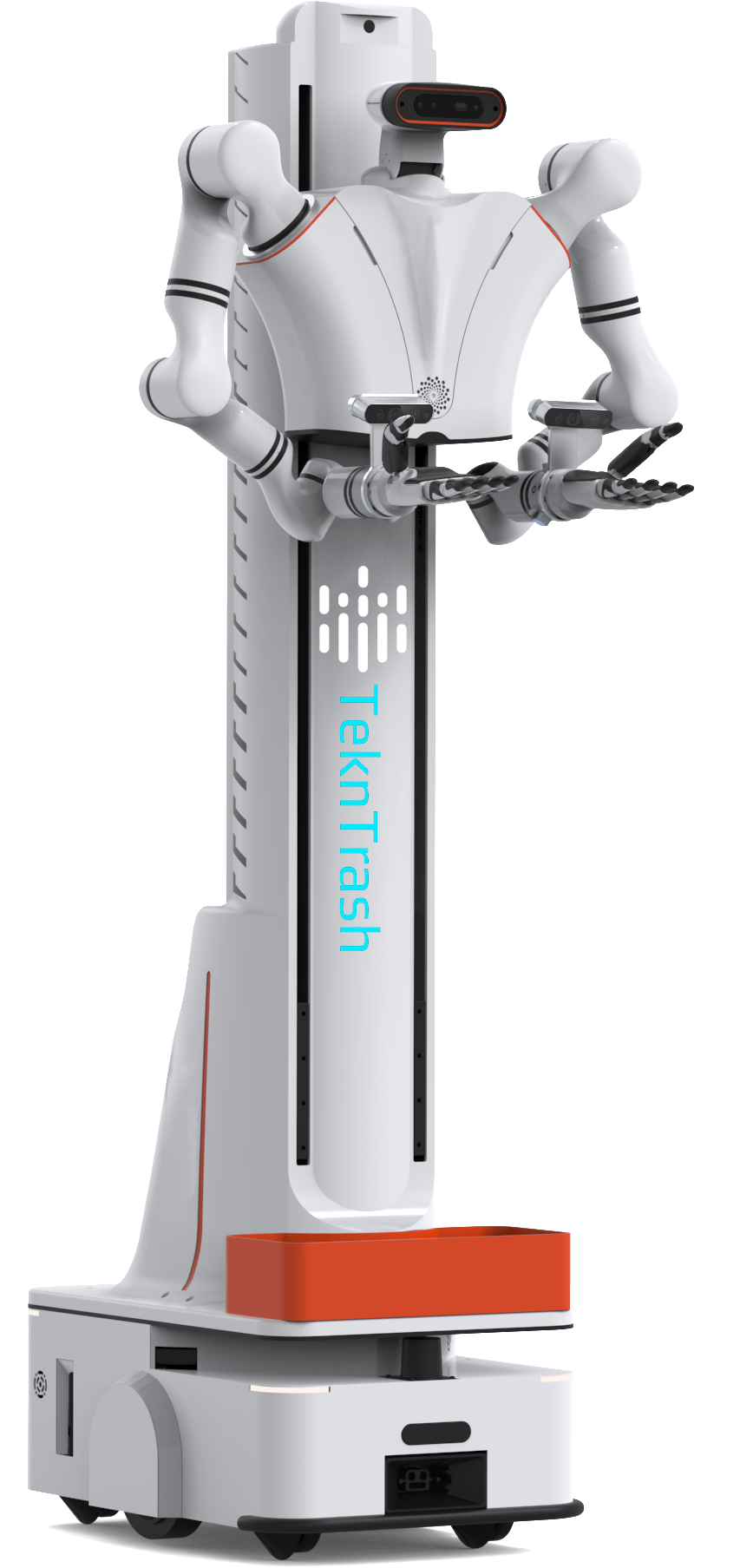
ALPHA (short for Automated Litter Processing Humanoid Assistant) is a humanoid robot developed by TeknTrash Robotics, a United Kingdom-based company specializing in AI-powered robotics and motion intelligence for waste management. ALPHA is designed specifically for waste sorting and recycling operations, targeting the repetitive, unsanitary, and hazardous tasks performed by human workers on picking lines at recycling facilities. The robot features dual 6-degree-of-freedom arms equipped with grippers trained through virtual reality motion capture, hyperspectral imaging for material identification beyond the visible spectrum, and cloud-based artificial intelligence processing through NVIDIA Isaac Lab and the GR00T framework.
 | |
| Developer | TeknTrash |
| Type | Humanoid robot |
| Full name | Automated Litter Processing Humanoid Assistant |
| Country of origin | United Kingdom |
| Status | Prototype / Pilot testing |
| Announced | 2025 |
| Height | 200 cm (6 ft 7 in) |
| Weight | 90 kg (198 lb) |
| Degrees of freedom | 13 total; 6 per arm |
| Battery life | Up to 7 hours |
| Arm payload | 5 kg (11 lb) |
| Compute | NVIDIA Jetson AGX Orin 64 (275 TOPS) |
| Vision | Hyperspectral cameras (UV, NIR, MWIR) |
| Business model | Robotics as a Service (RaaS) |
| Website | tekntrash.com/alpha |
Unlike most competitors in the robotic waste sorting space, which rely on stationary robotic arms mounted beside conveyor belts, ALPHA takes a humanoid form factor. The robot moves autonomously along rails, coordinates with multiple units in a fleet, and adapts dynamically to operational conditions. TeknTrash operates on a Robotics as a Service (RaaS) model, renting ALPHA units to recycling facilities rather than selling them outright, with pricing aligned to the salaries of the human teams they augment. As of early 2026, ALPHA is undergoing real-world pilot testing at Sharp Group's recycling facility in Rainham, East London, with plans for deployment across 1,000 European plants within 24 months.
Background
TeknTrash Robotics
TeknTrash was founded in 2019 and is headquartered in London, United Kingdom. The company was co-founded by Al Costa, a serial entrepreneur who previously sold his first startup to a NASDAQ-listed company and went on to found five additional companies across the United States, the United Kingdom, Brazil, Spain, and China.[1] Costa holds a BA in biology and a master's degree in computer engineering, a combination he has described as giving him a perspective on robotics and AI that draws from both technical and biological approaches.[2] He has also authored five books, including a science-fiction novel, and taught Big Data and Machine Learning at EAE University in Spain.[3]
TeknTrash was originally conceived around the observation that waste handling, both in industrial environments and in homes, is dangerous, unsanitary, and unhealthy. The company's initial product was Stipra, a mobile application that rewards users for proper recycling by recognizing products via barcode scanning at the point of disposal.[4] Stipra was described as the world's first Point of Disposal (POD) system, providing companies with real consumption data by tracking when, where, and how frequently their products are being discarded. The Stipra ecosystem includes a consumer app, a corporate monitoring website (corp.stipra.com), and a network of connected smart bins.[5]
TeknTrash gained early recognition as one of the "5 green tech start-ups out to change the world in 2021" by Euronews.[6] The company was also acknowledged by the World Economic Forum in a sustainability campaign that received 30,000 video submissions and over 500 million views.[7] TeknTrash is part of Microsoft for Startups and was a finalist for the Red Herring Top 100 Europe award.[8] The company is also a Google Cloud customer, using Google Cloud infrastructure to manage its data pipeline.[9]
The company subsequently expanded from data analytics into robotics, developing ALPHA as a physical extension of its waste management intelligence platform. This transition positioned TeknTrash at the intersection of data analytics, AI, and industrial robotics within the circular economy.
Industry Context
The waste and recycling industry presents significant occupational hazards. In the United Kingdom, workers in the waste and recycling sector experience a 4.5% illness rate compared to the 3.1% average across all industries, and the fatal injury rate is 17 times higher than the overall industry average.[10] Human sorters on picking lines typically achieve 30 to 40 picks per minute, but decision fatigue over the course of a shift leads to increasing error rates. Single-stream recycling, where all recyclables are collected together and sorted later, results in approximately 25% material contamination.[11] In England, dry recycling declined 7.1% in 2022, partly due to quality issues stemming from contamination.[12]
Traditional robotic sorting systems, such as those developed by AMP Robotics, ZenRobotics, and Machinex, use stationary robotic arms with suction-based grippers or simple pinch grippers mounted alongside conveyor belts. While these systems have improved sorting throughput (AMP Robotics reports speeds of up to 80 picks per minute), they face limitations in flexibility, the range of materials they can handle, and adaptability to different facility layouts.[13] TeknTrash developed ALPHA as a humanoid alternative that could offer greater dexterity and mobility while also collecting granular data about the waste stream.
Design and Technical Specifications
Physical Design
ALPHA stands 200 cm (6 feet 7 inches) tall and weighs approximately 90 kg (198 pounds). The robot's frame is constructed from aluminum and plastic, providing a balance between structural strength and light weight. It carries an IP32 ingress protection rating, offering protection against solid objects larger than 2.5 mm and dripping water.[14]
The robot features a humanoid upper body with two articulated arms, each with 6 degrees of freedom, for a total of 13 degrees of freedom across the system (including the base and torso). Each hand has four fingers configured as grippers rather than five-fingered dexterous hands. This gripper design was chosen deliberately over suction-based end effectors, which are common in competing systems, because grippers can physically grasp a wider variety of waste materials including irregularly shaped, wet, or deformable objects.[15]
Rather than walking on bipedal legs, ALPHA moves autonomously along rail systems installed alongside conveyor belts. This design choice prioritizes stability and precision in the industrial environment over general-purpose locomotion. The robot's maximum speed along the rail is 0.25 m/s (0.9 km/h).[16] Multiple ALPHA units can be deployed on the same rail system, coordinating their movements and sorting tasks through a centralized cloud control system.
Technical Specifications
| Category | Parameter | Value |
|---|---|---|
| Physical | Height | 200 cm (6 ft 7 in) |
| Physical | Weight | 90 kg (198 lb) |
| Physical | Frame material | Aluminum, plastic |
| Physical | IP rating | IP32 |
| Mobility | Total degrees of freedom | 13 |
| Mobility | DOF per arm | 6 |
| Mobility | DOF per hand | 2 |
| Mobility | Locomotion | Rail-mounted autonomous movement |
| Mobility | Max speed | 0.25 m/s (0.9 km/h) |
| Manipulation | Arm payload | 5 kg (11 lb) |
| Manipulation | Fingers per hand | 4 (gripper configuration) |
| Manipulation | End effector type | Mechanical grippers (not suction) |
| Power | Battery life | Up to 7 hours |
| Computing | Onboard compute | NVIDIA Jetson AGX Orin 64 |
| Computing | AI performance | 275 TOPS |
| Computing | Operating system | Ubuntu 24 |
| Computing | Inference latency | 20 ms |
| Computing | LLM integration | Yes |
| Sensors | Primary vision | Hyperspectral cameras (UV, NIR, MWIR) |
| Sensors | Camera resolution | 640 x 480 |
| Sensors | LiDAR | Yes |
| Sensors | IMU | Yes |
| Connectivity | Interface | WiFi |
| Connectivity | Fleet coordination | Cloud-based centralized control |
| Data | Imaging data rate | Over 6 MB per second |
Computing and AI Architecture
ALPHA runs on an NVIDIA Jetson AGX Orin 64 module, which delivers up to 275 trillion operations per second (TOPS) of AI performance.[17] The Jetson AGX Orin features an NVIDIA Ampere architecture GPU, Arm Cortex-A78AE CPUs, dedicated deep learning and vision accelerators, and 64 GB of DRAM with 204 GB/s memory bandwidth.[18] The robot runs Ubuntu 24 as its operating system and achieves an inference latency of approximately 20 ms.
A key architectural decision in ALPHA's design is the offloading of computationally intensive tasks to the cloud. By shifting image recognition, movement planning, and model training to centralized cloud servers, the robot can run on lighter, more energy-efficient onboard hardware. This extends battery life and improves runtime reliability in the demanding industrial environment.[19] Motion data collected during operations is processed through NVIDIA Isaac Lab, a modular open-source framework for robot learning, and deployed via the NVIDIA GR00T (Generalist Robot 00 Technology) framework for real-time inference.[20]
TeknTrash uses Google Cloud as its primary cloud infrastructure provider. The company relies on Google Cloud Storage to centralize and store over 49 terabytes of structured and unstructured data generated by ALPHA robots and their supporting systems.[9] Google Cloud Data Fusion orchestrates incoming data from multiple sources, including hyperspectral cameras, VR headset training sessions, and robot operational logs, transforming it into structured formats suitable for downstream analysis and model training.[21]
Hyperspectral Vision System
One of ALPHA's most distinctive technical features is its hyperspectral imaging system. Unlike standard RGB-D cameras used by most competing robotic sorting systems, ALPHA's hyperspectral cameras capture light across a broad spectrum that extends into the ultraviolet (UV), near-infrared (NIR), and mid-wave infrared (MWIR) ranges.[22]
Hyperspectral imaging works by measuring and analyzing the spectrum of light reflected from materials. Different materials have unique spectral signatures in the infrared region, even when they appear visually identical to the human eye or to conventional cameras. For example, two plastic items that look the same color under visible light may have completely different chemical compositions, such as PET and HDPE, which a hyperspectral camera can distinguish based on their infrared absorption patterns.[23] This capability is particularly valuable in recycling, where accurate material identification is essential for producing high-purity output streams.
The hyperspectral cameras are positioned at the start of the conveyor belt, allowing ALPHA to scan and identify waste items before they reach the picking zone. This upstream positioning gives the robot time to plan its sorting strategy for each item as it approaches. ALPHA captures over 6 megabytes of imaging data every second from these cameras.[24] The system can identify waste not only by material type (paper, plastic, glass, metal) but also by brand, enabling granular tracking of specific products through the waste stream.
Black plastics, which are notoriously difficult for conventional NIR sorting systems to identify because carbon black pigment absorbs near-infrared light, can potentially be addressed by ALPHA's MWIR capabilities. Research has shown that in the mid-wave infrared region, black pigments are less absorbing, allowing spectral identification of the underlying polymer.[25]
Training Methodology
HoloLab Platform
TeknTrash developed an in-house training platform called HoloLab that serves as the bridge between human expertise and robotic capability. HoloLab uses Meta Quest 3 VR headsets worn by frontline recycling workers to capture their movements during daily operations. The system records detailed motion data including body posture, hand positioning, individual finger articulations, and synchronized video footage, all timestamped for alignment.[26]
The HoloLab platform serves multiple functions beyond robot training. It also monitors recycling operations by using cameras at the start and end of the conveyor belt to count the number of products that could have been recycled versus those that actually were. Headsets worn by operatives track how much each worker recycles, providing performance benchmarking data.[27]
VR-Based Motion Capture
The training process works as follows: workers at partner facilities put on Meta Quest 3 headsets and perform their regular sorting tasks. As they work, TeknTrash's custom application captures their hand movements, arm positions, and overall body posture in real time. This data is transmitted to cloud servers, where it is processed and converted into training data for AI models.[28]
The motion capture approach allows ALPHA to learn from the actual techniques that experienced human sorters use. Rather than programming the robot with predefined movement sequences, the system learns the nuanced hand movements, grip adjustments, and decision-making patterns that skilled workers have developed through years of experience. The VR-trained grippers are designed to mirror human hand dexterity, enabling ALPHA to grab waste items more effectively than suction-based alternatives.[29]
Once sufficient data has been collected (TeknTrash specifies a six-month data collection period at each facility), it passes through quality metrics assessment and is then fed into NVIDIA Isaac Lab for model training. The resulting models are deployed through the NVIDIA GR00T framework, which provides the real-time inference capabilities needed for the robot to operate in a live sorting environment.[30]
Fleet Learning
ALPHA operates as part of a cloud-connected fleet, with each robot sharing its operational data and learning with the centralized system. This means that improvements discovered by one unit, such as better techniques for handling a particular type of packaging, can be distributed to all units in the fleet. TeknTrash's plan to deploy across 1,000 European plants is partly motivated by the desire to build a large, diverse dataset of recycling actions that will continuously improve ALPHA's sorting capabilities.[31]
Sharp Group Pilot Program
Partnership Overview
In April 2025, TeknTrash Robotics and Sharp Group, a leading UK environmental services provider, announced a partnership to pilot ALPHA at Sharp Group's recycling facility in Rainham, East London.[32] Sharp Group is a family-run waste management enterprise operating since 1983, providing same-day service across London, Essex, and Kent. Their Rainham facility features advanced sorting lines, a modern wash plant that converts inert waste into sand and stone, on-site solar panels, and a fleet of 38 ULEZ-compliant vehicles. The facility processes approximately 2,800 tonnes of waste per week, including plastic, paper, glass, metal, stone, and general waste.[33]
Pilot Structure
The pilot program involves three parallel deployments at the Rainham facility:
| Deployment | Description |
|---|---|
| VR headsets | Meta Quest 3 headsets worn by frontline workers to capture motion data for robot training |
| Hyperspectral cameras | Positioned at conveyor belt entry points for material identification and waste stream analysis |
| Conveyor belt monitoring | Camera systems at start and end of belts to track recycling rates and worker performance |
The initial phase focuses on six months of data collection, during which Sharp Group workers wear the VR headsets while performing their regular sorting duties. After the data passes quality assessment, it will be used to train AI models that will be loaded into ALPHA for live sorting operations.[34]
Stakeholder Perspectives
Al Costa, CEO of TeknTrash, stated: "Our goal is to build a smarter, more sustainable future where waste isn't just managed, it's understood."[35] Chelsea Sharp, Director of Sharp Group, commented: "The integration of AI and robotics into waste management has the potential to completely transform the industry."[36]
Sharp Group's facility was selected as the co-development hub for ALPHA, and once testing concludes, it will serve as the launchpad for the robot's broader rollout across the United Kingdom and, subsequently, across Europe.[37]
Applications and Data Capabilities
Waste Sorting
ALPHA's primary application is automated waste sorting on picking lines at recycling facilities. The robot identifies waste items on the conveyor belt using its hyperspectral vision system, determines the material type and, where possible, the specific brand, and then physically picks and places each item into the appropriate recycling stream. The combination of hyperspectral imaging and mechanical grippers allows ALPHA to handle materials that challenge conventional sorting systems, including wet items, deformable packaging, and visually similar materials with different chemical compositions.[38]
The minimum deployment unit is three ALPHA robots, as the system is designed to operate as a coordinated team rather than as individual units.[39] Multiple robots on the same rail can divide the sorting task, with each unit focusing on different material types or sections of the conveyor belt, and dynamically rebalancing their workload based on the composition of the incoming waste stream.
Data Analytics and Compliance
Beyond physical sorting, ALPHA generates detailed data about every item it processes. This data has several downstream applications:
| Application | Description |
|---|---|
| Extended Producer Responsibility (EPR) compliance | Brand-level identification enables tracking of which producers' products enter the waste stream, supporting regulatory reporting requirements |
| Material flow tracking | Cradle-to-grave tracking of materials through the recycling process |
| Carbon accounting and ESG reporting | Quantified data on recycling rates and material recovery for environmental, social, and governance disclosures |
| Consumer insights | Data comparing products sold versus consumed, giving FMCG companies visibility into actual consumption patterns |
| Performance benchmarking | Comparison of recycling rates across facilities, shifts, and time periods |
TeknTrash has reported that ALPHA's data capabilities can improve material recovery by 10% initially, with potential future gains of up to 50% per year as the system's AI models improve with more training data.[40]
Business Model
TeknTrash does not sell ALPHA robots. Instead, the company operates on a Robotics as a Service (RaaS) model, renting units to recycling facilities. Pricing is structured to align with the salaries of the human teams that ALPHA augments, making the economic case straightforward for facility operators: the cost of renting ALPHA units is comparable to the cost of employing the equivalent human sorting crew, while offering consistent performance without fatigue, reduced injury risk, and the added benefit of granular waste stream data.[41]
The estimated cost per ALPHA unit is approximately $55,000, though this figure may represent the hardware cost rather than the rental price, which would be structured as a recurring monthly or annual fee.[42] The RaaS model lowers the capital expenditure barrier for recycling facilities and provides TeknTrash with predictable recurring revenue.
Competitive Landscape
ALPHA occupies a unique position in the robotic waste sorting market as one of the few humanoid-form sorting robots, in contrast to the stationary robotic arm systems that dominate the industry.
| Company | Product | Approach | Key Differentiator |
|---|---|---|---|
| TeknTrash | ALPHA | Humanoid, rail-mounted, fleet-coordinated | Hyperspectral vision, VR-trained grippers, brand-level identification |
| AMP Robotics | AMP Cortex | Stationary robotic arm with suction | 80 picks/minute, large installed base in North America |
| ZenRobotics (Terex) | ZenRobotics 4.0 | Stationary robotic arm | Up to 98% sorting accuracy, Heavy Picker and Fast Picker variants |
| Machinex | SamurAI | Stationary robotic arm | Wide deployment across the United States |
| EverestLabs | RecycleOS | AI software platform for existing equipment | Software-first approach, works with existing sorting infrastructure |
| Glacier | Glacier robot | Stationary robotic arm with AI | Focus on flexible deployment and data analytics |
The robotic waste sorting market was valued at approximately $2.84 billion in 2025 and is projected to grow at a compound annual growth rate of 18.59%, reaching $6.66 billion by 2030.[43] ALPHA differentiates itself from these competitors through its humanoid form factor (which provides greater flexibility and mobility than fixed arms), its hyperspectral vision (which offers more accurate material identification than standard cameras), and its integrated data analytics platform (which provides business intelligence beyond simple sorting).
However, ALPHA faces challenges compared to established competitors. AMP Robotics and ZenRobotics have large installed bases and proven track records in commercial environments, while ALPHA remains in the pilot testing phase. ALPHA's maximum speed of 0.25 m/s along its rail is also significantly slower than the 80 picks per minute achieved by AMP's systems, though TeknTrash's fleet-based approach (deploying multiple coordinated units) is intended to compensate for the lower individual throughput.
Expansion Plans
TeknTrash has outlined an aggressive expansion roadmap. Following the completion of the Sharp Group pilot, the company plans to deploy ALPHA across multiple Sharp Group facilities in the United Kingdom, using the Rainham site as its initial deployment hub. The broader goal is to roll out the system across 1,000 recycling plants in Europe within 24 months of completing the pilot.[44]
All deployed ALPHA units will be connected to the cloud, contributing to what TeknTrash envisions as a massive, centralized dataset of recycling actions. As the fleet grows, each new deployment adds training data that improves the AI models for all units in the network, creating a flywheel effect where scale improves performance, which in turn drives further adoption.
TeknTrash has also indicated that ALPHA is being trained for tasks beyond waste sorting, including folding clothes, pouring tea, organizing objects, and cleaning tables, suggesting potential applications outside the recycling industry in the longer term.[45]
See Also
- Humanoid robot
- Humanoid robots
- TeknTrash
- Hyperspectral imaging
- Robotic process automation
- NVIDIA Isaac
- Circular economy
- Computer vision
- Extended Producer Responsibility
References
- ^"Al Costa." Crunchbase. crunchbase.com/...al-costa
- ^"Al Costa." TeknTrash official website. tekntrash.com/al
- ^"Al Costa." CEO Rankings. ceorankings.com/alcosta
- ^"Stipra." TeknTrash. tekntrash.com/stipra
- ^"TeknTrash - knowing your customers with the help of AI." 4i-mag. 4i-mag.com/...g-your-customers-with-the-help-of-ai
- ^"5 green tech start-ups out to change the world in 2021." Euronews, March 9, 2021. euronews.com/...ps-out-to-change-the-world-in-2021
- ^"TeknTrash Robotics and Sharp Group Launch Groundbreaking Humanoid Robot Pilot for Smarter Recycling." RoboticsTomorrow, June 2025. roboticstomorrow.com/...24851
- ^"TeknTrash." F6S. f6s.com/...tekntrash
- ^1 ^2"TeknTrash case study." Google Cloud. cloud.google.com/...tekntrash
- ^"TeknTrash Robotics and Sharp Group Launch Groundbreaking Humanoid Robot Pilot for Smarter Recycling." RoboticsTomorrow, June 2025.
- ^"TeknTrash Robotics and Sharp Group Launch Groundbreaking Humanoid Robot Pilot for Smarter Recycling." UK Tech News, April 28, 2025. uktechnews.co.uk/...ot-pilot-for-smarter-recycling
- ^"TeknTrash Robotics and Sharp Group Launch Groundbreaking Humanoid Robot Pilot for Smarter Recycling." RoboticsTomorrow, June 2025.
- ^"Will recycling ever be profitable? AMP Robotics is using AI to make it so." Fortune, June 26, 2025. fortune.com/...ai-recycling-trash-amp-robotics
- ^"ALPHA." TeknTrash official website. tekntrash.com/alpha
- ^"ALPHA." TeknTrash official website.
- ^"ALPHA." HumanoidSpecs. humanoidspecs.com/...tekntrash-alpha
- ^"NVIDIA Jetson AGX Orin." NVIDIA. nvidia.com/...jetson-orin
- ^"NVIDIA Jetson AGX Orin Series Technical Brief." NVIDIA, July 2022.
- ^"TeknTrash Robotics and Sharp Group Launch Groundbreaking Humanoid Robot Pilot for Smarter Recycling." RoboticsTomorrow, June 2025.
- ^"NVIDIA Isaac Lab." NVIDIA Developer. developer.nvidia.com/...lab
- ^"TeknTrash case study." Google Cloud.
- ^"ALPHA." TeknTrash official website.
- ^"Hyperspectral Imaging: Shaping the Future of Plastic Recycling." Konica Minolta Sensing. sensing.konicaminolta.us/...e-of-plastic-recycling
- ^"TeknTrash case study." Google Cloud.
- ^"Black plastic identification by hyperspectral imaging in mid-wave infrared." ScienceDirect. sciencedirect.com/...S0956053X25005860
- ^"Humanoid robots learn waste sorting from real workers using VR headsets." Recycling Product News, May 26, 2025. recyclingproductnews.com/...kers-using-vr-headsets
- ^"How it Works - HoloLab." TeknTrash. hololab.tekntrash.com/howitworks
- ^"TeknTrash Robotics and Sharp Group Launch Humanoid Robot Pilot for Smarter Recycling." EIN Presswire, April 2025. einpresswire.com/...ot-pilot-for-smarter-recycling
- ^"TeknTrash Robotics and Sharp Group Launch Groundbreaking Humanoid Robot Pilot for Smarter Recycling." RoboticsTomorrow, June 2025.
- ^"TeknTrash Robotics and Sharp Group Launch Groundbreaking Humanoid Robot Pilot for Smarter Recycling." UK Tech News, April 28, 2025.
- ^"TeknTrash Robotics and Sharp Group Launch Groundbreaking Humanoid Robot Pilot for Smarter Recycling." RoboticsTomorrow, June 2025.
- ^"TeknTrash Robotics and Sharp Group Launch..." TeknTrash press release, April 18, 2025. tekntrash.com/press-release-18-04-2025
- ^"Partnership with TeknTrash - Humanoid Robots at Rainham." Sharp Skips. sharpskips.co.uk/waste-humanoid
- ^"TeknTrash Robotics and Sharp Group Launch Groundbreaking Humanoid Robot Pilot for Smarter Recycling." RoboticsTomorrow, June 2025.
- ^"TeknTrash Robotics and Sharp Group Launch..." TeknTrash press release, April 18, 2025.
- ^"TeknTrash Robotics and Sharp Group Launch..." TeknTrash press release, April 18, 2025.
- ^"Partnership with TeknTrash - Humanoid Robots at Rainham." Sharp Skips.
- ^"ALPHA." TeknTrash official website.
- ^"TeknTrash Products." TeknTrash. tekntrash.com/products
- ^"TeknTrash case study." Google Cloud.
- ^"TeknTrash Products." TeknTrash.
- ^"ALPHA." HumanoidSpecs. humanoidspecs.com/...tekntrash-alpha
- ^"Waste Sorting Robots Market - Size, Share & Industry Analysis 2025-2030." Mordor Intelligence. mordorintelligence.com/...te-sorting-system-market
- ^"TeknTrash Robotics and Sharp Group Launch Groundbreaking Humanoid Robot Pilot for Smarter Recycling." RoboticsTomorrow, June 2025.
- ^"Humanoid Robots for Waste Management: Interview with Al Costa, CEO of TeknTrash." Robot Magazine, March 10, 2026. robot-magazine.fr/...ith-al-costa-ceo-of-tekntrash
Improve this article
Add missing citations, update stale details, or suggest a clearer explanation. Every suggestion is reviewed for sourcing before it goes live.
5 revisions · v5 · 3,993 words · full history
Fact-checks are independent of edits: a reviewer re-verifies the article against its sources and stamps the date. How we verify
Research and drafting on this wiki are AI-assisted, under named human editorial standards. How AI is used here
Cite this page: AI Wiki. "TeknTrash ALPHA." aiwiki.ai, updated 11 Apr 2026. CC BY 4.0. https://aiwiki.ai/wiki/tekntrash_alpha