

VinMotion Motion 1
 | |
| Developer | VinMotion |
| Type | Humanoid robot |
| Generation | 1st |
| Country of origin | Vietnam |
| First introduced | June 2025 |
| Height | 175 cm (5 ft 9 in) |
| Weight | 70 kg (154 lb) |
| Walking speed | 2 m/s |
| Sensors | Dual stereo depth cameras, ultrasonic sensors, 9-axis IMU |
| Navigation | Visual SLAM with 3D obstacle avoidance |
| Control mode | Semi-autonomous (human-in-the-loop) |
| Battery life | 3 to 5 years |
| Software compatibility | ROS2, Python APIs |
| Status | Prototype / Early deployment |
| Successor | Motion 2 |
| Website | vinmotion.net |
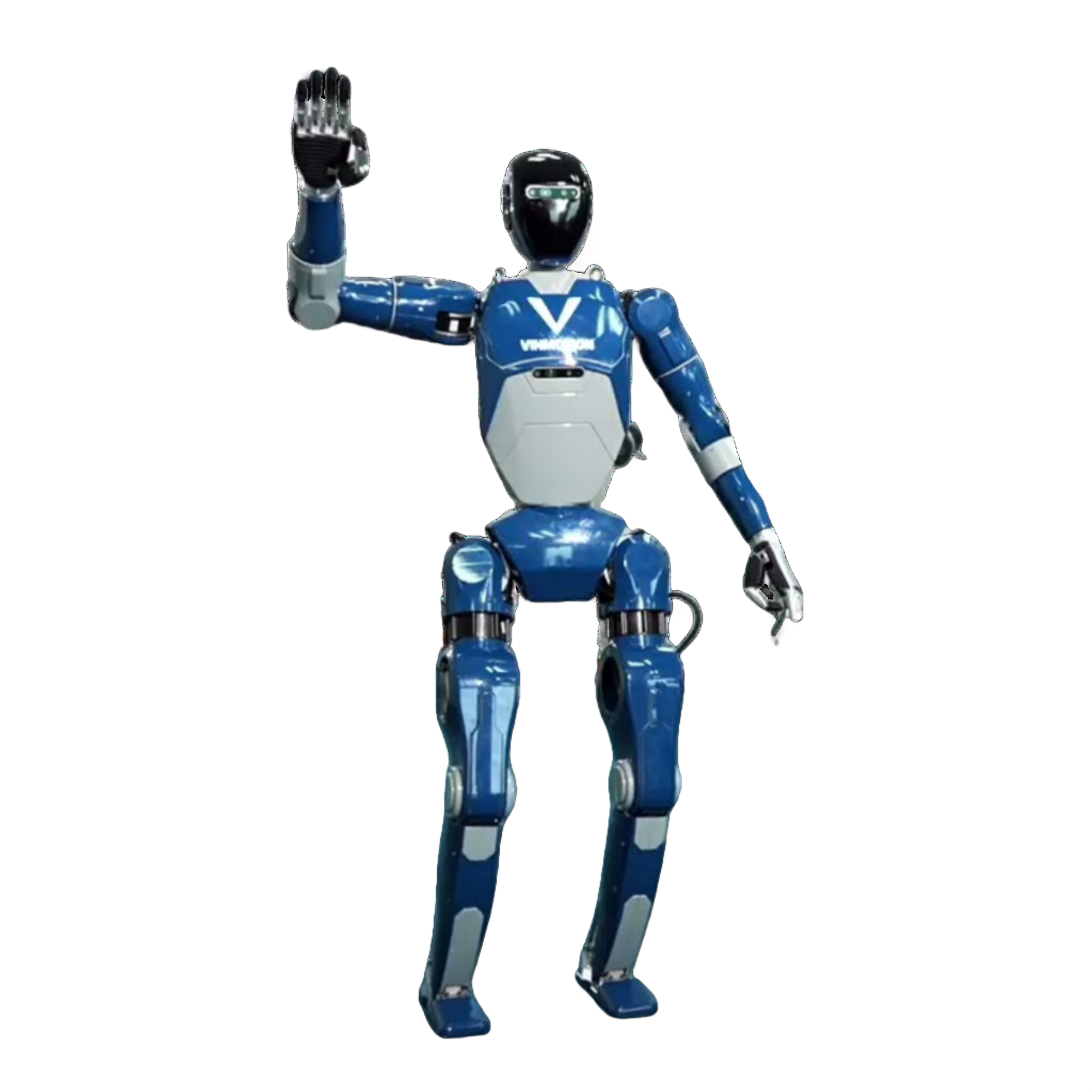
Motion 1 (also written as Motion_1) is the first-generation general-purpose humanoid robot developed by VinMotion, a robotics subsidiary of the Vietnamese conglomerate Vingroup. Introduced in June 2025, it is widely recognized as Vietnam's first domestically developed general-purpose humanoid robot and the country's most significant entry into the humanoid robotics field since the TOPIO table-tennis robot built by TOSY Robotics in the late 2000s.[1][2] Standing 175 cm tall and weighing 70 kg, Motion 1 was engineered for light-duty industrial tasks including material transport, visual inspection, and basic assembly support.
VinMotion's engineering team developed the first Motion 1 prototype in just three months after the company's founding in January 2025, and went on to build and test five prototype versions in rapid succession.[1][3] The robot gained widespread public attention on August 8, 2025, when multiple Motion 1 units performed a synchronized dance routine before over 1,000 attendees at Vingroup's 32nd anniversary celebration in Hanoi.[4][5] It was subsequently demonstrated before Vietnam's top government leaders, including Party Chief To Lam and Prime Minister Pham Minh Chinh, at a national ceremony on August 19, 2025.[6] Motion 1 also appeared at Vietnam's National Achievements Exhibition in late August and September 2025, where it showcased facial recognition, voice interaction, and context-based response capabilities.[7]
Motion 1 served as the foundation for VinMotion's second-generation robot, Motion 2, which was teased in December 2025 and debuted at CES 2026 in January with substantially upgraded specifications including a Qualcomm Dragonwing IQ9 processor, 31 proprietary smart motors, and a 40 kg payload capacity.[8][9]
Background
VinMotion and Vingroup
VinMotion was established in January 2025 with a charter capital of 1,000 billion VND (approximately $39 to $40 million USD). Vingroup holds a 51% stake in the company, with the remaining 49% owned by Vingroup chairman Pham Nhat Vuong and his two sons, Pham Nhat Quan and Pham Nhat Minh Hoang.[10][11] The company's full legal name is VinMotion General Purpose Humanoid Robots Application, Development and Research Joint Stock Company, and it is headquartered at Technopark Tower in Vinhomes Ocean Park, Gia Lam district, Hanoi, Vietnam.[12]
VinMotion's stated mission is to design and deliver general-purpose humanoid robots that bring AI-powered physical automation into real-world industrial, logistics, service, and everyday environments. The company integrates robotic hardware, machine intelligence, and human-in-the-loop AI systems for diverse deployment scenarios.[12] VinMotion is distinct from VinRobotics, another Vingroup subsidiary founded in November 2024 that focuses on industrial robot arms and manufacturing automation systems. While VinRobotics handles fixed-position automation, VinMotion specializes in humanoid robots designed to operate in environments built for humans.[13]
The company is led by Dr. Nguyen Trung Quan (also known as Quan Nguyen), who serves as chairman and chief scientific officer. Dr. Nguyen holds a doctorate in mechanical engineering from Carnegie Mellon University, where he received the Best Dissertation Award in 2017, and is an assistant professor of Aerospace and Mechanical Engineering at the University of Southern California (USC). Before joining USC, he worked as a postdoctoral associate in the Biomimetic Robotics Lab at the Massachusetts Institute of Technology (MIT).[14] His academic credentials include the Best Presentation of the Session award at the 2016 American Control Conference, the Best System Paper Finalist at the 2017 Robotics: Science and Systems conference, and the 2020 Charles Lee Powell Foundation Faculty Research Award.
Vingroup's technology ecosystem, which includes VinFast (electric vehicles), VinAI (artificial intelligence research), VinBigdata (data analytics), and other subsidiaries, provides VinMotion with access to AI research talent, big data capabilities, and real-world testing environments across Vingroup's manufacturing, hospitality, and healthcare operations.[15]
Vietnam's Humanoid Robotics History
Before Motion 1, Vietnam's most notable humanoid robot project was TOPIO (TOSY Ping Pong Playing Robot), developed by TOSY Robotics JSC beginning in 2005. TOSY Robotics, established in 2002 in Hanoi, was Vietnam's first company dedicated to robotics research and development. TOPIO was publicly demonstrated at the Tokyo International Robot Exhibition (IREX) on November 28, 2007, and evolved through three versions. TOPIO 3.0, the final iteration, stood 1.88 m (6 ft 2 in) tall, weighed 120 kg (260 lb), and had 28 degrees of freedom.[16] However, TOPIO was designed primarily for entertainment and research purposes, particularly table-tennis demonstrations.
Motion 1 represented a fundamentally different approach. Rather than building a robot for research or entertainment, VinMotion targeted practical industrial deployment from the outset, designing Motion 1 to fit into existing factory workflows for tasks like material transport, visual inspection, and assembly support.[1] Dr. Nguyen Trung Quan has argued that the current period represents a "golden time for Vietnam to rise as a tech powerhouse" in humanoid robotics, noting that the robotics industry requires three key capabilities: high-tech human resources for software and AI development, flexible manufacturing for prototyping and hardware production, and trust and security in application deployment. He argued that while the United States is dominant in the first area and China has an advantage in the second, Vietnam can compete effectively across all three.[4][17]
Development
Rapid Prototyping
VinMotion's development of Motion 1 proceeded at an unusually rapid pace. The company was founded in January 2025, and its engineering team produced the first working prototype within three months, by approximately April 2025.[1] In total, the team built and tested five prototype versions of Motion 1 between January and June 2025, iterating on the mechanical, electronic, and software systems with each version.[1][3] All systems were developed entirely in-house by VinMotion's team of Vietnamese engineers, without reliance on external robotics platforms or off-the-shelf humanoid components.[4]
Dr. Nguyen Trung Quan later described this development speed as "a potential world record for deployment speed," though this claim has not been independently verified.[4] The rapid development timeline was enabled in part by Vingroup's existing manufacturing infrastructure and technology ecosystem, which gave VinMotion immediate access to production facilities, AI research capabilities through VinAI, and data analytics resources through VinBigdata.[15]
Design Philosophy
Motion 1 was designed around the principle of fitting into existing human-scale environments and workflows rather than requiring facilities to be reconfigured for the robot. The robot's 175 cm height and 70 kg weight give it proportions comparable to an average adult, allowing it to navigate standard doorways, corridors, and workstations. Its bipedal locomotion enables it to traverse the same floors, ramps, and spaces that human workers use.[1]
The robot operates as a semi-autonomous system with a human-in-the-loop control architecture. Operators guide the robot through tasks via real-time supervision and feedback, with the robot's adaptive learning system improving performance over time based on accumulated human feedback and task repetition.[1] This approach reflects a pragmatic strategy: rather than attempting full autonomy from the start, VinMotion designed Motion 1 to work collaboratively with human operators, gradually building toward greater autonomous capability as the technology matures.
VinMotion also conceived of a broader infrastructure concept called the "Humanoid of Things Infrastructure," a platform that integrates software, AI modules, deployment tools, and operator interfaces into a unified industrial-grade solution designed to support mass deployment of humanoid robots with minimal setup.[18]
Technical Specifications
Physical Characteristics
Motion 1 stands 175 cm (5 ft 9 in) tall and weighs 70 kg (154 lb). Its bipedal frame achieves a walking speed of 2 m/s, which enables the robot to keep pace with human workers in factory and warehouse environments. The robot is powered by a battery system with a rated operational lifespan of 3 to 5 years, though specific battery capacity in watt-hours has not been publicly disclosed.[19]
Sensor Suite
Motion 1 incorporates a multi-sensor array designed for industrial navigation and human interaction:
| Sensor Type | Function |
|---|---|
| Dual stereo depth cameras | 3D environment mapping, object detection, and depth perception |
| Ultrasonic sensors | Proximity detection and obstacle ranging |
| 9-axis IMU (Inertial Measurement Unit) | Balance maintenance and orientation tracking |
| Distance sensors | Spatial awareness and multi-robot coordination |
The dual stereo depth cameras provide stereoscopic vision for three-dimensional environment mapping, enabling the robot to detect and track objects, recognize faces, and assess spatial relationships in its surroundings. The ultrasonic sensors complement the cameras by providing reliable proximity measurements at close range, particularly useful for detecting obstacles that may be outside the cameras' field of view. The 9-axis IMU continuously monitors the robot's orientation and acceleration across all axes, feeding data to the balance control algorithms that maintain stability during walking, turning, and manipulation tasks.[19]
Navigation and Safety
Motion 1 uses Visual SLAM (Simultaneous Localization and Mapping) for autonomous navigation, building and updating a real-time map of its environment while simultaneously tracking its own position within that map. The system incorporates 3D obstacle avoidance, allowing the robot to navigate through cluttered factory floors while avoiding carts, tools, equipment, and other obstacles in its path.[19]
For human safety, Motion 1 includes force-limiting safety mechanisms and collision detection systems. If the robot detects a human approaching within a safety threshold, it pauses mid-stride to prevent contact. These safety features are essential for deployment in shared human-robot workspaces where the robot must operate alongside factory workers without posing a physical hazard.[19]
Detailed Specifications
| Parameter | Value |
|---|---|
| Height | 175 cm (5 ft 9 in) |
| Weight | 70 kg (154 lb) |
| Walking speed | 2 m/s |
| Locomotion | Bipedal |
| Vision sensors | Dual stereo depth cameras |
| Proximity sensors | Ultrasonic sensors |
| Balance sensor | 9-axis IMU |
| Navigation | Visual SLAM with 3D obstacle avoidance |
| Safety systems | Force-limiting safety, collision detection |
| Control mode | Semi-autonomous (human-in-the-loop) |
| Learning | Adaptive learning from human feedback |
| Interaction | Voice commands, gestures, facial recognition |
| Battery life | 3 to 5 years (rated lifespan) |
| Software compatibility | ROS2, Python APIs |
| Connectivity | WiFi |
| Multi-robot synchronization | Yes |
| Development | 100% designed and built in Vietnam |
AI and Interaction Capabilities
Motion 1 incorporates several AI-powered interaction capabilities. The robot can recognize and respond to voice commands, interact through gestures, and perform facial recognition to identify individuals in its environment.[7] At the National Achievements Exhibition in August-September 2025, the robot demonstrated context-based responses, adjusting its behavior and communication based on the situation and the person it was interacting with.[7]
The robot's adaptive learning system allows it to improve its performance over time. Each deployment session generates data that refines the robot's task execution, with human operators providing real-time feedback that the system incorporates into its behavioral models. VinMotion has described this as an "adaptive loop that turns every feedback and experience into long-term performance gains and builds toward scalable autonomy."[1][18]
Software Platform
Motion 1 supports ROS2 (Robot Operating System 2) and Python APIs for custom skill development, allowing third-party developers and VinMotion's own engineers to create new capabilities and behaviors for the robot. The ROS2 compatibility places Motion 1 within the broader robotics software ecosystem used by research institutions and industry worldwide.[19]
Public Demonstrations
June 2025: Initial Introduction
Motion 1 was first publicly introduced in June 2025, approximately five months after VinMotion's founding. The initial demonstration showcased the robot's basic capabilities: walking, waving, object recognition, and interaction through gestures and voice commands. The introduction attracted coverage from Vietnamese and international media, marking VinMotion's emergence as a serious robotics company and Vietnam's entry into the global humanoid robotics race.[1][3]
August 8, 2025: Synchronized Dance Performance
The event that brought Motion 1 to widespread public attention was a synchronized dance performance on August 8, 2025, during Vingroup's 32nd anniversary celebration in Hanoi. Multiple Motion 1 units performed coordinated dance routines before an audience of over 1,000 attendees, including Vingroup chairman Pham Nhat Vuong.[4][5]
The technical achievement behind the performance was significant. VinMotion's engineers had to optimize real-time computing and the network infrastructure connecting the robots to ensure near-perfect synchronization. As Dr. Nguyen Trung Quan explained: "This ensures their 'communication' is almost perfectly synchronized, with algorithms executed in real time."[4] The system performed successfully despite potential WiFi interference from the large crowd, demonstrating the robustness of the multi-robot coordination platform.
Importantly, the dance routine was not fully pre-scripted. The robots used distance sensors to maintain stability and execute agile movements, with the real-time coordination algorithms adjusting for variations in balance and timing rather than simply playing back fixed motion sequences.[4][5] The viral video of the performance generated widespread attention on social media and established VinMotion's public profile both domestically and internationally.
August 19, 2025: National Leaders Demonstration
On August 19, 2025, Motion 1 robots were demonstrated at the groundbreaking and inauguration ceremony for 250 major projects celebrating the 80th anniversary of Vietnam's August Revolution and National Day. The ceremony was held in Dong Anh ward, Hanoi, and was attended by Vietnam's highest-ranking leaders, including Party Chief To Lam, Prime Minister Pham Minh Chinh, and former Prime Minister Nguyen Tan Dung, as well as Vingroup chairman Pham Nhat Vuong.[6][20]
The robots walked, waved, and interacted with gestures before the country's top officials, demonstrating their potential for deployment in manufacturing, services, and daily life. Leaders praised the technology's capacity to enhance productivity while generating employment opportunities in AI oversight roles, positioning Vietnam as an emerging center for humanoid robotics development.[6]
August-September 2025: National Achievements Exhibition
Motion 1 was displayed at Vietnam's National Achievements Exhibition, held from August 28 to September 15, 2025, at the National Convention and Exhibition Center. The exhibition commemorated the 80th anniversary of the August Revolution. At the exhibition, the Motion 1 prototype demonstrated flexible movement, balance, and natural gestures, and was equipped with AI for facial recognition, voice interaction, and context-based responses. The display was described as "the first success in implementing Vingroup's ambition to introduce 'Made in Vietnam' robots into service, industry, and everyday life."[7]
March 2026: Hanoi Government Demonstration
In March 2026, VinMotion demonstrated Motion 1 to Hanoi government officials, showcasing the robot's integration into VinFast's automotive manufacturing operations. Officials highlighted the technology's capacity to enhance productivity while creating skilled jobs in AI oversight, further supporting Vietnam's positioning as an emerging hub for humanoid robotics.[21]
Applications and Deployment
VinFast Factory Operations
Motion 1's primary deployment target is industrial manufacturing at VinFast electric vehicle factories. The robot handles several categories of tasks within the automotive production environment:
| Application | Description |
|---|---|
| Material handling | Transporting parts and tools between assembly lines and workstations |
| Quality inspection | Scanning parts and assemblies for defects using visual sensors |
| Tool transportation | Shuttling tools and supplies across the factory floor |
| Assembly support | Assisting with basic, repetitive assembly tasks |
VinFast's production facilities already employ more than 1,200 industrial robots, giving VinMotion access to established automation infrastructure and operational data for testing and refining Motion 1's capabilities in a real manufacturing setting.[13] The strategy of deploying first within Vingroup's own operations provides a controlled environment for iterating on the robot's performance before marketing it to external customers.
Vinmec Healthcare
Vinmec, Vingroup's healthcare system, has announced plans to deploy Motion 1 in hospital reception areas as a "smart medical staff" that connects patients with the hospital's medical technology systems. The robot is intended to welcome visitors, guide them through the facility, answer questions, and connect patients with specialized medical care services. According to Prof. Dr. Tran Trung Dung, General Director of the Vinmec Healthcare System, the goal is to build a smart hospital chain model where robots can communicate naturally and support medical staff in repetitive tasks, potentially receiving and supporting hundreds of patients per day.[22]
Vinpearl Hospitality
Motion 1 is also being tested at Vinpearl, Vingroup's hospitality and resort chain, for service applications including guest assistance, concierge functions, and facility navigation. The robot's ability to interact through voice commands and gestures makes it suitable for customer-facing roles in tourism and hospitality environments.[15]
Logistics and Warehousing
Beyond Vingroup's own operations, VinMotion envisions Motion 1 being deployed in logistics facilities for package routing, warehouse navigation, and material handling tasks. The robot's Visual SLAM navigation and 2 m/s walking speed enable it to operate efficiently in warehouse environments with standard human-scale infrastructure.[19][21]
Comparison with Motion 2
Motion 2, VinMotion's second-generation humanoid robot, was teased in a 10-second video in late December 2025 and made its international debut at CES 2026 in January, displayed at the Qualcomm booth.[8][9] Motion 2 represents a substantial generational upgrade over Motion 1 across nearly every dimension.
| Feature | Motion 1 | Motion 2 |
|---|---|---|
| First introduced | June 2025 | December 2025 (teaser); January 2026 (CES debut) |
| Height | 175 cm (5 ft 9 in) | 178 cm (5 ft 10 in) |
| Weight | 70 kg (154 lb) | 75 kg (165 lb) |
| Walking speed | 2 m/s | Not disclosed (faster than Motion 1) |
| Actuators | In-house motors (count not disclosed) | 31 proprietary smart motors |
| Payload capacity | Light-duty (unspecified) | 40 kg (88 lb) |
| Fall recovery | No | Yes (autonomous self-standing) |
| Battery system | Standard (3 to 5 year lifespan) | Dual hot-swappable (24/7 operation) |
| Autonomous charging | No | Yes (self-navigating to charging station) |
| Processor | Not disclosed | Qualcomm Dragonwing IQ9 Series |
| Voice interaction | Basic voice commands | Multilingual LLM + ASR (Vietnamese, English) |
| Hand dexterity | Basic gestures | Five-fingered dexterous manipulation |
| Control mode | Semi-autonomous (human-in-the-loop) | Enhanced autonomy |
| Dynamic capabilities | Walking, waving, dancing | Boxing, backbends, heavy lifting, object manipulation |
| Navigation | Visual SLAM, 3D obstacle avoidance | Enhanced sensor suite with proprietary balance sensors |
| Safety features | Force-limiting safety, collision detection | Inherited and expanded |
| Design philosophy | Practical industrial integration | "3S" (Self-standing, Self-charging, Stable) |
The most significant improvements in Motion 2 include the transition from semi-autonomous to more fully autonomous operation; the addition of fall recovery and autonomous battery management; a major increase in payload capacity to 40 kg; integration of the Qualcomm Dragonwing IQ9 processor for on-device AI inference; and five-fingered dexterous hands capable of grasping, carrying, and throwing objects.[8][9] Motion 2 was developed around a "3S" design philosophy (Self-standing, Self-charging, Stable) that addressed the key limitations of Motion 1's reliance on human intervention for charging and fall recovery.
Dr. Nguyen Trung Quan noted at the VinFuture 2025 symposium in December 2025 that Motion 2 was "much more groundbreaking" compared to Motion 1, with movement capabilities that "surpass even those of an average person."[23] He also observed that VinMotion's robots "move more flexibly and much faster than they did three months ago," referencing the pace of improvement from the Motion 1 platform to the Motion 2 prototype.[23]
Significance
Vietnam's Technological Ambitions
Motion 1 holds particular significance as a symbol of Vietnam's growing ambitions in advanced technology. While Vietnam has become a major global manufacturing hub for electronics, automotive components, and consumer goods, the country has historically been associated with contract manufacturing rather than indigenous high-technology product development. VinMotion's development of Motion 1 with 100% in-house engineering represents an effort to move Vietnam up the technology value chain, from assembling products designed elsewhere to creating original advanced technology.
The "Made in Vietnam" branding was a deliberate strategic choice. VinMotion repeatedly emphasized that all of Motion 1's mechanical, electronic, and software systems were developed by Vietnamese engineers, positioning the robot as proof that Vietnam can produce globally competitive advanced technology.[4][7] The robot's appearance before Vietnam's highest-ranking political leaders and at the National Achievements Exhibition underscored its significance as a national technology milestone.
Conglomerate-Backed Development Model
Motion 1 demonstrates the potential of conglomerate-backed robotics development. Unlike most humanoid robotics startups that must seek external customers from their earliest stages, VinMotion can deploy and iterate within Vingroup's own vast network of factories (VinFast), hotels (Vinpearl), hospitals (Vinmec), and other facilities. This internal deployment model, comparable to how Tesla has used its own factories as a testbed for the Optimus robot, provides a shorter feedback loop between engineering and real-world application.[13]
Vingroup's broader technology ecosystem further accelerates development. VinAI provides AI research capabilities, VinBigdata offers data analytics resources, and VinFast's existing fleet of over 1,200 industrial robots provides a foundation of automation expertise. The cross-pollination between these subsidiaries gives VinMotion advantages that a standalone robotics startup would not have.[15]
Broader Competitive Context
At the December 2025 VinFuture symposium, Dr. Nguyen Trung Quan projected that physical AI could become a "$10 trillion" industry "in the next 10 years" and suggested that Vietnam could become "the centre of robot research and production in the region" with proper investment.[24] He identified three key barriers to humanoid robot adoption: physical safety, data security, and social acceptance, noting that "only when people feel safe standing next to robots can robots operate naturally."[24]
Motion 1's emergence adds a Southeast Asian competitor to a humanoid robotics field previously dominated by American, Chinese, Japanese, and Korean companies. Although VinMotion's initial capitalization of approximately $39 to $40 million is modest compared to competitors like Figure AI (which has raised approximately $1.9 billion), VinMotion's access to Vingroup's resources, Vietnam's cost-effective manufacturing base, and the company's rapid development speed position it as a notable entrant in the global humanoid robotics race.[25]
Future Development
Beyond Motion 2, VinMotion has indicated plans for additional robot models. The company is developing a model referred to as "Super Motion" for more heavy-duty industrial applications, suggesting a product lineup that spans from the light-duty Motion 1 to increasingly capable platforms for demanding environments.[1]
In 2026, VinMotion announced plans to open an office in southern California to accelerate humanoid development, leveraging Dr. Nguyen Trung Quan's existing presence at USC in Los Angeles and positioning the company closer to the American robotics and AI talent pool. The US office focuses on AI and software development, complementing the Hanoi headquarters' hardware engineering and manufacturing capabilities. VinMotion is actively recruiting AI researchers with expertise in large language models, automatic speech recognition, and motion research covering control, planning, and manipulation.[14]
VinMotion's medium to long-term development roadmap targets intelligent robots capable of image and language processing for applications in logistics, healthcare, education, customer service, and home care, expanding well beyond Motion 1's initial focus on factory automation.[6]
See also
References
- ^1 ^2 ^3 ^4 ^5 ^6 ^7 ^8 ^9 ^10"VinMotion Motion_1 Humanoid Robot to Work at VinFast." Mike Kalil, June 2025. mikekalil.com/...vinmotion-humanoid-robot
- ^"Vietnam's Vingroup Debuts First Humanoid Robot, Eyes Global Tech Race." Bots N Beans, 2025. botsnbeans.com/...noid-robot-eyes-global-tech-race
- ^1 ^2 ^3"Vietnam's VinMotion's first humanoid robot prototype, Motion 1." CyberRobo, X (formerly Twitter). x.com/...1962331394094543068
- ^1 ^2 ^3 ^4 ^5 ^6 ^7 ^8"Vietnam's first humanoid robots dazzle crowd with precise dance moves." Interesting Engineering, August 2025. interestingengineering.com/...cing-humanoid-robots
- ^1 ^2 ^3"Vietnam's VinMotion unveils dancing humanoid robots just 7 months after founding." VnExpress International, August 2025. e.vnexpress.net/...7-months-after-founding-4926410
- ^1 ^2 ^3 ^4"Vingroup's humanoid robots VinMotion make performance in Hanoi." The Investor, August 19, 2025. theinvestor.vn/...make-performance-in-hanoi-d16724
- ^1 ^2 ^3 ^4 ^5"Impressive Vietnamese AI solutions showcased at national achievements exhibition." VietnamNet, 2025. vietnamnet.vn/...l-achievements-exhibition-2439021
- ^1 ^2 ^3"Vietnam's VinMotion Unveils Gen 2 Humanoid Robot." Mike Kalil, 2025. mikekalil.com/...-vinmotion-motion2-humanoid-robot
- ^1 ^2 ^3"Qualcomm and division of Vietnam's Vingroup debut industrial robot at CES." Nikkei Asia, January 2026. asia.nikkei.com/...p-debut-industrial-robot-at-ces
- ^"Vingroup to establish robotics subsidiary." VnExpress International, January 2025. e.vnexpress.net/...ish-robotics-subsidiary-4838026
- ^"Vingroup forms new company for humanoid robot production." The Investor, 2025. theinvestor.vn/...humanoid-robot-production-d17105
- ^1 ^2"VinMotion - Robotics Company." Aparobot. aparobot.com/...vinmotion
- ^1 ^2 ^3"VinGroup's VinMotion debuts humanoid robots to support EV factory automation in Vietnam." DigiTimes, August 27, 2025. digitimes.com/...vingroup-robot-vehicle-technology
- ^1 ^2"VinMotion Eyes US Expansion for Humanoid Development." Mike Kalil, 2025. mikekalil.com/...vietnam-vinmotion-us-expansion
- ^1 ^2 ^3 ^4"Vietnam's Vingroup launches VinMotion to develop general-purpose humanoid robots." Robotics and Automation News, May 3, 2025. roboticsandautomationnews.com/...90277
- ^"TOPIO." Wikipedia. en.wikipedia.org/...TOPIO
- ^"Robot development: An opportunity to put Vietnam on the world technology map." Vietnam.vn, 2025. vietnam.vn/...et-nam-len-ban-do-cong-nghe-the-gioi
- ^1 ^2"Humanoid robots are coming to Vietnam." CyberRobo, X (formerly Twitter). x.com/...1932466496388665851
- ^1 ^2 ^3 ^4 ^5 ^6"VinMotion Motion 1 Wows Hanoi Leaders, Deploys in VinFast Factories." OriginOfBots, March 2026. originofbots.com/...s-deploys-in-vinfast-factories
- ^"Vietnam's humanoid robot dance crew dazzles with live performance." Interesting Engineering, August 2025. interestingengineering.com/...t-dance-crew-dazzles
- ^1 ^2"VinMotion introduces synchronizing dancing humanoid robots." Inspenet, 2025. inspenet.com/...ts-with-synchronization-technology
- ^"Vinmec introduces 'Make in Vietnam' medical robot, pioneering smart hospital model." Vietnam.vn, 2025. vietnam.vn/...n-phong-mo-hinh-benh-vien-thong-minh
- ^1 ^2"VinMotion leader: 'We have been developing the Motion 2 robot model.'" Vietnam.vn, December 2025. vietnam.vn/...a-dang-phat-trien-mau-robot-motion-2
- ^1 ^2"Latest advances, challenges discussed at forum on intelligent robots and automation." Vietnam News, December 2025. vietnamnews.vn/...ntelligent-robots-and-automation
- ^"Figure AI raises $1B+ at $39B valuation." Convergence Now, September 2025.
Improve this article
Add missing citations, update stale details, or suggest a clearer explanation. Every suggestion is reviewed for sourcing before it goes live.
3 revisions · v4 · 4,214 words · full history
Fact-checks are independent of edits: a reviewer re-verifies the article against its sources and stamps the date. How we verify
Research and drafting on this wiki are AI-assisted, under named human editorial standards. How AI is used here
Cite this page: AI Wiki. "VinMotion Motion 1." aiwiki.ai, updated 12 Apr 2026. CC BY 4.0. https://aiwiki.ai/wiki/vinmotion_motion_1