

Borg 01
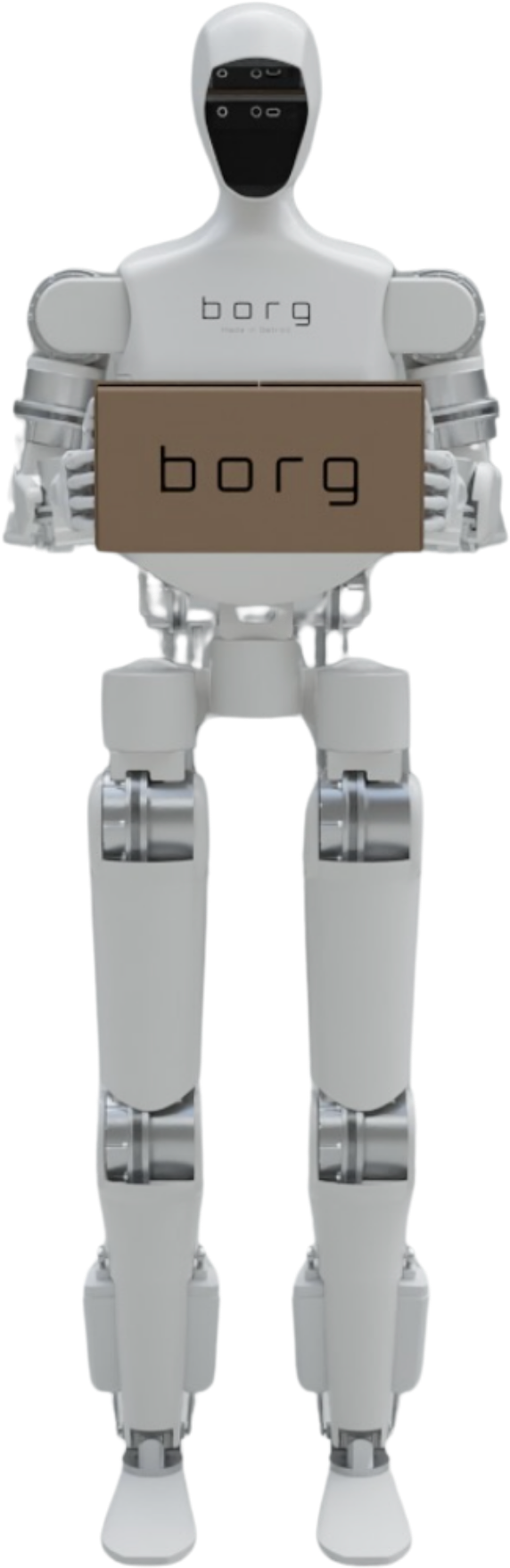 | |
| Developer | Borg Robotics |
| Type | Humanoid robot |
| Country of origin | United States |
| Unveiled | Late 2024 |
| Release target | Q2 2025 (missed; still in development as of August 2026) |
| Height | 173 cm (5 ft 8 in) |
| Weight | 62 kg (137 lb) |
| Degrees of Freedom | 23 |
| Payload capacity | 12 kg (26 lb) |
| Locomotion | Dual-mode (bipedal + wheeled) |
| Battery life | Up to 6 hours (bipedal), up to 12 hours (wheeled) |
| Actuators | Actuator 02 (proprietary, 270 Nm) |
| Software | Closed-source neural network AI |
| Status | Development / Pre-commercial |
| Website | borgrobotic.com |
Borg 01 is a modular humanoid robot developed by Borg Robotics, a Detroit-based robotics startup founded in 2022.[2] Designed and built specifically for industrial and manufacturing environments, the Borg 01 is notable for its dual-mode locomotion system, which allows it to autonomously switch between bipedal walking and a wheeled base depending on the task at hand. The robot also features a quick-change end-effector system that can be swapped autonomously in seconds, supporting vacuum grippers, dual grippers, and five-fingered robotic hands.[2]
Borg Robotics positions the Borg 01 as a practical industrial workhorse rather than a research platform or general-purpose demonstration robot. The company has described it as "purpose built for industrial environments" and "built to get real work done," drawing a deliberate contrast with humanoid robots designed primarily for dynamic locomotion demonstrations, dancing, or other showcase tasks.[1] The Borg 01 is the flagship product in a broader ecosystem of AI-powered autonomous robots that Borg Robotics is developing for warehouse and factory automation.
Background
Borg Robotics
Borg Robotics was founded in 2022 by Lorenzo Juncaj and is headquartered in Detroit, Michigan. Juncaj brings 17 years of experience in robotics to the venture and previously served as a cofounder and board member at Kiwibot, a delivery robotics company.[12] The startup operates with a small team of approximately 1 to 10 employees, reflecting its early-stage status and lean engineering approach.[4][15] Notably, the Borg 01 humanoid was designed by a core team of just three people.[2]
The company's mission centers on automating physically demanding, repetitive tasks in warehouses and factories, with an explicit focus on addressing chronic labor shortages and high employee turnover in American manufacturing and logistics sectors.[1][13] Borg Robotics emphasizes that all of its robots and key components, including proprietary actuators, are designed and manufactured in Detroit.[6] The company frames this as part of a broader effort to restore American manufacturing strength.
In April 2025, Borg Robotics was named to Specter Insights' "Hottest Startups" list and had attracted interest from eight venture capital firms over a 90-day period.[9] No funding round, amount, or valuation had been disclosed publicly as of August 2026.
Design Philosophy
The Borg 01's design philosophy prioritizes practical utility over technical spectacle. While many humanoid robots in development emphasize athletic capabilities such as fast running, jumping, or acrobatic maneuvers, Borg Robotics deliberately focused the Borg 01 on efficient task execution in controlled industrial environments. The company has stated that the robot was purpose-built for industrial work cells and is intended to integrate into existing factory workflows without requiring modifications to the facility or workstation layout.[2]
This philosophy extends to the robot's modular architecture. Rather than committing to a single locomotion mode, Borg Robotics designed the Borg 01 to switch between bipedal legs and a wheeled base, with the company acknowledging that the wheeled configuration is preferred for most industrial applications due to its superior efficiency and significantly longer battery life.[2][14] The bipedal mode remains available for environments where wheeled movement is impractical, such as stairs or uneven terrain.
Technical Specifications
Physical Design
The Borg 01 stands 173 cm (5 feet 8 inches) tall in its bipedal configuration and weighs approximately 62 kg (137 pounds).[3] This sizing was chosen to allow the robot to operate effectively in narrow aisles and crowded factory floors, where it can work alongside human employees and navigate the same pathways and doorways designed for people.
Detailed Specifications
| Category | Parameter | Value |
|---|---|---|
| Physical | Height (bipedal) | 173 cm (5 ft 8 in) |
| Physical | Weight (with battery) | 62 kg (137 lb) |
| Mobility | Total degrees of freedom | 23 |
| Mobility | DOF per arm | 6 |
| Mobility | DOF per leg | 5 |
| Mobility | Locomotion modes | Bipedal walking + wheeled base |
| Mobility | Maximum speed | 2 m/s (4.5 mph) |
| Mobility | Autonomous mode switching | Yes |
| Manipulation | Payload capacity | 12 kg (26 lb) |
| Manipulation | Arm reach | 2 meters |
| Manipulation | End effectors | Vacuum grippers, dual grippers, five-fingered hands |
| Manipulation | Autonomous tool swapping | Yes (seconds) |
| Power | Battery life (bipedal) | Up to 6 hours |
| Power | Battery life (wheeled) | Up to 12 hours |
| Power | Battery swapping | Hot-swappable in seconds |
| Actuators | Model | Actuator 02 (proprietary) |
| Actuators | Torque output | 270 Nm |
| Actuators | Actuator weight | 1.6 kg |
| Sensors | Vision | Multi-camera system for object recognition |
| Sensors | Navigation | Proximity sensors |
| AI | Onboard processing | AI processors with neural networks |
| AI | Capabilities | Real-time decision-making, task adaptation, autonomous navigation |
| Software | Type | Closed-source AI neural network |
| Manufacturing | Origin | Detroit, Michigan, USA |
Dual-Mode Locomotion
The Borg 01's defining hardware feature is its modular mobility system. The robot can operate in two distinct locomotion modes:
Bipedal mode: In this configuration, the Borg 01 uses two legs with 5 degrees of freedom each for walking. The bipedal setup provides the ability to navigate stairs, step over obstacles, and move through environments designed for human foot traffic. Battery life in bipedal mode is approximately 6 hours per charge.[3]
Wheeled mode: The robot can autonomously switch to a wheeled base, which provides superior speed, stability, and power efficiency. In the wheeled configuration, battery life extends to approximately 12 hours per charge. Borg Robotics has indicated that the wheeled mode is the preferred configuration for most industrial use cases, as factory floors and warehouse aisles are typically flat surfaces where wheels offer advantages over bipedal locomotion.[3]
The transition between modes is handled autonomously by the robot's AI systems, which can assess terrain and task requirements to determine the optimal locomotion approach.[2] This modularity reflects a pragmatic engineering decision: rather than optimizing solely for bipedal performance (which consumes significant energy and computational resources for balance control), Borg Robotics offers both options and lets the operational context dictate the best choice.
Quad-Arm Configuration
When operating in wheeled mode, the Borg 01 supports an optional quad-arm configuration. With four arms instead of two, the robot can perform multiple manipulation tasks simultaneously, increasing throughput for repetitive operations such as picking, packing, or sorting. This four-armed variant is positioned as a heavy-load mobile industrial cobot with a 30 kg payload capacity and a 2-meter reach, making it suitable for heavier material handling tasks that exceed the standard two-arm configuration's 12 kg limit.[5]
Proprietary Actuators
Borg Robotics develops its actuators in-house rather than sourcing them from third-party suppliers. The Actuator 02, which powers the Borg 01, delivers 270 Nm of torque from a package weighing just 1.6 kg.[3] This torque-to-weight ratio is a key performance metric for humanoid robots, as lighter actuators reduce overall robot weight and energy consumption while strong torque output enables the robot to handle heavier payloads and perform forceful manipulation tasks.
All actuators are designed and manufactured at the company's Detroit facility.[1] The decision to build actuators in-house gives Borg Robotics tighter control over performance characteristics, supply chain logistics, and iteration cycles.
End Effectors and Manipulation
The Borg 01 uses a quick-change end-effector system that allows it to swap between different tools depending on the task. Available end effectors include:
| End Effector | Use Case |
|---|---|
| Vacuum grippers | Flat or smooth-surfaced object handling (boxes, sheets, panels) |
| Dual grippers | Simultaneous two-point grasping for bulkier items |
| Five-fingered robotic hands | Fine manipulation and dexterous tasks requiring human-like grip |
| Specialized tools | Task-specific attachments for particular industrial applications |
The swapping process is autonomous and takes only seconds, meaning the robot can transition between different task types within a single work shift without human intervention.[2] This versatility enables the Borg 01 to handle widely varying payloads and object types across different stations in a factory or warehouse.
AI and Perception Systems
The Borg 01 is equipped with onboard AI processors running advanced neural networks for real-time decision-making, task adaptation, and autonomous navigation. The robot's perception system includes multi-camera vision for object recognition and proximity sensors for safe navigation in dynamic industrial environments.[5]
The AI system enables the robot to adapt to new tasks and environments without requiring extensive reprogramming. According to Borg Robotics, the neural network architecture allows the Borg 01 to learn and adjust to existing workflows, reducing the barrier to deployment in facilities that have not been specifically designed for robotic automation.
In early 2025, Borg Robotics announced a 40% improvement in the speed of autonomous box handling by the Borg 01, demonstrating ongoing software refinement and performance gains through iterative AI development.[11]
Power System
The Borg 01 uses hot-swappable batteries that can be replaced in seconds, enabling near-continuous operation across multiple shifts. In the wheeled configuration, a single battery charge provides up to 12 hours of operation, while the bipedal mode offers approximately 6 hours.[3] The hot-swap capability is particularly important for industrial applications, where downtime for charging can significantly reduce productivity. By allowing batteries to be exchanged without shutting down the robot, Borg Robotics ensures that the Borg 01 can maintain high uptime throughout a full workday.
Applications
Industrial and Manufacturing
The Borg 01's primary target market is industrial manufacturing, where it is designed to perform repetitive, physically demanding tasks that contribute to high employee turnover and difficulty in hiring. Specific applications include:
- Material handling: Moving parts, boxes, and components between stations on factory floors and in warehouses
- Pick and place: Selecting items from bins or conveyors and placing them in designated locations with precision
- Palletizing and depalletizing: Stacking and unstacking items on pallets for shipping and receiving
- Machine tending: Loading and unloading parts from CNC machines, presses, or other manufacturing equipment
- Quality inspection: Using vision systems to identify defects or verify assembly correctness
The robot is designed to integrate into existing work cells without requiring modifications to the facility. This "drop-in" deployment approach reduces the cost and complexity of adoption, a significant consideration for small and medium-sized manufacturers that may lack the resources for extensive facility retrofits.
Warehouse and Logistics
In warehouse environments, the Borg 01's dual-mode locomotion and modular end effectors make it suitable for diverse tasks across the fulfillment workflow. The wheeled mode allows for rapid transit between locations within large distribution centers, while the tool-swapping capability enables the robot to handle different product types and packaging formats without manual reconfiguration.
Future Applications
Borg Robotics has indicated that future development will extend the Borg 01's capabilities beyond industrial settings to include household and caregiving applications. This longer-term vision aligns with the broader humanoid robotics industry's trajectory toward consumer and service markets, though Borg Robotics has not disclosed specific timelines or product plans for these applications.
Borg Robotics Product Ecosystem
The Borg 01 is not a standalone product. It serves as the centerpiece of an integrated automation ecosystem that Borg Robotics is building for industrial and warehouse environments. All products in the ecosystem are designed to work together through a unified management system and share common AI capabilities.
| Product | Description | Key Specifications |
|---|---|---|
| Borg 01 | Modular humanoid robot | 173 cm, 62 kg, 12 kg payload, dual-mode locomotion |
| Borg L.01 | Autonomous pallet jack | 2,000 kg load capacity, 1.7 m/s top speed, 1.5 m turning radius |
| Autonomous forklift | Self-driving warehouse forklift | Details pending |
| Industrial cobot | Heavy-load mobile collaborative robot | 30 kg payload, 2-meter reach |
The Borg L.01 autonomous pallet jack is designed for maneuvering in tight warehouse spaces and comes in standard and "Pro" versions, with the Pro variant featuring omnidirectional wheels and adjustable forks.[1] The autonomous forklift and heavy-load industrial cobot round out the ecosystem, covering the full range of material handling tasks from light assembly work (Borg 01) through medium loads (industrial cobot) to heavy pallet movement (Borg L.01 and forklift).
Borg Robotics originally stated that the entire product lineup was targeted for launch in 2025, with the Borg 01 and autonomous pallet jack scheduled for initial availability in Q2 2025.[1][8] That target passed without a launch. As of August 2026 the company's own website still labelled its robotic workforce "IN DEVELOPMENT" and listed no product names, pricing, ordering channel, or revised launch date, and no shipment or customer deployment had been announced.[17]
Competitive Landscape
The Borg 01 enters a rapidly expanding humanoid robot market, competing with both well-funded technology giants and fellow startups.[10] However, its industrial-first, modular approach differentiates it from many competitors that are pursuing general-purpose humanoid platforms.
Comparison with Competitors
| Company | Robot | Height | Weight | DOF | Payload | Key Differentiator |
|---|---|---|---|---|---|---|
| Borg Robotics | Borg 01 | 173 cm | 62 kg | 23 | 12 kg | Dual-mode locomotion, modular end effectors |
| Figure AI | Figure 02 | 168 cm | 70 kg | 41 | 20 kg | Helix VLA, BMW deployment |
| Tesla | Optimus | 173 cm | 72 kg | 28+ | 20 kg | Tesla manufacturing integration, target price under $30,000 |
| Agility Robotics | Digit | 175 cm | 65 kg | 16+ | 16 kg | Bipedal logistics focus, Amazon pilot |
| Apptronik | Apollo | 172 cm | 73 kg | 36 | 25 kg | General-purpose, Mercedes-Benz pilot |
| Unitree Robotics | G1 | 127 cm | 35 kg | 23+ | 3 kg | Low cost (~$16,000), compact form factor |
| 1X Technologies | NEO | 167 cm | 30 kg | 28 | N/A | Lightweight, home-oriented |
The Borg 01's most direct competitors in the industrial space are Agility Robotics' Digit and Apptronik's Apollo, both of which target warehouse and manufacturing applications. However, neither of these competitors offers the dual locomotion capability that distinguishes the Borg 01. The wheeled-plus-bipedal approach allows Borg to optimize for efficiency in flat industrial environments while retaining the versatility of bipedal walking when needed.
Compared to heavily funded competitors like Figure AI (valued at $39 billion as of late 2025) and Tesla, Borg Robotics is a significantly smaller operation. The company's lean team and bootstrapped approach stand in stark contrast to the billions of dollars that companies like Figure AI, Tesla, and Agility Robotics have raised. This size difference means Borg Robotics faces challenges in scaling production, but it also allows for faster iteration and lower overhead.
Market Context
The global humanoid robot market is projected to grow from approximately $6.24 billion in 2026 to $165.13 billion by 2034, representing a compound annual growth rate (CAGR) of about 50.6%. The sector has seen a surge of investment activity, with investors committing over $6 billion to robotics startups globally in early 2025 and quarterly deal values reaching nearly $8.8 billion by Q2 2025.
Borg Robotics is positioned in the industrial and manufacturing segment of this market, where demand is driven by persistent labor shortages, rising wages for manual labor, and the need for 24/7 operational capacity. The company's focus on practical task execution and its integrated product ecosystem could appeal to manufacturers seeking turnkey automation solutions rather than standalone robot hardware.
Availability and Pricing
Borg Robotics has indicated an estimated price of approximately $100,000 USD for the Borg 01, though final pricing details have not been confirmed.[3] The company targeted Q2 2025 for the initial commercial launch, with the Borg 01 alongside the Borg L.01 autonomous pallet jack and at least one additional unannounced product.
As of early 2026, the Borg 01 remains in a pre-commercial development phase, with the company continuing to refine the robot's capabilities through iterative testing and AI improvements (as evidenced by the announced 40% speed increase in autonomous box handling).[11]
See Also
- Humanoid robot
- Humanoid robots
- Borg Robotics
- Cobot
- Neural network
- Industrial robot
- Figure 02
- Agility Robotics Digit
- Apptronik Apollo
- Tesla Optimus
References
- ^1 ^2 ^3 ^4 ^5Borg Robotics official website
- ^1 ^2 ^3 ^4 ^5 ^6 ^7"Borg Robotics Reveals Modular Borg 01 Humanoid Focused on Industrial Work." Humanoids Daily.
- ^1 ^2 ^3 ^4 ^5 ^6"Borg 01 - Robot Details, Use Case and Specifications." Aparobot.
- ^"Borg Robotics - Robotics Company." Aparobot.
- ^1 ^2"Borg 01." Humanoid.guide.
- ^Borg Robotics on X (Twitter): "A first look at our modular humanoid robot: Borg 01, built in Detroit."
- The Humanoid Hub on X: "First clean look at Borg 01!"
- ^The Humanoid Hub on X: "Detroit-based Borg Robotics teased their robot lineup."
- ^"Hottest Startups - April 2025." Specter Insights.
- ^"Tesla Bot 2.5, Figure AI at Dreamforce, Borg 01, Weave Laundry Robots." Mike Kalil.
- ^1 ^2"Borg Robotics boosts speed of humanoid robot by 40%." LinkedIn / Humanoid Robotics Technology.
- ^Lorenzo Juncaj, Founder and Engineer at Borg Robotics. LinkedIn.
- ^Borg Robotics. LinkedIn Company Page.
- ^"Borg 01: Modular design from Detroit robotics startup." EEWorld.
- ^Borg Robotics. Crunchbase Company Profile.
- "Humanoid Robot Market Report 2025-2030." MarketsandMarkets.
- ^Borg Robotics official website, accessed August 1, 2026 (status shown as "IN DEVELOPMENT"; no product names, pricing, or launch date published)
Improve this article
Add missing citations, update stale details, or suggest a clearer explanation. Every suggestion is reviewed for sourcing before it goes live.
6 revisions · v7 · 3,025 words · full history
Fact-checks are independent of edits: a reviewer re-verifies the article against its sources and stamps the date. How we verify
Research and drafting on this wiki are AI-assisted, under named human editorial standards. How AI is used here
Cite this page: AI Wiki. "Borg 01." aiwiki.ai, updated 1 Aug 2026. CC BY 4.0. https://aiwiki.ai/wiki/borg_robotics_borg_01