

1X Neo
| 1X Neo | |
|---|---|
 | |
| General information | |
| Manufacturer | 1X Technologies |
| Country of origin | Norway / United States |
| Year introduced | 2024 (NEO Beta) |
| Status | Pre-order (shipping 2026) |
| Price | $20,000 (early access) / $499/month (subscription) |
| Height | 167 cm (5 ft 6 in) |
| Weight | 30 kg (66 lb) |
| Degrees of freedom | 75 total; 25 per hand (2026 hand: 22 finger/palm + 3 wrist) |
| Actuation | Tendon Drive (bio-inspired) |
| Compute | 1X NEO Cortex (NVIDIA Jetson Thor) |
| Battery life | Up to 5.5 hours |
| Noise level | 22 dB |
| Website | 1x.tech/neo |
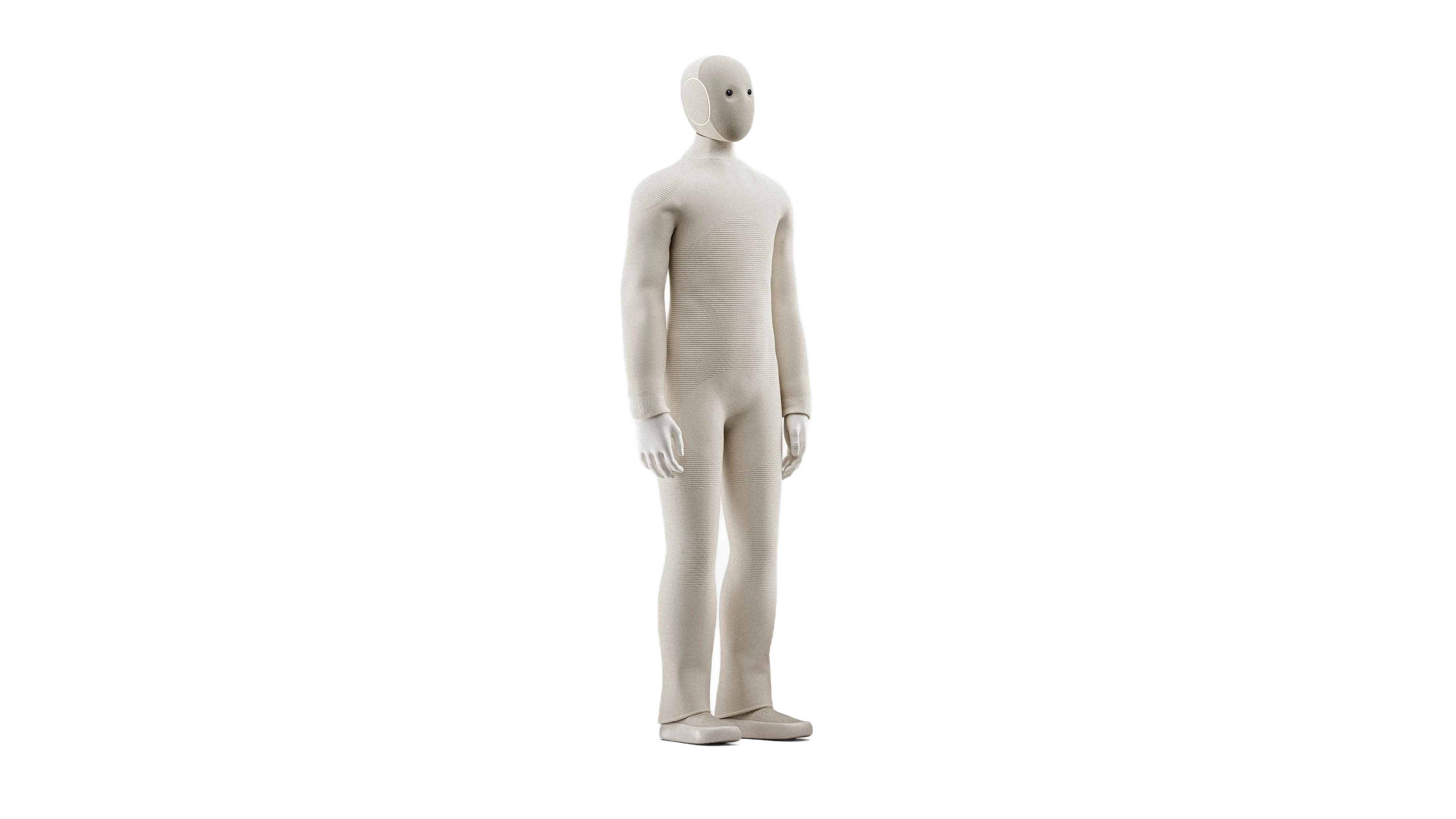
1X Neo (stylized as NEO) is a bipedal humanoid robot built for private homes by 1X Technologies (formerly Halodi Robotics), a Norwegian-American company backed by OpenAI. Priced at $20,000 or $499 per month, NEO opened for consumer pre-order on October 28, 2025, with first U.S. deliveries planned for 2026, making it the first consumer-focused humanoid robot to ship to private homes. It is a lightweight, human-sized android, 167 cm (5 ft 6 in) tall and 30 kg (66 lb), that pairs a bio-inspired tendon-driven actuation system with a soft, pinch-free exterior and near-silent 22 dB operation. Announcing the pre-order, founder and CEO Bernt Bornich said, "Humanoids were long a thing of sci-fi, then they were a thing of research, but today, with the launch of NEO, humanoid robots become a product."[13][14] NEO was first introduced as NEO Beta in August 2024, followed by the improved NEO Gamma in February 2025.
NEO represents a deliberate departure from the heavy, industrial-grade humanoids being developed by other companies. Instead of targeting factory floors, 1X has positioned NEO as a consumer product for everyday households, prioritizing safety, quiet operation, and natural human interaction. The robot is backed by significant investment from OpenAI, Samsung Next, EQT Ventures, and Tiger Global, with the company having raised over $125 million across early rounds and reportedly pursuing a $1 billion raise at a $10 billion valuation in late 2025.
NEO's most-discussed feature is its reliance on remote human operators. Because the onboard AI cannot yet complete most household chores unassisted, 1X lets owners schedule a teleoperator who controls NEO through a VR headset to finish unfamiliar tasks while the system learns from the demonstration. 1X has publicly characterized NEO's autonomy at launch as roughly 60 to 70 percent of attempted tasks completed without operator intervention.[38] This human-in-the-loop model drew both criticism, over privacy and the gap between marketing and capability, and a defense from 1X that supervised, logged teleoperation is more auditable than an in-person cleaner.[32]
In January 2026, 1X unveiled the 1X World Model, a physics-grounded generative video model that lets NEO acquire new tasks by watching video rather than relying solely on explicit programming or teleoperated demonstrations. In April 2026, the company opened its NEO Factory in Hayward, California, billed as the most vertically integrated humanoid robot factory in the United States, with a stated capacity of 10,000 units in its first year and an ambition to reach 100,000 units annually by the end of 2027. In June 2026, 1X established a dedicated World Model Lab to scale that research toward general-purpose home autonomy.[39] On July 9, 2026, the company unveiled a new 25-DoF, tendon-driven dexterous hand for NEO, presenting it as the production hand for shipping units and calling it "an API to the physical world."[42][43]
Background: 1X Technologies
Founding and early history
1X Technologies was founded in May 2014 in Moss, Norway, by roboticist Bernt Oivind Bornich along with co-founders Phuong Nguyen, Jorgen Sundell, and Pal Loken.[1] The company was originally named Halodi Robotics and focused on developing safe actuators and full-body control systems for industrial and healthcare robotics applications. Bornich, who studied Robotics and Nanoelectronics at the University of Oslo, had been interested in electromechanics since age 11 and envisioned building general-purpose robots that could coexist safely with humans.[2]
The company's early research centered on its proprietary Revo1 motor, a high-torque brushless direct current (BLDC) motor paired with low-gear-ratio cable drives. At the time of its development, the Revo1 was described as the highest torque-to-weight direct drive motor in the world.[3] This motor technology became the foundation for the company's first commercial robot, EVE.
EVE: the wheeled predecessor
In 2018, 1X (then Halodi Robotics) released EVE, a wheeled, self-balancing humanoid robot designed for logistics, security, and medical environments. Standing 188 cm (6 ft 2 in) tall and weighing 87 kg (192 lb), EVE used wheels rather than legs for locomotion and was capable of traveling at speeds up to 14.5 km/h (9 mph). The robot could carry loads of up to 15 kg and operate for approximately six hours on a single charge.[4]
EVE's most notable commercial deployment came through a partnership with ADT Commercial (Everon), which ordered 140 to 250 EVE units for autonomous night security patrols in commercial buildings across the United States.[5] This deployment represented one of the largest single orders of humanoid robots at the time and provided 1X with crucial real-world operational data. Teleoperated demonstrations performed on EVE later became a primary input to NEO's training datasets, since both robots share many low-level control conventions.
Rebranding and pivot to consumer robotics
In 2022, Halodi Robotics rebranded as 1X Technologies and shifted its primary focus from industrial and enterprise robotics to domestic consumer robotics. The company began developing humanoid assistants intended for use in private homes, leveraging the data and experience gained from EVE's commercial deployments to train artificial intelligence models for household tasks.[6]
In July 2025, 1X consolidated its teams from Moss, Norway, and Sunnyvale, California, into a new 80,000-square-foot global headquarters in Palo Alto, California, designed to accommodate up to 400 employees. The company maintains manufacturing operations at the Hayward, California facility and in Moss, Norway, with an additional U.S. plant in San Carlos slated to come online later in 2026.[7]
Development history
When was the 1X NEO released?
NEO reached the market through a staged rollout: a NEO Beta proof-of-concept in August 2024, a refined NEO Gamma in February 2025, and a consumer pre-order launch on October 28, 2025, with U.S. deliveries planned for 2026 and international markets from 2027.
| Milestone | Date | Significance |
|---|---|---|
| NEO Beta unveiled | August 30, 2024 | First home-focused prototype, 165 cm, 30 kg |
| NEO Gamma introduced | February 21, 2025 | 10x reliability, knitted suit, quieter (22 dB) |
| Home pilot announced | March 2025 | Plan to place units in "a few hundred to a few thousand" homes |
| Consumer pre-order launch | October 28, 2025 | $20,000 / $499 per month, deliveries from 2026 |
| 1X World Model unveiled | January 12, 2026 | Learning tasks from video |
| NEO Factory opened | April 30, 2026 | First vertically integrated U.S. humanoid factory |
| World Model Lab established | June 5, 2026 | Dedicated lab to scale autonomy research |
| New NEO hand unveiled | July 9, 2026 | 25-DoF tendon-driven dexterous hand for shipping units |
NEO Beta (August 2024)
The first version of the NEO platform, called NEO Beta, was unveiled on August 30, 2024.[8] The NEO Beta was a proof-of-concept humanoid standing 165 cm (5 ft 5 in) tall and weighing 30 kg (66 lb). It featured 1X's proprietary Tendon Drive actuation system and hands with 22 degrees of freedom each. The robot could walk at up to 4 km/h and sprint at 12 km/h, with a battery life of two to four hours.
NEO Beta demonstrated the core design philosophy behind the platform: a lightweight, bio-inspired humanoid built specifically for safe operation around people in domestic settings. The robot used tendon-driven actuators rather than traditional rigid gearboxes, creating movements described as inherently gentler and more compliant than those produced by conventional servo motors.[9] At the unveiling, Bornich framed safety as the platform's defining constraint, stating, "Safety is the cornerstone that allows us to confidently introduce NEO Beta into homes, where it will gather essential feedback and demonstrate its capabilities in real-world settings."[40]
NEO Gamma (February 2025)
On February 21, 2025, 1X introduced NEO Gamma, a substantially improved iteration of the NEO platform.[10] The Gamma version incorporated several major upgrades over the Beta:
| Feature | NEO Beta | NEO Gamma |
|---|---|---|
| Hardware reliability | Baseline | 10x improvement |
| Operating noise | ~32 dB | ~22 dB (10 dB reduction) |
| Exterior covering | Exposed frame | Knitted nylon suit (machine-washable) |
| Joint safety | Partially covered | Fully enclosed, pinch-proof |
| Gait quality | Basic bipedal walking | Natural human gait with arm swings |
| Movement capabilities | Walking, basic tasks | Squatting, sitting in chairs, running |
| Audio system | Basic speakers | 4-mic beamforming array + 3-speaker system |
| AI model | Early Redwood prototype | Improved Redwood with whole-body control |
The NEO Gamma's exterior is wrapped in a knitted nylon body suit manufactured using a Japanese Shima Seiki machine through a whole-garment seamless knitting process. This 3D-printed nylon fabric conforms to the robot's body without impeding movement and is designed to reduce potential injuries from robot-to-human contact. The suit is machine-washable and available in three colors: tan, gray, and dark brown.[11]
NEO Gamma also introduced "Emotive Ear Rings," a design element intended to improve communication between the robot and its users. The robot's dynamic control skills, including natural walking with arm swings and the ability to squat and sit, are learned through reinforcement learning from human motion capture data, running at 100 Hz.[12]
Consumer launch (October 2025)
On October 28, 2025, 1X officially launched NEO as a consumer product and opened pre-orders through its online store.[13] The company described NEO as "the world's first consumer-ready humanoid robot designed to transform life at home." Two purchasing options were offered:
- Early Access: $20,000 one-time purchase with priority delivery in 2026
- Subscription: $499 per month (six-month minimum commitment), with delivery at a later date
Additionally, customers could place a fully refundable $200 deposit to reserve a unit. 1X announced plans to begin U.S. deliveries in 2026 and expand to international markets starting in 2027.[14] The company said NEO would handle a limited set of tasks at launch, citing examples such as "opening doors for guests, fetching items, and turning off the lights at night," with abilities expanding through over-the-air software updates.[14]
NEO Factory in Hayward (April 2026)
On April 30, 2026, 1X opened the NEO Factory in Hayward, California, describing it as the first vertically integrated humanoid robot factory in the United States.[33] The facility manufactures the majority of NEO's critical components in-house, including the Revo1-derived motors, batteries, structural skeleton, Tendon Drive transmission assemblies, knitted soft goods, and sensors. According to the company, the Hayward plant can deliver up to 10,000 NEO units in its first operating year, and a second U.S. facility in San Carlos is scheduled to come online later in 2026.
1X has publicly targeted a production rate of more than 100,000 NEOs per year by the end of 2027, with planned increases in automation along the way. The Hayward opening was accompanied by an announcement of 200 or more high-skill American manufacturing jobs and was framed by 1X as a shift from research and development to volume product manufacturing.[34]
Technical specifications
Physical design
NEO stands 167 cm (5 ft 6 in) tall and weighs 30 kg (66 lb), making it one of the lightest bipedal humanoids in development. Its human-proportioned frame is designed to navigate standard home environments, including doorways, staircases, and furniture layouts. The robot's 75 total degrees of freedom enable a wide range of movements across the full body.[15]
| Specification | Value |
|---|---|
| Height | 167 cm (5 ft 6 in) |
| Weight | 30 kg (66 lb) |
| Total degrees of freedom | 75 |
| Degrees of freedom per hand | 25 on the 2026 hand (22 finger/palm + 3 wrist); 22 on NEO Beta/Gamma |
| Walking speed | Up to 4 km/h (2.5 mph) |
| Sprinting speed | Up to 12 km/h (7.5 mph) |
| Payload capacity (lift) | 68 kg (150 lb) |
| Payload capacity (carry) | 25 kg (55 lb) |
| Operating noise | 22 dB |
| Battery capacity | 5,200 mAh |
| Battery life | Up to 5.5 hours (standard mode) |
| Hand IP rating | IP68 (fully submersible) |
| Body IP rating | IP44 (splash-proof) |
| Colors available | Tan, Gray, Dark Brown |
Tendon Drive actuation system
NEO's most distinctive engineering feature is its patented Tendon Drive actuation system, which mimics the human musculoskeletal system. Rather than using traditional direct motor-to-joint coupling with rigid gearboxes, the system uses artificial polymer tendons to transmit force from motors to joints, similar to how biological tendons connect muscles to bones.[16]
This design offers several advantages for a home environment robot:
- Backdrivability: The tendon transmission provides 95% backdrivability, meaning the joints can be moved easily by external forces. If a person or pet bumps into NEO, the robot yields rather than resisting.
- Smooth motion: The tendon-plus-motor configuration produces movements with less jerk and lower impact forces than conventional actuators, resulting in more natural and human-like motion.
- Quiet operation: The absence of high-ratio gear trains eliminates a major source of mechanical noise, contributing to NEO's 22 dB operating level, which is quieter than a typical household refrigerator.
- Power efficiency: Despite the compliant design, the system maintains high power output, allowing NEO to lift over 68 kg (150 lb) and carry 25 kg (55 lb).
The Tendon Drive also relocates many motors away from joint axes and toward the torso, redistributing mass closer to the robot's center of gravity and reducing the angular inertia of swinging limbs.
The 2026 NEO hand (25-DoF tendon-driven hand)
On July 9, 2026, 1X unveiled a new dexterous hand for NEO, positioning it as the production hand that will ship on consumer units and calling it "an API to the physical world."[42][43] Announcing it, Bornich said the design was "nearing or surpassing human-level dexterity, strength, speed, and reliability," and framed the effort this way: "For seventy years, robotics worked around the hand problem. The humanoid bet is the reverse: it lives or dies at the fingertips."[42] The "nearing or surpassing human-level" phrasing is a company characterization, not an independently benchmarked result. Reviewers called it one of the most capable humanoid robot hands shown to date, with several outlets echoing 1X's claim that it could "match or surpass human capability," while cautioning that a polished demo reel does not prove reliable, unattended household use.[44][47][51]
The hand carries 25 degrees of freedom: about 22 fully actuated joints across the fingers and palm plus 3 at the wrist, with every joint natively force-controlled and backdrivable.[43][46] That figure refines and extends the "22 per hand" specification carried by NEO Beta and Gamma rather than contradicting it. The finger and palm articulation stays at roughly 22 DoF, and the 2026 design folds a 3-DoF wrist into the hand module itself, bringing the assembly to 25. 1X presents it as the next-generation, mass-producible hand that advances the earlier prototype spec.
The 25-DoF figure applies to each left or right hand-and-wrist assembly, not to both hands together. 1X's current NEO product page separately itemizes 22 DoF for each hand and 7 DoF for each arm, while the hand announcement defines 25 as those 22 finger-and-palm axes plus 3 wrist axes. The two official descriptions reconcile by treating the wrist axes as part of the existing 7-DoF arm chain rather than adding them again on top of NEO's 75-DoF whole-body total.[43][52]
The new hand was announced as an integrated NEO component, not a standalone product or developer kit: 1X says it will ship on every NEO, while the company's public order flow remains for the complete robot through a $200 deposit. "API to the physical world" is a metaphor for the hand's role in manipulation; as of July 24, 2026, 1X had not published a separate hand price, ordering channel, control API, or hand-specific SDK.[43][52]
Mechanically, the hand keeps NEO's signature 1X Tendon Drive but runs it as a quasi-direct drive. High-torque-density motors sit up in the forearm and pull polymer tendons routed through the wrist, so the hand itself stays light while the muscle stays proximal. The low gear ratios, roughly 5:1 to 15:1, are central to the design: they leave each joint transparent enough to both apply force and read contact forces by back-driving, which is what lets the hand feel what it touches rather than only issue commands.[43][47]
| Metric | Value (per 1X) |
|---|---|
| Degrees of freedom | 25 (about 22 finger/palm + 3 wrist) |
| Actuation | 1X Tendon Drive, quasi-direct drive, fully backdrivable |
| Gear ratio | About 5:1 to 15:1 |
| Thumb CMC peak torque | About 3.5 Nm |
| Finger MCP peak torque | About 2.6 Nm |
| Distal (fingertip) flexion force | Up to about 45 N |
| Wrist torque | About 17.75 Nm |
| Positioning accuracy | About plus or minus 0.2 mm |
| Ingress protection | IP68 (submersible), food-safe materials |
| Validation | Millions of interaction cycles; wrist joint beyond 2 million cycles under high load |
Across the fingertips and hand surfaces, 1X added high-resolution tactile sensing that measures normal (pressure) force, contact location, and shear.[43][46] The company says this lets NEO notice an object starting to slip and tighten its grip in real time, closing the "write-only" gap of grippers that can act but cannot feel.[47][48] The hand is rated IP68 and built from food-safe materials, so it can be rinsed under a tap or even wash itself, and 1X says the fingers and wrist were validated across millions of interaction cycles, with the wrist proven beyond two million cycles under high load.[43][44]
In launch footage the hand was shown building with LEGO bricks, catching a soft ball, picking a loose screw and coins off a flat surface, installing a light bulb, driving a screwdriver, rotating objects in-hand, zipping a jacket, plugging in a USB-C connector, pouring tea, holding a wine glass, and fingerspelling in sign language.[43][45] Bornich tied the hardware to 1X's data strategy, saying the goal "was never a hand that just looks impressive on paper": a hand that can be built at scale is what lets the company run manipulation experiments at scale and feed the Redwood and 1X World Model stacks toward home autonomy.[45][49] At the reveal, 1X said it had already produced several hundred hands and had capacity to produce up to 10,000 hands in 2026.[43][46][50]
The demonstrations did not all use the same control mode. WIRED reported that 1X described some clips as machine-articulated and others as operator-controlled demonstrations of the hardware's upper limit. The publication said the fingerspelling sequence was automated and separately observed a fully automated NEO perform a finger-speed sequence and a peace sign over a video call.[53] The launch reel and official video therefore document the hand's range of motion and object repertoire, but they do not establish that every depicted task was completed autonomously or repeatably by Redwood.[53][54]
For hand-specific safety, 1X showed the low-ratio, backdrivable fingers yielding when slapped, struck with a hammer, trapped in a closing drawer, and driven into foam.[43][54] Those are company demonstrations rather than a published safety certification or independent injury-risk test. The launch materials also provide no standardized manipulation benchmark, per-task trial counts or success rates, hand mass, actuator count, tactile sensor technology or spatial and sampling resolution, control bandwidth, power and thermal figures, detailed cycle-test conditions and failures, or third-party evaluation. The published force, ingress, food-safety, accuracy, and lifetime figures consequently remain manufacturer-reported specifications.[43]
Safety features
Safety has been a central design priority for NEO, given its intended deployment in homes alongside children, elderly individuals, and pets:
- Soft body: Custom 3D lattice polymer structures throughout the body provide cushioning during physical contact, protecting both the robot and the humans around it.
- Pinch-free joints: All joints are fully enclosed and covered from external access, eliminating pinch points that could injure fingers or skin.
- Knitted nylon suit: The machine-washable exterior covering further reduces the risk of injury from robot-to-human contact and gives the robot a softer, more approachable appearance.
- Compliant actuators: The Tendon Drive system's inherent compliance means NEO does not exert dangerous forces during unexpected contact.
- Predictable motion profiles: Whole-body trajectories are clipped to a low maximum jerk and a smooth velocity envelope, so the robot does not produce sudden jolts that could startle nearby humans or pets.
Compute and sensors
NEO runs on the 1X NEO Cortex, a custom compute module based on the NVIDIA Jetson Thor platform. This module delivers up to 2,070 FP4 TFLOPS of AI compute, providing sufficient processing power to run large language models and vision-language-action models entirely on-device.[17]
| Component | Details |
|---|---|
| Compute module | 1X NEO Cortex (NVIDIA Jetson Thor) |
| AI compute | Up to 2,070 FP4 TFLOPS |
| Cameras | Dual 8.85 MP stereo fisheye cameras (90 Hz) |
| Microphones | 4-microphone beamforming array with echo cancellation |
| Speakers | 3-speaker system (1 chest, 2 pelvis) |
| Connectivity | Wi-Fi, Bluetooth, 5G |
| AI model | Redwood (160M parameter VLA, runs at ~5 Hz on-device) |
The dual stereo fisheye cameras operate at 90 Hz and provide 3D perception for simultaneous localization and mapping (SLAM), enabling NEO to navigate rooms, avoid obstacles, and build spatial maps of its environment. The four-microphone beamforming array supports voice interaction, while the three-speaker system provides AI voice responses and room-filling audio.[18]
Redwood AI
NEO's intelligence is powered by Redwood, 1X's proprietary vision-language-action (VLA) model. Redwood is a 160-million-parameter transformer that handles perception, navigation, and manipulation through a single unified architecture rather than treating these as separate subsystems.[19]
Architecture and capabilities
Redwood operates as an end-to-end model, processing visual input from NEO's cameras and language instructions from users, then generating motor commands for the robot's entire body. The model runs at approximately 5 Hz on NEO's onboard GPU, meaning it makes five decisions per second about how to move the robot.[20]
Internally, Redwood fuses three modality streams: pre-trained language embeddings from natural language instructions, vision tokens from a pre-trained vision transformer over the fisheye camera feeds, and proprioception embeddings derived from joint positions and applied forces. These streams pass through a stack of transformer blocks that produces a latent representation. The representation is then decoded into continuous action trajectories using a diffusion policy, a generative decoder that samples motor command sequences from a learned conditional distribution rather than predicting a single deterministic output.[35]
A key technical distinction of Redwood is its whole-body control approach. Many robotic systems treat locomotion (walking, balancing) and manipulation (grasping, carrying) as separate problems handled by different controllers. Redwood predicts arm and hand commands together with walking, manipulation, and pelvis pose commands in one shot, enabling more fluid and natural behavior. For example, NEO can bend at the hips and spine to pick up clothes from the floor, or brace one hand against a surface for stability while opening a heavy door with the other.
Training methodology
Redwood is trained on a combination of real-world teleoperation data and autonomous rollouts from both EVE and NEO fleets. Human teleoperators wear VR headsets to remotely control NEO robots, performing household tasks while the system records camera feeds and motor commands. Critically, Redwood learns from both successful and failed task attempts, allowing the model to improve from any interaction regardless of outcome. The failure trajectories are particularly valuable because they teach the policy which actions to avoid in similar contexts.[21]
The model is also trained to handle variation in tasks, such as picking up objects it has never encountered before in locations it has not previously visited. This generalization capability is essential for a home robot, where environments and objects vary enormously from one household to the next. Researchers at 1X have reported emergent multi-contact manipulation, where the robot stabilizes a target with one hand while acting with the other.
On-device operation
The entire Redwood model runs locally on NEO's embedded GPU without requiring a cloud connection. This design choice addresses both latency concerns (the robot must react in real time) and privacy considerations (home environments contain sensitive data). NEO can operate in areas with unreliable internet connectivity, such as basements or gardens, without losing autonomous capability.[22]
1X World Model
On January 12, 2026, 1X publicly unveiled the 1X World Model, an AI system designed to let NEO acquire new tasks by predicting the visual consequences of its own actions rather than relying exclusively on teleoperated demonstrations or pre-programmed behaviors.[36] The release marked a shift in 1X's stated AI roadmap from imitation learning toward a self-supervised paradigm informed by world-model research in reinforcement learning.
How it works
The 1X World Model is, at its core, a physics-grounded video generative model. Given current camera frames and a prompt describing a desired outcome, the model produces a short video that depicts a plausible sequence of future observations consistent with the laws of physics in the robot's environment. NEO then runs an inverse dynamics model that maps the generated future frames back into the motor commands needed to actually reach those states.
In practice, this allows the robot to plan in image space: if the prompt is "put the mug on the shelf," the world model imagines what the next several seconds would look like if NEO performed that action, and the inverse dynamics model translates that imagined trajectory into joint targets. Redwood then executes the resulting commands while reacting to discrepancies between the imagined and observed frames.[37]
Learning from internet-scale video
A key claim by 1X is that the World Model lets NEO learn from internet-scale video footage in addition to teleoperated robot data. Because the model only needs to predict pixels rather than precise robot actions during pre-training, it can be trained on large quantities of unlabeled human video to absorb general priors about how objects, surfaces, and people behave. The robot-specific inverse dynamics model then bridges those imagined dynamics and NEO's body. 1X framed this as moving humanoids closer to the scaling regime that has driven large language models, where most of the training signal comes from passively observed data.
World Model Lab (June 2026)
On June 5, 2026, 1X announced a dedicated World Model Lab to scale this research, pretraining large world and foundation models on a mix of internet data, first-person human video, simulation, teleoperated robot data, and real-world NEO data. The company hired Sam Sinha, a founding research scientist from Luma AI, as founding AI researcher and head of world models. Announcing the lab, Bornich said, "World models will free humanoid robots from the trap of narrow tasks in static environments by unlocking generalization, adaptability, and self-learning."[39]
Relationship to Redwood
The World Model does not replace Redwood. Instead, 1X positions the two systems as complementary: Redwood provides the reactive, low-latency controller that runs at roughly 5 Hz on-device, while the World Model serves as a planning and self-supervision layer that generates training trajectories and proposes plans for unfamiliar tasks. Real-world failures feed back into the World Model, refining its predictions over time.
Capabilities and use cases
What can the 1X NEO do?
NEO is designed to perform everyday household chores such as tidying, laundry, and carrying groceries, alongside companionship and ambient home assistance, but as of its 2026 launch it completes only an estimated 60 to 70 percent of attempted tasks autonomously and relies on remote human operators for the rest.[38]
Operating modes
In marketing and product documentation around the consumer launch, 1X grouped NEO's behaviors into three modes that customers can invoke through the companion app or by voice:
| Mode | Purpose | Typical autonomy |
|---|---|---|
| Chores Mode | Scheduled or on-demand household tasks such as tidying, laundry, and carrying groceries | Mixed: autonomy plus teleoperated assistance when stuck |
| Companion Mode | Conversation, education, daily reminders, and social interaction | Mostly autonomous, on-device language and dialogue |
| Autonomous Mode | Ambient operation: navigating, monitoring the home, opening doors, operating switches | Fully autonomous within designated areas |
At launch, 1X has publicly characterized NEO's overall autonomy as roughly 60 to 70 percent of attempted tasks completed without operator intervention, with internal targets of 80 to 90 percent by 2027 and more than 95 percent by 2028 as the Redwood and World Model stacks mature.[38] In a launch-day interview, Bornich gave task-level figures for fully autonomous operation, saying NEO opens doors with "90 something percent" success and fetches objects with "maybe 80% successful" rates, while characterizing the broader rollout as "a data collection play."[25]
Household tasks
NEO is designed to perform a range of domestic tasks, including:
- Cleaning: Vacuuming floors, wiping surfaces, tidying rooms
- Laundry: Folding clothes, sorting garments, loading washing machines
- Kitchen tasks: Unloading dishwashers, organizing shelves, watering plants
- Carrying and moving: Transporting groceries, moving light furniture, delivering objects between rooms
- Companionship: Engaging in natural conversation, providing social interaction
- Ambient assistance: Greeting guests at the door, answering questions, fetching small objects on request
During demonstrations, NEO has shown the ability to vacuum, water plants, fold clothes, and navigate rooms without bumping into people or furniture.[23]
Current limitations
As of mid-2026, NEO's autonomous capabilities remain a work in progress. In independent testing by journalists, many household tasks required human assistance through 1X's teleoperation system rather than being completed fully autonomously.[24] The company has been transparent about this limitation, describing NEO's initial capability as "basic autonomy" that will grow over time as the AI models improve through real-world data collection.
Is the 1X NEO fully autonomous?
No. NEO is not fully autonomous at launch. To bridge the gap between current AI capabilities and fully autonomous operation, 1X employs a "human-in-the-loop" approach. When NEO encounters a task it cannot handle autonomously, a trained 1X operator wearing a Meta Quest 3 headset can remotely access the robot's cameras and control its movements to complete the task. These teleoperation sessions also serve as training data for Redwood, gradually expanding the range of tasks NEO can perform independently.[25] Bornich has been explicit that the dependence is structural for now, telling reporters, "It is going to be a while until there is absolutely no human in the loop ever."[25]
1X offers scheduled sessions where an "Expert" teleoperator can assist with complex tasks, and users have privacy controls that determine when and whether a teleoperator can access their robot's cameras and sensors. The company has stated that one human supervisor oversees roughly eight teleoperators at a time, with all sessions logged for incident review.
Privacy and data controls
Because NEO operates inside private homes and can in some cases stream camera and microphone data to remote operators, 1X has built a layered set of privacy controls into the product:
| Control | Purpose |
|---|---|
| No-go zones | Rooms or areas that are off-limits to both autonomy and teleoperation |
| Visual blur | Automatic blurring of human faces and bodies in the operator's video feed |
| Audio masking | Distortion of ambient speech so operators cannot transcribe conversations |
| Time windows | Configurable schedules that restrict when teleoperation is permitted |
| Data sharing opt-out | Per-task consent to contribute recordings back to 1X for training |
| Operator vetting | Background checks and confidentiality agreements for every teleoperator |
| Session logs | Recordings of all teleoperation sessions for incident tracing |
Founder Bernt Bornich has publicly argued that supervised teleoperation is more auditable than an in-person cleaner, since every minute of remote access is logged. He has described the operator interface as "Starcraft-like," in which operators cannot see the people in a home (who are blurred out) or know which household they are in, and has said 1X can therefore offer a "better, more secure service" than traditional cleaning through operator vetting, real-time oversight, audit trails, and anonymization.[25] Critics counter that even with these controls, the existence of a live camera feed inside the home is a fundamentally new privacy attack surface.[32]
Funding and investment
1X Technologies has raised over $125 million in venture capital funding through multiple rounds:
| Round | Date | Amount | Lead investor | Key participants |
|---|---|---|---|---|
| Series A2 | March 2023 | $23.5 million | OpenAI Startup Fund | Tiger Global, Sandwater, Alliance Ventures, Skagerak Capital |
| Series B | January 2024 | $100 million | EQT Ventures | Samsung Next, OpenAI Startup Fund, Tiger Global, Nistad Group |
The Series A2 round in March 2023 was significant as one of the first major investments by the OpenAI Startup Fund into a robotics company, signaling OpenAI's interest in embodied AI and physical intelligence.[26] The $100 million Series B round in January 2024 brought the company's total raised to approximately $137 million and was led by EQT Ventures, a European venture capital firm.[27]
In September 2025, reports indicated that 1X was in discussions to raise up to $1 billion in new funding at a valuation of at least $10 billion, representing a more than 12-fold increase from its approximately $820 million valuation at the time of the Series B round.[28] This potential fundraise, if completed, would make 1X one of the most highly valued humanoid robotics companies in the world.
Partnerships and deployments
EQT industrial partnership
In December 2025, 1X announced a strategic partnership with EQT to make up to 10,000 NEO humanoid robots available to EQT's global portfolio of more than 300 companies between 2026 and 2030. The partnership focuses on high-impact use cases where robots work closely with humans, including logistics, facility operations, warehousing, manufacturing, and healthcare.[29]
1X plans to launch pilot deployments in the United States in 2026, followed by scaling across Europe and Asia. If fully realized, this deployment would represent one of the largest commercial rollouts of humanoid robots in the industry's history. While NEO was originally designed as a home robot, this partnership demonstrates the platform's versatility in industrial settings.
Home pilot program
In March 2025, 1X CEO Bernt Bornich announced plans to begin in-home testing of NEO Gamma units in "a few hundred to a few thousand" homes by the end of 2025.[30] 1X never published a count of homes reached under that target, and the pilot was overtaken by the consumer program: pre-orders opened on October 28, 2025, the Hayward NEO Factory opened on April 30, 2026, and first customer shipments were still described as planned for 2026.[14][33] As of August 2026 the company had not reported the pilot's final size. The pilot program relied on a combination of autonomous AI operation and teleoperation to handle tasks, with the primary goal of collecting real-world household data to improve NEO's AI models.
Early adopters in the pilot program effectively serve as data contributors, helping 1X build a diverse dataset of robot-home interactions that is used to train future versions of the Redwood AI model and the 1X World Model. Each hour of household operation, whether autonomous or teleoperated, produces training signal that flows back into model updates pushed over the air to deployed units.
Market position and competition
How does the 1X NEO compare to Tesla Optimus and Figure?
NEO occupies a unique position in the humanoid robotics market as one of the few robots designed primarily for consumer home use rather than industrial or enterprise applications. At 30 kg it is markedly lighter than rivals such as Tesla Optimus (about 57 kg) and Figure 03 (about 70 kg), and as of 2026 it is the only one of the three shipping paid units to private homes.
| Robot | Manufacturer | Height | Weight | Target market | Price | Status (2026) |
|---|---|---|---|---|---|---|
| NEO | 1X Technologies | 167 cm | 30 kg | Home / consumer | $20,000 | Pre-order, shipping 2026 |
| Optimus | Tesla | 173 cm | 57 kg | Industrial / consumer | ~$20,000-$30,000 (projected) | In development |
| Figure 03 | Figure AI | 170 cm | 70 kg | Industrial / enterprise | Not announced | In development |
| Atlas | Boston Dynamics | 150 cm | 89 kg | Research / industrial | Not for sale | Research platform |
| GR-2 | Fourier Intelligence | 175 cm | 63 kg | Healthcare / industrial | ~$90,000+ | Limited availability |
NEO differentiates itself through several factors: its exceptionally low weight (30 kg compared to 57 kg or more for competitors), its bio-inspired tendon actuation for safe human interaction, and its explicit consumer home focus. Most competing humanoids are significantly heavier and designed for industrial or research applications. As of 2026, NEO is the only consumer-focused humanoid actively shipping to homes.[31]
However, the company faces stiff competition from well-funded rivals. Tesla has projected a similar $20,000 to $30,000 price range for its Optimus humanoid, though a consumer launch date has not been confirmed. Figure AI has raised billions in funding and is developing advanced humanoids with large language model integration. 1X is the first of these rivals to operate a vertically integrated U.S. consumer humanoid factory and ship paid units to private addresses. The July 2026 hand reveal sharpened this contrast on manipulation specifically: rival hand programs at Tesla and Figure remain in development, and 1X presented its 25-DoF tendon hand as both a shipping component and a bid to lead on dexterity.[44][47]
Reception and criticism
NEO has received attention for its ambitious consumer home positioning and its lightweight, safety-first design approach. The partnership with OpenAI and the high-profile funding rounds have generated significant media coverage. The January 2026 unveiling of the 1X World Model and the April 2026 opening of the Hayward factory further amplified press attention, with several outlets describing 1X as the most consumer-ready humanoid company in the West.
Critics and analysts have raised several concerns. The reliance on teleoperation for many tasks means that early adopters are essentially paying $20,000 for a robot that cannot yet perform most household tasks independently. Privacy advocates have noted that the teleoperation model requires human operators to view live camera feeds from inside people's homes, even with user-controllable access settings.[32] The long-term viability of the $499/month subscription model has also been questioned, given the robot's current limitations. Some commentators have characterized the launch as "selling the dream," arguing that the visible autonomy gap could damage consumer trust if not closed quickly.[41]
Supporters counter that the human-in-the-loop approach is a pragmatic strategy for collecting the training data needed to build truly autonomous home robots, and that early adopters are investing in a platform that will improve substantially over time through software and AI updates. They also point to the company's published autonomy roadmap, which projects steady improvements through 2028, as evidence that the teleoperation phase is intended to be transitional rather than permanent. The July 2026 hand reveal fed both sides of this debate: some analysts framed the hardware as the strongest evidence yet that 1X can close the dexterity gap, while others noted that a capable hand is necessary but not sufficient without the on-device autonomy to use it unsupervised.[44][48]
See also
- 1X Technologies
- Humanoid robots
- EVE
- Embodied AI
- Reinforcement learning
- Tesla Optimus
- Figure 03
- Tendon-driven actuation
- Dexterous hand
- Humanoid robot hands
References
- ^"About 1X Technologies." 1X Technologies official website. 1x.tech/about
- ^"1X Technologies' Bernt Bornich's Life with Robots." The Software Report. thesoftwarereport.com/...bornichs-life-with-robots
- ^"Report: 1X Business Breakdown & Founding Story." Contrary Research. research.contrary.com/...1x
- ^"EVE." ROBOTS: Your Guide to the World of Robotics. robotsguide.com/...eve
- ^"1X Technologies." Wikipedia. en.wikipedia.org/...1X_Technologies
- ^"The Story of 1X and Its Vision for Real-World AI." XMAQUINA DAO. xmaquina.io/...the-story-of-1x-technologies
- ^"1X Opens Global HQ in Palo Alto." 1X Technologies. 1x.tech/...palo-alto-hq
- ^"1X Unveils NEO Beta, A Humanoid Robot for the Home." 1X Technologies. 1x.tech/...-neo-beta-a-humanoid-robot-for-the-home
- ^"NEO Beta by 1X Technologies." HumanoidSpecs. humanoidspecs.com/...1x-technologies-neo-beta
- ^"Introducing NEO Gamma." 1X Technologies. 1x.tech/...introducing-neo-gamma
- ^"1X built its latest humanoid NEO Gamma to better fit into the home." The Robot Report. therobotreport.com/...id-neo-gamma-better-fit-home
- ^"Norway's 1X is building a humanoid robot for the home." TechCrunch, February 21, 2025. techcrunch.com/...ng-a-humanoid-robot-for-the-home
- ^1 ^2"1X NEO Home Robot." 1X Technologies. 1x.tech/...neo-home-robot
- ^1 ^2 ^3 ^4"NEO humanoid designed for household use, available for preorder." The Robot Report. therobotreport.com/...er-launch-neo-humanoid-robot
- ^"1X Neo - Humanoid Robot Specifications." HumanoidSpecs. humanoidspecs.com/...1x-neo
- ^"NEO by 1X Technologies - Humanoid Robot Specs & Details." humanoid-robots.io. humanoid-robots.io/...neo-by-1x-technologies
- ^"Inside 1X's Humanoid Robot Stack: Simulation, AI Training, and Onboard Compute with NVIDIA." 1X Technologies. 1x.tech/...nvidia-gtc-2026
- ^"NEO by 1X Technologies - Home Humanoid Robot." Livium. livium.com/...neo
- ^"Redwood AI." 1X Technologies. 1x.tech/...redwood-ai
- ^"1X Unveils Redwood AI: A Unified, Onboard Brain for Its NEO Humanoid Robots." Humanoids Daily. humanoidsdaily.com/...-for-its-neo-humanoid-robots
- ^"1X's NEO humanoid gains autonomy with new Redwood AI model." The Robot Report. therobotreport.com/...my-with-new-redwood-ai-model
- ^"Redwood AI: The small brain powering 1X's NEO Gamma robot." LiddleBit. liddlebit.co.uk/...in-powering-1xs-neo-gamma-robot
- ^"Meet NEO, the $20,000 Humanoid Robot That Can Clean, Chat, and Do Your Laundry." TechTimes, October 29, 2025. techtimes.com/...at-can-clean-chat-do-your-laundry
- ^"For $20,000, a humanoid robot will do your household chores for you." Fortune, February 26, 2026. fortune.com/...-chores-for-you-robotics-company-1x
- ^1 ^2 ^3 ^4"1X Details NEO's Human-in-the-Loop Strategy and Hardware as $20,000 Pre-Orders Go Live." Humanoids Daily. humanoidsdaily.com/...rdware-as-pre-orders-go-live
- ^"Norwegian humanoid robotic startup raises $23.5 million in a Series A." ArcticStartup. arcticstartup.com/1x-raises-23-5m-series-a2
- ^"1X Secures $100M in Series B Funding." 1X Technologies. 1x.tech/...1x-secures-100m-in-series-b-funding
- ^"Backed by OpenAI, 1X Technologies Aims for Up to USD 1 Billion Funding." EqualOcean, September 24, 2025. equalocean.com/...20250924230148618
- ^"1X Announces Strategic Partnership to Make up to 10,000 Humanoid Robots Available to EQT's Global Portfolio." BusinessWire, December 11, 2025. businesswire.com/...lable-to-EQTs-Global-Portfolio
- ^"1X will test humanoid robots in 'a few hundred' homes in 2025." TechCrunch, March 21, 2025. techcrunch.com/...s-in-a-few-hundred-homes-in-2025
- ^"Best Home Robots 2026: Tesla Optimus vs. Figure vs. 1X." AI Dev Day India. aidevdayindia.org/...best-humanoid-robots
- ^1 ^2 ^3"Sci-fi meets chores: this humanoid robot does your cleaning, but human may peek into your home." Euronews, October 30, 2025. euronews.com/...ng-but-human-may-peek-into-your-ho
- ^1 ^2"1X Opens NEO Factory in Hayward, CA, America's First Vertically Integrated Humanoid Robot Factory, with Consumer Shipments Planned for 2026." GlobeNewswire, April 30, 2026. globenewswire.com/...er-shipments-planned-for-2026
- ^"1X begins production of NEO humanoids in California facility." The Robot Report, April 30, 2026. therobotreport.com/...-hayward-california-facility
- ^"1X Unveils Redwood AI: Powering Human-Like Robot Dexterity." 1X Technologies, 2025. 1x.tech/...redwood-ai
- ^"Neo humanoid maker 1X releases world model to help bots learn what they see." TechCrunch, January 13, 2026. techcrunch.com/...to-help-bots-learn-what-they-see
- ^"1X launches world model enabling NEO robot to learn tasks by watching videos." The Robot Report, January 2026. therobotreport.com/...arn-tasks-by-watching-videos
- ^1 ^2 ^3"1X NEO Review: $20K Home Robot [2026]." RoboZaps. blog.robozaps.com/...1x-neo-review
- ^1 ^2"1X Launches World Model Lab to Advance Humanoid Robot Autonomy." The AI Insider, June 5, 2026. theaiinsider.tech/...vance-humanoid-robot-autonomy
- ^"Neo Beta humanoid unveiled ahead of limited rollout to people's homes." New Atlas, August 30, 2024. newatlas.com/...1x-neo-beta-humanoid-robot
- ^"1X's NEO Launch Splits Tech World, Sparking Heated Debate on Autonomy and 'Selling the Dream'." Humanoids Daily. humanoidsdaily.com/...n-autonomy-and-teleoperation
- ^1 ^2 ^3Bernt Bornich (@BerntBornich). "Introducing NEO's 25 Degrees of Freedom, tendon-driven hands, nearing or surpassing human-level dexterity, strength, speed, and reliability. For seventy years, robotics worked around the hand problem. The humanoid bet is the reverse: it lives or dies at the fingertips." X (Twitter), July 9, 2026. x.com/...2075253825494237660
- ^1 ^2 ^3 ^4 ^5 ^6 ^7 ^8 ^9 ^10 ^11 ^12"NEO's Hands: An API to the Physical World." 1X Technologies newsroom, July 9, 2026. 1x.tech/...neos-hands
- ^1 ^2 ^3 ^4Koetsier, John. "Human-Level Hands? 1X Just Gave Humanoid Robot Neo Something Close." Forbes, July 9, 2026. forbes.com/...e-humanoid-robot-neo-something-close
- ^1 ^2"1X Unveils New Dexterous Tendon-driven Hand for its Neo Humanoid Robots." The AI Insider, July 9, 2026. theaiinsider.tech/...d-for-its-neo-humanoid-robots
- ^1 ^2 ^3"NEO humanoid's new hands promise human-like dexterity and precision." Interesting Engineering, July 2026. interestingengineering.com/...t-hands-neo-humanoid
- ^1 ^2 ^3 ^4"1X Technologies designs humanoid hand to 'match or surpass human capability'." Dezeen, July 13, 2026. dezeen.com/...1x-technologies-neo-robot-hand
- ^1 ^2"1X's NEO robot gets hands that can feel a glass slipping." The Next Web, July 2026. thenextweb.com/...1x-neo-robot-tendon-driven-hands
- ^"1X Debuts Neo's Tendon-Driven Hands With 25 Degrees of Freedom." AI Weekly, July 2026. aiweekly.co/...en-hands-with-25-degrees-of-freedom
- ^"1X Unveils 25-DOF Biomimetic Dexterous Hand: 10,000-Unit Annual Capacity, a Quantum Leap in Robot Tactile Perception." BigGo Finance, July 2026. finance.biggo.com/...3-4bc4-4d10-8794-9710fe8de0a1
- ^"1X Neo Humanoid Robotics Hands Match Human Capability." NextBigFuture, July 2026. nextbigfuture.com/...-hands-match-human-capability
- ^1 ^2"NEO Home Robot." 1X Technologies product page. 1x.tech/neo
- ^1 ^2Ashworth, Boone. "The 1X Neo Robot Has Freaky Fast Fingers." WIRED, July 9, 2026, updated July 13, 2026. wired.com/...-1x-neo-robot-has-freaky-fast-fingers
- ^1 ^2"NEO's Hands." 1X Technologies official video, July 2026. youtube.com/watch
Improve this article
Add missing citations, update stale details, or suggest a clearer explanation. Every suggestion is reviewed for sourcing before it goes live.
9 revisions · v10 · 7,506 words · full history
Fact-checks are independent of edits: a reviewer re-verifies the article against its sources and stamps the date. How we verify
Research and drafting on this wiki are AI-assisted, under named human editorial standards. How AI is used here
Cite this page: AI Wiki. "1X Neo." aiwiki.ai, updated 1 Aug 2026. CC BY 4.0. https://aiwiki.ai/wiki/1x_neo