

Dexmate Vega
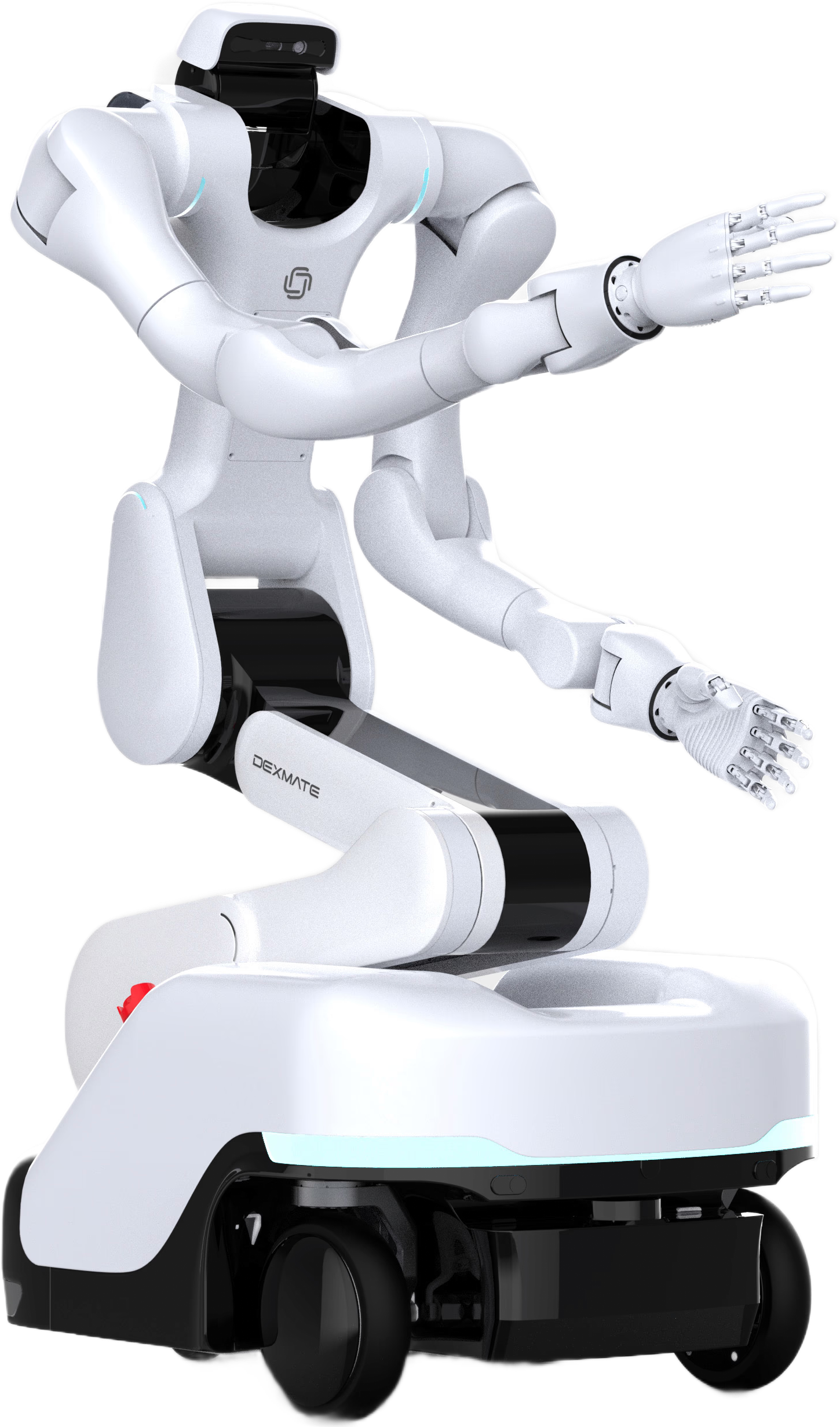
Dexmate Vega (often referred to simply as Vega) is a general-purpose mobile humanoid robot developed by Dexmate AI, Inc., a robotics startup headquartered in Santa Clara, California. Designed for both industrial and household applications, Vega combines a wheeled omnidirectional base with a foldable dual-arm torso and dexterous five-fingered hands. The robot was developed in under six months and became available for preorder in early 2025, with an approximate price of $89,999 for the standard configuration.
 | |
| Developer | Dexmate (Dexmate AI, Inc.) |
| Type | Humanoid robot (wheeled mobile manipulator) |
| Country of origin | United States |
| Founded | January 2024 |
| Unveiled | Early 2025 |
| Status | In production |
| Height | 171 cm (5 ft 7 in), extends to 220 cm (7 ft 2 in) |
| Weight | 135 kg (298 lb) |
| Degrees of Freedom | 36 total |
| Battery life | 10+ hours (full payload); up to 30 hours (light load) |
| Max speed | 1.1 m/s (4.0 km/h, 2.5 mph) |
| Arm payload | 7 kg (15 lb) per arm |
| Compute | NVIDIA Jetson AGX Orin (32 GB or 64 GB); AGX Thor option |
| Price | From $81,000 (no hands) to $96,000 (with dexterous hands) |
| Website | dexmate.ai |
Vega is notable for its distinctive foldable design, which allows the robot to compact down to just 66 cm for storage and transport, then extend to a full reach height of 2.2 meters for overhead tasks. The robot offers 36 degrees of freedom across its body, with each arm providing 7 DOF and each hand contributing additional dexterity for fine manipulation. Dexmate positions Vega as a practical, production-ready platform for researchers, developers, and commercial operators seeking capable mobile manipulation at a price point significantly below many competing humanoid systems.
Company Background
Founding and Leadership
Dexmate AI, Inc. was founded in January 2024 by roboticists with deep academic backgrounds in dexterous manipulation and embodied AI. The company name derives from the word "dexterous," reflecting its core focus on robotic hand manipulation capabilities.[1]
Tao Chen (CEO and Co-founder) holds a Ph.D. in Electrical Engineering and Computer Science from MIT, where he was a member of the MIT Improbable AI Lab under Professor Pulkit Agrawal. Chen's doctoral research focused on dexterous manipulation, and he received the Best Paper Award at the Conference on Robot Learning (CoRL) 2021 for his work on in-hand object reorientation. That research demonstrated a system capable of reorienting over 2,000 diverse objects using a simulated anthropomorphic hand with 24 degrees of freedom, trained through model-free reinforcement learning with a teacher-student training approach.[2][3] Before MIT, Chen studied at Carnegie Mellon University, where he applied reinforcement learning across multiple robot platforms. He has authored 22 papers in AI and robotics, including publications in Science Robotics.[4]
Yuzhe Qin (CTO and Co-founder) holds a Ph.D. in Computer Science from UC San Diego (UCSD), where he studied under Professors Hao Su and Xiaolong Wang. Qin is recognized as a core developer of the SAPIEN simulation platform (ManiSkill), a GPU-parallelized robotics simulator used widely in the research community. He was also a core developer of NVIDIA's teleoperation system and a Qualcomm Innovation Fellowship recipient. Qin has authored over 25 academic papers, including work on AnyTeleop (a general vision-based dexterous robot teleoperation system) and Dex1B (learning with one billion demonstrations for dexterous manipulation). He was among the first researchers globally to use Apple Vision Pro for dexterous hand teleoperation, and he open-sourced the code for that work.[5][6]
Chongyang Wang (COO and Co-founder) is an MIT graduate with over a decade of operational experience, responsible for managing Dexmate's business execution and scaling operations.[4]
Xiaolong Wang, a UCSD professor specializing in AI-driven robotics, serves as an advisor to the company.[4]
Funding and Partnerships
Dexmate is a member of the NVIDIA Inception program, a platform that provides startups with access to NVIDIA's technology, expertise, and go-to-market support. The company raised a seed round in July 2024, with investors including Cadenza Capital, iSeed Ventures, Llama Venture, NYX Ventures, and Sinovel Angel Fund.[7][8] As of early 2026, Dexmate has between 11 and 50 employees.[9]
Design Philosophy
Dexterous Manipulation as Core Focus
Dexmate's fundamental thesis is that dexterous manipulation, the ability of a robot to skillfully handle diverse objects using multi-fingered hands, represents the most critical unsolved problem in general-purpose robotics. As CEO Tao Chen has noted, while parallel-jaw grippers are commonly used in industrial settings due to their simplicity in control, they are physically unable to handle many tools and objects encountered in daily life.[2] Dexmate's approach centers on developing hands that can achieve near-human levels of object manipulation, powered by AI algorithms that combine reinforcement learning, large-scale simulation data, and real-world teleoperation.
At the core of Dexmate's innovation is a dexterous robotic hand system that the company claims achieves a 99% success rate in manipulating thousands of different object types. This capability is powered by advanced AI algorithms including reinforcement learning and large-scale data modeling, enabling the hands to perform complex tasks such as object reorientation, fine motor movements, and adaptive grip handling.[4]
Hardware-Software Co-Design
Dexmate emphasizes what it calls "hardware-software co-design," meaning that hardware design decisions are made with downstream AI requirements in mind from the start. The company's hand design follows a hybrid structure with a rigid skeletal core and soft exterior, mimicking the biomechanics of the human hand. Rather than pursuing maximal anthropomorphic similarity, Dexmate prioritizes "effective degrees of freedom" that provide functional flexibility for real manipulation tasks.[5]
Practical engineering considerations such as thermal management, waterproofing, and tactile feedback for grip control are central to the hardware design process. The company works closely with motor suppliers to achieve the miniaturization needed for compact, high-performance actuators in the hand assembly.[5]
Data Flywheel Strategy
Dexmate pursues what it terms a "data flywheel" strategy for training its manipulation AI. Rather than collecting data linearly, the company integrates multiple data sources simultaneously: simulation data from GPU-parallelized environments, real-world teleoperation data collected through VR headsets and exoskeletons, and human demonstration data captured from video and motion capture. The key insight is that existing data can be leveraged to accelerate the generation of future training data, creating a compounding effect.[5]
The company's approach blends sim-to-real transfer with real-world data collection, in contrast to competitors who may emphasize one approach over the other. Dexmate has stated that its AI algorithms are designed to be platform-agnostic, capable of working across different hand designs with minimal retraining, similar to how a large language model can be fine-tuned for different tasks from a common foundation.[5]
Foldable Form Factor
Vega's most distinctive physical feature is its foldable torso and arm design, which Dexmate describes as "Transformer-like." In its compact configuration, the robot folds down to approximately 66 cm (26 inches) in height, making it easy to store in closets, transport in standard vehicles, or ship in compact packaging. When deployed for work, the torso extends and the arms unfold to provide a maximum reach height of 220 cm (7 feet 2 inches), enabling the robot to access high shelves, overhead storage, and elevated work surfaces.[10][11]
This design choice reflects Dexmate's belief that practical deployment barriers, including storage, transportation, and space constraints, are just as important as raw manipulation capability. The foldable design also supports Dexmate's target of making humanoid robots accessible in home environments where permanent robot storage space may not be available.
Technical Specifications
Physical Dimensions and Structure
Vega stands 171 cm (5 feet 7 inches) tall in its standard working posture and weighs 135 kg (298 pounds). The robot's primary structural material is aluminum, providing a balance of strength and weight. The omnidirectional wheeled base allows movement in any direction without requiring the robot to rotate first, improving maneuverability in confined spaces such as narrow warehouse aisles or domestic hallways.[10][12]
Degrees of Freedom
Vega provides 36 total degrees of freedom distributed across its body.
| Body Segment | Degrees of Freedom |
|---|---|
| Head | 3 DOF (pan, tilt, roll) |
| Torso | 3 DOF (adjustable height and orientation) |
| Left arm | 7 DOF |
| Right arm | 7 DOF |
| Left hand | Up to 6 DOF (with dexterous hand option) |
| Right hand | Up to 6 DOF (with dexterous hand option) |
| Mobile base | Multiple DOF (omnidirectional) |
| Total | 36+ DOF |
Each arm provides 7 degrees of freedom with a payload capacity of approximately 7 kg (15 lb) per arm at any pose. The arms are designed for high-payload tasks such as lifting boxes, handling tools, and performing assembly operations.[10][12]
Dexterous Hands
Vega's optional dexterous hands are five-fingered units with touch sensors and up to 6 DOF per hand. The hands are designed to handle a wide variety of objects, from delicate glassware to heavy tools, using adaptive grip control informed by force/torque feedback and tactile sensing. The store listing offers two configurations: the full robot with dexterous hands (6 DOF, touch sensors) at $96,000, and the robot without end-effectors at $81,000, allowing researchers to mount their own custom grippers or hands.[13]
Detailed Specifications Table
| Category | Parameter | Value |
|---|---|---|
| Physical | Height (standard) | 171 cm (5 ft 7 in) |
| Physical | Height (extended) | 220 cm (7 ft 2 in) |
| Physical | Height (folded) | 66 cm (26 in) |
| Physical | Weight | 135 kg (298 lb) |
| Physical | Material | Aluminum |
| Mobility | Total DOF | 36 |
| Mobility | DOF per arm | 7 |
| Mobility | Head DOF | 3 |
| Mobility | Torso DOF | 3 |
| Mobility | Max speed | 1.1 m/s (4.0 km/h) |
| Mobility | Base type | Omnidirectional wheels |
| Manipulation | Arm payload | 7 kg (15 lb) per arm |
| Manipulation | Fingers per hand | 5 |
| Manipulation | Hand DOF | Up to 6 per hand (with dexterous option) |
| Power | Battery life (full payload) | 10+ hours |
| Power | Battery life (light load) | Up to 30 hours |
| Computing | Default compute | NVIDIA Jetson AGX Orin (32 GB or 64 GB) |
| Computing | Upgrade option | NVIDIA Jetson AGX Thor |
| Computing | CPU | Intel x86 |
| Computing | Operating system | Linux |
| Computing | LLM integration | Yes (optional) |
| Sensors | Cameras | RGB-D (head-mounted), stereo RGB |
| Sensors | LiDAR | Yes |
| Sensors | Force/torque | 6-axis force/torque sensors |
| Sensors | IMU | Yes |
| Sensors | Ultrasonic | Yes |
| Sensors | Depth | Yes |
| Connectivity | Ports | 4x USB 3.2, 1x Ethernet, 1x DisplayPort |
| Connectivity | Wireless | WiFi, Bluetooth |
| Connectivity | Power output | 5V and 12V power supplies for custom payloads |
| Connectivity | ROS compatible | Yes |
| Software | SDK | Python API (pip installable) |
| Software | Simulation | URDF and USD file support |
| Software | Teleoperation | VR and exoskeleton compatible |
| Software | Safety | Self-collision avoidance, compliance control |
| Commercial | Base price | $81,000 (without hands) |
| Commercial | Full price | $96,000 (with dexterous hands) |
| Commercial | Standard price (commonly cited) | $89,999 |
| Commercial | Deposit | $999 (non-refundable) |
| Commercial | Lead time | 1 to 3 months |
| Commercial | Safe with humans | Yes |
Computing and AI
Vega's onboard computing combines an Intel x86 CPU with an NVIDIA Jetson AGX Orin GPU, available in 32 GB or 64 GB configurations. The Dexmate product page also lists an NVIDIA AGX Thor option, reflecting either a recent upgrade path or a premium configuration for users needing greater AI inference performance.[10][14] The Jetson AGX Thor platform, which NVIDIA designed specifically for physical AI and humanoid robotics applications, offers up to 2,070 FP4 teraflops of AI performance.
The robot supports optional large language model integration for natural-language task assignment, allowing operators to issue verbal or text-based commands such as "clean the table" or "sort the packages" rather than programming specific motion sequences. The software stack runs on Linux and is ROS-compatible, with a Python API available through pip installation for straightforward integration into existing robotics workflows.[10][14]
Sensors and Perception
Vega carries a comprehensive sensor suite designed to support autonomous navigation, object recognition, and manipulation.
- RGB-D cameras mounted on the head provide color imaging with depth data for object detection, scene understanding, and visual servoing during manipulation tasks.
- LiDAR enables 360-degree environmental mapping for autonomous navigation and obstacle avoidance.
- 6-axis force/torque sensors at the wrists provide feedback for compliant manipulation, allowing the robot to adjust grip force in real time and detect contact events.
- Inertial measurement units (IMUs) track the robot's orientation and acceleration for balance and motion planning.
- Ultrasonic sensors supplement LiDAR for close-range obstacle detection, particularly useful for detecting transparent or reflective surfaces that optical sensors may miss.
Power System
Vega's high-capacity battery provides over 10 hours of continuous operation under full payload conditions, extending to approximately 30 hours under lighter workloads (such as arm movement without heavy lifting). This runtime is notably longer than many competing humanoid platforms; for comparison, Figure 02 offers approximately 5 hours of battery life, and many bipedal humanoids provide 2 to 4 hours of operation.[10][12]
The extended battery life is partly enabled by Vega's wheeled locomotion system, which consumes significantly less power than bipedal walking. Wheeled bases are mechanically simpler and more energy-efficient than legged locomotion for flat-surface environments, though they sacrifice the ability to navigate stairs and uneven terrain.
Product Lineup
Vega (Mobile Humanoid)
The standard Vega is the company's flagship product: a fully mobile humanoid with an omnidirectional wheeled base, foldable torso, dual arms, and optional dexterous hands. It is designed for end-to-end autonomous operation in structured and semi-structured environments.[10]
Vega U (Dual-Arm Manipulator)
Dexmate also offers the Vega U, a dual-arm manipulator that shares the exact upper-body kinematics of the Vega robot but without the mobile base. Vega U can be mounted on tabletops, custom mobile bases, or other surfaces to suit specific application needs. It is designed primarily for data collection, tabletop manipulation research, and integration into existing automation setups. Vega U features 7 DOF per arm, a 3-DOF head for spatial perception, stereo RGB cameras with depth imaging, and Python API access. The default compute is an NVIDIA AGX Nano, with upgrade options to AGX Orin or AGX Thor. The current lead time for Vega U is approximately 2 months.[15]
Vega Connect (Interaction System)
Dexmate developed Vega Connect, a dual-interface robot interaction system that won a MUSE Design Award in the Smart Home category in 2025. Vega Connect consists of two interfaces: a mobile app tailored for everyday users, allowing robot control through tapping, swiping, or natural language commands (such as "do laundry" or "clean the table"); and a web portal for advanced users that allows creation of personalized task sequences and teaching the robot new skills. The system was designed by Xueyun Tang and Xiaomeng Tang and was also recognized by the A' Design Award.[16][17]
Applications
Industrial and Logistics
Dexmate's primary near-term market focus is industrial automation and logistics. Several major commercial partners have been testing Vega's capabilities in tasks such as material transportation, inventory management, and fulfillment operations. The company exhibited at ProMat 2025 (Booth E12320), one of the largest material handling and supply chain trade shows in North America, positioning Vega for the warehousing and logistics sector.[18]
Vega's combination of omnidirectional mobility, high-payload arms, and dexterous hands makes it suitable for pick-and-pack operations, palletizing, quality inspection, and inter-station material transport within warehouses and factories. Dexmate has reported active pilot deployments in logistics warehouses, with plans for broader deployment following the pilot phase.[9][19]
Household and Service
Dexmate has demonstrated Vega performing household tasks including kitchen work, cleaning, and general domestic chores. The company's long-term vision includes deploying robots in homes for meal preparation, laundry, and elderly care assistance. The foldable design is particularly relevant for home deployment, where storage space is limited and the robot may need to be stowed between uses.[4][20]
Healthcare and Hazardous Environments
Dexmate has identified healthcare, elderly care, and hazardous environment operations as target application domains. Potential use cases include patient assistance in medical settings, handling materials in biohazard laboratories, and performing tasks in nuclear facilities where human exposure should be minimized.[4]
Research and Development
Vega is explicitly marketed toward the research community. The robot's ROS compatibility, Python API, URDF/USD simulation file support, and teleoperation compatibility (VR and exoskeleton systems) make it suitable as a platform for robot learning, manipulation research, and computer vision experiments. The availability of a tabletop-only configuration (Vega U) further supports research use cases where mobile navigation is not required.[13][15]
Business Model
Dexmate describes two operational approaches for its technology:[4]
-
Robot Copilot: An AI-powered system where the robot operates semi-autonomously but can be augmented by remote human teleoperation for complex or novel tasks. This model allows human operators to guide the robot through difficult situations while the AI handles routine operations.
-
Robot Autopilot: The long-term vision of fully autonomous robots driven entirely by advanced AI, requiring no human intervention for standard operations. Dexmate views this as the eventual goal, achievable once sufficient training data has been accumulated through the data flywheel process.
The hardware-only sales model (AI capabilities sold separately) allows Dexmate to serve customers who want to run their own AI models on the platform, while also offering Dexmate's own AI stack for customers who prefer a turnkey solution.[13]
Academic and Industry Engagement
ICRA 2025 Sponsorship
Dexmate sponsored the WBCD (What Bimanual Can Do) Challenge at ICRA 2025, a robotics competition with a $200,000+ total prize pool. The WBCD Challenge tasks teams with solving real-world bimanual manipulation problems representing actual industry needs, including packing, handling laboratory equipment, and table setting. First-place winners received a competition robot valued at $50,000 to $60,000. Other sponsors included Unitree, AgileX, ARX, and Galaxea, among others. Dexmate also co-hosted a networking event at ICRA 2025 alongside Abaka AI and RoboForce.[21][22]
Research Publications
The Dexmate founding team's academic work has been published in leading venues including Science Robotics, CoRL, RSS (Robotics: Science and Systems), and IROS. Notable publications by the founders include:
| Publication | Authors | Venue | Year |
|---|---|---|---|
| A System for General In-Hand Object Re-Orientation | Tao Chen, Jie Xu, Pulkit Agrawal | CoRL 2021 (Best Paper) | 2021 |
| Visual Dexterity: In-Hand Reorientation of Novel and Complex Objects | Tao Chen et al. | Science Robotics | 2023 |
| ManiSkill3: GPU Parallelized Robotics Simulation | Yuzhe Qin et al. | RSS 2025 | 2025 |
| Dex1B: Learning with 1B Demonstrations for Dexterous Manipulation | Yuzhe Qin, Xiaolong Wang et al. | RSS 2025 | 2025 |
| AnyTeleop: Vision-Based Dexterous Robot Teleoperation | Yuzhe Qin et al. | RSS 2023 | 2023 |
DexBot Prototype
Before Vega, Dexmate developed the DexBot prototype to demonstrate the practical viability of its dexterous manipulation technology across various scenarios. DexBot served as a proof-of-concept platform that validated the company's AI algorithms and hand designs in real-world conditions, providing the technical foundation for the more commercially oriented Vega platform.[4]
Competitive Landscape
Vega enters a rapidly expanding humanoid robotics market that has attracted billions of dollars in investment since 2023. The global humanoid robot market is projected to grow from approximately $2.9 billion in 2025 to over $15 billion by 2030.[23]
Vega occupies a distinctive position in this market. Unlike bipedal humanoids such as Figure 02, Tesla Optimus, Boston Dynamics Atlas, or Unitree H1, Vega uses a wheeled base, sacrificing stair-climbing ability for significantly longer battery life, lower cost, and greater reliability on flat surfaces. Its closest competitors in the wheeled-humanoid category include platforms from companies pursuing similar mobile manipulation approaches.
| Feature | Dexmate Vega | Figure 02 | Tesla Optimus | Unitree G1 |
|---|---|---|---|---|
| Locomotion | Wheeled (omnidirectional) | Bipedal | Bipedal | Bipedal |
| Height | 171 cm (extends to 220 cm) | 168 cm | 173 cm | 127 cm |
| Weight | 135 kg | 70 kg | ~73 kg | 35 kg |
| Total DOF | 36 | 41 | ~28 | 43 |
| Battery life | 10+ hours | ~5 hours | ~5 hours (est.) | ~2 hours |
| Arm payload | 7 kg per arm | 7 kg per arm | ~9 kg per arm | 3 kg per arm |
| Approx. price | $89,999 | ~$100,000 (est.) | $20,000-$30,000 (target) | ~$16,000 |
| Status (2026) | In production, shipping | Limited commercial | Prototyping | Commercial |
Dexmate's key differentiators include its foldable form factor, exceptionally long battery life, strong emphasis on dexterous hand manipulation, and relatively accessible price point with immediate availability. The company's academic pedigree in dexterous manipulation, with founders holding Best Paper awards and publications in top robotics venues, provides a technical credibility advantage in the manipulation-focused segment of the market.
However, Dexmate faces significant competition from far better-funded companies. Figure AI has raised approximately $1.9 billion at a $39 billion valuation, Boston Dynamics is backed by Hyundai's resources, and Tesla can leverage its massive manufacturing scale. As an early-stage startup, Dexmate's challenge will be scaling production, building a customer base, and continuing to advance its AI capabilities against competitors with substantially greater resources.
Availability and Pricing
Vega is currently in production and available for order through the Dexmate online store. The pricing structure as of early 2026 is:
| Configuration | Price |
|---|---|
| Vega without end-effector | $81,000 |
| Vega with dexterous hands (6 DOF, touch sensors) | $96,000 |
| Standard configuration (commonly cited) | $89,999 |
A non-refundable deposit of $999 is required to place an order. Lead times range from 1 to 3 months from order confirmation. The purchase covers robot hardware only; AI capabilities beyond the basic SDK are not included in the hardware price. Dexmate targets the industrial and research markets, with the store page noting the robot is designed for "development and research applications."[13]
Dexmate was scheduled to begin shipping Vega units in July 2025.[18]
See Also
- Humanoid robot
- Humanoid robots
- Dexterous manipulation
- Embodied AI
- Robot learning
- NVIDIA Jetson
- Reinforcement learning
- Figure 02
- Tesla Optimus
- Unitree G1
References
- ^NVIDIA Blog. "Celebrating More Than 2 Million Developers Embracing NVIDIA Robotics." 2025. blogs.nvidia.com/...2-million-robotics-developers
- ^1 ^2MIT News. "Dexterous robotic hands manipulate thousands of objects with ease." November 12, 2021. news.mit.edu/...-manipulate-thousands-objects-1112
- ^AIhub. "Interview with Tao Chen, Jie Xu and Pulkit Agrawal: CoRL 2021 best paper award winners." November 24, 2021. aihub.org/...al-corl-2021-best-paper-award-winners
- ^1 ^2 ^3 ^4 ^5 ^6 ^7 ^8TSV Capital. "Dexmate: Revolutionizing Robotics with Dexterous Hands." 2024. tsvcap.com/...nizing-robotics-with-dexterous-hands
- ^1 ^2 ^3 ^4 ^5Z Potentials. "Exclusive Interview with Dexmate: Redefining Dexterous Manipulation with MIT & UCSD Roots, Software-Hardware Synergy, and a Data Flywheel Strategy." 2024. zpotentials.substack.com/...xclusive-interview-6d8
- ^Yuzhe Qin, personal academic page. yzqin.github.io
- ^Crunchbase. "Seed Round - Dexmate - 2024-07-22." crunchbase.com/...dexmate-seed--51e1a795
- ^Cadenza Blog. "Science Fiction to Reality: A Look At Dexmate's Next-Gen Robots." May 6, 2025. cadenza.blog/...a-look-at-dexmates-next-gen-robots
- ^1 ^2Aparobot. "DEXMATE - Robotics Company." aparobot.com/...dexmate
- ^1 ^2 ^3 ^4 ^5 ^6 ^7Dexmate. "Vega - the general purpose robot." dexmate.ai/...vega
- ^Robotic Gizmos. "Dexmate's Vega Foldable Torso/Arms Humanoid Robot." 2025. roboticgizmos.com/dexmates-vega
- ^1 ^2 ^3HumanoidSpecs. "Vega by Dexmate." humanoidspecs.com/...dexmate-vega
- ^1 ^2 ^3 ^4Dexmate Store. "Vega, a general-purpose mobile robot." shop.dexmate.ai/...vega
- ^1 ^2Humanoid.guide. "Vega." humanoid.guide/...vega
- ^1 ^2Dexmate. "Vega U - the dual-arm manipulator." dexmate.ai/...vega-u
- ^MUSE Design Awards. "Vega Connect: A Dual-Interface Robot Interaction System by Dexmate Inc." 2025. design.museaward.com/winner-info
- ^A' Design Award. "Vega Connect Interaction System by Xueyun Tang and Xiaomeng Tang." competition.adesignaward.com/design
- ^1 ^2ProMat 2025. "Dexmate, Inc. Exhibitor Details." pm2025.mapyourshow.com/...exhibitor-details.cfm
- ^Mike Kalil. "Dexmate Opens Preorders for Vega Mobile Humanoid Robot." 2025. mikekalil.com/...dexmate-vega
- ^The Humanoid Hub (@TheHumanoidHub). "Dexmate showcased their Vega robot performing household chores." X (Twitter), March 7, 2025. x.com/...1898086682186203651
- ^Tao Chen (@taochenshh). "$200,000 ROBOTICS CHALLENGE ALERT - Dexmate is thrilled to support and sponsor the WBCD Challenge at ICRA 2025!" X (Twitter), December 2024. x.com/...1868749951607750779
- ^WBCD Competition. "2nd WBCD: What Bimanual Can Do." wbcdcompetition.github.io
- ^MarketsandMarkets. "Humanoid Robot Market Report 2025 - 2030." marketsandmarkets.com/...oid-robot-market-99567653
- LatestLY. "Dexmate AI Vega: US-Based Robotics Company Introduces Versatile Mobile Robot With High-Payload Arms." 2025. latestly.com/...price-features-watch-video-6685213
Improve this article
Add missing citations, update stale details, or suggest a clearer explanation. Every suggestion is reviewed for sourcing before it goes live.
7 revisions · v7 · 4,126 words · full history
Fact-checks are independent of edits: a reviewer re-verifies the article against its sources and stamps the date. How we verify
Research and drafting on this wiki are AI-assisted, under named human editorial standards. How AI is used here
Cite this page: AI Wiki. "Dexmate Vega." aiwiki.ai, updated 11 Apr 2026. CC BY 4.0. https://aiwiki.ai/wiki/dexmate_vega