

Unitree H1
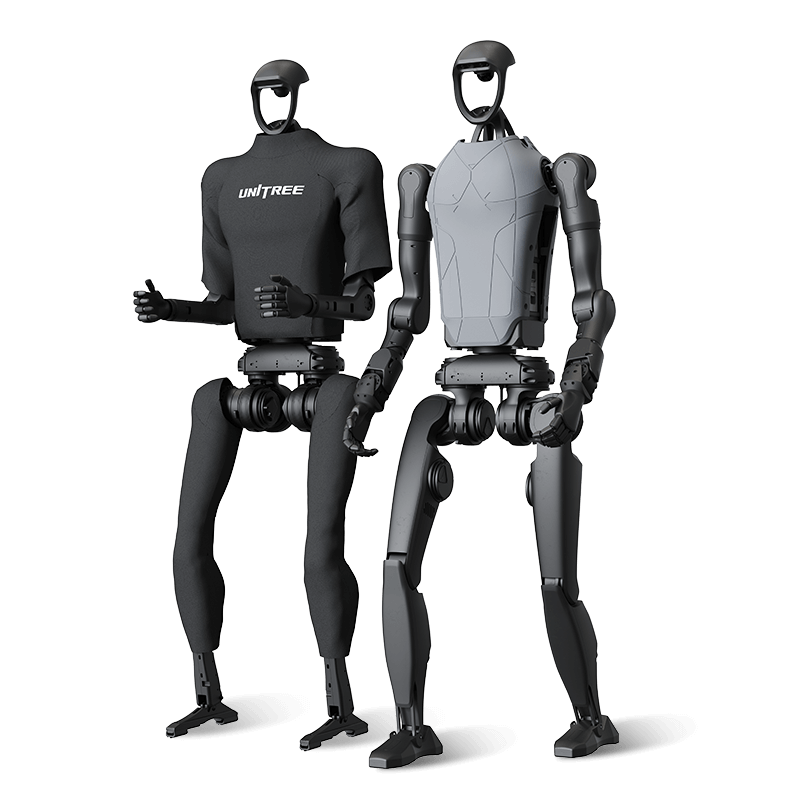
The Unitree H1 is a full-size, general-purpose humanoid robot developed by Unitree Robotics, a Chinese robotics company headquartered in Hangzhou, Zhejiang.[1] First unveiled on August 15, 2023, the H1 was Unitree's first bipedal humanoid platform after seven years of building quadruped robots, and Unitree markets it as "the first full-size general-purpose humanoid robot that can run in China."[1][7][8] Standing approximately 180 cm tall and weighing 47 kg, the H1 holds the Guinness World Record for the fastest full-size humanoid robot, achieving a verified linear walking speed of 3.3 m/s (11.9 km/h, 7.4 mph) in March 2024 before raising that mark to roughly 10 m/s on an athletics track in April 2026.[9][10][23][24] The H1 was also the first electrically actuated full-size humanoid to perform a standing backflip, a milestone previously achieved only by hydraulic machines such as Boston Dynamics' Atlas.[12][13] With a list price near $90,000 for the base configuration, the H1 is positioned as a research and development platform and has been adopted by universities, robotics laboratories, automotive manufacturers, and demonstration teams worldwide.[1]
| Unitree H1 | |
|---|---|
 | |
| General information | |
| Manufacturer | Unitree Robotics |
| Country of origin | China |
| Year unveiled | 2023 |
| Status | In production |
| Price | ~$90,000 to $99,900 USD (base); ~$128,900 to $150,000 (H1-2) |
| Availability | Commercially available |
| Website | unitree.com/h1 |
The H1 marked a deliberate inflection point for Unitree, which had built its reputation on low-cost quadrupeds such as the Go1 and B1 before turning to bipeds.[17] The platform combines proprietary M107 joint motors, a Livox MID-360 LiDAR, an Intel RealSense D435i depth camera, and a dual-computer architecture under an open SDK with full ROS 2 support.[2] Locomotion behaviors are trained in simulation through reinforcement learning and transferred to hardware via sim-to-real pipelines, an approach Unitree has shared through public GitHub repositories that have been widely adopted by the academic community.[4] By 2025 the H1 had become the dominant entry in nearly every public humanoid athletics event in China, winning four gold medals at the inaugural World Humanoid Robot Games in Beijing in August 2025 and entering Unitree's first official run at the Beijing humanoid half marathon in April 2026.[39][43]
What is the background of the Unitree H1?
Who is Unitree Robotics?
Unitree Robotics, formally Hangzhou Yushu Technology Co., Ltd., was founded by Wang Xingxing on August 26, 2016.[17] Wang, born in 1990 in Ningbo, Zhejiang, studied mechatronics engineering at Zhejiang Sci-Tech University before earning a master's degree in mechanical engineering from Shanghai University.[34] During his graduate studies he built XDog, a high-performance quadruped driven by low-cost brushless motors that drew significant attention online and attracted early investors.[34] After a brief stint at DJI, Wang left to start Unitree, choosing Hangzhou for its proximity to electronics suppliers and its growing pool of engineering talent.[34]
The company initially focused on affordable quadruped robots for both consumer and industrial markets. Its product line grew to include the Laikago (2017), Aliengo (2019), A1 (2020), Go1 (2021), Go2, B1, and B2, and Unitree captured an estimated 70% share of the global quadruped robot market by 2023.[17] By that year the company had expanded into humanoid robotics with the H1, followed by the smaller and cheaper Unitree G1 ($16,000) in 2024 and the consumer-oriented R1 ($5,900) in 2025. The full-size Unitree H2 successor launched in October 2025.
Unitree has raised funding from prominent investors including Tencent, Alibaba, China Mobile, Ant Group, Geely Capital, HongShan Capital (formerly Sequoia China), Matrix Partners China, Meituan, Xiaomi, ByteDance, BYD, Shunwei Capital, and Source Code Capital. Its Series C round in late June 2025 valued the company at approximately 12 billion yuan (about $1.7 billion).[18] On March 20, 2026, the Shanghai Stock Exchange formally accepted Unitree's filing for an initial public offering on the STAR Market, with the company seeking to raise 4.2 billion yuan (approximately $620 million) by offering at least 40.4 million shares.[22] The STAR Market listing committee approved the IPO on June 1, 2026, clearing the offering at a target post-money valuation of roughly 42 billion yuan (about $6.2 billion).[46] According to the IPO prospectus, Unitree generated 1.71 billion yuan in revenue during 2025, an increase of 335 percent year over year, with humanoid robots growing from 1.9 percent of revenue in 2023 to 51.5 percent in the first nine months of 2025 and gross margin reaching 59.5 percent.[21][46]
When was the Unitree H1 first revealed?
The H1 was first unveiled on August 15, 2023, through a video posted on Chinese social media platforms.[7] The video showed an early prototype walking down a Hangzhou street, maintaining balance while being kicked by an engineer, and navigating outdoor terrain.[8] The robot's head was a smooth black housing without a face, and the arms terminated in cushioned nubs rather than functional hands.[8] Unitree's accompanying announcement described the H1 as "the highest-power-performance robot of its counterparts with similar specifications in the world" and indicated that commercial availability would arrive within three to ten years, with a planned price below $90,000.[7][8]
Following the announcement, Unitree continued to release iterative footage labeled as H1 Evolution V1.0, V2.0, and V3.0, with each release demonstrating progressive improvements in gait stability, recovery from disturbances, and dynamic motion. The company displayed the H1 prominently at CES 2024 in Las Vegas in January 2024, where it took the unusual step of untethering the robot and walking it through the booth aisles without a safety leash, a decision that drew significant crowd attention and was rare for full-size bipeds at the time. The company brought the H1 to NVIDIA GTC in March 2024, where it again walked freely through the conference floor.[16] At the closing keynote of GTC 2024, NVIDIA chief executive Jensen Huang appeared on stage with nine humanoid robots, including the Unitree H1, to introduce Project GR00T.[16]
In March 2024, Unitree released the H1 Evolution V3.0 video showing the robot walking at a verified 3.3 m/s on flat ground, climbing and descending stairs, executing choreographed dance routines that demonstrated whole-body coordination, and jumping vertically to roughly human height.[10][11] Unitree stated that internal tests had measured speeds potentially exceeding 5 m/s.[10] Days later, on March 21, 2024, Unitree released a video of the H1 performing a standing backflip powered entirely by its M107 electric motors.[12][15] The backflip was trained in simulation using reinforcement learning and transferred to hardware.[12] Video showed the robot completing a full rotation and landing on both feet with a small corrective hop after touchdown.[12]
Unitree later introduced the H1-2 variant, which features upgraded 7-DOF arms and 6-DOF legs, bringing the total degrees of freedom to 27.[3] The H1-2 weighs roughly 70 to 73 kg and supports optional dexterous hands such as the Dex5-1 and the Dex3-1, making it suitable for manipulation research in addition to locomotion studies.[3] The H1-2 retains the same 1,760 mm height envelope while accepting up to three onboard compute modules.[3]
In February 2025 the H1 made its broadcast debut at the China Central Television Spring Festival Gala, where a troupe of H1 units in red and patterned costumes performed a Yangko folk dance routine directed by Zhang Yimou.[36][37] The performance helped catalyze investor interest that led to Unitree's Series C round later that year.[18] In August 2025 the H1 dominated the inaugural World Humanoid Robot Games in Beijing, winning four gold medals across track and field events and a total of eleven medals for Unitree across the meet.[39][40] On April 11, 2026, Unitree released video showing an H1 sprinting on an outdoor athletics track at a peak measured speed of about 10 m/s, displayed on the timing device as 10.1 m/s, surpassing the company's earlier 3.3 m/s record by roughly threefold.[23][24] The footage was captured with a calibrated speed-measurement device, although Unitree noted a possible measurement error.[24] The 10 m/s figure approached human elite sprinting territory, where the world record holder Usain Bolt averaged 10.44 m/s during his 2009 world record run.[25] Eight days later, on April 19, 2026, Unitree fielded a fine-tuned H1 in the qualifying round of the Beijing humanoid half marathon, where it autonomously completed a 1.9-kilometer winding course in 4 minutes and 13 seconds, a pace that exceeds the human 1,500-metre world record when scaled.[41][42]
How is the Unitree H1 named and revised?
Unitree has used a sequence of internal version labels for the H1, often abbreviated in promotional videos. The earliest demonstrations appeared as Evolution V1.0, focusing on basic standing and walking. V2.0 introduced disturbance rejection demonstrations, with engineers kicking and pushing the robot while it remained upright. V3.0 added the high-speed running, stair climbing, and acrobatic motions that established the H1 as a benchmark platform.[10][11] A V4.0 update emphasized whole-body dancing and choreography. Independent of these version labels, Unitree distinguishes between the original H1 (19 DOF) and the H1-2 (27 DOF), which are sold as separate products and are not field-upgradable from one to the other.[3]
In January 2026 the National Intellectual Property Administration of China granted Unitree two new humanoid robot design patents, one approved on January 6 and a second on January 20.[20] The filings cover modular humanoid architectures that allow for future functional expansion through interchangeable end effectors and compute modules, building on the H1 reference design.[20] Unitree filed the patents under the same simplified-structure approach that underpins the H1 and the smaller G1.[20]
What are the Unitree H1 specifications?
How big is the Unitree H1?
The standard H1 stands 1,805 mm tall when measured from the soles of its feet to the top of its head-mounted sensor pod and weighs approximately 47 kg.[28] Its leg segments measure 400 mm each for both the thigh and the calf, while each arm is 338 mm long.[28] The full envelope dimensions are roughly 1,520 mm by 570 mm by 220 mm with the head sensor adding another 285 mm to the total height.[28] The H1-2 maintains a similar 1,760 mm overall height but its denser actuators and additional joints increase mass to about 70 kg.[3]
| Specification | H1 | H1-2 |
|---|---|---|
| Height | ~1,805 mm | ~1,760 mm |
| Width (shoulders) | ~570 mm | ~570 mm |
| Depth | ~220 mm | ~220 mm |
| Weight | 47 kg | 70 to 73 kg |
| Total DOF | 19 | 27 |
| DOF per leg | 5 (3 hip + 1 knee + 1 ankle) | 6 (3 hip + 1 knee + 2 ankle) |
| DOF per arm | 4 (3 shoulder + 1 elbow) | 7 (3 shoulder + 1 elbow + 3 wrist) |
| Waist DOF | 1 | 1 |
| Max walking speed | 3.3 m/s record (potential >5 m/s) | <2 m/s |
| Peak sprint speed (track) | ~10 m/s (April 2026) | not reported |
| Arm length | 338 mm | 685 mm |
| Thigh length | 400 mm | 400 mm |
| Calf length | 400 mm | 400 mm |
| Payload capacity | up to 30 kg full-body | ~21 kg |
| Battery capacity | 864 Wh (15 Ah, 67.2 V max) | 864 Wh |
| Battery runtime | ~1.5 to 2 hours | ~2 hours |
| Hot-swap battery | yes | yes |
| Onboard compute slots | up to 2 | up to 3 |
| Backflip capable | yes | yes |
| Dexterous hands | optional | optional |
| Price (approx.) | $90,000 to $99,900 | $128,900 to $150,000 |
How does the H1 actuation system work?
The H1's joints are driven by Unitree's proprietary M107 electric motors.[1] The M107 uses a low-inertia, high-speed internal-rotor permanent magnet synchronous motor (PMSM) topology paired with a planetary or harmonic reduction depending on joint location. The motor is mechanically classified as a quasi-direct-drive (QDD) actuator: the gear ratio is low enough to preserve back-drivability and torque transparency yet high enough to multiply rotor torque to the levels required for full-body locomotion. The same QDD philosophy underpinned Unitree's earlier quadruped motors and is shared with research-grade actuators used in MIT's Cheetah series.
Key M107 parameters reported by Unitree and verified by third-party reviewers include:
| M107 motor parameter | Value |
|---|---|
| Form factor | 107 mm diameter, 74 mm length |
| Mass | ~1.9 kg per motor |
| Knee peak torque | 360 N.m |
| Hip peak torque | 220 N.m |
| Ankle peak torque | 45 to 59 N.m |
| Arm joint peak torque | 75 N.m |
| Peak torque density | 189 N.m/kg |
| Maximum tension | 10,000 N (equivalent to 3.5 cm force arm) |
| Encoders | dual encoders for position and velocity |
| Bearings | industrial-grade crossed roller |
| Shaft | hollow-bore for internal cable routing |
The M107's high torque density is central to the H1's ability to perform dynamic maneuvers like running and backflips without hydraulic actuators. Traditional hydraulic systems, as used in the original Boston Dynamics Atlas, offer high force output but are heavier, more complex, and prone to fluid leaks and overheating during long sessions.[13] Unitree's all-electric approach reduces maintenance requirements and overall system weight, though it demands extremely efficient motor design to achieve comparable performance. The H1 is, by Unitree's marketing, the only commercial full-size electric humanoid certified to clear a backflip on consumer-grade actuators alone.[1]
The motors communicate with the host computer over a custom CAN-style bus on a dedicated 192.168.123.x Ethernet subnet.[2] Each joint runs a high-rate inner control loop on the motor's onboard microcontroller, while higher-level torque, position, and velocity setpoints arrive from the motion control PC at typical rates of 500 Hz to 1 kHz.[2] The hollow shaft and sealed housing allow the cable harness to run inside the robot's structural members, reducing snag points during dynamic motion.
What sensors does the Unitree H1 use?
The H1 is equipped with a multi-modal perception system that Unitree describes as 360-degree depth sensing.[1] The default head-mounted assembly includes:
The Livox MID-360 is a non-repetitive scanning solid-state LiDAR with a horizontal field of view of 360 degrees, a vertical field of view of approximately 59 degrees, a maximum range of 40 m at 80 percent reflectivity, and a point rate of 200,000 points per second.[28] Its scanning pattern progressively densifies over time, which makes it well suited for static mapping but slightly less ideal for fast-moving obstacle detection. The Intel RealSense D435i complements the LiDAR by providing dense, close-range depth at up to 1280 by 720 resolution at 90 frames per second, along with RGB imagery and a built-in 6-DOF IMU.[28] Together the two sensors deliver redundant coverage for SLAM, navigation, and obstacle avoidance.
Researchers can extend the sensor suite. Common upgrades include hand-mounted RealSense cameras when the H1 is fitted with dexterous hands, RGB action cameras for documentation, and external motion-capture markers for ground truth in laboratory experiments.
How is the H1 computing architecture organized?
The H1 employs a dual-computer architecture that separates real-time motion control from higher-level user applications.[2] This division mirrors the convention used by Boston Dynamics, Agility Robotics, and other research humanoid platforms.
| Computer | Role | Typical hardware |
|---|---|---|
| PC1 (motion control) | low-level joint control, balance, safety | Intel Core i5-1235U, 8 GB LPDDR5, 500 GB SSD |
| PC2 (development) | perception, planning, user code, ROS 2 | Intel Core i7-1255U or i7-1265U, 16 to 32 GB LPDDR5, Iris Xe GPU |
| Optional accelerator | AI inference, vision-language models | NVIDIA Jetson Orin NX (100 to 200 TOPS) or Jetson AGX Orin (275 to 550 TOPS) |
PC1 runs a real-time operating system to ensure deterministic response times for locomotion control loops, isolating safety-critical code from user experimentation.[2] PC2 hosts user applications, perception pipelines, and ROS 2 nodes.[2] The H1-2 supports up to three compute modules in total, allowing simultaneous use of multiple Jetson Orin NX boards for heavier AI workloads such as vision-language inference or large-scale neural network policies.[3]
This separation ensures that experimental user code cannot destabilize the robot's core balance and safety systems. Researchers can deploy custom perception, planning, and control algorithms on the development computer without risking falls caused by software crashes. Communication between PC1 and PC2 is handled by CycloneDDS over a private Ethernet subnet, which is the default DDS implementation used by ROS 2.[2]
How long does the Unitree H1 battery last?
The H1 runs on a quickly replaceable lithium battery pack with a capacity of 864 Wh (15 Ah at a maximum voltage of 67.2 V).[1] The pack is split into two 432 Wh modules, each running at 28.8 V nominal. Under mixed-use conditions involving walking, standing, and moderate sensor usage, the battery provides approximately 1.5 to 2 hours of operation.[1] High-intensity activities such as running, jumping, or carrying heavy payloads reduce that figure substantially. The supplied charger delivers 33.6 V at 9 A, returning a depleted pack to full charge in roughly 1.5 to 2 hours. Unitree recommends allowing batteries to cool to room temperature before recharging after heavy use, a practice typical of high-discharge lithium chemistries.
The pack is mounted in the lower torso with quick-release latches so that an operator can swap a fresh battery in under a minute, which is important for laboratories running long demonstration sessions. A separate handheld remote control communicates with the robot over 2.4 GHz radio and Bluetooth at ranges of 100 m or more, with a self-contained battery providing up to 4.5 hours of remote operation.
What connectivity does the H1 offer?
The robot exposes several wired and wireless interfaces to support extension and integration with laboratory infrastructure:
| Interface | Purpose |
|---|---|
| Ethernet (192.168.123.x subnet) | inter-PC communication, motor bus |
| Wi-Fi 5 / 6 | wireless development, telemetry |
| Bluetooth 5 | remote control pairing |
| RS485 / RS232 | sensor and peripheral integration |
| CAN bus | battery management interface |
| 3.3 V / 5 V / 12 V / 24 V power taps | accessory power |
This interface set is generous compared to most consumer robots and reflects the H1's positioning as a research platform. The presence of multiple voltage rails simplifies the integration of third-party sensors, lighting, and grippers without requiring DC-DC converters.
Does the Unitree H1 have hands?
The base H1 ships with smooth or padded end effectors rather than functional hands. Customers who require manipulation can purchase optional dexterous hands from Unitree itself or from third-party suppliers such as Inspire Robots, which mount onto the H1 or H1-2 wrist interface with a standardized electrical and mechanical connector.[44][45] The most common options are summarized below.
| Hand | Vendor | DOF | Notes |
|---|---|---|---|
| Dex3-1 | Unitree | 7 active | 3-finger underactuated hand for lighter manipulation, lower cost |
| Dex5-1 | Unitree | 20 (16 active + 4 passive) | 5-finger hand with 94 tactile sensors, 1,000 Hz comms, 3.5 to 4.5 kg payload |
| Dex5-1P | Unitree | 20 | tactile variant for H1, H1-2, and G1 lineups |
| RH56DFX | Inspire Robots | 6 DOF, 12 joints | integrated force sensing, sub-millimeter repeatability, up to 3 kg load |
| RH56DFTP | Inspire Robots | 6 DOF | tactile-equipped variant for H1-2 |
The Unitree Dex5-1 in particular is designed to avoid the stiff-hand feel that limits fine manipulation on many earlier humanoid grippers. Its joints are fully back-drivable, and the 94 distributed tactile sensors can detect pressure from roughly 10 grams up to 2.5 kilograms.[44] Real-time communication at 1,000 Hz provides position, torque, stiffness, and per-finger IMU data, which is sufficient for closed-loop force control and for collecting demonstration data for imitation learning. Researchers integrating Inspire hands instead favor the RH56DFX or RH56DFTP for their balance of payload capacity, force feedback, and price.[45]
How is the Unitree H1 programmed?
What SDK and programming interfaces does the H1 use?
Unitree distributes the unitree_sdk2 package, which supports programming in C++, Python, and ROS 2.[2] The SDK exposes multiple levels of abstraction so that researchers can choose the appropriate granularity:
- Low-level motor control allows direct torque, position, and velocity commands to individual joints. This level is used for implementing custom locomotion controllers, model-predictive control, or whole-body control formulations.[2]
- High-level behavior APIs provide pre-built walking, standing, and navigation behaviors that can be called from user applications without the developer having to write a balance controller.[2]
- Sensor data streaming delivers real-time access to LiDAR point clouds, depth images, IMU data, joint state information, and battery telemetry over DDS topics.[2]
Full ROS 2 compatibility allows researchers to use the broader ROS ecosystem, including Gazebo and MuJoCo for simulation, MoveIt2 for manipulation planning, and Nav2 for autonomous navigation. Unitree maintains URDF and MJCF models of the H1 in its public unitree_ros and unitree_mujoco repositories on GitHub, which the academic community has adopted as a near-standard reference description.[4]
How does the H1 use reinforcement learning and sim-to-real transfer?
The H1's most impressive locomotion behaviors, including running at 3.3 m/s, the standing backflip, and the 10 m/s sprint, were developed using reinforcement learning policies trained in simulation and transferred to hardware through a sim-to-real pipeline.[4][12] Unitree has open-sourced two official training frameworks alongside a newer experimental project:
| Framework | Simulator | Notes |
|---|---|---|
| unitree_rl_gym | Isaac Gym + MuJoCo | classic legged_gym + rsl_rl pipeline, supports Go2, H1, H1_2, G1 |
| unitree_rl_lab | NVIDIA Isaac Sim and Isaac Lab | newer pipeline, ONNX export to C++ controllers via unitree_sdk2 |
| unitree_rl_mjlab | MuJoCo via mjlab | lightweight RL stack supporting Go2, A2, As2, G1, R1, H1_2, H2 |
All three frameworks share the same general workflow: train, play, sim-to-sim, and sim-to-real.[4][5] Policies are first trained in massively parallel physics simulations with extensive domain randomization. The randomized parameters typically include surface friction, link masses, motor delays and gains, sensor noise levels, and external pushes applied during training. The trained policy is then validated by playing it back in the same simulator, then transferred to a different simulator (sim-to-sim) to test for engine-specific overfitting, and finally deployed on the physical robot through unitree_sdk2.[5]
In practice, Unitree teams produce ONNX-format policies from PyTorch checkpoints generated in Isaac Lab and run them at 50 to 200 Hz on PC2, with the motion control PC translating the policy outputs into joint torque commands at higher rates.[5] This architecture enabled the H1 to learn gaits and acrobatic maneuvers that would be difficult or dangerous to train directly on hardware, including the backflip and the 10 m/s sprint. In December 2024 Unitree formally announced that it would fully open source its robot training code, including reinforcement learning frameworks and sim-to-sim and sim-to-real migration code, covering verified H1 and G1 workflows, which substantially accelerated third-party reproduction of the company's published results.[4]
How does the H1 connect to NVIDIA Isaac and Project GR00T?
The H1 has become one of the reference platforms for NVIDIA's robotics stack. NVIDIA's Project GR00T foundation model, announced at GTC 2024 with the H1 visible on stage during Jensen Huang's keynote, used Unitree humanoid platforms among its training and evaluation targets.[16] NVIDIA partner Lightwheel reported deploying GR00T N1.5 foundation models on Unitree H1 humanoids in Geely's automotive production environment, where simulated H1 robots were used to generate training trajectories for tasks such as cylindrical component manipulation and dual-arm tray lifting.[33]
The combination of low cost, an open URDF, full Isaac Lab support, and an active developer community has made the H1 a frequent test bed for academic papers on bipedal locomotion, whole-body control, and humanoid manipulation. Public benchmarks and dataset releases through 2024 and 2025 routinely include H1 runs alongside Boston Dynamics Spot quadruped data and Agility Digit footage. Research using the H1 has yielded several widely cited contributions, including the HOMIE loco-manipulation framework presented at the 2025 Robotics: Science and Systems conference, which used an isomorphic exoskeleton cockpit to teleoperate the H1-2, and narrow-terrain whole-body control papers that demonstrated traversal of beams and rubble on the same hardware.
How is the Unitree H1 teleoperated?
Unitree maintains the xr_teleoperate repository, which couples the H1 and H1-2 to consumer extended-reality devices.[6] Operators wearing a Meta Quest 3 or Apple Vision Pro can drive the robot's arms and head from their own pose, and stream first-person video back to the headset.[6] This pipeline is widely used for collecting human-demonstration data that feeds imitation-learning policies and foundation models.[6]
What records and milestones has the Unitree H1 set?
What is the Unitree H1 Guinness World Record for speed?
In March 2024, the H1 Evolution V3.0 set the Guinness World Record for the fastest full-size humanoid robot, achieving a verified linear walking speed of 3.3 m/s (11.9 km/h, 7.4 mph) on flat ground.[9][10] The previous record was held by Boston Dynamics' Atlas at approximately 2.5 m/s (5.6 mph).[14] Unitree stated that the H1 had demonstrated speeds potentially exceeding 5 m/s in internal testing, although the official Guinness figure was set at the lower verified speed.[10][11]
What was the first electric humanoid backflip?
On March 21, 2024, the H1 became the first full-size, electrically actuated humanoid robot to successfully perform a standing backflip.[12][15] Boston Dynamics had previously demonstrated backflips with the hydraulic Atlas robot in 2017, but no electric humanoid had replicated the feat at the H1's size class.[13] The H1's backflip was trained entirely in simulation using reinforcement learning and transferred to hardware.[12] Video of the achievement showed the robot completing the rotation and landing on both feet, with a small corrective hop after touchdown that highlighted the robustness of the recovery policy.[12] Unitree later summarized the lineage on its own channels, noting that "Unitree H1 (1.8m) pioneered the first standing backflip by an electric humanoid robot (March 2024)" before the smaller Unitree G1 performed the world's first humanoid standing side flip in March 2025.[35]
How fast is the Unitree H1 sprint record?
On April 11, 2026, Unitree released video of an H1 sprinting on an outdoor athletics track at a peak speed of approximately 10 m/s (about 22.4 mph), shown on the timing device as 10.1 m/s and measured by a calibrated speed-measurement device positioned along the track.[23][24] The robot tested in this run was reported to weigh roughly 62 kg and to have a combined leg length of about 80 cm, making its body proportions broadly comparable to an adult human.[23][25] Unitree captioned the demonstration as a robot "with the physique of an ordinary person, running at a world champion's speed."[23] The 10 m/s peak represents a roughly threefold improvement over the H1's 2024 Guinness mark and approaches Usain Bolt's 100 m world record average pace of 10.44 m/s, while effectively matching a comparable 10 m/s humanoid mark set months earlier by a robot from MirrorMe.[24][25] CEO Wang Xingxing publicly speculated that humanoid robots could break the ten-second 100 m barrier within a few years.[23] Independent observers noted that the achievement appeared to come almost entirely from improvements in software, control logic, and learned policies rather than from hardware redesign; researcher Boris Belousov remarked that "everyone who worked with H1 can appreciate how crazy this is."[24]
How did the Unitree H1 perform at the World Humanoid Robot Games?
The inaugural World Humanoid Robot Games were held in Beijing from August 15 to 17, 2025, drawing 280 teams from 16 countries competing across 26 sports.[39] Unitree fielded H1 units in nearly every track and field event and finished the three-day meet as the overall medal leader with eleven medals, including four golds.[39] The H1 won the 400-metre dash, the 1,500-metre race, the 100-metre hurdles, and the 4x100-metre sprint relay.[39][40] In the 1,500-metre race the winning H1 crossed the finish line in 6:34.40, the first gold medal awarded at the games and a time Unitree announced as a humanoid world record for the distance, while the 400-metre gold was set at 1:28.03.[40] H1 entries also placed in podium positions across additional disciplines including kickboxing, balance beam, and obstacle running.[38] The result positioned the H1 as the de facto benchmark for athletic humanoid hardware in 2025.
| Event (World Humanoid Robot Games 2025) | Result |
|---|---|
| 1,500 m race | gold, 6:34.40 (first gold of the games, claimed humanoid world record) |
| 400 m race | gold, 1:28.03 |
| 100 m hurdles | gold |
| 4x100 m relay | gold |
| Total Unitree medals | 11 (4 gold, others split between H1 and G1) |
How did the Unitree H1 do in the Beijing humanoid half marathon?
Unitree did not officially field an entry in the inaugural Beijing humanoid half marathon held in April 2025, although several third-party teams used Unitree hardware.[43] Public attention on the 2025 race focused on the visible failures of those independent teams, prompting Unitree to publicly distinguish its in-house entries from third-party fine-tunes.[43] For the 2026 edition on April 19, 2026, the company entered its own H1 unit and ran the autonomous category alongside more than twenty other humanoids.[42] In the qualifying round the Unitree H1 completed a 1.9-kilometre winding course in 4 minutes and 13 seconds, a pace which, on a proportional scaling argument, exceeds the human 1,500-metre world record.[41][42] In the main 21-kilometre half marathon, an H1 entry crossed the finish line before stumbling and falling shortly after the line, an outcome Unitree attributed to thermal limits in the legs after a sustained two-hour run.[42] The eventual overall race champion was a third-party robot from the Lightning team in 50 minutes 26 seconds, with Unitree's own entries finishing in the middle of the field.[42]
Demonstration timeline
| Date | Event | Notes |
|---|---|---|
| August 15, 2023 | H1 announcement video | first public reveal, walking and disturbance rejection |
| January 2024 | CES 2024 in Las Vegas | untethered booth demonstration, first major Western trade show appearance |
| March 2024 | NVIDIA GTC | onstage during Jensen Huang's GR00T keynote |
| March 2024 | Evolution V3.0 video | 3.3 m/s record run, stair climbing, dance routines |
| March 21, 2024 | Standing backflip | first by an electric full-size humanoid |
| August 2024 | Unitree G1 commercial release | smaller sibling at $16,000 |
| January 28, 2025 | China Spring Festival Gala | H1 troupe performs Yangko folk dance on national television |
| March 2025 | G1 standing side flip | follow-up to H1 backflip |
| Late June 2025 | Series C funding | ~$1.7 billion valuation |
| August 15-17, 2025 | World Humanoid Robot Games (Beijing) | four gold medals, eleven total |
| October 2025 | H2 reveal | successor with 31 DOF and bionic face |
| End of 2025 | Shipment milestone | over 5,500 humanoid robots delivered, more than 6,500 produced |
| January 6 and 20, 2026 | Two design patents granted | National IP Administration filings for modular humanoid architectures |
| February 2026 | Spring Festival Gala return | parkour, kung fu, single-leg flips with G1 and H2 |
| March 20, 2026 | IPO filing | 4.2 billion yuan target on Shanghai STAR Market |
| April 11, 2026 | 10 m/s track sprint | new informal speed mark on athletic track |
| April 19, 2026 | Beijing humanoid half marathon | first official Unitree entry, 4:13 over 1.9 km in qualifier |
| June 1, 2026 | IPO approved | STAR Market listing committee clears offering at ~$6.2 billion valuation |
What is the Unitree H1 used for?
Why is the H1 a research platform?
The H1 is primarily marketed as a research and development platform for academic and industrial robotics laboratories.[1] Its open SDK, ROS 2 compatibility, and accessible price point relative to competitors such as Boston Dynamics' Atlas, which is not sold commercially, have made it popular with universities studying bipedal locomotion, whole-body control, reinforcement learning for robotics, and autonomous navigation.[2] The H1 has been used in graduate-level robotics courses on modern control theory, where students implement balance controllers and walking policies on a real platform rather than working only in simulation.
Research groups use the H1 to investigate topics including:
- bipedal walking, running, and recovery from external perturbations
- sim-to-real transfer of learned locomotion policies
- terrain adaptation, stair climbing, and rough-ground navigation
- whole-body manipulation in conjunction with the Dex5-1 and Dex3-1 hands
- human-robot interaction and motion-imitation studies
- vision-language model integration through Project GR00T and similar foundation-model efforts
- perception and SLAM for humanoid platforms
- multi-agent coordination, including the cluster choreography demonstrated at China's Spring Festival Gala
A growing literature on humanoid locomotion and whole-body control reports results on the H1 or H1-2 platforms, often using public datasets and policies released through the unitree_rl_gym and unitree_rl_lab repositories.[4][5] By 2025 groups at Carnegie Mellon, Tsinghua, Shanghai Jiao Tong, ETH Zurich, and the University of Tokyo had all published H1-based experiments, making the H1 one of the most cited humanoid hardware platforms in 2024 and 2025 reinforcement-learning literature outside of pure-simulation studies.
Where is the H1 used in industrial pilots?
While the H1 is primarily a research tool, several companies have begun pilot deployments. The most prominent is the Lightwheel-Geely collaboration, in which Unitree H1 humanoids equipped with dexterous hands have been used in a Geely automotive production environment to test foundation-model-driven assembly tasks.[33] Reported tasks include manipulating cylindrical components and lifting heavy trays in coordination between two arms.[33] These deployments rely heavily on simulation-generated training data because the cost of human teleoperation at production scale would otherwise be prohibitive.[33] Chinese press reporting has also identified pilot deployments of Unitree humanoids on production lines at NIO and BYD, although neither automaker has disclosed deployment counts or task scopes publicly. Both deployments emphasize teleoperation-assisted data collection rather than fully autonomous shift work.
Other applications under exploration include facility inspection, where the H1's ability to navigate stairs and confined spaces makes it a candidate for environments where wheeled robots cannot operate effectively, and emergency response, where teleoperation through the xr_teleoperate stack lets a human pilot the robot through hazardous spaces.[6] As of mid-2026, however, most H1 deployments remain in research, education, and demonstration settings rather than continuous commercial operations.
How is the H1 used for entertainment and public demonstrations?
Unitree has actively promoted the H1 through demonstration content and public performances. Beyond CES 2024 and NVIDIA GTC, the H1 appeared at the World Robot Conference in Beijing, the World Artificial Intelligence Conference in Shanghai, and a long string of Chinese trade shows. The 2025 Spring Festival Gala performance, broadcast on January 28, 2025, featured a troupe of 16 H1 robots marketed under the codename Fuxi, dancing alongside human performers from the Xinjiang Art Institute in a coordinated Yangko routine directed by Zhang Yimou.[36][37] The robots, dressed in red floral jackets, spun handkerchiefs and synchronized leg movements while a 3D laser SLAM positioning system kept them in formation onstage.[36] The performance reached an estimated audience of more than one billion viewers and is widely credited with sparking the investor interest that culminated in Unitree's 2025 Series C and 2026 IPO filing.[37] Unitree returned to the Spring Festival Gala in 2026 with G1 and H2 robots performing parkour, kung fu, single-leg flips, and a drunken-fist and nunchaku routine, although the H1 itself remained a workhorse research and demonstration platform throughout 2026.[26]
How is the H1 used in education and consumer demonstrations?
A secondary market has emerged in which museums, science centers, and corporate visitor centers lease H1 units for live demonstrations. The robot's stable walking, expressive arm gestures, and ability to follow choreographed scripts make it a popular fixture at technology events. The base price of around $90,000, combined with the rapid emergence of the cheaper $16,000 G1 sibling, has reduced the cost barrier compared to legacy demonstration humanoids, although the H1 remains out of reach for individual consumers.[1]
How does the Unitree H1 compare with competing platforms?
The H1 entered a rapidly growing market for full-size humanoid robots. The following table compares the H1 with other prominent humanoid platforms available or in development during the same period.
| Feature | Unitree H1 | Boston Dynamics Atlas (Electric) | Agility Robotics Digit | Tesla Optimus | Figure 02 | Unitree G1 |
|---|---|---|---|---|---|---|
| Year unveiled | 2023 | 2024 (electric) | 2019 | 2022 | 2024 | 2024 |
| Height | 180 cm | 150 cm | 175 cm | 173 cm | 168 cm | 127 cm |
| Weight | 47 kg | 89 kg | 65 kg | 72 kg | 70 kg | 35 kg |
| DOF | 19 | 28+ | 16+ | 28+ | 22+ | 23 to 43 |
| Max walking speed | 3.3 m/s | ~2.5 m/s | 1.5 m/s | ~2.7 m/s | ~1.5 m/s | ~2 m/s |
| Backflip capable | yes | yes (hydraulic) | no | no | no | side flip |
| Actuation | electric | electric (2024+) | electric | electric | electric | electric |
| Price | ~$90,000 | not for sale | lease only | not yet sold | not for sale | ~$16,000 |
| Primary use | research | commercial R&D | warehouse logistics | factory automation | factory automation | research, consumer |
| SDK / ROS 2 support | yes | limited | limited | no public SDK | no public SDK | yes |
The H1's key differentiators are its combination of high-speed locomotion, an open development platform, and commercial availability at a price point accessible to well-funded research labs. Boston Dynamics' all-electric Atlas, introduced in 2024, is arguably more versatile in terms of manipulation, but it is not commercially available. Agility Robotics' Digit targets warehouse logistics rather than general-purpose research and walks roughly half as fast as the H1. Tesla's Optimus, while backed by significant resources, remained in early R&D stages through 2025 with limited external deployment, and as of mid-2026 was still not commercially available. Figure 02, Figure AI's second-generation humanoid, has been deployed in BMW factories under a partnership but is also not sold to outside customers.
How does the H1 compare within the Unitree humanoid family?
| Feature | Unitree H1 | Unitree H1-2 | Unitree H2 | Unitree G1 | Unitree R1 |
|---|---|---|---|---|---|
| Year released | 2023 | 2024 | 2025 | 2024 | 2025 |
| Height | 180 cm | 176 cm | 180 cm | 127 cm | small form factor |
| Weight | 47 kg | 70 to 73 kg | ~70 kg | 35 kg | lightweight |
| DOF | 19 | 27 | ~31 | 23 to 43 | 26 |
| Waist DOF | 1 | 1 | 3 | 3 | 3 |
| Bionic face | no | no | yes | no | no |
| Compute slots | 2 | 3 | up to 3 (Jetson Orin NX) | 1 | 1 |
| Battery runtime | ~2 hours | ~2 hours | ~3 hours | ~2 hours | ~1.5 hours |
| Backflip capable | yes | yes | yes (Spring Festival Gala 2026) | side flip | not demonstrated |
| Approx. price | $90,000 to $99,900 | $128,900 to $150,000 | $40,900 commercial / $68,900 EDU | ~$16,000 | ~$5,900 |
The H2, unveiled in October 2025 and branded with a Destiny Awakening campaign, is the H1's direct successor.[32] It adds a 3-DOF waist for more lifelike torso motion, a bionic face, and a more capable compute architecture supporting up to three NVIDIA Jetson Orin NX modules totaling around 2,070 TOPS of AI inference performance.[32] The H2 trades raw running speed (capped near 2 m/s) for dramatically expanded dexterity, manipulation, and human-robot collaboration capabilities, and its commercial pricing of roughly $40,900 brings full-size humanoid hardware close to the price of a midrange industrial robotic arm.[32] For locomotion-focused research and athletic demonstration the H1 continues to be Unitree's strongest entry through 2026. The G1 brought humanoid robotics to a significantly lower price point at $16,000 and has become Unitree's volume product, while the R1, launched in July 2025 at $5,900, further lowered the entry barrier for hobbyist and consumer audiences.
Where does the H1 sit in Unitree's product line?
The H1 sits within Unitree's broader product portfolio, which spans quadruped robots, humanoids, robotic arms, and dexterous hands.
| Category | Products |
|---|---|
| Consumer quadrupeds | Go1, Go2, Go2-W |
| Industrial quadrupeds | B1, B2, B2-W, A2 |
| Full-size humanoids | H1, H1-2, H2 |
| Compact humanoids | G1, R1 |
| Robotic arms | Z1 |
| Dexterous hands | Dex1-1, Dex3-1, Dex5-1, Dex5-1P |
Unitree reported shipping more than 5,500 humanoid robots to customers during 2025, with total mass-production output exceeding 6,500 units across its humanoid line.[19][20] According to Unitree's own announcement, this volume gave it the global lead in 2025 humanoid shipments and accounted for roughly a third of the entire global market by unit count, in a year when global humanoid installations reached about 16,000 units and China accounted for more than 80 percent of them.[19][47] The leadership claim is contested: research firm Omdia ranked Shanghai startup AgiBot first with 5,168 units shipped over the same period, narrowly behind Unitree's self-reported total.[47] The company has stated targets of around 20,000 humanoid units in 2026, a 3.6-fold increase that the IPO proceeds are intended to support through new manufacturing capacity in Hangzhou and Shanghai.[26]
How has the Unitree H1 been received?
Reception of the H1 has been broadly positive within the research community and within Chinese state media. Western coverage tends to highlight the contrast between the H1's open SDK and modest price and the closed-source, leased-only models offered by US competitors. Industry commentators routinely cite the H1 alongside the G1 as evidence that China has closed the historical gap between Boston Dynamics and the rest of the field, and as a signal that humanoid robotics has shifted from hydraulics to electric actuation across the industry. Skeptics note that the H1's manipulation capabilities are limited compared to its locomotion strengths, and that broad commercial deployments outside of research and demonstration contexts remain rare.
The Spring Festival Gala appearance, the backflip video, the World Humanoid Robot Games sweep, and the 10 m/s sprint each generated tens of millions of online views, contributing to the H1's status as a recognizable consumer brand asset for Unitree even though most units are sold to laboratories.[37] The 2026 Beijing humanoid half marathon, while a more ambiguous result than the World Games, drew tens of millions of livestream viewers and prompted debate in Chinese press about how to evaluate humanoid endurance alongside peak speed.[42] Investor interest at the time of the IPO filing was substantial, with the offering cleared at a target valuation around 42 billion yuan (about $6.2 billion) and the company disclosing that it had reached profitability while many international peers were still operating at significant losses.[21][46]
What are the limitations of the Unitree H1?
Despite its achievements, the H1 has several notable limitations:
- Limited manipulation: the standard H1's 4-DOF arms lack the dexterity required for fine manipulation tasks. The H1-2 addresses this with 7-DOF arms and optional dexterous hands, but at a higher price and increased weight.[3] The standard H1 also ships without a waist that can twist a full 3-DOF, restricting whole-body manipulation gestures that the Unitree H2 supports.[32]
- Battery life: approximately 1.5 to 2 hours of mixed-use operation limits the H1's usefulness for extended autonomous missions.[1] Hot-swapping mitigates the issue in laboratory settings but remains a constraint for unattended deployment.
- No integrated hands by default: the base configuration ends at smooth or padded effectors, requiring an additional purchase of Dex5-1 or Inspire RH56DFX hands for serious manipulation work.[44][45]
- No onboard large language model integration: unlike some competitors that bundle LLM-driven task planning, the H1 relies on traditional programmatic control and learned RL policies, with vision-language models only available through optional Jetson modules.
- Speed versus stability trade-off: while the H1 can reach 3.3 m/s and has been measured at 10 m/s on a track, sustained high-speed operation on uneven terrain remains challenging, and the robot's lightweight frame provides less stability margin than heavier platforms such as the electric Atlas.[24] The 2026 Beijing half marathon collapse after crossing the finish line illustrated the gap between sprint capability and endurance.[42]
- Field upgradeability: Unitree explicitly states that an H1 cannot be upgraded to an H1-2 in the field; the two platforms differ in actuator placement and frame design and are sold as separate products.[3]
- No published IP rating: Unitree has not disclosed a formal ingress protection certification for the H1, and the robot is generally specified for indoor use on flat or modestly uneven surfaces. Outdoor demonstrations have occurred but in controlled weather.
See also
- Humanoid robot
- Unitree Robotics
- Unitree G1
- Unitree H2
- Atlas (robot)
- Boston Dynamics
- Agility Robotics Digit
- Tesla Optimus
- Figure 02
- Reinforcement learning
- Sim-to-real transfer
- ROS (Robot Operating System)
- NVIDIA Isaac Sim
- Project GR00T
- LiDAR
- Inertial measurement unit
- Quadruped robot
References
- ^1 ^2 ^3 ^4 ^5 ^6 ^7 ^8 ^9 ^10 ^11Unitree H1 official product page.
- ^1 ^2 ^3 ^4 ^5 ^6 ^7 ^8 ^9 ^10 ^11 ^12Unitree H1 SDK Development Guide.
- ^1 ^2 ^3 ^4 ^5 ^6 ^7 ^8Unitree H1-2 documentation.
- ^1 ^2 ^3 ^4 ^5 ^6Unitree RL Gym, GitHub repository.
- ^1 ^2 ^3 ^4Unitree RL Lab, GitHub repository.
- ^1 ^2 ^3 ^4Unitree XR Teleoperate, GitHub repository.
- ^1 ^2 ^3"Unitree teases new H1 humanoid robot." The Robot Report, August 2023.
- ^1 ^2 ^3 ^4"Unitree enters the humanoid robot marketplace, with the bipedal H1." New Atlas, August 2023.
- ^1 ^2"Unitree's H1 sets world record as fastest humanoid robot at 7.38 mph." Interesting Engineering, March 2024.
- ^1 ^2 ^3 ^4 ^5 ^6"Video: Unitree H1 humanoid breaks world speed record and tackles stairs." New Atlas, March 2024.
- ^1 ^2 ^3"Unitree H1 Evolution V3.0 Breaks the World Record for Max Speed in Humanoid Robots." DigiAlps, March 2024.
- ^1 ^2 ^3 ^4 ^5 ^6 ^7 ^8"Video: Unitree H1 is first humanoid to nail a backflip without hydraulics." New Atlas, March 2024.
- ^1 ^2 ^3"Chinese robot's backflip a leap forward for electric-powered humanoid machines." South China Morning Post, March 2024.
- ^"China's Unitree H1 Sets World Record as the Fastest Bipedal Humanoid Robot." Science Times, March 2024.
- ^1 ^2"Unitree H1 Becomes First Full-Sized Humanoid Robot to Successfully Perform Backflip." TechEBlog, March 2024.
- ^1 ^2 ^3"Unitree H1 humanoid robot embraces AI with the world." PR Newswire (NVIDIA GTC), March 2024.
- ^1 ^2 ^3Unitree Robotics Wikipedia article.
- ^1 ^2"Unitree becomes a legged robot unicorn with Series C funding." The Robot Report, June 2025.
- ^1 ^2"China's Unitree ships more than 5,500 humanoid robots in 2025, surpassing US peers." South China Morning Post, January 2026.
- ^1 ^2 ^3 ^4"Unitree granted two humanoid robot design patents, ships over 5,500 units in 2025." TechNode, January 2026.
- ^1 ^2"Inside Unitree's landmark IPO: what to know about China's humanoid giant." South China Morning Post, March 2026.
- ^"Unitree Robotics Files for $608 Million STAR Market IPO." Caixin Global, March 2026.
- ^1 ^2 ^3 ^4 ^5 ^6"Unitree's H1 robot hits 10 m/s sprint speed." Global Times, April 2026.
- ^1 ^2 ^3 ^4 ^5 ^6 ^7"Unitree H1 Reclaims Speed Record with Blistering 10 m/s Sprint." Humanoids Daily, April 2026.
- ^1 ^2 ^3"China's humanoid robot inches closer to Usain Bolt-like speed on track." Interesting Engineering, April 2026.
- ^1 ^2"Kung fu, somersaults and scale: Unitree eyes 20,000-robot output in 2026 after gala." South China Morning Post, February 2026.
- "Unitree H1 Humanoid Robot." Top3DShop product specifications.
- ^1 ^2 ^3 ^4 ^5"H1 Overview." docs.quadruped.de Unitree H1 documentation.
- QVIRO Unitree H1 specifications page.
- "Unitree H1 Robot: Specs, Price & Buyer's Guide." BotInfo.ai, 2026.
- "Unitree H1 Review: $90K Humanoid Specs." Robozaps, 2026.
- ^1 ^2 ^3 ^4"Unitree H2 Overview: New Features and Key Differences from the H1 and H1-2." RobotShop Community, 2025.
- ^1 ^2 ^3 ^4"Lightwheel Accelerates Embodied AI With NVIDIA Foundation Models." NVIDIA case study.
- ^1 ^2 ^3"Meet Wang Xingxing, the young Chinese robotics star from Unitree." South China Morning Post, 2025.
- ^"World's First Side-Flipping Humanoid Robot: Unitree G1." Unitree on X, March 2025.
- ^1 ^2 ^3"Unitree's humanoid robots steal the show at 2025 CCTV Spring Festival Gala with AI-powered Yangge dance." TechNode, January 2025.
- ^1 ^2 ^3 ^4"Zhang Yimou Directs Unitree Robots in First-Ever Dance Performance on China's Spring Festival Gala." DeepNewz, January 2025.
- ^"Unitree H1 earns two gold medals at World Humanoid Robot Games." Robotics 24/7, August 2025.
- ^1 ^2 ^3 ^4 ^5"Unitree dominates inaugural World Humanoid Robot Games with four gold medals." Robotics and Automation News, August 2025.
- ^1 ^2 ^3"Unitree's H1 robot wins 1,500 metre race as China hosts world's first humanoid games." South China Morning Post, August 2025.
- ^1 ^2"Unitree's humanoid robot breaks human 1,500-meter world record in Beijing robot half marathon qualifying." Xinhua, April 2026.
- ^1 ^2 ^3 ^4 ^5 ^6 ^7"Humanoid robots shatter human record, showcase autonomy at Beijing half marathon." People's Daily Online, April 2026.
- ^1 ^2 ^3"Unitree Enters H1 in Beijing Marathon, Distances Itself from Independent Teams." Humanoids Daily, 2026.
- ^1 ^2 ^3"Unitree H1-2 Dexterous Hand Specs." Robots International.
- ^1 ^2 ^3"Inspire RH56DFX Dexterous Hand for Unitree H1." RobotShop product page.
- ^1 ^2 ^3"Unitree Clears Major Hurdle with Fast-Track STAR Market IPO Approval." Humanoids Daily, June 2026.
- ^1 ^2"Unitree Ranks No.1 Globally in Humanoid Robot Shipments, Exceeding 5,500 Units in 2025." PR Newswire, 2026.
Improve this article
Add missing citations, update stale details, or suggest a clearer explanation. Every suggestion is reviewed for sourcing before it goes live.
10 revisions · v10 · 8,293 words · full history
Fact-checks are independent of edits: a reviewer re-verifies the article against its sources and stamps the date. How we verify
Research and drafting on this wiki are AI-assisted, under named human editorial standards. How AI is used here
Cite this page: AI Wiki. "Unitree H1." aiwiki.ai, updated 20 Jun 2026. CC BY 4.0. https://aiwiki.ai/wiki/unitree_h1