

Figure 03
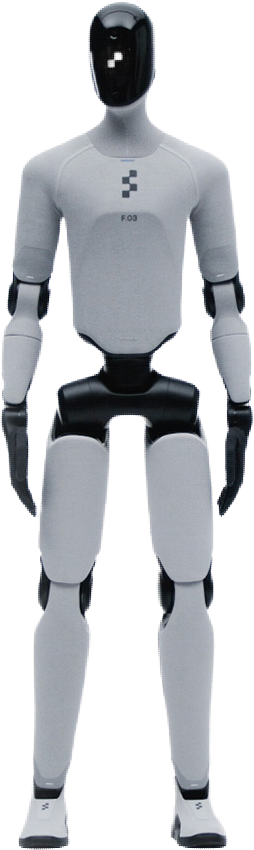
Figure 03 is a third-generation general-purpose humanoid robot developed by Figure AI and unveiled on October 9, 2025, as the company's first robot designed primarily for the home and engineered from the ground up for high-volume manufacturing. Figure's product page lists it at 5 ft 8 in (about 1.73 meters) tall and 61 kilograms;[37] it runs on a 2.3 kWh battery for roughly five hours per charge, and is controlled by Helix, Figure AI's proprietary vision-language-action model. By May 2026 Figure AI had delivered more than 350 Figure 03 units from its BotQ factory. One trade outlet reported that month that Figure had entered a first paid commercial-scale humanoid deployment of 40 robots at BMW's Spartanburg plant. Neither company has published such a contract, and both describe the Figure 03 work at the plant as a parts-sequencing task in logistics.[3][19][33]
| Figure 03 | |
|---|---|
 | |
| General information | |
| Manufacturer | Figure AI |
| Country of origin | United States |
| Year unveiled | October 9, 2025 |
| Predecessor | Figure 02 |
| Status | In volume production at BotQ; commercial pilots and partner-only home testing |
| Commercial pricing | Not published by Figure or BMW; ~$25 / robot-operating-hour reported by one trade outlet |
| AI system | Helix (VLA model), Helix 02, Vulcan balance policy |
| Manufacturing facility | BotQ (3960 N 1st St, San Jose, California; ~98,700 sq ft) |
| Initial production capacity | 12,000 units / year |
| Website | figure.ai |
Figure 03 represents a significant redesign from its predecessor, the Figure 02, shifting the company's focus from purely industrial applications toward consumer and home environments. Figure AI was founded by Brett Adcock. The robot was named one of TIME's Best Inventions of 2025 and appeared on the cover of the magazine's annual Best Inventions issue, accompanied by an exclusive cover story by journalist Billy Perrigo.[1][2]
The robot is built around four design pillars: enabling Figure AI's proprietary vision-language-action model (VLA), ensuring safe operation in homes, supporting high-volume manufacturing, and scaling commercial deployment. It is powered by Helix, the company's in-house VLA, which enables the robot to perceive its environment, understand natural language commands, and execute complex manipulation tasks in real time. In announcing the robot, Figure stated, "There's no path to scaling humanoid robots without AI," and described Figure 03 as "our first robot engineered from the ground-up for high-volume manufacturing."[3] Figure 03 is designed for mass production at BotQ, Figure AI's vertically integrated manufacturing facility in San Jose, California, with an initial capacity of 12,000 units per year and a stated four-year goal of 100,000 robots.[3]
Figure 03 is the first robot in the Figure lineup designed primarily for the home, replacing the hard mechanical shell of the Figure 02 with a soft, washable textile cladding layered over multi-density foam. It introduces wireless inductive charging, palm cameras, fingertip tactile sensors capable of resolving forces as small as three grams, and a torso-integrated battery pack engineered to humanoid robot battery safety standards. CEO Brett Adcock told TIME that in the next 10 years "the biggest company in the world will be a humanoid robot company" and that "every home will have a humanoid," framing Figure 03 as the platform on which that thesis will be tested.[2]
By May 2026, Figure 03 had transitioned from a reveal-stage product into an operational commercial platform. The company had delivered more than 350 units from BotQ, ramped production from one robot per day to one per hour, was reported by one trade outlet to have entered a paid commercial-scale deployment with BMW Manufacturing's Spartanburg plant, a contract neither Figure nor BMW has published, and demonstrated a full eight-hour autonomous logistics shift running its second-generation Helix 02 VLA. In parallel, multi-robot home demonstrations and a new fault-tolerant balance policy called Vulcan extended the platform toward continuously operating, self-maintaining fleets.[19][32][33][34]
Background and development
Figure AI company history
Figure AI was founded in 2022 by Brett Adcock, a serial entrepreneur previously known for founding Archer Aviation (an electric vertical takeoff and landing aircraft company) and Vettery (a hiring marketplace).[2] The company set out to build commercially viable general-purpose humanoid robots capable of operating in environments designed for humans. It is headquartered in San Jose, California, and grew from a small founding team to several hundred employees by the time of the Figure 03 unveiling.[4]
The company's first prototype, Figure 01, emerged from stealth in March 2023. The Figure 01 achieved dynamic bipedal walking in under a year of development, which Figure AI described as one of the fastest turnarounds in humanoid robotics history. Standing 1.68 meters tall and weighing 60 kilograms, Figure 01 demonstrated basic warehouse tasks including walking and box manipulation. It used external cabling and was primarily a research platform rather than a production-ready system.[5]
In August 2024, Figure AI unveiled the Figure 02, its second-generation robot designed for industrial deployment. The Figure 02 featured 16 degrees of freedom per hand, five-fingered hands, a 20-kilogram load capacity as published by BMW, six RGB cameras, integrated internal cabling (replacing the external wiring of Figure 01), and three times the computing power of its predecessor. It was the first Figure robot to run an onboard vision language model for visual reasoning and the first to integrate the battery into the torso rather than a backpack.[6]
BMW deployment and lessons learned
A pivotal moment in Figure AI's development came through its commercial partnership with BMW Manufacturing, announced in January 2024. Figure 02 robots were deployed at BMW's plant in Spartanburg, South Carolina, where they participated in automotive production operations. Over an 11-month deployment, the Figure 02 fleet accumulated more than 1,250 operational hours, loaded over 90,000 sheet-metal parts, and contributed to the production of more than 30,000 BMW X3 vehicles.[7]
The deployment generated critical data that directly shaped the Figure 03 design. The forearm emerged as the most common hardware failure point during factory operations. For Figure 03, the engineering team completely re-architected the wrist electronics, eliminating both the distribution board and dynamic cabling. Each wrist's motor controller now communicates directly with the main computer, reducing complexity, improving reliability, and simplifying thermal management.[7]
In February 2026, BMW extended its humanoid robotics program to Europe with a pilot at its Leipzig plant in Germany using Hexagon's AEON robot rather than a Figure machine, and set up a "Center of Competence for Physical AI in Production" to accelerate the integration of AI and robotics across the BMW Group.[8]
Why did Figure AI end its OpenAI collaboration?
Figure AI initially collaborated with OpenAI beginning in 2024, integrating OpenAI's large language models to enable speech-to-speech communication on the Figure 02. OpenAI also participated as an investor in Figure AI's February 2024 funding round.[9]
However, on February 4, 2025, Figure AI ended the partnership. CEO Brett Adcock cited two primary reasons: first, OpenAI announced plans to resurrect its own robotics program, making the two companies potential competitors; second, Figure AI concluded that building effective embodied AI required vertical integration of the robot's AI systems. Adcock stated, "We found that to solve embodied AI at scale in the real world, you have to vertically integrate robot AI." Following the split, Figure AI developed its Helix model entirely in-house, and the decision shaped both the AI architecture and the hardware design philosophy of Figure 03.[10]
Strategic positioning for the home
Unlike Figure 01 (a research platform) and Figure 02 (designed for factory deployment with BMW), Figure 03 is positioned as the company's first robot intended for everyday domestic environments. Brett Adcock has described the strategy in interviews as a phased approach: continue training humanoids in logistics and manufacturing settings where data collection and economics are more tractable, then graduate the platform into the home as autonomy and reliability mature. In an interview with TIME, Adcock predicted that in the next 10 years the biggest company in the world would be a humanoid robot company and that "every home will have a humanoid," and TIME reported at launch that Figure 03 was not yet ready for domestic use and would first go to a select list of Figure's partners for testing, with Adcock saying "We're not there yet. We think we can get there in 2026."[2][11]
Design and specifications
Physical characteristics
Figure's product page lists Figure 03 at 5 feet 8 inches (about 1.73 meters) tall and 61 kilograms (about 134 pounds); TIME's cover story, published on launch day, described it as a 5-foot-6 robot.[37][2] Figure says Figure 03 has 9% less mass than Figure 02. The reduced mass, combined with a more compact overall volume, enables easier navigation through standard doorways, hallways, and household environments. The robot's maximum walking speed is approximately 1.2 meters per second (4.3 km/h), and its rated payload is 20 kilograms.[3]
A defining design change in Figure 03 is its exterior. Rather than the exposed hard plastic and metal shells used on the Figure 01 and Figure 02, the Figure 03 is covered in soft, washable textiles layered over multi-density foam padding. This covering eliminates pinch points and reduces the risk of injury during close-proximity interaction with people. The soft goods are tool-free removable and fully washable, and they can be customized with different garments, including options made from cut-resistant and durable materials. Figure has emphasized that the textile covering is intended both as a safety measure and as an aesthetic choice to make the robot feel less industrial in domestic settings.[3][2]
The outer cladding is sometimes described in Figure's design literature as Figure-shaped soft goods, referring to garment panels specifically tailored to the robot's joints and sensor cutouts. Each panel is patterned around camera apertures, charging coil locations, and joint flex zones so that the textile can be put on and removed without tools, and so that it does not occlude visual or tactile sensing during normal motion. Color and pattern can be configured per deployment, and Figure has previewed cut-resistant variants intended for kitchen and tool-using work, alongside softer cotton-blend variants intended for child-facing home settings.[2][3]
Technical specifications
| Category | Specification | Value |
|---|---|---|
| Physical | Height | 5 ft 8 in (about 1.73 m) |
| Physical | Weight | 61 kg (about 134 lb) |
| Physical | Exterior | Soft washable textiles with multi-density foam |
| Physical | Mass reduction vs. Figure 02 | ~9% lighter |
| Mobility | Total degrees of freedom | 44 (reported by robot specification directories; not published by Figure) |
| Mobility | DOF per hand | 16 |
| Mobility | Max walking speed | 1.2 m/s (4.3 km/h) |
| Manipulation | Payload capacity | 20 kg |
| Manipulation | Fingers per hand | 5 |
| Power | Battery designation | F.03 |
| Power | Battery capacity | 2.3 kWh |
| Power | Runtime | ~5 hours at peak performance |
| Power | Charging | 2 kW wireless inductive (via foot coils) |
| Power | Energy density vs. F.01 | +94% |
| Power | Cost vs. F.02 | -78% |
| Sensors | Cameras | 6 main cameras + 2 palm cameras (8 total) |
| Sensors | Tactile | Custom fingertip sensors (3-gram sensitivity) |
| Sensors | Data offload | 10 Gbps mmWave |
| Actuators | Speed improvement | 2x faster than Figure 02 |
| Actuators | Torque density | Improved Nm/kg over Figure 02 |
| Actuators | Motor type | Frameless BLDC motors |
| AI | Model | Helix VLA (System 1 + System 2; later Helix 02 with System 0) |
| AI | Fault tolerance | Vulcan policy (up to 3 lower-body actuator losses) |
| AI | Compute | Dual embedded low-power GPUs |
| Safety | Battery certifications | UN38.3 (achieved); UL2271 (in process) |
| Manufacturing | Production line capacity | Up to 12,000 robots / year (initial) |
| Manufacturing | Stated 4-year goal | 100,000 robots |
| Manufacturing | Throughput (April 2026) | 1 robot / hour (24x vs. launch) |
Vision and sensing
Figure 03 features a completely redesigned sensory suite purpose-built to enable the Helix AI system. The camera architecture delivers twice the frame rate, one-quarter the latency, and approximately 60% wider field of view per camera compared to the Figure 02's vision system. Figure has not published a camera count for Figure 03; specification directories list six main cameras plus an embedded camera in each palm, eight in total. Figure's own description confirms the palm cameras and says they give Helix redundant close-range visual feedback when the main cameras are occluded, such as when reaching into a cabinet.[3]
The palm cameras are a notable departure from earlier humanoid designs. By embedding wide-angle cameras in each hand, Helix can maintain in-hand visual feedback even when the head-mounted cameras are blocked, such as when reaching into a cabinet, dishwasher rack, or refrigerator drawer. This redundant close-range view is critical for fine manipulation in cluttered or occluded household scenes.[3]
The audio system was also upgraded substantially. The speaker is twice the size and nearly four times more powerful than the Figure 02's speaker, enabling clearer voice communication. Microphone positioning was improved for better speech recognition clarity in noisy home environments.[3]
Hands and tactile sensing
Each of Figure 03's hands features 16 degrees of freedom and first-generation proprietary tactile sensors integrated into every fingertip. According to Figure, "Each fingertip sensor can detect forces as small as three grams of pressure," which is roughly the weight of a paperclip resting on a finger. This level of sensitivity enables the robot to distinguish between a secure grip and an impending slip before it occurs, allowing fine-grained, dexterous control over fragile, irregular, or moving objects.[3]
The fingertips themselves were redesigned with softer, more adaptive surfaces that increase the contact area during grasps. This combination of tactile feedback and compliant fingertip geometry allows Figure 03 to handle delicate items such as eggs, glassware, and fabrics without damaging them. Figure has stated that the tactile sensors were designed around three principles: extreme durability, long-term reliability, and high-fidelity sensing, reflecting the constraint that consumer hardware must remain functional after thousands of grasps in unstructured environments.[3][12]
F.03 battery system
Figure 03 is powered by the F.03 battery, a 2.3-kilowatt-hour pack that delivers approximately five hours of runtime at peak performance. The battery represents a 94% increase in energy density compared to the first-generation F.01 battery and a 78% reduction in cost compared to the F.02 battery. Unlike the F.01, which used a bulky external backpack design, the F.03 battery is integrated directly into the robot's torso. The pack's outer enclosure, formed from stamped steel, die-cast aluminum, and structural adhesives, doubles as a load-bearing component of the torso, removing the need for a separate chassis around the battery and reducing weight.[12]
The F.03 battery is the first humanoid robot battery in the process of being certified to both UN38.3 and UL2271 safety standards. It underwent 23 primary tests covering mechanical stress, thermal cycling, and electromagnetic interference. Safety features include a custom Battery Management System (BMS) with sensors, switches, and fuses that prevent overcharge, overdischarge, and overtemperature conditions. Cell-to-cell wirebond interconnect geometry is tuned to act as a fusible element, providing an additional layer of protection. Multiple safeguards aim to prevent thermal runaway from propagating between cells, including thermally insulative potting and flame-containment design. Fault-injection tests in which a single cell is intentionally heated to thermal runaway demonstrated that the pack prevents external flames.[12]
The robot supports wireless inductive charging through coils embedded in its feet. Rather than requiring manual cable connections, Figure 03 can step onto a wireless charging stand and recharge at 2 kilowatts with active forced-convection cooling. The charging system also supports wireless data offload via 10 Gbps mmWave, enabling fleet-wide learning without physical connectivity and removing the need for tethered docking stations in homes.[3][12]
Actuators and motion
The Figure 03's actuators are capable of twice the speed of those in the Figure 02, with improved torque density (measured in Newton-meters per kilogram). These improvements enable picking and positioning speeds comparable to human workers. Moving from Figure 02 to Figure 03 required the mechanical and electrical engineering teams to redesign nearly every component with manufacturability and cost in mind, aggressively reducing part count, assembly steps, and any components that were not strictly necessary. TIME reported that the moving joints are smaller and stronger than those in Figure 02 and that the components are 90% cheaper to manufacture.[2]
Figure's Helix System 1 visuomotor policy runs on the robot's dual embedded GPUs and outputs upper-body joint targets at 200 Hz; Figure has not published the motor or gearbox types used in Figure 03.[13]
Helix: the AI system
Architecture
Helix is Figure AI's proprietary vision-language-action model that controls Figure 03. Developed entirely in-house following the end of the OpenAI partnership, Helix unifies perception, language understanding, and learned motor control into a single model. It is the first VLA demonstrated to output high-rate continuous control of an entire humanoid upper body, including wrists, torso, head, and individual fingers.[13]
Helix uses a dual-system architecture inspired by cognitive science's "System 1, System 2" framework:
- System 2 (S2): A 7-billion-parameter vision-language model operating at 7 to 9 Hz. It handles scene understanding and language comprehension, providing broad generalization across objects and contexts.
- System 1 (S1): An 80-million-parameter transformer operating at 200 Hz. It translates the semantic representations from System 2 into precise continuous motor commands for 35 degrees of freedom in the upper body.
Gradient backpropagation flows between S1 and S2 through latent vectors, enabling end-to-end training from raw pixels and text to continuous robot actions. Both networks run on the embedded low-power GPUs onboard the robot, with S2 operating asynchronously while S1 maintains a real-time 200 Hz control loop.[13]
Training and capabilities
The original Helix release was trained on approximately 500 hours of high-quality teleoperated demonstrations collected across multiple robots and operators. This dataset is substantially smaller than those used by many competing VLA approaches; Figure has noted it represents less than 5% of the volume used in some published comparable VLA datasets. An auto-labeling vision-language model generated hindsight instructions from video clips, enriching the training data without additional human annotation effort.[13]
The model uses a single unified set of weights for all behaviors, including picking, placing, drawer operation, refrigerator use, and multi-robot handovers, without task-specific fine-tuning. Key capabilities include:
- Zero-shot generalization: The ability to handle thousands of novel household objects never encountered during training, simply by following natural language prompts such as "Pick up the [X]" or abstract descriptions like "dessert item."
- Multi-robot coordination: Helix is the first VLA demonstrated to operate simultaneously on two robots, enabling them to solve shared, long-horizon manipulation tasks collaboratively with previously unseen items.
- Full upper-body control: Coordinated 35-degree-of-freedom action across head, torso, wrists, and individual fingers at 200 Hz.
- Onboard execution: The model runs entirely on embedded, low-power GPUs carried by the robot, requiring no cloud connectivity for real-time operation.[13]
Helix 02 and full-body autonomy
On January 27, 2026, Figure AI released Helix 02, a major upgrade that extends control from the upper body to the entire robot. Where the original Helix governed wrists, torso, head, and fingers, Helix 02 incorporates walking, balance, and locomotion into the same unified neural network, producing what Figure calls full-body autonomy.[14]
Helix 02 introduces a third tier in the architecture:
- System 0 (S0): A 10-million-parameter neural network operating at 1 kHz that handles whole-body coordination. S0 was trained on more than 1,000 hours of joint-level retargeted human motion data and trained in parallel across more than 200,000 simulation environments with domain randomization.
- System 1 (S1): A visuomotor policy at 200 Hz connecting all sensors directly to all actuators.
- System 2 (S2): A semantic reasoning layer that handles language understanding and long-horizon task sequencing.
Figure has stated that S0 replaces 109,504 lines of hand-engineered C++ control code with a single learned neural prior. In a launch demonstration, Figure 03 running Helix 02 completed a four-minute autonomous kitchen task, unloading and reloading a dishwasher across a full-sized kitchen with no resets and no human intervention. The demonstration consisted of 61 coordinated loco-manipulation actions, including bimanual coordination, in-hand object transfers, and whole-body tool use that engaged the hips and feet alongside the hands and arms. Helix 02 operates across motor scales spanning four orders of magnitude, from millimeter-level finger movements to room-scale navigation.[14]
Perception-conditioned S0 and terrain handling
In April 2026, Figure released a perception-conditioned upgrade to System 0 that fused the existing proprioceptive controller with a real-time 3D spatial representation derived from the robot's onboard stereo cameras. Where the launch version of S0 controlled balance and locomotion using joint and IMU signals alone, the upgraded controller takes RGB imagery from the head cameras as an additional conditioning input and lifts it through a stereo model into a 3D representation of the surrounding scene. The result is that the same neural prior that handles flat-ground walking can also handle stair climbing and uneven terrain, with the policy trained entirely in simulation and transferred zero-shot to the real Figure 03.[19][33]
Vulcan: fault-tolerant balance
In April 2026, Figure publicly demonstrated Vulcan, a neural balance policy layered on top of Helix 02 that is explicitly trained to tolerate lower-body hardware failures. In Figure's tests, a Figure 03 unit could lose up to three lower-body actuators or joints and continue to maintain balance, walk in a limp mode, and autonomously navigate to a designated repair bay without human intervention. The company has framed Vulcan as a prerequisite for "lights-out" 24/7 operation, in which a deployed fleet must handle its own mechanical emergencies in order to avoid pausing on hardware faults. Because Figure 03 computes joint torque directly from pixels and proprioceptive state through learned networks, the controller can rapidly redistribute load across remaining joints in a way that is difficult to express in hand-written C++.[35]
Pretraining dataset
To scale training data for Helix, Figure announced a strategic partnership with Brookfield Asset Management in September 2025. Brookfield, which manages over $1 trillion in assets and oversees a real estate portfolio that includes approximately 100,000 residential units, more than 500 million square feet of commercial office space, and 160 million square feet of logistics space, is collaborating with Figure to capture human video data across this portfolio. Figure has stated that the collaboration is intended to produce "the world's largest and most diverse real-world humanoid pretraining dataset," and Brookfield also invested in Figure's Series C round as part of the broader partnership.[16]
Home demonstrations and capabilities
Figure AI has positioned Figure 03 as the company's first robot designed primarily for home environments. Demonstrations released alongside the October 2025 unveiling showed the robot performing a range of domestic tasks in simulated home settings. These included folding towels and clothing, loading and unloading dishwashers, clearing and wiping tables, sorting and loading laundry, watering plants, serving tea, and navigating between rooms while responding to voice commands.[17][18]
The robot's ability to perform these tasks relies on the combination of Helix's zero-shot generalization (allowing it to handle novel household objects), the fingertip tactile sensors (enabling gentle handling of fragile items), and the palm cameras (allowing manipulation of objects that are partially hidden or in tight spaces such as dishwasher racks). Figure has noted that the four-minute autonomous dishwasher task featured in the Helix 02 launch is a representative example of the long-horizon, multi-step domestic work the platform is being trained to handle without intervention.[3][14]
In a demonstration published on March 9, 2026, Figure showed Helix 02 tidying a living room and listed eight newly learned behaviors: spraying and then wiping a dirty surface with a towel, managing a towel's dynamics, holding a bin in both hands while scooping objects into it, tucking a container under one arm to free both hands, throwing a pillow onto a couch, reorienting a remote in hand to press a button, stowing a towel under an arm between tasks, and side-stepping through a narrow gap while still manipulating. Figure's logistics work predates Figure 03: in June 2025 the company reported that Helix running on Figure 02 had cut package handling to 4.05 seconds per package, down from about 5 seconds, roughly 20% faster, while extending handling to deformable poly bags and flat envelopes alongside rigid boxes.[38]
May 2026 multi-robot demonstrations
In the spring of 2026, Figure released two demonstrations that pushed Helix 02 beyond the single-robot, single-task regime of the launch dishwasher video.
On May 8, 2026, Figure published footage of two Figure 03 units resetting a bedroom in under two minutes. The robots performed eight major behaviors in sequence and in parallel, including opening doors, pushing an office chair under a desk, hanging garments on a coat rack, placing headphones on a vertical stand, closing books, operating a pedal-actuated trash can while balancing on one foot, manipulating shared deformable objects, and lifting, unfolding, and smoothing bedding to make the bed. The two robots ran a single learned VLA policy and coordinated their actions without explicit message passing between machines. Each unit perceived the other through its own cameras and inferred its partner's intent from observed motion alone, which Figure described as the first demonstration of a single learned neural network producing collaborative multi-humanoid loco-manipulation directly from pixels.[34]
On May 13, 2026, Figure released a video of a team of Figure 03 units running a full eight-hour autonomous shift on a small-package sorting conveyor belt. The robots picked packages, detected barcodes from camera pixels alone, and reoriented each parcel barcode-down for downstream scanning, processing one package roughly every three seconds at human-comparable throughput. All inference ran on the onboard GPUs with no cloud connectivity, and the eight-hour duration was the longest continuous autonomous shift Figure had publicly demonstrated. CEO Brett Adcock wrote that the robots were "running a full 8-hr shift at human performance levels" and that the run was "fully autonomous running Helix-02." The demonstration extended an earlier one-hour test and was presented as a step toward continuous, lights-out logistics operation.[32]
Limitations
Figure 03 is not yet capable of fully autonomous, all-day household operation across the full range of consumer scenarios. Independent reviews have noted that the publicly demonstrated home tasks are usually conducted in controlled settings with simple objects, even lighting, and no time pressure. Some tasks (such as folding T-shirts and other unstructured fabrics) remain difficult, and most general-purpose claims about home humanoids in the 2025 to 2026 period have rested on staged demonstrations rather than continuous, in-home autonomy. Initial home deployments are limited to select partner households, and the robot is not yet available for general consumer purchase. Reviewers have also flagged that even the May 2026 multi-robot demonstrations are still relatively short in absolute duration compared to a real domestic day, and that the eight-hour logistics shift was performed in a structured warehouse cell rather than an unstructured home.[20]
Manufacturing: what is BotQ?
To support mass production of Figure 03, Figure AI developed BotQ, a dedicated high-volume humanoid manufacturing facility located on the company's campus in San Jose, California. BotQ occupies an approximately 98,700-square-foot industrial flex building at 3960 North 1st Street, on the Assembly at North First tech campus, which Figure AI leased in 2025 ahead of the Figure 03 launch. The facility represents Figure AI's decision to bring humanoid robot manufacturing fully in-house, controlling the build process, quality assurance, and supply chain rather than relying on contract manufacturers. The company spent approximately eight months developing the manufacturing processes and a further six months building the supporting software infrastructure.[21][36]
The first-generation BotQ production line has an initial capacity of up to 12,000 humanoid robots per year. Figure AI's stated goal is to produce a total of 100,000 robots over four years, supported by a supply chain designed to scale to roughly 3 million actuators in the same period. The facility employs die-casting, injection molding, metal injection molding, and stamping processes, and vertically integrates the production of actuators, batteries, sensors, and electronics. Figure has noted that parts that previously required more than a week of CNC machining can now be manufactured in under 20 seconds using tooled processes. Figure AI also developed an internal Manufacturing Execution System (MES) to coordinate production across more than 150 networked workstations, alongside in-house product lifecycle management (PLM), enterprise resource planning (ERP), and warehouse management systems (WMS).[3][21]
Robots building robots
A distinctive feature of BotQ is the deployment of Figure's own humanoid robots on the assembly line. Figure said in March 2025 that its humanoids would be used on the BotQ line, acting as material handlers between stations and assembling select components once trained on Helix; the company has not since published results from that plan. Figure refers to this as a "robots building robots" approach and has framed it both as a productivity strategy and as a source of training data, since each hour a robot spends on the line generates supervised manipulation experience.[21]
Component cost reduction
TIME reported that Figure 03's components are 90% cheaper to manufacture than Figure 02's.[2] Figure says the move required redesigning nearly every component with manufacturability and cost in mind: Figure 02 was designed mainly for CNC machining, while Figure 03 relies heavily on tooled processes such as die-casting, injection molding, and stamping. Figure says this demanded a large up-front investment in tooling but that each Figure 03 unit now costs dramatically less to build, with the economics improving as volumes grow.[3] Figure has not published a consumer price for Figure 03.
How fast is Figure 03 production ramping?
On April 29, 2026, Figure AI reported that more than 350 Figure 03 units had been delivered from BotQ since the start of production, with the production rate rising from one robot per day at launch to one robot per hour, an approximately 24-fold throughput improvement in under 120 days. End-of-line first-pass yield exceeded 80% and continued to improve weekly. The dedicated F.03 battery line achieved a 99.3% first-pass yield, having shipped over 500 packs, while more than 9,000 actuators across more than 10 distinct product variations had been produced. Each unit undergoes more than 80 functional verification tests prior to deployment, and the line includes more than 50 in-process inspection points.[19]
BMW Spartanburg commercial deployment
In May 2026, the trade outlet The Platinum Capital reported that Figure and BMW had expanded their Spartanburg partnership into what the outlet called the first paid commercial-scale deployment of general-purpose humanoid robots at an industrial customer; Figure and BMW have not published the contract themselves, and BMW's own June 2026 statement described the Figure 03 work as a forthcoming logistics sequencing use case. The same report said the deployment covered an initial fleet of forty Figure 03 units across body-shop and assembly-line workstations, performing parts-handling, sub-assembly placement and quality-inspection work previously done by people or fixed automation. That description is not supported by either company's own account. BMW's 25 June 2026 release says the Figure 02 body-shop pilot is complete and that Figure 03 will start on a parts-sequencing use case in logistics, and Figure's own 30 June 2026 post places Figure 03 in Hall 52, one of the plant's assembly and logistics halls, on that sequencing task.[19][33]
The Platinum Capital reported a per-hour-of-operation arrangement at approximately $25 per robot-operating-hour, a figure it attributes to no named source and that neither Figure nor BMW has published, which the outlet said places unit-cost economics below the loaded cost of equivalent human labour at the facility. The same report framed the arrangement as a long-term commitment rather than a one-shot pilot, with phased expansion to additional Spartanburg workstations through the remainder of 2026 and 2027 and separate contracts contemplated for the company's German plants; BMW has not confirmed those plans. The deployment builds on the Figure 02 fleet that previously logged more than 1,250 operational hours and contributed to production of over 30,000 BMW X3 vehicles, and it provides Helix and Helix 02 with a continuous source of real-world supervised manipulation data.[7][33]
Funding and valuation
Figure AI's development has been supported by several major funding rounds:
| Round | Date | Amount | Valuation | Key investors |
|---|---|---|---|---|
| Series A | May 2023 | $70 million | Not disclosed | Parkway Venture Capital (lead) |
| Series B | February 2024 | $675 million | $2.6 billion | Jeff Bezos, Microsoft, NVIDIA, Intel, Amazon, OpenAI |
| Series C | September 2025 | $1+ billion | $39 billion | Parkway Venture Capital, Brookfield Asset Management, NVIDIA, Macquarie Capital, Intel Capital, Qualcomm Ventures, Salesforce, T-Mobile Ventures, Align Ventures, Tamarack Global, LG Technology Ventures |
The Series C round, announced on September 16, 2025, represented a roughly 15-fold increase in valuation from the February 2024 round just 18 months earlier. Total funding raised across all rounds exceeds $1.9 billion, making Figure AI one of the most well-capitalized pure-play humanoid robotics companies in the world. The Series C also formalized the strategic partnership with Brookfield that supports the Helix pretraining dataset effort.[22][23]
Competitive landscape
Figure 03 enters an increasingly crowded humanoid robot market. Key competitors include:
| Company | Robot | Focus | Notable features |
|---|---|---|---|
| Tesla | Optimus Gen 3 | Industrial, consumer | 22-DOF hands, manufacturing scale, $20,000 to $30,000 target price |
| 1X Technologies | NEO | Home, consumer | $20,000 outright or $499/month subscription, 22-DOF tendon-driven hands |
| Agility Robotics | Digit | Warehouse, logistics | RoboFab factory, deployed in Amazon and GXO facilities |
| Unitree | G1 / R1 | Consumer, education | R1 priced at $5,900, ultra-lightweight |
| Boston Dynamics | Atlas (electric) | Research, industrial | Advanced mobility and acrobatics |
| Apptronik | Apollo | Industrial, logistics | NASA heritage, modular design |
| Sanctuary AI | Phoenix | General purpose | Carbon (proprietary AI), teleoperation-first approach |
How does Figure 03 compare with other home humanoids?
The two robots most directly comparable to Figure 03 in 2025 to 2026 are the 1X NEO and the Tesla Optimus Gen 3. NEO and Figure 03 both explicitly market themselves as home robots, and 1X sells NEO for $20,000 outright, while Tesla Optimus Gen 3 is positioned for industrial deployment first.
| Feature | Figure 03 | 1X NEO | Tesla Optimus Gen 3 |
|---|---|---|---|
| Manufacturer | Figure AI | 1X Technologies | Tesla |
| Height | ~1.73 m (5 ft 8 in) | ~1.68 m (5 ft 6 in) | 1.73 m |
| Weight | 61 kg | ~30 kg | 57 kg |
| Hand DOF | 16 per hand | 22 per hand (tendon-driven) | 22 per hand |
| Payload | 20 kg | 25 kg carry / 70 kg lift (1X: 55 lb / 154 lb) | Not officially disclosed |
| Battery runtime | ~5 hours | ~4 hours | Not officially disclosed |
| Charging | Wireless inductive (2 kW, foot coils) | Wired | Wired |
| Exterior | Soft washable textiles + foam | Soft knitted fabric | Hard polymer shell |
| AI system | Helix VLA (in-house) | Redwood AI (in-house) | Tesla FSD-derived stack |
| Target price | Not published | $20,000 outright or $499/month | $20,000 to $30,000 (estimated) |
| Availability (mid-2026) | Commercial pilots; partner-only home | US consumer pre-orders open; deliveries through 2026 | Tesla internal use; external customers later |
| Primary market focus | Home + commercial | Home (with teleop fallback) | Industrial first |
At 61 kilograms, Figure 03 is approximately twice the mass of 1X NEO, reflecting two different home-safety philosophies. Figure has invested in a soft textile cover, fingertip tactile sensing, and the Vulcan balance policy to make a heavier, more capable platform behave safely around people. 1X has instead made a lighter, gentler platform a primary feature, accepting reduced payload and slower mechanical bandwidth to make the robot easier to catch if it falls and less destructive on impact. NEO also retains a hybrid teleoperation fallback in which remote operators can take control when the autonomous policy fails, a model Figure has so far declined to adopt for Figure 03 home deployments.[24][25]
Figure 03 differentiates itself through its home-first hardware design (soft textiles, wireless charging, safety-focused exterior), its proprietary vertically integrated AI stack (Helix and Helix 02), and its in-house manufacturing capability (BotQ). NEO competes on a similar consumer thesis but with a much lighter chassis and a hybrid teleoperation fallback, while Tesla Optimus prioritizes deployment within Tesla's own factories before targeting external customers.[24][25]
Market context
Chinese manufacturers, particularly Unitree and AgiBot, led global shipments in 2025 with over 10,000 robots combined, while U.S. companies including Tesla, Figure AI, and Agility Robotics each shipped roughly 150 units, underscoring the early stage of Western market development. Figure AI's BotQ ramp through April 2026 indicated that the next year may significantly reshape the U.S. share of global humanoid shipments.[26]
Public recognition and reception
TIME Best Inventions cover
Figure 03 was named one of TIME's Best Inventions of 2025 and appeared on the cover of the magazine's annual Best Inventions issue, accompanied by an exclusive cover story by journalist Billy Perrigo profiling Figure AI's ambitions to create a mass-producible home humanoid. The article noted that Figure 03's joints are smaller and stronger than those of Figure 02, that its components cost roughly 90% less to manufacture, that its hands are slimmer with tactile finger pads and a palm camera, and that its battery is less prone to thermal runaway than earlier designs. The 300-invention list in 2025 was the largest TIME has ever published. The Unitree R1 was also among the humanoid robots named to the list, reflecting the broader acceleration of humanoid hardware in that year.[1][27]
White House appearance
In March 2026, Figure 03 appeared at a White House event hosted by First Lady Melania Trump on March 25. The two-day summit, titled "Fostering the Future Together Global Coalition Summit," focused on AI in education and gathered first spouses from 45 nations. Figure AI described it as the first humanoid robot to appear inside the White House. Figure 03 walked alongside Mrs. Trump along a red carpet in the East Room, greeted attendees, described itself as "a humanoid built in the United States of America" and greeted attendees in several languages. CEO Brett Adcock posted that he was "proud to see F.03 make history as the first humanoid robot in the White House." The event generated significant global media coverage and public discussion about the role of humanoid robots in education and daily life.[28][29]
Safety lawsuit
In November 2025, Figure AI was sued by Robert Gruendel, the company's former head of product safety. The lawsuit, reported by CNBC and other outlets on November 21, 2025, alleged that mid-2025 impact testing of the Figure 02 produced forces about twenty times the ISO/TS 15066 pain threshold, and that the robot could exert more than twice the force needed to fracture an adult human skull, and that the company's next-generation robots moved at superhuman speeds that introduced significant safety risk. As evidence, the complaint cited an internal incident in which a malfunctioning robot allegedly carved a quarter-inch gash into a steel refrigerator door. Gruendel said he was terminated in September 2025, days after lodging detailed safety complaints, and alleged that executives had "gutted" his safety roadmap to accelerate deployment ahead of a funding round. He sought economic, compensatory, and punitive damages and a jury trial. Figure AI denied the claims, attributing Gruendel's termination to "poor performance" and stating that it would "thoroughly discredit" the allegations in court. The lawsuit prompted broader discussion of how humanoid robot makers should approach safety as their machines move from controlled factory cells into homes.[30][31]
Comparison with predecessors
| Feature | Figure 01 (2023) | Figure 02 (2024) | Figure 03 (2025) |
|---|---|---|---|
| Manufacturer | Figure AI | Figure AI | Figure AI |
| Height | 1.68 m | ~1.68 m (5 ft 6 in) | ~1.73 m (5 ft 8 in) |
| Weight | 60 kg | ~70 kg | 61 kg |
| Total DOF | Not disclosed | Not disclosed | 44 |
| Hand DOF | Not disclosed | 16 | 16 |
| Payload | 20 kg | 20 kg | 20 kg |
| Battery runtime | ~5 hours | ~5 hours | ~5 hours (F.03, 2.3 kWh) |
| Battery placement | External backpack | Torso-integrated | Torso-integrated, structural |
| Cameras | Cameras + LiDAR | 6 RGB | 8 (6 main + 2 palm) |
| Tactile sensors | Basic | Force sensors | 3-gram fingertip sensors |
| Charging | Wired | Wired | Wireless inductive (2 kW) |
| Exterior | Hard shell, external cabling | Hard shell, internal cabling | Soft washable textiles + foam |
| AI system | None (teleoperated) | Onboard VLA + OpenAI LLM | Helix VLA (in-house); Helix 02 (Jan 2026); Vulcan (Apr 2026) |
| Compute | Not disclosed | 3x Figure 01 | Dual embedded GPUs |
| Manufacturing | Prototype | Hand-built / pilot | BotQ (12,000 / yr line; 1 robot / hr by Apr 2026) |
| Target use | Research / warehouse | Industrial (BMW) | Home + commercial |
See also
- Figure AI
- Figure 02
- Helix
- Humanoid robot
- Vision-language-action model
- Tesla Optimus
- 1X NEO
- Embodied AI
- Robot learning
References
- ^1 ^2"Figure 03." TIME Best Inventions 2025.
- ^1 ^2 ^3 ^4 ^5 ^6 ^7 ^8 ^9"Figure 03 Is The Robot in Your Kitchen." TIME, October 2025.
- ^1 ^2 ^3 ^4 ^5 ^6 ^7 ^8 ^9 ^10 ^11 ^12 ^13 ^14 ^15"Introducing Figure 03." Figure AI, October 9, 2025.
- ^"Figure AI." Wikipedia.
- ^"Figure AI builds working humanoid within 1 year." The Robot Report.
- ^"Figure unveils Figure 02, its second-generation humanoid." PR Newswire, August 2024.
- ^1 ^2 ^3"F.02 Contributed to the Production of 30,000 Cars at BMW." Figure AI.
- ^"BMW Group to deploy humanoid robots in production in Germany for the first time." BMW Group Press.
- ^"Figure announces commercial agreement with BMW Manufacturing." PR Newswire, January 2024.
- ^"Figure AI CEO Brett Adcock Details 'Firing' OpenAI." Mike Kalil.
- ^"Figure will start 'alpha testing' its humanoid robot in the home in 2025." TechCrunch, February 27, 2025.
- ^1 ^2 ^3 ^4"F.03 Battery Development." Figure AI.
- ^1 ^2 ^3 ^4 ^5"Helix: A Vision-Language-Action Model for Generalist Humanoid Control." Figure AI.
- ^1 ^2 ^3"Introducing Helix 02: Full-Body Autonomy." Figure AI, January 27, 2026.
- "Figure AI opens new 'Helix Lab' to accelerate learning for its humanoid robots." MLQ.ai.
- ^"Figure Announces Strategic Partnership with Brookfield to Scale AI Infrastructure and Build World's Largest Humanoid Pretraining Dataset." PR Newswire, September 2025.
- ^"Humanoid robot Figure 03 can clean houses, do laundry and deliver packages." Designboom, October 2025.
- ^"Figure 03 robot tackles household chores with realistic motion." Interesting Engineering.
- ^1 ^2 ^3 ^4 ^5"Ramping Figure 03 Production." Figure AI, April 29, 2026.
- ^"Figure 03 Review: Home Robot 2026." RoboZaps.
- ^1 ^2 ^3"BotQ: A High-Volume Manufacturing Facility for Humanoid Robots." Figure AI.
- ^"Figure Exceeds $1B in Series C Funding at $39B Post-Money Valuation." Figure AI, September 2025.
- ^"Figure reaches $39B valuation in latest funding round." TechCrunch, September 16, 2025.
- ^1 ^2"NEO Home Robot." 1X Technologies.
- ^1 ^2"Tesla Optimus Gen 3 Hands: 22-DoF, 50 Actuators Explained." Basenor.
- ^"Ranked: The Companies Shipping the World's Humanoid Robots." Visual Capitalist.
- ^"Unitree R1 and Figure 03 Named to TIME's Best Inventions of 2025." Humanoids Daily.
- ^"First Lady Melania Trump Convenes Record 45 Nations at the White House and Introduces American-Built Humanoid." The White House, March 2026.
- ^"Meet Figure AI: The company behind the humanoid robot hosted by Melania Trump." CNBC, March 26, 2026.
- ^"Figure AI sued by whistleblower who warned that startup's robots could 'fracture a human skull'." CNBC, November 21, 2025.
- ^"Lawsuit Alleges Figure AI's Humanoid Robots Pose Lethal Safety Risks." OECD.AI, November 18, 2025.
- ^1 ^2"Figure AI's Helix-02 Robots Complete Full 8-Hour Autonomous Shifts as Humanoid Race Intensifies." TechTimes, May 14, 2026.
- ^1 ^2 ^3 ^4 ^5"Figure Confirms Commercial Deployment Of Figure 03 At BMW Plant As Humanoid Robotics Cycle Accelerates." The Platinum Capital, 2026.
- ^1 ^2"Figure Helix-02: Two Humanoid Robots Collaborate to Tidy Bedroom in Under 2 Minutes." explainx.ai, May 2026.
- ^"Vulcan: Figure Unveils AI Balance Policy That Prevents 'Death' From Hardware Failure." Humanoids Daily, 2026.
- ^"Figure AI leases 99K sf for new headquarters plant in San Jose." The Real Deal, March 17, 2025.
- ^1 ^2"Figure 03." Figure AI product page. Accessed September 25, 2026.
- ^"Scaling Helix: a New State of the Art in Humanoid Logistics." Figure AI, June 7, 2025.
Improve this article
Add missing citations, update stale details, or suggest a clearer explanation. Every suggestion is reviewed for sourcing before it goes live.
16 revisions · v16 · 7,483 words · full history
Fact-checks are independent of edits: a reviewer re-verifies the article against its sources and stamps the date. How we verify
Research and drafting on this wiki are AI-assisted, under named human editorial standards. How AI is used here
Cite this page: AI Wiki. "Figure 03." aiwiki.ai, updated 1 Oct 2026. CC BY 4.0. https://aiwiki.ai/wiki/figure_03