

Unitree R1
| Unitree R1 | |
|---|---|
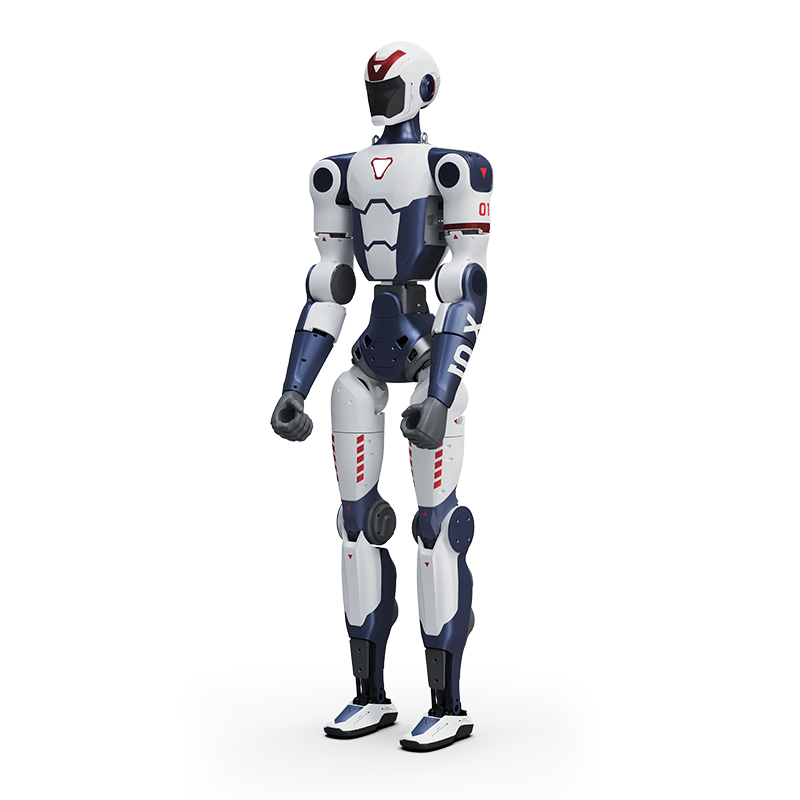 | |
| General information | |
| Manufacturer | Unitree Robotics |
| Country of origin | China |
| Year introduced | 2025 |
| Status | Pre-order (shipping April 2026) |
| Starting price | $4,900 USD (R1 Air) |
| Height | 121 to 123 cm |
| Weight | 25 to 29 kg |
| Degrees of freedom | 20 to 40 (varies by model) |
| Battery life | Approximately 1 hour |
| Website | unitree.com/R1 |
The Unitree R1 is a compact bipedal humanoid robot that, at a starting price of $5,900 (and $4,900 for the entry-level R1 Air), is the most affordable mass-produced full-size humanoid robot on the market. Introduced in July 2025 by Unitree Robotics, a Chinese company headquartered in Hangzhou, Zhejiang Province, the R1 stands roughly 121 to 123 cm tall, weighs about 25 kg in its base configuration, and runs Unitree's UnifoLM multimodal large language model on board for voice and image interaction.[1][5] It targets consumers, hobbyists, educators, and researchers who want access to humanoid robotics without the price tags of industrial or research-grade platforms.
The R1 was named one of TIME magazine's Best Inventions of 2025, and its global launch on AliExpress in April 2026 marked the first time a humanoid robot was sold through a mainstream global e-commerce marketplace.[1][2] Unitree positions the R1 as the entry point to its humanoid product line, sitting below the G1 and the full-size H1 in both price and capability.
What is the Unitree R1?
The Unitree R1 is an ultra-lightweight, customizable bipedal humanoid robot built around dynamic athletic movement rather than heavy industrial manipulation. Unitree markets it with the tagline "Born for Sport," emphasizing agility, running, and acrobatic locomotion.[5] The robot combines an 8-core CPU, binocular vision, a four-microphone array, and an onboard multimodal AI model to support voice and image recognition without relying on cloud computing. At 25 kg, the R1 is light enough for one person to lift and reposition, a deliberate choice intended to make humanoid robotics approachable for homes and classrooms.
Unitree describes the design philosophy as "ultra-lightweight, fully customizable," and the standard consumer model ships with fixed open fists rather than dexterous hands, positioning the robot for interaction, demonstration, and education rather than household task automation.[5][7]
Background and Development
Unitree Robotics was founded in 2016 by Wang Xingxing, who developed his first quadruped robot, XDog, during his master's studies at Shanghai University. The company built its reputation on affordable quadruped robots, beginning with the Laikago in 2017 and continuing with the Go1 (2021) and Go2 (2023). Unitree's quadruped products captured an estimated 60 to 70% of global quadruped robot shipments by volume, establishing the company as a leader in consumer and research-grade legged robotics.[3]
Unitree entered the humanoid market in 2023 with the H1, a full-size humanoid priced at approximately $90,000 and designed for industrial and research applications. The H1 gained attention for setting a world record in bipedal running speed at 3.3 m/s. In August 2024, Unitree launched the G1, a smaller humanoid starting at approximately $16,000 (later adjusted to roughly $13,500 by early 2026), which went viral on social media for its combination of agility and affordability.[4]
The R1 represents the third generation of Unitree's humanoid strategy, pushing the price even further downward. While the G1 targeted universities, research labs, and well-funded developers, the R1 aims to make humanoid robotics accessible to individual hobbyists, K-12 and university educators, small labs, and early-adopting consumers. The robot was unveiled in July 2025 with the tagline "Born for Sport," emphasizing its athletic agility and dynamic locomotion rather than heavy-duty manipulation or industrial work.[5]
Design and Physical Characteristics
The R1 follows a bipedal humanoid form factor with two legs, two arms, a torso, and a head module. At 121 to 123 cm tall (depending on the variant), the robot is roughly the height of a young child, a deliberate design choice intended to make it approachable and practical for home and classroom environments. The compact size also reduces manufacturing cost and shipping weight compared to full-size humanoids like the H1 (180 cm) or Tesla Optimus (approximately 173 cm).
The R1 weighs between 25 and 29 kg depending on the configuration. The lightest variant, the R1 Air, weighs approximately 25 to 27 kg, while the standard R1 and R1 EDU weigh closer to 29 kg. This makes the R1 roughly 6 to 10 kg lighter than the G1 (35 kg base weight), a meaningful difference for portability. A single person can lift and reposition the R1 without difficulty, which is not the case with heavier humanoids.
The body is constructed from lightweight composite materials and plastic rather than the metal frame used on the G1. This trade-off reduces durability and payload capacity compared to the G1 but contributes significantly to the R1's lower weight and cost. Standing dimensions are 1,230 x 357 x 190 mm (height x width x depth).[6]
Unitree offers interchangeable exterior finishes for the R1, allowing customization of the robot's appearance. The company describes the design philosophy as "ultra-lightweight, fully customizable."[7]
Technical Specifications
How many degrees of freedom does the Unitree R1 have?
The R1's joint configuration varies across its model tiers, ranging from 20 degrees of freedom (DOF) on the R1 Air up to 40 DOF on the EDU Pro models. The standard R1 has 26 DOF.[5][8]
| Component | R1 Air | R1 Standard | R1 EDU (base) | R1 EDU Pro |
|---|---|---|---|---|
| Legs (per leg) | 6 DOF | 6 DOF | 6 DOF | 6 DOF |
| Arms (per arm) | 4 DOF | 5 DOF | 5 DOF | 5 DOF |
| Waist | 0 | 2 DOF | 2 DOF | 2 DOF |
| Head | 0 | 2 DOF | 2 DOF | 2 DOF |
| Hands | None | None | None | 6 to 7 DOF per hand |
| Total | 20 DOF | 26 DOF | 26 DOF | 38 to 40 DOF |
The 6 degrees of freedom per leg provide full hip, knee, and ankle articulation, enabling walking, running, squatting, and dynamic balance recovery. The arms on the standard and EDU models have 5 DOF each, which allows basic reaching and object interaction but limits the range of manipulation compared to the G1's 7 DOF arms. The R1 Air's 4 DOF arms are more restricted, suitable primarily for gesturing and simple motions.
The 2 DOF waist on the standard and EDU models provides rotational flexibility that improves balance during dynamic locomotion and allows the torso to twist independently of the legs. The 2 DOF head enables pan-and-tilt active perception, allowing the robot to direct its cameras toward points of interest.
The EDU Pro variants extend the total DOF to 38 or 40 by adding dexterous hands, enabling grasping and manipulation tasks.[8]
Actuators
The R1 uses low-inertia, high-speed internal rotor permanent magnet synchronous motors (PMSM). These proprietary actuators are designed for rapid response and efficient heat dissipation. Joint support uses crossed roller bearings and double hook ball bearings. Each joint incorporates dual and single encoders for position feedback.
The maximum arm joint torque is approximately 2 kg, which limits the R1 to handling lightweight objects. For context, the G1 supports 2 to 3 kg per arm, while the H1 produces up to 360 N.m at the knee joint. The R1's actuators prioritize speed and agility over raw force, consistent with its athletic design philosophy.[9]
What AI runs on the Unitree R1?
All R1 models include an 8-core high-performance CPU as the base computing platform. The robot runs a Linux-based operating system and integrates Unitree's UnifoLM, a multimodal large language model designed for robotic control. UnifoLM fuses computer vision and audio processing, enabling the robot to interpret spoken commands, recognize objects and people through its camera feed, and generate appropriate responses or behaviors in real time without relying on cloud computing.[5][10]
The R1 EDU models can be equipped with an NVIDIA Jetson Orin computing module, available in configurations providing 40 TOPS (EDU Standard) or up to 100 TOPS (EDU Smart and Pro). The 100 TOPS option enables real-time inference with language models of 7 billion or more parameters, complex vision processing, and multimodal AI workloads. This represents approximately 2.5 times the computing power available on the G1's comparable configurations.[11]
Sensors and Perception
The sensor suite varies by model:
| Sensor | R1 Air | R1 Standard / EDU |
|---|---|---|
| Camera | Monocular | Binocular (stereo depth) |
| Microphones | 4-mic array | 4-mic array |
| Speaker | Integrated | Integrated |
| IMU | Dual 6-axis | Dual 6-axis |
| Joint encoders | Dual + single | Dual + single |
The binocular camera system on the standard and EDU models provides depth perception for spatial awareness and obstacle detection. The 4-microphone array enables sound source localization and voice command recognition. The twin 6-axis inertial measurement units (IMUs) provide orientation and acceleration data critical for balance control during dynamic movements.[12]
Notably, the R1 does not include 3D LiDAR or dedicated depth cameras (such as the Intel RealSense D435i used on the G1 and H1). This reduces cost but limits the robot's spatial mapping capabilities compared to its more expensive siblings.
Connectivity
All models support Wi-Fi 6 and Bluetooth 5.2. The robot can be controlled via the Unitree Explore mobile app (available for Android and iOS) or through direct network connections for development work.
Power and Battery
The R1 uses a lithium battery with approximately one hour of runtime per charge. The battery features a quick-release smart design that allows hot-swapping without powering down the robot. Spare batteries are estimated to cost $500 to $600 each. The package includes one smart battery and a charger.
The one-hour battery life is notably shorter than the G1's approximately two-hour runtime. Unitree compensates for this with the quick-swap mechanism, which allows near-continuous operation when spare batteries are available.[13]
How much does the Unitree R1 cost?
The R1 is available in three main tiers, with the EDU tier further subdivided into seven configurations. The consumer models start at $4,900 (R1 Air) and $5,900 (R1 Standard), while the developer-oriented EDU variants range from roughly $10,000 to $35,000 depending on computing module and hand options:
| Variant | Price (USD) | DOF | Computing | Camera | Hands | Warranty |
|---|---|---|---|---|---|---|
| R1 Air | $4,900 | 20 | 8-core CPU | Monocular | None | 6 months |
| R1 (Standard) | $5,900 | 26 | 8-core CPU | Binocular | None | 8 months |
| R1 EDU Standard | $10,000 to $12,000 | 26 | Jetson Orin (40 TOPS) | Binocular | None | 12 months |
| R1 EDU Smart | $15,000 to $19,000 | 26 | Jetson Orin (100 TOPS) | Binocular | None | 12 months |
| R1 EDU Pro A | $20,000 to $24,000 | 40 | Jetson Orin (100 TOPS) | Binocular | 3-finger (Dex3-1), no tactile | 12 months |
| R1 EDU Pro B | $22,000 to $28,000 | 40 | Jetson Orin (100 TOPS) | Binocular | 3-finger (Dex3-1), tactile | 12 months |
| R1 EDU Pro C | $25,000 to $32,000 | 38 | Jetson Orin (100 TOPS) | Binocular | 5-finger (BrainCo Revo 2), no tactile | 12 months |
| R1 EDU Pro D | $28,000 to $35,000 | 38 | Jetson Orin (100 TOPS) | Binocular | 5-finger (BrainCo Revo 2), tactile (17 sensors) | 12 months |
All prices exclude taxes and shipping. Shipping costs range from $300 to $1,200 depending on destination. Import duties and customs fees are the responsibility of the buyer.[14] In China, the R1 starts at 29,900 yuan (approximately $4,370), making it even more accessible in the domestic market.[19]
The R1 Air and R1 Standard are closed systems with no programming or secondary development support. They are designed for demonstrations, remote-controlled operation, and educational observation. Only the R1 EDU variants support software development through SDKs, ROS 2 interfaces, and Python/C++ programming.
Hand Options
The EDU Pro models offer two hand types:
- Dex3-1 (3-finger): 7 DOF per hand. Unitree's proprietary design that covers approximately 80 to 90% of typical grasping use cases at a lower cost.
- BrainCo Revo 2 (5-finger): 6 DOF per hand. Enables human-like grasp patterns suitable for human-robot interaction (HRI) research and complex manipulation studies. The Pro D variant adds 17 tactile sensors per hand for force feedback.
What can the Unitree R1 do?
The R1 is a fully bipedal humanoid that walks, runs, and balances on two legs. Its locomotion system is trained using reinforcement learning in simulation and transferred to the physical robot through sim-to-real techniques, consistent with Unitree's broader technical approach.
The robot's top speed reaches approximately 9 km/h (2.5 m/s). Demonstrated capabilities include:
- Running on flat and inclined terrain
- Downhill sprints
- Cartwheels and handstands
- Shadowboxing and martial arts movements
- Ground-to-standing transitions
- Autonomous fall recovery (push-recovery and self-righting)
- Squatting, waving, kicking, and mimicking human motion
The emphasis on dynamic, athletic movement reflects Unitree's "Born for Sport" positioning. The R1 prioritizes agility and locomotion performance over payload capacity and manipulation, differentiating it from humanoids like Figure 02 or Tesla Optimus that prioritize industrial task completion.[15]
Software and Development Platform
The R1 EDU variants run on a Linux-based operating system and provide developers with multiple interfaces for programming custom behaviors:
- Unitree SDK: Proprietary software development kit for low-level joint control and sensor access
- ROS 2 (Robot Operating System): Full compatibility with the ROS 2 ecosystem, enabling integration with the extensive ROS package library
- Python and C++ APIs: High-level programming interfaces for behavior scripting and algorithm development
- NVIDIA Jetson Orin development environment: For the EDU models, access to NVIDIA's CUDA, TensorRT, and other GPU-accelerated computing frameworks
Unitree also provides open-source resources through its GitHub repositories, including manipulation datasets and model training tools. The UnifoLM-WMA-0 (World-Model-Action) architecture and UnifoLM-VLA-0 (Vision-Language-Action) model are open-source frameworks spanning multiple robotic embodiments for general-purpose robot learning.[16]
The R1 Air and R1 Standard do not support custom development. They are operated through the Unitree Explore mobile app or a manual controller included with purchase.
All R1 models receive continuous over-the-air (OTA) software updates from Unitree, allowing the company to push improvements to locomotion policies, AI capabilities, and system stability after purchase.
What is the Unitree R1 used for?
Education and STEM
The R1's most immediate application is in educational settings. The sub-$5,000 entry price of the R1 Air makes it feasible for K-12 schools, community colleges, and university programs to acquire humanoid robots for hands-on instruction. The EDU variants, starting at $10,000, fill a gap in the market between $2,000 educational robot arms and $45,000-plus research humanoids. University robotics labs can now afford to purchase multiple R1 units for student projects, enabling multi-robot experiments that were previously cost-prohibitive.[17]
Research and Development
For robotics researchers, the R1 EDU serves as an affordable platform for studying bipedal locomotion, balance control, human-robot interaction, and embodied AI. The combination of ROS 2 compatibility, NVIDIA Jetson computing, and optional dexterous hands makes the EDU Pro variants suitable for manipulation research, computer vision experiments, and natural language processing integration.
Multi-robot research becomes particularly accessible with the R1. Three to four R1 EDU units can be purchased for roughly the same price as a single G1 EDU, enabling swarm behavior studies, collaborative manipulation experiments, and multi-agent reinforcement learning.
Consumer and Home Use
While Unitree markets the R1 toward consumers, the robot's practical home utility remains limited in its current form. The standard R1 lacks dexterous hands and cannot perform household tasks such as folding laundry, loading a dishwasher, or manipulating most everyday objects. Its one-hour battery life also constrains sustained use.
The R1 is better understood as an early-adopter product for technology enthusiasts who want to own a humanoid robot as a novelty, companion, or personal project platform. As OTA updates improve the robot's AI capabilities and as third-party software ecosystems develop, practical home applications may expand over time.
Light Commercial and Demonstration
The R1's dynamic movement capabilities and approachable size make it suitable for demonstrations, trade shows, retail environments, and reception areas. Its voice interaction and visual recognition through UnifoLM allow basic conversational interactions with visitors.
How does the Unitree R1 compare to the G1 and H1?
The R1 sits at the bottom of Unitree's humanoid lineup in both price and capability:
| Model | Year | Starting Price | Height | Weight | DOF | Target Market |
|---|---|---|---|---|---|---|
| R1 | 2025 | $4,900 | 121 to 123 cm | 25 to 29 kg | 20 to 40 | Consumers, educators, hobbyists |
| G1 | 2024 | $13,500 | 127 to 132 cm | 35 to 47 kg | 23 to 43 | Researchers, developers, universities |
| H1 | 2023 | $90,000 | 180 cm | 47 kg | 19 (base) | Industrial, advanced research |
| H2 | 2026 | TBD | 180 cm | 70 kg | 31 | Industrial, commercial deployment |
The R1 is approximately 64% cheaper than the G1 and over 94% cheaper than the H1. It sacrifices sensor sophistication (no LiDAR or depth camera), battery life (1 hour vs. 2 hours on the G1), arm payload (2 kg vs. 2 to 3 kg), and build ruggedness in exchange for lower cost and lighter weight.
The G1 remains the better choice for serious research requiring advanced sensors, longer runtime, and heavier manipulation. The H1 and H2 serve industrial applications demanding full-size humanoid capabilities. The R1 is designed specifically for the price-sensitive segment of the market that the G1 and H1 cannot reach.[18]
Market Context and Competitive Landscape
Pricing Strategy
Unitree's central business strategy, pioneered by founder Wang Xingxing, is to drive robotics prices down following the trajectory of smartphones and personal computers. The R1 represents the most aggressive expression of this strategy in the humanoid space. At $4,900 to $5,900, it undercuts virtually every other humanoid robot available for purchase:
| Robot | Manufacturer | Price | Height |
|---|---|---|---|
| Unitree R1 Air | Unitree | $4,900 | 121 cm |
| Unitree R1 | Unitree | $5,900 | 123 cm |
| Unitree G1 | Unitree | $13,500 | 127 to 132 cm |
| Tesla Optimus | Tesla | $20,000 to $30,000 (est.) | ~173 cm |
| 1X Neo | 1X Technologies | ~$20,000 (est.) | 165 cm |
| Unitree H1 | Unitree | $90,000 | 180 cm |
In China, the R1 starts at 29,900 yuan (approximately $4,370), making it even more accessible in the domestic market.[19]
Global Launch via AliExpress
In April 2026, Unitree launched the R1 globally through Alibaba's AliExpress platform, using the Brand+ channel that offers free shipping and returns. The initial rollout targets North America, Europe, Japan, and Singapore, with expansion to additional markets planned. This marks the first time a humanoid robot has been sold through a mainstream global e-commerce marketplace, signaling Unitree's intent to treat humanoids as consumer products rather than specialized industrial equipment.[20]
The AliExpress partnership reflects a broader strategic alignment between Unitree and the Alibaba ecosystem. Alibaba is among the investors in Unitree's Series C funding round.
Shipment Volumes
Unitree shipped over 5,500 humanoid robots in 2025, far exceeding U.S. competitors such as Tesla and Figure AI, which each shipped approximately 150 units during the same period. The company targets 10,000 to 20,000 humanoid shipments in 2026, with the R1 expected to be a significant contributor to that volume due to its lower price point.[21]
Recognition and Awards
The Unitree R1 was named one of TIME magazine's Best Inventions of 2025, alongside the Figure 03 humanoid robot. TIME highlighted the R1's role in advancing robotics research by providing an accessible platform that thousands of researchers can afford, rather than limiting cutting-edge humanoid robotics to elite labs with corporate partnerships.[1][22]
In the same year, TIME selected Unitree founder Wang Xingxing as one of The 100 Most Influential People, recognizing his impact on making robotics technology more widely available.[23]
Company Background
Unitree Robotics (Hangzhou Unitree Technology Co., Ltd.) was founded in August 2016 by Wang Xingxing in Hangzhou, Zhejiang Province, China. The company has raised approximately $155 million in total funding across six rounds, with a Series C valuation of approximately $1.7 billion (12.7 billion yuan) as of June 2025. Key investors include Tencent, Alibaba, Ant Group, China Mobile, Geely Capital, HongShan Capital (formerly Sequoia China), and Shunwei Capital.[24]
In March 2026, Unitree filed for an initial public offering on the Shanghai Stock Exchange's STAR Market, seeking to raise approximately 4.2 billion yuan ($610 million). The company's annual revenue exceeded 1 billion yuan for the first time in 2025, representing a 335% year-over-year increase driven largely by humanoid robot sales.[25]
As of early 2026, Unitree leads globally in the delivery of large-sized general-purpose humanoid robots by volume. The company's quadruped robots continue to account for the majority of its installed base, with over 30,000 quadrupeds shipped between 2022 and September 2025.
Limitations
Despite its affordability and agility, the R1 has several notable limitations:
- No hands on base models: The R1 Air and R1 Standard ship without dexterous hands, severely limiting manipulation capability. Only the EDU Pro variants ($20,000+) include hands.
- Low arm payload: The approximately 2 kg arm torque restricts the robot to handling very lightweight objects.
- Short battery life: One hour of runtime per charge is half the G1's duration and may limit practical applications.
- No LiDAR or depth camera: The absence of 3D LiDAR and dedicated depth sensors limits autonomous navigation and spatial mapping compared to the G1.
- Closed consumer models: The R1 Air and Standard are not programmable and do not support secondary development, limiting them to remote-controlled operation and pre-programmed behaviors.
- Lightweight construction: The composite and plastic body is less durable than the G1's metal frame.
Future Outlook
The R1's significance extends beyond its immediate capabilities. By establishing a sub-$5,000 entry point for humanoid robots, Unitree is testing whether consumer demand for personal humanoids exists at scale. If the April 2026 global launch generates strong sales, it could validate the broader industry thesis that humanoid robots will eventually become household products.
Unitree's continuous OTA update model means the R1's capabilities are expected to improve over time as the company refines locomotion algorithms, expands AI features, and potentially enables new applications through software alone. The open development ecosystem around the EDU models positions the R1 as a platform for community-driven innovation, similar to how early smartphones and single-board computers (such as the Raspberry Pi) spawned large developer ecosystems.
See Also
- Unitree Robotics
- Unitree G1
- Unitree H1
- Humanoid Robots
- Embodied AI
- Reinforcement Learning
- Tesla Optimus
- Boston Dynamics
References
- ^1 ^2 ^3"Unitree R1: The Best Inventions of 2025." TIME. time.com/...unitree-r1
- ^"Unitree's cheapest $4K sport-ready R1 humanoid robot to hit US markets via AliExpress." Interesting Engineering, April 2026. interestingengineering.com/...express-global-debut
- ^"Unitree Robotics." Wikipedia. en.wikipedia.org/...Unitree_Robotics
- ^"Unitree Robotics unveils G1 humanoid for $16K." The Robot Report, August 2024. therobotreport.com/...-unveils-g1-humanoid-for-16k
- ^1 ^2 ^3 ^4 ^5 ^6"$5,900 Unitree R1 is an ultra-lightweight, customizable humanoid robot." CNX Software, July 2025. cnx-software.com/...ht-customizable-humanoid-robot
- ^"Unitree R1." Unitree Robotics Official Website. unitree.com/R1
- ^1 ^2"Unitree R1: A Fully Customizable Ultra-Lightweight Humanoid Robot." Humanoid.guide. humanoid.guide/...ultra-lightweight-humanoid-robot
- ^1 ^2"Unitree R1 Review 2026: $4,900 Humanoid Robot Specs & Price." Robozaps. blog.robozaps.com/...unitree-r1-review
- ^"Unitree R1 Humanoid Robot: Price, Specs & Use Cases." DronesPlus Robotics. dronesplusrobotics.com/...tform-for-real-world-use
- ^"Unitree unveils its new R1 humanoid, What Can the Unitree R1 Robot Do?" Science Online. online-sciences.com/...can-the-unitree-r1-robot-do
- ^"Unitree R1 Price & Specs 2026." BotInfo. botinfo.ai/...unitree-r1-humanoid-robot
- ^"Unitree R1 Humanoid Robot: Features, Specifications, Applications, and Latest Developments." URCA Foundation. urca.foundation/...cations-and-latest-developments
- ^"Unitree R1 (Pre-sale)." Unitree Robotics Shop. shop.unitree.com/...unitree-r1
- ^"Unitree R1 EDU: All 7 Variants, Pricing & Pre-Order." BotInfo. botinfo.ai/...unitree-r1-edu
- ^"Affordable humanoid robot R1 launched by Unitree." New Atlas. newatlas.com/...unitree-r1-humanoid-robot
- ^"Unitree Robotics." GitHub. github.com/unitreerobotics
- ^"Unitree R1 and Figure 03 Named to TIME's Best Inventions of 2025, Highlighting Humanoid Momentum." Humanoids Daily. humanoidsdaily.com/...ghlighting-humanoid-momentum
- ^"Unitree R1 vs G1: Which Humanoid Should You Buy?" Robozaps, 2026. blog.robozaps.com/...unitree-r1-vs-g1
- ^1 ^2"China's Unitree debuts US$5,900 humanoid robot in race to make cheaper products." South China Morning Post. scmp.com/...anoid-robot-race-make-cheaper-products
- ^"China's Unitree Sells Cheapest Humanoid Robots Online with R1 Global Launch." Gizmochina, April 2026. gizmochina.com/...bal-launch-online-humanoid-robot
- ^"Unitree Ships 36x More Than U.S. Rivals: China's Humanoid Robot Supply Chain in 2026." Supply Chain Intelligence. news.yrules.com/...5446
- ^"Unitree R1: The Best Inventions of 2025." TIME. time.com/...unitree-r1
- ^"Unitree Robotics R1 humanoid robot named one of The Best Inventions of 2025 by TIME." Unitree Robotics (via X/Twitter). x.com/...1976864479813288146
- ^"China Unitree Robotics Raised Series C Funding at $1.7 Billion Valuation." Caproasia, June 2025. caproasia.com/...-funding-at-1-7-billion-valuation
- ^"China's Unitree Robotics rides humanoid tide as it targets US$610m IPO." South China Morning Post, March 2026. scmp.com/...es-humanoid-tide-it-targets-us610m-ipo
Improve this article
Add missing citations, update stale details, or suggest a clearer explanation. Every suggestion is reviewed for sourcing before it goes live.
5 revisions · v6 · 4,189 words · full history
Fact-checks are independent of edits: a reviewer re-verifies the article against its sources and stamps the date. How we verify
Research and drafting on this wiki are AI-assisted, under named human editorial standards. How AI is used here
Cite this page: AI Wiki. "Unitree R1." aiwiki.ai, updated 22 Jun 2026. CC BY 4.0. https://aiwiki.ai/wiki/unitree_r1