

HMND 01 Alpha Bipedal
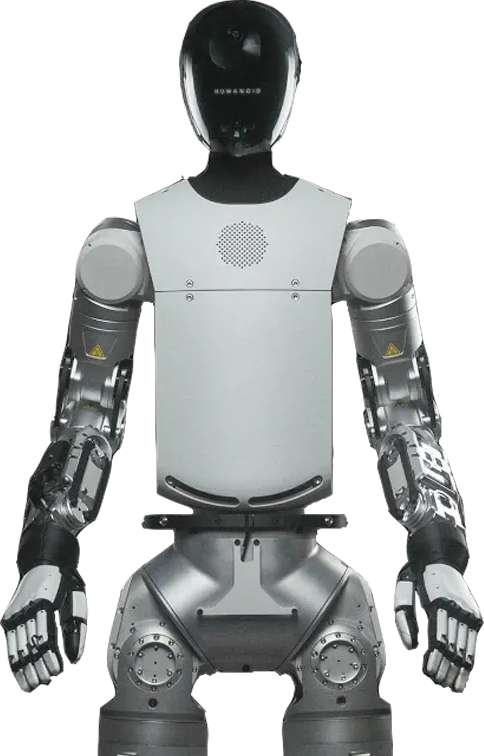
The HMND 01 Alpha Bipedal is a full-size bipedal humanoid robot built by Humanoid (legally SKL Robotics Ltd), a London-based United Kingdom robotics and artificial intelligence company founded in 2024 by serial entrepreneur Artem Sokolov. Announced on December 2, 2025, it stands 179 cm tall, weighs 90 kg, has 29 degrees of freedom, and is best known for a single claim: it walked autonomously just 48 hours after final assembly, having gone from initial design to working prototype in only five months.[1][2] It is the legged variant of the HMND 01 platform, sharing the same upper-body design and KinetIQ AI framework as the earlier Alpha Wheeled version but replacing the omnidirectional wheeled mobile base with articulated bipedal legs.[1]
| HMND 01 Alpha Bipedal | |
|---|---|
 | |
| General information | |
| Manufacturer | Humanoid (SKL Robotics Ltd) |
| Country of origin | United Kingdom |
| Year announced | December 2, 2025 |
| Status | Prototype / R&D platform |
| Price | $120,000 USD |
| Height | 179 cm / 5 ft 10 in |
| Weight | 90 kg / 198 lb |
| Degrees of freedom | 29 (excluding end-effectors) |
| Payload capacity | 15 kg / 33 lb (bimanual) |
| Max speed | 1.5 m/s / 5.4 km/h |
| Battery life | 3 hours (swappable) |
| AI framework | KinetIQ (VLM/VLA-based) |
| Compute | NVIDIA Jetson Orin AGX + Intel i9 |
| Locomotion | Bipedal (RL-trained whole-body controller) |
| End-effectors | 12-DOF hand or 1-DOF parallel gripper |
| Website | thehumanoid.ai |
The bipedal configuration targets environments that require stair climbing, navigation over uneven terrain, or operation in spaces designed for human workers rather than wheeled platforms. Humanoid reports that the 48-hour walking milestone, which typically requires weeks or months for comparable humanoid robot platforms, was enabled by extensive simulation training using NVIDIA Isaac Sim and Isaac Lab, in which the engineering team generated 52.5 million seconds of reinforcement learning locomotion data (equivalent to roughly 19 months of continuous training) in only two days.[2] As of early 2026, the Alpha Bipedal serves primarily as an R&D platform for future service and household applications, while the wheeled variant handles industrial proof-of-concept deployments.
What is the HMND 01 Alpha Bipedal?
The HMND 01 Alpha Bipedal is the bipedal (two-legged) member of Humanoid's HMND 01 robot family. The HMND 01 itself is a modular humanoid robot designed for industrial automation tasks including goods handling, picking, packing, kitting, and logistics operations. Humanoid built the platform around a shared upper-body architecture that can be paired with different lower-body configurations, allowing customers to select the mobility solution best suited to their operational environment.[3]
The first configuration, the HMND 01 Alpha Wheeled, was unveiled in September 2025. Standing 220 cm tall and weighing 300 kg, it uses an omnidirectional wheeled base capable of reaching 2 m/s. The wheeled variant was developed in seven months and has since completed multiple industrial proof-of-concept deployments at Siemens, Ford, and Martur Fompak facilities.[4]
The bipedal variant was conceived to extend the platform's reach into environments where wheels are impractical: multi-level buildings with staircases, outdoor terrain with curbs and ramps, older factory floors with uneven surfaces, and residential settings. By sharing the same 29-degree-of-freedom upper body and KinetIQ software stack, skills learned on one variant can transfer to the other with minimal retraining.[5]
Who makes the HMND 01 Alpha Bipedal?
Humanoid was founded in May 2024 by Artem Sokolov, a serial entrepreneur who previously took over his family business and grew a jewelry manufacturing company to a $1 billion valuation. The company is backed by $50 million in founder-led capital and employs over 200 engineers, researchers, and specialists drawn from companies such as Apple, Tesla, Google, Boston Dynamics, Sanctuary AI, and NVIDIA. Humanoid maintains offices in London (global headquarters), Boston, and Vancouver.[6]
Sokolov frames the company's mission around structural labor shortages. Announcing the bipedal robot, he stated: "HMND 01 is designed to address real-world challenges across industrial and home environments," pointing to rising workforce shortages and noting that some sectors face gaps of up to 27 percent.[12] In a separate statement on the bipedal launch he described the robot's purpose succinctly: "Alpha Bipedal is designed to open the door for broad home and service applications."[10]
How was the HMND 01 Alpha Bipedal developed?
Simulation-first design philosophy
Humanoid adopted a simulation-first development methodology, using NVIDIA Isaac Sim to create detailed digital twins of the robot and its operating environments before manufacturing physical hardware. This approach allowed the engineering team to iterate rapidly on mechanical designs, test control algorithms, and validate hardware choices entirely in software, compressing the typical 18-to-24-month development cycle for humanoid robots into a fraction of that time.[7]
For the bipedal variant specifically, the team evaluated six different leg configurations within Isaac Sim. By analyzing torque requirements, mass distribution, joint stability, and locomotion efficiency in simulation, the engineers were able to optimize actuator selection and joint strength before committing to physical prototypes. This process helped finalize the hardware design, reduce development risk, and avoid costly iteration on physical parts.[8]
Why did it take only five months to build?
Development of the Alpha Bipedal began in mid-2025, approximately two months after the wheeled variant reached its prototype milestone. The bipedal version went from first design to working prototype in five months, compared to the seven-month timeline for the wheeled variant. This acceleration was possible because the bipedal version inherited the proven upper-body design, sensor suite, and software architecture from the wheeled platform; the engineering team only needed to develop the leg mechanisms, locomotion controller, and associated power systems from scratch.[9]
How did it walk just 48 hours after assembly?
On December 2, 2025, Humanoid publicly announced the Alpha Bipedal with a claim that attracted significant industry attention: the robot achieved stable, autonomous walking just 48 hours after final assembly. For context, most humanoid robot platforms require weeks or even months of tuning, calibration, and adjustment between assembly and their first successful walking demonstrations.[10]
This rapid sim-to-real transfer was made possible by the quality of the simulation training. The engineering team used NVIDIA Isaac Sim and Isaac Lab to train a whole-body locomotion controller through online reinforcement learning. In total, they generated 52.5 million seconds of simulated locomotion data in two days, equivalent to nearly 19 months of continuous training time. The robot took its first real-world steps after exposure to 3.2 million seconds of this simulated experience. Ultra-precise 3D modeling of the physical robot minimized the simulation-to-reality gap, and the company reports that only minimal domain randomization adjustments were needed for successful transfer to the physical hardware.[11]
CES 2026
The Alpha Bipedal was presented alongside the wheeled variant at the Consumer Electronics Show (CES) 2026 in Las Vegas, held January 6 to 9, 2026. While the wheeled variant performed live autonomous bin-picking demonstrations at the show, the bipedal version served as a display model highlighting Humanoid's multi-configuration approach to the humanoid robot market.[13]
What are the HMND 01 Alpha Bipedal's specifications?
Physical dimensions
The Alpha Bipedal has dimensions of 179 x 60 x 40 cm (height x length x width) and weighs 90 kg including the battery. This makes it substantially smaller and lighter than the 220 cm, 300 kg wheeled variant, giving the bipedal version proportions much closer to an average adult human. The reduced mass is critical for bipedal locomotion, where the robot must support its own weight on alternating single legs during the gait cycle.
Degrees of freedom and actuators
The robot has 29 degrees of freedom excluding end-effectors. The upper body is identical to the wheeled variant, providing a common platform for manipulation tasks. The lower body uses high-torque electric actuators selected through simulation-based analysis of torque requirements and joint stability across the six candidate leg configurations evaluated during development. The actuators enable human-level loco-manipulation speeds and support the full range of locomotion modes, from slow precision walking to running and hopping.[14]
How does the bipedal compare with the Alpha Wheeled?
The following table summarizes the key differences between the two HMND 01 Alpha variants:
| Specification | Alpha Wheeled | Alpha Bipedal |
|---|---|---|
| Height | 220 cm (7 ft 3 in) | 179 cm (5 ft 10 in) |
| Weight | 300 kg (661 lb) | 90 kg (198 lb) |
| Dimensions (H x L x W) | 220 x 75 x 75 cm | 179 x 60 x 40 cm |
| Locomotion type | Omnidirectional wheeled base | Bipedal legs |
| Max speed | 2 m/s (7.2 km/h) | 1.5 m/s (5.4 km/h) |
| Average runtime | 4 hours | 3 hours |
| Degrees of freedom | 29 (excl. end-effectors) | 29 (excl. end-effectors) |
| Payload capacity (bimanual) | 15 kg (33 lb) | 15 kg (33 lb) |
| Vertical reach | Floor level to 2 m | Floor level to ~1.8 m |
| Shelf access depth | Up to 60 cm | Up to 60 cm |
| Processors | NVIDIA Jetson Thor | NVIDIA Jetson Orin AGX + Intel i9 |
| End-effectors | 12-DOF hand or 1-DOF gripper | 12-DOF hand or 1-DOF gripper |
| Battery | Swappable | Swappable |
| Stair climbing | No | Yes |
| Uneven terrain | Limited | Yes |
| Price | $50,000-$70,000 | ~$120,000 |
| Primary role | Industrial POC deployments | R&D / future service applications |
| Unveiled | September 2025 | December 2025 |
| Development time | 7 months | 5 months |
The shared upper-body architecture means that both variants accept the same end-effectors, use the same sensor suite for manipulation tasks, and run the same KinetIQ software layers above the locomotion controller. This cross-compatibility is a deliberate design choice that enables skill transfer between platforms and reduces total development and training costs.[15]
What can it do? (locomotion capabilities)
The Alpha Bipedal demonstrates a diverse range of locomotion modes, all trained through reinforcement learning in simulation and transferred to the physical robot:[16]
| Locomotion mode | Description |
|---|---|
| Straight-line walking | Standard forward gait at speeds up to 1.5 m/s |
| Curved trajectory walking | Smooth turns while maintaining forward motion |
| Turning in place | Stationary rotation for reorientation |
| Sidestepping | Lateral movement without changing facing direction |
| Backwards walking | Reverse gait for retreat or repositioning |
| Squatting | Lowering the center of mass for stability or access to low shelves |
| Squat walking | Forward locomotion while maintaining a lowered stance |
| Hopping | Single or repeated vertical jumps |
| Running | Higher-speed gait with flight phase |
| Push recovery | Omnidirectional balance recovery from external forces up to 350 Newtons |
The whole-body locomotion controller is trained entirely through online reinforcement learning in simulation, requiring approximately 15,000 hours of simulated experience to produce a capable model. Push recovery is a particularly notable capability: the robot can withstand lateral, frontal, and rear forces of up to 350 Newtons (roughly 79 pounds-force) and autonomously shift its weight and reposition its feet to regain its center of mass and stabilize without falling.[17]
Sensor suite
The Alpha Bipedal carries a comprehensive sensor package designed for both environmental perception and safe interaction with human coworkers:
| Sensor type | Details |
|---|---|
| RGB cameras | 6 head-mounted cameras providing 360-degree vision |
| Depth sensors | 2 head-mounted stereo depth sensors |
| Wrist cameras | RGB cameras mounted at each wrist for close-range manipulation guidance |
| Force/torque sensors | 6D F/T sensors on arms and end-effectors |
| Joint torque feedback | Torque sensing at each actuated joint |
| Haptic sensors | Contact detection sensors on hands and body surfaces |
| Microphone array | 6-microphone array for voice interaction and sound localization |
| IMU and gyroscope | Inertial measurement for balance and orientation tracking |
| LiDAR | Environmental mapping and obstacle detection |
| Ultrasonic sensors | Short-range proximity detection |
| Temperature monitoring | Thermal sensors for safety and component health |
The six head-mounted RGB cameras and two depth sensors together provide a continuous 360-degree field of view, enabling the robot to perceive its environment in all directions without requiring head rotation. The wrist-mounted cameras give the system close-range visual feedback during manipulation tasks, supplementing the head cameras for precision work.[18]
End-effectors
Like the wheeled variant, the Alpha Bipedal uses a modular end-effector system that allows operators to swap between two configurations depending on task requirements:
- 12-DOF dexterous hand: A five-fingered hand with 12 degrees of freedom, designed for complex manipulation tasks requiring fine motor control. The hands have been demonstrated handling delicate objects such as oranges and coffee cups, as well as performing garment manipulation tasks.
- 1-DOF parallel gripper: A simpler gripper with pad, optimized for high-speed pick-and-place operations where throughput matters more than dexterity.
The end-effectors attach to a common mounting interface on the robot's wrists, enabling tool changes without recalibration of the arm kinematic chain.[19]
Computing architecture
The Alpha Bipedal runs a dual-processor computing architecture:
| Component | Role |
|---|---|
| NVIDIA Jetson Orin AGX | Primary AI inference processor for vision, language, and action models |
| Intel i9 | General-purpose processing for system management, communications, and non-neural computation |
| NVIDIA Jetson Thor | Planned edge computing processor for next-generation robotic foundation models |
The Jetson Orin AGX handles the computationally intensive neural network inference required by the KinetIQ framework, including the vision-language-action models that drive autonomous task execution. The Intel i9 manages system-level tasks, sensor data preprocessing, and communication with fleet management systems. Humanoid has indicated that NVIDIA Jetson Thor will serve as the primary edge computing platform in future production units, enabling "the latest, largest, and most capable robotic foundation models directly at the edge."[20]
Navigation
The Alpha Bipedal supports multiple navigation modes for indoor environments:
- Indoor SLAM (Simultaneous Localization and Mapping)
- Visual SLAM using camera-based feature tracking
- LiDAR mapping for geometric environment representation
The navigation system runs on the robot's proprietary operating system, which maintains compatibility with ROS2 and supports development in Python and C++. This dual approach allows Humanoid's internal teams to develop on the proprietary stack while also providing an interface for third-party developers and researchers who prefer standard robotics middleware.[21]
Safety features
The Alpha Bipedal incorporates several safety mechanisms designed for operation in environments shared with human workers:
| Safety feature | Description |
|---|---|
| Force limiting | Restricts contact forces during interaction with humans or objects |
| Collision detection | Detects unexpected contacts and triggers protective responses |
| Emergency stop | Hardware-level kill switch for immediate cessation of all motion |
| Collaborative mode | Reduced speed and force mode for close-proximity human interaction |
| Push recovery | Autonomous balance recovery to prevent falls in dynamic environments |
| Temperature monitoring | Continuous thermal monitoring of actuators and electronics |
The combination of force/torque sensing, haptic feedback, and collision detection allows the robot to operate in a collaborative mode where it automatically reduces its speed and applied forces when human workers are detected in its immediate vicinity. Sokolov has described safety as central to the product, calling it "one of our core competitive advantages."[10][22]
Protective garments
A distinctive design element of the HMND 01 platform is its use of interchangeable protective garments. Rather than the bare-metal or exposed-frame aesthetic typical of most humanoid robots, the Alpha Bipedal is designed to wear fabric coverings that serve multiple practical functions: reducing contamination risks in food or pharmaceutical environments, cushioning potential contacts in shared workspaces, and providing a customizable visual appearance. The garments are exchangeable, allowing operators to swap them for cleaning or to match specific workplace requirements.[23]
What is the KinetIQ AI framework?
Both the Alpha Bipedal and Alpha Wheeled variants are powered by KinetIQ, Humanoid's proprietary AI framework for end-to-end orchestration of humanoid robot fleets. KinetIQ uses a cross-timescale architecture comprising four cognitive layers, each operating simultaneously at different temporal resolutions. Each layer treats the layer below it as a set of tools, orchestrating them through prompting and tool use to achieve goals set by the layer above.[24]
Architecture overview
| Layer | Name | Timescale | Function |
|---|---|---|---|
| System 3 | Fleet Orchestrator | Seconds | Allocates tasks across the robot fleet; integrates with WMS and ERP systems |
| System 2 | Robot-Level Executive | Seconds to subminutes | Decomposes goals into sub-tasks; monitors execution; escalates to humans when needed |
| System 1 | Vision-Language-Action (VLA) | Subseconds (5-10 Hz) | Commands target poses for body parts; exposes picking, placing, and locomotion as callable skills |
| System 0 | Whole-Body Control | Milliseconds (50 Hz) | Achieves pose targets while maintaining dynamic stability across all joints |
System 3 is an agentic AI layer that treats individual robots as tools and dynamically allocates tasks to optimize fleet-wide operations. It integrates bidirectionally with warehouse management systems (WMS), enterprise resource planning (ERP) platforms, and other facility management systems to receive task requests, track progress, and handle exceptions.[25]
System 2 uses an omni-modal large language model to observe the environment through the robot's sensors and decompose high-level instructions from System 3 into executable sub-tasks. Rather than following fixed sequences, it dynamically updates plans based on real-time visual context. When encountering situations beyond its capability, System 2 can escalate to human operators for intervention.[26]
System 1 is a vision-language-action neural network that commands target poses for subsets of the robot's body parts (hands, torso, pelvis) at a subsecond timescale. It exposes multiple capabilities (picking, placing, manipulating, locomoting) that System 2 can invoke as needed. The VLA issues new predictions at 5 to 10 Hz, with each prediction containing a chunk of higher-frequency actions executed at 30 to 50 Hz by System 0. A prefix conditioning technique ensures that successive action chunks remain coherent with unfolding reality.[27]
System 0 operates at 50 Hz and is responsible for achieving the pose targets set by System 1 while continuously guaranteeing dynamic stability. For the bipedal variant, this means maintaining balance through the gait cycle, recovering from perturbations, and coordinating all 29+ joints to produce stable locomotion. System 0 uses reinforcement-learning-trained whole-body control for both bipedal and wheeled robots, which is a key enabler of KinetIQ's cross-embodiment capability.[28]
How does cross-embodiment work?
One of KinetIQ's most significant architectural features is its cross-embodiment design. Because the upper-body control is kept invariant to the locomotion embodiment, VLA-based manipulation policies transfer cleanly between the wheeled and bipedal variants. Data collected by a wheeled robot performing warehouse tasks can improve the performance of a bipedal robot in a retail or service environment, and vice versa. This means a single AI model can control robots with different morphologies and end-effector configurations, and training data collected on one embodiment benefits the entire fleet.[29]
For the Alpha Bipedal specifically, this cross-embodiment approach means that the extensive manipulation training and task execution data gathered during the wheeled variant's proof-of-concept deployments at Siemens, Ford, and Martur Fompak can be leveraged to accelerate the bipedal variant's capabilities without starting from scratch.
NVIDIA technology integration
Humanoid has established a close collaboration with NVIDIA to accelerate robotic capabilities. The partnership involves three key NVIDIA technologies:[30]
| NVIDIA Technology | Role in Alpha Bipedal |
|---|---|
| Jetson Thor / Jetson Orin AGX | Edge computing for on-device execution of robotic foundation models |
| Isaac Sim | Simulation framework for digital twins, hardware design validation, and six-leg-configuration evaluation |
| Isaac Lab | Reinforcement learning framework for locomotion and manipulation training |
Humanoid was one of the first European companies to integrate NVIDIA Jetson Thor into a humanoid robot prototype. The company also integrates NVIDIA's Isaac GR00T N1.7 vision-language-action model to enhance autonomous decision-making. Using NVIDIA's AI infrastructure, Humanoid reports that VLA model post-training can be completed in just a few hours, and a locomotion policy can be trained from scratch and deployed on a physical robot within 24 hours.[31]
What is the HMND 01 Alpha Bipedal used for?
Industrial applications
While the wheeled variant currently handles industrial proof-of-concept deployments, the bipedal variant is intended for environments where wheels are impractical:
| Application | Environment | Why bipedal is needed |
|---|---|---|
| Multi-level facility logistics | Factories and warehouses with mezzanines | Stair climbing between floors |
| Brownfield manufacturing | Older factories with uneven floors and narrow passages | Terrain adaptation |
| Inspection and maintenance | Industrial sites with obstacles, steps, and cramped spaces | Human-like access to all areas |
| Assembly operations | Production lines designed for human workers | Step-in replacement without facility modification |
Service and home applications
The Alpha Bipedal is positioned as the R&D testbed for Humanoid's longer-term expansion into service and household markets. Humanoid's three-phase deployment roadmap outlines this progression:[32]
| Phase | Target year | Application domain |
|---|---|---|
| Phase 1 | 2027 | Physical tasks (manufacturing, warehousing, logistics) |
| Phase 2 | 2029 | Service sector (elder care, hospitality) |
| Phase 3 | 2031+ | Household applications |
The bipedal form factor is essential for Phase 2 and Phase 3 applications, where robots must navigate homes, hospitals, and retail spaces built for human bipedal locomotion. Lessons learned from the Alpha Bipedal are expected to guide development of the bipedal Beta, a next-generation variant scheduled for late 2026 that is designed specifically for home and service environments.[33]
Human interaction capabilities
The Alpha Bipedal includes several features designed for direct interaction with people, reflecting its intended role in service and domestic settings:
- Head display and LEDs: A front-facing display on the head can show status information, expressions, or visual feedback to nearby humans.
- Speaker system: Integrated speakers for verbal communication and audio alerts.
- 6-microphone array: Enables voice command reception and sound source localization for conversational interaction.
- Collaborative mode: Automatic speed and force reduction when operating near people.
At NVIDIA GTC 2026, Humanoid demonstrated voice-activated multi-robot collaboration using the KinetIQ framework, showing how robots can receive and interpret natural language commands from human users in real time.[34]
How does it compare to other humanoid robots?
The Alpha Bipedal enters a crowded field of bipedal humanoid robots from well-funded competitors. The following table compares it to major rivals:
| Robot | Manufacturer | Country | Height | Weight | DOF | Max speed | Runtime | Price |
|---|---|---|---|---|---|---|---|---|
| HMND 01 Alpha Bipedal | Humanoid | UK | 179 cm | 90 kg | 29 | 1.5 m/s | 3 hrs | $120,000 |
| Optimus | Tesla | USA | 173 cm | 57 kg | 28+ | 2.5 m/s | ~5 hrs | $20,000-$30,000 (target) |
| Figure 02 | Figure AI | USA | 170 cm | 70 kg | 41 | 1.2 m/s | 5 hrs | $100,000+ |
| Atlas (electric) | Boston Dynamics | USA | 150 cm | 89 kg | 56 | 2.5 m/s | ~1-2 hrs | Not for sale |
| NEO | 1X Technologies | Norway/USA | 167 cm | 30 kg | 28 | 4.0 m/s | N/A | ~$20,000 |
| Digit | Agility Robotics | USA | 175 cm | 65 kg | 16+ | 1.5 m/s | 4-8 hrs | Not disclosed |
| Apollo | Apptronik | USA | 173 cm | 73 kg | 36 | 1.4 m/s | 4 hrs | Not disclosed |
| G1 | Unitree | China | 127 cm | 35 kg | 23-43 | 2.0 m/s | ~2 hrs | $16,000 |
Strengths
Humanoid differentiates the Alpha Bipedal through several factors:
- Modular platform: The shared upper-body architecture between wheeled and bipedal variants allows customers to deploy both configurations under a single AI system and transfer skills between them.
- Cross-embodiment AI: KinetIQ's ability to train once and deploy across different morphologies reduces per-variant training costs.
- Fleet orchestration: The four-layer KinetIQ architecture includes native fleet management capabilities, whereas many competitors focus on single-robot autonomy.
- Rapid development: The five-month development cycle and 48-hour walking milestone demonstrate efficient engineering processes.
- Robots-as-a-Service model: The RaaS pricing model lowers adoption barriers compared to outright purchase.
Challenges
The Alpha Bipedal faces notable competitive pressures:
- Price: At $120,000, it is more expensive than Tesla's target price of $20,000 to $30,000 for Optimus and significantly above Unitree's $16,000 G1.
- Runtime: The 3-hour battery life falls short of competitors like Apptronik Apollo (4 hours) and Agility Digit (4-8 hours).
- Weight: At 90 kg, it is heavier than most competitors in its height class, potentially limiting deployment in weight-sensitive environments.
- Maturity: As an R&D platform, the bipedal variant has not yet completed the industrial proof-of-concept deployments that the wheeled variant has demonstrated at Siemens and Ford.
- Funding gap: Humanoid's $50 million in founder-led capital is modest compared to Figure AI's $1.5 billion+ in raised funding or Tesla's manufacturing scale.
What is next for the HMND 01 platform?
Bipedal Beta
Humanoid has announced plans for a bipedal Beta variant scheduled for late 2026. While details remain limited, the company has indicated that the Beta will be designed specifically for home and service environments, incorporating lessons learned from the Alpha Bipedal's R&D program. The Alpha platform serves as the testbed for locomotion algorithms, safety systems, and human interaction capabilities that will be refined in the Beta design.[35]
Production scaling and commercial traction
Humanoid operates on a Robots-as-a-Service (RaaS) business model, leasing units to enterprise customers rather than selling them outright. At the December 2025 launch, the company reported roughly 19,500 pre-orders for the HMND 01 platform (combining both variants), along with four completed and three ongoing industrial proofs of concept; by early 2026 the pre-order figure was reported at over 20,500.[10][36] Founder Artem Sokolov has indicated a target of reducing costs as production scales, with the wheeled variant priced at $50,000 to $70,000 per unit and the bipedal variant at approximately $120,000, translating to an effective operational cost intended to be significantly below the average wage for equivalent manual labor.[36]
ELI5: Explain it like I'm five
The HMND 01 Alpha Bipedal is a robot the size of a grown-up that walks on two legs, like a person. A company in London called Humanoid built it. The amazing part is how fast they made it: they practiced walking millions of times inside a computer game first, so when they finally built the real robot, it learned to walk by itself in only two days. Robots like this usually take months to learn that. One day, robots like this might carry boxes in factories, help take care of older people, or do chores at home.
See also
- HMND 01
- Humanoid robot
- Robotics
- Embodied AI
- Reinforcement learning
- NVIDIA
- Tesla Optimus
- Boston Dynamics
- Figure AI
- Agility Robotics
- Computer vision
References
- ^1 ^2"Humanoid Unveils Record Breaking Bipedal Robot Walking 48 Hours After Assembly." Humanoid official website, December 2, 2025. thehumanoid.ai/...-walking-48-hours-after-assembly
- ^1 ^2"Alpha: The Humanoid Robot That Learned to Walk in Just 2 Days." Hyperight. hyperight.com/...at-learned-to-walk-in-just-2-days
- ^"Product." Humanoid official website. thehumanoid.ai/product
- ^"Humanoid Unveils the UK's First Humanoid Robot For Industrial Use." RoboticsTomorrow, September 18, 2025. roboticstomorrow.com/...25559
- ^"Introducing KinetIQ." Humanoid official website. thehumanoid.ai/introducing-kinetiq
- ^"Artem Sokolov, Founder of Humanoid - Interview Series." Unite.AI. unite.ai/...v-founder-of-humanoid-interview-series
- ^"Humanoid takes seven-month path to HMND 01 Alpha." The Robot Report. therobotreport.com/...-month-path-to-hmnd-01-alpha
- ^"Humanoid Deploys NVIDIA Technologies to Power Advanced Humanoid Robots." Humanoid official website. thehumanoid.ai/...o-power-advanced-humanoid-robots
- ^"Humanoid Unveils Record Breaking Bipedal Robot Walking 48 Hours After Assembly." RoboticsTomorrow, December 2, 2025. roboticstomorrow.com/...25855
- ^1 ^2 ^3 ^4"Humanoid says its first bipedal robot can start walking just 48 hours after assembly." The Robot Report. therobotreport.com/...just-48-hours-after-assembly
- ^"Alpha: The Humanoid Robot That Learned to Walk in Just 2 Days." Hyperight. hyperight.com/...at-learned-to-walk-in-just-2-days
- ^"Video: UK humanoid robot walks just 48 hours after final assembly." Interesting Engineering. interestingengineering.com/...-alpha-bipedal-robot
- ^"World's fastest-developed humanoid robot highlights UK tech at CES." Interesting Engineering. interestingengineering.com/...-wheeled-robot-debut
- ^"HMND 01 Alpha Bipedal." Humanoid official website. thehumanoid.ai/hmnd-01-alpha-bipedal
- ^"Introducing KinetIQ." Humanoid official website. thehumanoid.ai/introducing-kinetiq
- ^"HMND 01 Alpha Bipedal." Humanoid official website. thehumanoid.ai/hmnd-01-alpha-bipedal
- ^"Humanoid Unveils Bipedal HMND 01 Alpha, Claims 'Walking Within 48 Hours' of Assembly." Humanoids Daily. humanoidsdaily.com/...-within-48-hours-of-assembly
- ^"HMND 01 ALPHA Bipedal - Robot Details, Use Case and Specifications." Aparobot. aparobot.com/...hmnd-01-alpha-bipedal
- ^"Product." Humanoid official website. thehumanoid.ai/product
- ^"Humanoid Deploys NVIDIA Technologies to Power Advanced Humanoid Robots." Humanoid official website. thehumanoid.ai/...o-power-advanced-humanoid-robots
- ^"HMND 01 Alpha Bipedal." Humanoid official website. thehumanoid.ai/hmnd-01-alpha-bipedal
- ^"Humanoid Unveils HMND 01 Alpha Bipedal." Origin of Bots. originofbots.com/...-unveils-hmnd-01-alpha-bipedal
- ^"HMND 01 Alpha Wheeled." Humanoid official website. thehumanoid.ai/hmnd-01-alpha-wheeled
- ^"Introducing KinetIQ." Humanoid official website. thehumanoid.ai/introducing-kinetiq
- ^"KinetIQ framework from Humanoid orchestrates robot fleets." The Robot Report. therobotreport.com/...id-orchestrates-robot-fleets
- ^"From Fleet to Joint: Inside Humanoid's KinetIQ Physical AI Framework." Humanoids Daily. humanoidsdaily.com/...inetiq-physical-ai-framework
- ^"Introducing KinetIQ." Humanoid official website. thehumanoid.ai/introducing-kinetiq
- ^"Introducing KinetIQ." Humanoid official website. thehumanoid.ai/introducing-kinetiq
- ^"KinetIQ: Humanoid's Unified AI Framework for Cross-Platform Robot Fleet Control." TechBeat. techbeat.co/kinetiq-humanoids-unified
- ^"Humanoid Accelerates Next-Generation Robotics with NVIDIA." Humanoid official website. thehumanoid.ai/thehumanoid-collaborates-with-nvidia
- ^"Humanoid Deploys NVIDIA Technologies to Power Advanced Humanoid Robots." RoboticsTomorrow, January 9, 2026. roboticstomorrow.com/...25986
- ^"About Us." Humanoid official website. thehumanoid.ai/about-us
- ^"Humanoid's Alpha Robot Gets Legs, Eyes Home Applications." Automate.org. automate.org/...t-gets-legs-eyes-home-applications
- ^"Humanoid Brings Voice-Activated Multi-Robot Collaboration Powered by KinetIQ to Life at NVIDIA GTC." Humanoid official website. thehumanoid.ai/...-by-kinetiqto-life-at-nvidia-gtc
- ^"Humanoid's Alpha Robot Gets Legs, Eyes Home Applications." Automate.org. automate.org/...t-gets-legs-eyes-home-applications
- ^1 ^2"Artem Sokolov, Founder of Humanoid - Interview Series." Unite.AI. unite.ai/...v-founder-of-humanoid-interview-series
Improve this article
Add missing citations, update stale details, or suggest a clearer explanation. Every suggestion is reviewed for sourcing before it goes live.
6 revisions · v6 · 4,985 words · full history
Fact-checks are independent of edits: a reviewer re-verifies the article against its sources and stamps the date. How we verify
Research and drafting on this wiki are AI-assisted, under named human editorial standards. How AI is used here
Cite this page: AI Wiki. "HMND 01 Alpha Bipedal." aiwiki.ai, updated 27 Jun 2026. CC BY 4.0. https://aiwiki.ai/wiki/humanoid_hmnd_01_alpha