

NVIDIA DGX Spark
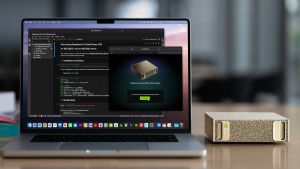
NVIDIA DGX Spark is a compact, deskside AI development system, marketed by NVIDIA as a "personal AI supercomputer," that puts a Grace Blackwell superchip on a desktop and delivers up to 1 petaFLOP (1,000 TOPS) of FP4 AI performance with 128 GB of unified memory. First announced as "Project DIGITS" at CES 2025, DGX Spark went on sale on 15 October 2025 and targets developers, researchers, and students who need local fine-tuning and inference without relying exclusively on the cloud.[1][2] In October 2026 NVIDIA added a 64 GB configuration sold only through partner manufacturers.[42]
DGX Spark is powered by the GB10 Grace Blackwell Superchip and is specified by NVIDIA for up to one FP4 petaFLOP of AI performance (theoretical, using sparsity). The Founders Edition has 128 GB of coherent unified memory, a 4 TB self-encrypting NVMe M.2 SSD, and a ConnectX-7 NIC that enables low-latency links between units. NVIDIA positions Spark for prototyping, local fine-tuning (up to roughly 70 billion parameters), and inference with models up to roughly 200 billion parameters; NVIDIA says two linked units can work with models of up to 405 billion parameters in FP4.[3][4]
The Founders Edition launched at $3,999 USD in October 2025. In February 2026 NVIDIA raised its MSRP to $4,699, citing worldwide memory supply constraints, and in October 2026, when the 64 GB model was announced from $4,999, reports put the 128 GB Founders Edition at about $6,950.[5][43][44]
Background and announcement timeline
When was DGX Spark announced? (CES 2025: Project DIGITS)
NVIDIA CEO Jensen Huang unveiled what would become DGX Spark during his keynote at the Consumer Electronics Show (CES) in Las Vegas on January 6, 2025. Announced under the codename "Project DIGITS," the device was described as a personal AI supercomputer small enough to sit on a desk, able to run large language models of up to 200 billion parameters on one unit and up to 405 billion parameters with two units linked over NVIDIA ConnectX networking. At the time, NVIDIA set an expected availability in May 2025 and a starting price of $3,000 USD.[28]
NVIDIA's announcement billed Project DIGITS as the "world's smallest AI supercomputer," bringing NVIDIA Blackwell architecture into a form factor previously associated with consumer mini-PCs, with the same software stack used on data center hardware.[28]
Why was Project DIGITS renamed DGX Spark? (GTC 2025)
At NVIDIA's GPU Technology Conference (GTC) on March 18, 2025, the company formally renamed Project DIGITS to NVIDIA DGX Spark. The rename placed the product inside NVIDIA's established DGX product family alongside DGX Cloud (NVIDIA's cloud AI platform) and a newly announced sibling product, DGX Station.[6][7] Reservations opened the same day. NVIDIA's pre-order page listed the 4 TB Founders Edition at $3,999, roughly $1,000 above the $3,000 starting price given at CES, and the 1 TB ASUS Ascent GX10 at $2,999; at the time, ServeTheHome reported that the systems were expected to ship that summer.[25] At Computex in May 2025, NVIDIA said DGX Spark would be available from partners starting in July.[8]
In the official announcement, Huang framed the two new machines as a new computing category, saying that "AI has transformed every layer of the computing stack" and that "it stands to reason a new class of computers would emerge," one "designed for AI-native developers and to run AI-native applications." He added that "with these new DGX personal AI computers, AI can span from cloud services to desktop and edge applications."[27] At the GTC keynote, Huang held up a unit roughly the size of a Wi-Fi router and likened it to the original DGX-1 server shrunk down "with Pym particles."[29]
The March 18 press release named ASUS, Dell, HP Inc. and Lenovo as global system builders for both DGX Spark and DGX Station, and listed ASUS, BOXX, Dell, HP, Lambda and Supermicro as the manufacturing partners expected to offer the GB300-based DGX Station.[27]
At the same GTC event, NVIDIA unveiled the DGX Station, a larger deskside workstation based on the GB300 Grace Blackwell Ultra Superchip, which NVIDIA says supports models of up to one trillion parameters locally.[50] This separated the two products: DGX Spark for entry-level local AI development, DGX Station for demanding research workloads.
October 2025: general availability
NVIDIA confirmed that DGX Spark systems would begin shipping the week of October 13, 2025. Sales opened on October 15, 2025 through NVIDIA.com, with Micro Center stores in the United States as a retail outlet. The October launch arrived roughly five months later than the May 2025 window NVIDIA had originally indicated at CES. Partner systems from Acer, ASUS, Dell, Gigabyte, HP, Lenovo, and MSI were listed as available alongside it, along with NVIDIA channel partners worldwide.[1][8]
To mark the launch, Jensen Huang personally delivered some of the first units to prominent AI figures. Huang visited SpaceX's Starbase facility in Texas to hand-deliver a DGX Spark to Elon Musk, calling back to Huang's 2016 delivery of the first DGX-1 to OpenAI, which Musk had co-founded, nine years earlier.[24] Huang also delivered a unit to OpenAI CEO Sam Altman and president Greg Brockman at OpenAI's Mission Bay office.[24][9]
February 2026: price increase
In the week of February 23, 2026, NVIDIA raised the price of the Founders Edition DGX Spark from $3,999 to $4,699, an 18 percent rise. In a Developer Forums post on February 25, NVIDIA said the change was "due to worldwide constraints in memory supply," that the new MSRP applied to all regions, that partner (OEM) pricing was up to each manufacturer, and that orders would be honored at the price in effect when they were placed.[5][10]
2026 software updates and clustering
At CES in January 2026, NVIDIA released a DGX Spark software update with NVFP4 model support and llama.cpp optimizations. It reported up to a 2.6x speedup for a Qwen 235B model on two linked units with NVFP4 and speculative decoding compared with FP8, and an average 35 percent uplift for mixture-of-experts models in llama.cpp. DGX Spark and partner GB10 systems were also added to the NVIDIA-Certified Systems program.[39] At GTC in March 2026, NVIDIA announced NemoClaw, a reference stack that installs the NVIDIA OpenShell runtime to run OpenClaw agents more safely, with DGX Spark among the supported machines.[41] A June 2026 software release added the NVIDIA Sync Cluster Assistant, which connects up to three units without a network switch and up to four with one.[46]
October 2026: 64 GB model and higher 128 GB pricing
On October 2, 2026, NVIDIA announced a 64 GB configuration of DGX Spark, sold only through Acer, ASUS, Dell, Gigabyte, HP and MSI from October 23, 2026, starting at $4,999. It keeps the GB10 chip, DGX OS and ConnectX-7 networking; NVIDIA says it supports models of up to 100 billion parameters on one unit, and that two clustered 64 GB units pool 128 GB, support models of up to 200 billion parameters and delivered up to 1.7x the performance of one unit in its own Qwen 3.8 27B test.[42] ServeTheHome and Guru3D reported that the 128 GB model was moving to about $6,950 at the same time, while heise reported a figure of about $6,000; NVIDIA's announcement did not state a new 128 GB price.[43][44][45]
Hardware design
What does DGX Spark look like? (Form factor)
The DGX Spark occupies a 150 x 150 x 50.5 mm footprint and weighs approximately 1.2 kg;[4] NVIDIA calls it the world's smallest AI supercomputer.[27] The enclosure is an all-metal chassis with a champagne-gold finish, and its front and rear panels are made of metal foam, a design that echoes NVIDIA's DGX A100 and H100 servers.[23] Power is supplied through an external 240 W power supply unit connected to one of the USB-C ports with USB Power Delivery, so the device itself carries no internal AC power supply and has no proprietary power connector.[4][23] All connectivity except the 10 GbE and QSFP ports uses standard consumer interfaces.
What is the GB10 Grace Blackwell Superchip?
DGX Spark uses the NVIDIA GB10 Grace Blackwell Superchip, a multi-die system-on-chip co-designed by NVIDIA and MediaTek.[12] Both dies are fabricated on TSMC's 3nm process node and joined with TSMC 2.5D packaging; NVIDIA's Hot Chips disclosure did not include a transistor count.[11][30] NVIDIA disclosed the GB10's detailed architecture at the Hot Chips 2025 symposium in August 2025. There, NVIDIA said the chip worked on its first spin (A0 silicon) with no respins needed. ServeTheHome credited the extensive verification done ahead of time, which was needed because MediaTek's CPU die implements NVIDIA IP such as the display controller and the C2C link and also hosts the memory controller.[11]
The two dies inside the GB10 are:
- The CPU die, designed by MediaTek, contains 20 Arm v9.2 cores: 10 Cortex-X925 high-performance cores and 10 Cortex-A725 efficiency cores, split into two clusters of ten. Measurements by Chips and Cheese found that each cluster holds five X925 and five A725 cores. NVIDIA described 16 MB of L3 cache per cluster (32 MB total) plus a 16 MB system-level cache, although Chips and Cheese measured 8 MB of L3 on one cluster and 16 MB on the other. The CPU die also hosts the memory controller and handles the operating system, software stack, and non-GPU compute.[11][30][31]
- The GPU die, designed by NVIDIA, contains 48 Streaming Multiprocessors (SMs) totaling 6,144 CUDA cores and fifth-generation Tensor Cores. It delivers up to 1 PFLOP of sparse FP4 AI compute and 31 TFLOPS of FP32 compute.[4][11][32]
The two dies communicate via NVLink-C2C at 600 GB/s bidirectional bandwidth, which gives both CPU and GPU coherent access to the shared memory pool without copying data between separate address spaces. NVIDIA states the NVLink-C2C link provides five times the bandwidth of fifth-generation PCIe.[30][27]
How much memory does DGX Spark have? (Unified memory architecture)
The memory subsystem is the most discussed aspect of DGX Spark's design. The system uses 128 GB of LPDDR5x-8533 memory on a 256-bit interface, delivering approximately 273 GB/s of bandwidth; the GB10's memory controller itself supports LPDDR5X-9400 (about 301 GB/s), according to NVIDIA's Hot Chips presentation.[4][11] This pool is shared coherently between the CPU and GPU, which means a 70 billion parameter model loaded in memory is directly addressable by both the CPU and the GPU Tensor Cores without separate transfers.
NVIDIA rates a single 128 GB unit for inference on models of up to roughly 200 billion parameters at 4-bit precision (FP4 or MXFP4 formats) and for fine-tuning models of up to 70 billion parameters.[3] This puts models like Llama 3.1 70B and Mistral 7B within reach for local inference and fine-tuning without any cloud dependency. The memory is soldered LPDDR5x and is not user-upgradeable.
The bandwidth constraint (273 GB/s) is frequently cited in reviews as the main performance ceiling for autoregressive token generation, which is a memory-bandwidth-bound operation. For comparison, Apple's M3 Ultra chip in the Mac Studio provides more than 800 GB/s of unified memory bandwidth (819 GB/s), roughly three times higher. This tradeoff means DGX Spark is faster than an M3 Ultra Mac Studio on compute-bound tasks (prompt processing, prefill) but slower on memory-bandwidth-bound tasks (token generation decode).[34][19]
How do you cluster DGX Spark units? (Networking and multi-unit scaling)
DGX Spark includes an onboard ConnectX-7 Smart NIC with two QSFP ports. NVIDIA specifies this NIC at up to 200 Gb/s, and the two ports share that aggregate bandwidth because the NIC connects to the GB10 over PCIe 5.0.[4][11][23] The ConnectX-7 enables direct links between two DGX Spark units using a single cable, without requiring a network switch. In a two-unit linked configuration, the combined 256 GB of unified memory allows running models up to roughly 405 billion parameters, according to NVIDIA.[4][23] In March 2026 NVIDIA described four-node clusters with 512 GB of memory, supporting inference for models of up to 700 billion parameters over ConnectX-7 with RoCE, and reported roughly 2x faster per-token generation with two nodes and about 4x with four nodes for Llama 3.3 70B using tensor parallelism.[16]
ConnectX-7 is the same NIC family NVIDIA uses in its data center infrastructure; in DGX Spark its ports run as 200 Gb Ethernet with RDMA.[25][42] This is a notable departure from consumer workstations, which typically use commodity Ethernet.
A standard 10 GbE port (RJ-45) is also present for conventional network connectivity. Wi-Fi 7 and Bluetooth 5.4 provide wireless options, and four USB-C ports (one dedicated to power delivery) handle peripheral connectivity alongside a single HDMI 2.1a port; up to three DisplayPort outputs are available over USB-C.[3][4]
Power and thermals
The GB10 SoC is rated at a 140 W TDP, and the 240 W external power supply leaves about 100 W for other components such as the ConnectX-7 NIC, Wi-Fi, SSD and USB-C ports.[4] Tom's Hardware measured about 35 W at idle as a headless system and about 160 W at the wall under a primarily GPU-driven load. Under an extended image-generation load, the loudest noise it measured was 37.5 dBA at 18 inches, against a 33 dBA room noise floor, and it judged that the system would not disturb people nearby.[20] LMSYS reported no thermal throttling during sustained high-intensity tests.[23]
Specifications
| Category | Detail |
|---|---|
| Architecture | Grace Blackwell (GB10 Superchip) |
| Process node | TSMC 3nm (both dies); transistor count not disclosed |
| CPU | 20-core Arm v9.2 (10x Cortex-X925 + 10x Cortex-A725), two clusters |
| CPU cache | L3 16 MB per cluster per NVIDIA (measured as 8 MB and 16 MB); 16 MB system-level cache |
| GPU | NVIDIA Blackwell GPU, 48 SMs, 6,144 CUDA cores, 5th-gen Tensor Cores |
| GPU cache | 24 MB L2 |
| AI performance | 1 PFLOP sparse FP4 (theoretical); 31 TFLOPS FP32 |
| Unified memory | 128 GB LPDDR5x-8533 (64 GB option from October 2026), coherent, 256-bit, ~273 GB/s bandwidth |
| Storage | 4 TB self-encrypting NVMe M.2 (Founders Edition); partner systems from 1 TB |
| High-speed networking | ConnectX-7 Smart NIC, 2x QSFP, 200 Gb/s aggregate |
| Standard networking | 1x RJ-45 10 GbE |
| Wireless | Wi-Fi 7, Bluetooth 5.4 |
| Display output | 1x HDMI 2.1a; up to 3x DisplayPort over USB-C |
| USB | 4x USB-C (one for power delivery) |
| Power supply | 240 W external PSU via USB-C PD; GB10 TDP 140 W |
| Dimensions | 150 x 150 x 50.5 mm |
| Weight | ~1.2 kg |
| Operating system | NVIDIA DGX OS (Ubuntu 24.04-based; Linux 6.11 kernel at launch, 6.17 as of September 2026) |
| Interconnect | NVLink-C2C at 600 GB/s (CPU-GPU) |
Software stack
What operating system does DGX Spark run? (DGX OS)
DGX Spark ships with NVIDIA DGX OS preinstalled. This is a customized distribution based on Ubuntu 24.04 LTS, preconfigured with the full NVIDIA AI software stack. At launch it used a Linux 6.11-based kernel; a November 2025 update moved to the Ubuntu 6.14 hardware enablement kernel, and as of September 2026 NVIDIA's release notes listed DGX OS 7.5.0 with a 6.17 kernel.[47][46] Canonical has described DGX OS as built on an Ubuntu base, with Ubuntu providing the package repositories and security update infrastructure.[48]
The operating system runs on the ARM64 architecture (Arm v9.2). This means x86-compiled binaries will not run natively, and some third-party software packages that only ship x86 builds require recompilation or emulation. NVIDIA and the open-source community have progressively expanded ARM64 support for major AI frameworks since launch, and early reviews noted that NVIDIA's official containers eased setup substantially for developers who encountered missing ARM64 wheels for certain framework versions.[32]
CUDA and GPU acceleration
DGX Spark supports CUDA for GPU-accelerated workloads, though the GB10's GPU is based on a consumer-tier Blackwell variant rather than the datacenter Hopper and Blackwell GPUs used in DGX H100 and DGX B200 systems. As of early 2026, the GB10 GPU reports a different SM architecture identifier (SM12x, compute capability 12.1) compared to datacenter Blackwell (SM100), which has caused compatibility issues with some tools in the vLLM and SGLang ecosystems that maintain separate code paths for Hopper, datacenter Blackwell, and consumer Blackwell. NVIDIA and the open-source community have been addressing these through software updates.[15] Some third-party software targets GB10 directly: the README of Atlas, an open-source large language model inference engine written in Rust and CUDA, says it is verified on DGX Spark (GB10, SM121) and that the same CUDA source compiles for AMD Strix Halo (gfx1151) systems.[57]
Included libraries and frameworks
NVIDIA's software for DGX Spark includes:
- CUDA toolkit and cuDNN libraries
- TensorRT for optimized inference
- NVIDIA Container Runtime (Docker-compatible GPU containers)
- NVIDIA NIM (NVIDIA Inference Microservices) for model serving
- NVIDIA NeMo for model fine-tuning and training
- NVIDIA RAPIDS libraries for GPU-accelerated data science (cuDF, cuML, cuGraph)
- PyTorch with CUDA, and runtimes such as Ollama and vLLM
- Access to the NVIDIA NGC catalog for pre-built containers and pre-trained models
- NVIDIA Blueprints: standardized AI application reference patterns
- NVIDIA OpenShell (added in 2026): a sandboxed runtime for running autonomous agents locally, installed through the NemoClaw stack[41]
NVIDIA's Isaac Sim / Isaac Lab robotics simulation environment, Metropolis for computer vision, and Holoscan for healthcare AI also run on DGX Spark, making it suitable as a development platform for embedded AI applications that will eventually deploy to NVIDIA Jetson devices at the edge.[16][39]
Cloud migration path
A design goal of DGX Spark is to serve as the first step in a pipeline that ends in data center deployment. Models prototyped and initially fine-tuned on Spark can migrate to DGX Cloud or NVIDIA-accelerated data center infrastructure through the same CUDA-based software stack, minimizing porting work; NVIDIA says users can move models from the desktop to DGX Cloud or other accelerated infrastructure "with virtually no code changes."[27]
Pricing and availability
How much does DGX Spark cost? (Founders Edition pricing)
The DGX Spark Founders Edition launched on October 15, 2025 at $3,999 USD MSRP. In the week of February 23, 2026, NVIDIA raised the price to $4,699 USD, citing memory supply constraints, and said the new MSRP applied to all regions.[5] In early October 2026, ServeTheHome reported that the 128 GB model was moving to about $6,950, as NVIDIA introduced a partner-only 64 GB configuration starting at $4,999.[43][42] Retail prices for the Founders Edition at launch, as compiled in October 2025, were approximately:[53]
| Region | Launch-period retail price (October 2025) |
|---|---|
| United States | $3,999 USD (MSRP) |
| United Kingdom | ~£3,700 GBP (Novatech, including VAT) |
| Germany | ~€3,689 EUR |
| Japan | ~¥899,980 JPY (Tsukumo, including tax) |
Retail and distribution
At launch, DGX Spark was sold through NVIDIA's own marketplace (marketplace.nvidia.com) and authorized partners. In the United States, Micro Center was a launch-day retail partner. International distribution is handled through regional NVIDIA partners.[1] The 64 GB configuration announced in October 2026 is available only from partner manufacturers, not as a Founders Edition.[42]
OEM and partner systems
Several major PC manufacturers announced GB10-based systems alongside or shortly after the DGX Spark Founders Edition launch. These products use the same GB10 Grace Blackwell Superchip and largely the same specifications, but differ in storage configurations, chassis design, bundled software, and price.
| Manufacturer | Model | Storage options | Notes |
|---|---|---|---|
| NVIDIA | DGX Spark Founders Edition | 4 TB NVMe | Reference design, includes full NVIDIA software stack |
| ASUS | Ascent GX10 | 1 TB to 4 TB NVMe | Front-mounted power button; ships with DGX OS[17] |
| Dell Technologies | Dell Pro Max with GB10 | 1 TB, 2 TB or 4 TB NVMe | Ships with a 280 W USB-C adapter[51] |
| HP Inc. | ZGX Nano G1n AI Station | Up to 4 TB NVMe | Part of HP's ZGX line |
| Lenovo | ThinkStation PGX | Up to 4 TB NVMe | ThinkStation brand; enterprise focus[54] |
| MSI | EdgeXpert MS-C931 | 1 TB or 4 TB NVMe | Released October 15, 2025[52] |
| Acer | Veriton GN100 | 4 TB NVMe | Announced at IFA in September 2025[55] |
| Gigabyte | AI TOP ATOM | Up to 4 TB NVMe | Part of Gigabyte's AI TOP line |
All of the 128 GB systems share the same unified memory, 1 PFLOP FP4 AI compute, ConnectX-7 200 Gb/s networking, Wi-Fi 7, and DGX OS. The main differentiation points are SSD capacity, chassis design, and vendor support agreements. The 64 GB configuration added in October 2026 comes from Acer, ASUS, Dell, Gigabyte, HP and MSI.[42]
Partner pricing has moved with memory costs, so figures are dated. On NVIDIA's March 2025 reservation page, the 1 TB ASUS Ascent GX10 was listed at $2,999.[25] Acer announced the Veriton GN100 in September 2025 at $3,999 in North America and €3,999 in EMEA.[55] In January 2026 Tom's Hardware found the Ascent GX10 for as little as about $3,000 with a 1 TB SSD,[20] and in March 2026 StorageReview saw the 1 TB Dell Pro Max with GB10 listed at $4,061.34 on Dell's store.[51] In October 2026 ServeTheHome said 128 GB GB10 systems were moving to a tier around $6,950, with OEMs charging different amounts.[43]
ServeTheHome's January 2026 review of the Ascent GX10 singled out its front-mounted power button as a useful feature for labs running clusters of GB10 boxes, and noted that the 1 TB configuration was often $1,000 cheaper than NVIDIA's 4 TB model.[17]
Comparison with competing systems
DGX Spark occupies a niche between consumer discrete-GPU workstations (which offer higher bandwidth but less total memory) and full data center nodes (which offer far greater performance but require infrastructure investment). Its most frequently cited competitors are Apple's Mac Studio and AMD's Ryzen AI Max-based systems.
How does DGX Spark compare to the Apple Mac Studio?
Apple's Mac Studio, based on Apple Silicon, is the most common comparison target. Both systems use unified memory architectures that share memory between CPU and GPU, but they differ substantially in memory bandwidth, software ecosystem, and design philosophy.
| Specification | NVIDIA DGX Spark | Apple Mac Studio (M3 Ultra, 2025) |
|---|---|---|
| Chip | NVIDIA GB10 Grace Blackwell | Apple M3 Ultra |
| CPU cores | 20 Arm (10 perf + 10 eff) | Up to 32 (24 perf + 8 eff) |
| GPU compute | 1 PFLOP sparse FP4; ~100 TFLOPS FP16 (EXO Labs estimate) | Up to 80 GPU cores; ~26 TFLOPS FP16 (EXO Labs estimate) |
| Unified memory | 128 GB LPDDR5x | 96 GB to 512 GB |
| Memory bandwidth | ~273 GB/s | over 800 GB/s (819 GB/s) |
| High-speed networking | ConnectX-7, 200 Gb/s | Thunderbolt 5 |
| AI software | CUDA, NVIDIA NIM, NeMo | MLX, Core ML |
| OS | DGX OS (Ubuntu 24.04) | macOS |
| Price (dated) | $3,999 at launch (October 2025); $4,699 from February 2026 | From $3,999 (28-core CPU, 96 GB) at launch in March 2025 |
Sources for the table: Apple, Macworld and EXO Labs.[34][35][19]
The key tradeoffs are: DGX Spark has about four times the FP16 compute of an M3 Ultra, while the M3 Ultra has about three times the memory bandwidth, which benefits autoregressive token generation. In EXO Labs' test with Llama 3.1 8B (FP16) and an 8,192-token prompt, DGX Spark completed prefill 3.8 times faster than an M3 Ultra Mac Studio, while the M3 Ultra generated tokens 3.4 times faster.[19] In a January 2026 throughput test with a quantized Qwen 4B model, Skorppio measured the Spark averaging 2,451 tokens per second against about 641 for an M3 Ultra Mac Studio.[13] The M4 Max version of the Mac Studio, which tops out at 128 GB and about 546 GB/s, is another frequent comparison point; configured with 128 GB and 4 TB, it cost about $700 more than the Spark around launch.[18][14][20] For workloads that rely heavily on CUDA-native libraries (PyTorch training, RAPIDS, NIM microservices), DGX Spark has a structural software advantage; for macOS-native workflows and Apple MLX-based inference, Mac Studio is the natural choice.
A combined deployment test by the EXO Labs team linked a DGX Spark and an M3 Ultra Mac Studio over 10 Gb Ethernet using EXO 1.0's distributed inference software, running prefill on the Spark and decode on the Mac. On the Llama 3.1 8B test, the pair finished 2.8 times faster than the Mac Studio alone and about 1.9 times faster than the Spark alone, illustrating a complementary rather than purely competitive relationship between the two platforms.[19]
In August 2026 Apple announced a Mac Studio with an M5 Ultra chip, offering up to 512 GB of unified memory and 1.2 TB/s of memory bandwidth, starting at $5,499, with deliveries from September 22, 2026.[36]
How does DGX Spark compare to AMD Ryzen AI Max?
AMD's Ryzen AI Max+ 395 ("Strix Halo") is the silicon behind several competing mini-PC and compact workstation products, including the Framework Desktop. AMD also unveiled its own Ryzen AI Halo developer mini-PC at CES on January 5, 2026, built on Ryzen AI Max+ processors with up to 128 GB of unified memory and planned for the second quarter of 2026.[37][20]
| Specification | NVIDIA DGX Spark | AMD Ryzen AI Max+ 395 system |
|---|---|---|
| Chip | NVIDIA GB10 Grace Blackwell | AMD Ryzen AI Max+ 395 |
| CPU cores | 20 Arm (10 perf + 10 eff) | 16 Zen 5 (x86-64) |
| GPU | NVIDIA Blackwell (6,144 CUDA cores) | AMD RDNA 3.5 (40 CUs) |
| AI compute | 1 PFLOP sparse FP4 | Up to 126 TOPS total (50 TOPS NPU); up to 60 TFLOPS FP16 |
| Unified memory | 128 GB LPDDR5x | up to 128 GB LPDDR5x-8000 |
| Memory bandwidth | ~273 GB/s | ~256 GB/s (256-bit) |
| AI software | CUDA, ROCm not supported | ROCm (improving), ONNX |
| OS | DGX OS (Ubuntu 24.04, ARM64) | Windows or Linux (x86-64) |
| Price (dated) | $3,999 at launch (October 2025); $4,699 from February 2026 | About $3,000 with 128 GB and 4 TB (January 2026) |
Sources for the AMD column: AMD and Tom's Hardware.[38][20]
Tom's Hardware's review of DGX Spark, published in January 2026, concluded that it beat the AMD Ryzen AI Max+ 395 for local AI work: it found the Radeon 8060S has about half the raw GPU horsepower of the Spark, and that the AMD system's performance at long LLM context lengths and for generative workflows "falls well short of GB10's." The review also found AMD's ROCm software still less mature and stable than CUDA despite recent improvements.[20] AMD-based systems have the advantage of running standard x86-64 software without recompilation, while DGX Spark requires ARM64 binaries, which can create friction for teams with existing x86-only toolchains. In October 2026 ServeTheHome noted that the higher 128 GB GB10 pricing put DGX Spark in the range of AMD's upcoming "Gorgon Halo" systems with up to 192 GB of memory.[43]
How does DGX Spark differ from the DGX Station?
DGX Station, announced at GTC 2025 alongside DGX Spark, uses the GB300 Grace Blackwell Ultra Desktop Superchip and targets a substantially different user base.
| Specification | DGX Spark | DGX Station |
|---|---|---|
| Chip | GB10 Grace Blackwell | GB300 Grace Blackwell Ultra |
| CPU | 20-core Arm | 72-core Arm Neoverse V2 |
| GPU memory | LPDDR5x shared | 252 GB HBM3e (GPU) + 496 GB LPDDR5X (CPU) in the shipping spec; 288 GB HBM3e in the 2025 spec[21] |
| Total memory | 128 GB (64 GB option from October 2026) | 748 GB (shipping spec); 784 GB in the March 2025 announcement[21][27] |
| AI performance | 1 PFLOP FP4 | Up to 20 PFLOPS FP4 |
| Networking NIC | ConnectX-7 (200 Gb/s) | ConnectX-8 (800 Gb/s) |
| Max single-unit model size | ~200B params | Up to 1T params (NVIDIA) |
| Price (dated) | $3,999 at launch (October 2025) | Around $100,000 (October 2026, ServeTheHome) |
DGX Station occupies the space between DGX Spark and a full rack-mounted DGX system. NVIDIA says it supports models of up to one trillion parameters on a single desktop unit, and it supports cluster configurations via its ConnectX-8 SuperNIC.[50] Partners ASUS, Dell, Gigabyte, HP, MSI and Supermicro began taking DGX Station orders during GTC in March 2026, most of them without published list prices; in October 2026 ServeTheHome said GB300-based DGX Station systems sold for around $100,000.[21][43]
What is DGX Spark used for?
Prototyping and development
NVIDIA positions DGX Spark primarily as a prototyping and development platform. The combination of 128 GB unified memory, a full CUDA software stack, and integrated DGX OS allows developers to iterate on models locally before committing workloads to cloud infrastructure. Common workflows include loading pre-trained models from Hugging Face or the NVIDIA NGC catalog, running inference tests, and writing training or fine-tuning scripts that will later run on larger data center hardware.
Fine-tuning
NVIDIA rates a single 128 GB DGX Spark for fine-tuning models of up to 70 billion parameters, and its CES 2026 playbooks added PyTorch fine-tuning of models up to 70B parameters across two linked systems.[3][39] Parameter-efficient methods like LoRA (Low-Rank Adaptation) work well within the memory budget; StorageReview's review walked through LoRA fine-tuning of Qwen3 8B with NVIDIA's NeMo framework.[33] Benjamin Marie of The Kaitchup saw the most promise for fine-tuning and small-scale training of models under about 8 billion parameters.[22]
Inference and evaluation
For inference, DGX Spark can run models up to roughly 200 billion parameters using FP4 quantization in a single unit. LMSYS's in-depth review found that the Spark "truly shines when serving smaller models, especially when batching is utilized," and that it can load very large models such as GPT-OSS 120B and Llama 3.1 70B, although those are better suited to prototyping and experimentation than production. LMSYS found that with speculative decoding enabled through EAGLE 3 in SGLang, end-to-end inference throughput improved by up to 2x compared to standard decoding.[23]
Agentic AI development
DGX Spark supports building and testing autonomous AI agent pipelines locally. The system's 128 GB unified memory allows running multiple models simultaneously (for example, a planner model and an executor model), which is common in multi-agent architectures. In March 2026 NVIDIA's technical blog described running always-on OpenClaw agents on DGX Spark, with NemoClaw installing the OpenShell runtime as a secure environment, and reported that four simultaneous subagents took only 2.6 times as long as one.[16][41] A June 2026 software update made the NemoClaw playbook the first thing shown after initial setup.[46]
Robotics and physical AI
NVIDIA's Isaac Sim and Isaac Lab robotics simulation frameworks run on DGX Spark, making it a local development station for physical AI applications. Developers can train reinforcement learning policies in GPU-accelerated simulation on Spark, then deploy to NVIDIA Jetson-based embedded systems at the edge; NVIDIA reported near-linear Isaac Lab scaling across two and four linked units.[16] In his CES 2026 keynote, Jensen Huang showed a desk-side agent built from a DGX Spark and a Reachy Mini robot from Pollen Robotics and Hugging Face.[40]
Data science
NVIDIA RAPIDS libraries (cuDF, cuML, cuGraph) run on DGX Spark's Blackwell GPU, accelerating data processing pipelines that would otherwise run on CPU. These tools allow GPU-accelerated alternatives to pandas, scikit-learn, and NetworkX, and can operate entirely within the unified memory space without GPU-to-CPU data transfers.
Edge AI development
DGX Spark fits into NVIDIA's end-to-end edge AI workflow: prototype and train on Spark, optimize with TensorRT and TAO Toolkit, simulate in Omniverse, then deploy to Jetson devices at the edge. The NVIDIA Metropolis framework for computer vision and the Holoscan SDK for medical device AI both support DGX Spark as a development target.
Early evaluators
NVIDIA provided DGX Spark units to a range of organizations prior to general availability. Publicly disclosed early evaluators included:
- Anaconda
- Cadence
- ComfyUI
- Docker
- Hugging Face
- JetBrains
- LM Studio
- Meta
- Microsoft
- Ollama
- Roboflow (computer vision platform)
- NYU Global AI Frontier Lab
Kyunghyun Cho, professor of computer and data science at the NYU Global AI Frontier Lab, stated that "DGX Spark allows us to access peta-scale computing on our desktop" and emphasized its value for rapid prototyping of AI algorithms. NVIDIA's launch coverage highlighted Roboflow's work on training and fine-tuning computer vision models locally on the system.[1][24]
Reception
Technical reviews
Early third-party reviews characterized DGX Spark as a capable developer platform whose strengths are compactness, unified memory capacity, CUDA software maturity, and integrated setup, while consistently noting that raw token generation throughput trails systems with higher memory bandwidth.
LMSYS's in-depth review, published October 13, 2025, found that Spark "truly shines when serving smaller models, especially when batching is utilized," and that its ConnectX-7 networking lets two units run distributed inference on larger models. In Ollama, GPT-OSS 20B (MXFP4) ran at 2,053 tokens per second for prefill and 49.7 tokens per second for decode; in SGLang, Llama 3.1 70B (FP8) ran at 803 tokens per second prefill and 2.7 tokens per second decode, while Llama 3.1 8B scaled to 368 tokens per second decode at a batch size of 32.[23]
Tom's Hardware's January 2026 review concluded that DGX Spark beats AMD's Ryzen AI Max+ 395, citing its faster GB10 GPU, NVIDIA's documentation and the proven CUDA stack. It called the $4,000 price of the Founders Edition it tested "plenty competitive" given the system's performance and versatility, while listing the price as a drawback for buyers who do not need everything it offers. It described the Spark as an AI development toolbox for "developers, institutions, and curious local AI enthusiasts who want a stable, dependable platform to build and explore with."[20]
ServeTheHome's first look at GTC in March 2025 described it as "a tiny 128GB AI mini PC made for scale-out clustering," singling out the ConnectX-7 NIC as an unusual and valuable feature for a form factor normally associated with single-node consumer workstations.[25]
StorageReview titled its October 2025 review "The AI Appliance Bringing Datacenter Capabilities to Desktops."[33]
Community and industry response
OpenAI president Greg Brockman posted on receiving the OpenAI unit: "Thanks Jensen for the hand delivery of DGX Spark. Best delivery service ever. Amazing to see so much compute (1 petaflop!) in such a tiny form factor." Sam Altman, commenting on Brockman's photo, wrote that "things have come a long way since the delivery of the DGX-1 9 years ago."[24][9] NVIDIA's coverage of the Jensen-to-Musk delivery called back to Huang's delivery of the original DGX-1 server to OpenAI, then backed by co-founder Musk, nine years earlier; Huang joked about "delivering the smallest supercomputer next to the biggest rocket." Musk, by then a public rival of Altman, received his unit separately at SpaceX's Starbase facility.[24][9]
Limitations
Reviewers and community discussions have identified several recurring limitations of the DGX Spark platform:
Memory bandwidth ceiling. With approximately 273 GB/s of LPDDR5x bandwidth, autoregressive token generation (the decode phase of inference) is slower than on systems with higher-bandwidth memory. Apple's Mac Studio with M3 Ultra offers more than 800 GB/s, and discrete GPU systems with GDDR7 memory can exceed 1 TB/s. For workloads that are decode-bound rather than compute-bound, DGX Spark performs below what its theoretical AI FLOP count suggests.[19][23]
ARM64 software compatibility. DGX OS runs on ARM64, which means x86-only binaries do not run natively. Most major AI frameworks have ARM64 builds, but some tools, enterprise software, and Python packages lag behind in ARM64 support. NVIDIA's official containers reduce this friction for common workflows, but developers with specialized toolchains may encounter missing packages.
Fixed memory configuration. The LPDDR5x memory is soldered and non-upgradeable. Users who need more memory must either link units via ConnectX-7 (up to four, using NVIDIA's 2026 clustering tools) or move to a DGX Station, at significantly higher cost.[46]
Price-to-throughput ratio. Community forums and some reviewers have noted that discrete GPU workstations with cards like the NVIDIA GeForce RTX 5090 can offer higher raw inference throughput, though they lack the 128 GB memory capacity and integrated software stack. In LMSYS's GPT-OSS 20B test in Ollama, an RTX Pro 6000 Blackwell reached 10,108 tokens per second prefill and 215 decode, roughly 4x the Spark, and an RTX 5090 reached 8,519 and 205.[23]
"Supercomputer" branding skepticism. Some technical observers have questioned NVIDIA's "personal AI supercomputer" marketing. LMSYS placed the Spark's 1 PFLOP FP4 performance roughly between a consumer RTX 5070 and RTX 5070 Ti, and The Register called it roughly on par with an RTX 5070.[23][30] NVIDIA has used similar language for small embedded boards, calling the $249 Jetson Orin Nano Super Developer Kit its "most affordable generative AI supercomputer" in December 2024.[56] The theoretical FP4 figure relies on sparsity acceleration and does not directly compare to the dense FP64 benchmarks used in traditional HPC rankings.
Ecosystem maturity at launch. Reviewers including Simon Willison noted that while NVIDIA's official containers and DGX OS eased setup considerably, the broader ARM64 ecosystem for Python wheels was still maturing around the October 2025 launch date, with certain framework versions requiring workarounds.[32]
Related products
At Computex 2026, NVIDIA announced RTX Spark, a superchip for Windows laptops and compact desktops that pairs a 20-core NVIDIA Grace CPU with a Blackwell RTX GPU with 6,144 CUDA cores over NVLink-C2C, with up to 1 petaflop of AI compute and 128 GB of unified memory. NVIDIA said RTX Spark systems from ASUS, Dell, HP, Lenovo, Microsoft Surface and MSI would arrive in fall 2026, with Acer and Gigabyte to follow.[49]
Relationship with Apache Spark
The "Spark" name is a branding choice and does not indicate a technical relationship with Apache Spark, the open-source distributed data processing framework. NVIDIA separately develops the RAPIDS Accelerator for Apache Spark, a software plugin that uses NVIDIA GPUs to accelerate Apache Spark SQL and DataFrame operations with no code changes required.[26]
See also
- NVIDIA Blackwell
- NVIDIA GB300 NVL72
- NVIDIA DGX
- NVIDIA DGX Station
- DGX Cloud
- NVIDIA Grace Hopper Superchip
- ConnectX-7
- NVLink-C2C
- Apple Silicon
- Large language model
- CUDA
- Inference
- Machine learning
- Apache Spark
- NVIDIA RAPIDS
- Edge computing
References
- ^1 ^2 ^3 ^4NVIDIA Newsroom. "NVIDIA DGX Spark Arrives for World's AI Developers." October 13, 2025. nvidianews.nvidia.com/...-for-worlds-ai-developers
- ^NVIDIA Investor Relations. "NVIDIA Announces DGX Spark and DGX Station Personal AI Computers." March 2025. investor.nvidia.com/...default
- ^1 ^2 ^3 ^4NVIDIA Product Page. "Personal AI Supercomputer Powered by Blackwell." nvidia.com/...dgx-spark
- ^1 ^2 ^3 ^4 ^5 ^6 ^7 ^8 ^9NVIDIA DGX Spark Hardware Overview. docs.nvidia.com/...hardware
- ^1 ^2 ^3NVIDIA Developer Forums. "2/23/2026 Price Change Announcement." February 25, 2026. forums.developer.nvidia.com/...361713
- ^HotHardware. "NVIDIA Project DIGITS Renamed DGX Spark, DGX Station Unveiled." 2025. hothardware.com/...named-dgx-spark-and-dgx-station
- ^NVIDIA Newsroom. "NVIDIA Announces DGX Spark and DGX Station Personal AI Computers." nvidianews.nvidia.com/...ion-personal-ai-computers
- ^1 ^2NVIDIA Newsroom. "NVIDIA Launches AI-First DGX Personal Computing Systems With Global Computer Makers." May 18, 2025. nvidianews.nvidia.com/...th-global-computer-makers
- ^1 ^2 ^3Tom's Hardware. "Jensen Huang personally delivers DGX Spark Mini PCs to Elon Musk and Sam Altman." October 18, 2025. tomshardware.com/...musk-and-sam-altman-separately
- ^Tom's Hardware. "Nvidia DGX Spark gets $700 price hike as memory shortages bite." February 2026. tomshardware.com/...-now-usd4-699-up-from-usd3-999
- ^1 ^2 ^3 ^4 ^5 ^6ServeTheHome. "NVIDIA Outlines GB10 SoC Architecture at Hot Chips 2025." August 26, 2025. servethehome.com/...architecture-at-hot-chips-2025
- ^MediaTek Press Room. "Newly-Launched NVIDIA DGX Spark Features GB10 Superchip Co-Designed by MediaTek." October 14, 2025. mediatek.com/...-superchip-co-designed-by-mediatek
- ^Skorppio Blog. "The Idle Myth: Why the 'Power-Hungry' DGX Spark Wins the TCO War." January 23, 2026. skorppio.com/...vs-mac-studio-efficiency-benchmark
- ^Robert McDermott. "NVIDIA's DGX Spark: Mini AI Supercomputer overview and review." Medium. October 28, 2025. robert-mcdermott.medium.com/...-spark-0e2ca7833c2c
- ^Backend.AI Blog. "Inside NVIDIA DGX Spark: Is DGX Spark Actually Blackwell?" February 2026. backend.ai/...02-is-dgx-spark-actually-a-blackwell
- ^1 ^2 ^3 ^4NVIDIA Technical Blog. "Scaling Autonomous AI Agents and Workloads with NVIDIA DGX Spark." March 16, 2026. developer.nvidia.com/...oads-with-nvidia-dgx-spark
- ^1 ^2ServeTheHome. "ASUS Ascent GX10 Review: A New NVIDIA GB10 Solution." January 5, 2026. servethehome.com/...iew-a-new-nvidia-gb10-solution
- ^Compute Market. "DGX Spark vs Mac Studio M4 Max: 128GB AI Desktop 2026." compute-market.com/...-studio-m4-max-local-ai-2026
- ^1 ^2 ^3 ^4 ^5EXO Labs. "Combining NVIDIA DGX Spark + Apple Mac Studio for 4x Faster LLM Inference with EXO 1.0." blog.exolabs.net/nvidia-dgx-spark
- ^1 ^2 ^3 ^4 ^5 ^6 ^7Tom's Hardware. "Nvidia DGX Spark review: the GB10 Superchip powers a fast and fun AI toolbox that beats out AMD's Ryzen AI Max+ 395." January 27, 2026. tomshardware.com/...nvidia-dgx-spark-review
- ^1 ^2 ^3ServeTheHome. "NVIDIA DGX Station Systems Available At Last GB300 and GB200 Workstations For Your Desktop." March 20, 2026. servethehome.com/...-workstations-for-your-desktop
- ^Benjamin Marie. "DGX Spark: Use It for Fine-Tuning." Kaitchup Substack. October 17, 2025. kaitchup.substack.com/...rk-use-it-for-fine-tuning
- ^1 ^2 ^3 ^4 ^5 ^6 ^7 ^8 ^9 ^10LMSYS. "NVIDIA DGX Spark In-Depth Review: A New Standard for Local AI Inference." October 13, 2025. lmsys.org/...2025-10-13-nvidia-dgx-spark
- ^1 ^2 ^3 ^4 ^5NVIDIA Blog. "Elon Musk Gets Just-Launched NVIDIA DGX Spark: Petaflop AI Supercomputer Lands at SpaceX." October 13, 2025. blogs.nvidia.com/...live-dgx-spark-delivery
- ^1 ^2 ^3 ^4ServeTheHome. "The NVIDIA DGX Spark is a Tiny 128GB AI Mini PC Made for Scale-Out Clustering." March 20, 2025. servethehome.com/...e-for-scale-out-clustering-arm
- ^NVIDIA RAPIDS Accelerator for Apache Spark. nvidia.github.io/spark-rapids
- ^1 ^2 ^3 ^4 ^5 ^6NVIDIA Newsroom. "NVIDIA Announces DGX Spark and DGX Station Personal AI Computers." March 18, 2025. nvidianews.nvidia.com/...ion-personal-ai-computers
- ^1 ^2NVIDIA Newsroom. "NVIDIA Puts Grace Blackwell on Every Desk and at Every AI Developer's Fingertips." January 6, 2025. nvidianews.nvidia.com/...-ai-developers-fingertips
- ^Vespertec. "DGX Spark Explained: A Researcher's Best Friend." May 28, 2025. vespertec.com/...plained-a-researchers-best-friend
- ^1 ^2 ^3 ^4The Register. "Nvidia details its itty bitty GB10 superchip for local AI development." August 27, 2025. theregister.com/...nvidia_blackwell_gb10
- ^Chips and Cheese. "Inside Nvidia GB10's Memory Subsystem, from the CPU Side." December 31, 2025. chipsandcheese.com/...vidia-gb10s-memory-subsystem
- ^1 ^2 ^3Simon Willison. "NVIDIA DGX Spark: great hardware, early days for the ecosystem." October 14, 2025. simonwillison.net/...nvidia-dgx-spark
- ^1 ^2StorageReview. "NVIDIA DGX Spark Review: The AI Appliance Bringing Datacenter Capabilities to Desktops." October 14, 2025. storagereview.com/...nter-capabilities-to-desktops
- ^1 ^2Apple Newsroom. "Apple unveils new Mac Studio, the most powerful Mac ever." March 5, 2025. apple.com/...mac-studio-the-most-powerful-mac-ever
- ^Macworld. "M4/M3 Mac Studio: 2025 release date, M4 Max & M3 Ultra specs, pricing." March 5, 2025. macworld.com/...tudio-design-processor-specs-price
- ^Apple Newsroom. "Apple introduces new Mac Studio with M5 Max and M5 Ultra." August 25, 2026. apple.com/...w-mac-studio-with-m5-max-and-m5-ultra
- ^AMD. "AMD Expands AI Leadership Across Client, Graphics, and Software with New Ryzen, Ryzen AI, and AMD ROCm Announcements at CES 2026." January 5, 2026. ir.amd.com/...d-amd-rocm-announcements-at-ces-2026
- ^AMD Product Page. "AMD Ryzen AI Max+ 395." amd.com/...amd-ryzen-ai-max-plus-395
- ^1 ^2 ^3NVIDIA Technical Blog. "New Software and Model Optimizations Supercharge NVIDIA DGX Spark." January 5, 2026. developer.nvidia.com/...percharge-nvidia-dgx-spark
- ^Hugging Face Blog. "NVIDIA brings agents to life with DGX Spark and Reachy Mini." January 5, 2026. huggingface.co/...nvidia-reachy-mini
- ^1 ^2 ^3NVIDIA Newsroom. "NVIDIA Announces NemoClaw for the OpenClaw Community." March 16, 2026. nvidianews.nvidia.com/...nvidia-announces-nemoclaw
- ^1 ^2 ^3 ^4 ^5 ^6NVIDIA Blog. "NVIDIA DGX Spark 64GB Gives Developers More Ways to Build and Scale Local AI." October 2, 2026. blogs.nvidia.com/...local-ai-dgx-spark-64gb-sync
- ^1 ^2 ^3 ^4 ^5 ^6ServeTheHome. "NVIDIA DGX Spark 64GB Launched and Big 128GB GB10 Price Increases." October 3, 2026. servethehome.com/...big-128gb-gb10-price-increases
- ^1 ^2Guru3D. "NVIDIA Launches 64GB DGX Spark Desktop AI System for $4,999." October 2, 2026. guru3d.com/...64gb-dgx-spark-desktop-ai-system-for
- ^heise online. "Nvidia's DGX Spark becomes more expensive despite halved RAM." October 3, 2026. heise.de/...-expensive-despite-halved-RAM-11475128
- ^1 ^2 ^3 ^4NVIDIA DGX Spark User Guide. "DGX Spark Release Notes." docs.nvidia.com/...release-notes
- ^NVIDIA DGX Spark Porting Guide. "DGX Spark Software Stack." docs.nvidia.com/...software-requirements
- ^Canonical. "NVIDIA DGX Spark: The developer's personal AI supercomputer built on an Ubuntu base." October 14, 2025. ubuntu.com/...nvidia-dgx-spark-ubuntu-base
- ^NVIDIA GeForce News. "NVIDIA RTX Spark Unveiled." June 1, 2026. nvidia.com/...026-nvidia-geforce-rtx-announcements
- ^1 ^2NVIDIA Product Page. "NVIDIA DGX Station." nvidia.com/...dgx-station
- ^1 ^2StorageReview. "Dell Pro Max with GB10 Review." March 3, 2026. storagereview.com/...dell-pro-max-with-gb10-review
- ^PC Watch. "MSI, NVIDIA GB10 mini PC for AI developers supports models of up to 200 billion parameters" (in Japanese). October 14, 2025. pc.watch.impress.co.jp/...2054705
- ^Rost Glukhov. "DGX Spark vs. Mac Studio: Price-Checked Look at NVIDIA's Personal AI Supercomputer." October 2025. glukhov.org/...nvidia-dgx-spark-prices
- ^Lenovo PSREF. "ThinkStation PGX Spec." psref.lenovo.com/...ThinkStation_PGX_Spec.pdf
- ^1 ^2Acer Newsroom. "Acer Unveils the Veriton GN100 AI Mini Workstation Built on the NVIDIA GB10 Superchip." September 3, 2025. news.acer.com/...uilt-on-the-nvidia-gb10-superchip
- ^NVIDIA Blog. "NVIDIA Unveils Its Most Affordable Generative AI Supercomputer." December 17, 2024. blogs.nvidia.com/...on-generative-ai-supercomputer
- ^Avarok-Cybersecurity/atlas. README.md. GitHub. Accessed October 25, 2026. github.com/...atlas
Improve this article
Add missing citations, update stale details, or suggest a clearer explanation. Every suggestion is reviewed for sourcing before it goes live.
11 revisions · v11 · 7,363 words · full history
Fact-checks are independent of edits: a reviewer re-verifies the article against its sources and stamps the date. How we verify
Research and drafting on this wiki are AI-assisted, under named human editorial standards. How AI is used here
Reviewer note: Checked against NVIDIA's announcements, documentation and price notices, Apple and AMD specifications, and reviews from LMSYS, Tom's Hardware and ServeTheHome; the memory speed, two-unit model size, several comparison and benchmark figures and two misattributed quotes were fixed, and the 2026 price changes, the 64 GB model and multi-unit clustering were added. Reports of the October 2026 price of the 128 GB model differ and are shown as reported.
Cite this page: AI Wiki. "NVIDIA DGX Spark." aiwiki.ai, updated 25 Oct 2026, fact-checked 15 Oct 2026. CC BY 4.0. https://aiwiki.ai/wiki/nvidia_dgx_spark