

Perceptyne PR-34D
| Perceptyne PR-34D | |
|---|---|
 | |
| General information | |
| Manufacturer | Perceptyne |
| Country of origin | India |
| Year unveiled | 2023 |
| Status | Pilot and early commercial deployments |
| Price | Not publicly disclosed |
| Availability | Sold for outright purchase or as robots-as-a-service; pilot customers |
| Website | perceptyne.com |
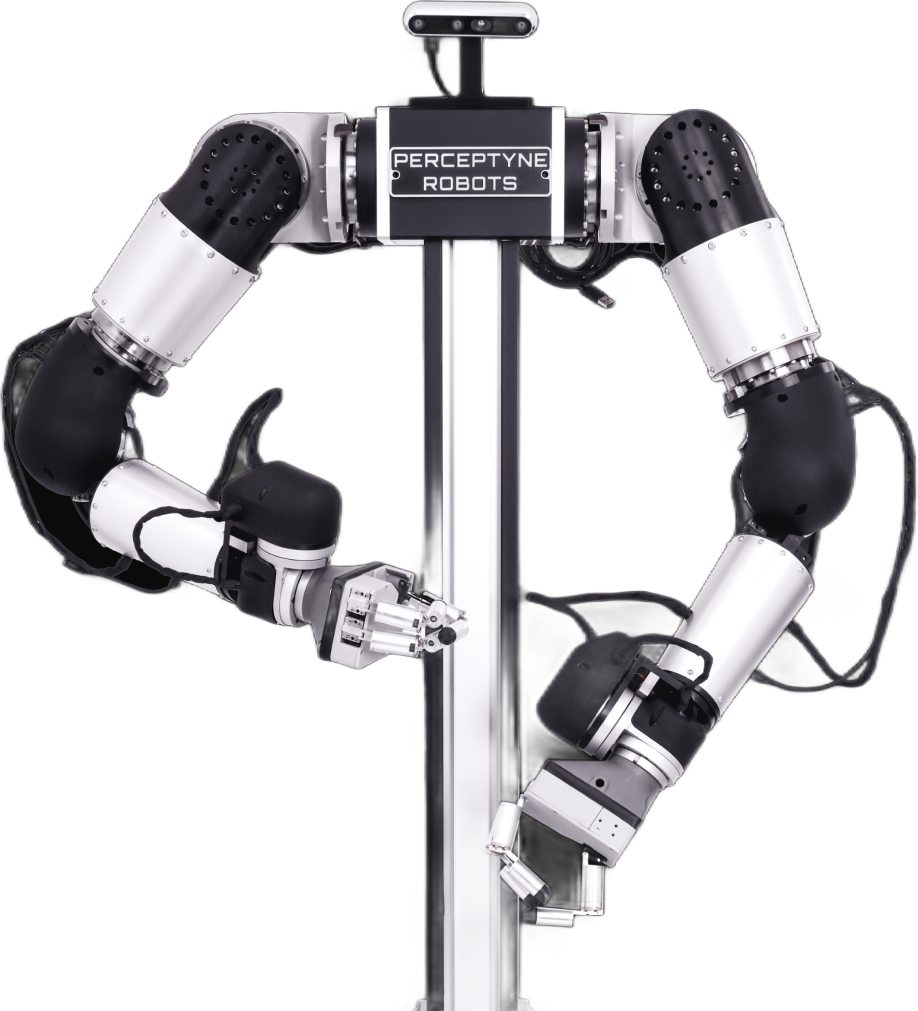
The Perceptyne PR-34D is a dual-arm, semi-humanoid robot developed by Perceptyne, a deep-tech robotics startup headquartered in Hyderabad, India. The name "PR-34D" reflects the robot's 34 total degrees of freedom, distributed across two 7-DOF arms and two 10-DOF three-fingered hands.[14][2] Designed for high-dexterity manufacturing tasks such as product assembly, quality inspection, and packaging, the PR-34D targets electronics and automotive production lines where traditional industrial robots lack the fine motor control needed to replace human hands.[14][2]
Perceptyne positions the PR-34D as a collaborative semi-humanoid that can be "dropped in" to existing factory workstations and trained on new tasks through teleoperation and imitation learning. The company says the robot can be installed at an existing assembly station and deployed in roughly 20 to 30 days, compared with the 6 to 12 months typical of conventional automation.[6][9] The PR-34D was named a finalist in the "Groundbreaking Technology" category at the 2025 Humanoid Robotics Industry Awards, standing alongside entries from NVIDIA and AgiBot, and Perceptyne went on to win the HYSEA Startup and Product Innovation Award in 2026.[5][10] The company has also been recognized in the Forbes India DGEMS Select 200.[1]
Background
Perceptyne
Perceptyne Technologies Private Limited was incorporated on 30 September 2021 (corporate identity number U72900TG2021PTC155496, Registrar of Companies, Hyderabad) by Raviteja Chivukula, Jagga Raju Nadimpalli, and Mrutyunjaya Nadiminti.[15][11] The three founders bring engineering and product backgrounds spanning aerospace, automotive, semiconductor, and electronics.[2][6] Raviteja Chivukula, CEO and Co-CTO, is an IIT Madras and BITS Pilani alumnus who previously led the avionics work at Skyroot Aerospace, India's first private space launch company.[2][19] Mrutyunjaya Nadiminti, an IIT Madras and BITS Pilani alumnus, holds the dual role of Chief Business Officer (CBO) and Co-CTO.[2][11] Jagga Raju Nadimpalli, the COO, graduated in Engineering Design from IIT Madras and studied finance at SPJIMR (with a stint at Cornell's Johnson School), and was previously Chief Technology Officer at Boson Motors after earlier roles at Ola, Ashok Leyland, and Caterpillar.[19]
The company was initially incubated at IIIT Hyderabad (International Institute of Information Technology, Hyderabad) and began active operations in 2022.[2] The seed of the idea dates back nearly a decade, to when Chivukula interned at a company that built vending machines. Observing the limitations of the pick-and-place mechanisms, he envisioned an intelligent robotic arm capable of picking and dispensing products with human-like dexterity. As Chivukula recalled: "This made me wonder if I could develop an intelligent minion with arms, fingers, and vision sitting in the vending machine to pick any product and dispense it."[2] That early concept evolved into the broader mission of building scalable, intelligent robotic manipulators for industrial assembly lines.
Perceptyne describes its core focus as developing a vertically integrated, full-stack AI robotics platform. The company designs its own hardware (motor controllers, gearboxes, actuators, drivers, and control firmware) as well as its own perception systems (encoders, tactile sensors, torque sensors) and the AI-driven intelligence layer that sits on top; Perceptyne says roughly 70 to 80 percent of the critical components in its robots are designed in-house.[3][2] According to the founders, this level of integration is necessary because dexterous robotics demands extremely tight coupling between actuators, sensors, controllers, and AI algorithms, and off-the-shelf components introduce latency that undermines the precision needed for fine closed-loop control.[3]
The company reported revenue of approximately INR 2.07 crore for the financial year ending 31 March 2024 and holds ISO 9001:2015 certification.[12][1]
Funding
Perceptyne has raised a total of approximately $4.31 million across three funding rounds from 22 investors, according to data aggregator Tracxn; the company has not disclosed a valuation.[12]
| Round | Date | Amount | Lead investor(s) | Notable participants |
|---|---|---|---|---|
| Initial (angel) | April 2023 | Undisclosed | Not disclosed | Z21 Ventures, T-Hub[12] |
| Pre-seed | 1 May 2024 | Undisclosed | Venture Catalysts | Tarun Mehta and Swapnil Jain (Ather Energy co-founders), Pawan Chandana and Bharat Daka (Skyroot Aerospace co-founders), T-Hub, Z21 Ventures, Aditya Damani (Credit Fair)[16][8] |
| Seed | 14 October 2024 | $3 million | Endiya Partners, Yali Capital | Whiteboard Capital, angel investors[4][7][11] |
The seed round, announced on 14 October 2024 and co-led by Endiya Partners and Yali Capital, was earmarked for accelerating product development, acquiring early customers, and scaling the team.[4][7] Endiya's Raghav Gupta described Perceptyne as building "a drop-in, generic automation solution that learns through AI-led tele-operation," while Yali Capital partner Karthik Madathil said the company had "unique multi-faceted technology to deliver robotic solutions precisely tuned to sunrise sectors of India's growing economy."[4][11] Notable angel investors in the earlier rounds included founders of prominent Indian deep-tech startups such as Ather Energy (electric vehicles) and Skyroot Aerospace (space launch vehicles), reflecting the overlap between India's emerging aerospace and robotics talent pools.[16][8]
Development history
After the three co-founders came together in 2022, Perceptyne focused its first year on developing core subsystems: custom actuators, tactile sensing arrays, force-torque sensors, and the initial version of its AI control stack. By 2023, the company had a working prototype of the PR-34D and its single-arm sibling, the PR-9D, and both robots were demonstrated to prospective industrial customers.[2][9]
The PR-34D's design philosophy was shaped by observations on real factory shop floors. The founders noted that many assembly stations still relied entirely on manual labor because conventional automation struggled with unstructured inputs, fine force control, and frequent product changeovers. Traditional point-to-point industrial robots from companies like ABB and Yaskawa Motoman excel at repetitive, high-volume tasks but cannot easily adapt when product lines change or when tasks require nuanced dexterity.[2]
By 2024, Perceptyne was in discussions with multinational corporations in the electronics and automotive manufacturing sectors for pilot deployments, and by 2025 it reported that four global companies had initiated paid pilots, with focus markets in Hyderabad, Chennai, and Bangalore.[2][17] The company has also reported its first purchase order, from a global manufacturer of automotive electronic components.[3] The founders have publicly identified 2026 as "the year of deployment," signaling their expectation that the industry will transition from pilot phases to larger-scale commercial rollouts.[9]
Design and technical specifications
Form factor
The PR-34D is classified as a "semi-humanoid" rather than a full humanoid. It features a human-like upper body with dual arms and dexterous hands but does not have bipedal legs.[14] Instead, the torso is mounted on a base that can be integrated into existing factory workstations, gantry systems, or mobile platforms depending on the deployment scenario. The company's newer PR-OMNI variant adds a holonomic drive base with vertical gantry capability for mobile applications.[1]
This design choice reflects Perceptyne's focus on manipulation rather than locomotion. Factory assembly tasks rarely require a robot to walk between stations; they require a robot to sit at a workstation and perform intricate, two-handed operations with high repeatability.
How many degrees of freedom does the PR-34D have?
The PR-34D's name derives from its 34 total degrees of freedom, broken down as follows:[14]
| Component | DOF per unit | Units | Total DOF |
|---|---|---|---|
| Arm (shoulder) | 3 | 2 | 6 |
| Arm (elbow) | 1 | 2 | 2 |
| Arm (wrist) | 3 | 2 | 6 |
| Hand (three-fingered gripper) | 10 | 2 | 20 |
| Total | 34 |
Each arm provides 7 DOF (3 at the shoulder, 1 at the elbow, and 3 at the wrist), giving it the full kinematic redundancy needed to reach objects from multiple orientations while avoiding obstacles.[14] The 10-DOF three-fingered hands are designed for fine manipulation tasks where traditional two-finger parallel grippers or vacuum suction cups fall short. Depending on the application, Perceptyne can also equip the arms with conventional two-finger or vacuum grippers.
Key specifications
| Category | Specification | Details |
|---|---|---|
| Total degrees of freedom | 34 | 7 per arm + 10 per hand |
| Arm DOF | 7 per arm | 3 shoulder + 1 elbow + 3 wrist |
| Hand DOF | 10 per hand | Three-fingered gripper |
| Payload capacity | 6 kg | Combined, across both arms |
| Sensing | Multimodal | Vision, force/torque, tactile |
| Force-torque sensors | All joints | Enables compliant, force-aware manipulation |
| Tactile feedback | High-resolution | Finger-level tactile arrays |
| Control loop frequency | Up to 1 kHz | For high-precision force control |
| Actuators | Electric servo motors | In-house designed motor controllers and gearboxes |
| Operating system | ROS/Linux | ROS-compatible interfaces |
| Connectivity | Ethernet, WiFi | Standard industrial interfaces |
| Simulation support | NVIDIA Isaac | Pre-deployment testing and training |
| Certification | ISO 9001:2015 | Quality management system |
The 6 kg combined payload, up-to-1 kHz control loop, and multimodal sensing are drawn from Perceptyne's product descriptions and trade-press coverage of the platform.[14][3][2]
Sensing and perception
The PR-34D employs a multimodal sensing architecture that combines three primary input channels:[3][14]
-
Computer vision: The robot uses camera-based perception to identify objects, estimate their pose, and guide grasping. Perceptyne's computer vision stack is built on NVIDIA foundational models, allowing the system to recognize and localize objects in cluttered, unstructured environments typical of factory settings.[2]
-
Force/torque sensing: Every joint in the PR-34D is equipped with force-torque sensors, enabling the robot to measure and respond to contact forces in real time. This is critical for tasks like snap-fit assembly, where the robot must detect the exact moment a component seats into place, or for quality inspection, where the robot must apply consistent pressure without damaging delicate parts.[3]
-
Tactile feedback: The three-fingered grippers incorporate high-resolution tactile sensor arrays that provide information about contact pressure distribution, slip detection, and surface texture. This allows the robot to handle fragile or irregularly shaped objects, adjusting its grip force dynamically to prevent dropping or crushing.[14]
These three sensing modalities feed into a unified perception pipeline that gives the robot what Perceptyne calls a comprehensive understanding of "the placement or pose of an object, obstacles in the environment, and the forces acting during manipulation."[14] The tight integration of sensing and control, with feedback loops running at up to 1 kHz, enables the kind of reactive, force-aware manipulation that distinguishes the PR-34D from conventional industrial robots.[3]
How is the PR-34D trained and controlled?
Perceptyne's software platform, referred to as PR-PhI (Physical Intelligence), orchestrates the robot's perception, decision-making, and motor control.[1][3] Key capabilities of the PR-PhI stack include:
- Visual servo control: The robot can track moving objects in real time using camera feedback, without relying on external markers or fixed-position assumptions. This allows it to handle parts on a moving conveyor or adapt when objects shift unexpectedly.[1]
- Slip-free grasping: Using combined tactile and force feedback, the control system ensures stable grasps even on slippery or irregularly shaped objects.[14]
- Force-based assembly: The robot can perform contact-rich assembly tasks (such as inserting connectors, pressing bearings, or snapping components into place) by modulating applied force rather than relying on position control alone.[3]
- Imitation learning and teleoperation: New tasks can be taught to the PR-34D through low-code teleoperation, where a human operator demonstrates the task while the robot records trajectories and sensor data. The AI system then generalizes from these demonstrations to handle variations in object position, orientation, and size.[2][6]
- Redundancy optimization: The PR-34D's AI layer exploits its kinematic redundancy (7 DOF per arm when only 6 are needed for arbitrary end-effector positioning) to select the most efficient movement path based on the specific task, workspace constraints, and real-time sensor feedback.
Perceptyne uses NVIDIA Isaac for simulation and pre-deployment testing, allowing the robot to train and validate behaviors in a digital twin of the target factory environment before being deployed on a physical production line.[1]
How fast can the PR-34D be deployed?
A key differentiator of Perceptyne's platform is its no-code and low-code programming interface. Traditional industrial robot programming requires skilled engineers to write motion scripts or use proprietary teach pendants, a process that typically takes weeks or months per task. Perceptyne's teleoperation-based approach allows the PR-34D to learn new tasks in days rather than months, and the company advertises roughly a 90% reduction in automation implementation time compared to conventional approaches, marketing a drop in setup time "from 6 months to 10 days" with zero production downtime.[1][6]
According to the company and its investors, a PR-34D can be installed at an existing assembly station without modifying the surrounding line and deployed in about 20 to 30 days, versus the 6 to 12 months typical of conventional automation. Perceptyne says customers see up to a 40% cost reduction and a 20 to 30% productivity improvement in electronics manufacturing services and automotive applications.[6][9] This rapid deployment capability is particularly valuable in high-mix, medium-volume manufacturing environments where product lines change frequently and traditional hard-coded automation cannot justify its setup cost.
How is the PR-34D priced and sold?
Perceptyne does not publicly disclose PR-34D pricing; it directs prospective buyers to request a quote. Coverage in 2026 reported that the company sells its robots through two commercial routes: customers can buy systems outright as a capital expenditure, or take them under an operating-expenditure model in which the robots are deployed as a service, a form of robotics-as-a-service priced on usage or performance.[18] The dual model is intended to lower the barrier to adoption for manufacturers that prefer to treat automation as an operating cost tied to output rather than a large upfront purchase. Perceptyne has confirmed that it received its first purchase order from a global manufacturer of automotive electronic components, indicating that the outright-purchase route is already in commercial use.[3]
How does the PR-34D compare to the PR-9D?
The PR-34D is the dual-arm flagship of Perceptyne's product line. Its single-arm counterpart, the PR-9D, shares the same AI stack and sensing capabilities but offers a more compact and cost-effective solution for tasks that do not require bimanual coordination.[14][2]
| Feature | PR-34D | PR-9D |
|---|---|---|
| Arms | 2 (dual-arm) | 1 (single-arm) |
| Total DOF | 34 | 9 |
| Arm DOF | 7 per arm | 7 |
| Hand DOF | 10 per hand | 2 (gripper) |
| Payload | 6 kg | 3 kg |
| Best suited for | Complex two-handed assembly, bimanual tasks | Single-handed pick-and-place, inspection |
| AI/Software | PR-PhI full stack | PR-PhI full stack |
| Sensing | Vision + force/torque + tactile | Vision + force/torque + tactile |
Both robots share the same underlying AI platform, modular architecture, and teleoperation training workflow.[2] The choice between them depends on whether the target task requires two-handed coordination (favoring the PR-34D) or can be accomplished with a single arm (favoring the PR-9D's lower cost and smaller footprint). The PR-9D's name reflects its 9 total degrees of freedom (a 7-DOF arm plus a 2-DOF gripper), and it carries a 3 kg payload.[14]
Perceptyne product evolution
As of 2026, Perceptyne has expanded its product lineup beyond the original PR-34D and PR-9D:[1][12][13]
| Product | Description |
|---|---|
| PR-34D | Dual-arm semi-humanoid, 34 DOF, flagship manipulation platform |
| PR-9D | Single-arm robot, 9 DOF, compact dexterity solution |
| PR-OMNI | Next-generation semi-humanoid with dual 7-DOF arms, holonomic mobile base, vertical gantry, 10 kg combined payload |
| PR-DUO | Dual-armed robotic system |
| PR-UNO | Single articulated robotic arm |
| PR-PhI | Physical Intelligence software platform (modular skill modules, visual servo, multimodal perception, teleoperation) |
| PR-SYNC | Upcoming product (details not yet disclosed) |
The PR-OMNI represents an evolution of the PR-34D concept, adding mobility through a holonomic drive system and increasing the combined payload to around 10 kg.[1] This enables the robot to move between workstations rather than being fixed at a single position, broadening its potential applications in larger factory environments.
What is the Perceptyne PR-34D used for?
Electronics manufacturing
The PR-34D's primary target market is electronics assembly, where products are small, fragile, and frequently redesigned. Tasks include assembling mobile phone components, inserting connectors, soldering-related handling, and performing visual quality inspections.[2][3] The robot's three-fingered grippers and tactile sensing allow it to handle tiny components that would defeat conventional two-finger grippers.
Automotive manufacturing
In the automotive sector, the PR-34D targets sub-assembly tasks that require precision rather than brute force: assembling headlight modules, brake components, and interior electronics.[2] These are tasks that sit in a gap between what human hands do well (adapting to variation) and what traditional robots do well (high-speed repetition).
Other sectors
Perceptyne has identified several additional application domains for future expansion:[1][3]
- E-commerce warehousing: Sorting, picking, and packing operations requiring object recognition and gentle handling
- Food processing: Packaging tasks requiring hygienic, dexterous manipulation
- Data center hardware: Assembly of server components and cable management
- Laboratory automation: Handling of samples, reagents, and delicate equipment
- Recycling and material sorting: Identifying and separating materials using vision and tactile feedback
The company's near-term strategy focuses on establishing 4 to 5 successful deployments with Indian manufacturers before expanding into the US market, with European markets also identified as a target.[2][9]
Competition and market context
India's robotics ecosystem
The PR-34D enters a market at an inflection point. India's industrial robotics sector is valued at approximately $600 to $700 million and is expanding quickly, driven by the growth of electronics manufacturing, automotive production, electric vehicle assembly, and e-commerce warehousing; investors cite adoption growth rates above 20% CAGR in some segments.[6] The Indian government's Production-Linked Incentive (PLI) schemes and "Make in India" initiative have created favorable conditions for domestic robotics companies to scale.[6]
However, India's robot density (the number of industrial robots per 10,000 manufacturing employees) remains far below that of leading manufacturing nations like South Korea, Japan, Germany, and China. This gap represents both a challenge and an opportunity: while existing adoption is low, rising labor costs and growing demand for precision manufacturing are creating new incentives for automation.[6]
Other Indian robotics startups working in related spaces include:
- Muks Robotics: Pune-based builder of the SpaceO industrial humanoid, focused on heavy-payload tasks
- Addverb Technologies: Backed by Reliance Industries, developing warehouse automation and humanoid robots
- Genrobotics: Kerala-based company building robots for hazardous environments
- Invento Robotics: Creator of Mitra, a social humanoid robot
How does the PR-34D differ from traditional cobots?
Internationally, the PR-34D competes in the broader category of dexterous manipulation platforms rather than full-body humanoid robots such as Tesla Optimus or Figure AI systems. Its closest competitors include:
| Company | Product | Country | Key differentiator |
|---|---|---|---|
| Perceptyne | PR-34D | India | Dual 7-DOF arms with 10-DOF tactile hands, full-stack AI, rapid deployment |
| ABB | YuMi (IRB 14000) | Switzerland | Established dual-arm cobot with large install base |
| Universal Robots | UR series | Denmark | Industry-leading single-arm cobots, large ecosystem |
| Rethink Robotics | Baxter/Sawyer | USA | Pioneered adaptive manufacturing cobots (company defunct, IP acquired) |
| Agility Robotics | Digit | USA | Full humanoid with locomotion and manipulation |
Perceptyne differentiates itself from traditional cobots like ABB's YuMi and Universal Robots' UR series by offering higher degrees of freedom in its hands (10 DOF versus simple parallel grippers), multimodal tactile sensing, and an AI-driven training approach.[2] As CEO Raviteja Chivukula has framed it, Perceptyne positions itself between "superhumanoid robots and extremely unintelligent robots," aiming to deliver practical dexterity at a price point accessible to Indian and global manufacturers.[2] Chivukula has also argued that "India is uniquely positioned to become a global hub for dexterous humanoid robotics."[3]
Market size
The global industrial robotics market was valued at approximately $17 billion in 2024 and is projected to exceed $29 billion by 2029 and reach $41 billion by 2030, growing at roughly 12% CAGR.[2][6] By some industry projections, the humanoid robotics segment specifically could reach around $30 billion by 2035. India's potential share of this market is estimated at 5 to 10% as the country's manufacturing sector scales.[6]
What awards has Perceptyne won for the PR-34D?
Perceptyne and the PR-34D have received several notable accolades:
| Award | Year | Details |
|---|---|---|
| Humanoid Robotics Industry Awards (Finalist) | 2025 | "Groundbreaking Technology" category; alongside NVIDIA, AgiBot, and other global leaders[5] |
| Forbes India DGEMS Select 200 | 2025 | Recognized among 200 companies with global business potential[1] |
| HYSEA Startup and Product Innovation Awards | 2026 | Selected from over 300 applications, evaluated by 70+ industry jury members across three rounds; live demo at HICC, Hyderabad[10] |
Co-founder Jagga Raju Nadimpalli said of the Humanoid Robotics Industry Awards nomination: "It's an incredible honor for Perceptyne to be recognized on a global stage alongside pioneers like NVIDIA and AgiBot."[5] On the 2026 HYSEA award, Nadimpalli said the recognition was "a proud moment for our team and a strong validation" of the company's work in intelligent robotics platforms for manufacturing automation.[10]
What are the PR-34D's limitations?
The PR-34D, while innovative, has several constraints that are important to note:
- Payload: With a 6 kg combined payload across both arms, the PR-34D is not suitable for heavy-lifting tasks. It is designed for precision and dexterity, not for moving large or heavy objects.[14]
- No locomotion: As a semi-humanoid without legs, the PR-34D cannot walk between workstations. It must be mounted at a fixed position or on an external mobile base (such as the PR-OMNI's holonomic drive).[1]
- Early-stage deployment: As of early 2026, the PR-34D is transitioning from paid pilots with select multinational customers toward broader commercial rollout, which the founders describe as 2026's "year of deployment."[9]
- Limited public benchmarks: Perceptyne has not published detailed independent benchmarks for manipulation speed, accuracy, or cycle time comparisons against established cobots, making direct performance comparisons difficult.
See also
- Humanoid robots
- Humanoid robot
- Perceptyne
- Industrial robot
- Collaborative robot
- Robotics-as-a-service
- Humanoid robot deployments
- Teleoperation
- Imitation learning
- Computer vision
- NVIDIA Isaac
- Tesla Optimus
- Figure AI
- Make in India
References
- ^1 ^2 ^3 ^4 ^5 ^6 ^7 ^8 ^9 ^10 ^11 ^12Perceptyne official website.
- ^1 ^2 ^3 ^4 ^5 ^6 ^7 ^8 ^9 ^10 ^11 ^12 ^13 ^14 ^15 ^16 ^17 ^18 ^19 ^20 ^21 ^22"Can Perceptyne's Robot Army Become The New Growth Engine For 'Make In India'?" Inc42.
- ^1 ^2 ^3 ^4 ^5 ^6 ^7 ^8 ^9 ^10 ^11 ^12 ^13"Engineering physical intelligence: How Perceptyne is redefining industrial automation from India." BizzBuzz News.
- ^1 ^2 ^3"AI focused robotic startup Perceptyne secures $3 million in seed funding." Business Standard, October 2024.
- ^1 ^2 ^3"Perceptyne Named Finalist at Global Humanoid Robotics Awards, Showcasing India's Deep-Tech Strength." Business Standard, October 2025.
- ^1 ^2 ^3 ^4 ^5 ^6 ^7 ^8 ^9 ^10"Why We Invested in Perceptyne: Powering India's Manufacturing Leap with AI-First Robotics." Endiya Partners.
- ^1 ^2"Deeptech robotics startup Perceptyne raises $3 Mn in seed round." Entrackr, October 2024.
- ^1 ^2"Perceptyne Secures Pre-Seed Funding Round Led by Venture Catalysts." SMEStreet.
- ^1 ^2 ^3 ^4 ^5 ^6"Indian startup Perceptyne's founders on why 2026 could be the year of deployment of robots." India Tech Report, January 2026.
- ^1 ^2 ^3"Industrial robotics gains attention as Perceptyne Robots earns HYSEA innovation recognition." Prittle Prattle News, 2026.
- ^1 ^2 ^3 ^4"Robotics Startup Perceptyne Bags $3 Mn From Endiya Partners, Yali Capital & Others." Inc42, October 2024.
- ^1 ^2 ^3 ^4Perceptyne company profile. Tracxn.
- ^Perceptyne company profile. CB Insights.
- ^1 ^2 ^3 ^4 ^5 ^6 ^7 ^8 ^9 ^10 ^11 ^12 ^13"The World As Perceived By Perceptyne's PR-34D." Electronics For You.
- ^"Perceptyne Technologies Private Limited" (CIN U72900TG2021PTC155496). ZaubaCorp.
- ^1 ^2"Venture Catalysts Leads Pre-Seed Funding Round for Perceptyne." Outlook Business, 1 May 2024.
- ^"From Vision to Intelligent Machines: Raviteja Chivukula on Reimagining Robotics with Perceptyne." StartupTalky.
- ^"Perceptyne: AI robots for factory automation." YourStory, April 2026.
- ^1 ^2"Jagga Raju Nadimpalli profile." Perceptyne corporate website.
Improve this article
Add missing citations, update stale details, or suggest a clearer explanation. Every suggestion is reviewed for sourcing before it goes live.
6 revisions · v7 · 3,986 words · full history
Fact-checks are independent of edits: a reviewer re-verifies the article against its sources and stamps the date. How we verify
Research and drafting on this wiki are AI-assisted, under named human editorial standards. How AI is used here
Cite this page: AI Wiki. "Perceptyne PR-34D." aiwiki.ai, updated 7 Jul 2026. CC BY 4.0. https://aiwiki.ai/wiki/perceptyne_pr_34d