

UBTECH Cruzr S2
| UBTECH Cruzr S2 | |
|---|---|
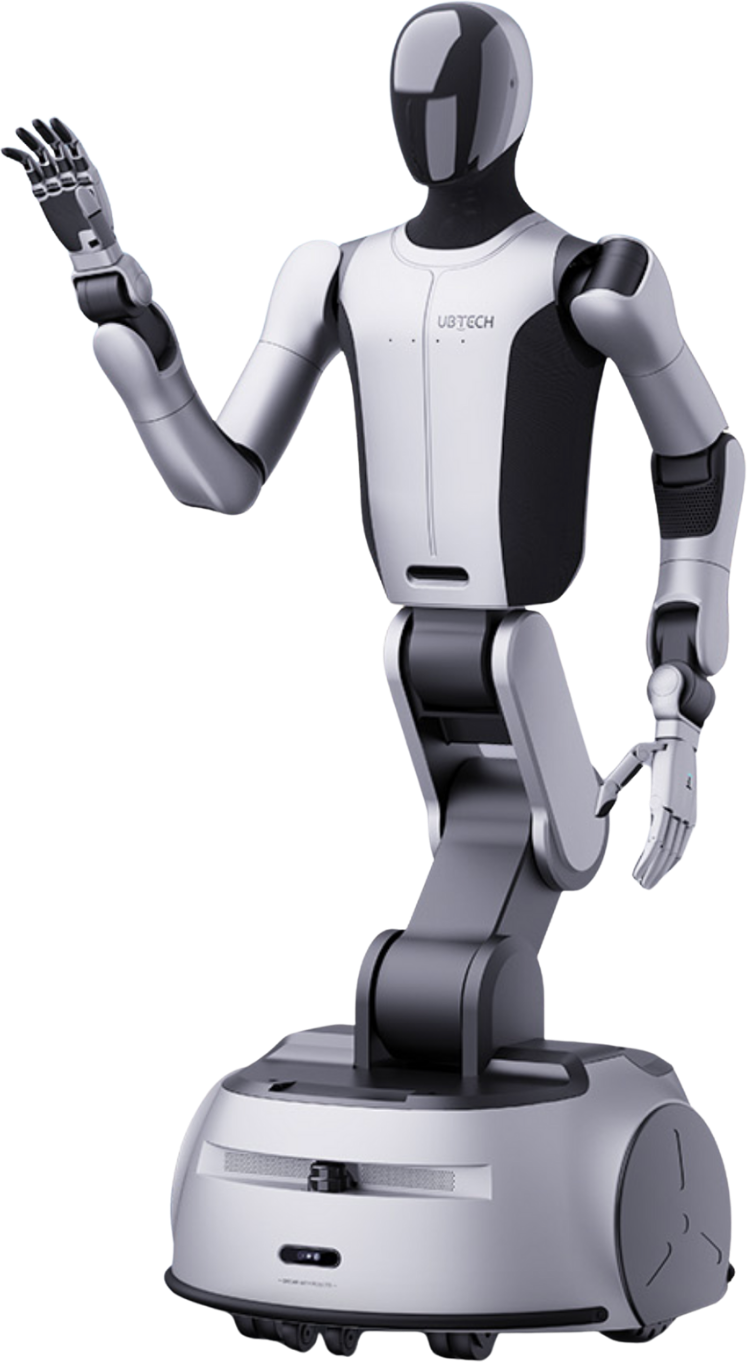 | |
| General information | |
| Manufacturer | UBTECH Robotics |
| Type | Wheeled humanoid service robot |
| Country of origin | China |
| Introduced | August 2025 (World Robot Conference) |
| Status | In production |
| Height | 176 cm |
| Weight | 50 - 80 kg (estimated) |
| Degrees of freedom | 44 |
| Top speed | 2 m/s |
| Payload | 15 kg per arm |
| Website | ubtrobot.com |
The UBTECH Cruzr S2 is a full-size wheeled humanoid robot developed by UBTECH Robotics, a Shenzhen-based robotics company listed on the Hong Kong Stock Exchange. The Cruzr S2 is designed for commercial and light industrial applications, combining the mobility of a wheeled platform with the dexterity of a humanoid upper body. It was unveiled alongside the bipedal Walker S2 at the 2025 World Robot Conference in Beijing.[1]
With 44 degrees of freedom, generation-4 dexterous hands capable of sub-millimeter manipulation, and an integrated large language model for conversational interaction, the Cruzr S2 represents a significant advancement over UBTECH's original Cruzr service robot. Where the original Cruzr (launched in 2017) was a compact, touchscreen-equipped concierge robot, the Cruzr S2 is a taller, more capable platform suitable for tasks ranging from reception and guided tours to sorting, assembly assistance, and material transport.[2]
Background
UBTECH Robotics
UBTECH Robotics was founded in 2012 by Zhou Jian in Shenzhen, Guangdong, China. The company initially gained recognition for its consumer and educational robots, including the Alpha series of small humanoids and the Jimu Robot construction kits. A pivotal early innovation was UBTECH's development of proprietary digital servo systems, which dramatically reduced the cost of humanoid joint actuators compared to Japanese and European imports that previously cost $2,000 to $4,000 per unit.[3]
UBTECH completed a Series C funding round led by Tencent and ICBC that valued the company at $5 billion. In December 2023, UBTECH went public on the Hong Kong Stock Exchange (SEHK: 9880), raising approximately HK$1 billion. By mid-2025, the company reported revenue of roughly $87 million for the first half of the year, reflecting 28% year-over-year growth. UBTECH employs around 2,000 people and operates its European division from the Netherlands.[4][5]
The company's product portfolio spans three main categories: educational robots (Alpha Mini, uKit, Jimu), commercial service robots (Cruzr line, ADIBOT UV-C disinfection robots), and industrial humanoid robots (the Walker series). The Cruzr S2 sits within the commercial and service division, bridging customer-facing roles and light industrial applications.
The original Cruzr
UBTECH introduced the original Cruzr at CES 2017 in Las Vegas as a "cloud-based intelligent humanoid service robot." It became commercially available in mid-2017.[6] Standing 120 cm (approximately 4 feet) tall and weighing about 45 kg, the original Cruzr was a compact, wheeled robot with a large 11.6-inch touchscreen face, articulated arms for gesturing, and a cloud-connected AI system for speech recognition and natural language processing.
Key capabilities of the original Cruzr included:
- U-SLAM navigation: UBTECH's proprietary simultaneous localization and mapping system enabled centimeter-level indoor positioning using LiDAR, sonar, infrared sensors, and a 9-axis inertial measurement unit.
- Facial recognition: 98% accuracy rate with the ability to detect emotion, gender, age, and ethnicity through compatible third-party integrations.[7]
- Voice interaction: A 6+0 microphone array paired with cloud-based conversational AI for multilingual customer service.
- Autonomous recharging: The robot could return to its charging dock automatically using conductive wheeling technology.
- 8-hour battery life: A single charge provided up to 480 minutes of active use and 24 hours of standby.[7]
Priced at approximately $8,000 to $10,000 (with a Robot-as-a-Service option available at around $1,000 per month), the original Cruzr was substantially less expensive than competitors like SoftBank's Pepper, which carried a total cost of ownership near $20,000 including mandatory subscription fees. By 2019, UBTECH reported selling more than 2,100 Cruzr units worldwide.[3] The robot found deployments across retail, hospitality, healthcare, airports, and government facilities.
An upgraded variant, the Cruzr 1S, was later released with improvements including an enhanced depth visual system for better navigation, IoT device integration for controlling smart building systems (lights, curtains, air conditioning, displays), and a built-in multilingual large model for more natural conversational interactions.[8]
Design and specifications
The Cruzr S2 departs substantially from the original Cruzr's compact form factor. Standing 176 cm tall (roughly human height), it features a symmetrical humanoid upper body mounted on a wheeled mobile base. The construction uses a 3D-printed aerospace-grade aluminum skeleton combined with high-end fiber and composite materials, providing both structural rigidity and a weight that allows safe operation around people.[9]
Technical specifications
| Category | Specification | Details |
|---|---|---|
| Physical | Height | 176 cm |
| Physical | Dimensions | 176 x 55 x 38 cm (H x W x D) |
| Physical | Weight | 50 - 80 kg (estimated) |
| Physical | Construction | 3D-printed aerospace-grade aluminum skeleton, fiber and composite materials |
| Mobility | Locomotion type | Wheeled (omnidirectional) |
| Mobility | Maximum speed | 2 m/s |
| Mobility | Rotation | Plus/minus 170 degrees within 0.8 m passages |
| Mobility | Self-balancing | Learning-based motion control for complex terrain |
| Articulation | Total degrees of freedom | 44 |
| Articulation | Hand DOF | 11 per hand |
| Articulation | Fingers per hand | 5 |
| Articulation | Body design | Symmetrical with bidirectional bending |
| Manipulation | Payload per arm | 15 kg |
| Manipulation | Lifting range | 0 - 40 cm |
| Manipulation | Workspace | 0 - 1.8 m |
| Manipulation | Hands | Generation-4 industrial dexterous hands |
| Manipulation | Precision | Sub-millimeter |
| Vision | Primary system | Pure RGB binocular stereo vision |
| Vision | Algorithm | Deep learning-based stereo depth estimation |
| Vision | Output | High-precision, left-aligned dense depth maps (real-time) |
| Sensors | Additional sensors | LiDAR, depth cameras, sonar, IR sensors, 9-axis IMU, force/torque sensors, joint encoders |
| Interaction | Display | 4-inch circular screen |
| Interaction | Audio | Microphone array and speaker |
| Interaction | AI | Large Language Model (LLM) integration for voice dialogue |
| Navigation | System | Visual-laser fusion navigation |
| Software | Agent platform | Co-Agent (industrial agent for humanoid robots) |
| Software | Multi-robot | Brain Network 2.0 for fleet coordination |
| Software | OS | Linux-based with ROS 2 support |
| Software | Development | Python SDK, open API |
| Connectivity | Wireless | Wi-Fi 5/6, Bluetooth 5.0 |
| Connectivity | Wired | Ethernet |
| Power | Battery type | LiPo (48V) |
| Power | Runtime | 3 - 5 hours active use (estimated) |
| Power | Charging time | 2 - 4 hours (estimated) |
Mobility and dynamic balancing
Unlike bipedal humanoids such as UBTECH's own Walker series, the Cruzr S2 uses a wheeled base for locomotion. This design choice prioritizes stability and speed in indoor environments. The robot can travel at a steady 2 m/s and navigate narrow corridors, rotating up to 170 degrees within passages as tight as 0.8 meters wide. UBTECH describes the mobility system as "human-like dynamic balancing," with learning-based motion control technology enabling self-balanced movement across uneven or complex terrain.[2]
The symmetrical body design with bidirectional bending allows the Cruzr S2 to reach and manipulate objects both in front of and behind its body axis, a capability that increases its effective workspace in constrained environments.
Manipulation and dexterous hands
One of the most significant upgrades over the original Cruzr is the Cruzr S2's manipulation capability. The robot's arms can handle loads of up to 15 kg each, and its generation-4 industrial dexterous hands (with 11 degrees of freedom per hand and five fingers) achieve sub-millimeter precision in tasks such as sorting, component assembly, and multi-scenario grasping operations.[2][10]
The manipulation system is powered by a sim-to-real embodied AI data system. This approach trains manipulation policies in simulation environments and then transfers them to the physical robot, enabling the Cruzr S2 to adapt to varied objects and scenarios without extensive manual programming for each new task.
Vision and perception
The Cruzr S2's head houses a pure RGB binocular stereo vision system developed in-house by UBTECH. This passive binocular vision approach uses deep learning-based stereo depth estimation algorithms to generate high-precision, left-aligned dense depth maps in real-time. UBTECH describes this as providing "human-eye" stereoscopic perception, allowing the robot to understand the three-dimensional structure of its environment without relying solely on active depth sensors like structured-light cameras.[2]
The robot's broader sensor suite includes LiDAR for long-range mapping, depth cameras, sonar and infrared sensors for proximity detection, force/torque sensors in the limbs, joint encoders for precise motor control, and a 9-axis inertial measurement unit for orientation tracking. Together, these sensors support the visual-laser fusion navigation system that combines camera-based perception with laser-based mapping for robust autonomous movement.[10]
Interaction and AI
The Cruzr S2 supports conversational interaction through integrated large language model capabilities. A 4-inch circular display screen on the robot's head, combined with a microphone array and speaker, enables natural human-machine dialogue. The robot can greet visitors, answer questions, provide directions, and carry on extended conversations in multiple languages.[2]
UBTECH's open API and SDK allow developers and enterprise customers to customize the robot's body movements, facial expressions, voice interactions, and facial recognition capabilities for specific deployment scenarios.
Software platform
Co-Agent
The Cruzr S2 runs UBTECH's self-developed Co-Agent, which the company describes as "the world's first industrial agent for humanoid robot." Co-Agent serves as the robot's high-level task planning and execution layer, enabling autonomous decision-making for multi-step tasks across industrial and service scenarios. It builds on concepts from agentic AI, where the robot can decompose complex objectives into sequences of actions and adapt its behavior based on environmental feedback.[2]
Brain Network 2.0
For multi-robot deployments, UBTECH offers Brain Network 2.0, a fleet coordination platform. Through this system, multiple Cruzr S2 units can collaborate with each other and with UBTECH's other robot platforms (including Walker S2 bipedal humanoids and mobile logistics robots) for integrated workflows in manufacturing and logistics environments. Brain Network 2.0 handles task allocation, path coordination, and real-time status monitoring across the fleet.[11]
Applications
The Cruzr S2 is designed for deployment across a range of commercial, public-sector, and light industrial environments. UBTECH positions it as a multitasking platform for diverse scenarios including sorting and handling, production and assembly, medical transport, reception, and guidance.[1]
Hospitality and tourism
In hotels and resorts, the Cruzr S2 can serve as a robotic concierge, greeting guests, handling check-in procedures, providing tourist information, answering questions, and fulfilling personal requests. Its humanoid appearance and conversational AI create a more engaging guest experience than screen-based kiosks. The original Cruzr was already deployed in hospitality settings for these tasks; the S2's added manipulation capability allows it to physically hand items to guests, carry luggage tags, or deliver small objects.
Retail
In retail environments, the robot functions as an intelligent shopping assistant. It can guide customers to specific products, provide product information, facilitate promotional interactions, and assist with wayfinding in large stores. UBTECH's earlier Cruzr models were deployed at EasyHome (China's largest home-improvement retail chain), BYD overseas stores, Denza vehicle showrooms, and Alibaba Koubei smart restaurants.[12]
Healthcare
During the COVID-19 pandemic, UBTECH deployed its Cruzr robots alongside AIMBOT and ATRIS units at a specialized hospital in Shenzhen treating COVID-19 patients. In that deployment, Cruzr provided videoconferencing services between patients and doctors (reducing direct contact), while companion robots handled temperature monitoring and UV disinfection.[13] The Cruzr S2's enhanced manipulation capabilities extend its healthcare potential to tasks like delivering medical supplies between departments and assisting with patient intake processes.
Airports
Airport deployments represent one of the original Cruzr's most visible use cases. The robot has been deployed at Paris Charles de Gaulle Airport, where it operates with an eight-language system to provide flight information, terminal directions, and security reminders to international travelers. Additional airport deployments include Shenzhen Bao'an International Airport, Guangzhou Baiyun International Airport, Chengdu Tianfu International Airport, and Kunming Changshui International Airport.[14] The Cruzr S2's improved navigation and manipulation would allow it to take on more complex airport tasks beyond pure information kiosks.
Banking and government services
In financial institutions and government service halls, the Cruzr series robots handle visitor reception, queue management, form guidance, and basic transaction assistance. These environments benefit from the robot's ability to operate consistently during extended service hours without fatigue, and its multilingual capabilities serve diverse populations.
Light industrial and logistics
The Cruzr S2's manipulation capabilities open up applications that were not feasible for the original Cruzr. The robot can perform sorting operations, assist with component assembly tasks, handle material transport within facilities, and participate in quality inspection workflows. Through Brain Network 2.0, multiple Cruzr S2 units can coordinate with Walker S2 bipedal humanoids in factory environments, with the wheeled Cruzr units handling tasks on flat floors while Walker units address areas requiring stair climbing or uneven terrain navigation.[11]
Cruzr S2 vs. Walker S2
UBTECH unveiled both the Cruzr S2 and the Walker S2 at the 2025 World Robot Conference, and the two robots serve complementary roles in the company's product strategy.
| Feature | Cruzr S2 | Walker S2 |
|---|---|---|
| Locomotion | Wheeled | Bipedal |
| Height | 176 cm | 176 cm |
| DOF | 44 | 44+ |
| Speed | 2 m/s | Up to 2 m/s |
| Payload | 15 kg per arm | 15 kg |
| Primary environment | Indoor flat surfaces (retail, offices, hospitals) | Factories, uneven terrain, multi-level facilities |
| Battery management | Standard charging dock | Autonomous battery swapping (3-minute swap) |
| Key applications | Reception, guidance, retail, light assembly | Quality inspection, automotive assembly, material handling |
| Target sector | Commercial services, public-facing roles | Heavy industry, automotive manufacturing |
The Walker S2 is a fully bipedal robot with autonomous battery-swapping capability (completing a swap in approximately three minutes), which allows near-continuous operation across factory shifts. It has been deployed at automotive manufacturers including BYD, Geely Auto, FAW-Volkswagen, Audi FAW, and at Foxconn for electronics assembly tasks.[15] The Cruzr S2, by contrast, trades bipedal agility for the speed, stability, and lower cost of a wheeled platform, making it better suited for flat-floor commercial environments where stair-climbing is unnecessary.
Together, the two platforms can operate in coordinated fleets through Brain Network 2.0, with task allocation based on each robot's strengths.
Competitive landscape
The commercial service robot market features several established competitors, each with different approaches to customer-facing automation.
| Robot | Manufacturer | Type | Approximate price | Key differentiator |
|---|---|---|---|---|
| Cruzr S2 | UBTECH Robotics | Wheeled humanoid | ~$80,000 (estimated) | Dexterous manipulation + humanoid interaction |
| Cruzr 1S | UBTECH Robotics | Wheeled humanoid | ~$10,000 | Affordable touchscreen concierge |
| Pepper | SoftBank Robotics | Wheeled humanoid | ~$20,000 (with subscription) | Emotion recognition, first major service humanoid |
| BellaBot | Pudu Robotics | Wheeled delivery | ~$15,000 | Restaurant delivery specialist |
| DINERBOT T8 | Keenon Robotics | Wheeled delivery | ~$12,000 | Food service, 22.7% global market share (2024) |
| Temi | Temi | Wheeled telepresence | ~$2,000 | Low-cost telepresence platform |
The broader commercial service robot market has been growing rapidly. Keenon Robotics held the largest global market share in commercial service robots in 2024 at 22.7% of shipments, driven primarily by food delivery robots. SoftBank Robotics, which created the pioneering Pepper humanoid in 2014, partnered with Keenon in 2021 to expand service robot offerings in Japan.[16]
UBTECH's competitive advantage with the Cruzr S2 lies in its combination of humanoid form factor (which creates a more engaging customer interaction than box-shaped delivery robots) with genuine manipulation capability. Most competing service robots lack dexterous hands entirely, limiting them to navigation-only tasks like delivery and wayfinding. The Cruzr S2's 44 degrees of freedom and sub-millimeter manipulation precision position it in a category between simple service robots and full industrial humanoids.
However, the Chinese service robot market remains intensely competitive and often operates on thin margins. Industry observers note that Chinese producers have exported their domestic price competition as they expand internationally, putting pressure on profitability across the sector.[16]
Pricing and availability
Pricing for the Cruzr S2 has not been officially published by UBTECH. Third-party sources have estimated the price at approximately $80,000, which represents a substantial premium over the original Cruzr's $8,000 to $10,000 price point.[10] This higher price reflects the Cruzr S2's significantly more advanced capabilities, including its 44-DOF articulation, dexterous hands, binocular vision system, and LLM integration.
The original Cruzr and Cruzr 1S remain available through UBTECH's reseller network. RobotLAB, a U.S.-based robotics distributor, offers the Cruzr 1S at approximately $35,000 for outright purchase, with a Robot-as-a-Service leasing option at $1,000 per month that includes hardware, installation, training, software updates, and 24/7 support.[7]
The Cruzr S2 is available in the United States, Canada, the European Union, Japan, Singapore, and South Korea, with a typical delivery time of approximately three weeks.[10] UBTECH also sells through regional distributors and integrators who provide site assessment, installation, and ongoing support services.
See also
- UBTECH Robotics
- Walker S2
- Humanoid robot
- Service robot
- Embodied AI
- SoftBank Robotics
- Simultaneous localization and mapping
References
- ^1 ^2"UBTECH Unveils Five Humanoid Robots at World Robot Conference, Secures Record Commercial Contract." TMTPOST, August 2025. en.tmtpost.com/...7654785
- ^1 ^2 ^3 ^4 ^5 ^6"Ubtech Cruzr S2 Full-sized Wheeled Humanoid Robot." UBTECH Robotics official product page. ubtrobot.com/...cruzr-s2
- ^1 ^2Kalil, Mike. "UBTECH Takes Huge Lead in Humanoid Robotics Race." MikeKalil.com, 2025. mikekalil.com/...the-rise-of-ubtech-robotics
- ^"Tencent-Backed Robot-Maker UBTech Robotics IPO in Hong Kong with $4.8 Billion Market Value on 29th December 2023." Caproasia, January 2024. caproasia.com/...mes-zhou-jian-becomes-billionaire
- ^"UBtech Robotics." Wikipedia. en.wikipedia.org/...UBtech_Robotics
- ^"UBTECH Introduces Cruzr: a Cloud-Based Intelligent Humanoid Service Robot." Business Wire, January 5, 2017. businesswire.com/...lligent-Humanoid-Service-Robot
- ^1 ^2 ^3"Ubtech Cruzr Robot." RobotLAB. robotlab.com/cruzr
- ^"Cruzr 1S." UBTECH Robotics official product page. ubtrobot.com/...cruzr-1s
- ^tphuang (@tphuang). "Ubtech unveils Cruzr S2, new full sized GP humanoid robot w/ wheeled bottom @ 185 kg & 44 DOFs." X (Twitter), July 2025. x.com/...1954133175325851783
- ^1 ^2 ^3 ^4"Cruzr S2 by UBTECH Robotics: Price, Details, Review 2025." OriginOfBots. originofbots.com/...-details-specifications-rating
- ^1 ^2"UBTECH Cruzr S2." RBTX Marketplace, igus. rbtx.com/...ubtech-humanoid-cruzr-s2
- ^"UBTECH Commercial Robots Guide." Robots International. robotsinternational.com/UBtech-Commercial-Robots
- ^"Video Friday: Robots Help Keep Medical Staff Safe at COVID-19 Hospital." IEEE Spectrum, March 2020. spectrum.ieee.org/...ts-covid-19-shenzhen-hospital
- ^"UBTECH CRUZR Serves at Paris Charles de Gaulle Airport to Enhance Global Travelers' Stress-Free Journeys." UBTECH Commercial. commercial.ubtrobot.com/...rs-stress-free-journeys
- ^"UBTECH Humanoid Robot Walker S2 Begins Mass Production and Delivery, with Orders Exceeding 800 Million Yuan." PR Newswire, November 2025. prnewswire.com/...eding-800-million-yuan-302616924
- ^1 ^2"China is Churning Out a Growing Army of Service Robots." The Wire China, February 2026. thewirechina.com/...growing-army-of-service-robots
Improve this article
Add missing citations, update stale details, or suggest a clearer explanation. Every suggestion is reviewed for sourcing before it goes live.
6 revisions · v7 · 3,172 words · full history
Fact-checks are independent of edits: a reviewer re-verifies the article against its sources and stamps the date. How we verify
Research and drafting on this wiki are AI-assisted, under named human editorial standards. How AI is used here
Cite this page: AI Wiki. "UBTECH Cruzr S2." aiwiki.ai, updated 12 Apr 2026. CC BY 4.0. https://aiwiki.ai/wiki/ubtech_cruzr_s2