

UBTECH Walker S2
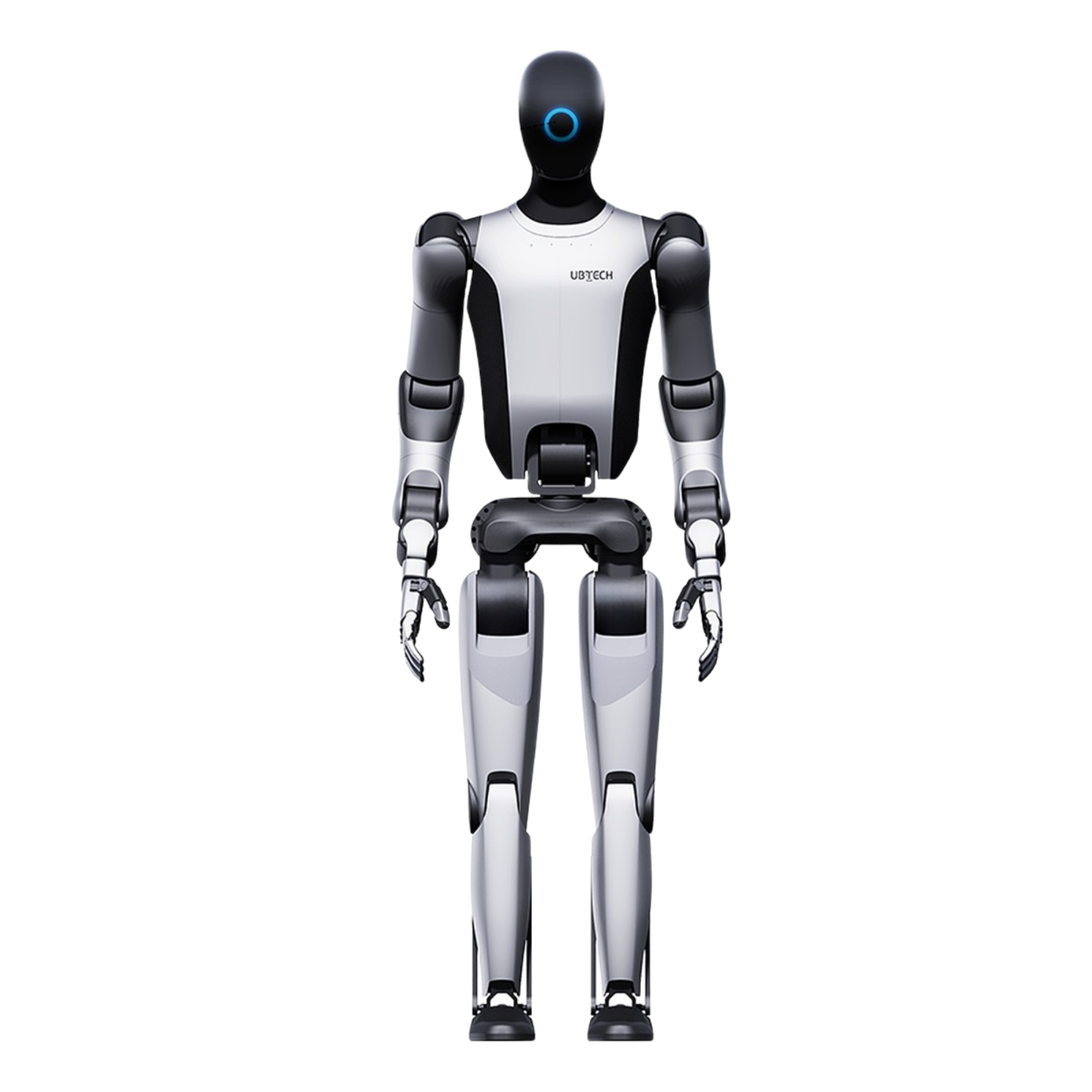
The UBTECH Walker S2 is a full-size industrial humanoid robot developed by UBTECH Robotics, a Shenzhen-based company, and is the world's first humanoid robot able to autonomously swap its own batteries, enabling true 24/7 continuous operation.[16][1] Standing 1.76 meters tall with 52 degrees of freedom, the Walker S2 was unveiled in July 2025 as the latest and most advanced entry in UBTECH's Walker series of bipedal humanoid platforms. It is the direct successor to the Walker S1 and represents a significant leap in industrial humanoid capabilities, most notably through its autonomous battery-swapping system that allows the robot to replace a depleted battery pack in under three minutes without stopping work.
| UBTECH Walker S2 | |
|---|---|
 | |
| General information | |
| Manufacturer | UBTECH Robotics |
| Country of origin | China |
| Year unveiled | July 2025 |
| Status | In mass production (November 2025) |
| Price | ~$90,000 USD |
| Predecessor | Walker S1 |
| Website | ubtrobot.com/en/humanoid/products/walker-s2 |
The Walker S2 is designed specifically for intelligent manufacturing scenarios including automotive assembly, quality inspection, logistics handling, and component sorting. UBTECH began mass production and delivery of the Walker S2 in November 2025, with the first batch consisting of several hundred units. In December 2025, the company's Liuzhou factory in southern China rolled out its 1,000th Walker S2 unit.[2][23] Since early 2025, cumulative orders for UBTECH's Walker series humanoid robots have exceeded 800 million yuan (approximately $112 million USD), with the company targeting annual production capacity of 5,000 units by 2026 and 10,000 units by 2027.[3]
Background
UBTECH Robotics
UBTECH Robotics was founded in 2012 by Zhou Jian in Shenzhen, China. The company specializes in the development of humanoid robots for industrial, commercial, and educational applications. Prior to going public, UBTECH received Series-C funding from Tencent and ICBC, achieving a valuation of $5 billion.[4] On December 29, 2023, UBTECH completed its initial public offering on the Hong Kong Stock Exchange (ticker: SEHK 9880), raising over HK$1 billion (approximately US$130 million). The offering was priced at HK$90 per share, giving the company a market capitalization of approximately HK$37.6 billion. UBTECH became the first humanoid robot company to list on the Hong Kong exchange's main board.[5]
As of late 2023, UBTECH had serviced over 50 countries and regions, worked with more than 900 corporate clients, and sold over 760,000 robots across its product lines. The company's research and development investment accounted for 56.5% of its total revenue from 2020 through the first half of 2023, reflecting its heavy focus on technology development.[5] In 2023, the company reported revenue of CN¥1.06 billion alongside a net loss of CN¥1.27 billion, underscoring the capital-intensive nature of humanoid robot development.[4]
Walker Series Evolution
The Walker S2 sits at the top of a product line that has evolved over nearly a decade of iterative development. UBTECH first previewed the original Walker at CES 2018 as a bipedal robot with legs but no arms. At CES 2019, the company revealed a dramatically updated version standing 1.45 meters (4.75 feet) tall and weighing 77 kg, now equipped with a full upper body including arms, dexterous hands, and a head. This version featured U-SLAM navigation, face and object recognition, and smart home control capabilities.[6]
In July 2021, UBTECH showed the Walker X at the World Artificial Intelligence Conference in Shanghai.[7] UBTECH's specification for the Walker X lists a height of 130 cm, a weight of 63 kg, and 41 degrees of freedom (6 in each leg, 7 in each arm, 6 in each hand and 3 in the neck), with a maximum walking speed of 3 km/h. The company says it can carry 10 kg, or walk carrying 3 kg with both hands, and rates each arm at 1.5 kg when extended.[26] The Walker X introduced an upgraded quadranocular stereo camera system with dual RGB-D sensors. It was primarily positioned as a commercial service and research robot, capable of household tasks such as serving tea, pouring liquids, and operating vacuum cleaners.[7]
The Walker C was introduced as a compact commercial service humanoid standing 1.63 meters tall and weighing 43 kg with 20 degrees of freedom. Designed for reception, tour guidance, and visitor engagement in public spaces like malls and airports, the Walker C operates at speeds up to 6 km/h and supports multilingual interaction through voice, text, and gestures.[8]
In October 2024, UBTECH launched the Walker S Series for industrial applications, including the Walker S1 and Walker S Lite. The Walker S1 stands 1.72 meters tall, weighs 76 kg, and features 41 degrees of freedom with a maximum walking speed of 0.83 m/s. The S1 marked UBTECH's decisive pivot toward industrial manufacturing, with deployments at BYD, Geely Auto's Zeekr factory, and other automotive facilities. At BYD's Shenzhen plant, the Walker S1 achieved 99.7% precision in component sorting and doubled overall sorting efficiency. It also demonstrated inspection accuracy exceeding 99% for non-destructive quality checks on automotive components such as logos and headlights.[9][10]
| Model | Year | Height | Weight | DOF | Max Speed | Primary Application |
|---|---|---|---|---|---|---|
| Walker (Gen 1) | 2018 | ~1.30 m | N/A | Legs only | N/A | Consumer (prototype) |
| Walker (Gen 2) | 2019 | 1.45 m | 77 kg | Full body | N/A | Consumer / Smart home |
| Walker X | 2021 | 1.30 m | 63 kg | 41 | 3 km/h | Service / Research |
| Walker C | 2023 | 1.63 m | 43 kg | 20 | 6 km/h | Commercial reception |
| Walker S1 | 2024 | 1.72 m | 76 kg | 41 | 0.83 m/s | Industrial manufacturing |
| Walker S2 | 2025 | 1.76 m | 95 kg | 52 | 2.0 m/s | Industrial manufacturing (24/7) |
Design and Technical Specifications
Physical Design
The Walker S2 stands 1.76 meters tall and weighs 95 kg, making it the tallest and heaviest robot in the Walker series. Its human-scale dimensions allow it to operate in workspaces designed for human workers without requiring facility modifications. The robot features a bionic body structure with 52 degrees of freedom, a significant increase from the 41 DOF of the Walker S1 and Walker X. The additional degrees of freedom provide greater flexibility, smoother motion, and expanded manipulation capabilities.
The arms feature a hollow structure with integrated wiring, which reduces cable-related failures during complex manipulations and improves reliability in continuous industrial operation. The high-power, high-torque waist servo motor enables a rotation angle of plus or minus 162 degrees and supports a payload capacity of 15 kg across a workspace spanning from ground level to 1.8 meters. The robot can perform deep squats with a 125-degree pitch angle, giving it ground-reaching flexibility for tasks like picking items from low shelves or floor-level conveyors.[11][1]
Fourth-Generation Dexterous Hands
One of the Walker S2's most significant hardware upgrades is its fourth-generation industrial-grade dexterous hands. Each hand has five fingers with 11 degrees of freedom (22 DOF total across both hands), designed with human-like dimensions for natural gripping and manipulation. The hands can perform operations with sub-millimeter precision, and durability testing has confirmed they can withstand over 80,000 operational cycles. This level of endurance is critical for industrial environments where robots may perform thousands of repetitive grasping and placement operations per shift.[11][12]
The hands are paired with the robot's bionic arms for dual-arm coordinated manipulation, enabling tasks that require both hands working together, such as autonomous battery swapping, tray transfer, and component assembly.
Vision and Perception System
The Walker S2 employs a pure RGB binocular stereo vision system housed in its head. This passive dual-camera approach, described by UBTECH as a first for industrial humanoid robots in China, uses deep learning-based stereo depth estimation algorithms to generate high-precision, left-aligned dense depth maps in real time. The system provides what UBTECH calls "human-eye" stereoscopic perception, enabling accurate spatial awareness and reliable object recognition in dynamic factory environments.[11]
This design represents a departure from the RGB-D sensors used in earlier Walker models like the Walker X. By relying on pure RGB cameras combined with deep learning algorithms rather than active depth sensors, the Walker S2 achieves deeper integrated perception with less hardware overhead and fewer points of failure.
Computing Architecture
The Walker S2 runs on a split-brain computing architecture with two processors handling different aspects of operation:
| Component | Role | Details |
|---|---|---|
| Intel Core i7-1185G7 | Real-time OS tasks | Motor control, joint coordination, safety systems |
| NVIDIA Jetson AGX Orin | AI and vision processing | 64 GB RAM, 275 TOPS; handles computer vision, V-SLAM navigation, AI inference |
This dual-processor design separates time-critical motor control from computationally intensive AI workloads, ensuring that real-time safety and balance control are never compromised by heavy vision processing or inference tasks. Connectivity is provided through Bluetooth and WiFi interfaces.[12]
How does the Walker S2 swap its own battery?
The Walker S2's most distinctive innovation is its autonomous battery-swapping capability, which UBTECH describes as a world first for industrial humanoid robots. The system uses dual 48V lithium-ion battery packs with a dynamic balancing architecture that supports both dual-battery and single-battery operational modes.
Each battery pack provides approximately two hours of active walking operation (and up to roughly four hours of standing operation). When a battery nears depletion, the robot autonomously navigates to a designated charging station, uses its dual arms to remove the spent battery, inserts a fully charged replacement module, and resumes its assigned tasks. The entire swap process takes less than three minutes. During the swap, the dual-battery balancing system ensures seamless switching to backup power, preventing any interruption during critical tasks.[11][1][16]
In its official announcement, UBTECH stated that "with its dual-battery dynamic balancing and dual-arm coordinated precision battery swapping technologies, Walker S2 is able to swap battery autonomously within 3 minutes," describing the result as the world's first autonomous hot-swappable battery system for humanoid robots.[1] This capability addresses one of the most significant limitations of the Walker S1 and other industrial humanoid robots: the inability to operate continuously without human intervention for battery management. By enabling true 24/7 operation, the Walker S2 can match the continuous uptime expected in modern automotive and logistics facilities.
AI and Software Systems
Co-Agent System
The Walker S2 is described by UBTECH as the world's first industrial humanoid robot integrated with Co-Agent, UBTECH's proprietary intelligent agent system. Co-Agent integrates multimodal reasoning models, embodied interaction models, skill-specific models, and what UBTECH calls "human-like thinking chain technology." This combination gives the robot closed-loop operational capabilities including intention understanding, task planning, tool usage, and autonomous anomaly detection and handling.[3][11]
In practice, Co-Agent allows the Walker S2 to interpret high-level task instructions, break them into executable sub-tasks, select appropriate tools or manipulation strategies, and detect when something has gone wrong during execution. If an anomaly occurs (such as a misaligned part or an unexpected obstacle), the robot can autonomously decide on a corrective action rather than halting and waiting for human intervention.
BrainNet 2.0 and Swarm Intelligence
Building on Co-Agent, the Walker S2 incorporates UBTECH's BrainNet 2.0 platform, which provides a dual-loop AI architecture for coordinated multi-robot operations. The first loop handles task-driven decision-making at the individual robot level, while the second loop manages swarm-level coordination across fleets of robots.
BrainNet 2.0 enables multiple Walker S2 units, as well as other robot types such as wheeled autonomous mobile robots (AMRs) and automated guided vehicles (AGVs), to share environmental data and coordinate their movements in real time. This is particularly valuable in factory settings where humanoid robots must work alongside existing automated logistics infrastructure. The Walker S1 had already demonstrated this concept at BYD, completing what UBTECH described as the world's first one-stop autonomous logistics application where humanoid robots coordinated with autonomous logistics vehicles and intelligent manufacturing management systems.[9][13]
The system is continuously optimized using data accumulated from industrial deployments, with UBTECH citing billions of data points from industrial training informing the system's ongoing improvement.[11]
Industrial Deployments
What is the Walker S2 used for?
The Walker S2 builds on the deployment foundation established by the Walker S1, which had already been placed at several major automotive manufacturers. As of late 2025, UBTECH's Walker series robots are deployed or under contract with the following industrial partners:[3][10]
| Partner | Industry | Application Areas |
|---|---|---|
| BYD | Automotive | Component sorting, assembly, quality inspection |
| Geely Auto / Zeekr | Automotive | 5G smart factory operations |
| FAW-Volkswagen Qingdao | Automotive | Manufacturing operations |
| Audi FAW | Automotive | Air-conditioning leak detection (Walker S1), pilot trials[25] |
| Dongfeng Liuzhou Motor | Automotive | Manufacturing operations |
| BAIC New Energy | Automotive | Manufacturing operations |
| Foxconn | Electronics | Logistics operations (Longhua facility) |
| SF Express | Logistics | Logistics trials |
| SANY RE | Renewable energy | Wind turbine component handling, bolt sorting |
| Midea Auto | Automotive | Manufacturing operations |
| Airbus | Aerospace | Aircraft manufacturing trials (agreement January 2026) |
| Texas Instruments | Semiconductor | Chip production line support (SM1 fab, Sherman, Texas) |
At BYD's facilities, the predecessor Walker S1 demonstrated a 99.7% precision rate in component sorting and doubled sorting efficiency compared to previous methods. The robot's intelligent camera system paired with deep learning models also achieved inspection accuracy exceeding 99% for non-destructive quality checks on automotive components.[9][10]
Airbus Aerospace Partnership
In January 2026, UBTECH signed a humanoid robot cooperation agreement with Airbus, the European aerospace manufacturer, marking the Walker S2's entry into aviation production and one of the first industrial trials of a humanoid robot in large-scale aerospace manufacturing. Airbus purchased Walker S2 robots for use in its aircraft manufacturing facilities, and the two companies agreed to jointly explore how the robots could support production tasks such as parts logistics, tool handling, and inspection support alongside human workers. The companies did not disclose the number of robots involved or the value of the deal.[17][18] Both sides characterized the arrangement as early-stage concept testing focused on understanding technical limits, safety integration, and return on investment rather than immediate line deployment, reflecting the high precision, strict safety standards, and process consistency demanded by aircraft assembly.[18][19] News of the agreement, reported in mid-January 2026, lifted UBTECH's Hong Kong-listed shares by more than 5 percent.[17]
The Airbus deal came alongside a comparable arrangement with Texas Instruments, which acquired Walker S2 robots to deploy on semiconductor production lines, including work tied to its SM1 chip fabrication plant in Sherman, Texas. The Texas Instruments agreement also carried a reciprocal supply element under which UBTECH would incorporate more of the chipmaker's components into its robots.[20] Together, these deals extended Walker S2 deployment across what UBTECH described as five major manufacturing sectors: aerospace, automotive, 3C electronics, smart logistics, and semiconductor manufacturing.[17]
SANY Renewable Energy Factory
A notable deployment of the Walker S2 took place at SANY RE's facility, described as China's first 5G-enabled wind power smart factory. At this site, Walker S2 robots perform precision handling and assembly operations including autonomous bolt sleeve removal, bolt sorting and placement on conveyors, full-tray transfer to storage racks, and empty tray retrieval in collaboration with human workers. The deployment leverages 5G connectivity for distributed intelligence across the factory floor, allowing the robots to share data and coordinate in real time.[14]
Data Collection Centers
Beyond manufacturing, the Walker S2 has secured contracts for deployment in data collection centers. A contract to deploy Walker S2 robots at a data collection center in Zigong was valued at 159 million yuan and ranked as the second-largest order of 2025, following a record 250 million yuan order secured in September 2025.[3]
Border and Customs Deployment
The Walker S2 has also moved into frontline government service. In a contract reported in late 2025, UBTECH agreed to deploy Walker S2 robots at the Fangchenggang land border crossing in Guangxi, one of China's busiest frontier crossings with Vietnam.[21] By mid-2026 the robots were operating in live conditions at the crossing, assisting with traveler guidance, personnel-flow management, patrols, logistics operations, and cargo inspection, in one of the first deployments of autonomous humanoid robots in a customs and border-control role.[22] Chinese authorities indicated that a successful trial at Fangchenggang could lead to a broader rollout of Walker S2 robots to airports, international rail stations, and seaports.[21][22]
Mass Production and Commercial Strategy
When did the Walker S2 enter mass production?
UBTECH began mass production and delivery of the Walker S2 in November 2025, with the first batch consisting of several hundred units deployed across frontline industrial applications. The company set an initial target of delivering 500 units within the year. In late December 2025, UBTECH's Liuzhou manufacturing facility rolled out its 1,000th Walker S2, about six months after the first unit.[23] More than 500 units had been delivered and were operational at the time of this milestone.[2]
To mark the 1,000-unit milestone, UBTECH released a video showing hundreds of Walker S2 robots lined up in the factory, with one robot performing a short dance and another executing martial arts moves and kicking a cardboard box.[2]
Order Pipeline and Revenue
Since early 2025, UBTECH's Walker series humanoid robots have accumulated orders exceeding 800 million yuan (approximately $112 million USD). Key contracts include:[3][2]
| Contract | Value | Details |
|---|---|---|
| September 2025 deal | 250 million yuan (~$35M) | Largest single order of 2025 |
| Zigong data center | 159 million yuan (~$22.5M) | Data collection center deployment |
| Guangxi project | 126 million yuan (~$17.9M) | Regional deployment |
| Midea Auto (Hubei) | >100 million yuan (~$14.2M) | Automotive manufacturing |
The 21st Century Business Herald reported in January 2026 that UBTECH had won three further orders of 50 million, 59.62 million and 77.8 million yuan in December 2025, bringing its full-year 2025 humanoid robot orders to nearly 1.4 billion yuan.[24]
Production Roadmap and Siemens Partnership
UBTECH has outlined an aggressive production ramp-up plan, targeting annual capacity of 5,000 industrial humanoid robots by 2026 and scaling to 10,000 units by 2027. CEO Zhou Jian stated that "mass production of tens of thousands of units has become a goal that we must achieve."[15]
To support this scaling effort, UBTECH signed a strategic cooperation agreement with Siemens Digital Industries Software in March 2026. Under this partnership, Siemens will design a comprehensive digital transformation roadmap covering the entire Walker S2 product lifecycle, from research and development through full-scale production. The collaboration leverages Siemens' Xcelerator platform and industrial software stack to connect design, production, and operations into a unified digital workflow. Siemens will also provide technical training and support to help UBTECH build the workforce capabilities needed for high-volume production.[15]
Pricing and Market Position
The Walker S2 is priced at approximately $90,000 USD per unit, positioning it as one of the more competitively priced full-size industrial humanoid robots on the market. At this price point, UBTECH is targeting use cases where the robot can replace or supplement human labor in physically demanding, repetitive, or hazardous factory tasks. The company's strategy emphasizes fleet deployment, with multiple units working together at a single facility, rather than single-robot sales.[12][3]
How does the Walker S2 differ from the Walker S1?
The Walker S2 represents a substantial upgrade over its predecessor across nearly every dimension:
| Feature | Walker S1 | Walker S2 | Improvement |
|---|---|---|---|
| Height | 1.72 m | 1.76 m | +4 cm |
| Weight | 76 kg | 95 kg | +19 kg (added battery system) |
| Degrees of freedom | 41 | 52 | +11 DOF (27% increase) |
| Max walking speed | 0.83 m/s | 2.0 m/s | +141% faster |
| Dexterous hands | Gen 3 | Gen 4 (sub-mm precision, 80K+ cycles) | Major upgrade |
| Battery swapping | Not supported | Autonomous (<3 min) | New capability |
| Continuous operation | Limited by battery | 24/7 via hot-swap | Fundamental improvement |
| AI system | BrainNet | BrainNet 2.0 + Co-Agent | Dual-loop AI architecture |
| Vision | RGB-D sensors | Pure RGB binocular stereo | Reduced hardware, deeper integration |
| Payload | N/A | 15 kg | Specified industrial payload |
| Waist rotation | Limited | ±162° | Expanded workspace |
The most transformative improvement is the autonomous battery-swapping system, which eliminates the operational downtime that limited the Walker S1's usefulness in continuous production environments. The increase from 41 to 52 degrees of freedom, combined with the fourth-generation dexterous hands, gives the Walker S2 significantly greater manipulation capability and flexibility. The more than doubling of walking speed (from 0.83 m/s to 2.0 m/s) allows the robot to traverse large factory floors more efficiently.[1][12][10]
Competitive Landscape
The Walker S2 competes in a rapidly growing market for industrial humanoid robots. Key competitors include Tesla's Optimus (which has been piloted in Tesla's own factories), Figure AI's Figure 02 (deployed at BMW facilities), and domestic Chinese competitors such as Unitree's H1/H2 series, Fourier Intelligence's GR-2, and Agibot's lineup.
UBTECH differentiates itself through its focus on commercial deployment at scale rather than research demonstrations. With over 1,000 units produced and more than 500 delivered as of early 2026, the Walker S2 represents one of the largest mass production runs of full-size humanoid robots in the world. The company's established relationships with major automotive manufacturers like BYD, Geely, and Foxconn provide a strong commercial foundation that many competitors have yet to build.[2][3]
See Also
- Humanoid robots
- UBTECH Robotics
- Walker S1
- Walker X
- Walker C
- Industrial robot
- Embodied AI
- Tesla Optimus
References
- ^1 ^2 ^3 ^4 ^5UBTECH Walker S2 Official Product Page. UBTECH Robotics.
- ^1 ^2 ^3 ^4 ^5"UBTECH robot dances, kicks box as 1,000 Walker S2 milestone marked." Interesting Engineering, December 30, 2025.
- ^1 ^2 ^3 ^4 ^5 ^6 ^7"UBTECH Humanoid Robot Walker S2 Begins Mass Production and Delivery, with Orders Exceeding 800 Million Yuan." PR Newswire, November 2025.
- ^1 ^2"UBtech Robotics." Wikipedia.
- ^1 ^2"Tencent-Backed Robot-Maker UBTech Robotics IPO in Hong Kong with $4.8 Billion Market Value on 29th December 2023." Caproasia, January 2024.
- ^"UBTECH Unveils Next-Generation Intelligent Humanoid Robots at CES 2019." Business Wire, January 2019.
- ^1 ^2"UBTECH Robotics unveils latest version of Walker X humanoid." Robotics and Automation News, August 2021.
- ^"Walker C." UBTECH Robotics Official Product Page.
- ^1 ^2 ^3"Humanoid robots clock in for work." People's Daily Online, April 2025.
- ^1 ^2 ^3 ^4"Fully Automated Logistics at BYD with UBTECH's Walker S1 Humanoid Robot." Mike Kalil, 2025.
- ^1 ^2 ^3 ^4 ^5 ^6"UBTECH Unveils the Full-Size Industrial Humanoid Robot Walker S2." Heyup, July 2025.
- ^1 ^2 ^3 ^4"Walker S2 Humanoid Robot Specifications." HumanoidSpecs.com.
- ^"UBTech Humanoids Clock In: Walker S1 Robots Deployed at Zeekr Factory." Humanoids Daily, 2025.
- ^"UBTECH Walker S2 humanoid robots automate tasks at wind turbine plant." Interesting Engineering, 2025.
- ^1 ^2"UBTech's push for 10,000 humanoid robots by 2026 gets Siemens backing." Interesting Engineering, March 2026.
- ^1 ^2"UBTech unveils 'world's first' humanoid robot to autonomously swap its own battery." Robotics and Automation News, August 2025.
- ^1 ^2 ^3"Chinese unicorn UBTech Robotics signs cooperation deal with Airbus, expanding application scenarios." Global Times, January 2026.
- ^1 ^2"Humanoid Robots Building Airplanes: Airbus Buys 6-Figure Robots From UBTech." Forbes, January 2026.
- ^"Airbus to test China-made humanoid robots in aviation production." Interesting Engineering, January 2026.
- ^"Texas Instruments To Deploy Humanoid Robots on Its Chip Production Lines." Dallas Innovates, January 2026.
- ^1 ^2"UBTech wins US$37 million deal to deploy humanoid robots at China-Vietnam border crossings." South China Morning Post, November 2025.
- ^1 ^2"China Deploys Humanoid Robots at Vietnam Border: Walker S2 Begins Live Customs Work." Tech Times, July 2026.
- ^1 ^2"柳州优必选第1000台工业人形机器人下线 已进入东风柳汽产线" (Liuzhou UBTECH's 1,000th industrial humanoid robot rolls off the line and enters Dongfeng Liuzhou Motor's production line). Sina Tech, December 26, 2025.
- ^"优必选加速'进厂':从'造车'到'造飞机',年订单近14亿元" (UBTECH speeds into factories: from building cars to building aircraft, annual orders of nearly RMB1.4 billion). 21st Century Business Herald, January 26, 2026.
- ^"Audi integrates UBTech's Walker S1 humanoid robot in its China plant." Interesting Engineering, March 28, 2025.
- ^"Walker X Commercial Humanoid Robot." UBTECH Robotics Official Product Page.
Improve this article
Add missing citations, update stale details, or suggest a clearer explanation. Every suggestion is reviewed for sourcing before it goes live.
10 revisions · v10 · 4,047 words · full history
Fact-checks are independent of edits: a reviewer re-verifies the article against its sources and stamps the date. How we verify
Research and drafting on this wiki are AI-assisted, under named human editorial standards. How AI is used here
Cite this page: AI Wiki. "UBTECH Walker S2." aiwiki.ai, updated 25 Sept 2026. CC BY 4.0. https://aiwiki.ai/wiki/ubtech_walker_s2