

XPENG PX5
| XPENG PX5 | |
|---|---|
 | |
| General information | |
| Manufacturer | XPENG Robotics (Pengxing Intelligence) |
| Parent company | XPeng Inc. |
| Country of origin | China |
| Year introduced | 2023 |
| Status | Prototype (succeeded by XPENG IRON) |
| Height | 150 cm (4 ft 11 in) |
| Weight | 109 kg (240 lb) |
| Degrees of freedom | 22 total |
| Arm DOF | 7 per arm |
| Hand DOF | 11 per hand |
| Hand weight | 430 g (including control and drive) |
| Arm payload | 3 kg per arm |
| Grip force | 1 kg per hand |
| Positioning accuracy | 0.05 mm (repeatability) |
| Max walking speed | 1 m/s |
| Battery life | 2+ hours |
| Actuation | Hybrid rigid-soft drive (hands) |
| Connectivity | Wi-Fi (2.4 GHz / 5 GHz) |
| Website | pxing.com |
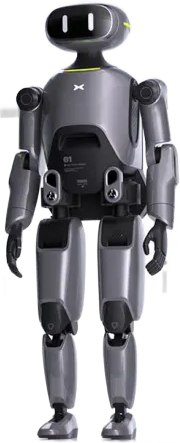
The XPENG PX5 is a bipedal humanoid robot prototype developed by XPENG Robotics (formally Shenzhen Pengxing Intelligence Co., Ltd.), the robotics subsidiary of Chinese electric vehicle manufacturer XPeng Inc. Publicly unveiled on October 24, 2023, at XPeng's annual 1024 Tech Day event in Guangzhou, China, the 150 cm (4 ft 11 in), 109 kg PX5 was the company's first humanoid robot and its first bipedal platform, and it reached stable bipedal walking after roughly five months of research and development by reusing perception, planning, and control technology from XPeng's autonomous driving stack.[1][12]
Standing 150 cm tall and weighing 109 kg, the PX5 served as a technology demonstrator for XPeng's ambitions in embodied AI and physical intelligence. The robot featured 22 degrees of freedom, self-developed high-performance joints, and ultra-lightweight dexterous hands weighing just 430 grams each. While the PX5 itself was never mass-produced, it established foundational technologies in bipedal locomotion, manipulation, and autonomous navigation that directly informed the development of its successor, the XPENG IRON, which debuted in November 2024. The PX5 should not be confused with IRON: the PX5 is the 2023 first-generation prototype (150 cm, 109 kg, 22 total degrees of freedom, 11 per hand), whereas IRON is the taller, lighter, and far more articulated humanoid (178 cm, 70 kg, 62 or more degrees of freedom) that XPeng unveiled a year later and has since moved toward mass production.
The PX5 project represented the convergence of XPeng's expertise in autonomous driving, computer vision, and AI software with hardware capabilities acquired through the company's 2020 acquisition of Dogotix, a Shenzhen-based quadruped robot startup.
Background: XPENG's entry into robotics
He Xiaopeng's robotics vision
XPeng's involvement in robotics traces back to the personal interest of the company's founder and chairman, He Xiaopeng. His attention to the robotics sector began as early as 2016, when he started conducting serious research into robot technologies almost every year. During this period, He held conversations with prominent figures in the Chinese robotics industry, including Wang Xingxing, the founder of Unitree Robotics.[2]
He Xiaopeng came to view robotics as XPeng's "third growth curve" after intelligent driving and globalization. His strategic reasoning centered on the observation that intelligent driving represents the smallest implementation unit of embodied AI, and that the technology chain of "perception, decision, and execution" in the automotive field is highly homologous to that required for robots. This insight would later prove foundational to XPeng's approach of transferring autonomous driving technology to its robotics platforms.[3]
Acquisition of Dogotix (2020)
In the autumn of 2020, He Xiaopeng traveled to Shenzhen to personally negotiate the acquisition of Dogotix, a startup company specializing in quadruped robot research and development. Dogotix was founded by Zhao Tongyang and was recognized as one of the earliest teams in China to achieve the practical implementation of quadruped robot technology. Under Zhao's leadership, the team had completed the R&D of its first-generation robot dog in fewer than two months.[4]
Xiaomi founder Lei Jun reportedly helped facilitate the deal. XPeng spent approximately $100 million (USD) to buy out the shares of Dogotix's existing investors, bringing the company fully under XPeng's corporate umbrella.[5] This acquisition gave XPeng immediate access to expertise in legged locomotion, dynamic balance control, and robot actuation systems.
Establishment of Pengxing Intelligence
Following the Dogotix acquisition, XPeng established Shenzhen Pengxing Intelligence Co., Ltd. (also known as Pengxing Intelligent or XPENG Robotics) on December 22, 2020, with a registered capital of 10 million yuan. The subsidiary was headquartered at the Shenzhen Bay Science and Technology Ecological Park and served as XPeng's dedicated robotics division.[6]
The Pengxing team, however, had deeper roots. The core engineering group was originally established in Shenzhen in 2016 and was one of the earliest Chinese teams to invest in the research and development of foot-type (legged) robots. After being absorbed into XPeng's ecosystem, Pengxing was positioned as part of the company's "Future Transportation Explorer" strategy, leveraging automotive systems and concepts to empower the R&D and manufacturing of intelligent robots.[7]
At its peak, the Pengxing team grew to more than 300 employees. However, internal misalignments, including strategic disagreements between Zhao Tongyang and He Xiaopeng, eventually led to the departure of core team members. Zhao left XPeng and went on to found EngineAI (also known as Zhongqing Robotics), a competing humanoid robot company. After these departures, the team was reduced to approximately 70 people before being rebuilt under new leadership.[8]
Quadruped robot products
Before developing the PX5, Pengxing Intelligence produced several quadruped robot platforms. The most notable was the intelligent robot horse, internally code-named "Xiaobailong," which was unveiled in September 2021 as the world's first rideable intelligent robot horse. The third-generation prototype featured a car-level intelligent driving system incorporating cameras and LiDAR for environment perception, map building, route planning, autonomous movement, target following, and automatic obstacle avoidance. The robot horse also included voice interaction, face and voiceprint recognition capabilities, emotional expression through a face screen, and tactile perception.[9]
XPeng developed a total of seven generations of robots, with five being quadruped designs, before ultimately pivoting to humanoid form factors. The company concluded that quadruped robots lacked hands for manipulation tasks and had difficulty navigating complex home and workplace environments, prompting the shift to bipedal humanoid designs that culminated in the PX5.[10]
Development history
R&D timeline
After the leadership transition at Pengxing Intelligence, He Xiaopeng brought in Mi Liangchuan to lead the robot business in 2023. Mi Liangchuan had joined NVIDIA in 2005, where he served as senior Android software manager at NVIDIA's Santa Clara headquarters, managing a team of hundreds of people and reporting to NVIDIA's global vice-president Wu Xinzhou. He was a University of Science and Technology of China alumnus and former Carnegie Mellon University researcher.[11]
Under this new leadership, the PX5 development team achieved a rapid development cycle. According to He Xiaopeng, the humanoid robot achieved stable walking capabilities after just five months of R&D, a pace that the company attributed to its ability to leverage existing autonomous driving algorithms and sensor fusion technologies from its EV business.[12]
When was the PX5 unveiled? The 2023 Tech Day
The PX5 made its public debut at XPeng's fifth annual 1024 Tech Day on October 24, 2023, in Guangzhou. The event, which also featured the unveiling of the X9 MPV, AI valet driving technology, and two new flying car concepts, served as a showcase for XPeng's multi-domain technology ambitions.[13]
During the presentation, XPeng demonstrated the PX5 through live demonstrations and video presentations showing the robot performing a variety of tasks. The demonstrations included navigation across varied terrain types (grass, rocky surfaces, and indoor environments), object manipulation (holding screwdrivers, lifting boxes, grasping pens, and pouring water into cups), playing football, and riding a self-balancing scooter. The robot also demonstrated shock resistance, maintaining stability even when kicked.[14]
He Xiaopeng articulated a vision where automotive companies would combine AI-powered vehicles with robotics across two phases: first integrating assisted driving and automatic parking capabilities, and then incorporating urban intelligent driving features into robot platforms. He announced plans to deploy PX5 robots in factories and stores by the following year's Tech Day event, with specific applications including factory patrolling and in-store product sales demonstrations at XPeng dealerships.[15]
What are the XPENG PX5's specifications?
Physical design and locomotion
The PX5 stands 150 cm (approximately 4 feet 11 inches) tall and weighs 109 kg with its battery. Its silver-white exterior was noted by observers as resembling the anime character Astro Boy. The robot features 22 total degrees of freedom distributed across its body, enabling bipedal walking with various gait patterns including straight-knee walking and extended-stride locomotion.[16]
| Specification | Value |
|---|---|
| Height | 150 cm (4 ft 11 in) |
| Weight (with battery) | 109 kg (240 lb) |
| Total degrees of freedom | 22 |
| Maximum walking speed | 1 m/s |
| Operational duration | 2+ hours (indoor/outdoor) |
| Terrain capability | Multi-terrain (grass, rocks, indoor surfaces) |
The locomotion system is built on XPeng's self-developed high-performance joints, which enable stable bipedal walking and obstacle crossing across both indoor and outdoor environments for over two hours of continuous operation. The robot demonstrated the ability to traverse grass, rocky terrain, and other challenging surfaces while maintaining stability, positioning it as what XPeng described as an "all-terrain, obstacle-crossing" platform.[17]
Arm system
The PX5 features ultra-lightweight humanoid mechanical arms, each providing 7 degrees of freedom. The arm system was designed with an emphasis on the load-to-weight ratio, a critical metric for practical manipulation tasks.
| Arm specification | Value |
|---|---|
| Degrees of freedom (per arm) | 7 |
| Arm self-weight | 5 kg |
| Maximum payload (per arm) | 3 kg |
| Load-to-weight ratio | >0.6 (3 kg / 5 kg) |
| Repeat positioning accuracy | 0.05 mm |
| Maximum end-point linear velocity | 1 m/s |
The arms achieve a repeat positioning accuracy of 0.05 mm, a figure more commonly associated with industrial robotic arms than humanoid prototypes. This precision, combined with a load-to-weight ratio exceeding 0.6, made the PX5's arms notably capable for a humanoid robot of its generation. Each arm weighs approximately 5 kg and can carry a maximum payload of 3 kg, while the end-point can reach a maximum linear velocity of 1 m/s.[18]
Hand system
The PX5's dexterous hands represent one of the robot's most technically distinctive features. Each hand provides 11 degrees of freedom and employs a hybrid rigid-soft drive scheme, a design that combines rigid structural elements for force transmission with soft, compliant components for adaptive grasping.
| Hand specification | Value |
|---|---|
| Degrees of freedom (per hand) | 11 |
| Hand unit weight (including control and drive) | 430 g |
| Grip force (per hand) | 1 kg |
| Drive mechanism | Hybrid rigid-soft |
| Tactile sensing | Fingertip tactile perception |
The entire hand unit, including all control electronics and drive components, weighs only 430 grams. This ultra-lightweight design was a significant engineering achievement, as it minimized the inertial load on the arm system while preserving functional dexterity. Each hand is capable of generating up to 1 kg of grip force, sufficient for handling everyday objects.[19]
The hybrid rigid-soft drive mechanism enables the hands to both grasp rigid objects firmly and envelop irregularly shaped or deformable objects. This versatility was demonstrated during Tech Day 2023 through tasks such as holding a screwdriver (requiring a firm cylindrical grip), lifting boxes (requiring a power grasp), grasping pens (requiring a precision pinch), and pouring water from a container into a cup (requiring controlled wrist orientation and grip maintenance).[20]
The hands are also equipped with end-point tactile perception capabilities at the fingertips, allowing the robot to sense contact forces and object properties during manipulation. This tactile feedback enables force-controlled interactions, preventing the robot from crushing delicate objects or losing grip on heavier ones.[21]
Computing and software
The PX5 runs integrated AI processors executing real-time perception, control, and decision-making algorithms. The robot's software stack includes real-time motion planning, obstacle avoidance, and autonomous navigation capabilities. XPeng announced at Tech Day 2023 that the company planned to apply its Xnet deep neural network, XEEA electrical-electronic architecture, and XGPT large-scale AI model to future versions of its intelligent robots.[22]
XNet is XPeng's deep neural network architecture for autonomous driving. The XNet 2.0 version combines dynamic networks, static networks, and an exclusively visual occupancy network, unifying dynamic bird's eye view (BEV), static BEV, and occupancy networks into a single perception framework.[23]
XEEA (XPeng Electrical/Electronic Architecture) version 3.5 serves as the core of XPeng's in-car computing center, integrating smart cockpit and smart driving capabilities including intelligent driving, cabin features, dashboard, gateways, IMU, amplifiers, and related systems.[24]
XGPT is XPeng's large-scale artificial intelligence model integrated into the smart cockpit system, enabling natural language interaction capabilities. The application of these three technologies to robotics was positioned as a key differentiator, leveraging years of automotive AI development for humanoid robot intelligence.[25]
The robot's sensor suite includes tactile sensors on the fingertips, vision sensors for navigation, and environmental sensors for obstacle detection. Connectivity is provided through Wi-Fi (2.4 GHz and 5 GHz bands).
Technology transfer from autonomous driving
The PX5 exemplifies XPeng's strategy of leveraging its autonomous driving technology stack for robotics development. He Xiaopeng's thesis that intelligent driving is the "smallest implementation unit of embodied intelligence" drove the company to systematically transfer perception, planning, and control technologies from its EV business to its robot platforms.
Several key technology domains were shared between XPeng's vehicles and the PX5:
| Technology domain | Automotive application | Robotics application |
|---|---|---|
| Computer vision | XNGP autonomous driving perception | Environment sensing and navigation |
| Neural networks | XNet 2.0 BEV perception | Spatial awareness and obstacle detection |
| E/E architecture | XEEA 3.5 vehicle computing | Robot computing and control integration |
| AI models | XGPT cockpit interaction | Natural language understanding |
| Motion planning | Path planning for driving | Bipedal locomotion planning |
| Sensor fusion | Multi-sensor ADAS | Multi-modal robot perception |
This cross-domain approach offered XPeng several advantages. The company could amortize its substantial R&D investments in autonomous driving across multiple product lines. Engineers experienced in developing perception and planning systems for vehicles could apply their expertise to analogous robotics challenges. Additionally, the shared software infrastructure reduced development time, contributing to the five-month timeline from project start to stable bipedal walking.[26]
The technology transfer strategy became even more pronounced in the PX5's successors. The XPENG IRON robot reused the Hawkeye (Eagle Eye) vision system originally developed for automotive use, and the fifth-generation robot was designed to share approximately 70% of its technology stack with XPeng's automotive division.[27]
What was the XPENG PX5 designed to do?
XPeng envisioned the PX5 for deployment in two primary sectors: manufacturing and retail.
Manufacturing applications included factory patrolling, inspection tasks, and assembly assistance. The robot's multi-terrain locomotion and extended operational duration (over two hours) made it suitable for traversing factory floors and performing repetitive surveillance routes. The precise arm positioning (0.05 mm accuracy) suggested potential for quality inspection and light assembly tasks.[28]
Retail applications focused on customer-facing roles at XPeng's EV dealership showrooms. The company envisioned the PX5 welcoming guests, demonstrating products, and providing information to potential customers. This application leveraged the robot's bipedal form factor (which allows it to navigate human-designed spaces) and its planned integration with XGPT for natural language interaction.[29]
While the PX5 itself was not mass-produced for these applications, the use cases it targeted directly influenced the development priorities for its successors, which eventually saw trial deployment on XPeng's production lines.
How does the XPENG PX5 differ from the XPENG IRON?
The PX5 occupies a pivotal position in XPeng's robotics lineage, bridging the company's quadruped robot heritage and its current humanoid platform. In short, the PX5 (2023) was the first-generation demonstrator that proved XPeng could build a walking, grasping humanoid, while IRON (from 2024 onward) is the taller, lighter, far more actuated and AI-heavy successor that XPeng is preparing for mass production. The two are distinct robots and should not be treated as the same model.
| Feature | Quadruped platforms (pre-2023) | PX5 (2023) | IRON (2024) | Next-gen IRON (2025) |
|---|---|---|---|---|
| Form factor | Quadruped | Bipedal humanoid | Bipedal humanoid | Bipedal humanoid |
| Height | Varies | 150 cm | 178 cm | ~170 cm |
| Weight | Varies | 109 kg | 70 kg | ~70 kg |
| Total DOF | Limited | 22 | 62 | 82 |
| Hand DOF | N/A | 11 per hand | 15 per hand | 22 per hand |
| AI chip | N/A | Integrated processors | Turing AI chip | 3x Turing AI chips (2,250 TOPS) |
| AI model | Basic control | Perception + planning | VLA 1.0 | VLA 2.0 |
| Status | Discontinued | Prototype | Production trial | Mass production (late 2026) |
Transition to IRON
The XPENG IRON was unveiled on November 6, 2024, at XPeng's AI Tech Day, representing a dramatic leap forward from the PX5. Standing 178 cm tall and weighing just 70 kg (compared to the PX5's 109 kg at 150 cm), IRON featured 62 active degrees of freedom, a 1:1 human-scale hand design with 15 degrees of freedom per hand, and a 20% improvement in torque density over the PX5's joint actuators.[30]
IRON incorporated XPeng's self-developed Turing AI chip, which features a 40-core processor capable of supporting models with up to 30 billion parameters. The robot also introduced the Eagle Eye AI vision system providing 720-degree environment sensing for spatial awareness and obstacle avoidance. These computing and perception capabilities far exceeded the PX5's integrated AI processors.[31]
The design philosophy also shifted significantly. While the PX5 prioritized demonstrating core bipedal locomotion and manipulation capabilities, IRON adopted what XPeng calls an "extreme anthropomorphism" approach, featuring a biomimetic spine, bionic muscles, flexible skin, and a 3D curved display on its head. The rationale was that highly human-like robots are easier to commercialize, easier to generalize across tasks, and easier to train with human demonstration data.[32]
Next-generation IRON (2025)
At XPeng's 2025 AI Day in Guangzhou on November 5, 2025, the company unveiled the second-generation IRON with further improvements: 82 total degrees of freedom, 22 degrees of freedom in the hands, three self-developed Turing AI chips delivering a combined 2,250 TOPS of computing power, and the VLA 2.0 (Vision-Language-Action) model trained on nearly 100 million video clips. The next-gen IRON was also presented as the first humanoid robot in the world to run on an all-solid-state battery.[33][38] At the same event, He Xiaopeng set an explicit commercialization target, stating that "by the end of 2026, XPENG aims to achieve large-scale mass production of high-level humanoid robots."[38]
XPeng announced plans for a 110,000-square-meter robot factory in Guangzhou, with groundbreaking in Q1 2026 and mass production targeted for late 2026. In February 2026, the company confirmed that the facility, described as the industry's first "full-chain" humanoid robot mass production base, would be built in the Guangtang Sci-Tech Innovation City in the Tianhe district of Guangzhou, covering everything from R&D validation and small-batch trial production to large-scale manufacturing.[39] The company has also disclosed partnerships with industrial firms including Baosteel for inspection tasks, validating the production-readiness of the platform that evolved from the PX5 prototype.[34]
Legacy and significance
Although the PX5 was a prototype that was never mass-produced, its significance to XPeng's robotics program and the broader humanoid robot industry is substantial.
The PX5 validated XPeng's core thesis that automotive AI technology could be effectively transferred to humanoid robotics. The five-month development timeline from project initiation to stable bipedal walking demonstrated that an EV company's existing capabilities in perception, planning, and control could dramatically accelerate robot development. This approach has since been adopted or acknowledged by other automotive companies entering the robotics space, including Tesla with its Optimus program.
The robot's ultra-lightweight 430-gram hand design with hybrid rigid-soft actuation represented a meaningful contribution to dexterous manipulation research. The combination of rigid components for force transmission with soft elements for adaptive grasping addressed a persistent challenge in humanoid hand design: achieving both precision and versatility in a compact, lightweight package.
The PX5 also served as a recruitment and organizational catalyst. By publicly demonstrating a functional humanoid prototype, XPeng attracted talent from the broader AI and robotics community, enabling the team to rebuild from its post-departure low of 70 employees to approximately 200 engineers by 2025.[35]
He Xiaopeng has stated that XPeng plans investments that could total up to 100 billion yuan (approximately $14 billion USD) for its humanoid robotics program, underscoring the strategic importance of the initiative that the PX5 launched.[36] Several hundred humanoid robots derived from the PX5's technological lineage have already been deployed on XPeng's production lines for algorithm refinement and teleoperation data collection, laying the groundwork for commercial-scale manufacturing of autonomous humanoid systems.[37]
See also
- XPENG IRON
- XPENG Robotics
- Humanoid robots
- Embodied AI
- Autonomous driving
- Unitree Robotics
- Tesla Optimus
- Boston Dynamics Atlas
References
- ^"XPeng Tech Day 2023 recap: X9 revealed, plus AI valet driver, two new flying cars, and bipedal robot." Electrek, October 24, 2023. electrek.co/...iver-adas-flying-cars-bipedal-robot
- ^"Exclusive from Intelligence Emergence: XPeng Robotics Unveiled." 36Kr, 2025. eu.36kr.com/...3433980784938631
- ^"Xpeng to unveil fifth-gen humanoid robot built on 70% of its EV tech." KrASIA, 2025. kr-asia.com/...id-robot-built-on-70-of-its-ev-tech
- ^"Exclusive from Intelligence Emergence: XPeng Robotics Unveiled." 36Kr, 2025. eu.36kr.com/...3433980784938631
- ^"XPENG Plans Major Investment Humanoid Robotics Program." Mike Kalil, 2024. mikekalil.com/...xpeng-humanoid-robot-funding
- ^"Xpeng founds Pengxing Intelligence for AI innovation." Tech In China, Medium, 2021. techinchina.medium.com/...-innovation-544f8604c743
- ^"Xpeng founds Pengxing Intelligence for AI innovation." Tech In China, Medium, 2021. techinchina.medium.com/...-innovation-544f8604c743
- ^"Exclusive from Intelligence Emergence: XPeng Robotics Unveiled." 36Kr, 2025. eu.36kr.com/...3433980784938631
- ^"Xpeng Releases World's First Intelligent Robot Horse that People Can Ride." Pandaily, September 2021. pandaily.com/...t-robot-horse-that-people-can-ride
- ^"Xpeng Robotics: Ambitions to Rival Tesla." CMRA, 2025. cnmra.com/xpeng-robotics-ambitions-to-rival-tesla
- ^"Exclusive from Intelligence Emergence: XPeng Robotics Unveiled." 36Kr, 2025. eu.36kr.com/...3433980784938631
- ^1 ^2"Xpeng Motors unveils PX5 humanoid robot, underlining its vision for the future." KrASIA, October 2023. kr-asia.com/...derlining-its-vision-for-the-future
- ^"XPENG Hosts its 2023 TECH DAY: Advancing Leadership in Intelligent Driving and AI-defined Mobility." BusinessWire, October 24, 2023. businesswire.com/...riving-and-AI-defined-Mobility
- ^"Xpeng Motors unveils PX5 humanoid robot, underlining its vision for the future." KrASIA, October 2023. kr-asia.com/...derlining-its-vision-for-the-future
- ^"Xpeng Tech Day: first MPV, self-driving timeline, flying cars, robots." TechNode, October 25, 2023. technode.com/...ne-flying-cars-and-humanoid-robots
- ^"PX5 - Robot Details, Use Case and Specifications." Aparobot. aparobot.com/...px5
- ^"PX5 - Robot Details, Use Case and Specifications." Aparobot. aparobot.com/...px5
- ^"Xpeng Motors unveils PX5 humanoid robot, underlining its vision for the future." KrASIA, October 2023. kr-asia.com/...derlining-its-vision-for-the-future
- ^"Xpeng Motors unveils PX5 humanoid robot, underlining its vision for the future." KrASIA, October 2023. kr-asia.com/...derlining-its-vision-for-the-future
- ^"Xpeng Motors unveils PX5 humanoid robot, underlining its vision for the future." KrASIA, October 2023. kr-asia.com/...derlining-its-vision-for-the-future
- ^"PX5 - Robot Details, Use Case and Specifications." Aparobot. aparobot.com/...px5
- ^"Xpeng unveils XNGP roadmap, new flying cars, bipedal robot at annual Tech Day event." CnEVPost, October 24, 2023. cnevpost.com/...xpeng-1024-tech-day-2023
- ^"XPENG Hosts its 2023 TECH DAY: Advancing Leadership in Intelligent Driving and AI-defined Mobility." BusinessWire, October 24, 2023. businesswire.com/...riving-and-AI-defined-Mobility
- ^"Highlights of XPeng's 2023 TECH DAY." Gasgoo, October 2023. autonews.gasgoo.com/...70029024
- ^"Highlights of XPeng's 2023 TECH DAY." Gasgoo, October 2023. autonews.gasgoo.com/...70029024
- ^"Xpeng to unveil fifth-gen humanoid robot built on 70% of its EV tech." KrASIA, 2025. kr-asia.com/...id-robot-built-on-70-of-its-ev-tech
- ^"Xpeng to unveil fifth-gen humanoid robot built on 70% of its EV tech." KrASIA, 2025. kr-asia.com/...id-robot-built-on-70-of-its-ev-tech
- ^"Xpeng Motors unveils PX5 humanoid robot, underlining its vision for the future." KrASIA, October 2023. kr-asia.com/...derlining-its-vision-for-the-future
- ^"Xpeng Tech Day: first MPV, self-driving timeline, flying cars, robots." TechNode, October 25, 2023. technode.com/...ne-flying-cars-and-humanoid-robots
- ^"Xpeng Robotics: Ambitions to Rival Tesla." CMRA, 2025. cnmra.com/xpeng-robotics-ambitions-to-rival-tesla
- ^"XPENG Plans Major Investment Humanoid Robotics Program." Mike Kalil, 2024. mikekalil.com/...xpeng-humanoid-robot-funding
- ^"Xpeng Iron Review: 82 DOF Specs, Price & 2026 Production." Robozaps, 2025. blog.robozaps.com/...xpeng-iron-review
- ^"Xpeng unveils next-gen Iron humanoid robot at 2025 AI Day." CnEVPost, November 5, 2025. cnevpost.com/...veils-next-gen-iron-humanoid-robot
- ^"Xpeng Iron Review: 82 DOF Specs, Price & 2026 Production." Robozaps, 2025. blog.robozaps.com/...xpeng-iron-review
- ^"Exclusive from Intelligence Emergence: XPeng Robotics Unveiled." 36Kr, 2025. eu.36kr.com/...3433980784938631
- ^"XPENG Plans Major Investment Humanoid Robotics Program." Mike Kalil, 2024. mikekalil.com/...xpeng-humanoid-robot-funding
- ^"Xpeng to unveil fifth-gen humanoid robot built on 70% of its EV tech." KrASIA, 2025. kr-asia.com/...id-robot-built-on-70-of-its-ev-tech
- ^1 ^2"XPENG Shares Achievements in Physical AI Emergence: Unveils XPENG VLA 2.0, Robotaxi, Next-Gen IRON, and Flying Car." XPENG (official newsroom), November 5, 2025. xpeng.com/...019a56f54fe99a2a0a8d8a0282e402b7
- ^"Xpeng to break ground on humanoid robot factory in Q1, with mass delivery targeted in 2026." CnEVPost, February 25, 2026. cnevpost.com/...round-on-humanoid-robot-factory-q1
Improve this article
Add missing citations, update stale details, or suggest a clearer explanation. Every suggestion is reviewed for sourcing before it goes live.
6 revisions · v7 · 4,128 words · full history
Fact-checks are independent of edits: a reviewer re-verifies the article against its sources and stamps the date. How we verify
Research and drafting on this wiki are AI-assisted, under named human editorial standards. How AI is used here
Cite this page: AI Wiki. "XPENG PX5." aiwiki.ai, updated 7 Jul 2026. CC BY 4.0. https://aiwiki.ai/wiki/xpeng_px5