

Honda ASIMO
Honda ASIMO (Advanced Step in Innovative Mobility) was a humanoid robot built by Honda Motor Co., Ltd. and unveiled on October 31, 2000, the first robot that could reliably walk, run, and climb stairs on two legs in real-world settings and the machine that launched the modern era of bipedal humanoid robotics. Standing 130 cm tall and weighing 48 kg in its final 2011 configuration, ASIMO was the culmination of over three decades of locomotion research that began at Honda in 1986, and it remained the field's reference design for nearly 20 years before the current wave of AI and reinforcement-learning-driven humanoids such as Boston Dynamics' Atlas and Tesla Optimus [1][2].
| Honda ASIMO | |
|---|---|
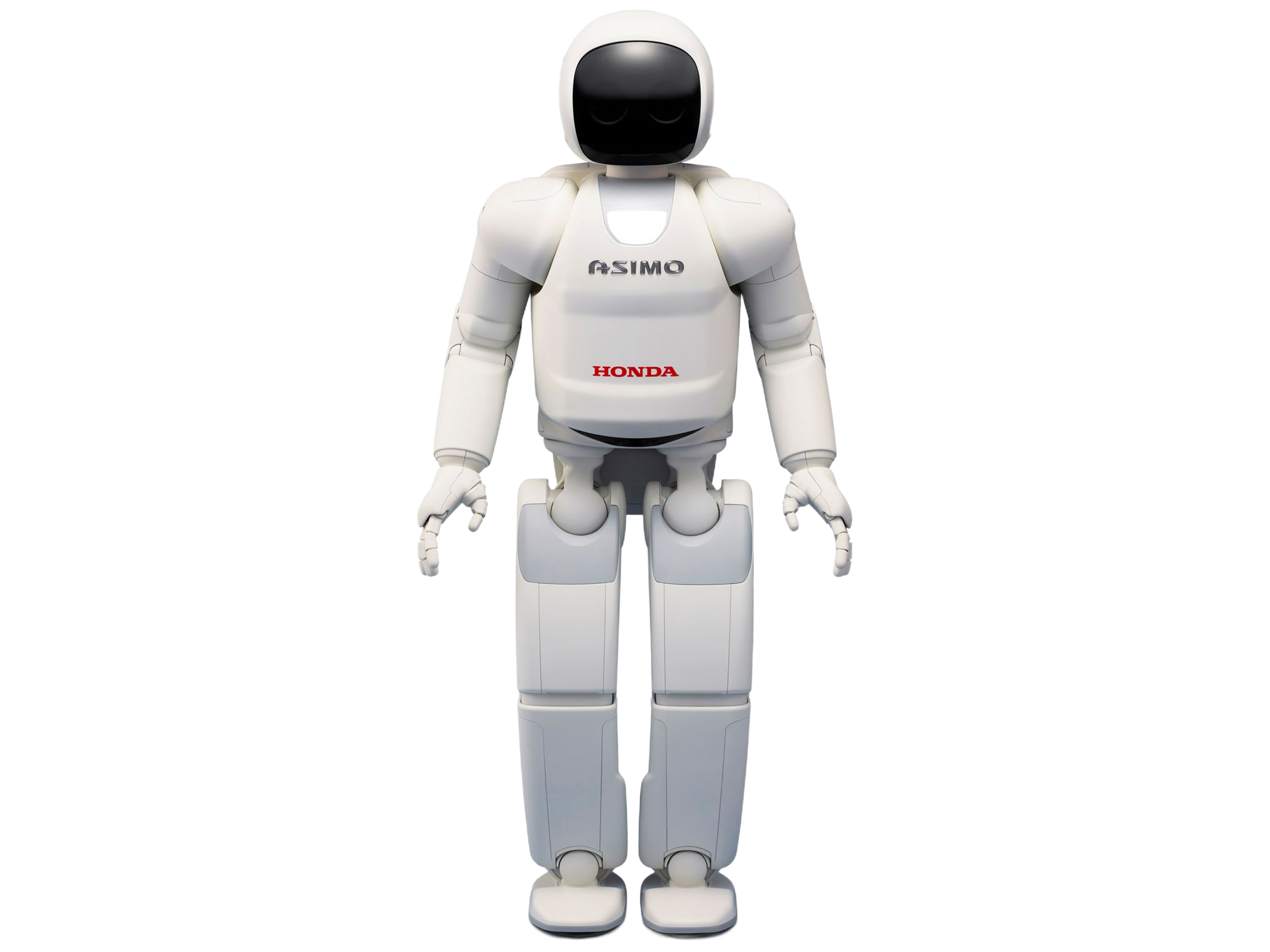 | |
| General information | |
| Manufacturer | Honda |
| Country of origin | Japan |
| Year unveiled | 2000 |
| Year retired | 2022 |
| Full name | Advanced Step in Innovative Mobility |
| Height | 130 cm (4 ft 3 in) |
| Weight | 48 kg (106 lb) |
| Degrees of freedom | 57 |
| Max running speed | 9 km/h (5.6 mph) |
| Battery | 51.8V lithium-ion |
| Operating time | ~1 hour |
| Units produced | ~100 |
| Website | global.honda |
ASIMO was formally announced on November 20, 2000, at Honda's Tokyo headquarters, where the original model stood 120 cm tall, weighed 43 kg, and had 26 degrees of freedom [6]. Honda never sold ASIMO commercially but produced roughly 100 units for demonstrations, research, and corporate events worldwide. The program ran through seven major iterations between 2000 and 2011; Honda ended development in June 2018 and the robot gave its final public performance on March 31, 2022, at the Miraikan museum in Tokyo. Over its operational life, all ASIMO units collectively took more than 33.26 million steps and walked a combined distance of approximately 7,907 kilometers (4,913 miles) [1].
Etymology
The name ASIMO is an acronym for "Advanced Step in Innovative Mobility." It also serves as a play on the Japanese word "ashi" (meaning leg or foot) combined with a shortened form of "mobility" [2]. The name's phonetic similarity to Isaac Asimov, the science fiction author who formulated the famous Three Laws of Robotics, has been widely noted. Honda's corporate communications department officially stated in a 2004 interview with Japan Inc. magazine that the name has "absolutely nothing to do with Isaac Asimov" [3]. Despite this denial, many observers and commentators have continued to interpret the naming as an intentional homage to the influential writer.
When did Honda start developing ASIMO?
Origins and the E-series (1986 to 1993)
Honda's humanoid robotics program began in 1986, when the company established a fundamental technology research center at its Wako facility in Saitama Prefecture, Japan. The goal was ambitious: to create a robot that could walk on two legs like a human. This initiative, undertaken by an automobile manufacturer with no prior robotics pedigree, was considered unusual at the time.
The program produced the E-series ("E" for experimental), a sequence of seven increasingly capable bipedal walking robots developed between 1986 and 1993 [4].
| Model | Year | Height (cm) | Weight (kg) | DOF | Speed (km/h) | Key achievement |
|---|---|---|---|---|---|---|
| E0 | 1986 | 101.3 | 16.5 | 6 | Very slow (~5 sec/step) | First Honda bipedal robot; straight-line walking |
| E1 | 1987 | 128.8 | 72 | 12 | 0.25 | Faster step cycles; improved joint control |
| E2 | 1989 | 132 | 67.7 | 12 | 1.2 | Dynamic walking capability |
| E3 | 1991 | 136.3 | 86 | 12 | 3.0 | Matched average human walking speed |
| E4 | 1991 | 159.5 | 150 | 12 | 4.7 | Extended knee design for higher speed |
| E5 | 1992 | 170 | 150 | 12 | N/A | Autonomous walking with self-contained sensors |
| E6 | 1993 | 174.3 | 150 | 12 | N/A | Stair climbing; obstacle traversal; autonomous balancing |
The E-series focused exclusively on legs and locomotion. E0, the first model, could only walk in a straight line, with each step taking about five seconds. By E3 in 1991, engineers had achieved walking at 3 km/h, matching the average human pace. E6, the final prototype, represented a breakthrough: it could autonomously balance, walk over obstacles, and climb stairs [4].
The P-series (1993 to 2000)
With the leg technology maturing, Honda's engineers turned to building complete humanoid bodies. The P-series ("P" for prototype) added torsos, arms, and heads to the walking platform established by the E-series [5].
| Model | Year | Height (cm) | Weight (kg) | DOF | Walking speed (km/h) | Battery | Operating time | Key achievement |
|---|---|---|---|---|---|---|---|---|
| P1 | 1993 | 191.5 | 175 | 30 | 2.0 | 135V Ni-Zn | 15 min | First full-body humanoid prototype (kept secret until 1996) |
| P2 | 1996 | 182.0 | 210 | 30 | 2.0 | 38.4V NiMH | 25 min | First self-regulating wireless bipedal walking robot; public debut |
| P3 | 1997 | 160.0 | 130 | 28 | 2.0 | 51.8V Li-ion | 30 min | First completely independent bipedal humanoid walking robot |
| P4 | 2000 | 160.0 | 80 | 34 | 1.6 | Li-ion | 1 hr (walking) | Bridge to ASIMO; significant weight reduction |
P1 was developed in 1993 but kept under wraps until Honda publicly revealed P2 in December 1996. At 182 cm tall and 210 kg, P2 was the first self-regulating, two-legged walking robot using wireless control, which made it a landmark achievement in robotics [5]. Honda's public announcement of P2 stunned the robotics community, as few outside the company knew Honda had been working on humanoid robots for a decade.
P3, introduced in September 1997, was described as the first completely independent bipedal humanoid walking robot. It was significantly smaller and lighter than P2 (160 cm, 130 kg) and introduced lithium-ion battery technology. P4, initially called the "P3-improved prototype" and later designated P4 in 2009, further reduced weight to 80 kg and served as the direct precursor to ASIMO [5].
When was ASIMO unveiled?
ASIMO was unveiled on October 31, 2000, with a formal global announcement on November 20 [6]. Designed to function in human living environments, Honda's research indicated that the ideal height for a mobility assistant robot was between 120 cm and the height of an average adult, a range conducive to operating door knobs, light switches, and working at standard table height. The original ASIMO stood 120 cm tall, weighed 43 kg, and had 26 degrees of freedom, a dramatic reduction in size and weight from the P3 [6].
Honda's president at the time described the project as consistent with the company's direction to "enhance human mobility," the same philosophy that guided its automobile and motorcycle businesses.
ASIMO versions and evolution
ASIMO underwent seven major updates between 2000 and 2011, each bringing substantial improvements in physical capability, intelligence, and autonomy.
Version comparison table
| Specification | 2000 (Original) | 2002 | 2004 | 2005 | 2007 | 2011 (All-New) |
|---|---|---|---|---|---|---|
| Height | 120 cm | 120 cm | 120 cm | 130 cm | 130 cm | 130 cm |
| Weight | 43 kg | 54 kg | 48 kg | 54 kg | 54 kg | 48 kg |
| DOF | 26 | 26 | 34 | 34 | 34 | 57 |
| Walking speed | 1.6 km/h | 1.6 km/h | 2.5 km/h | 2.7 km/h | 2.7 km/h | 2.7 km/h |
| Running speed | N/A | N/A | 3 km/h | 6 km/h | 6 km/h | 9 km/h |
| Battery | 38.4V NiMH | 38.4V NiMH | 51.8V Li-ion | 51.8V Li-ion | 51.8V Li-ion | 51.8V Li-ion |
| Operating time | ~30 min | ~30 min | 40 min to 1 hr | ~1 hr | ~1 hr | ~1 hr |
| Key advance | First ASIMO | Face/voice recognition, Internet | First running (3 km/h), Li-ion battery | 6 km/h running, receptionist tasks | Multi-robot coordination, auto-charging | 57 DOF, autonomous behavior, dexterous hands |
2002 update
The 2002 version added intelligence capabilities that transformed ASIMO from a walking machine into an interactive robot [7]. New features included face recognition (capable of identifying approximately 10 faces), voice recognition (distinguishing human voices from background noise), gesture recognition, and Internet connectivity that allowed it to answer simple questions about news and weather. In 2002, Honda produced 20 units of this model and began offering ASIMO for rental in Japan [7].
2004 update
The 2004 update represented a major hardware overhaul [8]. Honda replaced the nickel-metal hydride battery with a 51.8V lithium-ion pack, increasing operating time from 30 minutes to between 40 minutes and one hour. A newly developed high-speed processing circuit and high-power motor drive unit provided hardware performance more than four times faster than the previous model. Most notably, ASIMO ran for the first time, achieving 3 km/h with a step cycle of 0.36 seconds and an airborne time of 0.05 seconds per stride, comparable to a person jogging [8]. The number of degrees of freedom increased from 26 to 34.
2005 update
Debuted on December 13, 2005, this version doubled the running speed to 6 km/h and added the ability to run in circular patterns through proactive posture control while both feet were airborne [9]. ASIMO gained the ability to walk while holding a person's hand, navigate using a "total control system" for receptionist and delivery tasks, and push a cart. Honda began deploying this version at the Honda Wako Building office in spring 2006, where it served as a receptionist and guide [9].
2007 update
In December 2007, Honda demonstrated new intelligence technologies at its Tokyo headquarters that enabled multiple ASIMO robots to work together in coordination [10]. The robots could share task information over a network and, based on factors like battery power and distance to the task, determine the most efficient way to divide responsibilities. When one ASIMO unit needed to recharge, other units would automatically step in to cover its duties. A new autonomous charging station allowed ASIMO to identify and walk to the nearest available charger when its battery fell below a set threshold [10].
The 2007 update also introduced improved navigation: ASIMO could predict the direction a person would walk within the next few seconds using pre-set space sensors and choose an alternate path to avoid collision.
2011 "All-New ASIMO"
_2011_Tokyo_Motor_Show.jpg)
Unveiled on November 8, 2011, the "all-new ASIMO" was the final and most advanced version [11]. Honda described it as "the world's first autonomous behavior control technology," marking a transition in which the robot "advanced from an 'automatic machine' to an 'autonomous machine'" capable of making decisions based on its surroundings without operator control [11].
Physical improvements: The 2011 model stood 130 cm tall (10 cm taller than the original) and weighed 48 kg (a 6 kg reduction from the 2005/2007 versions). Degrees of freedom increased dramatically to 57 (an addition of 23 over the previous model), distributed as follows [11]:
| Body part | DOF |
|---|---|
| Head | 3 |
| Each arm | 7 (14 total) |
| Each hand | 13 (26 total) |
| Torso | 2 |
| Each leg | 6 (12 total) |
| Total | 57 |
Mobility advances: Running speed increased to 9 km/h (5.6 mph). For the first time, ASIMO could run backward, hop continuously on one foot, and jump on two feet. A new control technology enabled mid-motion adjustments to landing positions, allowing the robot to handle uneven surfaces [11].
Dexterous hands: Honda developed "a highly functional compact multi-fingered hand, which has a tactile sensor and a force sensor imbedded on the palm and in each finger," enabling independent finger control. This allowed ASIMO to perform delicate tasks such as picking up a glass bottle and twisting off the cap, holding a soft paper cup to pour liquid without crushing it, and communicating using sign language [11].
Autonomous intelligence: The new ASIMO could integrate information from multiple sensors to estimate environmental changes in real time. It could simultaneously track and predict the motion of multiple people, perform voice recognition in noisy and crowded environments, and determine its next action without operator control [11].
How does ASIMO work?
Locomotion and balance
ASIMO's walking system was built on the Zero Moment Point (ZMP) theory, a mathematical framework for bipedal balance control. The ZMP defines the point on the ground where the sum of horizontal inertia and gravity forces produces zero moment. By continuously calculating and adjusting to keep the ZMP within the robot's support polygon (the area where its feet contact the ground), ASIMO maintained dynamic stability during walking and running [12].
Honda implemented three layered postural control strategies [12]:
- Floor Reaction Control: Specialized padding on the soles of the feet absorbed floor irregularities while maintaining a firm stance.
- Target ZMP Control: When the robot's body began to tilt forward, it shifted its upper body in the opposite direction to maintain position.
- Foot-Planting Location Control: If ZMP correction alone was insufficient, the system adjusted step length to restore the proper relationship between body position, speed, and stride.
Honda's intelligent real-time flexible walking technology, branded "i-WALK," extended these principles to enable continuous turning. According to Honda, ASIMO could "predict its next movement in real time and shift its centre of gravity in anticipation," whereas previous prototypes such as P2 and P3 "turned according to combinations of stored walking patterns" [27]. The i-WALK system predicted how far ASIMO should shift its center of gravity to the inside of a turn and how long that shift should be maintained, allowing it to walk faster or slower and change foot placement at will without stopping [27].
Sensors and perception
ASIMO carried a comprehensive sensor suite for environmental awareness:
- Visual system: Two camera "eyes" provided stereo vision for object recognition, distance measurement, posture analysis, gesture recognition, facial recognition, and environmental mapping.
- Ground sensors: Laser and infrared sensors on the ground detected surface conditions and aided navigation.
- Ultrasonic sensors: Front and rear ultrasonic sensors measured distances to obstacles.
- Foot sensors: Six-axis force sensors in each foot measured ground reaction forces.
- Torso sensors: A gyroscope and acceleration sensors monitored body orientation.
- Hand sensors: Tactile and force sensors in the palms and fingers (2011 model) enabled delicate object manipulation.
For navigation, ASIMO used pre-loaded maps combined with floor markings and real-time sensor data to determine its position and plan routes. The 2011 version added predictive algorithms that could anticipate pedestrian movements several seconds in advance [11].
Computing
ASIMO used a custom three-dimensional computer processor designed by Honda, consisting of three stacked dies: a processor, a signal converter, and memory. This integrated design helped minimize the size and weight of the onboard computing system while providing sufficient processing power for real-time balance control, sensor fusion, and autonomous decision-making [2].
Power system
The original 2000 ASIMO used a 38.4V nickel-metal hydride battery providing approximately 30 minutes of operation. Starting with the 2004 version, Honda switched to a 51.8V lithium-ion battery that extended operating time to approximately one hour. Charging time was reduced from the original system to about three hours for the Li-ion pack [2]. The 2007 update added autonomous recharging capability, allowing ASIMO to navigate to a charging station independently when battery levels dropped below a predefined threshold.
What could ASIMO do?
Mobility
ASIMO's mobility evolved significantly across its generations. The original 2000 model could walk at 1.6 km/h on flat surfaces. By 2004, it achieved its first running gait at 3 km/h. The 2005 version doubled running speed to 6 km/h, and the final 2011 model reached 9 km/h [8][9][11]. Throughout its development, ASIMO demonstrated stair climbing, walking on slopes and uneven surfaces, and turning while walking. The 2011 model could run backward and perform continuous hopping on one or both feet.
Manipulation and dexterity
The 2011 model's 13-degree-of-freedom hands (per hand) with embedded sensors represented a significant achievement in robotic manipulation. ASIMO could [11]:
- Pick up a glass bottle and twist off the cap
- Hold a soft paper cup and pour liquid without crushing it
- Carry a tray of drinks to a person who placed an order
- Push a cart through an environment
- Perform sign language expressions
- Open doors and operate light switches
Communication
ASIMO could interpret voice commands in both English and Japanese. It could recognize approximately 10 different faces and respond to handshakes, waves, and pointing gestures. Its vocabulary included roughly 50 different greetings and calls, plus 30 commands. When deployed as a receptionist, it could identify visitors, greet them by name, and guide them to their destination [2][7].
Notable public appearances
ASIMO became one of the most publicly visible robots in history, appearing at major events, museums, and on television programs around the world.
Key events timeline
| Date | Event | Details |
|---|---|---|
| February 14, 2002 | New York Stock Exchange opening bell | First robot to ring the NYSE opening bell; celebrated Honda's 25th anniversary on the exchange. ASIMO climbed stairs to the podium, shook hands with NYSE Chairman Richard Grasso, and rang the bell [13]. |
| 2003 | Science Museum, London | European demonstrations |
| 2003 to 2005 | U.S. and Canada tour | Reached more than 130,000 people |
| 2004 | Carnegie Mellon Robot Hall of Fame | Inducted alongside Robby the Robot, Astro Boy, C-3PO, and Shakey [14] |
| March 2005 | Film premiere of "Robots" | Walked the red carpet at the world premiere of the animated film |
| June 2005 | Disneyland Tomorrowland | Began appearing at the Honda ASIMO Theater inside the Innoventions attraction for Disneyland's 50th anniversary [15] |
| May 13, 2008 | Detroit Symphony Orchestra | Conducted "The Impossible Dream" from "Man of La Mancha" alongside cellist Yo-Yo Ma; first known robot to conduct a live orchestra performance [16] |
| October 28, 2008 | Miraikan, Tokyo | Performed a seven-minute step and dance routine for Prince Charles during his visit [17] |
| 2008 | Genoa Science Festival, Italy | Italian debut at the annual science event |
| 2010 | Sundance Film Festival | Featured in a documentary |
| 2011 | FIRST Championship | Demonstrated at the student robotics competition |
| December 2, 2011 | QI (British quiz show) | Appeared as a guest on the BBC panel show hosted by Stephen Fry; carried drinks to the panel and danced with comedian Jo Brand [18] |
| April 24, 2014 | Miraikan, Tokyo | Met U.S. President Barack Obama during his state visit to Japan; the two bowed to each other, conversed in English, and played soccer, with ASIMO kicking the ball to the president [19] |
| March 31, 2022 | Final performance, Honda headquarters | Farewell show featuring classic routines including running and dancing [1] |
The Detroit Symphony Orchestra concert
One of ASIMO's most memorable appearances was conducting the Detroit Symphony Orchestra on May 13, 2008. Honda programmed ASIMO to mimic the conducting motions of Charles Burke, the orchestra's education director, who had recorded his movements conducting "The Impossible Dream" approximately six months earlier. The concert also featured renowned cellist Yo-Yo Ma performing a separate piece. The event highlighted both ASIMO's precision in reproducing human movements and its limitations: during the first rehearsal, the orchestra lost its place when ASIMO began slowing the tempo, something a human conductor would have sensed and corrected in real time. Honda brought ASIMO to Detroit alongside a $1 million gift to the orchestra's music education fund [16].
Meeting President Obama
During President Obama's April 2014 state visit to Japan, a meeting with ASIMO at the Miraikan (National Museum of Emerging Science and Innovation) in Tokyo became a widely covered media moment. The robot introduced itself in English, saying "Mr. President, I am ASIMO." The two exchanged bows, and ASIMO demonstrated its jumping ability before challenging Obama to a game of soccer. ASIMO kicked the ball toward the president, who trapped it with his foot. "How about that, that was pretty impressive," Obama remarked. In subsequent remarks to students at the museum, the president joked, "The robots are a little scary" [19].
Disneyland residency
From June 2005, ASIMO performed at the Honda ASIMO Theater inside Disneyland's Innoventions attraction in Tomorrowland. This was ASIMO's only permanent installation in North America and was part of Disneyland's 50th anniversary celebration. The attraction continued until Innoventions closed in April 2015 [15].
Miraikan Science Museum
The Miraikan (National Museum of Emerging Science and Innovation) in Tokyo served as ASIMO's primary public venue for much of its career. The robot performed regular demonstrations at the museum, interacting with visitors and showcasing its latest capabilities. ASIMO's final public demonstrations at the Miraikan ended on March 31, 2022 [1].
Notable incidents
ASIMO's public career was not without mishaps. The most famous incident occurred in 2006, when the robot fell while climbing a set of stairs during a live demonstration in Japan. Midway up the steps, ASIMO turned toward the audience before suddenly collapsing. Stagehands quickly erected a screen around the fallen robot to prevent further photography, but audience members had already captured the entire incident on video. The footage went viral on YouTube and became one of the most viewed robotics clips of its era [20].
Honda engineers acknowledged that stair climbing remained one of the most challenging tasks for bipedal robots. On multiple occasions, audience members at public demonstrations filmed ASIMO stumbling or falling on stairs, and several such videos gained widespread attention online. These incidents, while embarrassing for Honda, underscored the genuine difficulty of bipedal locomotion and made the robot more relatable to the public [20].
Deployment and production
How many ASIMO units were built?
Honda produced approximately 100 ASIMO units over the robot's lifetime [2]. The first batch of 20 units was manufactured in 2002. Additional units were built for subsequent versions, though Honda never disclosed exact production figures for later models.
How much did ASIMO cost?
Honda never officially disclosed the per-unit cost of ASIMO. Various estimates have placed the figure at approximately $2.5 million per robot, though some sources have cited higher figures [21]. The high cost reflected the custom-designed components, including the stacked three-dimensional processor, precision actuators, and extensive sensor suite. ASIMO was never offered for commercial sale to the general public.
Rental program
In November 2001, Honda introduced an improved ASIMO version available for rental in Japan [22]. The rental program was aimed at corporate events, trade shows, and promotional appearances. The 2001 rental version featured dramatically reduced startup time (4 minutes compared to the previous 40-minute requirement), voice command recognition, and autonomous navigation along prescribed routes [22].
When did ASIMO retire?
Honda first signaled the end of ASIMO development in July 2018, announcing that it would cease development to "focus on more practical applications" using the technology developed through ASIMO's lifespan [1]. The decision came after 18 years of research and reflected both the limitations of the ASIMO platform and a strategic shift in Honda's robotics priorities.
ASIMO's operational costs presented significant challenges for any potential commercial deployment. The robot required expert operators, regular maintenance, and carefully managed environments. Its battery life, while improved to approximately one hour, limited practical work duration. The robot also depended on pre-mapped environments and floor markings for navigation, constraining its usefulness outside controlled settings.
ASIMO made its final public performance on March 31, 2022, at Honda's facilities. During the farewell event, the robot performed some of its signature routines, including running across the stage and dancing. Honda marked the occasion as the end of an era, though the company emphasized that the knowledge and technology developed through ASIMO would continue to inform its future robotics work [1].
Legacy
Influence on humanoid robotics
ASIMO's impact on the field of humanoid robotics is difficult to overstate. As one of the first robots to demonstrate stable, dynamic bipedal walking in real-world conditions, it established fundamental principles that continue to underpin modern humanoid robot development. The ZMP-based walking algorithms pioneered for ASIMO formed the foundation for bipedal control systems used by subsequent robots from Boston Dynamics, Agility Robotics, and numerous other companies [12].
ASIMO also demonstrated that a humanoid robot could function, however imperfectly, in human-oriented environments. Its ability to climb stairs, open doors, carry objects, and interact with people through speech and gesture showed the field what was possible, even if the technology was not yet practical for commercial deployment.
How does ASIMO compare to modern AI-driven humanoids like Atlas and Optimus?
ASIMO was an explicitly programmed, model-based machine: its motion relied on the analytically derived ZMP framework and pre-loaded walking patterns rather than learned behavior. The current generation of humanoids takes a fundamentally different approach, using deep reinforcement learning, neural networks, and large-scale simulation to learn locomotion and manipulation policies. Modern platforms, including Tesla's Optimus, Boston Dynamics' all-electric Atlas, Agility Robotics' Digit, and Unitree's H1, all build on the proof of concept that ASIMO established, that a bipedal robot can walk, run, and work in spaces designed for humans. These newer systems benefit from advances in computing power, battery technology, artificial intelligence, and actuator design that were unavailable during ASIMO's development, and they are aimed at real commercial work such as warehouse logistics and factory tasks rather than the demonstration role ASIMO filled [23].
Carnegie Mellon Robot Hall of Fame
In 2004, ASIMO was inducted into the Carnegie Mellon Robot Hall of Fame, alongside fictional robots C-3PO, Robby the Robot, and Astro Boy, as well as the real-world Shakey robot. Takeo Kanade, a professor of computer science and robotics at Carnegie Mellon, noted that "when we look back, the Honda P2 Robot, from which ASIMO was developed, is THE one which ignited the current fever of humanoid and entertainment robots" [14].
Cultural impact
ASIMO became a global cultural icon that transcended the robotics community. Its distinctive astronaut-like appearance, with a white body and dark visor-like face, made it instantly recognizable. The robot appeared in films, television programs, museums, and advertising campaigns worldwide. It inspired the 2012 film "Robot & Frank," which featured a humanoid assistant caring for an aging man [2].
ASIMO served as an important educational tool, sparking interest in science, technology, engineering, and mathematics (STEM) among young people. Its U.S. and Canada tour from 2003 to 2005 reached more than 130,000 people, and its long-running Disneyland residency introduced millions of visitors to humanoid robotics [15].
Walking assist devices
Honda's ASIMO research directly led to the development of practical assistive devices. The company created the Stride Management Assist and Bodyweight Support Assist prototypes, which applied bipedal locomotion technology to help people with mobility impairments. Honda began lease sales of its Walking Assist Device in Japan, priced at 45,000 yen per month for a 36-month contract [24].
Post-ASIMO: Honda's robotics future
Avatar robots
Following ASIMO's retirement, Honda shifted its robotics focus to avatar robots: remote-controlled systems that allow a human operator to interact with distant environments through a robotic body. In September 2021, Honda unveiled research achievements in avatar robotics, with a target of practical deployment in the 2030s [25]. The avatar robot's multi-fingered hands are being developed by engineers who previously worked on ASIMO, applying the dexterity expertise accumulated over decades. Unlike the grippers used by many competing avatar robots, Honda is developing hands with individually articulated fingers to enable intuitive synchronization with a human operator's hand movements [25].
ASIMO OS
At the Consumer Electronics Show (CES) in January 2025, Honda announced that its first in-house software system for the then-forthcoming 0 Series electric vehicles would be called "ASIMO OS," honoring the robot's legacy within the company's next-generation products [26]. ASIMO OS was designed to manage over-the-air software updates, Level 3 autonomous driving capabilities, and other vehicle systems, and it was to be standard equipment on all 0 Series Honda models, including the Honda 0 SUV and Honda 0 Saloon, with production planned to begin in 2026 at Honda's Ohio facility [26]. Those vehicles never reached buyers. On March 12, 2026, Honda announced that it had cancelled the development and market launch of three EV models planned for North American production, the Honda 0 SUV, the Honda 0 Saloon, and the Acura RSX, citing changes in the business environment, and said it would book losses of up to 2.5 trillion yen while shifting resources back toward hybrids [28]. That announcement did not mention ASIMO OS by name, and it did not state what becomes of the operating system now that its launch vehicles are cancelled.
The decision to name the vehicle operating system after ASIMO reflected the cultural significance the robot holds within Honda. Company executives described it as a way to carry forward the spirit of innovation that ASIMO represented into Honda's electric vehicle future.
Specifications summary (final 2011 model)
| Category | Specification |
|---|---|
| Height | 130 cm (4 ft 3 in) |
| Weight | 48 kg (106 lb) |
| Width | 45 cm |
| Depth | 34 cm |
| Total degrees of freedom | 57 |
| Head DOF | 3 |
| Arm DOF (each) | 7 |
| Hand DOF (each) | 13 |
| Torso DOF | 2 |
| Leg DOF (each) | 6 |
| Maximum walking speed | 2.7 km/h (1.7 mph) |
| Maximum running speed | 9 km/h (5.6 mph) |
| Battery type | 51.8V lithium-ion |
| Operating time | Approximately 1 hour |
| Charging time | Approximately 3 hours |
| Actuators | Servomotor + harmonic drive |
| Vision | Stereo cameras (two eyes) |
| Ground sensors | Laser and infrared |
| Proximity sensors | Ultrasonic (front and rear) |
| Foot sensors | 6-axis force sensors |
| Body sensors | Gyroscope, accelerometer |
| Hand sensors | Tactile and force (palm and fingers) |
| Face recognition | Up to ~10 faces |
| Voice recognition | English and Japanese |
| Fingers per hand | 5 |
| Navigation | Pre-loaded maps, floor markings, real-time sensor fusion |
| Autonomous charging | Yes (from 2007) |
| Connectivity | Wi-Fi |
See also
- Humanoid robot
- Honda
- Boston Dynamics Atlas
- Tesla Optimus
- SoftBank Robotics NAO
- Toyota T-HR3
- Zero Moment Point
- Bipedal locomotion
- History of humanoid robots
References
- ^1 ^2 ^3 ^4 ^5 ^6ASIMO retires from performing after 22 years - SoraNews24
- ^1 ^2 ^3 ^4 ^5 ^6 ^7ASIMO - Wikipedia
- ^ASIMO is retiring: A history of Honda's groundbreaking robots - Japanese Nostalgic Car
- ^1 ^2Honda E series - Wikipedia
- ^1 ^2 ^3Honda P series - Wikipedia
- ^1 ^2 ^3Honda Debuts New Humanoid Robot "ASIMO" - Honda Global Newsroom
- ^1 ^2 ^3Introducing a New ASIMO Featuring Intelligence Technology - Honda Global Newsroom
- ^1 ^2 ^3Honda Reveals Technologies Next-Generation ASIMO - Honda Global Newsroom
- ^1 ^2 ^3Honda Debuts New ASIMO (December 2005) - Honda Global Newsroom
- ^1 ^2Honda Develops Intelligence Technologies Enabling Multiple ASIMO Robots to Work Together - Honda Global Newsroom
- ^1 ^2 ^3 ^4 ^5 ^6 ^7 ^8 ^9Honda Unveils All-new ASIMO with Significant Advancements - Honda Global Newsroom
- ^1 ^2 ^3How ASIMO Works - HowStuffWorks
- ^Honda's Humanoid Robot "ASIMO" Rings Opening Bell at the NYSE - Honda Global Newsroom
- ^1 ^2Carnegie Mellon University Announces 2004 Inductees into The Robot Hall of Fame
- ^1 ^2 ^3Mickey Welcomes ASIMO to Disneyland's 50th Anniversary - Honda Global Newsroom
- ^1 ^2Honda's ASIMO Robot to Conduct the Detroit Symphony Orchestra - Honda News
- ^Prince Charles looks at 'Asimo' at Miraikan - Getty Images
- ^QI: Series I, Episode 13 - Intelligence - British Comedy Guide
- ^1 ^2ASIMO Greets U.S. President Obama - Honda Global Newsroom
- ^1 ^2Honda Asimo takes a nasty fall - Engadget
- ^Unpacking the ASIMO Robot Cost - TechAnnouncer
- ^1 ^2Honda Introduces New ASIMO Humanoid Robot for Rental Business - Honda Global Newsroom
- ^ASIMO Robot: The Humanoid That Changed Robotics History - ThinkRobotics
- ^Honda to Begin Lease Sales of Honda Walking Assist Device in Japan - Honda News
- ^1 ^2Honda Takes on Challenges to Create Avatar Robots Applying ASIMO Technologies - Honda Stories
- ^1 ^2Honda 0 Saloon and Honda 0 SUV Prototypes Make Global Debut at CES; Honda Announces New ASIMO Operating System - PR Newswire
- ^1 ^2All-New ASIMO - Honda European Media Newsroom
- ^Honda Announces Losses Associated with Reassessment of Automobile Electrification Strategy; Revision to Forecast for Consolidated Financial Results; and Future Direction - Honda Global Newsroom, March 12, 2026
- ^Morio. "Honda ASIMO (ver. 2011) 2011 Tokyo Motor Show.jpg". Wikimedia Commons. Original source. CC BY-SA 3.0. Wikimedia Commons 960-pixel rendition; no additional changes. Accessed October 3, 2026.
Improve this article
Add missing citations, update stale details, or suggest a clearer explanation. Every suggestion is reviewed for sourcing before it goes live.
8 revisions · v8 · 5,576 words · full history
Fact-checks are independent of edits: a reviewer re-verifies the article against its sources and stamps the date. How we verify
Research and drafting on this wiki are AI-assisted, under named human editorial standards. How AI is used here
Cite this page: AI Wiki. "Honda ASIMO." aiwiki.ai, updated 1 Aug 2026. CC BY 4.0. https://aiwiki.ai/wiki/honda_asimo