

PNDbotics Adam Lite
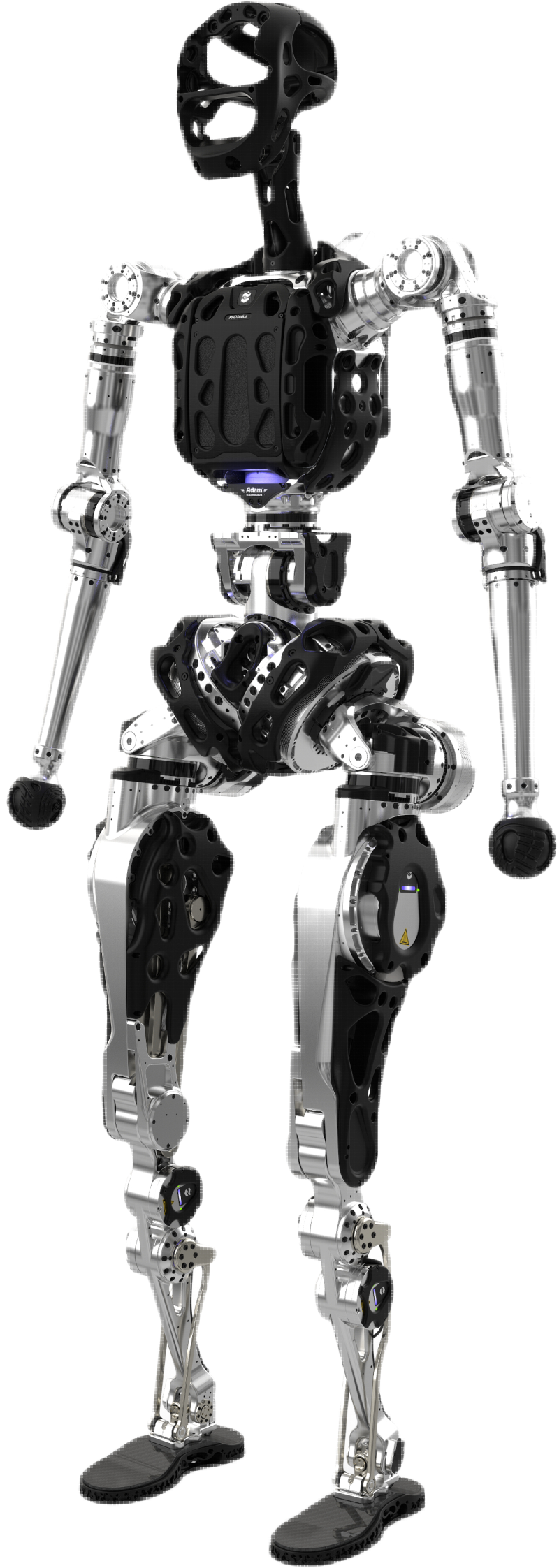
PNDbotics Adam Lite is a full-size bipedal humanoid robot developed by PNDbotics, a Chinese robotics company specializing in full-stack humanoid robot design and manufacturing. Standing 1.67 meters tall and weighing 60 kilograms, Adam Lite features 25 degrees of freedom powered by proprietary quasi-direct-drive (QDD) force-controlled actuators capable of delivering up to 340 N-m of torque at the knee and hip joints. The robot serves as the entry-level configuration in the Adam product family, which also includes the Adam SP, Adam Standard, and Adam Pro variants.
| PNDbotics Adam Lite | |
|---|---|
 | |
| General information | |
| Manufacturer | PNDbotics |
| Country of origin | China |
| Year revealed | 2024 |
| Status | Available for order |
| Price | ~$120,000 USD |
| Website | pndbotics.com |
Designed primarily as a developer and research platform, Adam Lite targets academic institutions, robotics startups, and R&D laboratories seeking a standardized, stable hardware base for locomotion research, embodied AI experimentation, and reinforcement learning development. Its open-source SDK and compatibility with NVIDIA Isaac Gym simulation environments position it as a practical tool for accelerating sim-to-real transfer workflows in humanoid robotics.
PNDbotics
PNDbotics (formally registered as PNDbotics (Ningbo) Co., Ltd.) is a Chinese robotics company that began operations in June 2023, focusing on the design, development, and manufacture of humanoid robots.[1][2] The company maintains its headquarters in the Future Science and Technology Building on Yiheyuan Road in Haidian District, Beijing, with additional operations in Ningbo and a Hong Kong business center established in March 2026 for international expansion.[3][4]
The company distinguishes itself through full-chain independent research and development, spanning from underlying core components to complete robot bodies. PNDbotics operates its own intelligent manufacturing center that supports in-house production of motors, drivers, reducers, robot joints, and assembled platforms.[2] This vertical integration gives the company control over the entire supply chain, from individual actuator modules to finished humanoid systems, rather than relying on third-party components.
PNDbotics' core technical competencies include model-based robot gait planning, whole-body control, embodied intelligence algorithms, and motion control technology based on deep reinforcement learning.[2] The company has developed high-performance robot controllers, battery management systems (BMS), and its proprietary PND Smart Actuator (PSA) series of integrated modular actuators.
In February 2026, following the Adam robot's appearance on CCTV's Spring Festival Gala, PNDbotics completed a funding round of hundreds of millions of yuan (tens of millions of US dollars), led by CITIC Goldstone.[5] The company's core team consists of veterans from leading universities and top-tier technology companies.[1]
Design and hardware
Physical configuration
Adam Lite follows a conventional humanoid layout with a head, torso, two arms, and two bipedal legs, designed to maximize compatibility with human environments such as stairs, handrails, doors, and workstations. The robot stands 1.67 meters (5 feet 6 inches) tall and weighs 60 kilograms (132 pounds), making it roughly comparable in stature to an average adult human.[6][7]
The body shell is constructed from composite materials that protect the internal mechanisms while keeping overall weight manageable. A key design principle of the Adam Lite is modularity. The architecture allows users to swap components such as sensor heads, battery packs, and limb units without extensive reconfiguration, making it an effective testbed for developing custom robotics solutions. PNDbotics describes the platform as built around the concepts of "modulation, standardization, integration, and uncompromising standard of stability."[1][7]
Unlike the higher-tier Adam SP and Adam Pro, the Adam Lite uses simplified spherical hand end-effectors (ball grippers) rather than dexterous five-fingered hands. This simplification reduces mechanical complexity and cost while still allowing basic grasping and manipulation tasks sufficient for locomotion-focused research.
Degrees of freedom
Adam Lite provides 25 degrees of freedom distributed across the body. The joint configuration breaks down as follows:[6]
| Body region | DOF per side | Joint breakdown |
|---|---|---|
| Leg | 6 | Hip x3, Knee x1, Ankle x2 |
| Arm | 5 | Shoulder x3, Elbow x1, Forearm x1 |
| Waist | 3 (total) | 3 rotational axes |
| Head | 0 | Fixed (no active neck joints) |
The 12 degrees of freedom in the legs (6 per leg) provide a full range of bipedal locomotion capabilities, including forward walking, lateral stepping, turning, and stair climbing. Each arm has 5 degrees of freedom, giving the robot functional reach and basic manipulation ability. The 3-DOF waist allows torso rotation and bending, which contributes to natural gait dynamics and balance recovery.
Notably, the Adam Lite lacks active head joints. The Adam Pro variant adds a 2-DOF head (yaw and pitch) for active gaze control, while Adam Lite relies on body-mounted or fixed-position sensors for perception.[6]
Actuators
All 25 joints in Adam Lite are driven by PNDbotics' proprietary quasi-direct-drive (QDD) force-controlled actuators from the PND Smart Actuator (PSA) series. These actuators highly integrate motors, reducers, position encoders, servo drivers, and communication units into compact modular packages.[8]
The PSA series uses a naming convention of PND-[Motor Model]-[Reducer Model]-[Reduction Ratio]-[Type], where "S" denotes a harmonic reducer and "P" denotes a planetary reducer. PNDbotics offers 11 PSA variants across its product line, covering different torque and speed requirements for various joint positions.[8]
Key actuator specifications for Adam Lite include:
| Joint location | Peak torque | Notes |
|---|---|---|
| Knee / Hip | ~340 N-m | Primary locomotion joints |
| Ankle | ~46 N-m | Balance and ground contact |
| Arm (shoulder/elbow) | ~60 N-m | Manipulation and gesturing |
The quasi-direct-drive design minimizes gear reduction ratios compared to traditional high-ratio gearbox actuators. This approach provides several advantages for a research platform: improved back-drivability (allowing the joints to be moved by external forces), better force transparency for contact-sensitive tasks, and inherent mechanical compliance that makes physical interactions safer for nearby humans. The trade-off is that QDD actuators typically require larger, more powerful motors to achieve equivalent output torques, contributing to the robot's overall weight.[7][9]
Power system
Adam Lite shares the same standardized battery system used across the entire Adam product family. The specifications are:[6]
| Parameter | Value |
|---|---|
| Battery capacity | 1,172 W-h |
| Maximum voltage | 46.2 V |
| Maximum output current | 25 A |
| Estimated runtime | ~3 hours |
The substantial 1,172 W-h battery capacity supports extended operation sessions, which is particularly valuable for research environments where experiments may run for hours at a time. PNDbotics' in-house battery management system (BMS) handles charging, cell balancing, and thermal monitoring.[2]
Compute platform
Adam Lite's central control unit is built around the Intel NUC12WSKi7, featuring a 12th-generation Intel Core i7-1260P processor. This processor provides 12 cores and 16 threads with a maximum turbo frequency of 4.7 GHz, paired with 16 GB of DDR4 3200 MHz RAM, 128 GB of storage, and Intel Iris Xe integrated graphics.[6]
| Component | Specification |
|---|---|
| Processor | Intel Core i7-1260P (12th Gen) |
| Cores / Threads | 12 / 16 |
| Max turbo frequency | 4.7 GHz |
| RAM | 16 GB DDR4 3200 MHz |
| Storage | 128 GB |
| GPU | Intel Iris Xe Graphics |
| AI compute module | None (Lite configuration) |
| Control unit | PND Real-Time Control Unit (RCU) |
One significant distinction between Adam Lite and the higher-tier Adam variants is the absence of a dedicated AI compute module. The Adam Standard, Adam SP, and Adam Pro all include an NVIDIA Jetson Orin NX 16 GB module, which delivers up to 100 TOPS of AI inference performance through 32 Tensor Cores and a 1,024-core Ampere GPU. Adam Lite relies solely on the Intel i7 processor for all computation, including motion control, sensor processing, and any on-board AI inference.[6]
This means that developers working with Adam Lite who require high-throughput neural network inference (for example, running large computer vision models or vision-language-action models on the robot) may need to add external compute resources or offload processing to a workstation over the network. For pure locomotion research and control algorithm development, the Intel i7 provides sufficient processing power.
The PND Real-Time Control Unit (RCU) works alongside the main processor to handle low-level motor control, joint coordination, and real-time communication with the actuators over PNDbotics' proprietary PND-Network protocol.
Sensors and connectivity
Adam Lite does not ship with a standard perception sensor (depth camera or LiDAR) in its base configuration, unlike the Adam Standard and Adam SP which include an Intel RealSense D455 depth camera, or the Adam Pro which ships with a ZED MINI stereo depth sensor.[6] The modular sensor head design allows researchers to mount their preferred perception hardware, giving flexibility for custom sensor configurations.
All Adam variants share the same connectivity specifications:[6]
| Feature | Specification |
|---|---|
| Wi-Fi | Wi-Fi 6 |
| Bluetooth | Bluetooth 5.0 |
| Internal network | 16-port Gigabit Ethernet programmable switch |
| Control protocol | PND-Network (proprietary real-time protocol) |
The 16-port Gigabit Ethernet switch provides a high-bandwidth internal network for connecting actuators, sensors, and compute modules with low latency. The PND-Network protocol is a proprietary high-real-time communication stack that supports integration of multimodal sensors including LiDAR, visual cameras, and force/torque sensors.[7]
Software and control
Control architecture
Adam Lite runs PNDbotics' full-stack control system, which fuses Whole-Body Control (WBC) and Model Predictive Control (MPC). This combination ensures balance robustness and trajectory tracking accuracy even under dynamic disturbances such as uneven terrain, external pushes, or unexpected obstacles. The same control framework is shared across all Adam variants.[6][10]
Whole-Body Control coordinates the motion of all joints simultaneously, ensuring that locomotion, balance, and arm movements work together as a unified system rather than being controlled independently. Model Predictive Control provides a forward-looking optimization that plans the robot's trajectory over a short time horizon, allowing it to anticipate and prepare for upcoming terrain changes or disturbances.
Reinforcement learning and sim-to-real transfer
A central part of Adam Lite's value proposition as a research platform is its compatibility with modern reinforcement learning workflows. PNDbotics has designed the platform to support the full sim-to-real pipeline:[10][11]
- Simulation training: Locomotion and control policies are developed in large-scale physics simulation environments, with explicit support for NVIDIA Isaac Gym as the primary parallel deep reinforcement learning (DRL) training environment.
- Policy transfer: Trained policies are transferred from simulation to the physical robot through sim-to-real techniques.
- Real-world refinement: The robot's QDD actuators and force sensors provide the precise feedback needed to fine-tune policies on real hardware.
This workflow enables rapid iteration on locomotion behaviors. Researchers can train thousands of policy variants in parallel simulation, select the most promising candidates, and deploy them on the Adam Lite hardware for real-world validation. The mechanical transparency of the QDD actuators (their ability to accurately reflect external forces) is particularly important for this process, as it reduces the "reality gap" between simulated and physical dynamics.[9][10]
Open-source SDK
PNDbotics provides an open-source SDK that allows low-level robot operation and customization. The SDK gives developers direct access to joint-level control, sensor data streams, and motion planning interfaces. It is compatible with NVIDIA Isaac Gym for parallel DRL training, enabling developers to prototype custom behaviors and reproduce them across robot fleets.[10][11]
The company maintains a GitHub repository (github.com/Greatsjk/Adam-PNDbotics) with open-source resources, and provides a teleoperation framework (pnd_teleoperation) that supports multiple data input sources for developing teleoperated behaviors.[12][13]
For Adam Lite specifically, the SDK supports:
- Direct joint position, velocity, and torque control
- Real-time sensor data acquisition over PND-Network
- Integration with ROS (Robot Operating System) workflows
- Custom gait development and locomotion policy deployment
- Battery monitoring and power management
CLOT teleoperation system
While primarily developed for the higher-DOF Adam variants, PNDbotics' CLOT (Closed-Loop Global Motion Tracking) teleoperation system is part of the broader Adam ecosystem. Published as a research paper in February 2026, CLOT uses a high-frequency localization feedback loop to achieve drift-free human-to-humanoid motion mimicry. The system employs a Transformer-based policy network to capture spatiotemporal information and was trained using over 20 hours of carefully captured human motion data.[14]
CLOT supports input from Noitom motion capture systems and Meta Quest 3S headsets, and was validated on the Adam Pro 1 (a 31-DOF variant). The underlying teleoperation framework is available to all Adam platform users through the open-source SDK.[14][13]
Adam product family comparison
Adam Lite is the entry-level configuration within PNDbotics' Adam product line. The following table compares all four humanoid variants:[6]
| Feature | Adam Lite | Adam Standard | Adam SP | Adam Pro |
|---|---|---|---|---|
| Height | 1.67 m | 1.67 m | 1.67 m | 1.67 m |
| Weight | 60 kg | 61 kg | 62 kg | 63 kg |
| Total degrees of freedom | 25 | 29 | 41 | 43 |
| Arm DOF (per arm) | 5 | 7 | 13 | 13 |
| Leg DOF (per leg) | 6 | 6 | 6 | 6 |
| Waist DOF | 3 | 3 | 3 | 3 |
| Head DOF | 0 | 0 | 0 | 2 |
| Hand type | Spherical gripper | Not specified | Dexterous 5-fingered | Dexterous 5-fingered |
| DOF per hand | 0 | 2 (wrist only) | 6 + 2 wrist | 6 + 2 wrist |
| Peak leg torque | 340 N-m | 340 N-m | 340 N-m | 340 N-m |
| Max walking speed | 1.5 m/s (5.4 km/h) | 1.5 m/s | 1.5 m/s | 1.5 m/s |
| Battery capacity | 1,172 W-h | 1,172 W-h | 1,172 W-h | 1,172 W-h |
| Motion control CPU | Intel i7-1260P | Intel i7-1260P | Intel i7-1260P | Intel i7-1260P |
| AI compute module | None | Jetson Orin NX 16 GB | Jetson Orin NX 16 GB | Jetson Orin NX 16 GB |
| Depth sensor | None (modular slot) | Intel RealSense D455 | Intel RealSense D455 | ZED MINI |
| Estimated price | ~$120,000 USD | Not publicly listed | ~$100,000 USD | Not publicly listed |
The progression from Adam Lite to Adam Pro primarily adds upper-body dexterity and perception capabilities while keeping the leg platform, power system, and core control architecture identical. Adam Lite's 25-DOF configuration focuses resources on robust bipedal locomotion with functional but simplified arms, making it the most straightforward platform for researchers whose work centers on walking, balance, and terrain navigation.
The Adam Standard adds wrist articulation (2 DOF per wrist, bringing arms to 7 DOF each) and the NVIDIA Jetson Orin NX for on-board AI inference, but does not include dexterous hands. The Adam SP adds 6-DOF dexterous five-fingered hands to each arm (13 DOF per arm total), enabling complex manipulation tasks. Adam Pro adds a 2-DOF active head on top of the SP configuration, allowing active gaze tracking and a ZED MINI stereo camera for higher-fidelity depth perception.
PNDbotics also offers the Adam-U, an upper-body variant that mounts a torso and arms (with up to 31 quasi-direct-drive joints) onto a stationary or wheeled base. The Adam-U is aimed at high-precision motion capture, AI training data collection, and desktop-level manipulation tasks, with pricing starting at $45,000 for certain configurations.[15]
Technical specifications summary
| Category | Specification | Value |
|---|---|---|
| Physical | Height | 1.67 m (5 ft 6 in) |
| Physical | Weight | 60 kg (132 lb) |
| Mobility | Total degrees of freedom | 25 |
| Mobility | Leg DOF (per leg) | 6 |
| Mobility | Arm DOF (per arm) | 5 |
| Mobility | Waist DOF | 3 |
| Mobility | Max walking speed | 1.5 m/s (5.4 km/h, 3.4 mph) |
| Manipulation | Hand type | Spherical gripper (ball gripper) |
| Manipulation | Payload capacity | 5 kg (11 lb) |
| Power | Battery capacity | 1,172 W-h |
| Power | Maximum voltage | 46.2 V |
| Power | Maximum output current | 25 A |
| Power | Estimated runtime | ~3 hours |
| Computing | Motion control processor | Intel Core i7-1260P (12th Gen) |
| Computing | CPU cores / threads | 12 / 16 |
| Computing | RAM | 16 GB DDR4 3200 MHz |
| Computing | Storage | 128 GB |
| Computing | AI compute module | None (available in Standard/SP/Pro) |
| Computing | Control unit | PND Real-Time Control Unit (RCU) |
| Actuators | Type | QDD force-controlled (PSA series) |
| Actuators | Peak knee/hip torque | ~340 N-m |
| Actuators | Peak ankle torque | ~46 N-m |
| Actuators | Peak arm torque | ~60 N-m |
| Connectivity | Wi-Fi | Wi-Fi 6 |
| Connectivity | Bluetooth | Bluetooth 5.0 |
| Connectivity | Internal network | 16-port Gigabit Ethernet |
| Connectivity | Control protocol | PND-Network (proprietary) |
| Control | Locomotion framework | Whole-Body Control + Model Predictive Control |
| Control | Learning support | Reinforcement learning, imitation learning |
| Control | Simulation compatibility | NVIDIA Isaac Gym |
Applications
Academic research
Adam Lite's primary target market is academic and institutional robotics research. The combination of documented, reproducible hardware with an open-source SDK and standardized simulation support makes it suitable for several research domains:[7][10]
- Locomotion control: The 12-DOF leg system and QDD actuators provide a full-featured platform for studying bipedal gait generation, dynamic balance, and terrain adaptation algorithms.
- State estimation: Joint-level torque sensing and force feedback enable research into proprioceptive state estimation and contact detection without relying on external motion capture systems.
- Whole-body planning: The 25-DOF kinematic chain allows investigation of coordinated multi-limb motion planning, including tasks that require simultaneous walking and reaching.
- Sim-to-real transfer: The mechanical transparency of the QDD actuators reduces the simulation-to-reality gap, making Adam Lite a practical testbed for validating reinforcement learning policies trained in simulation.
Robotics education
The modular architecture and standardized hardware reduce the setup burden for educational programs in robotics and AI. Students and educators can focus on developing control algorithms and AI models rather than debugging hardware integration issues. The compatibility with widely used tools such as NVIDIA Isaac Gym and ROS provides a familiar software environment for graduate and undergraduate robotics courses.
Developer prototyping
Robotics startups and corporate R&D teams can use Adam Lite as a standardized hardware platform for prototyping humanoid behaviors. The open SDK and modular sensor head allow teams to develop and test custom perception, navigation, and manipulation solutions before committing to more expensive hardware configurations. Successful prototypes can then be migrated to the Adam Standard or Adam SP for deployment-oriented testing with dexterous hands and dedicated AI compute.
Industrial and service pilot programs
While the Adam SP is PNDbotics' primary platform for industrial deployment, Adam Lite can serve as a lower-risk entry point for companies evaluating humanoid robots for manufacturing, logistics, or service applications. The robot's human-scale form factor allows it to navigate standard human environments (doorways, corridors, stairs), and its 5 kg payload capacity enables basic material handling tasks.
In September 2025, Chinese automation equipment supplier Tianyong Engineering announced a strategic partnership with PNDbotics to integrate Adam into core automotive production processes, including parts assembly, handling, testing, commissioning, and hazardous task substitution. Tianyong also committed to providing full-lifecycle services through its Robot Management System (RMS), covering maintenance, upgrades, and predictive maintenance.[16]
Competitive landscape
Adam Lite competes in the growing market for humanoid robot research and development platforms. Several other companies offer humanoid robots positioned at the research and developer tier.
Key competitors
| Robot | Manufacturer | Height | DOF | Approximate price | Key differentiator |
|---|---|---|---|---|---|
| Adam Lite | PNDbotics | 1.67 m | 25 | ~$120,000 | Full-size QDD platform, open SDK |
| G1 | Unitree Robotics | 1.32 m | 23-43 | $16,000-$74,000 | Low cost, high volume, large developer community |
| GR-2 | Fourier Intelligence | 1.75 m | 53 | ~$150,000-$170,000 | Healthcare focus, high payload |
| Walker S2 | UBTECH | 1.70 m | 44 | Not publicly listed | Industrial partnerships, established brand |
| Digit | Agility Robotics | 1.75 m | 16+ | ~$100,000+ | Warehouse logistics focus |
| GR-1 | Fourier Intelligence | 1.65 m | 44 | ~$100,000+ | Rehabilitation and research |
The Unitree G1 has emerged as the most widely adopted research humanoid due to its substantially lower price point (starting around $16,000 for the base model), with over 5,500 units shipped in 2025 and more than 30 published academic papers using the platform.[17] However, the G1 is significantly smaller at 1.32 meters tall and was designed primarily as a compact, affordable platform rather than a full-size human-scale robot.
Adam Lite differentiates itself through its full-size human-scale form factor (1.67 m), its proprietary QDD actuators with high force transparency, and PNDbotics' full-stack vertical integration. The vertical integration means PNDbotics designs and manufactures everything from individual actuator components to the complete robot body, giving the company fine-grained control over hardware quality and performance characteristics.[2]
Internationally, the humanoid robot market includes larger players such as Figure AI (Figure 02, Figure 03), Apptronik (Apollo), Tesla (Optimus), and Boston Dynamics (Atlas), though these companies primarily target industrial deployment rather than the research platform segment.
The broader humanoid robot market is projected to grow substantially. Citibank has forecast that the global humanoid robot market could reach $7 trillion by 2050, with approximately 650 million robots deployed worldwide. China's government has committed to investing 1 trillion yuan in robotics and high-tech industries, creating a favorable policy environment for companies like PNDbotics.[18]
Availability and pricing
Adam Lite is listed at approximately $120,000 USD, making it the mid-range option in the Adam product family when considering that the Adam-U upper-body variant starts at $45,000 and the Adam SP is priced at approximately $100,000.[15][7] PNDbotics does not maintain standard retail pricing; prospective customers are directed to contact the company for custom quotations, SDK access, and developer kit details.
The robot is available for order through PNDbotics directly and through international distributors. The Tianyong Engineering partnership is expected to support scaling production capacity through manufacturing expertise and production line infrastructure.[16]
See also
- Humanoid robots
- Adam SP
- PNDbotics
- Reinforcement learning
- Embodied AI
- Unitree G1
- Fourier Intelligence GR-2
References
- ^1 ^2 ^3PNDbotics official website
- ^1 ^2 ^3 ^4 ^5About PNDbotics - PNDbotics Wiki
- ^After Spring Festival Gala Appearance, Ningbo-Based Humanoid Robot Company PNDbotics Secures Tens of Millions of Dollars in Funding - Pandaily
- ^PNDbotics Establishes Hong Kong Business Center - Submit123PR
- ^After Spring Festival Gala Appearance, PNDbotics Secures Funding - Pandaily
- ^1 ^2 ^3 ^4 ^5 ^6 ^7 ^8 ^9 ^10Product Introduction - PNDbotics Wiki
- ^1 ^2 ^3 ^4 ^5 ^6Adam Lite - Humanoid.guide
- ^1 ^2PNDbotics PSA Actuator Series - PNDbotics Wiki
- ^1 ^2From Lab to Pavement: PNDBotics Adam Humanoid Demonstrates Real-World Stair Navigation - Humanoids Daily
- ^1 ^2 ^3 ^4 ^5PNDbotics - Modular Full-Size Humanoid Robot Platform - Robots International
- ^1 ^2China's humanoid robot learns complex skills in hours without setup - Interesting Engineering
- ^Adam-PNDbotics - GitHub
- ^1 ^2PND Adam Teleoperation - PNDbotics Wiki
- ^1 ^2CLOT: Closed-Loop Global Motion Tracking for Whole-Body Humanoid Teleoperation - arXiv
- ^1 ^2Humanoid robots Adam and Adam-U display lifelike AI movement - Interesting Engineering
- ^1 ^2Tianyong Engineering partners with PNDBotics to accelerate humanoid robot deployment in China - Gasgoo
- ^Unitree G1 Price and Specs 2026 - BotInfo
- ^China, U.S. Locked in High-Stakes Race to Lead Humanoid Robot Revolution - TMTPOST
Improve this article
Add missing citations, update stale details, or suggest a clearer explanation. Every suggestion is reviewed for sourcing before it goes live.
6 revisions · v6 · 3,938 words · full history
Fact-checks are independent of edits: a reviewer re-verifies the article against its sources and stamps the date. How we verify
Research and drafting on this wiki are AI-assisted, under named human editorial standards. How AI is used here
Cite this page: AI Wiki. "PNDbotics Adam Lite." aiwiki.ai, updated 12 Apr 2026. CC BY 4.0. https://aiwiki.ai/wiki/pndbotics_adam_lite