

Adam SP
| Adam SP | |
|---|---|
 | |
| General information | |
| Manufacturer | PNDbotics |
| Country of origin | China |
| Status | In development / Early customer trials |
| Year revealed | 2025 |
| Price | ~$100,000 USD |
| Website | pndbotics.com |
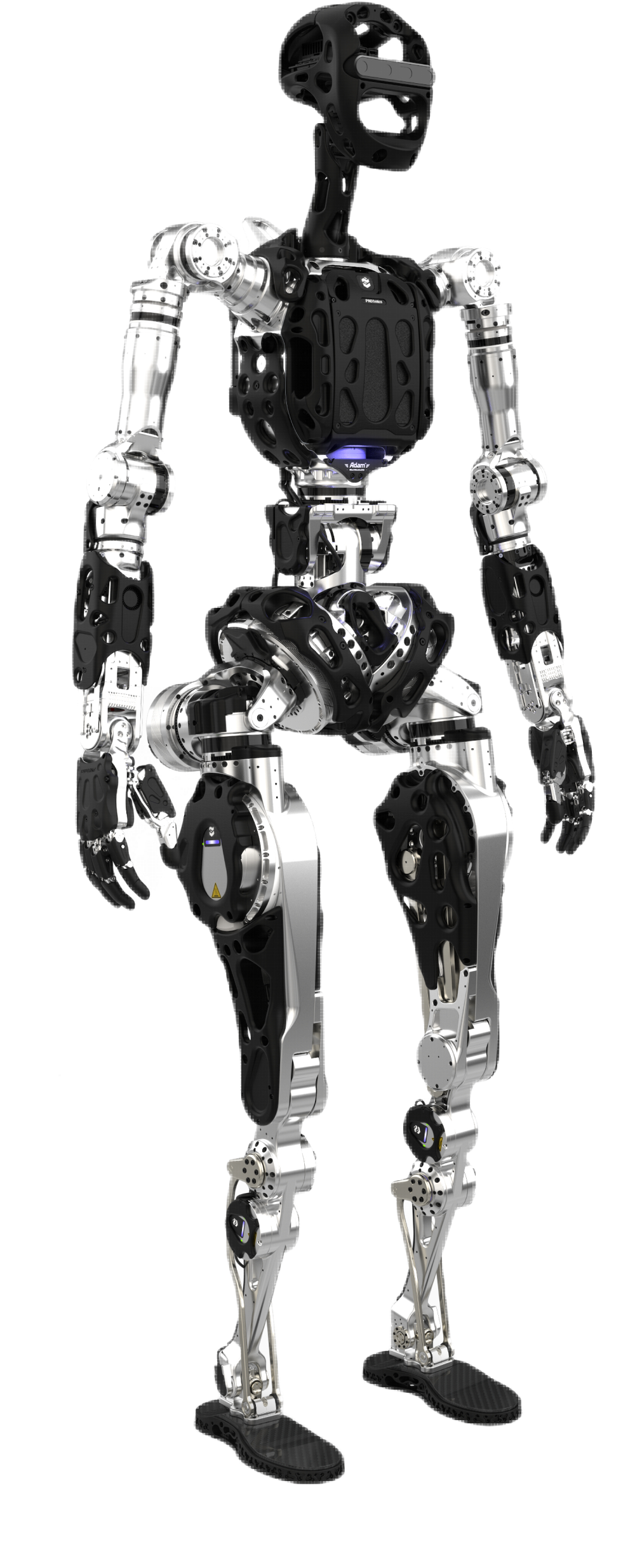
Adam SP is a full-size humanoid robot developed by PNDbotics, a Chinese robotics company specializing in full-stack humanoid robot design and manufacturing. Standing 1.67 meters tall and weighing 62 kilograms, Adam SP features 41 degrees of freedom, five-fingered dexterous hands, and proprietary PSA quasi-direct-drive actuators capable of delivering peak torques of 360 N-m. The robot combines reinforcement learning-based control with whole-body motion planning to achieve fluid, human-like movement across complex terrains. Adam SP represents the high-end configuration in PNDbotics' Adam product family, which also includes the Adam Lite developer platform and the Adam-U upper-body variant.
Since its introduction, Adam SP has attracted public attention through appearances at the VOYAGEX Music Festival in Changchun, the CAFA AI Week at Beijing's Central Academy of Fine Arts, and the 2025 World Humanoid Robot Games in Beijing, where it earned a gold medal in the martial arts performance category.
PNDbotics
PNDbotics (formally registered as PNDbotics (Ningbo) Co., Ltd.) is a Chinese robotics company founded in 2023 that designs, develops, and manufactures humanoid robots. The company is headquartered in the Future Science and Technology Building on Yiheyuan Road in Haidian District, Beijing, with additional operations in Ningbo.[1][2]
Unlike many robotics firms that integrate third-party components, PNDbotics has achieved full-chain independent research and development spanning from underlying core components to complete robot bodies. The company operates its own intelligent manufacturing center that supports in-house production of motors, drivers, reducers, robot joints, and assembled platforms.[2] This vertical integration gives PNDbotics control over the entire supply chain, from individual actuator modules to finished humanoid systems.
PNDbotics has successfully developed high-performance robot controllers, battery management systems (BMS), and integrated modular actuators. The company's core technical competencies include model-based robot gait planning, whole-body control, embodied intelligence algorithms, and motion control technology based on deep reinforcement learning (DRL).[2]
In February 2026, following a high-profile appearance of the Adam robot on CCTV's Spring Festival Gala, PNDbotics completed a funding round of hundreds of millions of yuan (tens of millions of US dollars), led by CITIC Goldstone.[3] In March 2026, the company established a Hong Kong business center as part of its internationalization strategy, positioning Hong Kong as a strategic hub for expansion into global markets.[4]
Design and hardware
Physical configuration
Adam SP follows a conventional humanoid layout with a head, torso, two arms, and two bipedal legs, designed to maximize compatibility with human environments such as stairs, handrails, doors, and workstations. The robot stands 1.67 meters (5 feet 6 inches) tall and weighs 62 kilograms (137 pounds), making it roughly comparable in stature to an average adult human.[5][6]
The body shell is constructed from composite materials that protect the internal mechanisms while keeping overall weight manageable. The modular architecture allows for quick swaps of sensor heads, battery packs, and limb units, which PNDbotics says will enable adaptation across diverse deployment scenarios including medical rehabilitation, hazardous-site inspection, and academic research.[5]
Actuators
Adam SP is powered by 41 joints driven by PNDbotics' proprietary PND Smart Actuator (PSA) quasi-direct-drive modules. These actuators can deliver peak torques of 360 N-m without requiring bulky gearboxes, achieving a combination of high power density and mechanical compliance.[5][6] Each limb incorporates a variable-ratio transmission that optimizes performance across different motion profiles, improving back-drivability and force sensing.
The quasi-direct-drive design is central to Adam SP's safety profile. By minimizing gear reduction ratios, the actuators allow the robot to produce soft, "human-safe" contacts during physical interactions. This compliance also enables precise force feedback, which is critical for manipulation tasks that involve handling fragile objects or working alongside human operators.[5]
Dexterous hands
A key differentiator of Adam SP from the entry-level Adam Lite is its pair of five-fingered dexterous hands. Each hand provides multiple degrees of freedom, enabling the robot to grasp tools, manipulate objects, and perform tasks such as packaging and laboratory work. The Adam Lite, by contrast, uses simplified ball-gripper or paddle-style end-effectors.[5][7]
Compute platform
Adam SP integrates the NVIDIA Jetson Orin NX 16 GB embedded module for on-board artificial intelligence inference and real-time decision-making.[5] The Jetson Orin NX provides up to 100 TOPS of AI compute performance within a compact, power-efficient form factor, supporting sensor fusion, computer vision, and neural network inference for locomotion and manipulation policies. The system also includes a PND Real-Time Control Unit that handles low-level motor control and joint coordination.
Software and AI
Control architecture
Adam SP's motion planning is handled by PNDbotics' full-stack control system, which fuses Whole-Body Control (WBC) and Model Predictive Control (MPC). This combination ensures balance robustness and trajectory tracking accuracy even under dynamic disturbances. The control framework enables the robot to maintain stability while performing complex full-body motions such as walking on uneven terrain, climbing stairs, and executing coordinated arm-leg movements.[8][9]
Reinforcement learning and imitation learning
The robot's locomotion and manipulation behaviors are trained using a combination of deep reinforcement learning and imitation learning. Policies are first developed in large-scale physics simulation environments and then transferred to the real robot through sim-to-real transfer techniques. PNDbotics uses NVIDIA Isaac Gym as its primary parallel DRL training environment, enabling rapid iteration on locomotion policies.[8][10]
The system comes preloaded with a vision-language-action (VLA) large model and a dataset of over 10,000 high-quality samples collected from real robots operating across diverse physical scenarios. This foundation enables the robot to learn and deploy new task capabilities within hours, with minimal task-specific configuration required.[11]
CLOT teleoperation system
PNDbotics developed CLOT (Closed-Loop Global Motion Tracking), a whole-body teleoperation system designed specifically for the Adam platform. Published as a research paper in February 2026, CLOT uses a high-frequency localization feedback loop to achieve drift-free human-to-humanoid motion mimicry. The system employs a Transformer-based policy network to capture spatiotemporal information, and was trained using over 20 hours of carefully captured human motion data.[12]
CLOT was deployed on the Adam Pro 1 (a 31-DoF full-sized variant) and demonstrated successful performance across three real-world teleoperation experiments: long-horizon loco-manipulation, extended-duration continuous operation, and robustness under strong external disturbances. The system supports input from Noitom motion capture systems and Meta Quest 3S headsets.[12][13]
Developer ecosystem
PNDbotics positions the Adam product family as developer-friendly, offering an open-source SDK that allows low-level robot operation and customization. The SDK is compatible with NVIDIA Isaac Gym for parallel DRL training, enabling developers to prototype custom behaviors (from ladder climbing to anomaly inspection) and reproduce them across robot fleets.[5][10]
The company maintains a GitHub repository (github.com/Greatsjk/Adam-PNDbotics) with open-source resources, and provides a teleoperation framework (pnd_teleoperation) that supports multiple data input sources for developing teleoperated behaviors.[13][14]
Technical specifications
| Category | Specification | Value |
|---|---|---|
| Physical | Height | 167 cm (5 ft 6 in) |
| Physical | Weight | 62 kg (137 lb) |
| Mobility | Total degrees of freedom | 41 |
| Mobility | DOF per hand | 7 |
| Mobility | Max walking speed | 6 km/h (1.67 m/s) |
| Manipulation | Payload capacity | 5 kg (11 lb) |
| Manipulation | Fingers per hand | 5 |
| Manipulation | Hand type | Dexterous five-fingered |
| Power | Battery life | ~2 hours |
| Computing | AI compute module | NVIDIA Jetson Orin NX 16 GB |
| Computing | Control unit | PND Real-Time Control Unit |
| Actuators | Type | PSA quasi-direct-drive |
| Actuators | Peak torque | 360 N-m |
| Actuators | Transmission | Variable-ratio integrated design |
| Control | Locomotion method | RL + imitation learning (sim-to-real) |
| Control | Control framework | Whole-Body Control + Model Predictive Control |
| AI | VLA model | Preloaded with 10,000+ real-world samples |
| AI | Simulation environment | NVIDIA Isaac Gym compatible |
Comparison with Adam Lite
Adam SP is the advanced configuration within PNDbotics' Adam product line. The following table compares it with the entry-level Adam Lite platform.
| Feature | Adam SP | Adam Lite |
|---|---|---|
| Height | 167 cm | 160 cm |
| Weight | 62 kg | 60 kg |
| Degrees of freedom | 41 | 25 |
| Peak actuator torque | 360 N-m (PSA) | 340 N-m (QDD) |
| Hand type | Dexterous five-fingered | Ball gripper |
| Battery life | ~2 hours | ~3 hours |
| Compute module | NVIDIA Jetson Orin NX 16 GB | 12th Gen Intel i7 + PND Control Unit |
| Target use case | Industrial, logistics, service | Research, education, developer platform |
| Estimated price | ~$100,000 USD | ~$120,000 USD |
The Adam Lite serves as a baseline developer platform with simpler end-effectors and fewer degrees of freedom, making it well-suited for locomotion research and embodied AI experimentation. Adam SP, with its additional 16 degrees of freedom and dexterous hands, targets more demanding industrial and service applications where complex manipulation is required.
PNDbotics also offers the Adam-U, an upper-body variant that mounts a torso and arms (with up to 31 quasi-direct-drive joints) onto a stationary or wheeled base. Built in partnership with Noitom and Inspire, the Adam-U is aimed at high-precision motion capture, AI training, and desktop-level manipulation tasks. A pre-order price of $45,000 has been reported for certain Adam-U configurations.[15]
Public demonstrations and events
CAFA AI Week (December 2024)
From December 3 to 13, 2024, the Central Academy of Fine Arts (CAFA) in Beijing held its Artificial Intelligence Digital Literacy Activity Week, focusing on the integration of artificial intelligence and art. PNDbotics was the only humanoid robot company invited to participate. The Adam robot navigated through the CAFA Art Museum, walking smoothly between classic artworks by masters such as Qi Baishi and Xu Beihong, demonstrating its ability to operate in crowded public spaces with fluid locomotion.[16]
VOYAGEX Music Festival (July 2025)
On July 12, 2025, Adam appeared on stage with Chinese musician Hu Yutong's band at the Changchun stop of the VOYAGEX Music Festival. Dressed in a loose-fitting hoodie, cap, and face covering to blend into the band's aesthetic, the robot played a white keytar strapped over its shoulder, tapping keys in rhythm and swaying side to side. While the sequences were pre-programmed and monitored by a live support team, the performance marked one of the first public demonstrations of a full-size humanoid robot performing as part of a live music act in China.[6][17] The appearance generated significant online discussion, with some commentators expressing fascination and others describing the spectacle as unsettling.[18]
World Humanoid Robot Games (August 2025)
At the 2025 World Humanoid Robot Games held in Beijing, PNDbotics' Adam competed in multiple events. The robot performed a Tai Chi routine called "Parting the Wild Horse's Mane," which earned a gold medal in the martial arts performance category. A judging panel scored PNDbotics' choreographed kung fu form at 31 points, the highest in the event. Adam was also the only full-sized humanoid to successfully complete the 100-meter obstacle course, demonstrating real-world navigation and balance capabilities.[19]
CCTV Spring Festival Gala (January 2026)
Adam appeared on CCTV's 2026 Spring Festival Gala, one of the most-watched television broadcasts in the world. The Gala featured humanoid robots from several Chinese companies, including Unitree Robotics, Galbot, Noetix, and MagicLab, marking the event as a showcase for China's rapidly advancing humanoid robotics industry. PNDbotics' appearance on this stage significantly raised the company's public profile and preceded its major funding round.[3][20]
Stair navigation demonstration
PNDbotics has released video footage showing Adam navigating real-world stairs in urban environments without external support, handling irregular step heights and public spaces. Development of this capability began with headless engineering prototypes (stripped-down versions of the Adam chassis) training on laboratory stairs with safety harnesses. The progression from lab to real-world stair climbing highlights the effectiveness of the company's reinforcement learning approach to terrain adaptation.[9]
Applications and deployment
Adam SP targets several application domains where repetitive, ergonomically taxing jobs require a human form factor.
Industrial manufacturing
In September 2025, Chinese automation equipment supplier Tianyong Engineering announced a strategic partnership with PNDbotics through its majority-owned subsidiary. Under the agreement, Tianyong Engineering will integrate Adam into core automotive production processes, including parts assembly, handling, testing, commissioning, and hazardous task substitution. Tianyong will also support PNDbotics in designing and building humanoid robot production lines and establishing local manufacturing facilities to bridge the gap from prototype development to mass production.[21]
Additionally, Tianyong Engineering will provide full-lifecycle services for PNDbotics products through its Robot Management System (RMS), covering maintenance, upgrades, refurbishment, second-hand recovery and circulation, and predictive maintenance. This arrangement essentially functions as a "4S shop" (sales, service, spare parts, survey) for robots.[21]
Logistics and service
PNDbotics positions Adam SP for logistics and customer-service pilots where human-scale navigation (through doorways, along corridors, up stairs) is essential. The robot's 5 kg payload capacity and dexterous hands allow it to handle packages, operate switches, and use standard human tools.[5]
Research and education
The open-source SDK, NVIDIA Isaac Gym compatibility, and modular hardware architecture make the Adam platform suitable for academic research in embodied AI, robot learning, and human-robot interaction. The CLOT teleoperation system provides an additional research tool for studying whole-body control and imitation learning.[12]
Competitive landscape
Adam SP enters a rapidly growing global market for humanoid robots. In China, PNDbotics competes with companies such as Unitree Robotics (H1, H2), UBTECH (Walker S), Fourier Intelligence (GR-1, GR-2), AGIBot (A2 series), and Galbot. Internationally, competitors include Figure AI (Figure 02, Figure 03), Apptronik (Apollo), Tesla (Optimus), and Boston Dynamics (Atlas).[22]
PNDbotics differentiates itself through its full-stack vertical integration (designing and manufacturing everything from individual actuators to complete robot bodies), its open developer ecosystem, and its focus on combining reinforcement learning with whole-body control for natural locomotion. The company's relatively modest scale compared to larger competitors like Unitree or Tesla is offset by its agility in deploying robots for specialized demonstrations and partnerships.
The broader humanoid robot market is expected to grow substantially. Citibank has forecast that the global humanoid robot market could reach $7 trillion by 2050, with approximately 650 million robots deployed worldwide. China's government has committed to investing 1 trillion yuan in robotics and high-tech industries, providing a favorable policy environment for companies like PNDbotics.[22]
Production and availability
As of early 2026, Adam SP is in the early customer trial phase, with scaled production planned to follow pending field feedback from initial deployments. The robot is priced at approximately $100,000 USD for the SP configuration. PNDbotics does not publicly list standard retail pricing; prospective customers are directed to contact the company for custom quotations, SDK access, and developer kit details.[5][6]
The Tianyong Engineering partnership is expected to play a central role in scaling production by providing manufacturing expertise and production line infrastructure.[21]
See also
- Humanoid robot
- Adam Lite
- PNDbotics
- Reinforcement learning
- Embodied AI
- Unitree Robotics
- UBTECH
- Figure AI
References
- ^PNDbotics official website
- ^1 ^2 ^3About PNDbotics - PNDbotics Wiki
- ^1 ^2After Spring Festival Gala Appearance, Ningbo-Based Humanoid Robot Company PNDbotics Secures Tens of Millions of Dollars in Funding - Pandaily
- ^PNDbotics Establishes Hong Kong Business Center, Advancing Global Expansion - Submit123PR
- ^1 ^2 ^3 ^4 ^5 ^6 ^7 ^8 ^9Adam SP - Humanoid.guide
- ^1 ^2 ^3 ^4Humanoid robot Adam debuts at music festival in China - New Atlas
- ^Adam Lite - Humanoid.guide
- ^1 ^2Product Introduction - PNDbotics Wiki
- ^1 ^2From Lab to Pavement: PNDBotics Adam Humanoid Demonstrates Real-World Stair Navigation - Humanoids Daily
- ^1 ^2PNDbotics - Modular Full-Size Humanoid Robot Platform - Robots International
- ^China's humanoid robot learns complex skills in hours without setup - Interesting Engineering
- ^1 ^2 ^3CLOT: Closed-Loop Global Motion Tracking for Whole-Body Humanoid Teleoperation - arXiv
- ^1 ^2PND Adam Teleoperation - PNDbotics Wiki
- ^Adam-PNDbotics - GitHub
- ^Humanoid robots Adam and Adam-U display lifelike AI movement - Interesting Engineering
- ^PNDbotics Brought The Humanoid Robot Adam To The CAFA AI Week - Sango Automation
- ^Robot Adam grooves on keytar at China's futuristic music festival - Interesting Engineering
- ^Outrage Erupts as Humanoid Robot Adam Steals the Spotlight at Major Chinese Music Festival - AI Commission
- ^Beijing World Humanoid Robot Games Takeaways - Mike Kalil
- ^The Robot Super Bowl: Humanoids Dominate China's 2026 Spring Festival Gala - Humanoids Daily
- ^1 ^2 ^3Tianyong Engineering partners with PNDBotics to accelerate humanoid robot deployment in China - Gasgoo
- ^1 ^2China, U.S. Locked in High-Stakes Race to Lead Humanoid Robot Revolution - TMTPOST
Improve this article
Add missing citations, update stale details, or suggest a clearer explanation. Every suggestion is reviewed for sourcing before it goes live.
5 revisions · v6 · 2,788 words · full history
Fact-checks are independent of edits: a reviewer re-verifies the article against its sources and stamps the date. How we verify
Research and drafting on this wiki are AI-assisted, under named human editorial standards. How AI is used here
Cite this page: AI Wiki. "Adam SP." aiwiki.ai, updated 12 Apr 2026. CC BY 4.0. https://aiwiki.ai/wiki/pndbotics_adam_sp