

SwitchBot Onero H1
| SwitchBot Onero H1 | |
|---|---|
 | |
| General information | |
| Manufacturer | SwitchBot (Wonderlabs, Inc.) |
| Country of origin | China |
| Year introduced | 2026 (CES 2026) |
| Status | Pre-order announced; shipping expected late 2026 |
| Price | US$9,999 (official pre-order listing); "less than $10,000" target |
| Height | ~1.3 m (4 ft 3 in) |
| Locomotion | Wheeled cylindrical base |
| Degrees of freedom | 22 |
| End effectors | Two options: claw gripper or five-finger hand |
| AI system | OmniSense VLA (on-device) |
| Sensors | Intel RealSense cameras (head, arms, hands, abdomen) |
| Battery life | ~4 hours |
| Website | switch-bot.com/products/onero-h1 |
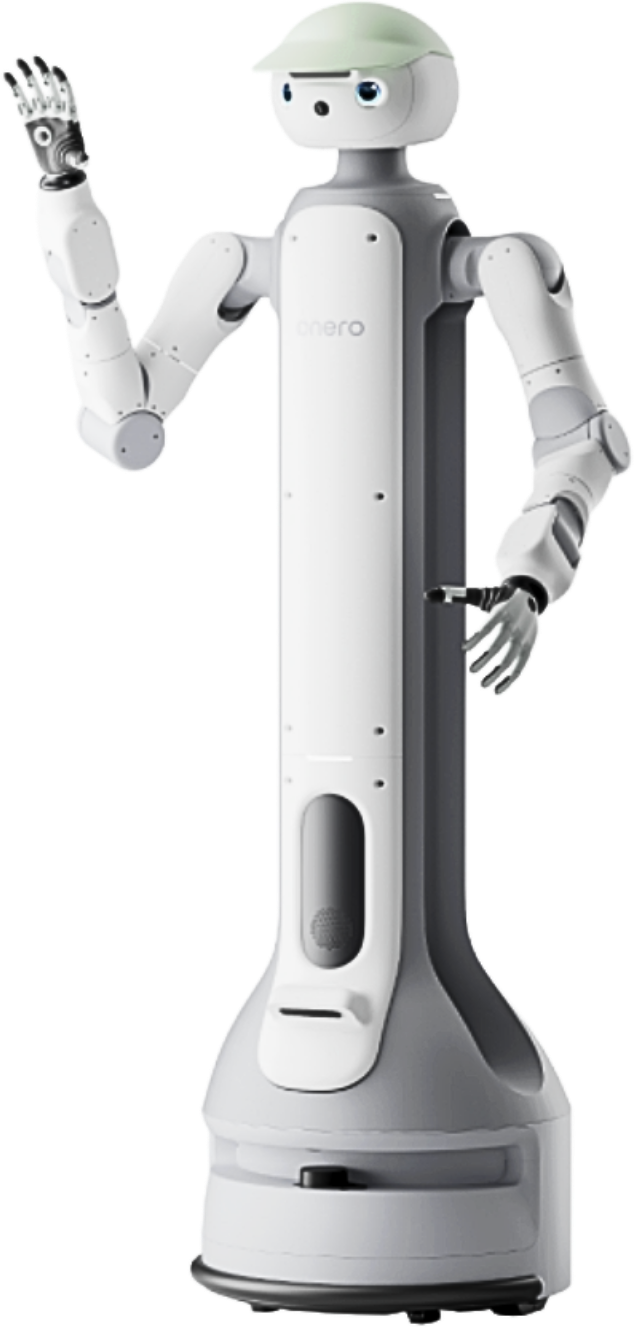
The SwitchBot Onero H1 (stylized as onero H1) is a wheeled humanoid robot developed by SwitchBot, a Chinese smart home technology company known for its line of affordable home automation products. SwitchBot's official store lists the Onero H1 at US$9,999 for pre-order, making it one of the most affordable manipulation-capable humanoid robots announced to date.[17] Unveiled at CES 2026 in Las Vegas in January 2026, the Onero H1 is SwitchBot's first humanoid robot and represents the company's entry into embodied AI and household robotics. SwitchBot has positioned it as "an accessible household robot that embodies the company's long-term vision for fully realized embodied AI"[10] and has promoted it as "the most accessible AI household robot,"[5] an affordable alternative to more expensive humanoid platforms from companies like Tesla, 1X Technologies, and Figure AI.[1][2]
Rather than attempting to replicate the full range of human locomotion through bipedal walking, the Onero H1 uses a wheeled base for mobility combined with two articulated arms featuring 22 degrees of freedom. This design choice reduces mechanical complexity and cost while still enabling the robot to perform a wide range of household tasks such as loading laundry, washing dishes, serving coffee, and folding clothes. A core element of SwitchBot's strategy is that the Onero H1 functions not as a standalone device but as an orchestrator within SwitchBot's broader smart home ecosystem, coordinating with robot vacuums, air purifiers, smart locks, and other connected devices to manage household duties.[3][4]
The robot is powered by SwitchBot's proprietary OmniSense Vision-Language-Action (VLA) model, which runs entirely on-device to process visual, depth, and tactile data without relying on cloud computing. SwitchBot has said the final retail price will be "less than $10,000," consistent with the US$9,999 figure shown on its official pre-order page, with availability expected in 2026.[5][11][17]
Background: SwitchBot
Company history
SwitchBot was founded in 2015 by Connery Lee (Zhichen Li) and Richard Mou. The company operates under the parent entity Wonderlabs, Inc. and is headquartered in Shenzhen, Guangdong, China. Lee, who had previously worked as an engineer at a smart home company in Singapore, conceived the idea for SwitchBot after moving to a rented apartment in China where he could not replace traditional light switches with smart ones. He designed a small mechanical device that could retrofit onto existing wall switches and toggle them on and off via a smartphone app.[6]
The company launched its first product, the SwitchBot Bot, through a Kickstarter campaign in December 2016, raising $72,311 from 667 backers. The SwitchBot Bot became the company's signature product: a compact, adhesive-backed actuator that physically presses buttons or flips switches, converting any "dumb" appliance into a smart one without requiring electrical modification or professional installation.[7]
Product ecosystem
Over the following years, SwitchBot expanded its product line to include a range of affordable smart home devices built around its core philosophy of retrofitting existing home infrastructure rather than replacing it. Key products include:
| Product | Description | Year introduced |
|---|---|---|
| SwitchBot Bot | Smart button pusher for switches and buttons | 2017 |
| SwitchBot Curtain | Motorized curtain opener/closer | 2019 |
| SwitchBot Hub Mini | Infrared hub for controlling legacy appliances | 2019 |
| SwitchBot Lock | Smart lock retrofit for existing deadbolts | 2022 |
| SwitchBot Universal Remote | Centralized IR remote supporting 80,000+ devices | 2024 |
| SwitchBot K20+ Pro | Modular multitasking household robot (vacuum, patrol, delivery) | 2025 |
| SwitchBot S20 Pro | Floor cleaning robot with dual-extension design | 2025 |
SwitchBot's devices are compatible with major smart home platforms including Amazon Alexa, Google Assistant, Apple Siri, and Matter. The company has built a reputation for producing practical, budget-friendly smart home gadgets that appeal to renters and homeowners alike.[8]
Progression toward robotics
SwitchBot's move into robotics began gaining momentum in 2025 with the introduction of the K20+ Pro at CES 2025. Billed as "the world's first multitasking household robot," the K20+ Pro combined a mini robot vacuum with a wheeled FusionPlatform that could carry loads up to 8 kg and integrate with accessories such as security cameras, air purifiers, and UV sterilization modules. The K20+ Pro used D-ToF LiDAR navigation for centimeter-level mapping accuracy and was priced starting at $699.99.[9]
The K20+ Pro represented a transitional step between traditional smart home devices and a full humanoid robot. Its modular, platform-based approach, where a mobile base coordinates multiple specialized functions, foreshadowed the ecosystem-centric philosophy that would later define the Onero H1.
Development and announcement
CES 2026 debut
SwitchBot unveiled the Onero H1 at CES 2026 on January 4-7, 2026, as the centerpiece of its "Smart Home 2.0" vision. The announcement positioned the robot as the logical extension of SwitchBot's decade-long journey from single-purpose smart home devices to a unified ecosystem where artificial intelligence and robotics work together to anticipate and respond to household needs.[10]
At the CES booth, SwitchBot demonstrated the Onero H1 performing a live laundry task. The robot picked up individual articles of clothing from a couch, rolled over to a washing machine, opened the appliance door, placed the items inside, and closed the door. Reporters from Engadget and The Verge observed the demo firsthand, noting that the robot completed the task successfully but moved slowly, taking nearly two minutes to transfer a single piece of clothing across a distance of only a few feet.[11][12] Yahoo Tech, describing the same demo, reported that the process took "about two minutes per garment, glacially slow by human standards, but potentially acceptable for a robot working while you're away."[18]
The Verge's senior smart home reviewer, Jennifer Pattison Tuohy, noted that while the robot collected clothing and loaded it into a washer, there was "no sign of it sorting, folding, or putting anything away" during the live demo. Pre-recorded promotional videos, however, showed the robot performing a broader range of tasks including making breakfast, washing windows, and folding clothes.[12]
Smart Home 2.0 vision
The Onero H1 was announced alongside several other new SwitchBot products as part of the company's broader "Smart Home 2.0" initiative. SwitchBot described Smart Home 2.0 as "a future where homes can sense, understand, and act across living, studying, working, and everything in between," a shift from homes that merely respond to commands toward systems with greater autonomy.[10] Other products announced at CES 2026 included:[10][20]
- Lock Vision Series: The world's first deadbolt smart lock with 3D structured-light facial recognition, using over 2,000 infrared projection points for millimeter-level biometric accuracy, with 3D liveness detection to prevent spoofing and up to 19 unlock methods. It runs on a 10,000mAh rechargeable battery (rated up to six months) with a CR123A backup, and a Pro variant adds palm-vein/palm-print recognition.
- AI MindClip: An 18-gram personal voice-based knowledge engine that records meetings and conversations, transforming them into structured summaries, to-dos, and searchable knowledge bases, with support for 100+ languages.
- Weather Station: A 7.5-inch E-Ink display that shows weather forecasts, air quality, sunrise/sunset times, and calendar integration with AI-powered weather briefings.
- OBBOTO: An AI companion desk globe light with over 2,900 RGB LEDs, motion sensing, and music visualization.
- Acemate Tennis Robot: An AI-powered tennis practice robot for real-rally training, developed by a SwitchBot-incubated sports tech subsidiary.
Design and technical specifications
Physical design
The Onero H1 stands approximately 1.3 meters (about 4 feet 3 inches) tall. Its body consists of a humanoid upper torso with a head, two articulated arms, and an oblong midsection, all mounted on a cylindrical wheeled base. This hybrid form factor deliberately trades the complexity of bipedal locomotion for simplified wheeled movement, reducing both cost and potential points of mechanical failure.[3]
The wheeled base allows the robot to navigate smoothly across flat indoor surfaces. Unlike bipedal humanoids that require sophisticated balance algorithms (such as Boston Dynamics' Atlas or Tesla's Optimus), the Onero H1's wheeled design provides inherent stability, which in turn reduces the computational overhead dedicated to maintaining balance and allows more processing resources to be allocated to manipulation and perception tasks.
Degrees of freedom and manipulation
The robot features 22 degrees of freedom distributed across its two articulated arms and joints. This provides sufficient flexibility for the robot to perform a variety of manipulation tasks, including grasping, pushing, opening doors and appliance lids, organizing objects, and folding fabrics. SwitchBot has stated that the 22 DoF configuration gives the Onero H1 "impressive range of motion compared to simpler robotic arms."[1]
According to reporting from Yahoo Tech, the Onero H1 is offered with two end-effector options: a simpler claw gripper and a more dexterous five-finger hand, the latter intended for grasping delicate objects and handling fabrics.[18]
The Onero H1 is designed to work in conjunction with SwitchBot's separately available Onero A1 robotic arms. The A1 is a lightweight, open-source robotic arm compatible with LeRobot, ROS 2, and MoveIt2, suggesting that SwitchBot envisions a modular ecosystem where robotic components can be developed, upgraded, and customized over time.[13]
Sensors and perception
The Onero H1's perception system relies on multiple Intel RealSense depth cameras embedded throughout the robot's body, positioned on the head, arms, hands, and abdomen. These cameras provide real-time visual and depth data that feed into the robot's AI system, enabling it to construct 3D maps of its environment, detect obstacles, recognize objects, and plan manipulation strategies.[1][14][19]
The multi-camera placement ensures that the robot has perception coverage from multiple angles simultaneously. Head-mounted cameras provide a wide-angle view of the room for navigation and scene understanding, while cameras on the arms and hands enable close-range perception during manipulation tasks, such as judging the position and orientation of objects being grasped.
| Sensor component | Location | Function |
|---|---|---|
| Intel RealSense cameras | Head | Room-level 3D mapping and navigation |
| Intel RealSense cameras | Arms | Mid-range object detection and tracking |
| Intel RealSense cameras | Hands | Close-range grasp planning and tactile awareness |
| Intel RealSense cameras | Abdomen | Lower-field obstacle detection |
| Depth sensors | Integrated with cameras | Distance measurement and spatial mapping |
| Tactile feedback sensors | Hands/grippers | Contact detection and force estimation |
How does the OmniSense VLA AI system work?
The Onero H1 is powered by SwitchBot's self-developed OmniSense VLA (Vision-Language-Action) model, an on-device AI system that processes visual, depth, and tactile data to understand the robot's surroundings and determine how to interact with objects.[5]
The OmniSense VLA is a multimodal intelligence system that integrates three core capabilities:
- Vision: Processing camera feeds to identify objects, surfaces, obstacles, and spatial relationships in the home environment
- Language: Interpreting natural language commands from users, allowing people to instruct the robot verbally rather than through a dedicated interface
- Action: Generating motor commands that translate perceptual understanding and user instructions into physical movements of the robot's arms, hands, and wheeled base
A key design decision is that the OmniSense model runs entirely on-device rather than relying on cloud-based computation. This local processing approach offers two primary advantages: reduced latency (the robot can react in real time without waiting for round-trip network communication) and enhanced privacy (sensitive visual data from inside the home is not transmitted to external servers).[14][15]
The VLA model enables the robot to learn and adapt across different household scenarios. Rather than requiring pre-programmed routines for every possible task, the system recognizes different object shapes, positions, and interaction states dynamically. SwitchBot has described this capability as allowing the robot to understand "what it's looking at and how to interact with it" on the fly.[5]
Battery and power
The Onero H1 reportedly operates for approximately four hours on a single charge. The robot uses a docking station for autonomous recharging. Detailed battery specifications, including capacity, charging time, and power management strategies, have not been publicly disclosed as of early 2026.[15]
Capabilities
What household tasks can the Onero H1 do?
SwitchBot has demonstrated or claimed the following household capabilities for the Onero H1:
| Task category | Specific tasks demonstrated |
|---|---|
| Laundry | Picking up clothes, loading washing machine, folding clothes |
| Kitchen | Serving coffee, filling coffee machines, making breakfast, washing dishes |
| Cleaning | Washing windows |
| Organization | Arranging items, tidying surfaces |
| Coordination | Directing robot vacuums, syncing with smart locks for security patrols |
The robot's approach to chores reflects a hybrid strategy. For tasks requiring physical manipulation (such as loading a washing machine or washing dishes), the Onero H1 uses its articulated arms directly. For tasks that can be handled more efficiently by specialized devices (such as floor vacuuming or air quality management), the robot delegates to other SwitchBot ecosystem products.[3][4]
How does the Onero H1 work with SwitchBot's smart home ecosystem?
The Onero H1's most distinctive feature relative to other humanoid robots is its role as an orchestrator within SwitchBot's existing smart home ecosystem. Rather than attempting to be a fully self-sufficient household helper, the robot is designed to coordinate with task-specific devices:[3]
- Robot vacuums: The Onero H1 can initiate and coordinate cleaning sessions with SwitchBot's robot vacuums, directing them to specific rooms or areas
- Smart locks: The robot can sync with SwitchBot smart locks for home security patrols
- Environmental devices: Integration with air purifiers, humidifiers, and climate sensors allows the robot to manage indoor environmental conditions
- Smart home hubs: Through SwitchBot's hub infrastructure, the robot can control IR-based appliances such as air conditioners, TVs, and fans
This ecosystem approach represents a philosophical departure from most humanoid robot projects, which typically aim to create a single robot capable of performing all tasks independently. SwitchBot's argument is that a middle ground, where a humanoid orchestrates an existing network of specialized devices, is more practical and affordable for consumer deployment than building a robot that does everything on its own. As SwitchBot put it, the Onero H1, "rather than being defined by any single function, represents a shift toward robotics that can adapt to a wide range of domestic scenarios."[4][10]
Pricing and availability
How much does the SwitchBot Onero H1 cost?
SwitchBot's official store lists the Onero H1 at US$9,999.00 for pre-order.[17] At CES 2026, a company representative confirmed that the robot would cost "less than $10,000,"[11] and The Verge reported that it would open for pre-orders in 2026 for "under $10k."[12] One early report cited a figure of approximately $1,500,[2] but this was never officially confirmed; the US$9,999 listing on SwitchBot's own store indicates that the sub-$1,500 figure was erroneous or referred to a different product, such as the companion A1 robotic arm.[17]
If the sub-$10,000 price holds, the Onero H1 would be significantly less expensive than most humanoid robots currently in development or available for purchase. For context:
| Robot | Manufacturer | Price (2026) | Form factor |
|---|---|---|---|
| Onero H1 | SwitchBot | US$9,999 (pre-order) | Wheeled humanoid |
| 1X NEO | 1X Technologies | $20,000 | Bipedal humanoid |
| Unitree G1 | Unitree Robotics | $16,000+ | Bipedal humanoid |
| Tesla Optimus | Tesla | $25,000-$30,000 (projected) | Bipedal humanoid |
| Unitree R1 | Unitree Robotics | Under $6,000 (base kit) | Wheeled humanoid |
When will the Onero H1 be released?
A SwitchBot representative confirmed at CES 2026 that the Onero H1 will be available for purchase sometime in 2026, though it will "likely be closer to the end of the year." As of the CES launch the official product page listed the robot as "Coming Soon" and open for pre-order, with pre-orders for both the Onero H1 and the companion Onero A1 robotic arm expected through SwitchBot's official website.[11][17]
Onero A1 companion arm
Alongside the Onero H1, SwitchBot introduced the Onero A1, a standalone robotic arm designed to complement the humanoid robot. The A1 is described as a lightweight embodied intelligence robotic arm.
Is the Onero A1 open source?
Yes. SwitchBot describes the Onero A1 as open-source and compatible with the following software frameworks:[13]
- LeRobot: An open-source robotics framework developed by Hugging Face
- ROS 2: The second generation of the Robot Operating System
- MoveIt2: A motion planning framework for robotic manipulation
The open-source compatibility of the A1 suggests that SwitchBot is positioning its robotics products to attract developer and hobbyist communities in addition to general consumers. This could enable third-party software development, custom applications, and community-driven improvements to the robot's capabilities over time.
Pricing for the Onero A1 has not been disclosed.
Limitations and challenges
Mobility constraints
The Onero H1's wheeled base, while providing stability and cost advantages, introduces limitations that bipedal humanoids do not face. The most significant constraint is the inability to navigate staircases, which restricts the robot's usefulness in multi-story homes unless elevators or ramps are available. Uneven surfaces, thick carpets, and raised thresholds between rooms may also present challenges for wheeled locomotion.[15]
Speed and task completion time
During the CES 2026 demonstration, observers noted that the robot moved slowly. Engadget reported that it took the Onero H1 nearly two minutes to pick up a single piece of clothing and deposit it in a washing machine that was only a few feet away.[11] Yahoo Tech independently described the pace as "about two minutes per garment."[18] It remains unclear whether this pace was a limitation of the hardware, a result of network latency at the busy CES venue, or a deliberate choice to ensure reliability during a public demo.
As Engadget noted, the slow speed may be less concerning for a robot designed to work autonomously while its owner is away from home: "The whole appeal of a chore robot is that it can take care of things when you're not around; if you come home to a load of laundry that's done, it's not that concerning if the robot took longer to complete the task than you would have."[11]
Manipulation dexterity
While the 22 degrees of freedom provide substantial range of motion, delicate manipulation tasks remain a challenge for current robotic grippers. Handling fragile items, managing wrinkled or irregularly shaped fabrics, and performing tasks that require fine motor control (such as buttoning clothing or handling small objects) are areas where the Onero H1's capabilities have not been fully demonstrated. Real-world variables such as pet hair, scattered toys, and changing lighting conditions remain untested outside of controlled demos.[15][18]
Privacy concerns
A household robot equipped with multiple cameras that operates throughout the home raises significant data privacy questions. While SwitchBot's on-device processing approach means that visual data is not routinely uploaded to the cloud, questions remain about encrypted storage, incident logging, and whether any cloud-connected features will be offered in the future. Privacy-conscious consumers are likely to want detailed information about how camera data is stored, who can access it, and whether the robot's cameras can be remotely accessed.[15]
Battery life
The approximately four-hour battery life means the Onero H1 cannot operate continuously throughout a full day without returning to its charging dock. For households expecting all-day autonomous operation, this limitation could be significant. Battery swappability and charging behavior details have not been disclosed.[15]
Market context
What household humanoid robots can you buy in 2026?
The Onero H1 enters a nascent but rapidly growing market for consumer-oriented humanoid robots. As of 2026, very few humanoid robots are available for individual consumers to purchase. The Unitree G1 is available at approximately $16,000, while the 1X NEO has opened pre-orders at $20,000 (or $499/month via subscription). Tesla has projected a $25,000 to $30,000 price target for its Optimus humanoid, though a consumer launch date has not been confirmed.[16]
Most humanoid robots in development are targeted at industrial, logistics, or enterprise applications rather than home use. Companies such as Figure AI, Apptronik, and Boston Dynamics are primarily focused on commercial deployments. The consumer home market remains largely unproven, with analysts projecting that practical home humanoids in the $10,000 to $20,000 range may not become widespread until 2028 to 2030.[16]
SwitchBot's competitive advantages
SwitchBot brings several distinctive strengths to the humanoid robot market that differentiate it from robotics-focused competitors:
-
Existing smart home ecosystem: Unlike pure robotics companies, SwitchBot already has millions of smart home devices deployed in homes worldwide. The Onero H1 can leverage this installed base by coordinating with existing SwitchBot products rather than needing to perform every task independently.
-
Consumer hardware experience: SwitchBot has a decade of experience designing, manufacturing, and distributing affordable consumer electronics. This supply chain expertise could help the company achieve lower price points than robotics startups that lack established manufacturing relationships.
-
Pragmatic design philosophy: By choosing a wheeled base over bipedal legs and emphasizing ecosystem coordination over standalone capability, SwitchBot has made engineering trade-offs that prioritize affordability and near-term practicality over technical ambition.
-
Brand recognition: SwitchBot is already a well-known brand in the smart home market, with distribution channels on Amazon, its own website, and retail partners. This existing consumer awareness and trust could lower the barrier to adoption for the Onero H1.
Competitive risks
Despite these advantages, SwitchBot faces significant challenges in the humanoid robot market. The company does not have a track record in advanced robotics, computer vision, or AI model development at the scale required for a general-purpose humanoid. Competitors such as Tesla and Figure AI have invested billions of dollars and recruited world-class robotics talent. The question of whether SwitchBot's practical, ecosystem-centric approach can produce a robot that genuinely delivers on its promises remains open.[15]
Additionally, the Unitree R1, a wheeled humanoid priced under $6,000 as a base kit, targets a similar market segment and could compete directly with the Onero H1 on price if SwitchBot's final pricing stays close to the US$9,999 listing.[16]
Reception
The Onero H1 generated significant media attention following its CES 2026 debut. Coverage from outlets including Engadget, The Verge, Digital Trends, Android Authority, Yahoo Tech, and Interesting Engineering highlighted the robot's affordability ambitions and ecosystem integration approach as its most distinctive features.
Engadget described the robot as a "laundry robot you might actually be able to buy," emphasizing the practical price point relative to competitors. The publication acknowledged the robot's slow demo speed but argued that speed is less critical for a robot designed to work autonomously while its owner is away.[11]
Dataconomy characterized the Onero H1 as signaling "the beginning of the real household robot era," noting that SwitchBot's approach of using a humanoid as an ecosystem coordinator rather than a standalone jack-of-all-trades could prove more practical than the more ambitious humanoid projects being pursued by larger companies.[4]
Critics and skeptics have raised questions about whether the Onero H1 will deliver on its promises at the projected price point, whether the robot's capabilities will extend meaningfully beyond what was shown in promotional videos, and whether SwitchBot has the AI and robotics expertise to iterate on the product effectively after launch.[15]
See also
- Humanoid robots
- Embodied AI
- SwitchBot
- 1X Neo
- Tesla Optimus
- Unitree G1
- Robot Operating System
- Computer vision
- Smart home
References
- ^1 ^2 ^3"SwitchBot Onero H1 Humanoid Robot: Specs, Reviews & Information." HouseBots. housebots.com/...switchbot-onero-h1
- ^1 ^2"CES 2026: SwitchBot Debuts $1,500 Onero H1 Humanoid Robot for Home Tasks." WebProNews, January 2026. webpronews.com/...h1-humanoid-robot-for-home-tasks
- ^1 ^2 ^3 ^4"SwitchBot unveils humanoid robot Onero H1 to handle household chores." Interesting Engineering, January 2026. interestingengineering.com/...tler-unveiledces2026
- ^1 ^2 ^3 ^4"SwitchBot Unveils Onero H1 Robot And Smart Home 2.0 At CES 2026." Dataconomy, January 5, 2026. dataconomy.com/...t-and-smart-home-2-0-at-ces-2026
- ^1 ^2 ^3 ^4"SwitchBot Demonstrates onero H1: The Most Accessible AI Household Robot." Autonomy Global, January 2026. autonomyglobal.co/...accessible-ai-household-robot
- ^"Connery Lee & Richard Mou from SwitchBot: Smart Home Founders." Homey. homey.app/...connery-lee-and-richard-mou-switchbot
- ^"SwitchBot's CEO talks about ancient proverbs, and never giving up." SwitchBot Blog. blog.switch-bot.com/...roverbs-and-never-giving-up
- ^"About Us." SwitchBot US. us.switch-bot.com/...about-us
- ^"SwitchBot Showcases New Robotics and Smart Home Products at CES 2025." PR Newswire, January 5, 2025. prnewswire.com/...robot-s20-pro-and-more-302341757
- ^1 ^2 ^3 ^4 ^5"SwitchBot Demonstrates Smart Home 2.0 Powered by AI Robotics at CES 2026." PR Newswire, January 4, 2026. prnewswire.com/...-robotics-at-ces-2026--302652014
- ^1 ^2 ^3 ^4 ^5 ^6 ^7"Switchbot came to CES with a laundry robot you might actually be able to buy." Engadget, January 2026. engadget.com/...-actually-be-able-to-buy-153000025
- ^1 ^2 ^3"SwitchBot's Onero H1 is the company's first humanoid robot." The Verge (TikTok), January 2026. tiktok.com/...7592021682139761934
- ^1 ^2"onero A1." SwitchBot US. us.switch-bot.com/...onero-a1
- ^1 ^2"SwitchBot Launches Onero H1 Humanoid Robot at CES 2026." TechBuzz AI, January 2026. techbuzz.ai/...onero-h1-humanoid-robot-at-ces-2026
- ^1 ^2 ^3 ^4 ^5 ^6 ^7 ^8"SwitchBot Onero H1: Affordable Wheeled Humanoid Robot Debuts at CES 2026." WebProNews, January 2026. webpronews.com/...umanoid-robot-debuts-at-ces-2026
- ^1 ^2 ^3"Humanoid Robots for Home: What You Can Actually Buy in 2026." HumAI Blog, 2026. humai.blog/...me-what-you-can-actually-buy-in-2026
- ^1 ^2 ^3 ^4 ^5"onero H1." SwitchBot International (official product page). switch-bot.com/...onero-h1
- ^1 ^2 ^3 ^4"CES 2026's $10,000 Household Robot Hero: It Finally Handles Real Chores Like Laundry." Yahoo Tech, January 2026. tech.yahoo.com/...-2026-10-000-household-165727631
- ^"SwitchBot just made a robot butler." Android Authority, January 2026. androidauthority.com/...bot-onero-h1-robot-3626360
- ^"SwitchBot Unveils AI-Powered Smart Home Devices at CES 2026." Homecrux, January 2026. homecrux.com/...355806
Improve this article
Add missing citations, update stale details, or suggest a clearer explanation. Every suggestion is reviewed for sourcing before it goes live.
6 revisions · v7 · 4,271 words · full history
Fact-checks are independent of edits: a reviewer re-verifies the article against its sources and stamps the date. How we verify
Research and drafting on this wiki are AI-assisted, under named human editorial standards. How AI is used here
Cite this page: AI Wiki. "SwitchBot Onero H1." aiwiki.ai, updated 7 Jul 2026. CC BY 4.0. https://aiwiki.ai/wiki/switchbot_onero_h1