

Transformers
Note: This article is about the neural network architecture introduced in 2017. For the open-source Python library by Hugging Face, see Hugging Face Transformers.
A Transformer is a deep learning architecture, introduced by eight Google researchers in the 2017 paper "Attention Is All You Need"[1], that uses attention as the sole mechanism for modeling relationships between elements of a sequence, with no recurrence or convolution. The paper states its central idea in one sentence: "We propose a new simple network architecture, the Transformer, based solely on attention mechanisms, dispensing with recurrence and convolutions entirely."[1] Because attention lets every position attend to every other position in a single parallel operation, the Transformer trains far faster than the recurrent neural network and long short-term memory models it replaced, and it scales smoothly with model size and data. It now underpins almost every large language model in production, including the GPT series, BERT, Claude, Gemini, LLaMA, Mistral, and Qwen. Beyond language, transformers have become the default architecture for image classification (Vision Transformer), object detection (DETR), speech recognition (Whisper), protein structure prediction (AlphaFold), and class-conditional image and video generation (Diffusion Transformer)[2][3][4][5][6].
The 2017 paper has been cited more than 250,000 times and, in an April 2025 Nature analysis of citations across five major databases, ranked as the seventh most-cited research paper of the 21st century; the top spot in the same analysis went to another deep learning work, Microsoft's 2016 paper on deep residual learning (ResNet)[44].
When was the transformer invented?
The paper was submitted to arXiv on June 12, 2017, and presented at the 31st Conference on Neural Information Processing Systems (NeurIPS) in December 2017[1]. The eight authors were Ashish Vaswani, Noam Shazeer, Niki Parmar, Jakob Uszkoreit, Llion Jones, Aidan N. Gomez, Lukasz Kaiser, and Illia Polosukhin, all working at Google Brain or Google Research at the time. The paper noted that all authors contributed equally and that the listing order was randomized[1].
The original goal was practical. Sequence-to-sequence machine translation models built on RNNs and LSTMs had to process tokens one at a time during training, which made it difficult to use the parallelism of GPUs efficiently and made very long-range dependencies hard to capture. Earlier work on additive attention by Bahdanau, Cho, and Bengio (2014) and on convolutional sequence models by Gehring et al. at Facebook (2017) showed that attention could shorten the path between distant tokens[7]. The Transformer pushed that idea to its limit by removing the recurrent and convolutional backbones entirely and relying only on attention plus simple feedforward layers.
On the WMT 2014 English-to-German translation task, the large Transformer reached 28.4 BLEU, beating the previous best ensemble by more than 2 BLEU. On WMT 2014 English-to-French, a single model reached 41.8 BLEU after 3.5 days of training on eight NVIDIA P100 GPUs[1]. The model also generalized to English constituency parsing.
Why transformers were created
Recurrent models compute the hidden state at position t from the hidden state at position t minus 1. That sequential dependency creates two problems. First, training cannot be fully parallelized across the positions of a single sequence, because each step waits on the previous one. Second, gradients have to travel through many time steps to relate distant tokens, which causes vanishing or exploding gradients in practice. LSTMs and gated recurrent units soften the second problem but do not eliminate it.
Attention sidesteps both issues. Every output position can look directly at every input position in a single matrix multiplication. The path length between any two tokens is constant, regardless of how far apart they are, so long-range dependencies become a matter of soft retrieval rather than long-distance error propagation. The same operation can run as a single batched matrix multiplication on a GPU or TPU, which is exactly the kind of workload modern accelerators are built for.
The Bahdanau attention mechanism of 2014 already used a small attention computation between an LSTM encoder and an LSTM decoder, mainly to soften the bottleneck of compressing a whole source sentence into one vector[7]. By 2017 the field had spent three years incrementally adding attention to recurrent systems. The contribution of the Transformer was to remove the recurrent backbone entirely and let attention carry the full sequence-modeling load.
How do transformers differ from RNNs?
The table below summarizes the differences that made the Transformer replace recurrent models for most sequence tasks.
| Property | RNN / LSTM | Transformer |
|---|---|---|
| Sequence processing | Sequential, one token at a time | Parallel, all positions at once |
| Path length between two tokens | Grows with their distance | Constant (one attention step) |
| Training parallelism within a sequence | Limited by the recurrence | Full, a single batched matrix multiply |
| Long-range dependencies | Weakened by vanishing gradients | Direct soft retrieval via attention |
| Cost in sequence length | Linear () | Quadratic () per layer |
The practical upshot is a tradeoff. An RNN pays a linear cost in sequence length but cannot parallelize across time, so it underuses modern accelerators and struggles to relate distant tokens. A Transformer pays a quadratic cost in sequence length but turns the whole sequence into one parallel operation, which maps perfectly onto GPUs and TPUs and keeps every pair of tokens one step apart. For the sequence lengths and hardware of the late 2010s the second tradeoff won decisively, which is why attention displaced recurrence across nearly every domain.
How does a transformer work?
A transformer turns a sequence of tokens into a sequence of context-aware vectors and, in generative models, predicts the next token. It does this in a few repeated steps: map each token to an embedding, add a positional encoding so the model knows token order, run the result through a stack of identical layers (each combining attention with a feedforward network, wrapped in residual connections and normalization), and apply a final softmax to produce a probability distribution over the vocabulary. The sections below describe each piece.
Architecture overview
The original Transformer uses an encoder-decoder layout. The encoder reads the source sequence and produces a stack of contextual representations. The decoder reads the encoder output along with the partially generated target sequence and produces the next token. Both halves are stacks of identical layers, each built from a small number of standard pieces.
The paper used six encoder layers and six decoder layers, an embedding dimension of 512 (1024 in the large model), eight attention heads (16 in the large model), and a feedforward inner dimension of 2048 (4096 in the large model)[1]. The full base model has roughly 65 million parameters. The large model has roughly 213 million.
Encoder layer
Each encoder layer has two sublayers:
- A multi-head self-attention block, where every token in the source sequence attends to every other token.
- A position-wise feedforward network applied independently to each position.
A residual connection wraps each sublayer, followed by layer normalization. In the original paper, normalization is applied after the residual addition ("post-LN"). Most modern implementations apply it before the sublayer ("pre-LN") because pre-LN trains more stably without a learning rate warmup[58].
Decoder layer
Each decoder layer has three sublayers:
- A masked multi-head self-attention block, in which each position can only attend to earlier positions in the target sequence. The mask enforces autoregressive generation.
- A multi-head cross-attention block, where queries come from the decoder and keys and values come from the encoder output.
- A position-wise feedforward network.
Residual connections and layer normalization wrap each sublayer just as in the encoder.
Embeddings, projections, and weight tying
Input tokens are mapped to vectors through an embedding matrix. The same matrix is often shared with the output projection that produces logits over the vocabulary, a trick called weight tying that reduces parameter count and tends to improve perplexity. A final softmax over the logits gives the next-token probability distribution.
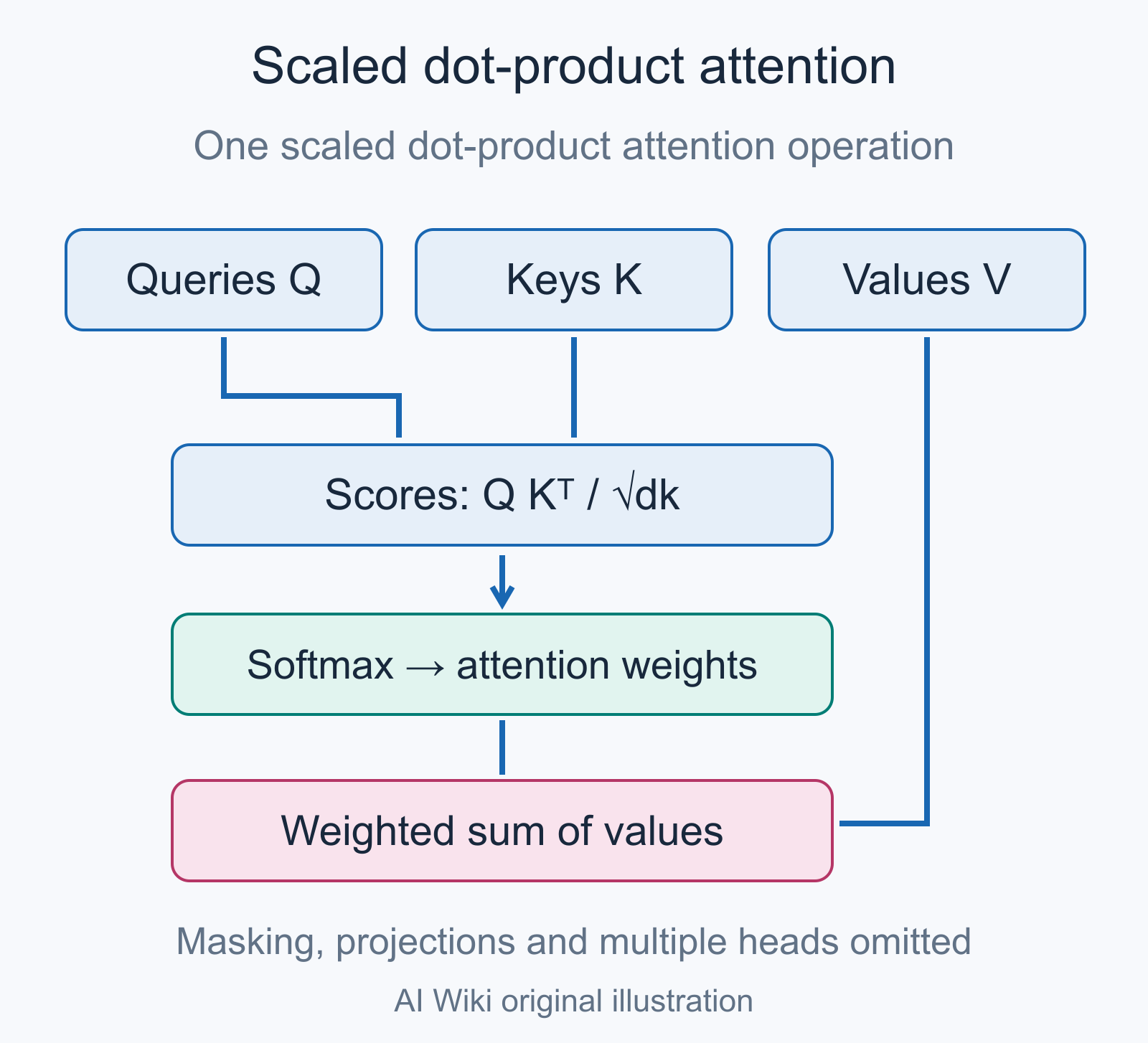
A simplified scaled dot-product attention operation forms scores from queries and keys, scales them by the square root of the key dimension, applies softmax and combines the values using the resulting weights. Masking, learned projections and multiple attention heads are omitted.[64] Illustration: AI Wiki original diagram. CC0 1.0.
Scaled dot-product attention
The attention operation at the heart of the architecture is straightforward to write down. Given a set of queries Q, keys K, and values V (each a matrix of vectors stacked row by row), the output is:
where is the dimension of each key vector[1]. The dot products measure how well each query matches each key. Dividing by keeps the magnitudes from growing with dimension, which would otherwise push the softmax into regions with vanishing gradients. The softmax turns the scores into a distribution, and multiplying by produces a weighted sum of value vectors.
In self-attention, , , and are all linear projections of the same input. In cross-attention, comes from one sequence and come from another. In masked self-attention, an additive mask sets the scores for forbidden positions (such as future tokens during decoding) to negative infinity before the softmax.
Multi-head attention
A single attention operation can only encode one set of relationships at a time. Multi-head attention runs parallel attention operations on different learned projections of the input, then concatenates the results and projects them back to the model dimension. With model dimension and heads, each head usually has key and value dimensions divided by , so the total compute is similar to a single attention with full dimension[1].
Different heads tend to specialize. Some look at adjacent tokens, some track syntactic structure such as verb-subject agreement, some attend to specific token types like punctuation or rare nouns. The original paper visualized several heads that captured anaphora resolution and long-range dependencies in English sentences[1].
A common modern variant is multi-query attention, introduced by Noam Shazeer in 2019, in which all heads share a single key and value projection while keeping per-head queries[62]. Grouped-query attention (GQA), introduced by Ainslie et al. at Google Research in May 2023, is a middle ground that groups heads to share keys and values[8]. GQA interpolates between standard multi-head attention and multi-query attention. Both variants reduce the size of the key-value cache during autoregressive decoding, which is the main memory bottleneck for long-context inference. Meta adopted GQA for the larger LLaMA 2 models (the 70B model uses 8 KV heads, while the 7B and 13B variants kept standard multi-head attention) and applied it across all LLaMA 3 sizes[8][9][45].
Positional encoding
Attention is permutation-invariant. Without extra information, a Transformer would treat "the cat sat on the mat" and "the mat sat on the cat" the same way. Positional encoding injects the order of tokens into the model.
The original paper used fixed sinusoidal positional encodings:
for position and embedding dimension index . The encoding is added to the token embedding before the first attention layer[1]. Sine and cosine were chosen so that is a linear function of for any fixed , which the authors argued might help the model learn relative offsets.
Later work has produced several alternatives:
| Encoding | Year | Used in | Idea |
|---|---|---|---|
| Sinusoidal | 2017 | Original Transformer | Fixed sin/cos values added to embeddings |
| Learned absolute | 2018 | BERT, GPT-2 | Trainable position vectors per index |
| Relative position | 2018 | Transformer-XL, T5 | Bias attention scores by relative distance |
| RoPE (Rotary Position Embedding) | 2021 | LLaMA, GPT-NeoX, PaLM, Mistral | Rotate Q and K vectors by an angle proportional to position |
| ALiBi (Attention with Linear Biases) | 2021 | BLOOM, MPT | Add a per-head linear bias to attention logits |
| NoPE / iRoPE (interleaved RoPE and no-positional-encoding layers) | 2023-2025 | Llama 4 | Alternate RoPE layers with layers that use no positional encoding at all |
RoPE, introduced by Jianlin Su and colleagues in April 2021 in the RoFormer paper, encodes the absolute position by rotating the query and key vectors with a rotation matrix whose angle depends on position, which has the side effect that the dot product between two rotated vectors only depends on their relative offset[10]. RoPE has become the default for most large language models trained after 2022 because it encodes relative position cleanly and can extrapolate to longer contexts than were seen during training, especially when combined with techniques like position interpolation, NTK-aware scaling, and YaRN. RoPE is the default positional strategy in LLaMA, LLaMA 2, LLaMA 3, Gemma, Mistral, and Code Llama[10].
ALiBi, from Press, Smith, and Lewis (2021), adds a fixed linear bias to each attention score that grows with distance, biasing the model toward closer tokens and supporting length extrapolation without any learned parameters[11].
A newer thread of work questions whether every layer needs explicit position information at all. Meta's Llama 4 (April 2025) uses what it calls iRoPE ("interleaved" RoPE), alternating standard RoPE layers with periodic layers that carry no positional encoding (NoPE) and apply a full causal mask over the whole context; the RoPE layers handle local structure with chunked attention while the NoPE layers preserve unbiased global reach, an arrangement Meta credits for the very long context lengths of the Llama 4 Scout model (advertised up to 10 million tokens)[57]. The observation that decoder-only Transformers can partly infer order from the causal mask alone, rather than from an added positional signal, has made NoPE and hybrid RoPE/NoPE schemes an active area through 2025 and 2026.
Feedforward, residual, and normalization layers
After attention, each position passes through a feedforward block applied independently:
The original paper used a two-layer fully connected network with a ReLU between them and an inner dimension four times the model dimension[1]. Modern variants almost always replace ReLU with a smoother activation (GELU in BERT and GPT-2, SwiGLU or GeGLU in LLaMA, PaLM, and most current open models)[60][61]. The feedforward layers hold the majority of the model's parameters, often more than 60 percent in large language models.
Residual connections add the sublayer input to its output, which keeps gradient signals strong and lets very deep networks train without degrading. Layer normalization stabilizes the activations across the embedding dimension. RMSNorm, a simpler variant that omits the mean subtraction and keeps only the root-mean-square rescaling, is now common in LLaMA and other production models[59][61].
Following one sequence through a decoder-only transformer
The sections above describe each piece on its own. This one puts them in order and follows a single input string from raw text to a sampled next token through a decoder-only stack, the layout used by the GPT and LLaMA families and by most large language models in production. Batch dimensions are omitted; a real implementation carries a leading batch axis on every shape below.
The symbols are the ones used earlier in this article, plus the few the walkthrough needs. There are tokens in the sequence, the model dimension is , there are attention heads whose queries and keys have dimension and whose values have dimension (this walkthrough takes throughout, as the 2017 model and most models since do, and ), the feedforward inner dimension is , the stack is blocks deep, and the vocabulary holds tokens. Two concrete instantiations: the 2017 base model used layers in each of its two stacks, , , , and [1]; Llama 3 8B uses blocks, , query heads against 8 key-value heads, a feedforward inner dimension of 14,336, and a vocabulary of 128,000 tokens, which works out to a head dimension of 4096 divided by 32, or 128[9].
Take the prompt "The capital of France is". Steps 1 through 3 happen once, steps 4 through 13 repeat for each of the blocks, and steps 14 through 17 turn the final activations into a token.
The shapes below assume standard multi-head attention, in which all three projections produce heads. Grouped-query and multi-query models project keys and values to a smaller number of heads , so and have shape and the key and value tensors at steps 5 through 9 are , each shared across query heads[8][62]. For the Llama 3 8B configuration above, that means and are 4096 by 1024 rather than 4096 by 4096, and the key and value tensors are while the query tensor stays [9].
| Step | Operation | Input shape | Output shape |
|---|---|---|---|
| 1 | Tokenization: segment the string into subwords, map each to an integer id | one string | ids in the range 0 to |
| 2 | Embedding lookup: gather rows from the embedding matrix (shape ); the 2017 model then multiplies by | ids | |
| 3 | Add the absolute positional encoding (2017 sinusoids, GPT-2 learned vectors). RoPE models skip this and rotate inside step 6 instead | ||
| 4 | Block , pre-norm: normalize each row across the axis, keeping the unnormalized rows aside for the residual | ||
| 5 | Three matrix multiplies by , , (each under standard multi-head attention), then a reshape that splits the last axis into heads | three tensors of | |
| 6 | RoPE, if used: rotate each coordinate pair of every query and key by an angle set by that token's position | ||
| 7 | Scores: per head (matrix multiply), divided by | two of | |
| 8 | Causal mask: add a matrix that is 0 at entry when and when , broadcast across heads | ||
| 9 | Softmax along each row, then multiply by the value tensor (matrix multiply) | ||
| 10 | Concatenate the heads back into one axis and project by (shape ) | ||
| 11 | Residual add: elementwise sum with the tensor set aside at step 4 | ||
| 12 | Normalize again, then the feedforward block: up-project to , apply the activation elementwise, down-project back | ||
| 13 | Residual add, then return to step 4 for the next block, times in all | ||
| 14 | One final normalization after the last block | ||
| 15 | Unembedding: a single matrix multiply by (shape ), which is when the weights are tied | logits | |
| 16 | Keep the last row, divide by the temperature, softmax across the vocabulary | probabilities | |
| 17 | Sample a token id (or take the argmax), append it to the sequence, and start again at step 1 with tokens | one id |
Which steps are matrix multiplies. Steps 5, 7, 9, 10, 12, and 15 are matrix multiplies, and they account for essentially all of the arithmetic. Steps 3, 6, 8, 11, and 13 are elementwise: the positional addition, the rotation, the mask addition, and the two residual sums leave every shape untouched and cost one pass over the tensor. Step 2 is a gather rather than a multiply, although it is mathematically identical to multiplying an one-hot matrix by ; implementations index the rows because the one-hot form would do times the work for the same answer. The softmax in steps 9 and 16 is a reduction along one axis followed by an elementwise division.
Where the normalization sits, and why it moved. The 2017 paper normalizes last: the output of each sublayer is , so the normalization sits directly on the residual stream, and the original training recipe pairs that arrangement with a learning-rate warmup[1]. That is post-norm. GPT-2 moved layer normalization to the input of each sub-block and added one more after the final block[20], GPT-3 kept the change[16], and Xiong et al. later supplied the analysis: at initialization a post-norm Transformer has large expected gradients at the parameters near the output layer, so a large learning rate destabilizes training, whereas a pre-norm Transformer has well-behaved gradients at initialization and can drop the warmup stage entirely[58]. The step table assumes pre-norm because that is what production decoder-only models use. The difference shows up in the walkthrough: under pre-norm the tensor created at step 2 runs unnormalized all the way to step 14, and each block reads a normalized copy of it and adds an unnormalized update back. Under post-norm there is no such uninterrupted path, because step 11 would be followed by a normalization rather than preceded by one.
What the modern blocks put in those slots. Three substitutions account for most of the distance between the 2017 block and a 2026 one, and none of them changes a shape in the table. Normalization is usually RMSNorm, which drops the mean subtraction and rescales by the root mean square alone, on the argument that re-centering invariance is dispensable[59]. Position information is usually RoPE applied inside every block at step 6, which removes step 3 entirely[10]. The feedforward block is usually a gated variant: SwiGLU projects the input twice in parallel, passes one copy through a Swish activation, multiplies the two elementwise, and then down-projects. That is three weight matrices instead of two, so is cut by a factor of two-thirds to hold the parameter count and the arithmetic constant[60]. The original LLaMA paper adopted all three at once and named its source for each: pre-normalization with RMSNorm, SwiGLU in place of ReLU, and rotary embeddings at every layer in place of absolute ones[61]. The Qwen3 report lists the same set in 2025[56].
The causal mask is what makes this a next-token predictor. Step 8 is the only thing separating this forward pass from a bidirectional encoder. Vaswani et al. implement it inside scaled dot-product attention by "masking out (setting to ) all values in the input of the softmax which correspond to illegal connections", which in the decoder means every position later in the sequence[1]. Because the exponential of negative infinity is zero, those entries get exactly zero weight, so row of the attention output is a weighted average over value vectors at positions 0 through and nothing else. Without the mask, row would already contain the token it is being asked to predict. With it, every one of the rows produced at step 15 is a legitimate prediction of the token that follows its own position, which is why one forward pass over tokens yields training signals rather than one.
Training and inference walk the table differently. In training the whole sequence is known in advance, teacher forcing supplies the ground-truth tokens as input, and all rows of the step-15 logits are scored against the same sequence shifted one position left; the causal mask is what keeps that scoring honest. In generation only the final row matters, so steps 16 and 17 discard the other rows and the model runs again with one more token. Recomputing the full attention at every step would repeat work that cannot change, which is what the key-value cache described below avoids: the keys and values from step 5 are kept, the new step projects a single row, and step 7 produces a length- vector of scores rather than an matrix. Multi-query and grouped-query attention shrink what that cache holds by giving several query heads a shared key and value projection, which is why Llama 3 pairs 32, 64, or 128 query heads with only 8 key-value heads at all three of its sizes[9][62].
The last step is a choice, not a computation. Everything up to step 15 is deterministic given the weights and the input. The temperature at step 16 divides the logits before the softmax, flattening the distribution above 1 and sharpening it below 1; at the limit of zero it collapses into greedy decoding, which simply takes the argmax. Truncated sampling restricts the draw to part of the vocabulary: top-k keeps the highest-probability tokens, and nucleus or top-p sampling keeps the smallest set whose probabilities sum to . Holtzman et al. introduced the nucleus method after finding that using likelihood as a decoding objective "leads to text that is bland and strangely repetitive", even in models for which likelihood works well as a training objective[63].
Training
For sequence-to-sequence translation, the Transformer is trained with teacher forcing: the decoder input at time t is the ground-truth token at time t, not the model's own previous prediction. Cross-entropy loss is computed between the model's predicted distribution and the actual next token, summed across positions, and minimized with a variant of stochastic gradient descent. The Adam optimizer with the warmup-then-decay learning rate schedule from the original paper became the default for years[1]. Modern training usually uses AdamW with cosine decay and label smoothing of around 0.1.
Language models are trained with self-supervised objectives. Decoder-only models predict the next token. Encoder-only models predict masked tokens given the rest of the sequence. Encoder-decoder models such as T5 use a span corruption objective in which a contiguous span of tokens is replaced with a sentinel and the decoder is trained to reconstruct it[12].
Tokenization
Text is split into subword tokens before entering the model. Common schemes include Byte-Pair Encoding (BPE), used by GPT and most open models; WordPiece, used by BERT; and SentencePiece, a language-agnostic library that supports both[13]. The vocabulary size is usually between 30,000 and 200,000 tokens. LLaMA 3 uses a vocabulary of 128,000 tokens, a substantial increase from the 32,000 used by LLaMA 1 and LLaMA 2, which Meta reports gave a non-trivial improvement in per-token efficiency and downstream quality[9].
Scaling laws
The earliest empirical evidence that loss scales predictably with data, model, and compute came in 2017 from Joel Hestness and colleagues at Baidu Research. Their paper "Deep Learning Scaling is Predictable, Empirically" found power-law generalization error scaling across machine translation, language modeling, image processing, and speech recognition, and noted that model size grows sublinearly with data size[14].
In 2020, Jared Kaplan and colleagues at OpenAI published "Scaling Laws for Neural Language Models"[15]. They found that test loss falls as a power law in three quantities: model size , dataset size , and training compute . Architectural details such as depth and width matter much less than the totals, within a wide range. The result was a recipe for spending compute: train very large models on relatively small amounts of data and stop well before convergence. This reasoning informed the design of GPT-3, which used 175 billion parameters trained on around 300 billion tokens[15][16].
In 2022, Jordan Hoffmann and colleagues at DeepMind published "Training Compute-Optimal Large Language Models", known as the Chinchilla paper[17]. By training more than 400 models from 70 million to 16 billion parameters on 5 to 500 billion tokens, they found that for a fixed compute budget, model size and dataset size should scale roughly equally: every doubling of parameters should be matched by a doubling of training tokens. They demonstrated this by training Chinchilla, a 70B-parameter model on 1.4 trillion tokens, which outperformed the much larger Gopher (280B), GPT-3 (175B), Jurassic-1 (178B), and Megatron-Turing NLG (530B) on a wide range of evaluations[17].
The Chinchilla finding shifted the field. Later models, including LLaMA 1, LLaMA 2, LLaMA 3, and most open-source releases since 2023, have used compute-optimal or even data-heavy training ratios. LLaMA 3 in particular was pretrained on over 15 trillion tokens, far beyond the Chinchilla-optimal ratio for its 8B and 70B sizes, on the empirical grounds that smaller models keep improving past the compute-optimal point if extra data is available[9].
What kinds of transformers are there?
Transformers come in three main flavors based on which halves of the original architecture are kept.
| Variant | Examples | Typical use | Pretraining objective |
|---|---|---|---|
| Encoder-only | BERT, RoBERTa, ALBERT, DeBERTa, ELECTRA | Classification, retrieval, sentence embeddings | Masked language modeling |
| Decoder-only | GPT-2, GPT-3, GPT-4, LLaMA, Mistral, Claude, Qwen, Falcon | Text generation, chat, code | Next-token prediction |
| Encoder-decoder | Original Transformer, T5, BART, mT5, FLAN-T5 | Translation, summarization, structured generation | Span corruption or denoising |
Encoder-only models
BERT (Bidirectional Encoder Representations from Transformers), introduced by Jacob Devlin and colleagues at Google in 2018, was the first widely adopted encoder-only Transformer[18]. BERT-Base has 12 layers, 768 hidden dimensions, 12 heads, and 110 million parameters. BERT-Large has 24 layers, 1024 hidden dimensions, 16 heads, and 340 million parameters[18]. It was pretrained with masked language modeling (predicting 15 percent of tokens that are randomly masked) and next-sentence prediction. BERT pushed the GLUE benchmark to 80.5, lifted SQuAD v1.1 F1 to 93.2, and was deployed in Google Search starting in October 2019. RoBERTa (Facebook AI, 2019) showed that BERT was undertrained and improved scores by removing next-sentence prediction and training longer on more data. DeBERTa added disentangled attention for content and position, and ELECTRA replaced the masked-token objective with replaced-token detection.
Decoder-only models
The first GPT, presented in "Improving Language Understanding by Generative Pre-Training" by Alec Radford, Karthik Narasimhan, Tim Salimans, and Ilya Sutskever at OpenAI in 2018, used a 12-layer decoder-only Transformer with 768 hidden dimensions, 12 attention heads, 3072 inner FFN dimension, and roughly 117 million parameters[19]. It was pretrained on the BookCorpus and then fine-tuned discriminatively for each downstream task. GPT-2 (2019) scaled this to 1.5 billion parameters and was trained on WebText, a 40 GB corpus of 8 million web pages linked from Reddit posts with at least three karma[20]. GPT-2 showed that a single model could perform many tasks zero-shot. GPT-3 (2020) reached 175 billion parameters and demonstrated few-shot learning, requiring an estimated FLOPs to train[16]. GPT-4 and later models follow the same decoder-only blueprint with mixtures of experts, longer context windows, and multimodal inputs added on top.
Most open-weight large language models released since 2023 also use decoder-only Transformers: LLaMA, LLaMA 2, LLaMA 3, Mistral, Mixtral, Qwen, Yi, Falcon, DeepSeek, and Gemma all follow the same recipe with variations in normalization, position encoding, attention heads, and FFN activations.
Encoder-decoder models
T5 (Text-to-Text Transfer Transformer), released by Google in 2019, framed every NLP task as text-in, text-out and used the original encoder-decoder layout pretrained on the C4 corpus with a span corruption objective[12]. BART, from Facebook AI in 2019, used a similar layout with a more general denoising autoencoder objective and excelled at summarization[21]. mT5 and FLAN-T5 extended the recipe to more languages and instruction tuning.
Long-context transformers
Several variants emerged specifically to handle sequences longer than the few thousand tokens that fit in a base Transformer. Transformer-XL (Dai et al., 2019) introduced segment-level recurrence in which hidden states from the previous segment are cached and reused, letting attention reach across segment boundaries[22]. The authors reported that Transformer-XL captures dependencies 80 percent longer than RNNs and 450 percent longer than vanilla Transformers, and is up to 1,800 times faster than vanilla Transformers during evaluation[22].
For frontier-scale long-context inference, Gemini 1.5 Pro (Google DeepMind, 2024) used a sparse mixture-of-experts architecture and a 1 million token context window at launch, later expanded to 2 million tokens in production, with near-perfect recall (over 99.7 percent) on needle-in-a-haystack retrieval tests up to 1 million tokens, and reasonable performance with contexts extended to 10 million tokens for text, 9.7 million for audio, and 9.9 million for video[23]. Claude and GPT-4 likewise extended context lengths into the hundreds of thousands of tokens through 2024 and 2025.
Vision and multimodal
The Vision Transformer (ViT), introduced by Alexey Dosovitskiy and colleagues at Google Research in the 2020 paper "An Image Is Worth 16x16 Words," treats an image as a sequence of fixed-size patches[2]. A standard ViT splits a 224 by 224 image into 14 by 14 patches of 16 by 16 pixels, projects each patch into an embedding, prepends a learnable [CLS] token, adds positional embeddings, and runs the result through a stack of standard Transformer encoder layers. With enough pretraining data, ViT matched or exceeded the best convolutional neural networks on ImageNet classification[2]. Variants followed quickly: DeiT made ViT trainable on ImageNet-1k alone with distillation, Swin Transformer (Liu et al., 2021) added shifted-window attention to give a hierarchical, CNN-like inductive bias and won the ICCV 2021 Marr Prize, reaching 87.3 top-1 accuracy on ImageNet-1K and 58.7 box AP on COCO[24], and DETR used a Transformer encoder-decoder for object detection[3].
Multimodal models pair Transformers across modalities. CLIP (OpenAI, 2021) trains a text Transformer and an image Transformer jointly with a contrastive objective on 400 million image-text pairs[25]. Flamingo (DeepMind, 2022) interleaves vision and language tokens for few-shot visual question answering. Modern frontier models (GPT-4o, Gemini, Claude 3) accept images, audio, and video as token streams alongside text.
Audio transformers
Whisper, released by OpenAI in September 2022, is an encoder-decoder Transformer trained on 680,000 hours of multilingual and multitask supervised audio scraped from the web[4]. Input audio is split into 30-second chunks, converted to a log-Mel spectrogram, and passed through two 1D convolutional layers that downsample along time before entering the Transformer encoder. The decoder is conditioned on special tokens that specify the task (transcription, translation, voice-activity detection, language identification), so a single set of weights handles many speech tasks. The large-v3 model has 32 encoder layers, a model dimension of 1280, and 20 attention heads[4].
Earlier, wav2vec 2.0 (Baevski et al., Meta AI, 2020) introduced a self-supervised contrastive objective for speech representations, masking parts of a latent representation of the audio and learning to identify the masked content[26]. Using all labeled data of LibriSpeech it achieves 1.8/3.3 WER on the clean/other test sets; with just ten minutes of labeled data and pretraining on 53,000 hours of unlabeled audio it still reaches 4.8/8.2 WER[26]. AudioLM and MusicLM extended Transformers to audio generation; the speech recognition lineage culminated in Whisper.
Biology and chemistry transformers
DeepMind's AlphaFold 2 (Jumper et al., 2021) used a deep attention-based module called the Evoformer that integrates multiple sequence alignments with residue-residue pair representations, plus a structure module that includes Invariant Point Attention specifically designed for 3D point clouds[5]. AlphaFold 2 won the CASP14 protein structure prediction competition by a wide margin and is widely credited with substantially solving the single-domain protein folding problem. AlphaFold 3 (2024) replaced the Evoformer with a Pairformer and added a diffusion-based structure decoder, extending coverage to protein-protein and protein-ligand complexes.
Meta's Evolutionary Scale Modeling (ESM) line produced protein language models trained on hundreds of millions of amino-acid sequences with a masked-language-modeling objective. ESMFold (Lin et al., 2022) used ESM-2 as a backbone to predict structure from a single sequence without the multiple sequence alignment that AlphaFold relies on. EvolutionaryScale, founded by a team of former Meta researchers including Alexander Rives, released ESM3 in June 2024, a generative model that reasons jointly over sequence, structure, and function.
Diffusion transformers
The Diffusion Transformer (DiT), introduced by William Peebles (UC Berkeley) and Saining Xie (NYU) at ICCV 2023, replaced the U-Net backbone of latent diffusion models with a Transformer operating on patches of the diffusion latent[6]. DiT incorporates timestep and class label as embeddings and uses adaptive layer normalization (adaLN) to inject conditioning. The largest DiT-XL/2 reached a Frechet inception distance of 2.27 on class-conditional ImageNet 256x256, then state of the art, with FID continuing to drop as the model's training compute (Gflops) increases[6]. DiT became the basis of Stable Diffusion 3, Stable Diffusion 3.5, FLUX.1, OpenAI's Sora text-to-video model, and many other 2024-2025 generative systems[27]. Sora itself treats video as sequences of spacetime patches passed through a Transformer-based denoiser that does not constrain input resolution or duration[27].
Reinforcement learning transformers
Decision Transformer, introduced by Lili Chen, Kevin Lu, and colleagues at UC Berkeley and Facebook AI Research in June 2021, cast offline reinforcement learning as a sequence modeling problem[28]. By conditioning a causal Transformer on the desired return, past states, and past actions, the model can generate future actions that achieve the target return without any value-function or policy-gradient machinery. It matches or exceeds state-of-the-art offline RL baselines on Atari, OpenAI Gym, and Key-to-Door tasks[28]. DeepMind's Gato (2022) trained a single 1.2-billion-parameter Transformer to play Atari, caption images, chat, and control a robot arm by tokenizing every modality into a shared sequence. Robotics Transformer (RT-1, RT-2) extended the same idea to physical manipulation.
Mixture-of-experts transformers
Mixture of experts (MoE) replaces the dense feedforward block in some Transformer layers with a sparse layer of expert subnetworks and a learned router that sends each token to a small subset of experts, usually one or two. This decouples total parameter count from per-token compute. The first large-scale MoE Transformer was GShard (Lepikhin et al., Google, 2020), which scaled a multilingual neural machine translation Transformer to 600 billion parameters across 2048 experts and trained it efficiently on 2048 TPU v3 chips in 4 days, beating dense baselines on 100-language to English translation[29]. Switch Transformer (Fedus et al., Google, 2021) simplified the router to pick the single top expert, scaled to 1.6 trillion parameters, and demonstrated up to 7x faster pre-training than dense T5 baselines with the same computational resources[30].
Mixtral 8x7B (Mistral AI, December 2023) was an influential open-weight MoE: each layer routes tokens to two of eight feedforward experts, giving 47 billion total parameters with 13 billion active per token, and matched or beat LLaMA 2 70B and GPT-3.5 across most benchmarks[31][46]. DeepSeek V3 (December 2024) pushed open MoE further with 671 billion total parameters and 37 billion active per token, using 256 routed experts plus 1 shared expert (8 routed plus 1 shared activated per token), Multi-head Latent Attention, and FP8 mixed-precision training[32]. Google's Gemini 1.5 series, OpenAI's GPT-4 (per third-party reports), and other frontier models also adopted MoE for the same compute-vs-quality tradeoff.
By 2025 the fine-grained, many-small-experts recipe pioneered by DeepSeek had become the default for open-weight frontier models. Meta's Llama 4 (April 2025) was the first Llama generation built as a mixture of experts, with the Scout and Maverick models each activating 17 billion parameters per token out of much larger totals (Maverick routes to 128 experts). Alibaba's Qwen3 family (technical report May 2025) spans dense and MoE models from 0.6 to 235 billion parameters; its flagship Qwen3-235B-A22B routes each token to 8 of 128 experts across 94 layers, activating 22 billion of its 235 billion parameters[56]. The pattern, hundreds of billions of total parameters with only tens of billions active per token, is now standard across DeepSeek, Qwen, Llama, and the closed frontier systems.
Efficient attention variants
Standard attention has time and memory complexity in the sequence length , which becomes the bottleneck for long contexts. Many lines of work try to reduce that cost.
| Method | Year | Approach |
|---|---|---|
| Sparse Transformer | 2019 | Restrict attention to fixed sparse patterns (strided and fixed factorizations) |
| Reformer | 2020 | Locality-sensitive hashing groups similar queries and keys; reversible residuals reduce memory |
| Linformer | 2020 | Project keys and values to a fixed lower dimension |
| Longformer | 2020 | Combine local sliding-window attention with a few global tokens |
| Performer | 2020 | Approximate softmax attention with random feature kernels |
| BigBird | 2020 | Random plus local plus global attention pattern |
| FlashAttention | 2022 | Exact attention reordered to minimize GPU memory I/O |
| FlashAttention-2 | 2023 | Better parallelism, work partitioning across thread blocks and warps |
| FlashAttention-3 | 2024 | Asynchrony on Hopper Tensor Cores, FP8 support |
| FlashAttention-4 | 2026 | Algorithm and kernel co-design for NVIDIA Blackwell (B200/GB200) |
| Native Sparse Attention (NSA) | 2025 | Natively trainable hierarchical sparse attention, hardware aligned |
| DeepSeek Sparse Attention (DSA) | 2025 | Near-linear long-context attention with a lightning indexer |
The Sparse Transformer (Child, Gray, Radford, Sutskever at OpenAI, 2019) introduced factorized attention patterns that reduce the cost from to , and set state-of-the-art density estimation results on CIFAR-10, Enwik8, and ImageNet 64 while modeling sequences tens of thousands of tokens long[33]. Reformer (Kitaev, Kaiser, Levskaya, 2020) used locality-sensitive hashing to bucket similar queries and keys, reducing attention to and pairing it with reversible residual layers; the authors demonstrated context windows of up to one million tokens on a single 16 GB accelerator[34]. Longformer (Beltagy, Peters, Cohan at AI2, 2020) combined sliding window, dilated sliding window, and task-specific global attention. Linformer (Wang et al., Facebook, 2020) projected key and value lengths down to a fixed dimension. Performer (Choromanski et al., Google, 2020) approximated the softmax kernel with positive orthogonal random features. BigBird (Zaheer et al., Google, 2020) combined random, window, and global attention, proved that the resulting sparse attention is a universal approximator and Turing-complete, and supported sequences up to 8x longer than full attention on the same hardware[35].
FlashAttention, from Tri Dao and colleagues at Stanford in 2022, is the most widely adopted of these efficiency techniques and unlike the others it computes exact softmax attention rather than an approximation. It restructures the computation in tiles that fit in fast on-chip SRAM, cutting reads and writes to GPU high-bandwidth memory[36]. FlashAttention is now the default attention kernel in PyTorch, JAX, and most inference frameworks. FlashAttention-2 (Dao, July 2023) reworked parallelism and partitioning between thread blocks and warps, reaching 50 to 73 percent of theoretical peak FLOPs on A100 GPUs and up to 225 TFLOPs/s end-to-end for GPT-style training (72 percent model FLOPs utilization)[37]. FlashAttention-3 (Shah et al., July 2024) targets NVIDIA Hopper H100 GPUs with asynchronous Tensor Core scheduling, warp specialization, interleaved matmul and softmax, and FP8 block quantization. It reaches roughly 740 TFLOPs/s on FP16 (75 percent of H100 peak) and nearly 1.2 PFLOPs/s on FP8, while keeping FP8 numerical error 2.6x smaller than the baseline FP8 attention[38]. FlashAttention-4 (Zadouri, Hoehnerbach, Shah, Liu, Thakkar, and Dao), first presented at Hot Chips in August 2025 and posted to arXiv in March 2026, retargets the kernel to NVIDIA's Blackwell GPUs (B200 and GB200), where tensor-core throughput roughly doubled while shared-memory bandwidth and the special-function (exponential) units did not. To keep the fast tensor cores fed, FA4 emulates the softmax exponential with a polynomial on the general-purpose math units and skips the online-softmax rescaling step unless the running maximum shifts enough to threaten numerical stability, and it is written in NVIDIA's CuTe-DSL. It reaches up to about 1,613 TFLOPs/s (71 percent utilization) in BF16, up to 1.3x faster than NVIDIA's own cuDNN 9.13 attention and 2.7x faster than a Triton baseline on B200[49].
A second, distinct line of 2025-2026 work revived approximate sparse attention, but this time trained end to end and co-designed with the hardware rather than bolted on after pretraining. DeepSeek's Native Sparse Attention (NSA), by Jingyang Yuan and colleagues (including DeepSeek founder Wenfeng Liang) and the winner of a best-paper award at ACL 2025, combines coarse-grained token compression with fine-grained token selection under a dynamic hierarchical strategy; because the sparsity is present during training, models keep or exceed full-attention quality while running substantially faster on 64,000-token sequences across decoding, forward, and backward passes[50]. DeepSeek carried the idea into a production model with DeepSeek Sparse Attention (DSA) in DeepSeek-V3.2 (the DeepSeek-V3.2-Exp checkpoint shipped September 29, 2025, with a full technical report in December 2025). DSA uses a lightweight "lightning indexer" to pick which past tokens each query attends to, giving near-linear O(kL) cost in context length L and cutting reported long-context API prices by roughly half relative to the dense DeepSeek-V3.1 model while holding quality roughly constant on the same 671-billion-parameter mixture-of-experts backbone (37 billion active parameters)[51].
KV caching is a complementary trick used during autoregressive decoding. Once a token has been processed, its key and value vectors do not change, so they are stored and reused for every later step. This reduces inference cost from quadratic to linear in sequence length per step, at the cost of memory proportional to context length times number of heads times key dimension. Multi-query and grouped-query attention specifically target the size of this cache.
For sequences that no longer fit on a single accelerator, Ring Attention (Liu, Zaharia, Abbeel at UC Berkeley, October 2023) distributes blocks of keys and values around a conceptual ring of devices and overlaps the inter-device communication with on-device computation, scaling context length linearly with the number of devices and supporting millions of tokens[39].
What are transformers used for?
Transformers are now the default architecture in almost every domain that involves sequences or sets.
- Natural language processing: machine translation, summarization, question answering, named entity recognition, sentiment analysis, dialog systems, code generation, retrieval-augmented generation.
- Computer vision: image classification (Vision Transformer, Swin Transformer), object detection (DETR, DINO), segmentation (Mask2Former, SAM), depth estimation, video understanding.
- Speech and audio: Whisper for speech recognition, AudioLM and MusicLM for audio generation, wav2vec 2.0 for self-supervised speech representations.
- Biology and chemistry: AlphaFold 2 and AlphaFold 3 use attention-based modules (the Evoformer and Pairformer) to predict protein structures from sequences. ESM3, ProGen, and similar protein language models use Transformers trained on amino-acid sequences[5].
- Image and video generation: Diffusion Transformer backbones power Stable Diffusion 3, FLUX.1, and OpenAI's Sora text-to-video model[6][27].
- Code: Codex, AlphaCode, Code Llama, StarCoder, and DeepSeek-Coder are decoder-only Transformers fine-tuned or pretrained on source code.
- Reinforcement learning and robotics: Decision Transformer, Gato, and Robotics Transformer treat trajectories as token sequences[28].
Adoption history and scaling timeline
The Transformer's takeover of the field can be tracked by year.
- 2017: Original paper published; large Transformer reaches 28.4 BLEU on WMT 2014 English-German[1].
- 2018: BERT-Large (340M parameters) sets new state of the art on GLUE, SQuAD, and many other NLP benchmarks[18]. OpenAI releases the original GPT (117M parameters)[19].
- 2019: GPT-2 (1.5B parameters) demonstrates zero-shot capabilities[20]. T5 (11B parameters) and BART consolidate the encoder-decoder approach[12][21]. Transformer-XL extends to longer contexts[22].
- 2020: GPT-3 (175B parameters) demonstrates few-shot in-context learning, costing an estimated several million dollars in compute[16]. Vision Transformer (ViT) brings the architecture to image classification[2]. Several efficient attention variants released. GShard scales translation MoE to 600B parameters[29]. wav2vec 2.0 for speech[26].
- 2021: Switch Transformer reaches 1.6 trillion parameters[30]. RoPE published[10]. DALL-E 1 and CLIP show text-image pairing[25]. Swin Transformer wins ICCV Marr Prize[24]. AlphaFold 2 published[5]. Decision Transformer published[28].
- 2022: PaLM (540B) demonstrates emergent capabilities at scale on 6144 TPU v4 chips[40]. Chinchilla paper reframes scaling laws[17]. FlashAttention released[36]. ChatGPT (built on GPT-3.5) is released in November and reaches 100 million users in two months. Whisper open-sourced[4].
- 2023: GPT-4, LLaMA 1 and 2, Mistral 7B, and Claude 1 and 2 released. FlashAttention-2 doubles training throughput[37]. DiT establishes diffusion-transformer scaling laws for image generation[6]. Mamba state-space model emerges as a possible alternative[41]. Mistral AI releases Mixtral 8x7B in December[31][46].
- 2024: Mixtral 8x22B. LLaMA 3 (8B, 70B, 405B) trained on 15+ trillion tokens with 16,000 H100 GPUs[9]. Gemini 1.5 hits 2M-token context[23]. FlashAttention-3 on Hopper[38]. DeepSeek V3 (671B MoE)[32]. Sora launches publicly in December[27]. AlphaFold 3 released for protein, ligand, and nucleic-acid complexes.
- 2025: MiniMax-01 ships a mostly-linear-attention model at 456B parameters with a 4M-token context[52]. DeepSeek's Native Sparse Attention wins a best paper award at ACL 2025[50]. Meta's Llama 4 introduces iRoPE (interleaved RoPE and no-positional-encoding layers) and moves the Llama line to mixture of experts[57]. Qwen3 spans dense and MoE models up to 235B parameters[56]. Kimi Linear (Kimi Delta Attention) and DeepSeek-V3.2 (DeepSeek Sparse Attention) demonstrate hybrid linear or sparse attention in production-scale models[51][53].
- 2026: FlashAttention-4 retargets exact attention to NVIDIA Blackwell GPUs[49]. Mamba-3 refines the pure state-space design and is presented at ICLR 2026[54]. Frontier models trained on tens of thousands to hundreds of thousands of GPUs at costs estimated to range from hundreds of millions to over one billion dollars per training run. MoE has become standard across the frontier, and the strongest efficiency-oriented systems are hybrids that keep a minority of full-attention layers. Long-context techniques (Ring Attention, native and dynamic sparse attention, sliding window plus full-attention layers) routinely target millions of tokens.
Limitations and criticisms
Transformers have well-known weaknesses.
Quadratic attention cost. The cost of self-attention in sequence length is the most obvious weakness. Even with FlashAttention and KV caching, very long contexts (hundreds of thousands or millions of tokens) require special techniques such as Ring Attention, sliding-window attention, sparse attention, or state-space hybrids[36][39]. Many efficient-attention papers from 2019 to 2021 promised linear or sub-quadratic alternatives in theory; in practice FlashAttention's exact kernel with optimized memory hierarchy outperformed most of them for sequences under tens of thousands of tokens, leaving the long-context regime as the main place where approximate methods remain competitive. The picture changed in 2025 and 2026: sparse and linear attention returned in a form that is trained end to end and co-designed with the hardware (Native Sparse Attention, DeepSeek Sparse Attention, lightning attention, Kimi Delta Attention), which recovers most of the quality lost by the earlier bolt-on approximations while delivering the long-context speedups they had promised[50][51][52][53].
Hallucination. Autoregressive Transformers can produce confident but false statements, a behavior usually called hallucination. The model is trained to predict the most likely next token, not to verify facts. Mitigations include retrieval-augmented generation, reinforcement learning from human feedback, tool use, and explicit chain-of-thought, but no current technique eliminates hallucination.
Training cost and concentration of capability. Large Transformers are expensive to train. GPT-3 (175B parameters) reportedly cost several million dollars in compute alone[16]. PaLM 540B was trained on 6144 TPU v4 chips[40]. LLaMA 3 405B used 16,000 H100 GPUs and roughly 30.84 million H100 GPU-hours of training compute, according to Meta's model card[9][47]. Frontier models in 2025 and 2026 are estimated to cost hundreds of millions to over a billion dollars per training run. The hardware required (tens of thousands of high-end GPUs or TPUs) is concentrated in a small number of companies and labs.
Energy and environmental impact. Strubell, Ganesh, and McCallum (ACL 2019) estimated that training one large NLP Transformer with neural architecture search could emit roughly 626,000 pounds (about 284 metric tons) of CO2-equivalent, comparable to the lifetime emissions of five average American cars[42]. They argued for transparent reporting of training compute and emissions. Since then, the field has shifted toward training efficiency (compute-optimal scaling, MoE, FP8, FlashAttention), and the largest model providers now run on partially renewable electricity, but the absolute scale of frontier training continues to grow.
Interpretability. Researchers can visualize attention weights and probe individual neurons, but understanding why a 70-billion-parameter model produces a particular output is largely an open problem and the central concern of the mechanistic interpretability research program. Attention weights in particular are often misleading: they show what positions a head attends to, not what computations the head is performing.
Other failure modes. Transformers can be brittle to prompt phrasing, fall into repetition loops, struggle with arithmetic and symbolic manipulation at longer lengths than seen in training, and fail to learn algorithms that recurrent networks handle naturally (such as counting parentheses to arbitrary depth). They are also susceptible to jailbreaks, prompt injection, and adversarial inputs.
Are transformers still state of the art?
As of 2026 the Transformer remains the dominant architecture for general-purpose language modeling and for most frontier multimodal systems, but it is no longer unchallenged. State-space models such as Mamba (Gu and Dao, 2023) achieve linear-time inference and competitive quality on language modeling; the Mamba-3B model outperformed Transformers of the same size on standard benchmarks[41]. RWKV reframes the recurrent structure of an RNN with parallelizable training, claiming Transformer-level quality with linear time and constant memory inference[43]. Hybrid architectures such as Jamba combine state-space and attention blocks, and Mamba 2 (Dao and Gu, 2024) refined the pure state-space design and showed that Transformers and structured state-space models are two views of the same underlying math (structured state-space duality)[48].
The state of the debate shifted through 2025 and 2026 in a notable direction: rather than replacing attention outright, the strongest new systems mix a majority of cheap linear or recurrent layers with a minority of full-attention layers. MiniMax-01 (January 2025) was the first large-scale model built mostly on linear attention, stacking seven "lightning attention" (linear) layers for every one softmax-attention layer inside a 456-billion-parameter mixture of experts (45.9 billion active) and reaching a 4-million-token inference context[52]. Moonshot AI's Kimi Linear (October 2025) interleaves its Kimi Delta Attention, a gated linear-attention module that extends Gated DeltaNet, with full attention in a 3:1 ratio, cutting key-value cache use by up to 75 percent and raising decoding throughput up to sixfold at a 1-million-token context while, its authors report, beating full attention under matched-training comparisons[53]. On the pure state-space side, Mamba-3 (presented at ICLR 2026, by Lahoti, Li, Chen, Wang, Bick, Kolter, Dao, and Gu) added a more expressive discretized recurrence, a complex-valued state update for richer state tracking, and a multi-input multi-output formulation, improving retrieval and state-tracking accuracy while matching strong Transformer baselines at roughly half the decoding cost[54]. A parallel thread pursues learned test-time memory: Google's Titans (Behrouz, Zhong, and Mirrokni, arXiv December 2024) adds a neural long-term memory module that updates its own weights during the forward pass, using a gradient-based "surprise" signal to decide what to memorize and forget, and scales past a 2-million-token context[55].
Whether one of these alternatives eventually displaces the Transformer for general-purpose language modeling is still an open question. As of mid-2026 most frontier models remain attention-based; even the leading efficiency-oriented designs retain some full-attention layers rather than discarding them, and the clearest lesson of the period is that the practical frontier belongs to hybrids, models that keep attention where it matters (global recall, in-context retrieval) and swap in cheaper linear, recurrent, or sparse layers everywhere else.
See also
- Mamba-3
- Titans (neural architecture)
- Attention
- Self-attention
- Multi-head attention
- Positional encoding
- RoPE
- ALiBi
- BERT
- GPT
- T5
- BART
- Layer normalization
- RMSNorm
- Embedding
- Softmax
- LSTM
- RNN
- Feedforward neural network
- Vision Transformer
- Swin Transformer
- DETR
- CLIP
- Whisper
- AlphaFold
- ESM3
- Diffusion Transformer
- Sora
- Switch Transformer
- Mixture of experts
- Mixtral
- FlashAttention
- KV cache
- Mamba
- RWKV
- Scaling laws
- Chinchilla
- Sparse attention
- Tokenization
- Byte-Pair Encoding
- Hallucination
- Mechanistic interpretability
References
- ^1 ^2 ^3 ^4 ^5 ^6 ^7 ^8 ^9 ^10 ^11 ^12 ^13 ^14 ^15 ^16Vaswani, A., Shazeer, N., Parmar, N., Uszkoreit, J., Jones, L., Gomez, A. N., Kaiser, L., and Polosukhin, I., "Attention Is All You Need", NeurIPS 2017, 2017-06-12. arxiv.org/...1706.03762. Accessed 2026-06-20.
- ^1 ^2 ^3 ^4Dosovitskiy, A., Beyer, L., Kolesnikov, A., Weissenborn, D., Zhai, X., Unterthiner, T., Dehghani, M., Minderer, M., Heigold, G., Gelly, S., Uszkoreit, J., and Houlsby, N., "An Image Is Worth 16x16 Words: Transformers for Image Recognition at Scale", ICLR 2021 / arXiv:2010.11929, 2020-10-22. arxiv.org/...2010.11929. Accessed 2026-05-24.
- ^1 ^2Carion, N., Massa, F., Synnaeve, G., Usunier, N., Kirillov, A., and Zagoruyko, S., "End-to-End Object Detection with Transformers", ECCV 2020 / arXiv:2005.12872, 2020-05-26. arxiv.org/...2005.12872. Accessed 2026-05-24.
- ^1 ^2 ^3 ^4Radford, A., Kim, J. W., Xu, T., Brockman, G., McLeavey, C., and Sutskever, I., "Robust Speech Recognition via Large-Scale Weak Supervision", OpenAI / arXiv:2212.04356, 2022-12-06. arxiv.org/...2212.04356. Accessed 2026-05-24.
- ^1 ^2 ^3 ^4Jumper, J., Evans, R., Pritzel, A., et al., "Highly accurate protein structure prediction with AlphaFold", Nature 596, 583-589, 2021-07-15. nature.com/...s41586-021-03819-2. Accessed 2026-05-24.
- ^1 ^2 ^3 ^4 ^5Peebles, W. and Xie, S., "Scalable Diffusion Models with Transformers", ICCV 2023 / arXiv:2212.09748, 2022-12-19. arxiv.org/...2212.09748. Accessed 2026-05-24.
- ^1 ^2Bahdanau, D., Cho, K., and Bengio, Y., "Neural Machine Translation by Jointly Learning to Align and Translate", ICLR 2015 / arXiv:1409.0473, 2014-09-01. arxiv.org/...1409.0473. Accessed 2026-05-24.
- ^1 ^2 ^3Ainslie, J., Lee-Thorp, J., de Jong, M., Zemlyanskiy, Y., Lebron, F., and Sanghai, S., "GQA: Training Generalized Multi-Query Transformer Models from Multi-Head Checkpoints", EMNLP 2023 / arXiv:2305.13245, 2023-05-22. arxiv.org/...2305.13245. Accessed 2026-05-24.
- ^1 ^2 ^3 ^4 ^5 ^6 ^7 ^8Meta AI, "The Llama 3 Herd of Models", arXiv:2407.21783, 2024-07-31. arxiv.org/...2407.21783. Accessed 2026-05-24.
- ^1 ^2 ^3 ^4Su, J., Lu, Y., Pan, S., Murtadha, A., Wen, B., and Liu, Y., "RoFormer: Enhanced Transformer with Rotary Position Embedding", arXiv:2104.09864, 2021-04-20. arxiv.org/...2104.09864. Accessed 2026-05-24.
- ^Press, O., Smith, N. A., and Lewis, M., "Train Short, Test Long: Attention with Linear Biases Enables Input Length Extrapolation", ICLR 2022 / arXiv:2108.12409, 2021-08-27. arxiv.org/...2108.12409. Accessed 2026-05-24.
- ^1 ^2 ^3Raffel, C., Shazeer, N., Roberts, A., Lee, K., Narang, S., Matena, M., Zhou, Y., Li, W., and Liu, P. J., "Exploring the Limits of Transfer Learning with a Unified Text-to-Text Transformer", JMLR 21(140), 2020 / arXiv:1910.10683, 2019-10-23. arxiv.org/...1910.10683. Accessed 2026-05-24.
- ^Sennrich, R., Haddow, B., and Birch, A., "Neural Machine Translation of Rare Words with Subword Units", ACL 2016 / arXiv:1508.07909, 2015-08-31. arxiv.org/...1508.07909. Accessed 2026-05-24.
- ^Hestness, J., Narang, S., Ardalani, N., Diamos, G., Jun, H., Kianinejad, H., Patwary, M. M. A., Yang, Y., and Zhou, Y., "Deep Learning Scaling is Predictable, Empirically", arXiv:1712.00409, 2017-12-01. arxiv.org/...1712.00409. Accessed 2026-05-24.
- ^1 ^2Kaplan, J., McCandlish, S., Henighan, T., Brown, T. B., Chess, B., Child, R., Gray, S., Radford, A., Wu, J., and Amodei, D., "Scaling Laws for Neural Language Models", arXiv:2001.08361, 2020-01-23. arxiv.org/...2001.08361. Accessed 2026-05-24.
- ^1 ^2 ^3 ^4 ^5Brown, T. B., et al., "Language Models Are Few-Shot Learners", NeurIPS 2020 / arXiv:2005.14165, 2020-05-28. arxiv.org/...2005.14165. Accessed 2026-05-24.
- ^1 ^2 ^3Hoffmann, J., Borgeaud, S., Mensch, A., et al., "Training Compute-Optimal Large Language Models", arXiv:2203.15556, 2022-03-29. arxiv.org/...2203.15556. Accessed 2026-05-24.
- ^1 ^2 ^3Devlin, J., Chang, M.-W., Lee, K., and Toutanova, K., "BERT: Pre-training of Deep Bidirectional Transformers for Language Understanding", NAACL 2019 / arXiv:1810.04805, 2018-10-11. arxiv.org/...1810.04805. Accessed 2026-05-24.
- ^1 ^2Radford, A., Narasimhan, K., Salimans, T., and Sutskever, I., "Improving Language Understanding by Generative Pre-Training", OpenAI technical report, 2018-06-11. cdn.openai.com/...language_understanding_paper.pdf. Accessed 2026-05-24.
- ^1 ^2 ^3Radford, A., Wu, J., Child, R., Luan, D., Amodei, D., and Sutskever, I., "Language Models Are Unsupervised Multitask Learners", OpenAI technical report (GPT-2), 2019-02-14. cdn.openai.com/...upervised_multitask_learners.pdf. Accessed 2026-05-24.
- ^1 ^2Lewis, M., Liu, Y., Goyal, N., Ghazvininejad, M., Mohamed, A., Levy, O., Stoyanov, V., and Zettlemoyer, L., "BART: Denoising Sequence-to-Sequence Pre-training for Natural Language Generation, Translation, and Comprehension", arXiv:1910.13461, 2019-10-29. arxiv.org/...1910.13461. Accessed 2026-05-24.
- ^1 ^2 ^3Dai, Z., Yang, Z., Yang, Y., Carbonell, J., Le, Q. V., and Salakhutdinov, R., "Transformer-XL: Attentive Language Models Beyond a Fixed-Length Context", ACL 2019 / arXiv:1901.02860, 2019-01-09. arxiv.org/...1901.02860. Accessed 2026-05-24.
- ^1 ^2Google DeepMind, "Gemini 1.5: Unlocking multimodal understanding across millions of tokens of context", arXiv:2403.05530, 2024-03-08. arxiv.org/...2403.05530. Accessed 2026-05-24.
- ^1 ^2Liu, Z., Lin, Y., Cao, Y., Hu, H., Wei, Y., Zhang, Z., Lin, S., and Guo, B., "Swin Transformer: Hierarchical Vision Transformer Using Shifted Windows", ICCV 2021 / arXiv:2103.14030, 2021-03-25. arxiv.org/...2103.14030. Accessed 2026-05-24.
- ^1 ^2Radford, A., Kim, J. W., Hallacy, C., et al., "Learning Transferable Visual Models From Natural Language Supervision", ICML 2021 / arXiv:2103.00020, 2021-02-26. arxiv.org/...2103.00020. Accessed 2026-05-24.
- ^1 ^2 ^3Baevski, A., Zhou, H., Mohamed, A., and Auli, M., "wav2vec 2.0: A Framework for Self-Supervised Learning of Speech Representations", NeurIPS 2020 / arXiv:2006.11477, 2020-06-20. arxiv.org/...2006.11477. Accessed 2026-05-24.
- ^1 ^2 ^3 ^4OpenAI, "Video generation models as world simulators (Sora technical report)", OpenAI Research, 2024-02-15. openai.com/...eneration-models-as-world-simulators. Accessed 2026-05-24.
- ^1 ^2 ^3 ^4Chen, L., Lu, K., Rajeswaran, A., Lee, K., Grover, A., Laskin, M., Abbeel, P., Srinivas, A., and Mordatch, I., "Decision Transformer: Reinforcement Learning via Sequence Modeling", NeurIPS 2021 / arXiv:2106.01345, 2021-06-02. arxiv.org/...2106.01345. Accessed 2026-05-24.
- ^1 ^2Lepikhin, D., Lee, H., Xu, Y., Chen, D., Firat, O., Huang, Y., Krikun, M., Shazeer, N., and Chen, Z., "GShard: Scaling Giant Models with Conditional Computation and Automatic Sharding", ICLR 2021 / arXiv:2006.16668, 2020-06-30. arxiv.org/...2006.16668. Accessed 2026-05-24.
- ^1 ^2Fedus, W., Zoph, B., and Shazeer, N., "Switch Transformers: Scaling to Trillion Parameter Models with Simple and Efficient Sparsity", JMLR 23, 2022 / arXiv:2101.03961, 2021-01-11. arxiv.org/...2101.03961. Accessed 2026-05-24.
- ^1 ^2Jiang, A. Q., et al., "Mixtral of Experts", arXiv:2401.04088, 2024-01-08. arxiv.org/...2401.04088. Accessed 2026-05-24.
- ^1 ^2DeepSeek-AI, "DeepSeek-V3 Technical Report", arXiv:2412.19437, 2024-12-27. arxiv.org/...2412.19437. Accessed 2026-05-24.
- ^Child, R., Gray, S., Radford, A., and Sutskever, I., "Generating Long Sequences with Sparse Transformers", OpenAI / arXiv:1904.10509, 2019-04-23. arxiv.org/...1904.10509. Accessed 2026-05-24.
- ^Kitaev, N., Kaiser, L., and Levskaya, A., "Reformer: The Efficient Transformer", ICLR 2020 / arXiv:2001.04451, 2020-01-13. arxiv.org/...2001.04451. Accessed 2026-05-24.
- ^Zaheer, M., Guruganesh, G., Dubey, A., Ainslie, J., Alberti, C., Ontanon, S., Pham, P., Ravula, A., Wang, Q., Yang, L., and Ahmed, A., "Big Bird: Transformers for Longer Sequences", NeurIPS 2020 / arXiv:2007.14062, 2020-07-28. arxiv.org/...2007.14062. Accessed 2026-05-24.
- ^1 ^2 ^3Dao, T., Fu, D. Y., Ermon, S., Rudra, A., and Re, C., "FlashAttention: Fast and Memory-Efficient Exact Attention with IO-Awareness", NeurIPS 2022 / arXiv:2205.14135, 2022-05-27. arxiv.org/...2205.14135. Accessed 2026-05-24.
- ^1 ^2Dao, T., "FlashAttention-2: Faster Attention with Better Parallelism and Work Partitioning", arXiv:2307.08691, 2023-07-17. arxiv.org/...2307.08691. Accessed 2026-05-24.
- ^1 ^2Shah, J., Bikshandi, G., Zhang, Y., Thakkar, V., Ramani, P., and Dao, T., "FlashAttention-3: Fast and Accurate Attention with Asynchrony and Low-precision", NeurIPS 2024 / arXiv:2407.08608, 2024-07-11. arxiv.org/...2407.08608. Accessed 2026-05-24.
- ^1 ^2Liu, H., Zaharia, M., and Abbeel, P., "Ring Attention with Blockwise Transformers for Near-Infinite Context", arXiv:2310.01889, 2023-10-03. arxiv.org/...2310.01889. Accessed 2026-05-24.
- ^1 ^2Chowdhery, A., et al., "PaLM: Scaling Language Modeling with Pathways", JMLR 24, 2023 / arXiv:2204.02311, 2022-04-05. arxiv.org/...2204.02311. Accessed 2026-05-24.
- ^1 ^2Gu, A. and Dao, T., "Mamba: Linear-Time Sequence Modeling with Selective State Spaces", arXiv:2312.00752, 2023-12-01. arxiv.org/...2312.00752. Accessed 2026-05-24.
- ^Strubell, E., Ganesh, A., and McCallum, A., "Energy and Policy Considerations for Deep Learning in NLP", ACL 2019 / arXiv:1906.02243, 2019-06-05. arxiv.org/...1906.02243. Accessed 2026-05-24.
- ^Peng, B., et al., "RWKV: Reinventing RNNs for the Transformer Era", EMNLP 2023 / arXiv:2305.13048, 2023-05-22. arxiv.org/...2305.13048. Accessed 2026-05-24.
- ^Pearson, H. and Ledford, H., "Exclusive: the most-cited papers of the twenty-first century", Nature 640, 2025-04-15. nature.com/...d41586-025-01125-9. Accessed 2026-06-20.
- ^Touvron, H., Martin, L., Stone, K., et al., "Llama 2: Open Foundation and Fine-Tuned Chat Models", arXiv:2307.09288, 2023-07-18. arxiv.org/...2307.09288. Accessed 2026-07-10.
- ^1 ^2Mistral AI, "Mixtral of experts", mistral.ai, 2023-12-11. mistral.ai/...mixtral-of-experts. Accessed 2026-07-10.
- ^Meta AI, "Llama 3.1 Model Card", meta-llama/llama-models repository, 2024-07-23. github.com/...MODEL_CARD.md. Accessed 2026-07-10.
- ^Dao, T. and Gu, A., "Transformers are SSMs: Generalized Models and Efficient Algorithms Through Structured State Space Duality", ICML 2024 / arXiv:2405.21060, 2024-05-31. arxiv.org/...2405.21060. Accessed 2026-07-10.
- ^1 ^2Zadouri, T., Hoehnerbach, M., Shah, J., Liu, T., Thakkar, V., and Dao, T., "FlashAttention-4: Algorithm and Kernel Pipelining Co-Design for Asymmetric Hardware Scaling", arXiv:2603.05451, 2026-03-05. arxiv.org/...2603.05451. Accessed 2026-07-23.
- ^1 ^2 ^3Yuan, J., Gao, H., Dai, D., et al., "Native Sparse Attention: Hardware-Aligned and Natively Trainable Sparse Attention", ACL 2025 (best paper) / arXiv:2502.11089, 2025-02-16. arxiv.org/...2502.11089. Accessed 2026-07-23.
- ^1 ^2 ^3DeepSeek-AI, "DeepSeek-V3.2: Pushing the Frontier of Open Large Language Models", arXiv:2512.02556, 2025-12-02; DeepSeek, "Introducing DeepSeek-V3.2-Exp", api-docs.deepseek.com, 2025-09-29. arxiv.org/...2512.02556. Accessed 2026-07-23.
- ^1 ^2 ^3MiniMax, "MiniMax-01: Scaling Foundation Models with Lightning Attention", arXiv:2501.08313, 2025-01-14. arxiv.org/...2501.08313. Accessed 2026-07-23.
- ^1 ^2 ^3Kimi Team, "Kimi Linear: An Expressive, Efficient Attention Architecture", arXiv:2510.26692, 2025-10-30. arxiv.org/...2510.26692. Accessed 2026-07-23.
- ^1 ^2Lahoti, A., Li, K. Y., Chen, B., Wang, C., Bick, A., Kolter, J. Z., Dao, T., and Gu, A., "Mamba-3: Improved Sequence Modeling using State Space Principles", ICLR 2026 / arXiv:2603.15569. arxiv.org/...2603.15569. Accessed 2026-07-23.
- ^Behrouz, A., Zhong, P., and Mirrokni, V., "Titans: Learning to Memorize at Test Time", arXiv:2501.00663, 2024-12-31. arxiv.org/...2501.00663. Accessed 2026-07-23.
- ^1 ^2 ^3Qwen Team, "Qwen3 Technical Report", arXiv:2505.09388, 2025-05-14. arxiv.org/...2505.09388. Accessed 2026-07-23.
- ^1 ^2Meta AI, "The Llama 4 herd: The beginning of a new era of natively multimodal AI innovation", ai.meta.com/blog, 2025-04-05. ai.meta.com/...llama-4-multimodal-intelligence. Accessed 2026-07-23.
- ^1 ^2Xiong, R., Yang, Y., He, D., Zheng, K., Zheng, S., Xing, C., Zhang, H., Lan, Y., Wang, L., and Liu, T.-Y., "On Layer Normalization in the Transformer Architecture", ICML 2020 / arXiv:2002.04745, 2020-02-12. arxiv.org/...2002.04745. Accessed 2026-09-08.
- ^1 ^2Zhang, B. and Sennrich, R., "Root Mean Square Layer Normalization", NeurIPS 2019 / arXiv:1910.07467, 2019-10-16. arxiv.org/...1910.07467. Accessed 2026-09-08.
- ^1 ^2Shazeer, N., "GLU Variants Improve Transformer", arXiv:2002.05202, 2020-02-12. arxiv.org/...2002.05202. Accessed 2026-09-08.
- ^1 ^2 ^3Touvron, H., Lavril, T., Izacard, G., Martinet, X., Lachaux, M.-A., Lacroix, T., Roziere, B., Goyal, N., Hambro, E., Azhar, F., Rodriguez, A., Joulin, A., Grave, E., and Lample, G., "LLaMA: Open and Efficient Foundation Language Models", arXiv:2302.13971, 2023-02-27. arxiv.org/...2302.13971. Accessed 2026-09-08.
- ^1 ^2 ^3Shazeer, N., "Fast Transformer Decoding: One Write-Head is All You Need", arXiv:1911.02150, 2019-11-06. arxiv.org/...1911.02150. Accessed 2026-09-08.
- ^Holtzman, A., Buys, J., Du, L., Forbes, M., and Choi, Y., "The Curious Case of Neural Text Degeneration", ICLR 2020 / arXiv:1904.09751, 2019-04-22. arxiv.org/...1904.09751. Accessed 2026-09-08.
- ^AI Wiki. "Scaled dot-product attention". CC0 1.0. Original geometric illustration; not a reproduction of a source figure. Technical basis: Vaswani et al., Attention Is All You Need.
Improve this article
Add missing citations, update stale details, or suggest a clearer explanation. Every suggestion is reviewed for sourcing before it goes live.
15 revisions · v16 · 10,938 words · full history
Fact-checks are independent of edits: a reviewer re-verifies the article against its sources and stamps the date. How we verify
Research and drafting on this wiki are AI-assisted, under named human editorial standards. How AI is used here
Reviewer note: Mathematical content checked against the original 2017 paper and each cited arXiv source on September 8, 2026, including the attention scaling, positional-encoding formulas and stated model configurations. Tensor shapes in the walkthrough were verified for dimensional consistency.
Cite this page: AI Wiki. "Transformers." aiwiki.ai, updated 8 Sept 2026, fact-checked 8 Sept 2026. CC BY 4.0. https://aiwiki.ai/wiki/transformers