

AIDOL
| AIDOL | |
|---|---|
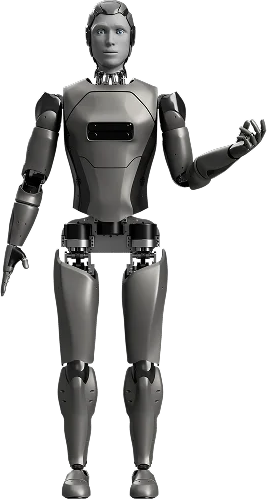 | |
| General information | |
| Manufacturer | AI Dynamic Organism Lab |
| Country of origin | Russia |
| Year announced | 2025 |
| Status | Prototype |
| CEO | Vladimir Vitukhin |
| Team size | 14 employees |
| Price | ~$60,000 USD (estimated) |
| Availability | Not yet commercially available |
| Website | aidoltech.ru |
AIDOL is a humanoid robot developed by Artificial Intelligence Dynamic Organism Lab (commonly abbreviated as AIDOL or Idol), a Russian robotics startup headquartered in Moscow. Marketed as Russia's first anthropomorphic robot powered by artificial intelligence, AIDOL stands 186 cm (6 ft 1 in) tall, weighs 95 kg (209 lb), and features 67 degrees of freedom. Its most distinctive characteristic is a silicone face driven by 19 servomotors capable of reproducing over 12 basic human emotions and hundreds of micro-expressions. The robot is designed to operate fully offline, processing dialogue and perception locally on a GPU-based compute module without requiring an internet connection.
AIDOL gained worldwide attention during its public debut in Moscow on November 10, 2025, when the robot lost its balance and fell forward on stage within seconds of its first steps. Despite the incident, the company treated it as a transparent learning moment inherent to the development of complex bipedal locomotion. AIDOL is part of the broader New Technological Coalition, a Russian consortium of robotics companies seeking to develop domestic anthropomorphic robot technology.
Company background
AI Dynamic Organism Lab
Artificial Intelligence Dynamic Organism Lab is a self-funded Russian startup that was formally registered in August 2025, though development work on the AIDOL project began earlier under the leadership of Vladimir Vitukhin, who has served as CEO since February 2023.[1][2] Vitukhin, who is based in Dubai, previously oversaw federal IT projects for the Russian government. He studied at Bauman Moscow State Technical University, one of Russia's premier engineering institutions.[3]
The company operates with a lean team of approximately 14 employees and has no major government or corporate backers. Despite its small size, the lab positions itself as a pioneer in Russia's emerging anthropomorphic robotics sector. The company's official website describes its mission as combining "engineering precision and human-centered communication" to build "next-generation robots for real businesses and the cities of tomorrow."[4]
New Technological Coalition
AIDOL is a member of the New Technological Coalition (Russian: Novaya Tekhnologicheskaya Koalitsiya), a Russian consortium dedicated to developing anthropomorphic robots. The coalition includes several organizations:[5]
- Promobot - a well-established Russian manufacturer of service robots that also produces industrial robot manipulators (since 2024)
- Dabl Yu Expo (Double U Expo) - a robotics and exhibition company
- AIDOL (AI Dynamic Organism Lab)
- Korporatsiya Robotov (Corporation of Robots)
Alexey Yuzhakov, the founder of Promobot and head of the New Technological Coalition, has been a key figure in pushing for investment in Russian anthropomorphic robotics. Yuzhakov told the Russian business newspaper Vedomosti that the coalition hopes to attract up to $50 million (approximately 4 billion rubles) in investments from both Russian and foreign private investors and funds to support further development of humanoid robots.[6]
Technical specifications
Overview
AIDOL is a full-size bipedal humanoid robot constructed from a combination of metal and plastic/composite materials. It features 67 degrees of freedom across its body, five-fingered hands capable of grasping objects up to 10 kg, and a sophisticated facial expression system. The robot runs on a 48-volt battery that provides up to six hours of continuous autonomous operation.
Specifications table
| Category | Specification | Value |
|---|---|---|
| Physical | Height | 186 cm (6 ft 1 in) |
| Physical | Weight | 95 kg (209 lb) |
| Physical | Body material | Metal + plastic/composite |
| Physical | Skin (face) | Silicone with varying firmness zones |
| Mobility | Degrees of freedom (total) | 67 |
| Mobility | Maximum walking speed | 1.67 m/s (6.0 km/h / 3.7 mph) |
| Mobility | Locomotion type | Bipedal walking |
| Manipulation | Payload capacity (hands) | 10 kg (22 lb) |
| Manipulation | Fingers per hand | 5 |
| Facial expression | Facial servomotors | 19 |
| Facial expression | Basic emotions | 12+ |
| Facial expression | Micro-expressions | Hundreds |
| Sensors | Microphones | 7 (3D sound mapping) |
| Sensors | Vision | Stereo cameras |
| Power | Battery voltage | 48 V |
| Power | Battery life | Up to 6 hours |
| Computing | Processing | Local GPU module |
| Computing | Connectivity | Online and fully offline modes |
Facial expression system
One of AIDOL's most technically ambitious features is its facial expression system. The robot's face is covered in a custom silicone "skin" that has been engineered with varying degrees of firmness to replicate the way human facial muscles stretch and compress during emotional expressions. Beneath this silicone layer, 19 servomotors control different facial regions, enabling the robot to display at least 12 basic human emotions (such as happiness, surprise, sadness, and anger) as well as hundreds of more subtle micro-expressions.[7]
The company has stated that the face can "smile, think, and be surprised, just like a person." This capability is intended to make AIDOL more approachable and effective in service-oriented roles where human-robot interaction quality is important, such as reception desks, banks, and airports.[8]
Audio and speech system
AIDOL incorporates seven microphones arranged to create a 3D sound map of its environment. This spatial audio capability allows the robot to determine the direction and distance of sounds and voices, enabling more natural conversational interaction with multiple people. The robot can recognize individual speakers and respond to voice commands while filtering ambient noise.[7]
All voice processing is performed locally on the robot's onboard GPU module rather than being sent to cloud servers. This design choice serves two purposes: it ensures the robot can operate without an internet connection, and it provides enhanced privacy and security for sensitive applications where data should not leave the premises.
Stereo vision system
AIDOL uses stereo cameras for visual perception and navigation. These cameras enable depth perception and spatial awareness, allowing the robot to map its surroundings and navigate through environments. However, the stereo camera system proved to be a point of vulnerability during the robot's public debut, as the cameras were found to be sensitive to lighting conditions. CEO Vladimir Vitukhin attributed the robot's on-stage fall to calibration issues with the stereo cameras caused by the dark lighting conditions in the presentation hall.[9]
Offline operation
A distinguishing feature of AIDOL is its ability to operate entirely offline. The robot's GPU-based compute module handles all perception, dialogue processing, and movement control locally. This means the robot can function in environments without internet connectivity, making it suitable for secure facilities, remote locations, or situations where data privacy is paramount. While the robot also supports online connectivity for software updates and expanded capabilities, its core functions do not depend on a cloud connection.[4]
Product lineup
AI Dynamic Organism Lab is developing AIDOL in two distinct form factors, each targeting different use cases.
Walking robot (full-size humanoid)
The walking version is the primary product and the version that was demonstrated at the November 2025 debut. Standing 186 cm tall and weighing 95 kg, this bipedal humanoid is designed for dual-purpose deployment across industrial and service sectors. Target applications include manufacturing floors, logistics warehouses, banks, airports, and other public spaces where the robot can move autonomously, transport objects, and interact with people.[4]
Desktop version
The company is also developing a smaller, stationary desktop version of the AIDOL platform, weighing approximately 40 kg. Described by the company as "the social communication interface of the future," the desktop version retains the expressive face and conversational capabilities of the full-size robot but eliminates the bipedal walking system. It is designed to integrate into fixed locations such as:[4]
- Medical centers and hospitals (patient check-in, information)
- Reception desks and front offices
- Educational institutions
- Retail environments
The desktop version supports the same facial recognition, emotional expression, and offline conversation capabilities as the walking robot. It also offers integration with third-party software and equipment, making it adaptable to specific business workflows.
Public debut and the Moscow incident
The fall
AIDOL made its first public appearance on November 10, 2025 (some sources report November 11 or 12, depending on time zone reporting), at a technology event held at the Yarovit Hall Congress Center in Moscow.[9] The debut was highly anticipated, as AIDOL was being presented as Russia's first AI-powered anthropomorphic robot.
The robot was introduced to the audience with dramatic flair, walking onto the stage accompanied by two human handlers while "Gonna Fly Now" (the iconic theme from the 1976 film Rocky) played over the speakers. However, within seconds of taking its first independent steps, AIDOL lost its balance while attempting to wave at the audience and toppled forward, falling face-first onto the stage. Staff members rushed to the robot, initially attempting to conceal it behind a black screen before carrying it away.[10][11]
Recovery and second attempt
After a brief repair interval, technicians returned AIDOL to the stage for a second attempt. With minimal assistance from handlers to initiate stability, the robot managed to remain upright throughout the remainder of the demonstration, though it was not fully unassisted.[12] Vitukhin confirmed that the robot was not damaged by the fall.
Explanation
Vitukhin attributed the malfunction to the robot's stereo cameras, which he said are sensitive to lighting conditions. The presentation hall was apparently too dark for the cameras to calibrate properly, disrupting the alignment between the robot's movement algorithms and physical execution. "I hope that this mistake will turn into an experience," Vitukhin told journalists, adding: "This is exactly what real-time learning is: when a successful mistake turns into knowledge, and an unsuccessful one into experience."[9][12]
Alexey Yuzhakov of the New Technological Coalition had reportedly warned the AIDOL development team prior to the event that insufficient effort had been invested in improving the robot's walking capability, suggesting that the stability issues were known risks within the coalition.[13]
Public reaction
Video of the fall went viral on social media platforms worldwide, drawing a mixture of humor, criticism, and some sympathy. Russian social media users were particularly critical, questioning the prototype's readiness for a public demonstration. International media coverage was extensive, with outlets drawing comparisons to the challenges faced by other humanoid robot programs globally. Some observers noted that public failures during live demonstrations are not uncommon in robotics; Boston Dynamics' robots have stumbled during demonstrations over the years, and early-stage prototypes from multiple companies have experienced similar setbacks.[10][11]
Applications
AIDOL is designed to address three core functional areas that its developers describe as the "three key human functions": walking on two legs, manipulating objects, and communicating with people.[12] Based on these capabilities, the company envisions deployment across several sectors:
| Application sector | Use cases |
|---|---|
| Manufacturing | Assembly assistance, parts handling, quality inspection |
| Logistics | Warehouse operations, object transport, inventory tasks |
| Banking | Customer greeting, information provision, queue management |
| Airports | Passenger assistance, wayfinding, information services |
| Healthcare | Patient check-in (desktop version), information delivery |
| Education | Interactive tutoring, campus assistance (desktop version) |
| Entertainment | Live performances, exhibitions, promotional events |
| Research | Robotics research platform, AI development testbed |
Russian robotics ecosystem context
Industry landscape
AIDOL's development takes place against the backdrop of Russia's broader efforts to build a domestic robotics industry. Russia has historically lagged behind the United States, China, Japan, and South Korea in commercial robotics. As of 2024, Russia introduced approximately 2,000 to 2,400 new industrial robots per year, a fraction of the volumes deployed annually in leading robotics markets.[14]
Key Russian robotics companies include:
| Company | Focus area | Notable products |
|---|---|---|
| Promobot | Service robots, industrial manipulators | Promobot V4, industrial arms |
| AIDOL (AI Dynamic Organism Lab) | Humanoid robots | AIDOL walking and desktop robots |
| Aripix Robotics | Industrial manipulators, logistics | Robotic arm systems |
| Robotech | Industrial manipulators | 4-axis and 6-axis robotic arms |
| CRP Russia | Welding robots (joint venture with China) | Welding cells, linear modules |
Impact of sanctions
Since 2022, Western sanctions imposed on Russia following the invasion of Ukraine have significantly affected the country's access to advanced technology components. The robotics sector has been impacted by restrictions on importing advanced semiconductors, sensors, and precision actuators from Western suppliers. This has created both challenges and incentives for domestic development:[14][15]
- Supply chain disruption: Access to advanced Western components has been restricted, forcing Russian robotics firms to source alternatives domestically or from non-sanctioned countries.
- Talent drain: A wave of engineers and AI specialists left Russia following the start of the conflict, reducing the available talent pool for robotics development.
- Domestic production push: The sanctions environment has accelerated Russia's push for technological self-reliance, with AIDOL's goal of 77% (rising to 93%) domestic component sourcing being a direct reflection of this strategy.
- Reorientation toward Asian markets: Russian robotics firms have increasingly looked to China and other Asian countries for components and partnerships.
AIDOL's emphasis on domestic component production (currently 77%, with a target of 93% in future production runs) directly reflects this geopolitical reality. The company views high localization as both a practical necessity and a selling point for government and defense-adjacent applications where foreign component dependencies are undesirable.[7][8]
Comparison with global competitors
AIDOL enters the humanoid robotics market at a significant technological gap compared to leading international programs. The following table provides context on where AIDOL stands relative to other humanoid robots:
| Robot | Company | Country | Height | Weight | DOF | Walking speed | Status |
|---|---|---|---|---|---|---|---|
| AIDOL | AI Dynamic Organism Lab | Russia | 186 cm | 95 kg | 67 | 6 km/h | Prototype |
| Optimus Gen 3 | Tesla | USA | 173 cm | 57 kg | 28 body + 22/hand | 8.4 km/h | Production Summer 2026 |
| Atlas (electric) | Boston Dynamics | USA | 150 cm | 89 kg | 56+ | N/A | Commercial deployment |
| Figure 02 | Figure AI | USA | 167 cm | 70 kg | 41+ | 4.8 km/h | Factory deployment |
| Digit | Agility Robotics | USA | 175 cm | 65 kg | 44+ | 5.1 km/h | Commercial deployment |
| GR-2 | Fourier Intelligence | China | 175 cm | 63 kg | 53 | 5 km/h | Commercial sales |
| Unitree H1 | Unitree Robotics | China | 180 cm | 47 kg | 19 | 5.4 km/h | Commercial sales |
While AIDOL has a relatively high DOF count (67) and competitive walking speed specifications, it remains in the prototype stage. Competitors like Boston Dynamics' Atlas can perform backflips and dynamic parkour maneuvers, Tesla's Optimus has been deployed in factory environments for data collection, and Figure AI's Figure 02 has demonstrated millimeter-precision manipulation in BMW manufacturing facilities. AIDOL's core differentiation lies in its expressive face (19 servomotors with silicone skin), full offline operation capability, and its focus on the Russian domestic market where import restrictions create a distinct competitive environment.
Development challenges
AIDOL faces several significant challenges as it moves from prototype to potential production:
Bipedal stability. The public debut highlighted that bipedal locomotion remains the robot's most pressing technical challenge. Bipedal walking is one of the hardest problems in robotics, requiring real-time integration of balance sensing, actuator coordination, terrain adaptation, and environmental perception. Even well-funded programs with decades of research (such as Boston Dynamics) have experienced falls during development.[10]
Limited resources. With only 14 employees and self-funding, AIDOL operates with a fraction of the resources available to competitors. Tesla has invested billions in its Optimus program, Figure AI has raised over $750 million in venture capital, and Boston Dynamics has had decades of DARPA and corporate (Alphabet, SoftBank, Hyundai) funding. AIDOL's ability to compete on technical capability is constrained by its financial and human capital limitations.
Sanctions-related component access. While the company has achieved 77% domestic sourcing, the remaining 23% of components that must be imported could include critical items such as advanced sensors, high-precision actuators, or specialized chips. Continued sanctions pressure could make sourcing these components increasingly difficult.
Talent availability. The departure of many skilled engineers and AI researchers from Russia since 2022 has reduced the domestic talent pool. Recruiting and retaining top robotics talent is challenging for a small, self-funded startup competing against well-resourced international programs.
Future plans
AI Dynamic Organism Lab has outlined several goals for AIDOL's continued development:
- Increasing domestic component sourcing from the current 77% to 93% or higher in future production versions.[7][8]
- Continued refinement of the bipedal walking system, with particular focus on stability and environmental adaptability.
- Development and deployment of the 40 kg desktop version for service and communication applications.
- Pursuing the New Technological Coalition's broader goal of attracting $50 million in investment for Russian anthropomorphic robotics development.[6]
- Expanding the AIDOL AI platform for human-machine communication, facial recognition, and context-preserving dialogue capabilities.
No specific timeline for mass production has been announced. Given the prototype's current development stage and the challenges outlined above, commercial availability is likely several years away.
See also
- Humanoid robot
- Humanoid robots
- AI Dynamic Organism Lab
- Promobot
- Boston Dynamics Atlas
- Tesla Optimus
- Degrees of freedom
- Facial recognition
- Embodied AI
References
- ^"Russia's First Humanoid Robot AIDOL Face-Plants During Moscow Debut." *The Outpost*, November 2025. theoutpost.ai/...t-at-moscow-tech-conference-21658
- ^"Russian humanoid robot AIDOL face-plants during debut, highlighting gap in global humanoid race." *Robotics and Automation News*, November 17, 2025. roboticsandautomationnews.com/...96675
- ^"Vladimir Vitukhin - Aidol." *LinkedIn*. linkedin.com/...vitukhin
- ^1 ^2 ^3 ^4"AI Dynamic Organism Lab official website." aidoltech.ru/en
- ^"A Russian AIDOL Falls." *Russian Life*, November 2025. russianlife.com/...a-russian-aidol-falls
- ^1 ^2"Russia's much-hyped humanoid robot face-plants onstage during debut." *The Spokesman-Review*, November 13, 2025. spokesman.com/...d-humanoid-robot-face-plants-onst
- ^1 ^2 ^3 ^4"Russia's first autonomous humanoid robot falls on debut." *The Register*, November 13, 2025. theregister.com/...aidol_russia_robot_fail
- ^1 ^2 ^3"Russia's first AI-powered robot walked on stage to triumphant music, took a few steps, and then immediately faceplanted." *Fortune*, November 13, 2025. fortune.com/...demonstration-features-capabilities
- ^1 ^2 ^3"Russia's AI robot stumbles and falls on its face in debut appearance." *Meduza*, November 12, 2025. meduza.io/...falls-on-its-face-in-debut-appearance
- ^1 ^2 ^3"Russia 'human' robot falls on stage during debut." *Newsweek*, November 2025. newsweek.com/...-falls-stage-during-debut-11031104
- ^1 ^2"Russia's first humanoid robot debuts and immediately eats the floor." *TechSpot*, November 2025. techspot.com/...obot-debuts-ndash-immediately-eats
- ^1 ^2 ^3"AIdol, Russia's first AI humanoid, collapses on stage." *The Jerusalem Post*, November 2025. jpost.com/...article-873595
- ^"Russia's Humanoid AI Robot Stumbles at Debut, Spotlighting Challenges in Domestic Robotics." *Azat TV*, November 2025. azat.tv/...ighting-challenges-in-domestic-robotics
- ^1 ^2"Industrial robotics in Russia under the conditions of sanctions." *Russian Robotics*, Vol. 12, Issue 3, 2024. rusrobotics.ru/...nder-the-conditions-of-sanctions
- ^"Russia shifts gears amid sanctions to make strides in artificial intelligence race." *Anadolu Agency*, 2025. aa.com.tr/...3752878
- "HumanoidSpecs.com - AIDOL." humanoidspecs.com/...ai-dynamic-organism-lab-aidol
Improve this article
Add missing citations, update stale details, or suggest a clearer explanation. Every suggestion is reviewed for sourcing before it goes live.
4 revisions · v5 · 3,237 words · full history
Fact-checks are independent of edits: a reviewer re-verifies the article against its sources and stamps the date. How we verify
Research and drafting on this wiki are AI-assisted, under named human editorial standards. How AI is used here
Cite this page: AI Wiki. "AIDOL." aiwiki.ai, updated 12 Apr 2026. CC BY 4.0. https://aiwiki.ai/wiki/ai_dynamic_organism_lab_aidol