

Tian Yi 2.0
| Tian Yi 2.0 | |
|---|---|
 | |
| General information | |
| Manufacturer | Beijing Humanoid Robot Innovation Center (X-Humanoid) |
| Country of origin | China |
| Year revealed | 2025 |
| Status | Production / Deployed |
| List price | 350,000 yuan (about $49,000) |
| Locomotion | Wheeled (mobile base) |
| Degrees of freedom | 35 total (7 per arm) |
| Onboard compute | NVIDIA Jetson AGX Orin (~275 TOPS) |
| AI platform | Wise KaiWu (Huisi Kaiwu) |
| Website | x-humanoid.com |
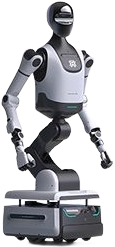
Tian Yi 2.0 (Chinese: 天轶2.0, also written Tianyi 2.0) is a wheeled humanoid robot developed by the Beijing Humanoid Robot Innovation Center, commonly known as X-Humanoid. It pairs a humanoid upper body, with two seven-degree-of-freedom arms and five-fingered dexterous hands, with a wheeled mobile base optimized for structured indoor environments such as factories, offices, and warehouses, and it carried a list price of 350,000 yuan (about $49,000) at its 2025 debut.[22] Unlike the center's bipedal Tiangong/Tien Kung series, which are designed for locomotion across varied terrain, Tian Yi 2.0 trades legs for wheels to gain energy efficiency, stability, and payload while keeping a humanoid upper body for object manipulation and human interaction. The robot is powered by X-Humanoid's proprietary Wise KaiWu (Huisi Kaiwu) embodied AI platform and is designed for autonomous patrol, inspection, material handling, and service tasks.
Tian Yi 2.0 was showcased at CES 2026 in January alongside the Embodied Tien Kung 2.0 and Tien Kung Ultra, and has been deployed on active production lines at a Foton Cummins engine plant in China. In August 2025, Tian Yi 2.0 units took both first and second place in the material-handling event at the inaugural World Humanoid Robot Games in Beijing, winning the first gold medal awarded in the games' scenario (applied-task) competition.[1][2][18]
Background
Beijing Humanoid Robot Innovation Center
The Beijing Humanoid Robot Innovation Center (formally Beijing Innovation Center of Humanoid Robotics Co., Ltd.) was established on November 2, 2023, in the Beijing Economic-Technological Development Area, commonly known as Beijing E-Town or Yizhuang.[3] It was jointly founded by four entities: Beijing Jingcheng Machinery Electric Company (28.57% stake), Beijing Xiaomi Robotics Technology (28.57%), UBTECH Robotics (28.57%), and Beijing Yizhuang Robotics Technology Industry Development, a state-owned subsidiary (14.29%).[4] The center's general manager is Xiong Youjun, who also serves as UBTECH's chief technology officer.[4]
The center was the first innovation platform in China dedicated specifically to core humanoid robot technologies, product development, and application ecosystem construction. In October 2024, it was upgraded to the status of a National and Local Co-built Embodied Artificial Intelligence Robotics Innovation Center, receiving support from both the Beijing municipal government and China's central government for research and development in embodied AI and robotics.[5]
In February 2026, X-Humanoid closed its first market-oriented funding round, raising over 700 million yuan (approximately $100 million USD). The round was led by state-linked investors including the Beijing Robotics Industry Development Investment Fund, E-Town Capital, and the Beijing Gaojingjian Industrial Development Investment Fund, with additional participation from TH Capital and strategic investors Baidu and Kyland Technology.[6]
The Tiangong Project and Product Lineup
X-Humanoid's product strategy centers on a family of robots rather than a single model. The naming can be complex: "Tiangong" (天工, meaning "Heavenly Craft") and its anglicized form "Tien Kung" refer to the bipedal humanoid series, while "Tian Yi" (天轶) designates the wheeled humanoid platform. Both product lines share the same Wise KaiWu AI platform and many of the same software and perception components.
The bipedal Tiangong series has progressed through several generations:
| Model | Year | Height | Weight | DOF | Top Speed | Key Milestone |
|---|---|---|---|---|---|---|
| Tiangong 1.0 | April 2024 | 163 cm | 43 kg | N/A | 12 km/h | World's first full-size purely electric running humanoid |
| Tiangong 2.0 / Tien Kung 2.0 | April 2025 | 170 cm | >45 kg | 20 | 12 km/h | Dual-battery hot-swap; industrial-grade design |
| Tiangong Ultra / Tien Kung Ultra | April 2025 | 180 cm | 52 kg | N/A | 12 km/h | Won world's first humanoid half-marathon (2:40:42); 100m sprint in 21.50 seconds |
| Tiangong 3.0 / Tien Kung 3.0 | February 2026 | 169 cm | 62 kg | 43 | N/A | Industry-first full-body tactile control; parkour capabilities |
The original Tiangong was unveiled on April 27, 2024, at the Zhongguancun Forum in Beijing, billed as the world's first full-size humanoid robot capable of running solely on electric drive.[7] Equipped with 550 TOPS of computing power and a sensor suite including RGB cameras, stereo cameras, LiDAR, ultrasonic rangefinders, high-precision IMU, gyroscopes, and six-axis force/torque sensors, the original Tiangong demonstrated an average speed of 10 km/h and could navigate slopes, stairs, grass, gravel, and sand.[7]
Tian Yi 2.0 complements these bipedal models by targeting use cases where wheeled locomotion is more practical, energy-efficient, and stable, particularly in structured facilities with smooth floors, corridors, and elevators.
Design and Architecture
Tian Yi 2.0 is a wheel-arm mobile manipulation platform. Its upper body follows a humanoid form factor with a torso, dual articulated arms, dexterous hands with five fingers per hand, and a sensor-equipped head. The lower body replaces legs with a wheeled mobile base, providing efficient and stable navigation across flat indoor surfaces. The robot weighs roughly 88.5 kg and uses an adjustable torso height in the range of about 130 to 165 cm, which lets it reach containers and shelves at different heights.[8]
This hybrid design reflects a deliberate engineering trade-off. Bipedal locomotion, as demonstrated by the Tiangong series, excels on uneven terrain and in human-scale environments with stairs, but it consumes significantly more energy and requires more complex balancing algorithms. Wheeled locomotion trades terrain versatility for greater energy efficiency, faster travel between task points, higher payload capacity, and simpler validation for routine indoor navigation. For industrial facilities where robots operate on level floors and can use elevators between stories, the wheeled approach provides a more immediately deployable solution.
Physical Build, Power, and Compute
Tian Yi 2.0 is driven by electric servo actuators and runs its onboard intelligence on an NVIDIA Jetson AGX Orin module rated at roughly 275 TOPS of AI compute. A 48-volt, 15-ampere-hour battery gives the robot a runtime of more than two hours per charge. Its real-time control loops run at high frequency: the arm control rate reaches at least 200 Hz, the dexterous-hand controller runs at 20 Hz, and the vision cameras stream at 30 Hz. The robot runs the Ubuntu 22.04 operating system.[8]
Degrees of Freedom
Tian Yi 2.0 features a total of 35 degrees of freedom distributed across its head, dual arms and hands, waist, and mobile base, including two seven-degree-of-freedom arms that give it the reach and articulation needed for fine assembly work.[8] This is substantially more than the 20 DOF of the Tien Kung 2.0 bipedal model and approaches the 43 DOF of the newer Tien Kung 3.0, reflecting the emphasis on upper-body dexterity for manipulation tasks.
Perception and Sensors
The robot's sensor suite supports three primary functions: navigation safety, object interaction, and human communication. Documented hardware includes a head-mounted RGBD camera, two RGBD cameras on the mobile base, an RGB camera, a single-line LiDAR unit, and a four-microphone array.[8]
| Sensor Category | Components | Function |
|---|---|---|
| Navigation | Depth cameras, LiDAR | Obstacle avoidance, SLAM-based mapping |
| Object interaction | RGBD cameras | Object recognition, grasp planning |
| Thermal imaging | Thermal infrared camera | Equipment temperature monitoring, anomaly detection |
| Visible-light imaging | RGB cameras | Visual patrol, object and person identification |
| Audio | Four-microphone array | Voice commands, spoken interaction |
| Proprioception | Joint encoders, force sensors | Arm and hand feedback during manipulation |
The combination of visible-light and thermal infrared imaging is particularly important for industrial patrol and inspection tasks, allowing Tian Yi 2.0 to detect overheating equipment, electrical faults, and other thermal anomalies that would be invisible to standard cameras.[1]
Communication Interfaces
For integration into existing industrial and robotics systems, Tian Yi 2.0 supports the following connectivity options:[8]
| Interface | Type |
|---|---|
| Wi-Fi 6 | External wireless |
| Ethernet | External wired |
| Bluetooth | External short-range |
| CAN / EtherCAT (500 Hz to 1 kHz) | Internal real-time bus |
The robot also supports ROS2, MQTT, and TCP/IP protocols for software integration, enabling compatibility with existing factory automation systems and multi-robot coordination frameworks.[9]
What is the Wise KaiWu embodied AI platform?
Tian Yi 2.0 runs on X-Humanoid's proprietary Wise KaiWu (Chinese: 慧思开物, also romanized Huisi Kaiwu) general-purpose embodied AI platform, which also powers the entire Tiangong/Tien Kung bipedal series. X-Humanoid describes it as "a universal embodied AI platform, which integrates cognitive and physical systems to form a closed-loop system encompassing perception, decision-making, and execution."[1] The platform "establishes a continuous perception-decision-execution loop, reducing reliance on remote control and human intervention, while driving a shift from single-unit operation to multi-robot collaboration," linking the robot's sensor inputs to high-level reasoning and low-level motor control without relying on pre-programmed task scripts.[9]
The platform uses a dual-brain architecture:
- "Large brain" (cortex): Handles high-level reasoning, task planning, and natural language understanding. It integrates vision-language models (VLMs) and world models for semantic scene understanding, object identification, and goal decomposition.
- "Small brain" (cerebellum): Manages real-time motion control, balance maintenance, and reflexive responses. On Tian Yi 2.0, this handles arm trajectory planning, wheel coordination, and gripper force control.
Wise KaiWu enables Tian Yi 2.0 to use large language model capabilities to customize object recognition on the fly. For instance, operators can instruct the robot in natural language to watch for specific types of equipment faults or to identify particular items during patrol rounds, and the embodied AI system adapts its perception pipeline accordingly.[1]
The platform also supports multi-robot scheduling and coordination, allowing a fleet of Tian Yi 2.0 units (or mixed fleets including bipedal Tien Kung robots) to divide tasks, share spatial maps, and hand off assignments. X-Humanoid demonstrated these multi-robot capabilities publicly at the World Artificial Intelligence Conference (WAIC) in Shanghai on July 26, 2025, in what it called China's first industrial multi-ontology, multi-scenario, multi-task autonomous collaborative operation. Four robots took on specialized roles, an electrical technician, a transporter, a quality inspector, and a packaging assistant, coordinating asynchronously across three work zones under a single mobile-app command interface, with dual-arm dexterous manipulation reaching task success rates above 90 percent.[21]
In December 2025, X-Humanoid introduced what it described as China's first fully autonomous, unmanned guided-tour solution, built on Wise KaiWu's global scheduling and its "one brain, many machines" and "one brain, many skills" design. The solution runs on multiple robot models including the Embodied Tien Kung 2.0 and Tian Yi 2.0, controls venue IoT devices directly, and responds with latency under 50 milliseconds.[20]
What can Tian Yi 2.0 do?
X-Humanoid markets Tian Yi 2.0 under the slogan "one machine, multiple uses," meaning the same hardware can be reassigned to different jobs by loading different software modules, for example running night security patrols and then handling daytime reception.[19] Its behavior is generated by an end-to-end vision-language-action (VLA) model rather than fixed scripts, and its voice interaction offers sub-second, interruptible dialogue with generalized question answering drawn from a knowledge base.[19]
Autonomous Patrol and Inspection
Tian Yi 2.0 is primarily framed for autonomous patrol and inspection in offices, warehouses, and industrial facilities. Typical deployment scenarios include after-hours security rounds, equipment condition monitoring, perimeter checks, and alert escalation workflows. The robot uses its visible-light and thermal imaging systems to detect anomalies, and its large language model-powered recognition pipeline can be customized to identify facility-specific objects and conditions.[1]
Manipulation and Physical Interaction
Using its dual articulated arms and dexterous gripper hands, Tian Yi 2.0 can perform a range of physical tasks in human environments:
- Opening and closing doors
- Pressing elevator buttons and swiping access cards
- Operating switches and control panels
- Carrying items between locations
- Opening and closing cabinet doors
- Picking up, transporting, and placing bins and containers
The robot's ability to autonomously identify and operate elevators is a high-value capability for multi-floor facility deployment, enabling real-world use without requiring building retrofits.[1]
Material Handling
At the Foton Cummins engine plant in China, Tian Yi 2.0 units operate on an unmanned production line performing autonomous bin pickup, transport, and placement. The robots adapt to varying shelf heights and container types, demonstrating the flexibility of the Wise KaiWu perception and planning stack in real industrial conditions.[2]
Guided Reception and Service
Beyond industrial applications, Tian Yi 2.0 is also positioned for visitor reception, guided tours, and customer service in commercial buildings and exhibition halls. Its microphone array and natural language processing capabilities allow it to engage in spoken dialogue with visitors. The robot's emotion-aware interaction can recognize a person's actions and expressions and proactively initiate contact, and it can accompany speech with full-body motion.[19]
Remote Teleoperation
For tasks that exceed the robot's autonomous capabilities or in emergency situations, Tian Yi 2.0 supports remote control through VR equipment or an operator "cockpit" interface. A single operator can switch between and control multiple robots, providing fine manipulation guidance and decision support. This teleoperation mode is particularly valuable in hazardous environments where the robot can serve as a physical proxy, reducing human exposure to risk.[1]
Technical Specifications
| Category | Specification | Details |
|---|---|---|
| Physical | Locomotion type | Wheeled mobile base |
| Upper body | Humanoid (torso, dual arms, head) | |
| Degrees of freedom | 35 total, 7 per arm | |
| Fingers per hand | 5 | |
| Weight | About 88.5 kg | |
| Torso height | Adjustable, about 130 to 165 cm | |
| Power | Battery | 48 V, 15 Ah |
| Runtime | Over 2 hours per charge | |
| Perception | Visible-light cameras | Head RGBD, dual base RGBD, RGB |
| Thermal imaging | Infrared thermal camera | |
| Ranging | Single-line LiDAR | |
| Audio | Four-microphone array | |
| AI/Computing | AI platform | Wise KaiWu (Huisi Kaiwu) |
| Onboard compute | NVIDIA Jetson AGX Orin (~275 TOPS) | |
| LLM/VLA integration | Yes (end-to-end VLA) | |
| Control rates | Arm >= 200 Hz, hand 20 Hz, cameras 30 Hz | |
| Operating system | Ubuntu 22.04 | |
| Connectivity | Wireless | Wi-Fi 6, Bluetooth |
| Wired | Ethernet | |
| Internal bus | CAN / EtherCAT (500 Hz to 1 kHz) | |
| Software protocols | ROS2, MQTT, TCP/IP | |
| Actuators | Type | Electric servo |
| Commercial | List price | 350,000 yuan (about $49,000) |
| Target applications | Primary | Industrial patrol, inspection, material handling |
| Secondary | Reception, guided service, teleoperation |
How much does Tian Yi 2.0 cost?
Tian Yi 2.0 was displayed with a list price of 350,000 yuan (about $49,000) at the 2025 World Robot Conference in Beijing, where it was positioned, in the event coverage's words, for "commercial and professional service" applications and placed in the mid-to-high price tier of humanoid robots offered for sale.[22] That price undercuts most full-size bipedal humanoids while sitting well above wheeled service robots that lack a manipulating upper body, reflecting Tian Yi 2.0's target market of facilities that need dexterous manipulation but not legged locomotion.
How did Tian Yi 2.0 perform at the World Humanoid Robot Games?
Tian Yi 2.0 achieved notable success at the inaugural World Humanoid Robot Games, held in Beijing in August 2025. The event, organized as the world's first competition integrating sports, arts, and applied scenarios for humanoid robots, featured participants from robotics companies and research institutions worldwide.[2]
In the material-handling event of the games' scenario (applied-task) competition, Tian Yi 2.0 units powered by the Wise KaiWu platform took both first and second place, capturing the very first gold medal awarded in the scenario competition. The winning task required each robot to autonomously insert 27 slender parts, each with an end diameter of only 8 millimeters, precisely into the holes of a storage bin, a test of fine grasping, stability, and manipulation accuracy that the robots completed fully autonomously at a pace matched to industrial cycle times.[18] The same event saw X-Humanoid's bipedal Tiangong Ultra win the 100-meter sprint final with a fully autonomous time of 21.50 seconds, becoming the world's first humanoid robot sprint champion.[10]
Where is Tian Yi 2.0 deployed?
X-Humanoid has established partnerships with several major industrial organizations for deploying both Tian Yi 2.0 and the bipedal Tien Kung series:
| Partner | Application | Robot(s) Used |
|---|---|---|
| Foton Cummins | Engine plant production line: bin pickup, transport, placement | Tian Yi 2.0, Tien Kung 2.0 |
| China Electric Power Research Institute | Power grid inspections | Tien Kung 2.0 |
| Li-Ning Group (Sports Science Lab) | Athletic shoe testing | Tien Kung 2.0 |
| Bayer | Pharmaceutical manufacturing applications | Tien Kung series |
The Foton Cummins deployment is particularly significant as an early example of humanoid robots operating autonomously on a live, unmanned production line in a major industrial facility. Both the wheeled Tian Yi 2.0 and the bipedal Tien Kung 2.0 work on the same production line, each handling tasks suited to its locomotion type.[2] Beyond the factory floor, the December 2025 guided-tour solution extends Tian Yi 2.0 into exhibition halls, shopping malls, and cultural-tourism venues, where it can lead visitors, deliver briefings, and operate connected devices autonomously.[20]
What did X-Humanoid show at CES 2026?
X-Humanoid exhibited its full product lineup at CES 2026 in Las Vegas in January 2026, making it one of approximately a dozen Chinese humanoid robot companies present at the show. Chinese humanoid robot firms made up roughly half of all humanoid exhibitors at CES 2026, reflecting the rapid growth of China's embodied AI industry.[11]
At the exhibition, X-Humanoid demonstrated live autonomous sorting tasks with the Embodied Tien Kung 2.0, visitor interactions, and operational showcases highlighting real-world deployability. The Embodied Tien Kung 2.0 demonstrated X-Humanoid's proprietary UVMC (Unified Vision-Motion Codes) technology, high-frequency control exceeding 60 Hz, and robust bimanual coordination in which, as the company described it, "if the right arm misses a part, the left arm immediately steps in."[1] Tian Yi 2.0 was presented as the company's solution for facilities requiring robust indoor navigation and manipulation without the complexity of bipedal locomotion.[2]
UBTECH Collaboration: Tiangong Walker
X-Humanoid's relationship with founding shareholder UBTECH extends beyond equity ownership. In March 2025, the two organizations jointly launched the Tiangong Walker, a full-size research-grade humanoid robot priced at RMB 299,000 (approximately $41,300 USD).[12] Standing 170 cm tall with 20 degrees of freedom and a biomimetic torso, the Tiangong Walker was designed specifically for research and educational institutions as an accessible entry point into humanoid robotics.
The Tiangong Walker supports a modular, expandable design with add-on options including depth cameras, LiDAR, NVIDIA Orin computing boards, six-axis force sensors, collaborative dual-arm systems, and dexterous hands. Full access to motor, sensor, and motion control interfaces enables secondary development by researchers.[12]
A more advanced variant, the Tiangong Walker DEX, was subsequently introduced with improved stability, motion control, and coordination between cerebellum (motion) and cortex (cognition) functions for fully autonomous task execution.[13]
Is the Tian Yi 2.0 software stack open source?
A distinctive aspect of X-Humanoid's strategy is its commitment to open-source releases. Reporting in April 2025 likened the effort to building an "Android" operating system for AI-enabled machines, a shared platform that outside developers can build on, and quoted general manager Xiong Youjun, who also serves as UBTECH's chief technology officer, saying the center aims to build "core platforms" for humanoid robot hardware and software.[4] The open-source initiative formally launched in November 2024 when X-Humanoid released the Tiangong design and associated technologies to the public.[14]
Open-sourced components include:
- Robot hardware platform: Structural blueprints, software architecture, and electrical system documentation for the Embodied Tiangong series
- Motion control framework: Control algorithms and training toolchains for locomotion and manipulation
- Pelican-VL: An embodied vision-language model developed by X-Humanoid for visual perception and language understanding in robotic contexts
- RoboMIND dataset: A large-scale multi-embodiment robotic manipulation dataset containing over 107,000 demonstration trajectories across 479 tasks involving 96 object classes, collected from four different robot platforms including the Tien Kung humanoid[15]
- ArtVIP simulation asset library: A collection of simulation assets for robotics training and testing
- World model and VLA models: Cross-ontology vision-language-action models for real-time control
The RoboMIND dataset is notable as the largest multi-embodiment teleoperation dataset collected on a unified platform. It includes data from the Franka Emika Panda single-arm robot (52,926 trajectories), the Tien Kung humanoid (19,152 trajectories), the AgileX Cobot Magic V2.0 dual-arm robot (10,629 trajectories), and the UR-5e single-arm robot (25,170 trajectories). It also contains 5,000 real-world failure demonstrations with detailed cause annotations.[15]
These open-source releases are hosted on GitHub under the Open X-Humanoid organization and on Hugging Face for the dataset, and they support integration with the open-source LeRobot framework.[16]
Competitive Context
Tian Yi 2.0 occupies a specific niche in the rapidly expanding global humanoid robot market. As a wheeled humanoid, it competes less directly with bipedal platforms from companies like Unitree Robotics, Figure AI, Tesla (Optimus), and Agility Robotics (Digit), and more directly with other wheeled or hybrid manipulation platforms designed for industrial service tasks.
Within China specifically, the humanoid robot industry experienced explosive growth in 2025 and 2026. Unitree Robotics shipped over 5,500 humanoid robots in 2025, while AgiBot and UBTECH also delivered units at scale. The market saw significant government support: China's Ministry of Industry and Information Technology issued guidelines aiming to establish a preliminary humanoid robot innovation system by 2025, and six major humanoid robot innovation centers were established across the country.[5]
X-Humanoid differentiates itself through several factors: its status as a national innovation platform with government backing, its extensive open-source ecosystem, the breadth of its product lineup (spanning wheeled, bipedal, research, and athletic platforms), and its strategic focus on enabling a standardized development ecosystem rather than competing solely on hardware sales.
The broader competitive landscape also saw Chinese humanoid robot companies achieving growing international visibility. At CES 2026, Chinese firms made up approximately half of all humanoid robot exhibitors, and several Chinese humanoid robots were featured at the 2026 Spring Festival Gala, drawing comparisons to a Super Bowl-level audience.[11][17]
Future Development
X-Humanoid's February 2026 launch of the Embodied Tien Kung 3.0, with 43 degrees of freedom and industry-first full-body tactile interaction capabilities, signals the direction of the broader platform's evolution. The Tien Kung 3.0 demonstrated advanced physical capabilities including one-handed vaults over one-meter obstacles, somersaults, dancing, and precision manipulation in confined spaces.[9]
For the Tian Yi product line, the improvements to the Wise KaiWu platform introduced with Tien Kung 3.0 are expected to cascade to the wheeled platform as well, including enhanced multi-robot collaboration, improved autonomous decision-making, and more sophisticated manipulation capabilities. The $100 million funding secured in early 2026 is directed toward scaling X-Humanoid's Embodied Tiangong and Wise KaiWu platforms and pushing toward broader real-world deployment.[6]
See also
- Humanoid robot
- Beijing Humanoid Robot Innovation Center
- Embodied AI
- UBTECH
- Tiangong Walker
- Computer vision
- Reinforcement learning
References
- ^1 ^2 ^3 ^4 ^5 ^6 ^7 ^8X-Humanoid Showcases Fully Autonomous and More Useful Robotics Solutions at CES 2026, PR Newswire, January 2026.
- ^1 ^2 ^3 ^4 ^5Humanoid robots show autonomous sorting and mobility at CES 2026, Engineering.com, January 2026.
- ^Beijing Establishes Humanoid Robot Innovation Center, Beijing Municipal Government, November 2023.
- ^1 ^2 ^3China's humanoid robot half marathon winner wants to be 'Android' of robotics, South China Morning Post, April 2025.
- ^1 ^2China pools efforts to fuel development of embodied AI robotics, State Council of the People's Republic of China, October 2024.
- ^1 ^2China's X-Humanoid Raises $100M in First Funding Round, The AI Insider, February 2026.
- ^1 ^2Chinese company unveils humanoid running robot with large-scale commercial potential, Global Times, April 2024.
- ^1 ^2 ^3 ^4 ^5Tian Yi 2.0 Wheeled Humanoid Robot, Robots Asia.
- ^1 ^2 ^3X-Humanoid Introduces Embodied Tien Kung 3.0, a More Open and Practical Humanoid Robotics Platform, PR Newswire, February 2026.
- ^Tiangong Ultra clinches victory in 100m dash, EyeShenzhen, August 2025.
- ^1 ^2China's humanoid robot firms make up half of exhibitors at CES 2026, Interesting Engineering, January 2026.
- ^1 ^2UBTECH Opens Preorders for $41K Tiangong Walker Humanoid Robot, Mike Kalil, March 2025.
- ^UBTech Launches Full-Size Research Humanoid Robot Tiangong Walker DEX, Gasgoo.
- ^World's first electric running humanoid robot 'Tiangong' open sourced, to accelerate robots into human life, Global Times, November 2024.
- ^1 ^2RoboMIND: Benchmark on Multi-embodiment Intelligence Normative Data for Robot Manipulation, X-Humanoid RoboMIND Project, 2024.
- ^Open X-Humanoid GitHub Organization, GitHub.
- ^Who's laughing now? China's humanoid robots go from viral stumbles to kung fu flips in one year, CNBC, February 2026.
- ^1 ^2Tian Yi 2.0 sweeps first and second in material handling at the World Humanoid Robot Games (fully autonomous operation), Sina Finance / China Securities Journal, August 2025.
- ^1 ^2 ^3Tian Yi Product Page, Beijing Humanoid Robot Innovation Center (X-Humanoid).
- ^1 ^2Wise KaiWu global scheduling powers China's first fully autonomous, unmanned guided-tour solution, AiBang Robots, December 2025.
- ^Beijing Humanoid Debuts at WAIC: China's First Industrial Multi-ontology, Multi-scenario, Multi-task Autonomous Collaborative Operation, X-Humanoid, July 2025.
- ^1 ^2A guide to the 2025 World Robot Conference, East Money, August 2025.
Improve this article
Add missing citations, update stale details, or suggest a clearer explanation. Every suggestion is reviewed for sourcing before it goes live.
7 revisions · v8 · 4,270 words · full history
Fact-checks are independent of edits: a reviewer re-verifies the article against its sources and stamps the date. How we verify
Research and drafting on this wiki are AI-assisted, under named human editorial standards. How AI is used here
Cite this page: AI Wiki. "Tian Yi 2.0." aiwiki.ai, updated 1 Aug 2026. CC BY 4.0. https://aiwiki.ai/wiki/beijing_humanoid_tian_yi_2