

UBTECH Walker Tienkung
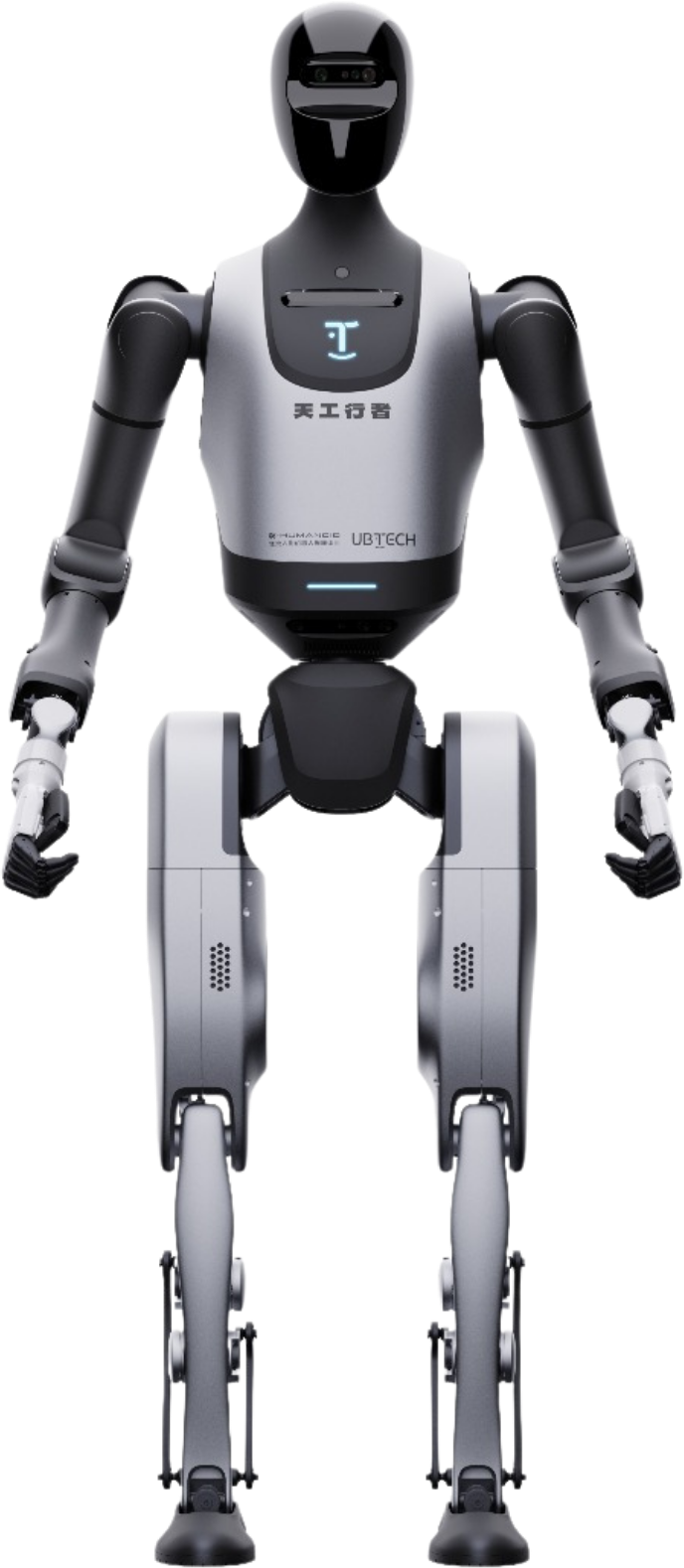
The UBTECH Walker Tienkung (Chinese: 天工行者, pinyin: Tiangong Xingzhe; also written Tiangong Walker, Tien Kung Walker, or Tien Kung Xingzhe) is a full-size, research-grade humanoid robot jointly developed by UBTECH Robotics and the Beijing Humanoid Robot Innovation Center (also known as X-Humanoid). Launched on March 13, 2025 at RMB 299,000 (approximately US$41,310), it was positioned by UBTECH as the industry's first research-grade humanoid robot priced under RMB 300,000, with pre-orders opening at launch and deliveries beginning in the second quarter of 2025.[1][2]
| UBTECH Walker Tienkung | |
|---|---|
 | |
| General information | |
| Manufacturer | UBTECH Robotics |
| Co-developer | Beijing Humanoid Robot Innovation Center (X-Humanoid) |
| Country of origin | China |
| Release year | 2025 |
| Status | In production |
| Base price | RMB 299,000 (~US$41,310) |
| Website | ubtrobot.com |
The Walker Tienkung is designed for academic research, STEM education, and secondary development rather than industrial manufacturing. It represents a distinct branch in UBTECH's Walker product family, sitting alongside the industrial Walker S series and the commercial Walker C. The robot is offered in two configurations: a Voice and Vision version with 21 degrees of freedom and 275 TOPS of computing power, and an Embodied Intelligence (EI) version with 42 degrees of freedom, five-finger dexterous hands, and up to 550 TOPS of computing power.[3][4] At roughly half the price of comparable research platforms such as the Unitree H1 (about RMB 650,000), it was widely covered as part of a Chinese push to lower the cost of full-size humanoid research hardware.[14]
Name and Etymology
The name "Tienkung" is a romanization of the Chinese characters 天工 (pinyin: tiangong), which translates roughly to "heavenly work" or "the craftsmanship of nature." The term has deep roots in Chinese literary tradition, appearing as early as the Shangshu (Book of Documents), one of the Five Classics of ancient Chinese literature, where it describes the creative forces of nature.[5] The most famous use of the term is in the title of the Ming Dynasty encyclopedia Tiangong Kaiwu (天工開物, "The Exploitation of the Works of Nature"), written by Song Yingxing in 1637, which was a comprehensive compendium on agriculture, industry, and craftsmanship.[6]
The full Chinese name of the robot, 天工行者 (Tiangong Xingzhe), combines "heavenly work" with "walker" or "traveler," conveying the idea of a technologically advanced walking machine that embodies the ingenuity of both nature and human engineering. The spelling "Tienkung" used in UBTECH's English marketing materials follows an older Wade-Giles-influenced romanization convention, while "Tiangong" follows the standard Hanyu Pinyin system. Both spellings refer to the same product.
Is the Walker Tienkung the same as X-Humanoid's Tiangong robot?
No. The name "Tiangong" (天工, Tien Kung) is shared across several distinct machines, and they are easy to confuse. The Walker Tienkung is a specific commercial product jointly developed by UBTECH and X-Humanoid, and it should not be conflated with X-Humanoid's own in-house Tiangong robots:
- The original Tiangong (天工) is X-Humanoid's own full-size humanoid, unveiled in April 2024 as, in the center's description, the world's first full-size humanoid robot able to run using a purely electric drive. It is not a UBTECH product.[7]
- The Walker Tienkung (Tiangong Walker), the subject of this article, is the commercialized research-and-education robot that pairs X-Humanoid's Tiangong motion-control lineage with UBTECH's Walker hardware, servo actuators, and manufacturing. It carries both the "Walker" name (UBTECH's humanoid product family) and the "Tiangong / Tien Kung" name (X-Humanoid's robot line).[1][2]
- Embodied Tien Kung 3.0 is X-Humanoid's own next-generation platform, introduced in February 2026 as, in the center's words, "the industry's first full-size humanoid robot to achieve whole-body, high-dynamic motion control integrated with tactile sensing," and open-sourced together with its motion-control framework, embodied vision-language model, and the RoboMIND dataset.[19] It is a separate line from the joint Walker product, although both draw on software from the same Huisi Kaiwu (Wise KaiWu) family.
In short, "Walker" denotes UBTECH's humanoid product family and "Tiangong / Tien Kung" denotes X-Humanoid's robot line; the Walker Tienkung is the jointly branded research robot that sits at their intersection.
Who developed the Walker Tienkung?
Beijing Humanoid Robot Innovation Center
The Walker Tienkung was co-developed with the Beijing Humanoid Robot Innovation Center (北京人形机器人创新中心), also known as X-Humanoid. This state-backed research center, located in Beijing's Economic-Technological Development Area, focuses on advancing humanoid robotics through open-source collaboration and industry partnerships. In October 2024 the center was upgraded to a National and Local Co-built Embodied Artificial Intelligence Robotics Innovation Center, a national-level designation, and in early 2026 it completed a first market-oriented funding round of more than RMB 700 million (about US$100 million) led by state-linked investors, with Baidu among the strategic backers.[20][17] The center had previously developed the original Tiangong humanoid robot, which was formally released in April 2024 as the world's first full-size humanoid robot capable of human-like running using a purely electric drive system.[7]
The original Tiangong robot, standing 163 cm tall and weighing 43 kg, demonstrated speeds up to 12 km/h and was capable of navigating slopes, stairs, grass, gravel, and sand. In November 2024, the Beijing Humanoid Robot Innovation Center launched the Tiangong Open Source Initiative, releasing software development documentation, structural design files, and its core motion control framework to the global research community.[8] A later "Tiangong Ultra" version of the robot went on to win the world's first humanoid robot half-marathon in Beijing in April 2025, completing the 21.1 km course in about 2 hours and 40 minutes.[21]
The Walker Tienkung represents an upgraded, commercialized evolution of the original Tiangong platform, incorporating UBTECH's proprietary servo actuator technology, industrial design expertise, and supply chain capabilities. By combining the innovation center's open-source research frameworks with UBTECH's mass production experience, the partnership aimed to create an accessible, full-featured research platform that could lower barriers to entry for universities and research institutions worldwide.
UBTECH's Product Differentiation Strategy
The Walker Tienkung occupies a specific niche in UBTECH's broader Walker product family, which by 2025 had grown into a multi-model lineup spanning consumer, commercial, industrial, and research applications.
| Model | Year | Height | DOF | Weight | Target Market | Price Range |
|---|---|---|---|---|---|---|
| Walker | 2018 | ~1.20 m | 36 | ~77 kg | Consumer/home | N/A |
| Walker X | 2021 | 1.45 m | 41 | N/A | Service/research | N/A |
| Walker S | 2023 | 1.70 m | 41 | N/A | Industrial manufacturing | Enterprise pricing |
| Walker C | 2024 | 1.63 m | 20 | 43 kg | Commercial service | Enterprise pricing |
| Walker S1 | 2024 | 1.72 m | 41 | 76 kg | Industrial manufacturing | Enterprise pricing |
| Walker Tienkung (V&V) | 2025 | 1.72 m | 21 | 61 kg | Research/education | ~US$85,000 |
| Walker Tienkung (EI) | 2025 | 1.72 m | 42 | ~73 kg | Research/education | ~US$235,000 |
| Walker S2 | 2025 | 1.76 m | 52 | N/A | Industrial manufacturing (mass production) | Enterprise pricing |
This product segmentation reflects UBTECH's strategy of addressing multiple market segments simultaneously. The industrial Walker S series (S, S1, S2) targets automotive and logistics factories, emphasizing durability, payload capacity, and autonomous operation. The Walker C serves commercial reception and service environments. The Walker Tienkung fills the research and academic gap, providing an open-architecture platform that researchers can customize, reprogram, and experiment with freely.
UBTECH has framed research platforms like the Walker Tienkung as a way to seed the broader humanoid robotics ecosystem. At launch, UBTECH and the Beijing Humanoid Robot Innovation Center established a Humanoid Robot Research Fund with RMB 10 million (approximately US$1.4 million) in initial funding to support global universities and research institutions working on humanoid robotics.[2]
What are the Walker Tienkung's specifications?
The Walker Tienkung is available in two configurations, each targeting different levels of research complexity. UBTECH's launch announcement described the base research configuration as having 20 degrees of freedom and a height of about 170 cm.[2][13] The two shipping configurations, as listed by international distributor RBTX, are detailed below. The RMB 299,000 (about US$41,310) figure is UBTECH's China domestic launch price for the base configuration; distributor listings for export markets are higher, reflecting shipping, import, and integration costs.[3][4]
Voice and Vision Version
| Category | Specification |
|---|---|
| Height | 1,720 mm (172 cm) |
| Weight | 61 kg |
| Degrees of freedom | 21 |
| Maximum speed | 2.4 m/s |
| Maximum joint torque | 300 Nm |
| Maximum payload | 6 kg |
| Computing power | 275 TOPS |
| Battery | 30 Ah + 3 Ah detachable dual batteries |
| Operating time | Up to 8 hours (continuous motion: ~3 hours) |
| Materials | Titanium alloy and aviation-grade aluminum |
| Connectivity | Wi-Fi, Bluetooth, Ethernet |
| Software | ROS2 compatible (Ubuntu, LinuxRT) |
| Price | ~US$85,932 (via RBTX) |
The Voice and Vision version provides a 172 cm humanoid platform with 21 degrees of freedom, equipped with language and vision modules for multimodal interaction research. It is designed as a more affordable entry point for institutions primarily interested in natural language processing, computer vision, and human-robot interaction studies.[3] At launch, Heise reported that the entry configuration shipped without the multi-finger hands, which belong to the higher Embodied Intelligence build.[13]
Embodied Intelligence (EI) Version
| Category | Specification |
|---|---|
| Height | 1,720 mm (172 cm) |
| Weight | ~73 kg |
| Degrees of freedom | 42 |
| Arm configuration | Dual 7-DOF arms |
| Hand configuration | Dual 6-DOF five-finger dexterous hands |
| Maximum speed | 10 km/h (2.78 m/s) |
| Maximum joint torque | 300 Nm |
| Maximum payload | 6 kg |
| Computing power | Up to 550 TOPS |
| Primary processor | Intel i7 |
| AI accelerators | Dual NVIDIA Jetson AGX Orin modules |
| Sensors | 3 depth cameras, 1 monocular camera, high-precision IMU, dual 6-axis force sensors |
| Battery | Hot-swappable 30 Ah + 3 Ah dual batteries |
| Operating time | Up to 8 hours (continuous motion: ~3.5 hours) |
| Materials | Aircraft-grade aluminum-titanium alloy |
| Connectivity | Wi-Fi, Bluetooth, Ethernet, high-frequency EtherCAT |
| Software | ROS2 compatible, Huisi Kaiwu AI platform |
| Price | ~US$234,925 (via RBTX) |
The EI version is the fully equipped research platform, featuring 42 degrees of freedom including dual 7-DOF arms and dual 6-DOF dexterous hands capable of human-level manipulation tasks. The additional 21 degrees of freedom over the Voice and Vision version come primarily from the arm and hand systems. The dual NVIDIA Jetson AGX Orin modules provide up to 550 TOPS of AI computing power, enabling on-device deep learning inference, visuomotor learning, and real-time decision-making.[4]
Construction and Materials
The Walker Tienkung employs titanium alloy in critical structural areas and aviation-grade aluminum throughout the chassis to achieve a balance between lightweight construction and impact resistance. This material selection makes the robot suitable for repeated physical testing in research environments, where falls and collisions during locomotion experiments are common. The robot is rated for anti-fall and impact resistance, with a full-body heat dissipation system using air duct cooling to manage thermal loads during extended operation.[3][4]
What software does the Walker Tienkung run?
Open Architecture
One of the Walker Tienkung's defining characteristics is its open-architecture design. The robot provides full access to all joint motors, sensors, and motion control interfaces through documented APIs. UBTECH supplies comprehensive development resources including development guides, sample code, and high-fidelity URDF (Unified Robot Description Format) simulation models compatible with physics simulators such as Gazebo and Isaac Sim.[9]
The software stack runs on Ubuntu with a Linux RT-Preempt real-time kernel and is fully compatible with ROS2 (Robot Operating System 2), the standard middleware framework used in academic robotics research. This ensures that algorithms developed on the Walker Tienkung can be readily transferred to other ROS2-compatible platforms and vice versa.
Huisi Kaiwu AI Platform
The EI version of the Walker Tienkung runs on the Huisi Kaiwu (慧思开悟) general-purpose embodied intelligence platform, developed by the Beijing Humanoid Robot Innovation Center and rendered in some English materials as "Wise KaiWu." The center unveiled the platform on March 12, 2025, one day before the Walker Tienkung launch, positioning it as the "brain" that moves robots from executing single tasks to autonomous decision-making in complex environments.[16] The center's chief technology officer, Tang Jian, described it as "a central nervous system for robots that integrates advanced cognitive functions such as perception, decision-making, language, learning, and motion control."[16]
The platform provides autonomous decision-making, task planning, vision processing, language understanding, and motion control capabilities, and can self-correct and re-plan when it encounters obstacles. It supports low-code development workflows, enabling researchers to deploy and test AI models without extensive systems programming, and it is applicable across humanoid, wheeled, and robotic-arm systems.[10][16] The platform integrates with the center's broader "Tiangong + Kaiwu" strategy, which promotes the application of embodied AI technology across various research fields.
AI and Machine Learning Support
The Walker Tienkung includes openly integrated AMP-style (Adversarial Motion Priors) reinforcement learning frameworks and complete toolchains for training embodied manipulation policies. Researchers can use the platform for:
- Visuomotor learning: Training policies that map visual observations directly to motor commands using deep learning models
- Imitation learning: Recording human demonstrations via teleoperation and training the robot to replicate observed behaviors
- Multimodal interaction: Combining vision and language models for task-level reasoning and scene understanding
- Dexterous manipulation: Developing fine motor control policies for the five-finger hands using the provided manipulation datasets
Embodied AI Datasets
UBTECH provides embodied AI datasets with the Walker Tienkung that include multi-view RGB-D images, proprioceptive robot state information (joint positions, velocities, and torques), end-effector states, and natural language task descriptions. These datasets are designed to accelerate research in areas such as vision-language-action models, sim-to-real transfer, and task-conditioned policy learning.[9]
What can the Walker Tienkung do?
Locomotion
The Walker Tienkung can generate adaptive locomotion across varied terrains including slopes, stairs, sand, and snow. During demonstrations, the robot has been shown climbing 134 consecutive stairs without interruption.[11] It maintains real-time dynamic balance and is resistant to external impacts and pushes, automatically compensating for disturbances while walking. The EI version achieves a top speed of 10 km/h (approximately 6.2 mph), making it one of the faster full-size humanoid research platforms available.[2]
The robot's proprietary integrated joint modules deliver a peak torque of 300 Nm, combined with high-torque density design that enables both powerful locomotion and precise movement control.
Manipulation
The EI version features dual 7-DOF arms and dual 6-DOF dexterous hands with five articulated fingers per hand. This configuration provides human-level manipulation capabilities, enabling the robot to grasp, hold, rotate, and place objects of varying sizes and shapes. The 6 kg maximum payload capacity applies to each arm, supporting a range of manipulation research scenarios from tabletop object sorting to tool use experiments.[4]
The dual 6-axis force sensors provide force feedback for the arms, enabling compliant manipulation strategies where the robot can adjust its grip and movement in response to contact forces.
Perception and Interaction
The sensor suite includes three depth cameras for spatial awareness, a monocular camera for visual recognition, a high-precision inertial measurement unit for balance and orientation, and dual 6-axis force sensors for force-aware manipulation. Optional integrations include LiDAR for 3D environment mapping and additional depth sensors for expanded perception.[4]
Both versions support voice command interaction and vision-language reasoning, allowing researchers to test conversational AI, gesture recognition, and scene understanding algorithms on a physical platform.
What is the Walker Tienkung used for?
Academic Research
The Walker Tienkung's primary target audience is university research labs and robotics departments. Its open-architecture design and ROS2 compatibility make it suitable for a wide range of research topics:
- Bipedal locomotion and dynamic balance control
- Whole-body motion planning and coordination
- Dexterous manipulation and grasping
- Vision-language-action models for embodied AI
- Sim-to-real transfer learning
- Multi-robot coordination and swarm behavior
- Human-robot interaction and social robotics
To support academic adoption, UBTECH and the Beijing Humanoid Robot Innovation Center established a Humanoid Robot Research Fund with RMB 10 million in seed funding. This fund provides grants to universities and research institutions globally to support humanoid robotics research projects using the Walker Tienkung platform.[2]
Education
The Voice and Vision version serves as a platform for university-level STEM education courses in robotics, artificial intelligence, and computer science. Its lower price point and simplified configuration (21 DOF without dexterous hands) make it accessible for classroom demonstrations, student projects, and hands-on coursework in human-robot interaction, motion control, and perception algorithms.
Secondary Development
The modular, expandable design supports secondary development, allowing users to add or swap components such as different end-effectors, additional sensors, or upgraded computing modules. The hot-swappable battery system and EtherCAT high-frequency communication bus facilitate rapid prototyping and iterative testing cycles. Developers can create, test, and deploy custom humanoid robotics applications using the provided development tools and APIs.[9]
How does the Walker Tienkung compare to other humanoid robots?
The Walker Tienkung entered a market where full-size humanoid robots suitable for research had traditionally been prohibitively expensive for most academic institutions. At US$41,310 for the base configuration, the Walker Tienkung significantly undercuts several competing platforms.
| Robot | Manufacturer | Height | DOF | Approximate Price | Target |
|---|---|---|---|---|---|
| Walker Tienkung (base) | UBTECH / X-Humanoid | 1.72 m | 20 | ~US$41,000 | Research/education |
| H1 | Unitree Robotics | 1.80 m | 19 | ~US$90,000 | Research/education |
| GR-2 | Fourier Intelligence | 1.75 m | 53 | >US$100,000 | Research/rehabilitation |
| Digit | Agility Robotics | 1.75 m | 16 | Enterprise pricing | Industrial logistics |
| PM01 | EngineAI | 1.38 m | N/A | ~US$12,000 | Research/education |
| Tron 1 | LimX Dynamics | N/A | N/A | ~US$30,000 | Education |
The Walker Tienkung's pricing strategy reflects the broader trend among Chinese robotics manufacturers to leverage domestic supply chain advantages (particularly from the electric vehicle sector) to offer capable humanoid platforms at significantly lower price points than Western competitors. UBTECH benefits from its own vertically integrated servo actuator production, having manufactured over one million servo units, which helps control component costs.[12]
However, the fully equipped EI version at approximately US$235,000 is positioned in a different price bracket, competing more directly with high-end research platforms. This tiered pricing allows UBTECH to serve both budget-constrained educational institutions and well-funded research laboratories with a single product family.
How does the Walker Tienkung differ from the other Walker models?
Comparison with Walker S Series
While the Walker Tienkung and the Walker S series share the Walker brand name and certain underlying technologies (such as UBTECH's proprietary servo actuators and sensor systems), they are designed for fundamentally different use cases.
The Walker S, S1, and S2 are industrial-grade humanoid robots built for deployment on automotive assembly lines and in logistics centers. They emphasize durability, high payload capacity (up to 15 kg for the S2), autonomous operation (including the S2's self-battery-swapping capability), and integration with factory management systems through UBTECH's BrainNet 2.0 AI platform. The S series robots are not designed to be reprogrammed by end users; they run UBTECH's proprietary software stack tailored for specific industrial tasks.
The Walker Tienkung, by contrast, prioritizes openness and customizability. Its open-architecture design, full API access, ROS2 compatibility, and included development resources are specifically intended for researchers who want to modify, extend, and experiment with every aspect of the robot's behavior. The Tienkung trades the industrial robustness and autonomy features of the S series for flexibility and accessibility.
Comparison with Walker C
The Walker C is UBTECH's commercial service robot, designed for reception, tour guide, and customer-facing roles in exhibition halls and office buildings. Standing 163 cm tall with 20 degrees of freedom, the Walker C features U-SLAM autonomous navigation, multilingual interaction powered by UBTECH's Embodied Interactive Large Model, and a consumer-friendly design. It operates in a fundamentally different mode from the Walker Tienkung: the Walker C runs pre-configured service applications, while the Walker Tienkung is a blank canvas for researchers to build upon.
Evolution from Walker X
The Walker X, introduced in 2021 with 41 degrees of freedom and 7-DOF arms with 6-DOF force-controlled hands, was UBTECH's most advanced general-purpose humanoid before the industrial pivot to the S series. The Walker Tienkung's EI version inherits some of the Walker X's design philosophy, particularly the emphasis on dexterous manipulation and hand-eye coordination, but packages it in a newer platform with updated computing hardware (dual NVIDIA Jetson AGX Orin), improved materials, and a purpose-built development ecosystem.
What is the Tiangong Walker DEX?
The Tiangong Walker DEX is a successor research humanoid in the joint UBTECH and X-Humanoid line, launched on February 12, 2026. The "DEX" suffix stands for dexterity, emphasizing agility and flexibility: the robot is designed to handle high-dynamic tasks such as vaulting one-meter obstacles and performing explosive movements while remaining stable, and its flexible torso lets it kneel or bend to work in confined spaces.[15]
Like the original Walker Tienkung, the DEX runs on the Huisi Kaiwu embodied intelligence platform and supports mainstream robotics protocols including ROS2 and MQTT within a low-code environment. It is built around a full-stack open-source ecosystem with multiple hardware expansion interfaces spanning uses from specialized operations to industrial manufacturing, and UBTECH positioned it for four groups: research universities, applied undergraduate institutions, vocational schools, and global developers.[15]
The DEX arrived in the same month as X-Humanoid's separately branded Embodied Tien Kung 3.0 platform, a reminder that the two organizations continue to develop both a jointly branded Walker product line and X-Humanoid's own in-house Tien Kung line in parallel.[15][19]
Reception and Significance
The Walker Tienkung was noted by industry observers as a significant step toward democratizing access to full-size humanoid robot research. The German technology publication Heise described it as "probably the first commercial, life-size humanoid robot that has been specially developed for research purposes."[13] The South China Morning Post highlighted the robot's competitive pricing in the context of the global race to build affordable humanoid machines, noting that it undercuts comparable platforms such as the Unitree H1 (priced at approximately RMB 650,000) by a substantial margin.[14]
The Walker Tienkung also serves a strategic purpose for UBTECH. While the Walker S2 industrial robot generates revenue through mass production orders (with UBTECH reporting that Walker S2 orders exceeded RMB 800 million by late 2025), the Tienkung builds UBTECH's presence in the academic community, fostering a pipeline of researchers and developers who become familiar with UBTECH's technology stack.[18] This approach mirrors strategies used by other technology companies that offer discounted or open-source tools to educational institutions as a long-term ecosystem investment.
See Also
- Humanoid robots
- UBTECH Robotics
- Beijing Humanoid Robot Innovation Center
- Walker S2
- Walker S1
- Walker X
- Walker C
- Embodied AI
- Dexterous hand
- Vision-language-action model
- Robot Operating System
- Reinforcement learning
- Unitree H1
- Fourier GR-2
References
- ^1 ^2UBTECH Robotics. "Walker Tienkung - Full-size Humanoid Robot Designed for Academic Research, Education & Secondary Development." ubtrobot.com. Retrieved April 2026. ubtrobot.com/...walker-tienkung
- ^1 ^2 ^3 ^4 ^5 ^6TechNode. "UBTECH launches Tiangong Walker, a research humanoid robot." March 13, 2025. technode.com/...de-humanoid-robot-priced-under-45k
- ^1 ^2 ^3 ^4RBTX. "UBTECH Walker Tienkung | Humanoid Robot | Voice & Vision Version." rbtx.com. Retrieved April 2026. rbtx.com/...ng-humanoid-robot-voice-vision-version
- ^1 ^2 ^3 ^4 ^5 ^6RBTX. "UBTECH Walker Tienkung EI | Humanoid Robot | 42 DOF." rbtx.com. Retrieved April 2026. rbtx.at/...walker-tienkung-humanoid-robot
- ^Wisdom Library. "Tian gong definitions." wisdomlib.org. Retrieved April 2026. wisdomlib.org/...tian-gong
- ^ChinaKnowledge. "Tiangong kaiwu 天工開物." chinaknowledge.de. Retrieved April 2026. chinaknowledge.de/...tiangongkaiwu
- ^1 ^2Interesting Engineering. "Tiangong: World's 1st electric humanoid robot goes open source." November 2024. interestingengineering.com/...umanoid-robot-design
- ^Global Times. "World's first electric running humanoid robot 'Tiangong' open sourced." November 2024. globaltimes.cn/...1322852.shtml
- ^1 ^2 ^3UBTECH Robotics. "Walker Tienkung product page - Development resources and datasets." ubtrobot.com. Retrieved April 2026. ubtrobot.com/...walker-tienkung
- ^Aparobot. "Tien Kung - Robot Details, Use Case and Specifications." aparobot.com. Retrieved April 2026. aparobot.com/...tien-kung
- ^Aparobot. "Tien Kung - Continuous stair climbing demonstration (134 steps)." aparobot.com. Retrieved April 2026. aparobot.com/...tien-kung
- ^UBTECH Robotics. "About UBTECH - Company Profile." ubtrobot.com. Retrieved April 2026. ubtrobot.com/...company-profile
- ^1 ^2 ^3Heise Online. "UBTech offers humanoid research robot for around 41,000 US dollars." March 2025. heise.de/...-for-around-41-000-US-dollars-10315912
- ^1 ^2South China Morning Post. "China's UBTech debuts US$41,000 humanoid robot in race to build cheaper machines." March 2025. scmp.com/...noid-robot-race-build-cheaper-machines
- ^1 ^2 ^3Gasgoo. "UBTech Launches Full-Size Research Humanoid Robot 'Tiangong Walker DEX'." February 12, 2026. autonews.gasgoo.com/...ker-dex-2021910760056164353
- ^1 ^2 ^3Global Times. "Tien Kung's developer launches intelligence platform to enable robots to handle complex tasks." March 12, 2025. globaltimes.cn/...1329994.shtml
- ^The AI Insider. "China's X-Humanoid Raises $100M in First Funding Round." February 5, 2026. theaiinsider.tech/...s-100m-in-first-funding-round
- ^PR Newswire. "UBTECH Humanoid Robot Walker S2 Begins Mass Production and Delivery, with Orders Exceeding 800 Million Yuan." November 2025. prnewswire.com/...eding-800-million-yuan-302616924
- ^1 ^2PR Newswire. "X-Humanoid Introduces Embodied Tien Kung 3.0, a More Open and Practical Humanoid Robotics Platform." February 2026. prnewswire.com/...noid-robotics-platform-302688505
- ^The State Council of the People's Republic of China. "China pools efforts to fuel development of embodied AI robotics." October 11, 2024. english.www.gov.cn/...t_WS67092284c6d0868f4e8ebb88
- ^Interesting Engineering. "China's 'Tiangong Ultra' wins world's first humans vs robots marathon." April 2025. interestingengineering.com/...umans-robot-marathon
Improve this article
Add missing citations, update stale details, or suggest a clearer explanation. Every suggestion is reviewed for sourcing before it goes live.
7 revisions · v7 · 4,242 words · full history
Fact-checks are independent of edits: a reviewer re-verifies the article against its sources and stamps the date. How we verify
Research and drafting on this wiki are AI-assisted, under named human editorial standards. How AI is used here
Cite this page: AI Wiki. "UBTECH Walker Tienkung." aiwiki.ai, updated 7 Jul 2026. CC BY 4.0. https://aiwiki.ai/wiki/ubtech_walker_tienkung