

Kepler Forerunner D1
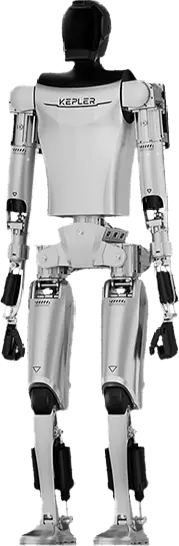
The Kepler Forerunner D1 is a dexterity-focused, general-purpose humanoid robot unveiled by the Shanghai company Kepler Robotics at CES 2024, the "Da Vinci" of the three-model Forerunner lineup, optimized for fine manipulation and safe human interaction rather than raw strength or speed. It stands 178 cm (5 ft 10 in) tall, weighs 85 kg (187 lb), has 40 degrees of freedom with 12-DOF dexterous hands, runs Kepler's Nebula AI system at 100 TOPS, and was announced with a target price of $20,000 to $30,000.[1][2]
| Kepler Forerunner D1 | |
|---|---|
 | |
| General information | |
| Manufacturer | Kepler Robotics |
| Country of origin | China |
| Year introduced | 2024 |
| Generation | 1st (Forerunner series) |
| Status | Succeeded by K2 Bumblebee |
| Designation | Dexterous specialist |
| Price | ~$20,000 - $30,000 USD |
| Website | gotokepler.com |
The D1 shares the same physical platform, planetary roller screw actuators, and Nebula AI as the Forerunner K1 and Forerunner S1, but its control software is tuned for intricate manipulation in healthcare, laboratory work, precision manufacturing, and educational research. With proprietary planetary roller screw actuators delivering up to 8,000 N of thrust and an intelligent dexterous hand carrying multiple force-feedback sensors, the D1 targets applications where fine motor control and compliant, safe operation take priority over payload capacity or high-speed mobility.[1][3]
The D1 also serves as a key platform for Kepler's developer ecosystem. Paired with the Kepler OS global developer platform, the D1 provides researchers and academic institutions with comprehensive development interfaces, reference projects, and documentation, making it a practical entry point for humanoid robotics research and education.[4] The D1, together with the K1 and S1, was succeeded by the Kepler K2 Bumblebee in October 2024, which entered mass production in September 2025.[5]
What is the Kepler Forerunner D1?
The Forerunner D1 is one of three models in the original Forerunner series of general-purpose humanoid robots that Kepler Robotics unveiled at CES 2024 in Las Vegas. Within the trio, the D1 is the dexterity specialist, nicknamed the "Da Vinci" of the lineup for its emphasis on fine manipulation and human-like dexterity.[1][2] It is a full-sized bipedal humanoid built to perform delicate, precise tasks in close proximity to people, such as handling laboratory glassware, assisting in healthcare settings, and assembling small components.
The D1's "Da Vinci" nickname is not incidental. Kepler explicitly chose the reference to Leonardo da Vinci, the Renaissance polymath known for his unparalleled combination of scientific rigor and artistic dexterity, to signal the D1's core purpose: performing tasks that require the kind of fine motor control, perceptual awareness, and gentle touch that most humanoid robots struggle to achieve.[2]
Unlike a single all-purpose design, the D1 was conceived as the precision-and-interaction member of a deliberately specialized family. Kepler designed the Forerunner series from the outset as three variants sharing a common mechanical and computational platform, with each variant tuned in software for a distinct category of work.[2][8]
Who makes the Forerunner D1?
The Forerunner D1 is made by Shanghai Kepler Exploration Robot Co., Ltd. (commonly known as Kepler Robotics), a Chinese robotics company headquartered in the Pudong district of Shanghai. Kepler is part of the wave of China AI and robotics firms that emerged after the Chinese government made humanoid robotics a national policy priority.
Shanghai Kepler Exploration Robot Co., Ltd. was founded in 2023 by Hu Debo as a high-tech enterprise dedicated to the research, development, production, and commercialization of general-purpose humanoid robots. The company is headquartered at Torch Lotus Business Park on Naxian Road in the China (Shanghai) Pilot Free Trade Zone in Pudong.[6] Hu Debo previously held positions at PowerVision Robot Corporation, Huawei, and Hubert Tech Oy, and holds a master's degree in scientific computing from KTH Royal Institute of Technology in Sweden (2003-2005).[7]
Kepler describes itself as a builder of "high-IQ blue-collar humanoid robots" dedicated to "revolutionizing productivity with cutting-edge technology, hastening the arrival of a 'three-day work week.'"[4] The Forerunner series emerged from three years of intensive research and four product iterations prior to its public debut.[4]
Why a three-model lineup?
The Forerunner series was designed from the outset as a family of three specialized variants sharing a common mechanical and computational platform. Rather than building a single general-purpose robot and marketing it for all applications, Kepler chose to differentiate the lineup by optimizing each variant for a distinct category of tasks. The Forerunner K1 was the heavy-duty powerhouse for construction and industrial settings, the Forerunner S1 was the agile explorer for search and rescue operations, and the D1 was the dexterous specialist for precision work and human interaction.[2][8]
This approach allowed Kepler to present a comprehensive product portfolio at CES 2024 while leveraging shared engineering across all three models. The common platform reduced development costs and manufacturing complexity, while the variant-specific tuning addressed distinct customer needs across healthcare, industry, and emergency services.[4]
How does the D1 differ from the K1 and S1?
The D1, K1, and S1 share identical hardware: the same 178 cm, 85 kg body, 40-DOF architecture, planetary roller screw actuators, rotary actuators, 12-DOF dexterous hands, Nebula AI with 100 TOPS, sensor suite, and 8-hour battery. The differentiation between the three is primarily in control software and tuning rather than in physical components.[4][8]
Where the K1 prioritizes raw strength (ideal for lifting heavy components on a factory floor) and the S1 emphasizes agility and speed (useful for navigating rubble in a disaster zone), the D1 is built around the principle that many of the most valuable applications for humanoid robots involve delicate, precise interactions with people and objects. Healthcare assistance, laboratory sample handling, precision assembly of small electronic components, and educational demonstrations all require a robot that can modulate its grip force, adjust its movements in real time based on tactile feedback, and interact safely in close proximity to humans.[2][3]
Kepler's design team tuned the D1's control software to prioritize smoothness and compliance over maximum force output. While the D1 shares the same actuator hardware as the K1, the control parameters are configured to favor gentle, adaptive movements that minimize the risk of damaging fragile objects or injuring nearby humans.[1][3]
The original Forerunner lineup launched at CES 2024 comprised three models, all sharing the same 178 cm, 85 kg physical platform and 40-DOF architecture. Each variant was optimized for a distinct set of applications:[2][8]
| Model | Nickname | Designation | Primary focus | Target applications |
|---|---|---|---|---|
| Forerunner K1 | "The Optimus" | Heavy-duty powerhouse | Strength and payload | Construction, industrial manufacturing, disaster relief, logistics |
| Forerunner S1 | N/A | Agile explorer | Speed and maneuverability | Exploration, search and rescue, confined-space navigation |
| Forerunner D1 | "The Da Vinci" | Dexterous specialist | Fine manipulation and human interaction | Healthcare, precision manufacturing, laboratory work, education |
All three models share the same core hardware: the planetary roller screw actuators, the rotary actuators, the 12-DOF dexterous hand system, the Nebula AI with 100 TOPS computing, the sensor suite, and the 8-hour battery life. The differentiation between models lies primarily in software tuning and control parameter optimization rather than in hardware changes. The K1's control software maximizes force output and stability under heavy loads. The S1's software prioritizes agile movement patterns and fast directional changes. The D1's software emphasizes smooth, compliant movements and precise force modulation for gentle handling tasks.[4][8]
What are the Forerunner D1's specifications?
The D1 is a full-sized bipedal humanoid with 40 total degrees of freedom, dexterous hands, planetary roller screw actuation, and Kepler's Nebula AI compute. Its headline specifications are summarized below.
| Parameter | Value |
|---|---|
| Height | 178 cm (5 ft 10 in) |
| Weight | 85 kg (187 lb) |
| Total degrees of freedom | 40 |
| Hand degrees of freedom | 12 total (6 per hand) |
| Fingers per hand | 5 |
| Payload capacity (total) | 25 kg (55 lb) |
| Payload capacity (per arm) | 15 kg (33 lb) |
| Maximum walking speed | 1.5 m/s (5.4 km/h, 3.4 mph) |
| Actuator type (limbs) | Proprietary planetary roller screw |
| Peak actuator thrust | 8,000 N (1,798 lbf) |
| Actuator type (waist/shoulders) | Custom rotary |
| Peak rotary actuator torque | 200 N.m |
| Rotary actuator repeat positioning accuracy | 0.01 degrees |
| Computing power | 100 TOPS |
| AI system | Nebula |
| Battery life | Up to 8 hours |
| Sensors (head) | Binocular wide-angle camera, 4-microphone far-field array, accelerometer, AHRS |
| Audio output | Synthetic voice module with stereophonic speakers |
| Connectivity | WiFi (2.4/5 GHz), Ethernet, USB |
| Target price | $20,000 - $30,000 USD |
Actuation system
The D1 uses the same dual-actuator architecture found across the entire original Forerunner series. The primary drive system consists of Kepler's proprietary planetary roller screw actuators, which are installed in the arms and legs. These actuators convert rotary motion into linear motion through planetary drive and threaded engagement, delivering up to 8,000 Newtons (approximately 1,798 pound-force) of thrust to the elbow, knee, and ankle joints. According to Kepler, the actuators "surpass conventional motors in delivering precision control, enhanced power and quick responsiveness, adeptly handling complex tasks."[1][9]
Custom rotary actuators manage waist and shoulder movement, achieving a peak torque of 200 N.m and a repeat positioning accuracy of 0.01 degrees. This level of precision provides robust support for torso movement while ensuring efficient and stable functionality. The combination of linear roller screw actuators and rotary actuators enables the robot to simulate human muscle movement with precision and fluidity.[9]
Compared to conventional ball screw systems, the planetary roller screw design offers lower friction, higher positioning accuracy, superior load-bearing capacity, smoother operation, and longer operational life. These qualities are particularly important for the D1's intended applications in healthcare and precision manufacturing, where jerky or imprecise movements could damage delicate objects or compromise patient safety.[1]
Dexterous hands
The D1's intelligent dexterous hands are arguably its defining feature. Each hand provides five articulated fingers with a total of 12 degrees of freedom across both hands (6 DOF per hand). Kepler developed these hands specifically to balance load capacity and control accuracy, positioning them as one of the most technically challenging components in the entire Forerunner design.[4][10]
The hands incorporate multiple high-precision, force-feedback sensors that enable the robot to sense the shape, weight, and surface properties of objects during grasping. This sensory feedback loop allows the D1 to grasp objects of varying sizes and shapes with exceptional dexterity, from rigid industrial components to soft, fragile items such as laboratory glassware or medical instruments. Kepler describes the hand's capabilities as rivaling human dexterity for many manipulation tasks.[1][2]
Each arm can support a payload of up to 15 kg (33 lb), and the robot can handle a total payload of 25 kg (55 lb) across both arms. While these payload numbers are identical to the K1, the D1's control software emphasizes fine-grained force modulation rather than maximum lifting capacity, making it better suited for tasks where gentle handling is more important than brute strength.[1][4]
Sensing and perception
The D1 perceives its environment through a multimodal sensor suite located primarily in its head unit. The sensor array includes:[1][9]
- Binocular wide-angle cameras: A stereo camera system providing depth perception and wide field-of-view coverage for object recognition and spatial mapping
- Four-microphone far-field array: Enables voice capture, speaker localization, and voice-command recognition at extended distances
- Accelerometer: Provides motion detection and inertial measurement data for balance and movement control
- AHRS (Attitude and Heading Reference System): Combines gyroscope, accelerometer, and magnetometer data for precise orientation tracking and body posture estimation
- Synthetic voice module with stereophonic speakers: Allows the robot to communicate verbally with humans, providing audio feedback, instructions, and conversational interaction
The sensor fusion capabilities provided by the Nebula AI system combine data from all these sensors to create a comprehensive understanding of the robot's surroundings, enabling autonomous navigation, obstacle avoidance, and context-aware interaction with people and objects.[1][2]
What is the Nebula AI system?
At the computational core of the D1 is Kepler's proprietary Nebula artificial intelligence system. The Nebula platform integrates a high-performance motherboard with 100 TOPS (Tera Operations Per Second) of computing power, enabling four primary functions:[4][10]
| Function | Description |
|---|---|
| Visual recognition | Identification of objects, people, and environmental features using the binocular camera system |
| Visual SLAM | Simultaneous Localization and Mapping for spatial awareness and autonomous navigation |
| Multimodal interaction | Integration of visual, auditory, and sensor data for natural human-robot communication |
| Hand-eye coordination | Real-time coordination between the vision system and the dexterous manipulators for precise grasping and manipulation |
Kepler employs a dual-model AI architecture for the D1. A cloud-based multimodal large language model handles complex reasoning, general interaction, and high-level task planning. Simultaneously, a smaller, industry-specific model runs locally on the robot for faster response times during operational scenarios. This split between cloud and edge processing allows the D1 to handle sophisticated conversational and reasoning tasks through the cloud model while maintaining the low-latency responsiveness needed for real-time physical operations through the local model.[4]
For the D1's healthcare and laboratory applications, the hand-eye coordination capability is especially critical. The system continuously tracks the position and orientation of objects in the robot's workspace and adjusts hand movements in real time to achieve precise grasping and placement, even when objects are moving or when the environment changes unexpectedly.[1]
Power system
The D1 operates on an internal battery system that provides up to 8 hours of continuous operation on a single charge. This endurance was designed to accommodate full work shifts in healthcare, laboratory, and educational settings, allowing the robot to operate throughout an entire school day or hospital shift without requiring a recharge. The battery supports standard charging via direct connection.[1]
What is the Forerunner D1 used for?
The D1's dexterity-first design philosophy makes it suitable for application domains where precise manipulation, gentle handling, and safe human interaction are paramount: healthcare assistance, laboratory and research work, precision manufacturing, education, and service roles involving direct human contact.[2][3]
Healthcare
In healthcare environments, the D1 can assist medical professionals with tasks requiring careful physical handling. Potential applications include transporting medical instruments and samples between departments, assisting with patient mobility and positioning, performing repetitive measurement and monitoring tasks, and handling pharmaceutical packaging and sorting. The robot's ability to modulate grip force and move smoothly in close proximity to patients makes it a candidate for environments where sudden or jerky movements could cause harm.[2][3]
Laboratory and research assistance
The D1's fine manipulation capabilities are well suited to laboratory settings where handling fragile glassware, pipetting, sample preparation, and equipment operation require steady, precise movements. The robot can follow standard operating procedures for repetitive laboratory tasks, freeing human researchers to focus on analysis and experimental design rather than routine physical work.[2]
Precision manufacturing
In manufacturing contexts that involve delicate assembly work rather than heavy-duty material handling, the D1 fills a niche that the strength-focused K1 does not address as effectively. Applications include electronic component assembly, quality inspection of small parts, precision soldering and wiring tasks, and assembly of consumer electronics or medical devices. The 12-DOF hand system provides the fine motor control needed for these tasks, while the 25 kg total payload capacity is sufficient for handling most components encountered in precision assembly environments.[2][3][8]
Education and academic research
The D1's combination of full-sized humanoid form factor, comprehensive sensor suite, capable manipulation system, and accessible developer platform makes it a valuable tool for educational institutions and research laboratories. Universities studying human-robot interaction, machine learning, computer vision, motion planning, and embodied AI can use the D1 as a physical testbed for algorithms and systems that are difficult to evaluate in simulation alone.[4]
The Kepler OS developer platform provides the APIs, documentation, and reference projects needed for academic users to integrate the D1 into coursework and research projects. The robot's $20,000 to $30,000 price range, while not inexpensive, is significantly lower than many competing full-sized humanoid research platforms, making it accessible to a broader range of institutions.[4]
Human interaction and service roles
The D1's emphasis on smooth, natural movement patterns and its multimodal interaction capabilities (combining visual recognition, voice interaction, and physical manipulation) make it suitable for service applications involving direct human interaction. Potential deployments include reception and visitor guidance, interactive demonstrations at exhibitions and trade shows, customer assistance in retail or hospitality environments, and eldercare companionship and assistance.[2][3]
What is the Kepler OS developer platform?
The D1's role as a developer and research platform is closely tied to the Kepler OS, a global developer platform that Kepler introduced alongside the Forerunner series. Kepler OS provides a comprehensive ecosystem for researchers, educators, and third-party developers working with Kepler's humanoid robots.[4]
Platform capabilities
| Component | Description |
|---|---|
| Development interfaces | Comprehensive APIs and programming interfaces for controlling robot movement, sensing, and behavior |
| Reference projects | Pre-built sample applications and code repositories demonstrating common robot tasks and behaviors |
| Documentation | Extensive technical documentation covering hardware specifications, software architecture, and integration guides |
| Multi-robot coordination | Tools for orchestrating and managing multiple robots working together in shared environments |
| Online development and debugging | Cloud-based tools for writing, testing, and debugging robot applications remotely |
The platform was designed to lower the barrier to entry for humanoid robotics research and development. By providing standardized interfaces and ready-made reference implementations, Kepler OS allows researchers and students to focus on their specific application logic rather than spending time on low-level robot control programming. The multi-robot coordination feature is particularly relevant for research scenarios studying swarm behavior, collaborative task execution, and fleet management.[4]
Evolution to Nebula OS
With the launch of the K2 Bumblebee, Kepler evolved its developer platform from Kepler OS into the more comprehensive Nebula OS ecosystem, formally launched at IROS 2025. Nebula OS is a microkernel-based operating system providing full-stack openness, standardized software and hardware interfaces, an integrated perception-decision-control toolbox, a high-fidelity simulation and digital twin environment, and Kepler Studio (a graphical drag-and-drop interface for assembling robot motion primitives). The K2 Bumblebee is available in dedicated "Bipedal Developer" and "Wheeled Developer" configurations with open platform access, representing the natural successor to the D1's developer-oriented role.[12]
When was the D1 released and what replaced it?
The Forerunner D1 was unveiled alongside the K1 and S1 at the Consumer Electronics Show (CES) 2024 in Las Vegas, held from January 9 to 12, 2024, and it was succeeded by the Forerunner K2 Bumblebee in October 2024. The CES event marked Kepler's first participation in a major international trade show, and the company's exhibit attracted significant attention from across the technology industry.[4]
High-profile visitors to the Kepler booth included Microsoft CEO Satya Nadella, the Vice President of Microsoft's Windows and Devices division, the head of NVIDIA's project management and ecosystem team, engineers from Tesla's Optimus humanoid robot project, experts from Google DeepMind, researchers from MIT, representatives from Canadian humanoid robotics firm Sanctuary AI, and members of Australian television networks.[4]
The three-model Forerunner portfolio presentation at CES 2024 demonstrated Kepler's strategy of offering specialized variants from a common platform, rather than a single general-purpose model. The D1's dexterity-focused positioning generated particular interest from visitors in the healthcare and research sectors, who recognized the value of a full-sized humanoid with fine manipulation capabilities at an accessible price point.[4][8]
How does the D1 compare with the K2 Bumblebee?
In October 2024, Kepler unveiled the Forerunner K2 "Bumblebee", which despite its sequential naming actually represents the company's fifth-generation design. The K2 effectively consolidates and surpasses the capabilities of all three original Forerunner variants. Its 52 degrees of freedom and 11-DOF-per-hand dexterous hands exceed the D1's manipulation specialization, while its 30 kg total payload capacity and hybrid serial-parallel architecture surpass the K1's industrial strength.[5][11]
| Specification | Forerunner D1 | K2 Bumblebee |
|---|---|---|
| Generation | 1st | 5th |
| Height | 178 cm (5 ft 10 in) | 175 cm (5 ft 9 in) |
| Weight | 85 kg (187 lb) | 75 kg (165 lb) |
| Total DOF | 40 | 52 |
| Hand DOF (per hand) | 6 | 11 (active + passive) |
| Total payload | 25 kg | 30 kg |
| Per-arm payload | 15 kg | 15 kg |
| Fingertip sensors | Force-feedback sensors | 96 contact points per fingertip |
| Wrist sensor | Not available | 6-axis force/torque |
| Battery capacity | Not disclosed | 2.33 kWh |
| Battery life | 8 hours | 8 hours (1-hour fast charge) |
| Energy efficiency | Not disclosed | Up to 81.3% |
| Actuation | Roller screw + rotary | Hybrid serial-parallel |
| AI system | Nebula (100 TOPS) | Nebula OS + VLA+ model |
| Operating system | Kepler OS | Nebula OS (microkernel) |
| Configurations | Single (bipedal) | Three (Bipedal Basic, Bipedal Developer, Wheeled Developer) |
| Price | ~$20,000 - $30,000 | RMB 248,000 (~$34,000) |
| Status | Succeeded by K2 | In mass production |
The K2's rope-driven hands with 96 flexible sensor contact points per fingertip, 25 force-sensing contact points per finger, and 6-axis force/torque sensors at each wrist represent a substantial leap beyond the D1's original hand design in terms of tactile sensitivity and manipulation precision. The K2 also introduced the Nebula OS microkernel-based operating system, the VLA+ (Vision-Language-Action plus) AI model, and a comprehensive open developer platform that expands on the Kepler OS concept introduced with the original Forerunner series.[5][11][12]
Production and availability
Kepler announced plans at CES 2024 to commence mass production of the Forerunner series (including the D1) in the second half of 2024, with an estimated retail price range of $20,000 to $30,000. This price point was positioned as a competitive advantage, aimed at making humanoid robots accessible to a wider range of businesses and institutions rather than limiting them to well-funded research laboratories.[4]
With the introduction of the K2 Bumblebee in October 2024 and its subsequent entry into mass production in September 2025, Kepler's commercial focus shifted to the fifth-generation platform. The K2 is available in three configurations, including dedicated developer editions (Bipedal Developer and Wheeled Developer) that serve the research and education market segment originally targeted by the D1. The K2's base price of RMB 248,000 (approximately $34,000) is modestly higher than the D1's announced range, but the substantially enhanced capabilities, including 52 DOF, 11-DOF-per-hand manipulation, and the full Nebula OS developer ecosystem, provide significantly more value for research and development users.[5][12]
2025-2026 developments
By 2025 Kepler had effectively retired the original D1/K1/S1 trio as commercial products and consolidated its lineup around the K2 Bumblebee, so most of the company's subsequent milestones concern the successor platform and Kepler Robotics as a whole rather than the D1 specifically. The developments below trace what happened to the D1's maker and product family after the original Forerunner series.
Mass production and order backlog. On September 26, 2025, Kepler announced that the K2 Bumblebee had entered mass production and begun shipping to customers, describing it as the world's first commercially available hybrid serial-parallel architecture humanoid robot. The company said it had signed framework agreements covering several thousand units with a total contract value in the hundreds of millions of yuan, spanning customers in industrial services, data center operations, exhibitions, smart manufacturing, and specialized applications.[13] Kepler later unveiled the K2 and its open Nebula OS developer platform at IROS 2025 in October 2025.[14]
Industrial deployments. Through 2025 Kepler moved its robots from demonstrations into pilot deployments. K2 Bumblebee units were placed at a SAIC-GM automotive plant in Shanghai, where the company reported they handled tasks such as transporting roughly 20 kg material bins, loading stamped parts, performing quality inspections, and manipulating mechanical fixtures.[15] Kepler also said the K2 took part in what it described as the world's first human-robot collaborative high-altitude welding operation, which it presented as a template for high-risk industrial work.[13][15] At the World Artificial Intelligence Conference (WAIC) in Shanghai in late July 2025, a K2 completed an eight-hour continuous livestreamed operation, which Kepler used to argue the robot was ready for full work shifts.[16]
Strategic investment and change of control. Kepler added strategic investors during 2025 and early 2026, and Chinese industry coverage reported the company closed a Series A round in the first half of 2026.[17] The most significant corporate development came in 2026, when the Shenzhen-listed power-equipment firm Hangzhou Kelin Electric (stock code 688611) moved to take control of Kepler. Kelin first bought a 9.43 percent stake for 100 million yuan around the end of December 2025, then announced on May 19, 2026 that it would pay up to 300 million yuan (about 44 million US dollars) for a further 41.57 percent, lifting its holding to 51 percent and making Kepler a consolidated subsidiary.[17][18] The deal valued Kepler at roughly 722 million yuan post-money, down about 32 percent from the roughly 1.06 billion yuan valuation implied by Kelin's earlier investment, a markdown that the financial press tied to the broader pullback in humanoid robot valuations.[17] Kelin, whose business centers on power-grid equipment monitoring and intelligent operation and maintenance, framed the acquisition as a route to deploy Kepler's robots in power, new-energy, and industrial maintenance settings such as high-altitude inspection and live-line work.[18]
Financial position. Disclosures tied to the Kelin transaction showed Kepler was still in an early commercial stage. The company reported revenue of about 4.34 million yuan for full-year 2025 against a net loss of roughly 66.9 million yuan, and Chinese press accounts of the filings noted in-hand orders in the single-digit millions of yuan as of early 2026.[17] These figures underline that, as of 2026, Kepler's humanoid business remained pre-scale despite the K2's mass-production announcement.
Founding and leadership. Coverage of the change-of-control transaction described Yang Hua as Kepler's founder and controlling shareholder and one of the sellers of the stake to Kelin, alongside other early investors; some company profiles list Hu Debo, an early executive associated with the company's founding, as chief executive.[17] Chinese reports stated that Hu Debo left Kepler around April 2026 to start a separate venture.[17] The exact attribution of the founder role varies between sources.
How does the D1 compare with rival humanoid robots?
The Forerunner D1 entered a rapidly expanding market for dexterity-focused humanoid robots in 2024. Several competitors offered or were developing platforms with similar emphasis on fine manipulation and research applications.
Dexterity-focused competitors
| Robot | Company | DOF | Hand DOF | Target market | Price |
|---|---|---|---|---|---|
| Forerunner D1 | Kepler Robotics | 40 | 6 per hand | Healthcare, precision manufacturing, research | $20,000 - $30,000 |
| GR-2 | Fourier Intelligence | 53 | 12 per hand | Rehabilitation, research | Not publicly disclosed |
| Walker S2 | UBTECH | 42 | Varied | Automotive manufacturing, service | Not publicly disclosed |
| G1 | Unitree Robotics | 43 | Varied | Research, education | From ~$16,000 |
| Figure 02 | Figure AI | N/A | Multi-fingered | Industrial, commercial | Not publicly disclosed |
| Digit | Agility Robotics | N/A | Gripper-based | Warehouse logistics | Not publicly disclosed |
The D1's competitive positioning rested on the combination of its relatively low price point ($20,000 to $30,000), its full-sized humanoid form factor, its dexterity-optimized control system, and the Kepler OS developer platform. While some competitors offered more degrees of freedom or more advanced hand designs, the D1 aimed to provide the best balance of capability, accessibility, and developer-friendliness within its price range.[4][8]
By 2026 the competitive landscape had shifted toward mass production and unit economics rather than capability demonstrations, with Kepler, Unitree, AgiBot, and UBTECH all reporting shipments in the thousands of units and competing primarily on manufacturing cost. Chinese industry observers characterized Kelin's takeover of Kepler as an early sign of consolidation, or a potential "M&A wave," in a humanoid robot sector that had attracted heavy investment but generated limited revenue.[17][18]
Why is the Forerunner D1 significant?
The Forerunner D1 holds a notable place in the evolution of Kepler's product strategy and in the broader humanoid robotics landscape for several reasons.
First, it represented an early example of a humanoid robot manufacturer offering specialized variants from a shared platform rather than a single all-purpose design. The K1/S1/D1 tri-model approach allowed Kepler to target distinct market segments (industrial, rescue, healthcare/research) without the engineering overhead of building three entirely different robots. This strategy has since been adopted by other humanoid robotics companies.[2][8]
Second, the D1's positioning as a dexterity-and-developer platform at a sub-$30,000 price point challenged the prevailing assumption that full-sized humanoid robots suitable for research required budgets in the hundreds of thousands of dollars. By pricing the D1 comparably to high-end collaborative robot arms (cobots) rather than to traditional humanoid research platforms, Kepler made the case that full-body humanoid robots could be practical tools for a broader range of academic and commercial users.[4]
Third, the D1's design philosophy, emphasizing gentle handling, precise manipulation, and safe human interaction, anticipated a broader industry trend. As humanoid robots have moved from research laboratories toward real-world deployment in healthcare, service, and education, the importance of dexterity and compliance has grown relative to raw speed and payload capacity. The K2 Bumblebee's dramatically enhanced hand system (11 DOF per hand, 96 tactile sensors per fingertip) can be seen as a direct evolution of the priorities that the D1 originally established within Kepler's product line.[5][11]
See also
- Humanoid robot
- Humanoid robots
- Kepler Robotics
- Forerunner K1
- Forerunner S1
- Kepler K2 Bumblebee
- Tesla Optimus
- Unitree Robotics
- UBTECH
- Embodied AI
- Robotics
References
- ^1 ^2 ^3 ^4 ^5 ^6 ^7 ^8 ^9 ^10 ^11 ^12"Kepler Forerunner humanoid robot may be heading for a workplace near you." New Atlas, January 2024.
- ^1 ^2 ^3 ^4 ^5 ^6 ^7 ^8 ^9 ^10 ^11 ^12 ^13 ^14 ^15"Kepler's Leap into the Future: Unveiling the Forerunner Series at CES 2024." The Blife Movement, January 2024.
- ^1 ^2 ^3 ^4 ^5 ^6 ^7"Chinese firm's first humanoid robot to take the fight to Tesla Optimus." Interesting Engineering, January 2024.
- ^1 ^2 ^3 ^4 ^5 ^6 ^7 ^8 ^9 ^10 ^11 ^12 ^13 ^14 ^15 ^16 ^17 ^18 ^19 ^20"CES 2024 Spotlight: Kepler's Humanoid Robot Launch Gains International Recognition." PR Newswire, January 22, 2024.
- ^1 ^2 ^3 ^4 ^5"Kepler Debuts Forerunner K2 Humanoid Robot, Accelerating Commercial Deployment." PR Newswire, October 2024.
- ^"Kepler Exploration Robot Co., Ltd." Tracxn Company Profile, 2025.
- ^"Huber Hu, CEO, Kepler Exploration Robotics." RocketReach contact profile.
- ^1 ^2 ^3 ^4 ^5 ^6 ^7 ^8 ^9"Kepler Forerunner General-Purpose Humanoid Robot." New Equipment Digest.
- ^1 ^2 ^3"Kepler's Humanoid Robot Makes Grand Debut at CES, Heralding a Bold New Chapter in Robotics Innovation." PR Newswire, January 2024.
- ^1 ^2"CES 2024 Spotlight: Kepler's Humanoid Robot Launch Gains International Recognition." RoboticsTomorrow, January 2024.
- ^1 ^2 ^3"World's First Commercially Available Hybrid-Architecture Humanoid Robot Moves Into Mass Production." PR Newswire, September 26, 2025.
- ^1 ^2 ^3"Kepler Robotics Unveils K2 'Bumblebee' at IROS 2025, Building a Global Developer Ecosystem Through an Open Robotics Platform." PR Newswire, October 27, 2025.
- ^1 ^2"World's First Commercially Available Hybrid-Architecture Humanoid Robot Moves Into Mass Production: Kepler Marks the Start of a New Industrial Era." RoboticsTomorrow, September 26, 2025.
- ^"Kepler Moves World's First Commercially Available Hybrid-Architecture Humanoid Robot Into Mass Production." The AI Insider, September 27, 2025.
- ^1 ^2"China: Humanoid robot transforms into car mechanic in Shanghai factory." Interesting Engineering, April 2025.
- ^"Kepler's Forerunner K2 'Bumblebee' Robot Completes 8-Hour Livestream at WAIC 2025." PR Newswire, August 1, 2025.
- ^1 ^2 ^3 ^4 ^5 ^6 ^7"Humanoid robots begin to shake out? This A-share company takes control of Shanghai Kepler for 400 million." Southern Metropolis Daily (Nandu), May 21, 2026.
- ^1 ^2 ^3"Breaking! A-share Listed Company Takes Controlling Stake in Kepler Robotics." Gasgoo, May 2026.
Improve this article
Add missing citations, update stale details, or suggest a clearer explanation. Every suggestion is reviewed for sourcing before it goes live.
8 revisions · v8 · 5,311 words · full history
Fact-checks are independent of edits: a reviewer re-verifies the article against its sources and stamps the date. How we verify
Research and drafting on this wiki are AI-assisted, under named human editorial standards. How AI is used here
Cite this page: AI Wiki. "Kepler Forerunner D1." aiwiki.ai, updated 27 Jun 2026. CC BY 4.0. https://aiwiki.ai/wiki/forerunner_d1