

Kepler Forerunner S1
The Kepler Forerunner S1 is an agility-focused general-purpose humanoid robot developed by Chinese robotics company Kepler Robotics (Shanghai Kepler Exploration Robot Co., Ltd.) and unveiled at CES 2024 in Las Vegas. Standing 178 cm (5 ft 10 in) tall and weighing 85 kg (187 lb), the S1 has 40 degrees of freedom, runs Kepler's Nebula AI system with 100 TOPS of onboard computing, and was priced at an estimated US$20,000 to US$30,000, making it one of the most affordable full-sized humanoid robots announced at the time.[1][2][3] Kepler positioned the S1 as the "Atlas" of its three-model Forerunner lineup, a "sleeker model" tuned for speed, maneuverability, exploration, and search and rescue rather than heavy lifting or fine manipulation.[2][4]
| Kepler Forerunner S1 | |
|---|---|
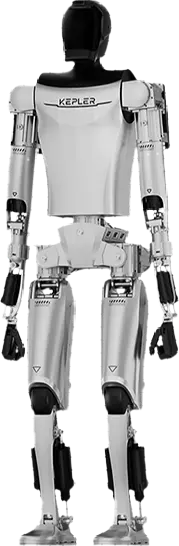 | |
| General information | |
| Manufacturer | Kepler Robotics |
| Country of origin | China |
| Year introduced | 2024 |
| Generation | 1st (Forerunner series) |
| Designation | Agile explorer |
| Status | Succeeded by K2 Bumblebee |
| Price | ~$20,000 - $30,000 USD |
| Website | gotokepler.com |
The S1 is the agility-focused variant of the original Forerunner series, designed for speed, maneuverability, and the ability to navigate tight or confined spaces. It shares a common 178 cm (5 ft 10 in), 85 kg (187 lb) platform with the Forerunner K1 (heavy-duty powerhouse) and the Forerunner D1 (dexterous specialist), but its software tuning and operational profile prioritize rapid movement, obstacle avoidance, and exploration over raw payload capacity or fine manipulation.[1][2]
The S1 was unveiled alongside the K1 and D1 at the Consumer Electronics Show (CES) 2024 in Las Vegas in January 2024, where one commentator likened it to Boston Dynamics' Atlas in terms of its agility focus.[3] All three original Forerunner models feature 40 degrees of freedom, Kepler's proprietary planetary roller screw actuators delivering up to 8,000 N of thrust, five-fingered dexterous hands with 12 DOF, and the Nebula artificial intelligence system with 100 TOPS of onboard computing power.[1][4] The S1 was positioned for deployment in exploration, search and rescue, emergency response, complex environment inspection, and outdoor safety operations.[2][3]
With the arrival of the Kepler K2 Bumblebee in October 2024, which consolidates and surpasses the capabilities of all three original Forerunner variants, the S1 is considered succeeded by the K2 platform. The K2 entered mass production in September 2025 at a price of RMB 248,000 (approximately $34,000 USD).[5][6]
What is the Forerunner S1?
The Forerunner S1 is the agility specialist among the three robots in Kepler's first humanoid lineup. Where the K1 was pitched as a strength-first industrial machine and the D1 as a fine-manipulation specialist, the S1 was tuned for movement: rapid traversal of complex terrain, quick obstacle avoidance, and operation in tight or hazardous spaces. Kepler's own marketing framed the distinction directly: "Think of the S1 as the 'Atlas.' Designed for agility and maneuverability, this sleeker model excels in tasks requiring precision and speed."[2][4]
Crucially, the S1 is not a separate piece of hardware. All three original Forerunner models share an identical 178 cm, 85 kg chassis, the same 40-DOF actuation system, the same 12-DOF dexterous hands, and the same Nebula AI platform. The difference between them lies in software configuration, movement profiles, and target applications rather than physical components.[2][4]
Who makes the Forerunner S1?
The S1 is made by Shanghai Kepler Exploration Robot Co., Ltd. (commonly known as Kepler Robotics), a Chinese AI and robotics company headquartered in the Pudong district of Shanghai. The company was founded in 2023 as a high-tech enterprise dedicated to the research, development, production, and commercialization of general-purpose humanoid robots, and is based at Torch Lotus Business Park on Naxian Road in the China (Shanghai) Pilot Free Trade Zone.[7]
Kepler was co-founded by Hu Debo (also rendered as Debo Hu or Huber Hu), who serves as CEO. Before establishing Kepler, Hu held positions at PowerVision Robot Corporation (a Chinese drone and robotics company), Huawei, and Hubert Tech Oy. He holds a master's degree in scientific computing from KTH Royal Institute of Technology in Sweden.[8][9]
Hu has publicly framed the company's mission in ambitious terms. At CES 2024 he stated: "The Kepler Humanoid Robot is dedicated to revolutionizing productivity with cutting-edge technology, hastening the arrival of a 'three-day work week.' The shift will enable humans to dedicate more time to meaningful endeavors, such as space exploration."[1] He has also credited Kepler's cost advantage to vertical integration, describing the company's "success in overcoming supply chain challenges through its substantial in-house research capabilities, aiding in both product development and cost efficiency."[10] The Forerunner series emerged from three years of intensive research and four product iterations prior to the K1's public debut in November 2023.[1]
Background
Forerunner series concept
Kepler designed the original Forerunner lineup as a trio of robots sharing a common physical platform but each optimized for a distinct category of real-world tasks. Rather than building a single general-purpose model and expecting it to perform equally well across all scenarios, Kepler adopted a specialization strategy where each variant received software tuning and marketing positioning appropriate to its target applications. The three models launched together were the K1 (targeting heavy-duty industrial tasks), the S1 (targeting agility and exploration), and the D1 (targeting dexterous manipulation and human interaction). All three share the same 178 cm, 85 kg chassis, the same 40-DOF actuation system, and the same Nebula AI platform.[2][4]
This approach allowed Kepler to address multiple market segments simultaneously while maintaining a single hardware platform, reducing manufacturing complexity and development costs.
When was the Forerunner S1 released?
The Forerunner S1 made its international debut at CES 2024 in Las Vegas, held from January 9 to 12, 2024. The event featured over 1,100 Chinese companies among its 4,000-plus exhibitors, accounting for approximately 25% of all participants.[1] At CES, Kepler announced plans to commence mass production of the Forerunner series in the second half of 2024 (Q3 2024), with an estimated retail price range of US$20,000 to US$30,000 for all three variants.[1]
The Kepler exhibit showcased all three Forerunner variants, attracting high-profile visitors including Microsoft CEO Satya Nadella, representatives from NVIDIA, engineers from Tesla's Optimus humanoid robot project, experts from Google DeepMind, researchers from MIT, representatives from Canadian humanoid robotics firm Sanctuary AI, and members of Australian television networks.[1] The CES appearance established Kepler as a notable entrant in the global humanoid robotics industry and was the company's first participation in a major global trade show following the official launch of its humanoid robots.[10]
Positioning within the lineup
At CES 2024 and in subsequent marketing materials, Kepler positioned the three Forerunner models using evocative comparisons to well-known robots and historical figures:[3]
| Model | Designation | Comparison | Target applications |
|---|---|---|---|
| Forerunner K1 | Heavy-duty powerhouse | Likened to Tesla's Optimus | Construction, industrial manufacturing, disaster relief |
| Forerunner S1 | Agile explorer | Likened to Boston Dynamics' Atlas | Exploration, search and rescue, confined-space navigation |
| Forerunner D1 | Dexterous specialist | Named after Leonardo da Vinci | Healthcare, precision manufacturing, human interaction |
The S1's comparison to Boston Dynamics' Atlas is notable because Atlas is widely regarded as one of the most agile humanoid robots ever built, known for its ability to perform backflips, navigate rough terrain, and recover from pushes. While the S1 does not match Atlas in gymnastic capability, the comparison signals Kepler's intention for the S1 to serve environments where mobility and maneuverability are the primary requirements.[3]
What are the Forerunner S1's specifications?
The Forerunner S1 shares its core hardware specifications with the K1 and D1, as all three are built on the same platform.
Specifications table
| Parameter | Value |
|---|---|
| Height | 178 cm (5 ft 10 in) |
| Weight | 85 kg (187 lb) |
| Total degrees of freedom | 40 |
| Hand degrees of freedom | 12 (6 per hand) |
| Fingers per hand | 5 |
| Payload capacity (total) | 25 kg (55 lb) |
| Payload capacity (per arm) | 15 kg (33 lb) |
| Max walking speed | 1.5 m/s (5.4 km/h, 3.4 mph) |
| Actuator type | Proprietary planetary roller screw + rotary |
| Peak actuator thrust | 8,000 N (1,798 lbf) |
| Computing power | 100 TOPS |
| AI system | Nebula |
| Battery life | Up to 8 hours |
| Sensors | Binocular camera, 4-mic array, accelerometer, AHRS |
| Connectivity | WiFi, 5G |
| Target price | $20,000 - $30,000 USD |
Actuation system
The S1 uses the same proprietary actuation system found across the Forerunner platform. The primary actuators are planetary roller screw units installed in the arms and legs. These actuators convert rotary motion into linear motion through planetary drive and threaded engagement, delivering up to 8,000 Newtons (approximately 1,798 pound-force) of thrust to the elbow, knee, and ankle joints. Compared to conventional ball screw systems, Kepler's planetary roller screw actuators offer lower friction, higher positioning accuracy, superior load-bearing capacity, smoother operation, and longer operational life.[4][11]
Custom rotary actuators handle waist and shoulder movement, providing the rotation needed for upper-body tasks. The combination of linear roller screw actuators and rotary actuators enables the robot to simulate human muscle movement with precision and fluidity. For the S1, this actuation system is particularly relevant to its agility focus: the smooth, responsive joint control enabled by the planetary roller screw design supports the rapid changes in direction and quick reaction times needed for navigating unpredictable environments.[4][11]
Sensing and perception
The S1's perception system, shared across the Forerunner platform, consists of sensors located primarily in the head unit:[4]
- Wide-angle binocular camera system for stereoscopic depth perception, enabling the robot to build a three-dimensional understanding of its surroundings
- Far-field array of four microphones for audio capture and voice interaction, supporting communication with human operators in the field
- Accelerometer for motion detection and inertial measurement
- AHRS (Attitude and Heading Reference System) for orientation tracking and balance maintenance
- Synthetic voice module with stereophonic speakers for verbal interaction with humans
For the S1's exploration and search-and-rescue applications, the binocular camera system and AHRS are particularly critical, as they enable the robot to perceive obstacles, judge distances, and maintain stable orientation while moving through uneven or cluttered environments.
Nebula AI system
At the computational core of the S1 is Kepler's proprietary Nebula AI system. The Nebula platform integrates a high-performance motherboard with 100 TOPS (Tera Operations Per Second) of computing power, enabling four primary functions:[1][4]
- Visual recognition: Identification of objects, people, environmental features, and potential hazards
- Visual SLAM: Simultaneous Localization and Mapping for spatial awareness and autonomous navigation through unknown environments
- Multimodal interaction: Integration of visual, auditory, and sensor data for natural human-robot communication
- Hand-eye coordination: Real-time synchronization between the vision system and the dexterous manipulators
Kepler also equips the Forerunner robots with a cloud-based multimodal large language model for complex reasoning and general interaction, alongside a smaller, industry-specific model running locally on the robot for faster response times in operational scenarios. The local model is important for the S1's search-and-rescue applications, where network connectivity may be unreliable or unavailable in disaster zones or confined underground spaces.[4]
Dexterous hands
The S1 features five-fingered dexterous hands with 12 degrees of freedom across both hands (6 DOF per hand). The hands are capable of grasping objects gently and performing delicate operations, with Kepler claiming they rival human dexterity for many manipulation tasks. Each arm can support a payload of up to 15 kg (33 lb), with a combined total payload capacity of 25 kg (55 lb) across both arms.[1][4]
While the S1's agility focus means it is less likely to be deployed for extended fine-manipulation tasks (which are better suited to the D1), the dexterous hands remain important for exploration and rescue scenarios. Moving debris, opening doors, operating switches, and handling rescue equipment all require capable manipulation alongside mobile agility.
Power system
The S1 operates on an internal battery system that provides up to 8 hours of continuous operation on a single charge. This endurance was designed to accommodate full operational shifts, making the robot suitable for extended deployment in search-and-rescue operations, prolonged inspection missions, and multi-hour exploration tasks without requiring field recharging.[4]
How does the S1 differ from the K1 and D1?
The fundamental distinction between the S1 and its sibling models lies not in hardware differences (all three share the same platform) but in operational philosophy and software configuration. Kepler describes the S1 as "designed for agility and maneuverability," a "sleeker model" that "excels in tasks requiring precision and speed."[2][3]
In practical terms, this means the S1's control algorithms and movement profiles are tuned to prioritize:
- Rapid traversal of complex environments, including uneven terrain, narrow corridors, and obstacle-dense areas
- Quick direction changes and responsive obstacle avoidance, leveraging the 40-DOF system for fluid, adaptive locomotion
- Speed over payload, accepting that maximum carrying capacity may be reduced during high-speed movement in favor of stability and nimbleness
- Environmental awareness, with the Nebula AI system's SLAM capabilities configured for real-time mapping of unfamiliar or rapidly changing environments
This stands in contrast to the K1, which emphasizes raw strength and maximum payload capacity for heavy-duty industrial work, and the D1, which prioritizes fine motor control and gentle, human-like interaction for healthcare and precision manufacturing tasks.
What can the Forerunner S1 do?
The S1 was designed for deployment in scenarios where mobility, speed, and the ability to operate in constrained or hazardous environments take priority over load-bearing or delicate manipulation.[2][3][4]
Search and rescue
The S1's primary target application is search and rescue operations, where the robot can enter collapsed structures, disaster zones, or other dangerous environments that are too risky for human responders. Its 40-DOF mobility system enables it to navigate rubble, squeeze through narrow openings, and traverse unstable surfaces. The 8-hour battery life supports extended operations during prolonged rescue efforts, and the binocular camera system with visual SLAM allows it to map unknown interiors and locate survivors.
Exploration
For exploration of unknown or hazardous environments, the S1 can serve as a forward scout, entering areas before human teams to assess conditions, map layouts, and identify potential dangers. Applications include underground tunnel inspection, building interior assessment following fires or earthquakes, and exploration of environments contaminated with chemicals, radiation, or other hazards.
Complex environment inspection
Industrial facilities often contain areas that are difficult for human inspectors to access safely, including elevated structures, confined machinery spaces, and environments with toxic atmospheres. The S1's combination of agile mobility and onboard sensing allows it to perform inspections in these settings, using its camera system and Nebula AI to detect equipment failures, structural damage, or safety hazards.
Emergency response
Beyond search and rescue, the S1 is designed for broader emergency response applications. These include initial assessment of accident scenes, delivery of emergency supplies to inaccessible locations, and operation of emergency equipment (valves, switches, barriers) in hazardous conditions where human presence would be dangerous.
Outdoor safety operations
The S1 can be deployed for patrol, surveillance, and hazard detection tasks in outdoor settings. Its ability to navigate uneven terrain and operate autonomously for up to 8 hours makes it suitable for perimeter monitoring, wildlife area patrol, and environmental hazard detection in remote locations.
Comparison with Forerunner series siblings
The three original Forerunner models share identical hardware specifications but are optimized for different operational profiles.
| Specification | Forerunner K1 | Forerunner S1 | Forerunner D1 |
|---|---|---|---|
| Designation | Heavy-duty powerhouse | Agile explorer | Dexterous specialist |
| Height | 178 cm | 178 cm | 178 cm |
| Weight | 85 kg | 85 kg | 85 kg |
| Total DOF | 40 | 40 | 40 |
| Hand DOF (per hand) | 6 | 6 | 6 |
| Payload (total) | 25 kg | 25 kg | 25 kg |
| Battery life | 8 hours | 8 hours | 8 hours |
| AI system | Nebula (100 TOPS) | Nebula (100 TOPS) | Nebula (100 TOPS) |
| Primary focus | Maximum strength and load capacity | Speed, agility, confined-space navigation | Fine manipulation and human-like interaction |
| Target sectors | Construction, manufacturing, disaster relief | Exploration, search and rescue, inspection | Healthcare, precision manufacturing, laboratories |
| Comparison | Tesla Optimus | Boston Dynamics Atlas | Leonardo da Vinci |
| Price | ~$20,000 - $30,000 | ~$20,000 - $30,000 | ~$20,000 - $30,000 |
All three models were designed to be manufactured on the same production line, sharing identical components and differing primarily in their software configuration, movement profiles, and marketing positioning. This shared-platform approach allowed Kepler to address multiple market segments while keeping manufacturing complexity low.[2][4]
How does the S1 compare to the K2 Bumblebee?
The Kepler K2 Bumblebee, unveiled in October 2024 and entering mass production in September 2025, effectively consolidates and surpasses the capabilities of all three original Forerunner models. Despite its sequential naming, the K2 represents Kepler's fifth-generation design.[5][6]
| Specification | Forerunner S1 | K2 Bumblebee |
|---|---|---|
| Generation | 1st | 5th |
| Height | 178 cm | 175 cm |
| Weight | 85 kg | 75 kg |
| Total DOF | 40 | 52 |
| Hand DOF (per hand) | 6 | 11 |
| Payload (total) | 25 kg | 30 kg |
| Fingertip sensors | Not available | 96 contact points per fingertip |
| Wrist sensor | Not available | 6-axis force/torque |
| Battery capacity | Not disclosed | 2.33 kWh |
| Battery life | 8 hours | 8 hours (1-hour fast charge) |
| Energy efficiency | Not disclosed | Up to 81.3% |
| Actuation | Roller screw + rotary | Hybrid serial-parallel |
| AI system | Nebula (100 TOPS) | Nebula OS + VLA+ |
| Gait capability | Standard bipedal | Disturbance-resistant, straight-knee bipedal |
| In-house hardware | Not disclosed | Over 80% |
| Configurations | Single (bipedal) | Three (Bipedal Basic, Bipedal Developer, Wheeled Developer) |
| Price | ~$20,000 - $30,000 | RMB 248,000 (~$34,000) |
| Status | Succeeded by K2 | In mass production |
The K2 exceeds the S1's agility capabilities through its advanced gait system with disturbance-resistant walking, which enables navigation of complex terrains including bricks, plastic surfaces, and grass while maintaining stability under external pushes. The K2's hybrid serial-parallel actuation architecture provides superior energy efficiency (up to 81.3%) and a human-like straight-knee gait, while its 10 kg weight reduction (from 85 kg to 75 kg) improves overall mobility. The K2 also addresses the S1's exploration and inspection applications through its 80+ integrated sensors, advanced VLA+ (Vision-Language-Action plus) AI model, and significantly enhanced tactile sensing in its rope-driven dexterous hands.[5][6][12]
Kepler product lineup
The full Kepler Robotics product lineup as of 2025 includes all original Forerunner models and the K2 Bumblebee.
| Model | Year | Height | Weight | DOF | Hand DOF | Payload | Focus | Status |
|---|---|---|---|---|---|---|---|---|
| Forerunner K1 | Nov 2023 | 178 cm | 85 kg | 40 | 6/hand | 25 kg | Heavy-duty industrial | Succeeded by K2 |
| Forerunner S1 | 2024 | 178 cm | 85 kg | 40 | 6/hand | 25 kg | Agility and exploration | Succeeded by K2 |
| Forerunner D1 | 2024 | 178 cm | 85 kg | 40 | 6/hand | 25 kg | Dexterity and interaction | Succeeded by K2 |
| K2 Bumblebee | Oct 2024 | 175 cm | 75 kg | 52 | 11/hand | 30 kg | All-purpose commercial | Mass production |
How does the S1 compare to other humanoid robots?
The S1 occupies a specific niche within the broader humanoid robotics landscape, competing with other agility-focused or exploration-oriented robots.
Agility-focused humanoid robots
| Robot | Manufacturer | Height | Weight | DOF | Focus | Price |
|---|---|---|---|---|---|---|
| Forerunner S1 | Kepler Robotics | 178 cm | 85 kg | 40 | Agility, exploration, SAR | ~$20,000 - $30,000 |
| Atlas | Boston Dynamics | ~150 cm | ~89 kg | ~28 | Research, extreme agility | ~$420,000 (enterprise) |
| Digit | Agility Robotics | 175 cm | 65 kg | 16+ | Warehouse logistics | Not publicly disclosed |
| Unitree H1 | Unitree Robotics | 180 cm | 47 kg | 19 | Research, mobility | ~$90,000 |
| Unitree G1 | Unitree Robotics | 127 cm | 35 kg | 23-43 | Consumer, education | From ~$16,000 |
The S1's value proposition compared to these competitors centers on its balance of capabilities at an aggressive price point. At $20,000 to $30,000, it offers substantially more degrees of freedom (40 vs. 16-28 for most competitors), a longer battery life (8 hours), and a full-sized humanoid form factor with dexterous five-fingered hands. Boston Dynamics' Atlas, while significantly more agile, is an enterprise-only platform priced at approximately $420,000 and is primarily a research vehicle rather than a commercially deployable field robot.[11][13]
The Chinese humanoid robotics market has grown rapidly, with Chinese companies accounting for nearly 90% of global humanoid robot shipments in 2025. AgiBot shipped over 5,100 units, Unitree Robotics shipped approximately 5,500 units, and UBTECH shipped approximately 1,000 units in 2025. Kepler's K2 Bumblebee has secured framework agreements covering several thousand units.[14]
Technology heritage
The S1 represents an important step in the lineage of Kepler's technology development, even though the K2 Bumblebee has since become the company's primary commercial product.
Planetary roller screw actuators
The S1 was among the first commercial humanoid robots to use planetary roller screw actuators as its primary drive mechanism. This actuator technology, developed in-house by Kepler, became a defining engineering characteristic of the company's approach to humanoid robotics. The actuators deliver up to 8,000 N of thrust with lower friction and higher positioning accuracy than conventional ball screw systems. The K2 Bumblebee extended this concept with a hybrid serial-parallel architecture that combines the planetary roller screw linear actuators with rotary actuators for enhanced energy efficiency.[4][5][12]
Nebula AI platform
The Nebula AI system deployed on the S1 provided the foundation for what eventually became Nebula OS, the more advanced microkernel-based operating system powering the K2 Bumblebee. The original Nebula system's four core functions (visual recognition, visual SLAM, multimodal interaction, and hand-eye coordination) were expanded in the K2 to include the VLA+ (Vision-Language-Action plus) model, which interprets natural language commands and translates them into actionable task sequences. The S1 served as a real-world testing platform for Nebula's autonomous navigation and environmental mapping capabilities, informing the development of the K2's more sophisticated perception and decision-making systems.[1][4][12]
Dexterous hand evolution
The S1's 12-DOF dexterous hands (6 DOF per hand) established the baseline design that Kepler refined into the K2's significantly more advanced rope-driven hands with 11 DOF per hand, 96 flexible tactile sensor contact points per fingertip, 25 force-sensing contact points per finger, and 6-axis force/torque sensors at each wrist.[5][6]
How much does the Forerunner S1 cost?
At CES 2024, Kepler announced plans to commence mass production of the Forerunner series in the second half of 2024, with an estimated retail price range of $20,000 to $30,000 for all three variants (K1, S1, and D1).[1] This price point was positioned as significantly more affordable than most other full-sized humanoid robots available at the time, aimed at making humanoid robots accessible to a broad range of businesses, research institutions, and government agencies.
With the subsequent launch of the K2 Bumblebee as Kepler's primary commercial product, the company's focus shifted to the K2 platform. The K2's base price of RMB 248,000 (approximately $34,000 USD) is modestly higher than the original Forerunner series pricing, but it delivers substantially greater capability, including 52 degrees of freedom, 11-DOF dexterous hands with tactile sensing, hybrid actuation, and the advanced Nebula OS with VLA+ AI.[5][6]
Significance
The Forerunner S1, along with the K1 and D1, holds significance in the history of humanoid robotics for several reasons.
First, the trio represented one of the earliest attempts by a Chinese humanoid robotics company to launch a multi-variant product lineup targeting distinct market segments simultaneously. Rather than following the typical pattern of developing a single prototype and iterating from there, Kepler debuted three specialized models at once, signaling confidence in its manufacturing capability and market understanding.[1]
Second, the S1's positioning as an agility-focused exploration and rescue robot at a sub-$30,000 price point challenged the assumption that mobile, capable humanoid robots were exclusively the domain of well-funded research labs and defense contractors. Boston Dynamics' Atlas, the benchmark for humanoid agility, operates at a price point approximately 14 times higher than the S1.[11][13]
Third, the shared-platform approach used by the K1, S1, and D1 demonstrated a viable commercial strategy for humanoid robotics: build one hardware platform, optimize it through software for different applications, and manufacture at scale. This strategy informed Kepler's subsequent decision with the K2 Bumblebee, which consolidates all three variants into a single, more capable robot available in multiple configurations (Bipedal Basic, Bipedal Developer, and Wheeled Developer).[5][6]
Finally, the rapid succession from the original Forerunner trio to the fifth-generation K2 within approximately one year illustrated the accelerating pace of development in Chinese humanoid robotics, where companies iterate on hardware and software at a speed that has drawn attention from international observers and competitors.[14]
ELI5: Explain Like I'm 5
The Forerunner S1 is a robot shaped like a person, about as tall as a grown-up. A company in China called Kepler made it. The S1 is the fast, nimble one in a family of three look-alike robots. Its job is to run into scary places that are dangerous for people, like a building that has fallen down, and look around to find people who need help. It has a computer brain (called Nebula) so it can see with cameras, walk around stuff in its way, and use its five-fingered hands to move things. Later, Kepler built a newer, better robot called the K2 Bumblebee, so the S1 is like the older big brother that taught the new robot how to walk.
See also
- Humanoid robot
- Humanoid robots
- Kepler Robotics
- Forerunner K1
- Forerunner D1
- Kepler K2 Bumblebee
- Boston Dynamics
- Tesla Optimus
- Unitree Robotics
- Robotics
- Embodied AI
- SLAM
References
- ^1 ^2 ^3 ^4 ^5 ^6 ^7 ^8 ^9 ^10 ^11 ^12 ^13"CES 2024 Spotlight: Kepler's Humanoid Robot Launch Gains International Recognition." PR Newswire, January 22, 2024.
- ^1 ^2 ^3 ^4 ^5 ^6 ^7 ^8 ^9 ^10"Kepler Forerunner General-Purpose Humanoid Robot." New Equipment Digest.
- ^1 ^2 ^3 ^4 ^5 ^6 ^7"Kepler's Leap into the Future: Unveiling the Forerunner Series at CES 2024." The B-Life Movement, 2024.
- ^1 ^2 ^3 ^4 ^5 ^6 ^7 ^8 ^9 ^10 ^11 ^12 ^13 ^14 ^15 ^16"Kepler Forerunner humanoid robot may be heading for a workplace near you." New Atlas, 2024.
- ^1 ^2 ^3 ^4 ^5 ^6 ^7"Kepler Debuts Forerunner K2 Humanoid Robot, Accelerating Commercial Deployment." PR Newswire, October 2024.
- ^1 ^2 ^3 ^4 ^5 ^6"World's First Commercially Available Hybrid-Architecture Humanoid Robot Moves Into Mass Production." PR Newswire, September 26, 2025.
- ^"Kepler Exploration Robot Co., Ltd." Tracxn Company Profile, 2025.
- ^"Huber Hu, CEO, Kepler Exploration Robotics." RocketReach contact profile.
- ^"Kepler Exploration Robot founders and board of directors." Tracxn, 2025.
- ^1 ^2"Kepler's Humanoid Robot Makes Grand Debut at CES, Heralding a Bold New Chapter in Robotics Innovation." PR Newswire, January 2024.
- ^1 ^2 ^3 ^4"Kepler S1 Humanoid Robot with 40DOF." Robotic Gizmos, January 16, 2024.
- ^1 ^2 ^3"Kepler Robotics Announces Advanced Gait Upgrade for K2 'Bumblebee,' Demonstrating the Potential of Hybrid Architecture." PR Newswire, September 11, 2025.
- ^1 ^2"Kepler." Humanoid.guide product page.
- ^1 ^2"Chinese firms outpace US rivals in 2025 humanoid robot shipments, as AgiBot takes lead." South China Morning Post, 2026.
Improve this article
Add missing citations, update stale details, or suggest a clearer explanation. Every suggestion is reviewed for sourcing before it goes live.
6 revisions · v7 · 4,641 words · full history
Fact-checks are independent of edits: a reviewer re-verifies the article against its sources and stamps the date. How we verify
Research and drafting on this wiki are AI-assisted, under named human editorial standards. How AI is used here
Cite this page: AI Wiki. "Kepler Forerunner S1." aiwiki.ai, updated 27 Jun 2026. CC BY 4.0. https://aiwiki.ai/wiki/forerunner_s1