

GigaChat 4
GigaChat 4 is a family of text-generating mixture-of-experts models released by Sber's GigaChat team on November 26, 2026. It comprises a 37-billion-parameter model and a 708-billion-parameter model. Each supports a context window of 1,048,576 tokens and can switch between instant and reasoning modes in the same instruction-tuned checkpoint.[1][2][3]
Models and availability
| Feature | GigaChat4-37B-A4B | GigaChat4-708B-A41B |
|---|---|---|
| Total parameters | 37 billion | 708 billion |
| Active parameters per token | About 3.8 billion, rounded to 4B in the model name | About 41 billion |
| Decoder layers | 32 | 64 |
| Gated DeltaNet / sparse attention layers | 24 / 8 | 48 / 16 |
| Routed experts per MoE layer | 192 | 256 |
| Routed experts selected per token | 8 | 8 |
| Maximum context | 1,048,576 tokens | 1,048,576 tokens |
| Listed weights license | Noncommercial License for individuals 1.0 | MIT |
Sources: Release announcement and the two official model cards.[1][2][3]
Sber's ai-sage collection lists instruction-tuned FP8, BF16 and GGUF variants for both sizes. It also includes BF16 base weights and intermediate checkpoints. The 708B instruction-tuned model card links the MIT license. The 37B card links a different agreement for noncommercial use by individuals. Each checkpoint's terms are listed in its repository.[2][3][4][5]
Architecture and training
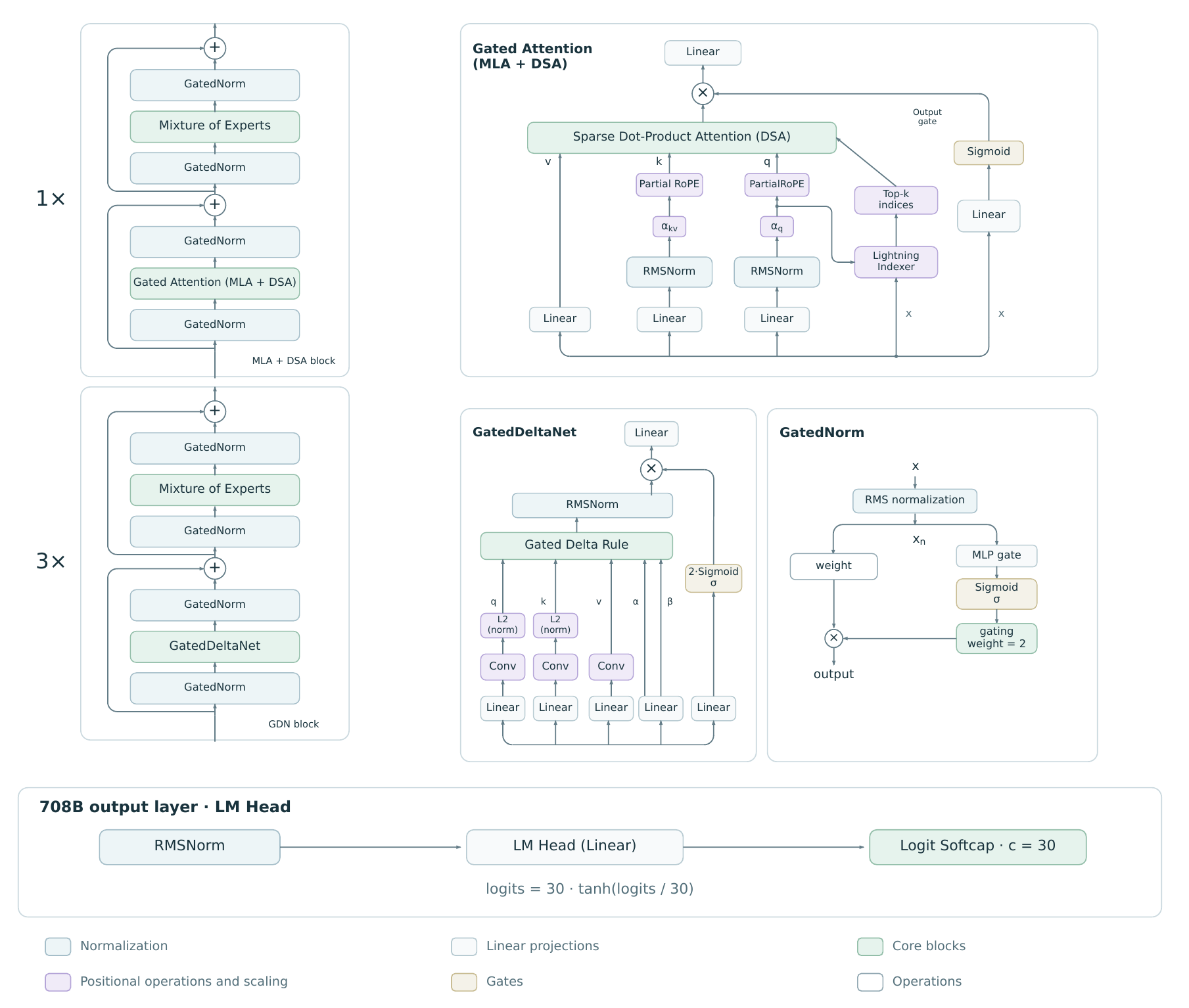
The two sizes alternate groups of three Gated DeltaNet layers with a layer that combines multi-head latent attention and DeepSeek Sparse Attention. Gated DeltaNet summarizes earlier inputs in a recurrent state. In the sparse attention layers, a learned index selects up to 2,048 earlier token positions per query. The report describes extending training from a 32K context to 128K and then roughly one million tokens. The team introduced the sparse index at 128K.[1][2][3][6]
Both models can call tools and produce structured text. The team first supervised the models on demonstrations, then trained specialist policies for tasks including mathematics, coding and tool use with reinforcement learning. In the final distillation stage, the student produced its own responses and received feedback from task-specific teachers. The cards describe a recurrent multi-token prediction layer and an external DFlash2 drafter for speculative decoding.[2][3][6]
Reported evaluation
The 708B model card publishes separate reasoning and instant-mode tables. On SWE-bench Verified with a seven-hour timeout, the card lists 80.89% in reasoning mode and 80.82% in instant mode. On LiveCodeBench v6 it reports 88.82% and 78.77%, respectively.[2]
The publisher's reasoning table places the 708B model ahead of Mistral 4 Large on SWE-bench Verified (80.89% to 79.60%) and behind it on SWE-bench Multilingual (77.00% to 81.67%) and Terminal-Bench 2.1 (69.66% to 83.33%). Each score reflects its own task and test configuration.[2][6]
Continue reading
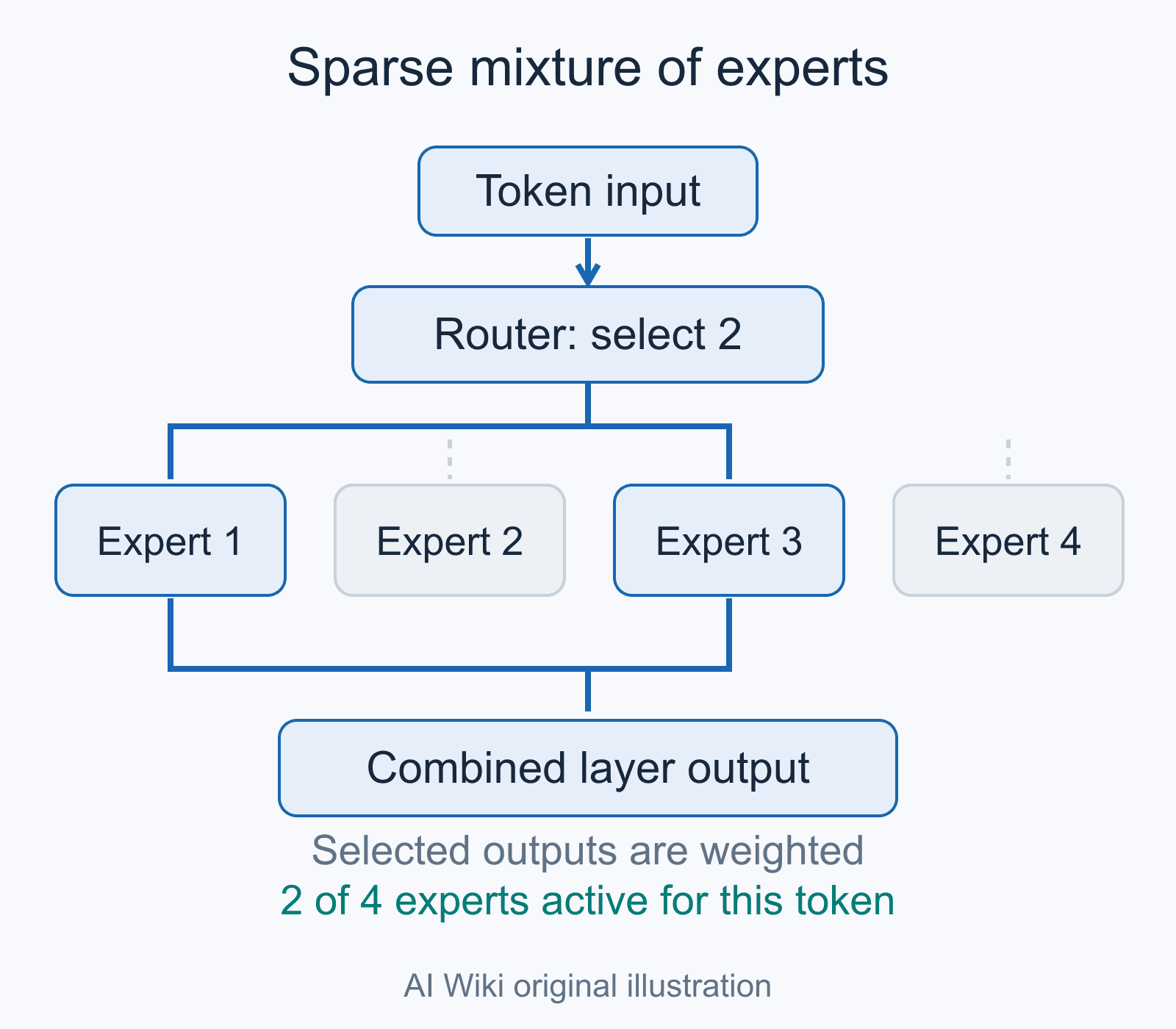
- Mixture of Experts (MoE)A mixture of experts (MoE) is a machine-learning architecture that contains multiple component functions called experts and a gating or routing mechanism that determines how their outputs contribute to a…Linked in the introduction
- Speculative DecodingSpeculative decoding is a lossless inference acceleration technique for autoregressive transformer models in which a small, fast draft model proposes several future tokens at once and the larger target model…Also in Large Language Models
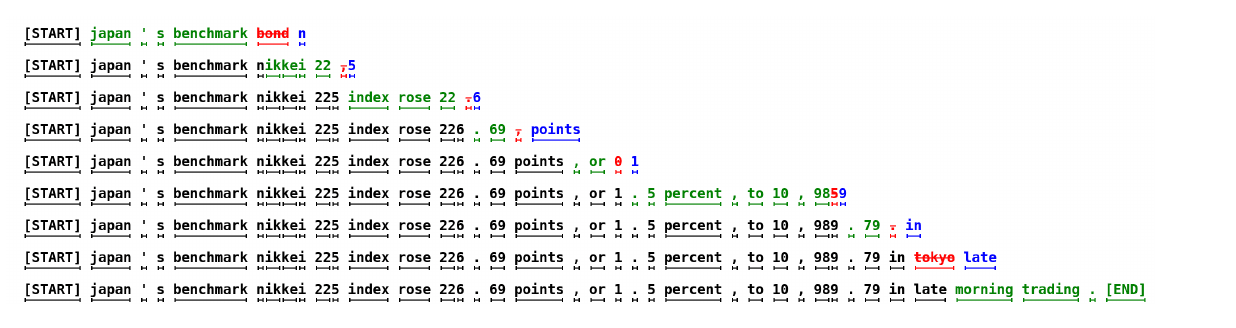
- Multi-token predictionMulti-token prediction (often abbreviated MTP) is a language modeling training objective in which the model is trained to predict several future tokens at each context position rather than only the next token.Also in Large Language Models
- DeepSeek V3DeepSeek-V3 is a 671-billion-parameter open-weights Mixture of Experts large language model from Chinese AI lab DeepSeek, released on December 26, 2024, that activates only 37 billion parameters per token and…Also in Mixture of Experts
- Qwen3Qwen3 is the third-generation family of large language models developed by the Qwen Team at Alibaba Cloud (also known as Tongyi Qianwen lab).Also in Mixture of Experts
- Kimi K3Kimi K3 is an open-weight multimodal reasoning model developed by Moonshot AI. Moonshot made the model available through its hosted products on July 16, 2026 and published the weights, code, configuration…Also in Mixture of Experts

More to read
References
- ^1 ^2 ^3Eugenia Nikishkina. GigaChat 4: Two Powerful Models, One Million Tokens, and New Agentic Capabilities. GigaChat, November 26, 2026. Release date, model specifications and training summary.
- ^1 ^2 ^3 ^4 ^5 ^6 ^7ai-sage. GigaChat4-708B-A41B. Official model card. Architecture, weight variants, benchmark tables and license.
- ^1 ^2 ^3 ^4 ^5ai-sage. GigaChat4-37B-A4B. Official model card. Architecture, weight variants and license.
- ^ai-sage. GigaChat 4 collection. Publisher's list of checkpoints.
- ^ai-sage. Noncommercial License for individuals 1.0. Terms for 37B-A4B model weights.
- ^1 ^2 ^3GigaChat team. GigaChat 4 technical report. November 2026.
- ^GigaChat Team, technical report, Figure 1. Copyright (c) 2026 Giga. Original image source. MIT License. Figure extracted and rasterized from page 5. The full copyright and permission notice is included in the PNG metadata.
Improve this article
Add missing citations, update stale details, or write a clearer explanation. Anyone can edit: changes go live when you publish, and every edit is checked by an editor.
2 revisions · v2 · 614 words · full history
Fact-checks are independent of edits: a reviewer re-verifies the article against its sources and stamps the date. How we verify
Research and drafting on this wiki are AI-assisted, under named human editorial standards. How AI is used here
Cite this page: AI Wiki. "GigaChat 4." aiwiki.ai, updated 29 Nov 2026. CC BY 4.0. https://aiwiki.ai/wiki/gigachat_4