

GR00T 2
GR00T 2 is a family of robot foundation world-action models developed by NVIDIA. It jointly predicts future camera observations and robot actions from recent video, robot state and a language instruction. NVIDIA introduced it at the Conference on Robot Learning in November 2026 as part of the Isaac GR00T program.[1][2]
The research covers parallel-gripper arms, dexterous hands and humanoids. Its main model emphasizes manipulation, while GR00T 2 Turbo uses a more compressed visual representation for faster inference, including onboard operation on a Unitree G1. The published results are NVIDIA's research evaluations, with task-specific training and deployment configurations.[2]
Announcement and availability
NVIDIA's CoRL announcement was published on November 9, 2026. The research website provides demonstrations and a November 2026 white paper, but on November 17 still listed code availability for December. The announcement therefore should not be treated as proof that the exact GR00T 2 implementation and checkpoints were already downloadable. Public availability of related data also does not establish a license for model weights.[1][3]
The WAM API described in the research is an interface through which a reasoning agent controls a robot policy in the experimental system. It is not presented as a generally available, metered cloud API.[2]
World-action architecture
GR00T 2 is initialized from the Cosmos-Predict2.5-2B video diffusion transformer in NVIDIA Cosmos. The white paper describes a single 2-billion-parameter transformer that processes video, robot-state and action tokens. It is trained with flow matching to predict future video latents and action sequences together.[2]
| Input or component | Published configuration |
|---|---|
| Visual history | 0.8 seconds, five frames per camera at 5 frames per second |
| Image resolution | 224 pixels high by 320 pixels wide |
| Camera support | Up to four views, commonly head and wrist cameras |
| Additional inputs | Robot proprioception and a natural-language instruction |
| Video encoder | Frozen Wan 2.1 video VAE in the main model |
| Language encoder | Frozen Cosmos-Reason1 model |
| Embodiment interface | Small robot-specific state/action encoders and an action decoder |
| Outputs | Future camera frames and a chunk of robot actions |
The diffusion transformer attends across time and camera views. Its action tokens can attend to the future video tokens being generated, tying the predicted movement to the model's predicted scene changes. The robot executes an action chunk while the system prepares the next one.[2]
This differs from treating a video model as a separate visualization of a policy's output. In GR00T 2, predicting observations and actions is part of the same trained model. It does not mean that generated video is a verified simulation of every physical consequence.[2]
GR00T 2 Turbo
The white paper states that Turbo retains the 2B joint transformer but replaces the Wan 2.1 VAE with Wan 2.2's higher-compression VAE. Spatial compression increases from 8 times to 16 times per dimension, producing a spatial latent grid four times smaller. Its input/output projections are adapted while the action horizon is retained.[2]
Turbo trades visual detail and task performance for lower inference cost. After post-training, it averages 65.0% success on the six-task YAM suite and 34.3% on the seven-task dexterous-hand suite, compared with 71.7% and 68.6% for the main model. These results do not isolate visual compression as the sole cause of the difference.[2]
Training data and process
The pretraining recipe first adapts the video model to embodied interactions using single-view video, then trains multi-view video and actions jointly, and finally increases the emphasis on robot demonstrations. Valid action supervision is used where available, including tracked human hand trajectories.[2]
| Source | Amount used in the reported mixture | Role |
|---|---|---|
| Human-1M egocentric human data | 402,730 hours, approximately 13.75 million episodes | Visual interactions across tasks, people and scenes |
| UMI-10K handheld demonstrations | 10,184 hours, 942,000 episodes across 2,897 tasks | Task demonstrations in a robot-compatible action format |
| Robot teleoperation | 23,500 hours, approximately 1.16 million episodes | Executable actions and embodiment-specific behavior |
The teleoperation mixture includes YAM and Franka arms, robots with Sharpa and Wuji hands, and the Unitree G1. Human-1M's overall collection is larger than the filtered portion used for GR00T 2. NVIDIA separately publishes a 100,000-hour subset as PhysicalAI-Human-1M-100K, whose dataset card lists CC BY 4.0 terms. That subset is not the whole pretraining mixture.[2][4]
In an ablation across 72 Dexter tasks, increasing human-video pretraining from none to the full tested share increased real-robot success from 18% to 41%. The experiment used three physical rollouts per task. The zero-human-data configuration also skipped a shared human-video pretraining stage, so the comparison is not a fixed-compute isolation of dataset size alone.[2]
Generalization and few-shot adaptation
Dexter denotes the experimental bimanual robot with Tianji arms and two 22-degree-of-freedom Sharpa hands. The Dexter-50 transfer study used tasks absent from Dexter's own training data but present in human video, YAM demonstrations or both.[2]
| Task-specific Dexter demonstrations | Mean success across Dexter-50 |
|---|---|
| None | 40% |
| One per task | 71% |
| Five per task | 95% |
The 40% zero-shot rate is a trial-success figure. Separately, the pretrained model completed 40 of the 50 task types at least once; that is not an 80% per-trial success rate. Few-shot adaptation used rank-32 LoRA adapters and took about 30 minutes on one RTX 5090 for each adapted task.[2]
The task selection limits the headline result: Dexter-50 contains tasks the model learned to at least 80% success with five demonstrations. Its 95% five-shot mean therefore measures adaptation on a selected learnable set, rather than an arbitrary sample of all possible new robot tasks.[2]
Learning without task-specific robot teleoperation
NVIDIA calls transfer to unseen task-scene-embodiment combinations X-Adapt. Human motion-capture or handheld demonstrations provide the task, while task-agnostic data from the target robot can provide its embodiment and visual setting. Thus "no teleoperation of the target task" does not generally mean "no target-robot data."[2]
In one human-to-Dexter experiment, sensorized human demonstrations taught filter-paper setup, including lining a funnel and wetting the paper. GR00T 2 completed 13 of 20 trials. The humans wore motion-capture gloves and cameras; this was not transfer from an arbitrary uninstrumented internet video.[2]
Handheld UMI demonstrations transferred to YAM despite differences in gripper and cameras. With 41-75 demonstrations per task and task-agnostic YAM data, the robot completed toy dump-truck assembly in 6 of 10 trials and NIST board disassembly in 5 of 10. Conveyor sorting scored 43 of 50 items, an 86% per-item rate rather than an end-to-end episode rate. Camera alignment and action-space conversion were part of the transfer pipeline.[2]
The report also studies DexUMI wearable-hand demonstrations and a separate human-video-to-simulation pipeline. The latter reconstructs a task from one human video, trains an expert in simulation, and fine-tunes GR00T 2 on simulated rollouts before physical deployment. It is a different training route from direct imitation of human camera footage.[2]
Manipulation and reinforcement learning
After supervised post-training, GR00T 2 averaged 71.7% success across six YAM assembly/insertion tasks and 68.6% across seven Dexter tasks. The paper distinguishes binary completion from partial task progress. Its truck-assembly comparison also carries a changed-start-scene caveat: GR00T 2 and Turbo used easier revised starts; the main model completed 7 of 20 trials on the original starts.[2]
The authors applied reinforcement learning to improve contact-sensitive skills. They compared residual corrections to a frozen policy, direct GRPO updates, and supervised self-imitation on successful GRPO rollouts.[2]
| Task | Supervised post-training | GRPO | GRPO-induced self-imitation |
|---|---|---|---|
| Fixed-pipe fittings | 66% | 86% | 88% |
| Finger placement | 58% | 72% | 98% |
| Ethernet cable insertion | 76% | 92% | 94% |
| Charger insertion | 40% | 94% | 96% |
Each bar in this evaluation represents 50 trials with no human intervention, with 95% Wilson intervals reported in the paper. The authors find that the direct-GRPO improvements on cable insertion and finger placement are not conclusive at that sample size. These rates apply to the specified task/reset distributions and trained policies.[2]
Reasoning agents and visual steering
The agentic system separates a higher-level reasoning agent, called System 2, from GR00T 2's manipulation policy, called System 1. The agent observes progress, sequences tasks, and invokes code-as-policy recovery tools for dropped parts or stalled execution. GR00T 2 remains responsible for much of the physical manipulation.[2]
| Cluttered YAM assembly task | Supervised policy | With corrective DAgger data | With DAgger and agent |
|---|---|---|---|
| Toy plane | 69/100 | 84/100 | 98/100 |
| Toy tractor | 51/100 | 71/100 | 97/100 |
| Hot Wheels car | 23/100 | 78/100 | 97/100 |
For each trial, a person dumped the parts onto the table, creating cluttered starts absent from post-training. Trials needing human help counted as failures. The final column measures a combined policy, corrective data and agent/recovery system, rather than GR00T 2 alone, and is not directly comparable with the arranged-start post-training benchmark.[2]
The WAM API also accepts visual steering: the planner marks grasp and release targets on camera images, with colors indicating which arm should act. This can reduce ambiguity about objects and destinations. In YAM's short-horizon what-and-where test, step instructions plus visual marks achieved 92% success, compared with 40% for the task instruction alone; each setting contained 90 such trials. Marks still do not fully specify requirements such as scooping, pouring or object orientation.[2]
Humanoid whole-body control
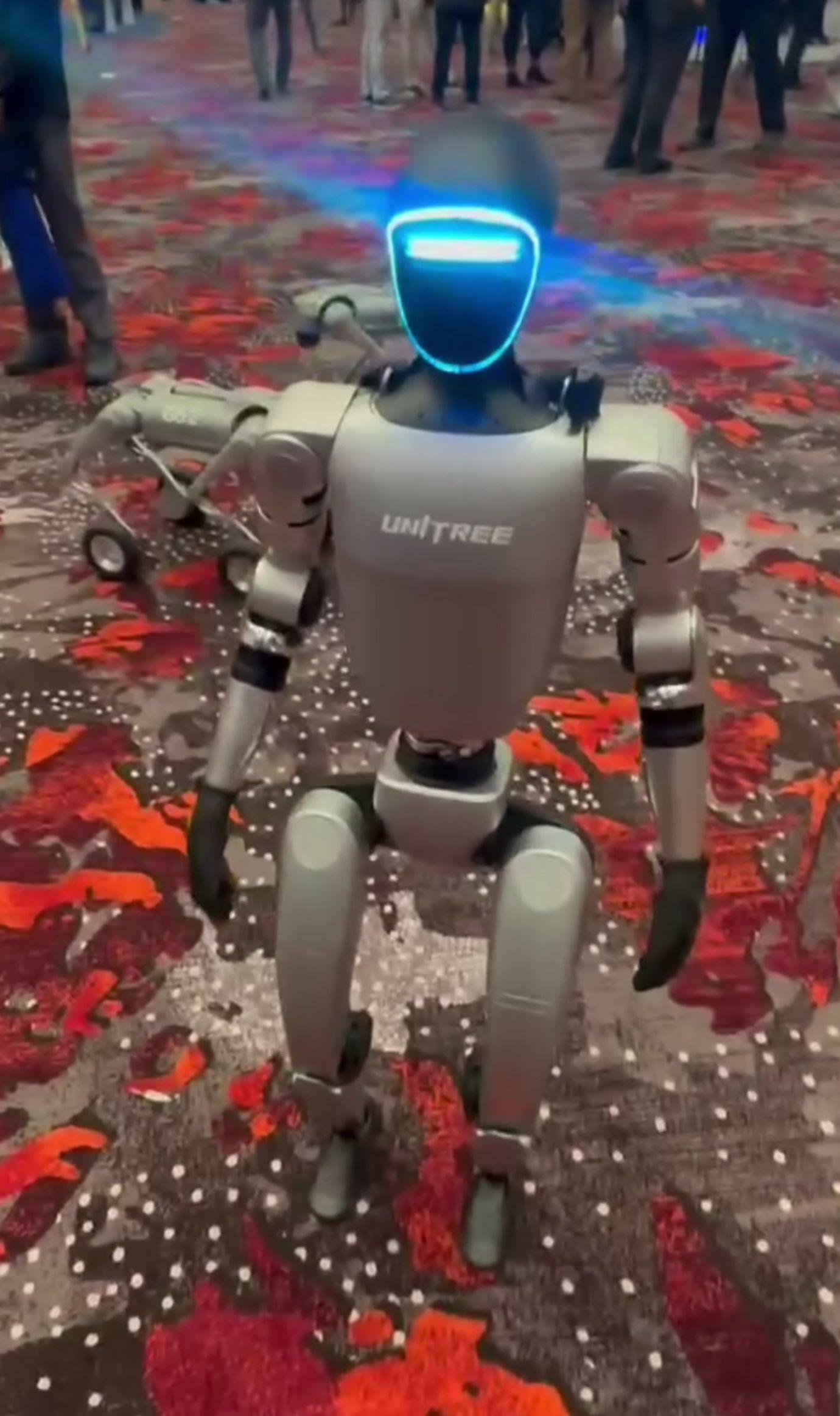
On the G1, Turbo works above the SONIC whole-body controller. Turbo predicts 1.6-second chunks of motion latents and gripper commands at approximately 1 Hz. SONIC decodes the motion at 50 Hz, while the robot's joint controller runs at 1,000 Hz. These are distinct layers with different update rates.[2]
| G1 task | Turbo successes | Success rate | GR00T 1.7 comparison |
|---|---|---|---|
| Scoop and serve popcorn | 48/48 | 100.0% | 83.3% |
| Clear a table of diverse objects | 28/30 | 93.3% | 73.3% |
| Pick objects up from the ground | 25/30 | 83.3% | 50.0% |
| Whole-body spill cleanup | 14/30 | 46.7% | 43.3% |
The policies used the same per-task demonstrations and SONIC action interface for the comparison. A popcorn run required two filled cups, and table cleanup required all six objects to reach a bin. The weaker spill-cleanup result is part of the reported performance, alongside the higher popcorn-serving rate.[2]
Inference and evaluation limits
The optimized Turbo configuration reported a median model-prediction latency of 123.97 milliseconds on Jetson Thor at 120 W. The same G1 checkpoint took 38.40 milliseconds on an RTX 5090. This timing covers model prediction, not the full interval from camera observation to applied robot action, and is not the humanoid's control frequency.[2]
Optimizations include TensorRT, CUDA graphs, selected mixed-precision operations and embodiment-specific denoising schedules. Some workstation timings move visual encoding before the prediction request, so latency figures must be read with the paper's timing boundaries and configuration notes.[2]
The authors identify short memory, force/touch sensing, physical verification and reliability measurement as open problems. GR00T 2 observes only 0.8 seconds of history, and the reported model does not take tactile measurements as input. In the cluttered assembly tests, some failures involved partially driven screws that the policy and supervising agent both considered complete.[2]
These studies show performance on specified robots and protocols. Small physical test sets, selected tasks, task-specific post-training and assistance from recovery tools limit broader conclusions about independent deployment, safety or reliability on unseen work.[2]
Continue reading
- NvidiaNvidia Corporation is an American technology company that designs graphics processing units (GPUs) and is the world's dominant supplier of hardware for artificial intelligenceMentioned 7 times above
- Isaac GR00TIsaac GR00T (short for Generalist Robot 00 Technology) is a foundation model family from NVIDIA for perception, reasoning, and motor control in humanoid robots and other robot embodiments.Linked in the introduction
- Simulation (in AI and robotics)Simulation in artificial intelligence and robotics is the use of computational physics, rendering, and procedural environments to recreate a synthetic version of a physical or virtual world inside which AI…Mentioned 3 times above
- Unitree G1The Unitree G1 is a compact, general-purpose humanoid robot developed by Unitree Robotics, a Chinese robotics company headquartered in Hangzhou, Zhejiang.Mentioned twice above
- NVIDIA CosmosNVIDIA Cosmos is a world foundation model platform developed by NVIDIA for physical AI applications, including autonomous vehicles and robotics.Also in World Models
- Jetson ThorNVIDIA Jetson Thor (also marketed as Jetson AGX Thor) is a Blackwell architecture edge AI computing module developed by NVIDIA that delivers up to 2,070 FP4 teraflops of AI compute in a 40 to 130 watt power…Also in Robotics

More to read
References
- ^1 ^2Sasa Docca. "Practice Makes Precise: At CoRL, NVIDIA and Partners Reveal How Robots Rehearse Delicate Work in Simulation." NVIDIA Blog, November 9, 2026.
- ^1 ^2 ^3 ^4 ^5 ^6 ^7 ^8 ^9 ^10 ^11 ^12 ^13 ^14 ^15 ^16 ^17 ^18 ^19 ^20 ^21 ^22 ^23 ^24 ^25 ^26 ^27 ^28 ^29 ^30NVIDIA. *GR00T 2: Scaling Robot Foundation Models for Generalization, Dexterity, and Adaptation*. Technical report, November 2026.
- ^NVIDIA GEAR. GR00T 2 research project. November 2026; availability checked November 17, 2026.
- ^NVIDIA. PhysicalAI-Human-1M-100K dataset card. Hugging Face; accessed November 17, 2026.
Improve this article
Add missing citations, update stale details, or write a clearer explanation. Anyone can edit: changes go live when you publish, and every edit is checked by an editor.
1 revision · v1 · 2,021 words · full history
Fact-checks are independent of edits: a reviewer re-verifies the article against its sources and stamps the date. How we verify
Research and drafting on this wiki are AI-assisted, under named human editorial standards. How AI is used here
Cite this page: AI Wiki. "GR00T 2." aiwiki.ai, updated 17 Nov 2026. CC BY 4.0. https://aiwiki.ai/wiki/gr00t_2