

Kinisi KR1
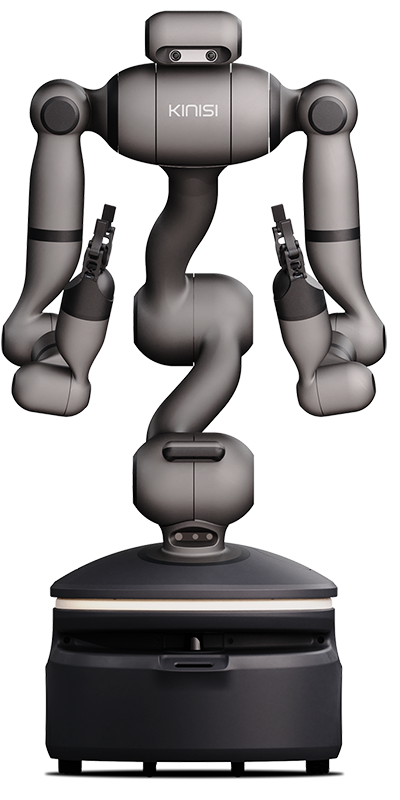 | |
| Developer | Kinisi Robotics |
| Type | Humanoid robot (wheeled mobile manipulator) |
| Also known as | Kinisi 01, KR1 |
| Unveiled | July 2025 |
| Country of origin | United States / United Kingdom |
| Height | 162 cm (5 ft 4 in) |
| Weight | 100 kg (220 lb) |
| Degrees of Freedom | 21 |
| Mobility | Omnidirectional wheeled base |
| Top Speed | 2.4 m/s (8.6 km/h) |
| Payload | 25 kg dynamic / 40 kg static (official); ~10 kg typical pick |
| Battery | 48V Li-ion, hot-swappable; 6 to 8 hours runtime |
| Computing | NVIDIA Jetson |
| Sensors | Stereo depth cameras, 180-degree LiDAR, SLAM |
| Price | ~$75,000 USD (or ~$4,000/month rental) |
| Owner | Bear Robotics (acquisition announced June 2026) |
| Status | In production; pilot deployments |
| Website | kinisi.com |
The Kinisi KR1, also marketed as the Kinisi 01, is a wheeled mobile manipulator (a humanoid-style upper body mounted on an omnidirectional wheeled base) developed by Kinisi Robotics for warehouse automation, logistics, and light manufacturing. Unlike most humanoid robots that rely on bipedal legs, the KR1 prioritizes speed, stability, and affordability, listing at approximately $75,000 (or roughly $4,000 per month on a rental plan) versus the $100,000-plus typical of bipedal humanoids. [1][2][4] It was designed by serial robotics founder Brennand "Bren" Pierce, and in June 2026 its maker, Kinisi Robotics, agreed to be acquired by Bear Robotics, the restaurant-service robot company Pierce had previously co-founded. [15][16]
Standing 162 cm tall and weighing 100 kg, the KR1 carries dual human-scale arms with modular grippers, an IP65-rated aluminum chassis, and on-board artificial intelligence running on an NVIDIA Jetson module. [1][8] Kinisi positions it as a deployment-ready alternative to more expensive bipedal humanoids. The robot was first publicly unveiled in July 2025 after roughly 18 months of development, won the Automate Start-up Challenge in May 2025, and by November 2025 had entered its first commercial deployment at a glass recycling facility in the United Kingdom. [1][3][5]
What is the Kinisi KR1?
The Kinisi KR1 is an industrial mobile manipulator: a wheeled robot with a humanoid torso and two arms, built to pick, sort, and move objects in warehouses and factories. [1][2] Rather than walking on legs, it glides on an omnidirectional wheeled base, which lets it move faster and more stably than bipedal humanoids while avoiding the risk of falling on smooth warehouse floors. [1][14] Kinisi describes the platform as covering pick-and-place, tote and material handling, palletizing, inspection, and replenishment tasks, and markets it under the tagline "The Future of Work, on Wheels." [10]
The robot pairs proven mobility hardware with custom artificial intelligence for manipulation. It uses stereo depth cameras (with depth accuracy of plus or minus 2 mm at 2 meters), a 180-degree LiDAR array, and a SLAM navigation system, processing all of it on-board for sub-100-millisecond perception-to-action latency. [1][8]
Who makes the KR1?
The KR1 is made by Kinisi Robotics, a robotics startup founded by Brennand "Bren" Pierce with offices in New York City (140 Broadway, New York, NY 10005) and Bristol, United Kingdom (Beacon Tower, Colston Street, Bristol BS1 5AQ). [4][9] The company was formally established in January 2024. Pierce is a roboticist with roughly 20 years of experience who previously co-founded Robotise GmbH (a Munich-based startup that built autonomous mobile delivery robots for hotels) and Bear Robotics (a Silicon Valley company behind the Servi/Penny restaurant delivery robot). [4][6][9] Across his career Pierce has been involved in deploying thousands of robots worldwide; Bear Robotics alone has shipped over 10,000 robots. [6]
In June 2026, Kinisi Robotics agreed to be acquired by Bear Robotics, reuniting Pierce with the company he co-founded (see Bear Robotics acquisition below). [15][16]
Pierce holds a PhD in humanoid robotics from the Technical University of Munich (TUM), where he conducted research at the Institute for Cognitive Systems from 2009 to 2015. During his academic career he built a full-size compliant humanoid robot called "Herbert" and developed a generation of FPGA-based robotic controllers, and he earlier worked on a project with Samsung at Carnegie Mellon University. [9][12] His stated philosophy centers on building robots that are economically viable for real-world commercial use rather than research demonstrations. The name "Kinisi" derives from the Greek word for movement.
Leadership Team
As of early 2026, the Kinisi Robotics leadership team included:
| Name | Role | Background |
|---|---|---|
| Brennand Pierce | Founder and CEO | PhD in humanoid robotics (TUM); co-founded Robotise and Bear Robotics |
| Aaron Colfer | Head of Product | Former Senior Manager of Industrial Design at Dyson (2021 to 2024); Senior Design Lead at Matter |
| Mitch Leibowitz | Head of Business Development | Business development and partnerships |
| Mark Finean | Head of Robotics | Robotics engineering lead |
Funding and Milestones
Kinisi Robotics raised approximately $2 million in seed funding through early 2026. [4] The company's development followed a rapid timeline:
| Date | Milestone |
|---|---|
| January 2024 | Company founded; initial customer conversations begin |
| May 2024 | KR1 prototype completed with agentic AI capabilities |
| September 2024 | First employees hired; Bristol office established |
| October 2024 | First customer visit |
| April 2025 | V2 hardware completed |
| May 2025 | First on-site customer demonstration in Europe; won Automate Start-up Challenge |
| July 2025 | Public unveiling of the KR1 platform |
| September 2025 | V3 hardware launched |
| November 2025 | First commercial deployment (glass recycling in UK) |
| June 2026 | Bear Robotics announces agreement to acquire Kinisi Robotics |
Why is the KR1 wheeled instead of legged?
The KR1's most distinctive design choice is its wheeled base instead of bipedal legs. Founder Bren Pierce argues that legs are unnecessarily complex for the vast majority of industrial applications. In an interview with The Robot Report he put it bluntly: "When thinking about humanoids, I think 80% of the tasks that they're aiming for, you don't need legs." [6] On the cost trade-off he added: "Why would I ever want to put 14 or 12 motors? Compared to expensive harmonic drives, I can just have two wheels that cost $200." [6] In a separate interview with Tech.eu he framed the customer view directly: "In our conversations with warehouse and factory operators, they see humanoids with legs and hands as cool toys, not industrial tools." [4]
This philosophy extends to the company's broader strategy. Kinisi focuses on what it calls "software layering," building robust AI software on top of proven, reliable hardware rather than trying to reinvent both hardware and artificial intelligence at once. Because the KR1 was built on Bear Robotics' production navigation stack, Pierce has said the team can concentrate narrowly on manipulation: "We don't have to worry about navigation. We're just literally looking at how to use AI to actually pick stuff in an unstructured environment." [6][15] Pierce has drawn comparisons to past consumer-robotics failures, citing companies like Anki, Jibo, and Kuri as cautionary examples of over-engineered hardware without practical commercial viability. [4]
The KR1 targets what Kinisi describes as the roughly 70% of warehouses that are small, irregular spaces unable to justify massive fixed automation. Pierce has noted that these facilities "can't justify huge automation budgets. Our robots are attractive here because they don't require cages." [4] The robot is designed to integrate into existing workflows without new conveyors, infrastructure, or facility redesigns.
What are the KR1's specifications?
Physical Structure
The KR1 stands 162 cm (approximately 5 feet 4 inches) tall and weighs 100 kg (220 lb). [1][8] The frame is aluminum and carries an IP65 ingress protection rating, meaning it is fully protected against dust and against low-pressure water jets from any direction. The chassis is precision-engineered with gaps no larger than 0.5 mm, and joints are protected with polyurethane bands to keep contaminants out.
Detailed Specifications
| Category | Specification | Value |
|---|---|---|
| Physical | Height | 162 cm (5 ft 4 in) |
| Physical | Weight | 100 kg (220 lb) |
| Physical | Frame material | Aluminum |
| Physical | IP rating | IP65 |
| Physical | Chassis gap tolerance | 0.5 mm or less |
| Mobility | Base type | Omnidirectional wheeled |
| Mobility | Turning radius | Zero-turn capable |
| Mobility | Top speed | 2.4 m/s (8.6 km/h / 5.4 mph) |
| Mobility | Degrees of freedom (total) | 21 |
| Mobility | DOF per hand | 2 |
| Manipulation | Dynamic payload | 25 kg (55 lb) |
| Manipulation | Static payload | 40 kg (88 lb) |
| Manipulation | Typical pick weight (cited) | ~10 kg (22 lb) |
| Manipulation | Gripper type | Dual-end gripper with quick-swap interface |
| Manipulation | End-effector options | Mechanical fingers, vacuum tools |
| Actuators | Motor type | Brushless DC (BLDC) |
| Actuators | Gear technology | Strain wave (harmonic drive) |
| Actuators | Arm modules | Compact wave gear with integrated encoders |
| Power | Battery voltage | 48V |
| Power | Battery type | Lithium-ion (20 Ah modular pack) |
| Power | Runtime | 6 to 8 hours (typical industrial duty cycle) |
| Power | Charging | 80% in 90 minutes (CC/CV smart charger) |
| Power | Battery swap | Hot-swappable with auto-docking |
| Power | Battery management | Integrated BMS with thermal and current protection |
| Perception | Cameras | Stereo depth cameras |
| Perception | LiDAR | 180-degree array with SLAM integration |
| Perception | Depth accuracy | Plus or minus 2 mm at 2 meters |
| Perception | Perception-to-action latency | Sub-100 ms |
| Computing | Processor | NVIDIA Jetson (CPU/GPU) |
| Computing | AI inference | Real-time transformer models |
| Computing | Operating system | Linux |
| Connectivity | Cloud telemetry | Encrypted, via Kinisi Mission Control |
| Connectivity | Updates | Over-the-air (OTA) firmware |
| Connectivity | API | Available |
| Connectivity | ROS compatible | Yes |
| Safety | Controllers | Dual redundant with watchdogs |
| Safety | Emergency stop | Hardware and software linked |
| Safety | Diagnostics | Continuous thermal and current monitoring |
| Safety | Fail-safe | Automatic deceleration and posture lock on critical alerts |
Note on payload and speed: Kinisi's official product page lists a 25 kg dynamic / 40 kg static load and a 2.4 m/s top speed. [10] Most press coverage of early demonstrations cites a practical pick weight of about 10 kg (22 lb), and some third-party spec aggregators list higher top-speed figures, so the conservative official numbers are used here. [1][8][14]
Mobility System
The omnidirectional wheeled base provides zero-turn capability, letting the KR1 rotate in place and navigate tight aisles and confined warehouse spaces. The base includes an active damping suspension that compensates for terrain variation and load shifting, helping maintain stability under heavy loads. At a top speed of 2.4 m/s (approximately 8.6 km/h), the KR1 moves significantly faster than most bipedal humanoid robots, which typically walk at 1.0 to 1.5 m/s, and the wheeled platform eliminates the fall risk that bipedal systems face on smooth floors. [1][14]
Manipulation System
The KR1 features dual human-scale arms with 21 total degrees of freedom distributed across the body, including 2 DOF per hand. [1][8] The arms use compact wave gear modules with integrated encoders, driven by brushless DC motors through strain wave (harmonic drive) gearing for precise, low-backlash motion.
The gripper system uses a dual-end design with a quick-swap interface so operators can change end-effectors by task. Options include mechanical finger grippers for items like bottles and boxes, and vacuum end-effectors for flat or smooth-surfaced objects such as cartons and poly-bags. Per Kinisi's official specifications the robot handles dynamic payloads of up to 25 kg and static loads of up to 40 kg. [10]
Perception and Sensing
The KR1's sensor suite combines stereo depth cameras with a 180-degree LiDAR array. The stereo cameras provide depth perception accurate to plus or minus 2 mm at a range of 2 meters, sufficient for precise picking and placement. [1][8] The LiDAR feeds a SLAM (Simultaneous Localization and Mapping) system that builds and continuously updates a map of the environment, enabling autonomous navigation without pre-programmed paths. All sensor data is fused in real time into a 3D representation of the workspace, and perception-to-action latency is under 100 milliseconds. [1]
Power System
The KR1 runs on a 48V lithium-ion battery with a 20 Ah modular pack, providing 6 to 8 hours of continuous operation under typical industrial duty cycles. [1][8] The battery is hot-swappable, so operators can replace a depleted pack with a charged one without shutting down the robot, and the system supports auto-docking, where the robot returns to its charging station when levels drop below a threshold. Rapid charging reaches 80% capacity in roughly 90 minutes using a CC/CV (constant current / constant voltage) smart charger, and an integrated battery management system (BMS) provides thermal and current protection.
How does the KR1's AI work?
On-board AI
All of the KR1's artificial intelligence processing runs locally on the NVIDIA Jetson module. This edge-computing approach means the robot does not depend on a cloud connection for real-time decisions, which improves response times and reliability in environments with poor connectivity, and keeps sensitive warehouse inventory and operational data on the robot rather than transmitting it externally. The AI system runs real-time transformer inference for both navigation and manipulation, and a reinforcement learning controller fuses LiDAR and stereo-vision data to plan paths, avoid obstacles, and adjust arm trajectories dynamically. [1]
Kinisi's manipulation intelligence is built around proprietary models, including a vision-language-action (VLA) model and a robot foundation model (RFM), which Bear Robotics highlighted as the key technology it was acquiring. [15][16]
Imitation Learning
A key feature of the KR1 is demonstration-based imitation learning. Rather than requiring traditional programming or coded task sequences, operators can teach the robot new tasks by physically demonstrating them; the robot observes and learns to replicate the task independently. Kinisi frames this as part of making robots accessible to warehouse workers without programming expertise.
The system also supports what Kinisi calls "Shadow Play," a teleoperation mode where a human operator can remotely control the robot's movements. Data captured during teleoperation and demonstrations feeds the robot's machine learning pipeline, progressively improving its autonomous performance on trained tasks.
Data Flywheel and Fleet Intelligence
A central element of Kinisi's software strategy is its "data flywheel" architecture. Every deployed KR1 contributes operational data to a shared knowledge base, so when one robot learns to handle a new object type, navigate a new obstacle pattern, or optimize a picking sequence, that knowledge can be distributed across the fleet. As Kinisi deploys more robots, each unit benefits from the collective experience of all deployed systems.
Fleet management is handled through Kinisi Mission Control, a cloud-based telemetry and management platform that provides real-time monitoring of robot status, task progress, and fleet-wide analytics. It supports remote task updates, over-the-air firmware updates, and encrypted data transmission, and lets operators switch individual robots between fully autonomous, semi-autonomous, and teleoperated modes.
Operating Modes
The KR1 supports three operating modes:
| Mode | Description |
|---|---|
| Autonomous | The robot operates independently using its onboard AI, navigating, picking, and placing without human intervention |
| Semi-autonomous | The robot handles routine operations autonomously but requests human guidance for edge cases or unfamiliar situations |
| Teleoperated (Shadow Play) | A human operator remotely controls the robot's movements in real time, useful for teaching new tasks or handling unusual scenarios |
What is the KR1 used for?
Target Industries
Kinisi Robotics has identified several primary application domains for the KR1:
| Application | Description |
|---|---|
| Pick and place | Retrieving items from shelves or bins and placing them into totes, boxes, or onto conveyors |
| Tote and material handling | Moving loaded totes, boxes, and pallets between stations within a facility |
| Palletizing and depalletizing | Stacking and unstacking items on pallets for shipping or storage |
| Inspection and quality control | Using stereo cameras and depth sensing to visually inspect items for defects |
| Replenishment | Restocking shelves and inventory locations |
| Assembly support | Handling components in light manufacturing and assembly operations |
Glass Recycling Deployment (November 2025)
The KR1's first commercial deployment took place in November 2025 at a glass recycling facility in the United Kingdom, the first time the Kinisi 01 platform performed live production work at a customer site. [3] The robot was tasked with autonomous glass bottle sorting for reuse, a process that requires delicate handling to prevent breakage while maintaining throughput. During the deployment, the KR1 used its stereo depth cameras and onboard AI to autonomously determine grasp points and classify bottles by shape, size, and material, balancing speed against careful handling since broken glass creates both product loss and safety hazards.
Aaron Colfer, Kinisi's Head of Product, acknowledged that throughput was initially below human-operator levels: "The process is still slower than a human operator at this stage. Our plan now is to gradually increase speed, with the ambition of surpassing human throughput over the next couple of months." [3] This transparency about early performance reflected Kinisi's approach of deploying real systems in production and iterating, rather than waiting for laboratory-perfect performance.
Automotive Pilot
Kinisi has also secured a pilot agreement with an unnamed major global automotive manufacturer. [4] The initial focus is on intra-logistics tasks (moving materials and parts within the factory) rather than complex assembly. This aligns with the broader industry pattern in which companies like BMW and Mercedes-Benz have started humanoid deployments with material handling before exploring more complex applications.
How much does the KR1 cost?
Kinisi Robotics offers the KR1 through two commercial channels: [1][4]
Direct purchase: approximately $75,000 USD, which positions it as one of the more affordable humanoid platforms on the market.
Monthly rental: approximately $4,000 per month, a Robot-as-a-Service approach that avoids upfront capital expenditure and lets customers evaluate the technology before committing.
Kinisi targets logistics operators, third-party logistics (3PL) providers, warehouse operators, light manufacturers, and retail fulfillment centers, and has been recruiting partners in fulfillment, retail replenishment, and light manufacturing ahead of a planned production ramp in 2026.
Automate Start-up Challenge
In May 2025, Kinisi Robotics won the Automate Start-up Challenge, a pitch competition held as part of the Automate trade show organized by the Association for Advancing Automation (A3), in which early-stage robotics and automation companies present their technology and business models to a panel of judges. [5][11] Kinisi competed against other startups including 3Laws Robotics (a CalTech spinout developing a dynamic universal safety layer for robots) and Sonair (which develops ultrasonic sensor technology). [11] The win gave Kinisi industry visibility and credibility ahead of broader pilot deployments. The event took place shortly before ICRA 2025 (the IEEE International Conference on Robotics and Automation) in Atlanta, Georgia.
Hardware Iterations
The KR1 has gone through multiple hardware revisions in its short history:
| Version | Date | Notes |
|---|---|---|
| V1 (Prototype) | May 2024 | Initial KR1 prototype with agentic AI capabilities |
| V2 | April 2025 | Second-generation hardware; used for first customer demonstrations in Europe |
| V3 | September 2025 | Third-generation hardware; deployed in glass recycling pilot |
This rapid iteration (three hardware versions in roughly 16 months) reflects both Kinisi's agile development and its engineering focus on getting functional hardware into real-world environments quickly. Each iteration incorporated feedback from customer visits and pilot deployments.
How does the KR1 compare to other humanoid robots?
The KR1 occupies a distinctive niche in the humanoid robotics market. While companies like Figure AI, Tesla, Boston Dynamics, and Apptronik are developing bipedal humanoid robots with general-purpose ambitions, Kinisi deliberately narrowed its focus to wheeled humanoids for industrial logistics. [4][7]
| Company | Robot | Locomotion | Key Focus | Price Range |
|---|---|---|---|---|
| Kinisi Robotics | KR1 (Kinisi 01) | Wheeled (omnidirectional) | Warehouse logistics, pick and place | ~$75,000 |
| Figure AI | Figure 02 / Figure 03 | Bipedal | General-purpose manufacturing | ~$100,000 (estimated) |
| Apptronik | Apollo | Bipedal | Factory and warehouse automation | Undisclosed |
| Agility Robotics | Digit | Bipedal | Logistics and material handling | Undisclosed |
| Tesla | Optimus | Bipedal | Factory automation, consumer | $20,000 to $30,000 (target) |
| Unitree Robotics | G1 / H1 | Bipedal | General-purpose, research | ~$16,000 to $90,000 |
Kinisi's competitive advantages center on cost, speed, and reliability. The $75,000 price point (or $4,000/month rental) undercuts most bipedal humanoids, and the wheeled base provides faster movement, greater stability, and lower maintenance than legged systems with their complex joint assemblies and balancing algorithms. [1][4] However, the wheeled design also limits the KR1 to relatively flat, smooth surfaces: it cannot climb stairs, step over obstacles, or work on uneven terrain.
Pierce has described many competitors as "show ponies," arguing that staged demonstrations in pristine laboratory environments misrepresent real-world performance, and has cited Magic Leap as a cautionary tale: "It burnt through billions because it was going to be this bleeding edge VR headset, but then Oculus Rift just came out with something very simple and shipped it." [4][6] He has emphasized that Kinisi's approach focuses on deployment-ready solutions that generate value for customers immediately, rather than pursuing the more ambitious but further-off goal of fully general-purpose bipedal robots.
Bear Robotics acquisition (2026)
On June 22, 2026, Bear Robotics announced that it had signed a definitive agreement to acquire Kinisi Robotics, with the transaction expected to close "in the coming days." [15][16] Financial terms were not disclosed. On closing, the KR1 humanoid platform, Kinisi's Bristol-based engineering team, and its manipulation artificial intelligence are to be integrated into Bear Robotics, with the Bristol office continuing as a strategic engineering hub. [15]
The deal reunites Bren Pierce with Bear Robotics, which he had previously co-founded. Pierce is to join Bear's leadership team as Chief Robotics Officer, continuing to lead the Kinisi engineering organization with the KR1 platform under his direction. [15][16] Bear framed the acquisition as completing an end-to-end Physical AI platform: Bear contributes an established commercial network, supply chain, and a deployed fleet of more than 16,000 robots, while Kinisi adds the missing manipulation layer, including its proprietary vision-language-action (VLA) model, robot foundation model (RFM), data-capture tools, and gripper design. [16] Notably, the KR1 had been built on Bear's production navigation stack since Kinisi's founding. [15]
John Ha, Bear Robotics' founder and CEO, said in the announcement: "Kinisi completes that platform. Its manipulation AI is the layer that lets our robots move from navigating and delivering to actually handling the work." [15] He added that "most companies are trying to get from a pilot to a product; we're expanding from a deployed commercial fleet into full Physical AI automation." [16]
Pierce said: "Manipulation is the missing layer, and that's what Kinisi brings. Together, we're not building one humanoid in isolation; we're completing an integrated, multi-robot automation platform." [15] He also noted: "What Bear has that no one else does is a real Physical AI platform already operating at commercial scale, deployed robots, enterprise customers, manufacturing, and cloud orchestration." [16]
Business Model
Kinisi Robotics offers the KR1 through direct purchase (approximately $75,000 USD) and monthly rental (approximately $4,000 per month), the latter a Robot-as-a-Service model that lowers the barrier to adoption. [1][4] The company targets logistics operators, 3PL providers, warehouse operators, light manufacturers, and retail fulfillment centers, and had been recruiting partners in fulfillment, retail replenishment, and light manufacturing ahead of a planned 2026 production ramp, a trajectory that the Bear Robotics acquisition is positioned to accelerate. [4][16]
Future Outlook
As of mid-2026, the KR1 platform is moving from initial pilot deployments toward broader commercial rollout, now within the larger Bear Robotics organization following the June 2026 acquisition agreement. [15] Immediate priorities include increasing the KR1's operational speed to match and eventually exceed human throughput in deployed applications, scaling production to meet pilot-customer demand, and continuing to develop the software stack that enables fleet-wide learning. [3]
The broader market context is favorable: the global warehouse automation market continues to grow as e-commerce expansion, labor shortages, and rising wages drive demand for robotic solutions, and Kinisi's focus on affordable, practical automation for small and mid-sized warehouses targets a segment historically underserved by traditional fixed automation.
ELI5 (Explain Like I'm 5)
The Kinisi KR1 is a robot with a body and two arms like a person, but instead of legs it rolls around on wheels. It works in warehouses, where it picks up boxes and bottles, sorts them, and moves them from place to place. The people who made it decided wheels were smarter than legs because wheels are simpler, cheaper, faster, and the robot can never trip and fall over. It uses cameras and a laser scanner to see where things are, and a little computer brain inside it to decide what to grab. It costs about $75,000 to buy, or you can rent one for about $4,000 a month, which is cheaper than a lot of other robots that walk on two legs. In 2026, a bigger robot company called Bear Robotics, started by the same person who built the KR1, agreed to buy the company.
See Also
- Kinisi Robotics
- Bear Robotics
- Humanoid robot
- Humanoid robots
- Warehouse automation
- Mobile manipulation
- Imitation learning
- Vision-language-action model
- Physical AI
- NVIDIA Jetson
- Apptronik Apollo
- Figure 02
References
- ^1 ^2 ^3 ^4 ^5 ^6 ^7 ^8 ^9 ^10 ^11 ^12 ^13 ^14 ^15 ^16 ^17"KR1 humanoid robot handles fragile, heavy loads safely in factories." Interesting Engineering, July 2025. interestingengineering.com/...oid-robot-kr1-kinisi
- ^1 ^2"New humanoid robot handles pick-and-place tasks with accuracy, speed." Interesting Engineering, July 2025. interestingengineering.com/...ot-kr1-warehouse-ops
- ^1 ^2 ^3 ^4"Kinisi Robotics Deploys Wheeled Humanoid for Glass Sorting." Humanoids Daily, November 2025. humanoidsdaily.com/...d-humanoid-for-glass-sorting
- ^1 ^2 ^3 ^4 ^5 ^6 ^7 ^8 ^9 ^10 ^11 ^12 ^13 ^14"Kinisi bets on simplicity over spectacle in the robotics race." Tech.eu, August 2025. tech.eu/...autionary-tale-for-todays-humanoid-hype
- ^1 ^2"Kinisi wins Automate Start-Up Challenge." Robots & Startups, May 2025. robotsandstartups.substack.com/...art-up-challenge
- ^1 ^2 ^3 ^4 ^5 ^6"5 questions with Kinisi Robotics founder Brennand Pierce." The Robot Report, 2025. therobotreport.com/...robotics-founder-bren-pierce
- ^"Kinisi Robotics Focuses on Wheeled Humanoids for Industry." NextTech Today, 2025. nexttechtoday.com/...-focuses-on-wheeled-humanoids
- ^1 ^2 ^3 ^4 ^5 ^6 ^7"Kinisi 01." HumanoidSpecs. humanoidspecs.com/...kinisi-01
- ^1 ^2 ^3"Kinisi Robotics About Page." Kinisi Robotics. kinisi.com/about
- ^1 ^2 ^3"Kinisi 01 Product Page." Kinisi Robotics. kinisi.com/kinisi-01
- ^1 ^2"Automate 2025 Startup Challenge Finalists." Automate Show. automateshow.com/...25-startup-challenge-finalists
- ^"Brennand Pierce Portfolio." brenpierce.com
- "From warehouses to restaurants: Kinisi Robotics on the potential of wheeled humanoids." The Robot Report, 2025. therobotreport.com/...tential-of-wheeled-humanoids
- ^1 ^2 ^3"Kinisi KR1." Humanoid.guide. humanoid.guide/...kinisi-kr1
- ^1 ^2 ^3 ^4 ^5 ^6 ^7 ^8 ^9 ^10 ^11"Bear Robotics acquires Kinisi Robotics to boost its physical AI capabilities." The Robot Report, June 24, 2026. therobotreport.com/...its-physical-ai-capabilities
- ^1 ^2 ^3 ^4 ^5 ^6 ^7 ^8 ^9"Bear Robotics to Acquire Kinisi Robotics, Completing Its End-to-End Physical AI Robotics Platform." Barchart / JCN Newswire, June 2026. barchart.com/...-end-physical-ai-robotics-platform
Improve this article
Add missing citations, update stale details, or suggest a clearer explanation. Every suggestion is reviewed for sourcing before it goes live.
4 revisions · v5 · 4,549 words · full history
Fact-checks are independent of edits: a reviewer re-verifies the article against its sources and stamps the date. How we verify
Research and drafting on this wiki are AI-assisted, under named human editorial standards. How AI is used here
Cite this page: AI Wiki. "Kinisi KR1." aiwiki.ai, updated 28 Jun 2026. CC BY 4.0. https://aiwiki.ai/wiki/kinisi_robotics_kr1