

Leju Kuavo-my
| Kuavo-MY | |
|---|---|
 | |
| General information | |
| Manufacturer | Leju Robotics |
| Country of origin | China |
| Year unveiled | 2024 |
| Status | In production |
| Height | approx. 1.4 m (1,400 to 1,470 mm depending on source) |
| Weight | 45 kg (99 lb) |
| Degrees of freedom | 26 (aggregator listings); Leju's launch described "more than 40" |
| Max walking speed | 4.6 km/h (1.28 m/s) |
| Payload capacity | 3 kg |
| Operating system | KaihongOS (OpenHarmony-based) |
| Price | ~$50,000 USD |
| Website | lejurobot.com |
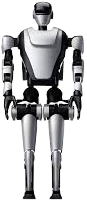
The Kuavo-MY is a full-size bipedal humanoid robot and open embodied-AI development platform built by Leju Robotics (officially Leju Intelligence (Shenzhen) Co., Ltd.), a Chinese robotics company headquartered in Shenzhen. It is a member of Leju's Kuavo (Chinese: Kuafu) humanoid line, sold for around $50,000 USD as a research, education, and commercial-service robot rather than an industrial production unit. The Kuavo-MY runs on KaihongOS, an operating system derived from Huawei's OpenHarmony platform, and ships with an open-source motion controller, multiple software development kits, and simulation tooling so that developers can program and extend it.[1][4]
Leju markets the Kuavo-MY as an open platform for general embodied intelligence aimed at both developers and industrial users. The Robot Report, covering Leju's October 2025 funding, described it as standing "1.4 m (4 ft., 9.8 in.) tall" with "more than 40 DoF" while noting that "the company did not list its weight."[8] Independent robot-database listings (originofbots, aparobot, humanoid.guide) instead report a height near 1,470 mm (about 145 cm), a weight of 45 kg, and 26 degrees of freedom, so the exact figures vary by source and are noted as such throughout this article.[2][12][22]
The Kuavo-MY (and the wider Kuavo line it belongs to) gained international visibility in 2025 through a series of public demonstrations: a world-first 5G-Advanced (5G-A) humanoid showcase with China Mobile and Huawei at Mobile World Congress in Barcelona, a ceremonial torchbearer run at China's 15th National Games, and deployments in exhibition halls, schools, art galleries, and research laboratories across China.[5][25]
What does the "MY" in Kuavo-MY mean?
The "MY" suffix designates a specific variant of the Kuavo line, but Leju's English-language materials and the major robot databases do not publish an official expansion of the two letters, so this article does not assert one. What is verifiable is the platform's positioning: Leju describes the Kuavo-MY as an open development platform that "supports secondary development and integration with mainstream AI large models," enabling customization through imitation learning and an open-source motion controller.[1][14] In practice the "MY" model is the developer- and research-facing configuration of Kuavo, distinct from the more industrially focused Kuavo-5.
Who makes the Kuavo-MY?
Leju Robotics
Leju Robotics was founded in 2016. The company was initially based in Harbin and later incorporated in Shenzhen, where it is now headquartered, with branch offices in Harbin and Hangzhou. Its legal representative is Leng Xiaokun.[6] The founding team came out of the Harbin Institute of Technology (HIT) robotics community, and the company's core technology centers on proprietary torque servos and self-stabilizing bipedal gait algorithms. Leju states that over 90% of the Kuavo series components are domestically produced in China and positions itself as a "leader in the industrialization of humanoid robots."[6]
Leju's earlier products established its reputation before the Kuavo series. The AELOS educational humanoid robot, launched in August 2016, gained international attention in February 2018 when it performed during the "Beijing 8 Minutes" segment at the closing ceremony of the PyeongChang Winter Olympics.[7] The company also developed the PANDO series of palm-sized coding robots, the ROBAN medium bipedal robot, and the Fluvo series of hospital logistics robots.
Leju's funding history reflects steady backing from major Chinese investors. According to public records, the company took roughly RMB 10 million in angel investment from Songhe Capital in 2016, pre-A funding from the state-linked Shenzhen Capital Group in 2017, and RMB 50 million in strategic investment from Tencent in 2017.[6] In October 2025, Leju closed a pre-IPO round of nearly 1.5 billion RMB (approximately $207 million) led by Beijing-based Greenwoods Asset Management, with participation from investors including CITIC Goldstone and Shenzhen Investment Holdings; the round brought total funding since founding to over 1.8 billion RMB and was earmarked for mass production and technological advancement of the Kuavo line.[8][9] In early 2026 the company operated under the name Leju Intelligence (Shenzhen) Co., Ltd. as it prepared for a planned initial public offering.[9]
When was the Kuavo line introduced?
The Kuavo name is a romanization of "Kuafu," a giant from Chinese mythology known for chasing the sun. The original Kuavo was unveiled in December 2023 as a high-dynamic humanoid robot, debuted publicly at the Appliance and Electronics World Expo (AWE) in Shanghai in March 2024, and appeared at Huawei's HDC 2024 developer conference in June 2024 as the first humanoid robot to run on Huawei's HarmonyOS-derived platform.[10]
Iterative improvements led to the Kuavo 3.0, specifying 360 N.m peak-torque joints and 4.6 km/h omnidirectional walking. The Kuavo-MY was released as the smaller, more affordable open-platform variant, followed by the Kuavo-5 in November 2025 as the most industrially focused model, incorporating modular design, dual locomotion (bipedal and wheeled), and extended battery life for sustained commercial operation.[11]
The series now spans three primary configurations:
| Model | Target market | Height | Weight | DOF | Max payload | Price |
|---|---|---|---|---|---|---|
| Kuavo-MY | Research, education, commercial service | approx. 1.4 m | 45 kg | 26 (aggregators) / 40+ (Leju) | 3 kg | ~$50,000 |
| Kuavo-5 | Industrial manufacturing, home service | 1,680 mm | 55 kg | 40 | 20 kg | ~$38,000 |
| Kuavo-5W | Industrial logistics, warehouses | 1,680 mm | Not disclosed | 40 (upper body) | 20 kg | Not disclosed |
The Kuavo-MY occupies a distinct niche. Despite a higher list price than the Kuavo-5, it provides an open development environment that institutions focused on research and software development value over pure industrial deployment.[11]
What are the Kuavo-MY's specifications?
Reported specifications for the Kuavo-MY differ between Leju's own launch messaging and third-party robot databases, and where they conflict this article presents both. Treat the figures below as the values published by the cited secondary sources; Leju has not released a single authoritative public spec sheet in English.
Physical design
The Kuavo-MY stands approximately 1.4 m tall. The Robot Report, citing Leju's launch, gives "1.4 m (4 ft., 9.8 in.)," while robot databases list a height nearer 1,470 mm (145 cm) and a weight of 45 kg (99 lb).[8][12][22] Its proportions approximate those of a teenager or small adult, allowing it to operate in human-scale environments while remaining manageable for laboratory handling.
Degrees of freedom and actuation
The number of degrees of freedom (DOF) is the clearest point of disagreement among sources. Third-party listings consistently report 26 total DOF (14 in the arms and 12 in the legs), whereas The Robot Report's account of Leju's launch states the Kuavo-MY has "more than 40 DoF."[8][12][13] The difference may reflect different arm/hand and finger-joint accounting or different configurations sold under the same name. Each joint is powered by Leju's self-developed high-torque electric actuators with precision reducers, reported to deliver up to 360 N.m of peak torque at a rated speed of 150 rpm, enabling omnidirectional walking, terrain adaptation, and continuous jumping with a clearance of more than 20 cm.[12]
| Category | Parameter | Value (per cited source) |
|---|---|---|
| Physical | Height | approx. 1.4 m (1,400 to 1,470 mm by source) |
| Physical | Weight | 45 kg (99 lb) (database listings) |
| Mobility | Total degrees of freedom | 26 (aggregators); 40+ (Leju launch, per Robot Report) |
| Mobility | Arm DOF | 14 (7 per arm) (database listings) |
| Mobility | Leg DOF | 12 (6 per leg) (database listings) |
| Mobility | Max walking speed | 4.6 km/h (2.86 mph) omnidirectional |
| Mobility | Jumping height | >20 cm continuous |
| Mobility | Terrain capability | Sand, grass, obstacles, uneven surfaces |
| Actuation | Peak joint torque | 360 N.m |
| Actuation | Rated joint speed | 150 rpm |
| Actuation | Actuator type | Self-developed high-torque electric joints |
| Manipulation | Payload capacity | 3 kg |
| Sensors | Vision | Stereo depth camera, RGB cameras |
| Sensors | Navigation | LiDAR |
| Sensors | Inertial | IMU, gyroscope, accelerometer |
| Sensors | Haptic | Force/torque sensors, joint encoders |
| Sensors | Audio | 6-microphone array |
| Connectivity | Wireless | Wi-Fi (2.4/5 GHz), 5G-A (optional) |
| Connectivity | Wired | HDMI, USB 3.0 |
| Software | Operating system | KaihongOS (OpenHarmony-based) |
| Software | AI integration | Huawei Pangu model, LLM compatible |
| Software | Control framework | Open-source motion controller (MPC + WBC) |
Sensors and perception
The Kuavo-MY is equipped with a multimodal sensor suite for environment perception and autonomous navigation. A stereo depth camera provides 3D spatial mapping and obstacle detection, while standard RGB cameras handle visual recognition. A LiDAR unit enables environmental awareness and supports visual SLAM for autonomous path planning. An inertial measurement unit (IMU), gyroscope, and accelerometer provide the balance and orientation data critical for bipedal stability. Force/torque sensors and joint encoders enable load monitoring, compliant manipulation, and precise position feedback, and a six-microphone array supports voice interaction and sound-source localization.[13]
What software does the Kuavo-MY run?
The Kuavo-MY runs on KaihongOS, an operating system derived from Huawei's OpenHarmony open-source platform, providing real-time control, AI processing, and multimodal sensor fusion. Integration with Huawei's ecosystem extends to the Pangu AI model, which provides embodied intelligence for adaptive behavior, task planning, and environmental understanding.
The software stack is built around an open-source motion controller that implements Model Predictive Control (MPC) for trajectory planning and Whole Body Control (WBC) for motion execution. This transparency lets developers understand, modify, and extend the control stack rather than treating it as a proprietary black box; the controller handles gait generation, feedback control, and state estimation, supporting stance, walking, trotting, and jumping modes.[14]
Leju provides a Python SDK (kuavo-humanoid-sdk) and a C++ SDK for arm motor control, giving developers a choice of language. The platform supports ROS (Robot Operating System) Noetic integration through an open-source repository on GitHub containing configuration interfaces, control nodes, and simulation support, and robot parameters can be modified through JSON configuration files and environment variables.[15]
Simulation support
The Kuavo platform integrates with three major physics simulation environments:
Docker containers with pre-built images are available for standardized development environments, including GPU acceleration. This infrastructure lets researchers develop and test control algorithms in virtual environments before deploying them on the physical robot, reducing development time and hardware risk.[16]
Control interfaces
The Kuavo-MY supports multiple control input methods:
- Joystick control: Compatible with the Betop Asura 2 wireless controller and H12Pro controller, with an extensible mapping system for additional devices
- VR teleoperation: Supports the Meta Quest 3 VR headset with hand tracking and inverse kinematics for intuitive remote manipulation
- Keyboard control: Available for bench development and testing
- ROS topic interface: Programmatic command interface for autonomous operation
- 5G-A remote control: Real-time teleoperation over 5G-Advanced networks with low-latency video feedback
A half-body mode allows developers to control only the upper body (arms and head) while disabling lower-limb locomotion, useful for manipulation research where bipedal walking is not required.[17]
End effectors
The Kuavo-MY supports configurable end effectors through its modular arm design. Available options include:
- Qiangnao dexterous hand: A multi-fingered hand for fine manipulation and human-like grasping (default configuration)
- Lejuclaw two-finger gripper: A simplified gripper for pick-and-place tasks
- Qiangnao touch hand: A tactile-enabled variant with enhanced haptic feedback
- Mechanical gripper: Standard gripper included with the XTRON distribution variant
End-effector selection is configurable through the kuavo.json configuration file, allowing users to switch between options without hardware modifications to the arm structure.[18]
What is the XTRON Kuavo-MY variant?
The Kuavo-MY is also available as the XTRON KUAVO-MY, a variant distributed internationally by Foxtech Robotics (formally Huixinghai Technology (Tianjin) Co., Ltd.). The XTRON variant is marketed specifically as a research platform and comes in enhanced configurations compared to the standard Kuavo-MY.
The XTRON version offers two size options:
| Parameter | XTRON Standard | XTRON Large |
|---|---|---|
| Height | 1,500 mm | 1,660 mm |
| Weight | 50 kg | 55 kg |
| Total DOF | 30 | 30 |
| Arm DOF per side | 7 | 7 |
| Leg DOF per side | 7 | 7 |
| Arm span | 1,770 mm | 2,148 mm |
The XTRON variant increases the total degrees of freedom to 30, with 7 DOF per arm and 7 DOF per leg, for advanced research in locomotion and manipulation. It features stereo vision, advanced motion control, and terrain adaptability. The XTRON model designation is KUAVO-MY-4 and ships with a mechanical gripper as standard equipment.[19][20]
Foxtech Robotics positions the XTRON KUAVO-MY for smart cargo handling, AI research, motion-control studies, and exhibition guidance. The variant has been deployed as a guide robot at an AI and Robotics Art Exhibition organized by the Scientist-Art Collaborative Laboratory, where it led visitors through six interactive installations under the theme "The Deduction of Questions."[21]
What is the Kuavo-MY used for?
Commercial service
The Kuavo-MY was designed for customer-facing commercial environments. In shopping centers and exhibition halls it serves as an intelligent guide, answering visitor queries, providing product information, and offering directional guidance. Its bipedal locomotion lets it navigate spaces designed for humans, while its AI-powered natural-language capabilities enable real-time conversational interaction with the public.[22]
Education
Kuavo robots have been deployed in educational settings in China. In 2025, footage from Chinese media showed a Kuavo humanoid teaching young children about artificial intelligence at a school in Mianyang, Sichuan province, using an educational AI system called "Little Bee" to deliver interactive lessons, answer student questions, and guide classroom discussions in real time.[23]
How did the Kuavo become the world's first 5G-A humanoid robot?
On March 6, 2025, China Mobile, Huawei, and Leju Robotics jointly unveiled the Kuavo at Mobile World Congress 2025 in Barcelona as the world's first humanoid robot equipped with 5G-Advanced (5G-A) technology.[5][24] During the conference's opening day, King Felipe VI of Spain shook hands with the robot, a moment that drew widespread international coverage.[5] The 5G-A connectivity enables capabilities that standard Wi-Fi cannot match:
- High-precision positioning in large indoor and outdoor spaces without additional infrastructure
- Real-time remote control with ultra-low latency for teleoperation
- Enhanced multi-robot collaboration through reliable high-bandwidth connections
- Accelerated data collection for machine learning model training
During the demonstration the Kuavo performed automated cooking tasks, using Huawei Cloud's Pangu embodied-agent framework to understand its environment, process natural language commands, plan tasks, and execute them with dual-arm coordination.[5][24]
National Games torch relay
On November 2, 2025, a Kuavo humanoid robot served as the ceremonial "Zero Torchbearer" during the torch relay for China's 15th National Games, held across Hong Kong, Macao, Guangzhou, and Shenzhen. Billed as the world's first humanoid-robot torchbearer equipped with 5G-A technology, the robot gripped a 1.6-kilogram torch, completed roughly 100 meters of the relay in Shenzhen, and executed a handover between the second and third legs.[25][26]
The demonstration was a collaboration between Leju, China Mobile, the Harbin Institute of Technology, and the Beijing Institute for General Artificial Intelligence (BIGAI). Operators directed the robot's start, running, waving, and torch-transfer motions in real time from a remote control room using live video feedback over 5G-A. Leju attributed the run's success to breakthroughs in three areas: dynamic motion control, load-bearing stability while carrying the torch, and real-time low-latency remote control.[25][26]
Research platform
Leju's official website describes the Kuavo-MY as "an embodied intelligence development platform, providing motion control algorithms, simulation platforms, and a complete set of development tools and controllers."[1] The platform supports behavior digitization and rapid dataset collection for application development. Its open-source ROS stack on GitHub, combined with simulation support for MuJoCo, Gazebo, and Isaac Sim, makes it suitable for university research groups working on reinforcement learning, imitation learning, locomotion control, and manipulation.
The Kuavo data challenge, hosted on Leju's GitHub repository, provides structured datasets and benchmarks for researchers developing machine learning algorithms on the Kuavo platform, combining the Lerobot framework with Kuavo-specific data formats for training and evaluation.[27]
How is the Kuavo-MY manufactured, and what does it cost?
Production
On March 29, 2026, a fully automated production line for humanoid robots began operations in Foshan, Guangdong Province. The facility, jointly developed by Guangdong Dongfang Precision Science and Technology Co., Ltd. and Leju, is capable of assembling one humanoid robot approximately every 30 minutes, an annual capacity of about 10,000 units. The factory incorporates 24 digitalized precision assembly processes and 77 inspection and testing procedures, reportedly improving efficiency by more than 50% compared with conventional manufacturing systems, and can switch between different Kuavo models without halting operations.[28]
Leju delivered its 100th full-size humanoid robot in 2025, and in the first quarter of 2025 the company received 250 orders for Kuavo robots, surpassing its target for the first half of the year.[29]
Pricing
The standard Kuavo-MY is priced at approximately $50,000 USD, a mid-range position in the humanoid-robot market. This is higher than the Kuavo-5's estimated $38,000, reflecting the Kuavo-MY's role as a developer-oriented platform with open software tools and documentation. Some listings quote a broader range (roughly $50,000 to $150,000) depending on configuration, and the XTRON variant through Foxtech Robotics may carry different pricing by configuration and region.[13]
International availability
The Kuavo-MY is available in multiple international markets. Leju's official website provides international sales channels, and the XTRON variant through Foxtech Robotics extends distribution to research institutions and commercial buyers outside China. Listings indicate availability in China, the United States, Canada, the European Union, Japan, Singapore, and South Korea.[30]
How does the Kuavo-MY compare to other humanoid robots?
The Kuavo-MY competes in a rapidly growing segment of developer-accessible humanoid robots. Several companies offer platforms targeting researchers and educational institutions at various price points.
| Robot | Manufacturer | Height | DOF | Price | Key differentiator |
|---|---|---|---|---|---|
| Kuavo-MY | Leju Robotics | approx. 1.4 m | 26 (40+ per Leju) | ~$50,000 | Open platform, Huawei ecosystem, 5G-A |
| G1 | Unitree Robotics | 1,270 mm | 23-45 | $16,000+ | Low cost, large community |
| Unitree H1 | Unitree Robotics | 1,800 mm | 19 | ~$90,000 | Full-size research, high speed |
| GR-2 | Fourier Intelligence | 1,750 mm | 53 | Not disclosed | High DOF, rehabilitation focus |
| NAO | SoftBank Robotics | 574 mm | 25 | ~$9,000 | Small form, education standard |
| Digit | Agility Robotics | 1,753 mm | 16+ | Not disclosed | Logistics, Amazon deployment |
The Kuavo-MY's closest competitor in the compact developer-humanoid space is Unitree's G1, which offers a much lower entry price starting at $16,000 for the base model but reaches $43,000 or more in higher-DOF educational configurations. The G1 benefits from Unitree's larger production volumes (about 5,500 units shipped in 2025) and broader community ecosystem. The Kuavo-MY differentiates through integration with the Huawei software ecosystem (KaihongOS, Pangu model), high joint torque (360 N.m), and optional 5G-A connectivity for industrial applications.[31][32]
Compared with legacy educational robots like SoftBank's NAO, the Kuavo-MY offers a far more capable platform at a higher price, providing full-size bipedal locomotion across real-world terrain rather than the tabletop-scale operation that smaller robots are limited to.
The broader Chinese humanoid-robot market saw explosive growth in 2025, with Chinese companies accounting for nearly 90% of global humanoid-robot shipments. The Chinese government has committed large-scale investment to robotics and high-tech sectors, with humanoid robots explicitly prioritized as a strategic technology, providing significant tailwinds for Chinese AI and robotics companies including Leju.[33]
See also
- Leju Robotics
- Kuavo-5
- Humanoid robots
- Humanoid robot market
- Embodied AI
- Robot learning
- Unitree G1
- Industrial robot
- Robot Operating System
References
- ^1 ^2 ^3"Kuavo-MY." Leju Robotics official website. lejurobot.com/en/application/kuavo-my. Accessed June 2026.
- ^"Leju Robotics Kuavo-my." Humanoid Robot Hub. humanoidrobothub.net. April 2025.
- "Kuavo-5 Humanoid Robot by Leju Robot." Humanoid.guide. 2025.
- ^"KUAVO-MY by Leju Robotics: Price, Details, Review." Origin of Bots. originofbots.com. 2025.
- ^1 ^2 ^3 ^4"China Mobile, Huawei, and Leju Robot unveil world's first 5G-A equipped humanoid robot at MWC 2025." TechNode. March 7, 2025.
- ^1 ^2 ^3"Leju Robot." Wikipedia. Accessed June 2026.
- ^"Robot Wants to Be More Than New Kid on Block." Sixth Tone. 2018.
- ^1 ^2 ^3 ^4"Leju raises $200M for humanoid production as Unitree unveils H2." The Robot Report. October 2025.
- ^1 ^2"Chinese humanoid robot maker Leju Robot secures $207 million in pre-IPO funding." Robotics and Automation News. October 22, 2025.
- ^"Kuavo Humanoid Robot by Leju Robotics." Humanoid Press. humanoid.press. 2025.
- ^1 ^2"Leju Launches Kuavo 5 Modular Humanoid Robot." Mike Kalil. November 2025.
- ^1 ^2 ^3 ^4"KUAVO-MY - Robot Details, Use Case and Specifications." Aparobot. aparobot.com. 2025.
- ^1 ^2 ^3"KUAVO-MY by Leju Robotics: Price, Details, Review." Origin of Bots. originofbots.com. 2025.
- ^1 ^2"kuavo-ros-opensource." GitHub, LejuRobotics. github.com/LejuRobotics/kuavo-ros-opensource. Accessed June 2026.
- ^"kuavo-ros-opensource." GitHub, LejuRobotics. github.com/LejuRobotics/kuavo-ros-opensource. Accessed June 2026.
- ^"kuavo-ros-opensource." GitHub, LejuRobotics. github.com/LejuRobotics/kuavo-ros-opensource. Accessed June 2026.
- ^"kuavo-ros-opensource." GitHub, LejuRobotics. github.com/LejuRobotics/kuavo-ros-opensource. Accessed June 2026.
- ^"kuavo-ros-opensource." GitHub, LejuRobotics. github.com/LejuRobotics/kuavo-ros-opensource. Accessed June 2026.
- ^"XTRON KUAVO-MY." Humanoid.guide. humanoid.guide/product/xtron-kuavo-my/. 2025.
- ^"XTRON KUAVO-MY Bipedal Humanoid Robot Research Platform." Foxtech Robotics. foxtechrobotics.com. 2025.
- ^"AI & Robotics Art Exhibition Guided by XTRON KUAVO-MY Humanoid Robot." Foxtech Robotics. foxtechrobotics.com. 2025.
- ^1 ^2 ^3"Kuavo-my." Humanoid.guide. humanoid.guide/product/kuavo-my/. 2025.
- ^"Leju's Kuavo Humanoid Robot Teaches Children at Sichuan School." Mike Kalil. mikekalil.com. November 2, 2025.
- ^1 ^2"MWC 2025: Chinese firms debut world-first 5G-A powered humanoid robot." Interesting Engineering. March 2025.
- ^1 ^2 ^3"Leju's Kuavo humanoid robot carries torch at China's National Games in historic first." Robotics and Automation News. November 3, 2025.
- ^1 ^2"Humanoid 'Kuafu' debuts as special torchbearer at 15th National Games relay in Shenzhen." People's Daily Online / Global Times. November 3, 2025.
- ^"kuavo_data_challenge." GitHub, LejuRobotics. github.com/LejuRobotics/kuavo_data_challenge. Accessed June 2026.
- ^"Foshan opens China's highest producing humanoid robot production line." China Daily. March 31, 2026.
- ^"Founder of Leju Robotics: bringing robots into every household." Yangcheng Evening News. May 4, 2025.
- ^"XTRON KUAVO-MY Bipedal Humanoid Robot Research Platform." Foxtech Robotics. foxtechrobotics.com. 2025.
- ^"Unitree G1 Humanoid." Unitree Robotics. unitree.com/g1/. 2025.
- ^"Chinese firms lead global humanoid robot production in 2025: report." Xinhua. January 10, 2026.
- ^"A Deep Look Into China's Humanoid Robot Market." DirectIndustry e-Magazine. March 17, 2026.
Improve this article
Add missing citations, update stale details, or suggest a clearer explanation. Every suggestion is reviewed for sourcing before it goes live.
6 revisions · v7 · 3,844 words · full history
Fact-checks are independent of edits: a reviewer re-verifies the article against its sources and stamps the date. How we verify
Research and drafting on this wiki are AI-assisted, under named human editorial standards. How AI is used here
Cite this page: AI Wiki. "Leju Kuavo-my." aiwiki.ai, updated 28 Jun 2026. CC BY 4.0. https://aiwiki.ai/wiki/leju_robotics_kuavo_my