

Kuavo-5
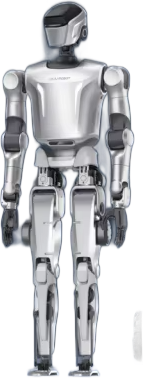 | |
| Developer | Leju Robotics |
| Type | Humanoid robot |
| Generation | 5th (Kuavo series) |
| Unveiled | November 18, 2025 |
| Height | 168 cm (adjustable) |
| Weight | 55 kg |
| Degrees of Freedom | 40 |
| Battery Life | 8+ hours |
| Walking Speed | 4.6 km/h (1.28 m/s) omnidirectional |
| Payload | 20 kg total; 10 kg per arm |
| Locomotion | Bipedal + wheeled (Kuavo-5W variant) |
| OS | KaihongOS (OpenHarmony-based) |
| Actuators | Self-developed high-torque electric joints |
| Price | ~$38,000 USD (estimated) |
Kuavo-5 is the fifth-generation humanoid robot in the Kuavo series developed by Leju Robotics (officially Leju Intelligence (Shenzhen) Co., Ltd.), a Chinese robotics company headquartered in Shenzhen.[1][2] Unveiled in November 2025, the Kuavo-5 is a modular humanoid designed for deployment in both industrial manufacturing and home-service environments, and its defining feature is a dual-locomotion system that lets it switch between bipedal walking and wheeled movement, with a dedicated wheeled variant designated the Kuavo-5W.[5][7] It carries a 20 kg total payload (10 kg per arm), runs for more than 8 hours per charge, and is built on Huawei's OpenHarmony-based KaihongOS with integration of Huawei's Pangu AI model for embodied intelligence.[5][7]
The Kuavo-5 represents Leju Robotics' push toward the industrialization of humanoid robots, following the company's 1.5 billion yuan (about $207 million) pre-IPO funding round in October 2025 and its milestone of delivering its 100th full-size humanoid robot earlier that year.[1][2][3] The robot features interchangeable hands and limbs, self-developed joints with up to 360 N.m peak torque, and integration with Huawei's KaihongOS operating system and Pangu large language model for embodied intelligence.[5][6]
What is the Kuavo-5?
The Kuavo-5 is a full-size, modular humanoid robot from Leju Robotics, positioned as the most industrially focused model in the company's Kuavo lineup. Roughly the proportions of an average adult (about 168 cm tall and 55 kg), it is engineered to operate in spaces designed for people while carrying meaningful loads across a full shift.[7] Two design choices set it apart from earlier Kuavo robots and from many competitors: modular limbs and end effectors that can be swapped for the task at hand, and a switchable locomotion system that trades between bipedal walking on varied terrain and faster, more energy-efficient wheeled movement on flat surfaces.[5][7] Leju describes itself as the "Leader in the industrialization of humanoid robots," and markets the Kuavo-5 and Kuavo-5W as part of its general-purpose humanoid robot series for research, business services, industrial manufacturing, and training.[18]
Who makes the Kuavo-5?
Leju Robotics
Leju Robotics was founded in 2016 by Leng Xiaokun, a PhD graduate of the Harbin Institute of Technology. The founding team originated from the university's Intelligent Robotics Research Center, where Leng serves as associate director. The company was initially established in October 2015 in Harbin with approximately 2 million yuan in personal investment from the founders and 30,000 yuan in university subsidies, before formally incorporating in Shenzhen in 2016. Leju maintains branch offices in Harbin and Hangzhou. Leng, born in Weifang, Shandong in 1992, is part of China's "post-90s" generation of technology founders.[17][20]
The company's core technology includes proprietary torque servos and self-stabilizing biped gait algorithms. Over 90% of the Kuavo series components are domestically produced in China. Leju positions itself as a "leader in the industrialization of humanoid robots," focusing on bridging the gap between research prototypes and commercially viable humanoid platforms.[17][18]
In early 2026, Leju Robotics rebranded as Leju Intelligence (Shenzhen) Co., Ltd., signaling a strategic shift from a pure robotics company to a broader intelligent-technology enterprise ahead of a planned initial public offering. The company filed for an IPO with the Shenzhen Securities Regulatory Bureau on October 30, 2025, with Orient Securities as its sponsoring broker.[2][19]
Funding History
Leju Robotics has raised substantial funding since its founding, culminating in a major pre-IPO round in 2025.
| Round | Date | Amount | Notable Investors |
|---|---|---|---|
| Angel | 2016 | 10 million RMB | Songhe Capital |
| Pre-A | 2017 | Tens of millions RMB | Shenzhen Capital Group |
| Strategic | 2017 | 50 million RMB | Tencent |
| Pre-IPO | October 2025 | 1.5 billion RMB (~$207 million) | Greenwoods Asset Management, Shenzhen Investment Holdings Capital, Shenzhen Longhua Capital, Qianhai Foundation Investment, Oriental Precision, CITIC Jingshi, Dongfang Precision Science & Technology, Tuopu Group, China-US Green Fund |
The October 2025 pre-IPO round, announced on October 22, 2025, was led by Beijing-based Greenwoods Asset Management and earmarked for scaling manufacturing and expanding the Kuavo humanoid robot line's applications in industrial and service sectors.[1][2] The round placed Leju among the most well-funded humanoid robotics startups in China. The company counts Tencent Holdings and the state-owned Shenzhen Capital Group among its early backers. Leju also maintains partnerships with Huawei Cloud, Haier, and China Mobile.[1][2][3]
Earlier Products
Before the Kuavo series, Leju Robotics developed several earlier product lines that established its reputation in robotics.
AELOS Series (2016): Leju's first product, the AELOS educational humanoid robot, launched in August 2016 and entered mass production. Standing 34.6 cm tall and weighing 1.8 kg, the AELOS featured 16 human-like joints and supported dancing, yoga, jumping, gymnastics, voice interaction, and smartphone remote control. The AELOS gained international attention in February 2018 when it appeared during the "Beijing 8 Minutes" segment at the closing ceremony of the PyeongChang Winter Olympics, showcasing Chinese technological capabilities to a global audience.[4]
PANDO Series (2018): A palm-sized, panda-shaped coding toy robot introduced in 2018. PANDO could roll, bow, and respond to voice commands, targeting younger audiences and introductory programming education.
Other Products: Leju also developed the ROBAN medium bipedal robot, the Fluvo series of hospital logistics robots, the CUBE smart building block kit, and the Clamber Man heavy-duty transport robot.
Kuavo Series Evolution
The Kuavo (also romanized as "Kuafu," referencing a giant from Chinese mythology) series represents Leju's full-size humanoid robot platform. The original Kuavo was officially unveiled in December 2023 as a high-dynamic humanoid robot featuring a robust structure, dynamic mobility, dexterous hands, and an intelligent system capable of precise perception and autonomous task planning.
Leju introduced the Kuavo publicly at the Appliance and Electronics World Expo (AWE) in Shanghai in March 2024. The robot also debuted at Huawei's HDC 2024 developer conference in June 2024, where it was presented as the first humanoid robot to run on Huawei's HarmonyOS platform. Iterative versions included the Kuavo 3.0, which specified 360 N.m peak torque joints and 4.6 km/h omnidirectional walking.
The Kuavo-MY ("MY" standing for "Make Yours") was released as a smaller, more affordable open platform variant targeting researchers, educators, and developers. Standing approximately 1,470 mm tall and weighing 45 kg, the Kuavo-MY features 26 degrees of freedom and is priced at around $50,000.
The Kuavo-5 builds on this lineage as the most industrially focused model, incorporating modular design principles, dual locomotion, and extended battery life for sustained commercial operation.[5][6]
What are the Kuavo-5's specifications?
Physical Design
The Kuavo-5 stands approximately 168 cm tall, with an adjustable body height, and weighs 55 kg. The frame is constructed from aluminum alloy with composite panels, designed to balance structural rigidity with weight efficiency for sustained bipedal locomotion. The robot's proportions approximate those of an average adult human, allowing it to operate in spaces designed for people.[7]
Detailed Specifications
| Parameter | Value |
|---|---|
| Height | 168 cm (adjustable) |
| Weight | 55 kg |
| Total degrees of freedom | 40 |
| DOF per hand | 10 |
| Fingers per hand | 5 |
| Total payload capacity | 20 kg (44 lb) |
| Dual-arm payload | 10 kg (22 lb) |
| Peak joint torque | 360 N.m |
| Rated joint speed | 150 rpm |
| Maximum walking speed | 4.6 km/h (2.86 mph) omnidirectional |
| Locomotion modes | Bipedal walking + wheeled (Kuavo-5W) |
| Terrain capability | Sand, grass, obstacles, factory floors |
| Battery life | 8+ hours continuous operation |
| Operating system | KaihongOS (OpenHarmony-based) |
| AI integration | Huawei Pangu model |
| Sensors | Depth cameras, IMU, force/torque sensors |
| Connectivity | 5G-A, Wi-Fi (2.4/5 GHz), Ethernet, USB 3.0, HDMI |
| Actuators | Self-developed high-torque electric joints with precision reducers |
| Control latency | 200 ms |
| Body rotation | Full rotational capability |
Leju has not published a complete official specification sheet for the Kuavo-5; the figures above are drawn from third-party robot databases and Leju's launch materials, and some values (notably exact height, weight, and degrees of freedom) are reported rather than officially confirmed.[5][7] The payload (20 kg total, 10 kg per arm), 8+ hour battery life, dual locomotion, and KaihongOS/Pangu integration are corroborated directly by Leju's launch coverage.[5][7]
How does the Kuavo-5's dual locomotion system work?
The Kuavo-5's most distinctive engineering feature is its ability to switch between two locomotion modes. In bipedal mode, the robot walks on two legs with omnidirectional capability at up to 4.6 km/h, navigating uneven terrain including sand, grass, and obstacles. The Kuavo-5W wheeled variant replaces the lower leg segments with a wheeled base, enabling faster, more energy-efficient movement on smooth surfaces such as factory floors, warehouses, and indoor residential spaces.
This dual approach addresses a practical challenge in humanoid deployment: bipedal walking offers versatility across varied terrain but consumes more energy and moves more slowly than wheeled locomotion on flat surfaces. By making the lower limbs modular, Leju allows operators to configure the robot for the environment it will primarily operate in, or to maintain both configurations for different shifts or tasks.[5][7]
Modular Hands and End Effectors
The Kuavo-5's arms and hands are designed as interchangeable modules. Users can select from three primary end-effector configurations depending on the task:
| End Effector | DOF | Use Case |
|---|---|---|
| Five-fingered dexterous hand | 10 per hand | Fine manipulation, object handling, human-like interaction |
| Gripper | Varies | Industrial pick-and-place, heavy object handling |
| Claw attachment | Varies | Specialized gripping, logistics, material transport |
This modularity allows a single Kuavo-5 platform to serve multiple roles within a facility without requiring separate robot platforms for different tasks. Swapping end effectors can be performed by trained operators, reducing downtime between task reconfigurations.[5]
Software and AI Platform
The Kuavo-5 runs on KaihongOS, an operating system based on Huawei's OpenHarmony open-source platform. KaihongOS provides real-time control, AI processing, and multimodal sensor fusion capabilities. The integration with Huawei's ecosystem extends to the Pangu AI model, which provides embodied intelligence for adaptive behavior, task planning, and environmental understanding.[5][7]
The software stack supports imitation learning for task adaptation, allowing the robot to learn new behaviors from human demonstrations rather than requiring explicit programming for every task. The platform also integrates with mainstream AI large language models, enabling natural language interaction for command interpretation and status reporting.
An open-source motion controller handles trajectory planning, feedback control, and state estimation, giving developers and integrators the ability to modify and extend the control stack for specialized applications.
Sensors and Perception
The Kuavo-5 is equipped with depth cameras for 3D environment perception and obstacle detection. Additional sensors include an inertial measurement unit (IMU) for balance and orientation, force/torque sensors at key joints for load monitoring and compliant manipulation, and joint encoders for precise position feedback. The sensor suite feeds into the onboard AI system for real-time environmental mapping and task execution.
What is the Kuavo-5 used for?
Industrial Manufacturing
Leju Robotics targets industrial automation as a primary application for the Kuavo-5. The company demonstrated the robot performing tasks in what appeared to be an automotive assembly environment, including component handling, quality inspection, and logistics operations. In July 2024, an earlier Kuavo model was tested at NIO's electric vehicle factory in China and at Jiangsu Hengtong Group for tasks including vehicle assembly and quality control. These deployments validated the platform's capability in real manufacturing environments and informed the Kuavo-5's design requirements for payload capacity, battery endurance, and modular tooling.[8]
Home Service
The Kuavo-5's demonstration video showcased the robot operating in a simulated home environment, performing tasks in a kitchen, living room, and laundry room. Leju envisions the robot assisting with domestic chores, elderly care, and general household tasks. The wheeled Kuavo-5W variant is particularly suited to home environments with smooth flooring, where wheeled locomotion offers superior efficiency and stability compared to bipedal walking.
Education
Kuavo robots have been deployed in educational settings. In early 2025, footage circulated on social media showing a Kuavo humanoid teaching young children about artificial intelligence at a school in Mianyang, Sichuan province. The robot demonstrated real-time interaction capabilities, answering questions and guiding lessons. This educational deployment highlights the versatility of the Kuavo platform beyond industrial applications.[9]
Torch Relay at China's National Games
On November 3, 2025, a Kuavo humanoid robot made history as the ceremonial "Zero Torchbearer" during the torch relay for China's 15th National Games. The relay was held simultaneously across Hong Kong, Macao, Guangzhou, and Shenzhen, with 200 torchbearers in total, including sanitation workers and delivery riders. Designated as the world's first humanoid robot torchbearer equipped with 5G-Advanced (5G-A) technology, Kuavo gripped a 1.6-kilogram torch and completed approximately 100 meters of the relay, executing a handover between the second and third legs of the relay.[10][11]
The demonstration was made possible through collaboration between Leju Robotics, China Mobile, Harbin Institute of Technology, and the Beijing Institute for General Artificial Intelligence (BIGAI). Leveraging 5G-A's low latency and high bandwidth, operators in a remote control room directed Kuavo's movements in real time, from "starting and running to waving and transferring the torch," using live video feedback from the relay site.[10] The robot's running posture was described by observers as lifelike, steady, and natural.
The technical success relied on three key breakthroughs: dynamic motion control algorithms optimized for running with a load, load-bearing stability while carrying the torch, and real-time remote control via 5G-A connectivity. The demonstration served as a high-profile showcase of China's progress in embodied AI and humanoid robotics.[10][11]
How is the Kuavo-5 manufactured at scale?
CTTL Certification
In March 2024, Leju's Kuavo humanoid robot became one of the first batch of humanoid robots to pass the general ontology test and evaluation conducted by CTTL Terminal Labs, a testing division of the China Academy of Information and Communications Technology (CAICT). The evaluation followed the "FG-Z18-0009-01 Humanoid Robot: General Ontology Test Scheme V1.0" standard and assessed the robot across 13 test dimensions in three aspects: ontology characteristics, motion control, and power consumption and battery life. Additional testing covered human-computer interaction, electromagnetic compatibility, environmental adaptability, and information security.[12]
Foshan Production Line
On March 29, 2026, a fully automated production line for humanoid robots began operations in Foshan, Guangdong Province. The facility was jointly developed by Guangdong Dongfang Precision Science & Technology Co., Ltd. and Leju Robotics. The production line is capable of assembling one humanoid robot approximately every 30 minutes, translating to an annual capacity of about 10,000 units.
The factory incorporates 24 digitalized precision assembly processes and 77 inspection checkpoints, improving efficiency by more than 50% compared to conventional manufacturing systems. A key feature of the facility is its flexibility: the production line can switch between different robot models without halting production. The initial lineup includes the Kuavo industrial humanoid robot.
This production line represents one of China's first mass-manufacturing facilities dedicated to humanoid robots, marking a transition from experimental prototypes to industrial-scale production.[13]
Delivery Milestones
Leju Robotics delivered its 100th full-size humanoid robot in January 2025, with the milestone unit going to BAIC Off-Road Vehicles, making Leju one of China's highest-volume humanoid robot suppliers by delivery count.[14][20] In the first quarter of 2025, the company received 250 orders for Kuavo robots, surpassing its target for the first half of the year.[20] Chairman Leng Xiaokun has stated the company's goal of making robots "truly serve every industry and every household," echoing the broader Chinese government initiative to develop humanoid robotics as a strategic industry.[20]
How does the Kuavo-5 compare to competitors?
The Kuavo-5 competes in an increasingly crowded Chinese humanoid robotics market. Chinese companies accounted for nearly 90% of global humanoid robot shipments in 2025, with Unitree Robotics and AgiBot leading the market.[14]
| Company | Robot | Units Shipped (2025) | Key Features |
|---|---|---|---|
| Unitree Robotics | H1 / G1 | ~5,500 | Low cost, open ecosystem, consumer-oriented |
| AgiBot | A2 / X2 | ~5,100 | Industrial focus, NVIDIA partnership |
| UBTECH | Walker S | ~1,000 | Service robotics, NIO factory deployment |
| Leju Robotics | Kuavo series | 150-500 | Modular design, Huawei ecosystem, dual locomotion |
| Figure AI | Figure 02 | Limited | Helix VLA, BMW deployment |
| Tesla | Optimus | Prototyping | Target price $20,000-$30,000 |
| Boston Dynamics | Atlas (electric) | Pre-commercial | 56 DOF, Hyundai backing |
Leju differentiates itself through its modular design philosophy and deep integration with Huawei's software ecosystem, including KaihongOS and the Pangu AI model. While Unitree and AgiBot have achieved higher shipment volumes, Leju's focus on industrial-grade payload capacity and switchable locomotion targets a different deployment niche. The company's $38,000 estimated price point for the Kuavo-5 positions it below research-grade platforms like the Kuavo-MY ($50,000) and significantly below international competitors such as Figure 02 (~$100,000 estimated).
The Chinese government has committed nearly $140 billion in investments for robotics and high-tech sectors, with humanoid robots explicitly prioritized as a strategic technology. This policy environment provides tailwinds for all Chinese humanoid companies, including Leju.[14][15]
Kuavo Model Comparison
The Kuavo series encompasses multiple models targeting different market segments.
| Feature | Kuavo-MY | Kuavo-5 | Kuavo-5W |
|---|---|---|---|
| Target market | Research, education | Industrial, home service | Industrial, logistics |
| Height | 1,470 mm | 1,680 mm (adjustable) | 1,680 mm (adjustable) |
| Weight | 45 kg | 55 kg | Not disclosed |
| Degrees of freedom | 26 (14 arms, 12 legs) | 40 | 40 (upper body) |
| Locomotion | Bipedal only | Bipedal | Wheeled |
| Max speed | 4.6 km/h | 4.6 km/h (walking) | Higher (wheeled) |
| Payload | 3 kg | 20 kg | 20 kg |
| Battery life | Not disclosed | 8+ hours | 8+ hours |
| End effectors | Fixed hands | Interchangeable | Interchangeable |
| Price | ~$50,000 | ~$38,000 | Not disclosed |
| Operating system | KaihongOS | KaihongOS | KaihongOS |
The XTRON Kuavo-MY is also available as a variant sold through distribution partners such as Foxtech Robotics. The XTRON version comes in two height options (1,500 mm and 1,660 mm) and weights (50 kg and 55 kg), with 30 degrees of freedom (an increase over the standard Kuavo-MY's 26 DOF), offering enhanced capability for advanced research applications.[16]
ELI5: What is the Kuavo-5?
The Kuavo-5 is a robot that is built to look and move like a person. It is about as tall as an adult, and it can walk on two legs over bumpy ground like grass or sand. If it needs to move fast across a smooth floor, like in a factory, you can swap its legs for wheels (that version is called the Kuavo-5W). Its hands come off too, so you can give it gentle fingers for picking up small things or a strong claw for carrying heavy boxes. A Chinese company called Leju Robotics makes it, and the robot's "brain" uses software from Huawei. One of these robots even helped carry the torch at a big Chinese sports event in 2025.
See Also
- Leju Robotics
- Humanoid robot
- Embodied AI
- Unitree Robotics
- AgiBot
- UBTECH
- Kuavo-my
- Robot learning
- Industrial robot
- Huawei
References
- ^1 ^2 ^3 ^4"Leju raises $200M for humanoid production as Unitree unveils H2." The Robot Report, October 2025.
- ^1 ^2 ^3 ^4 ^5"Chinese humanoid robot maker Leju Robot secures $207 million in pre-IPO funding." Robotics and Automation News, October 22, 2025.
- ^1 ^2"Tencent-backed humanoid robot startup Leju raises $210m in pre-IPO round." DealStreetAsia, October 2025.
- ^"Robot Wants to Be More Than New Kid on Block." Sixth Tone, 2018.
- ^1 ^2 ^3 ^4 ^5 ^6 ^7 ^8 ^9 ^10"Leju Launches Kuavo 5 Modular Humanoid Robot." Mike Kalil, November 2025.
- ^1 ^2"Kuavo Humanoid Robot by Leju Robotics." Humanoid Press, 2025.
- ^1 ^2 ^3 ^4 ^5 ^6 ^7 ^8 ^9"Kuavo-5 Humanoid Robot by Leju Robot." Humanoid.guide, 2025.
- ^"Huawei's humanoid robot in testing at EV maker Nio's factory." Gizmochina, July 7, 2024.
- ^"Leju's Kuavo Humanoid Robot Teaches Children at Sichuan School." Mike Kalil, February 2025.
- ^1 ^2 ^3"Leju Robot's humanoid makes history as torchbearer at China's 15th National Games." Robotics and Automation News, November 3, 2025.
- ^1 ^2"Kuavo humanoid robot joins historic torch relay for China's National Games." CGTN, November 2, 2025.
- ^"Leju passed the general ontology test and evaluation of humanoid robots." CTTL Terminal Labs, March 2024.
- ^"China launches humanoid robot production line with 10,000-unit capacity." ECNS, March 31, 2026.
- ^1 ^2 ^3"Chinese firms lead global humanoid robot production in 2025: report." Xinhua, January 10, 2026.
- ^"A Deep Look Into China's Humanoid Robot Market." DirectIndustry e-Magazine, March 17, 2026.
- ^"XTRON KUAVO-MY Bipedal Humanoid Robot Research Platform." Foxtech Robotics, 2025.
- ^1 ^2"Leju Robot." Wikipedia. Accessed April 2026.
- ^1 ^2"Leju Robot official website." lejurobot.com. Accessed June 2026.
- ^"Leju Robot Rebrands as Leju Intelligence, Eyes IPO With Strategic Overhaul." RobotToday, 2026.
- ^1 ^2 ^3 ^4"Founder of Leju Robotics: bringing robots into every household." Yangcheng Evening News, May 4, 2025.
Improve this article
Add missing citations, update stale details, or suggest a clearer explanation. Every suggestion is reviewed for sourcing before it goes live.
4 revisions · v5 · 3,614 words · full history
Fact-checks are independent of edits: a reviewer re-verifies the article against its sources and stamps the date. How we verify
Research and drafting on this wiki are AI-assisted, under named human editorial standards. How AI is used here
Cite this page: AI Wiki. "Kuavo-5." aiwiki.ai, updated 28 Jun 2026. CC BY 4.0. https://aiwiki.ai/wiki/leju_robotics_kuavo_5