

LongCat-2.5
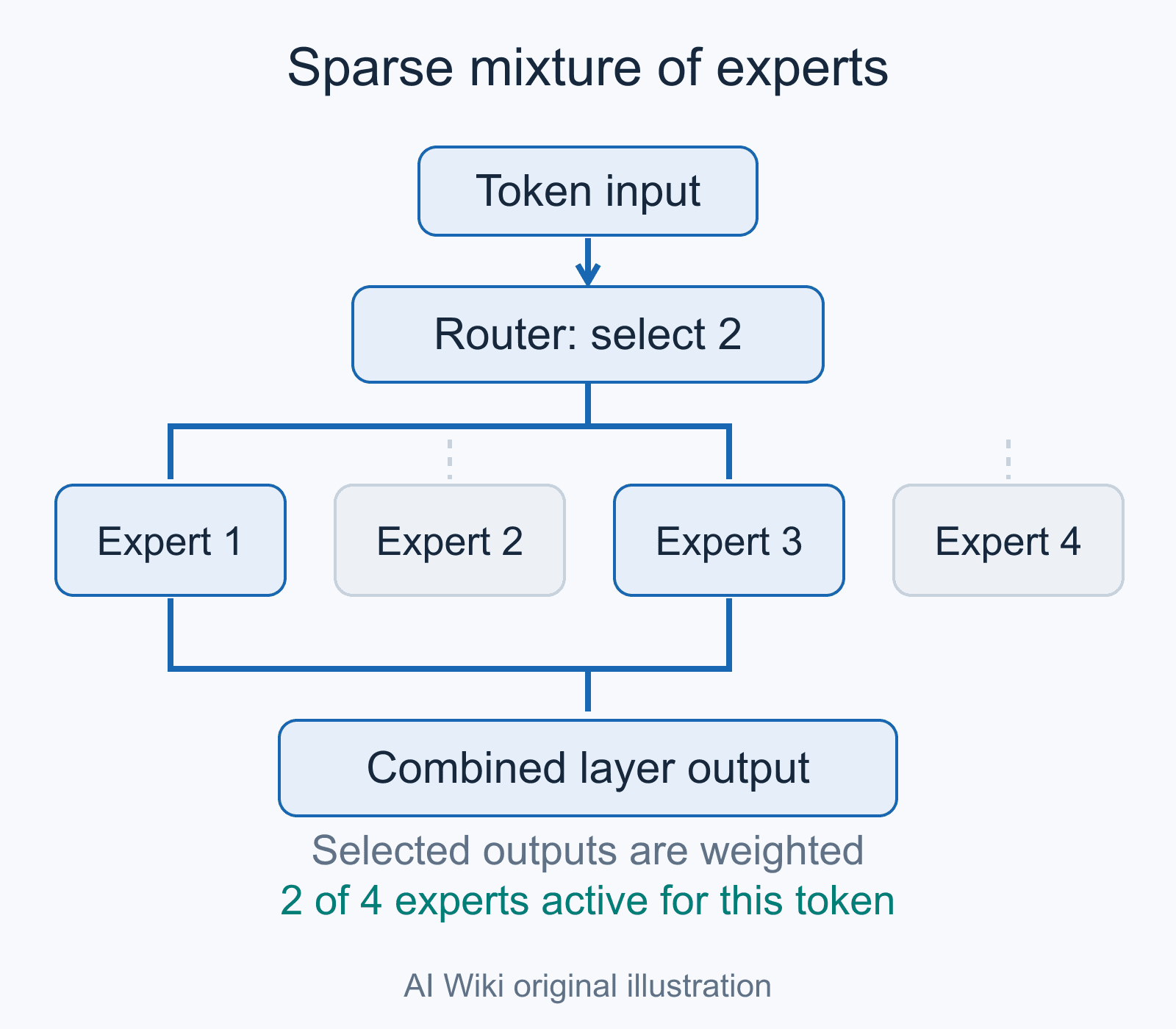
LongCat-2.5 is a multimodal mixture-of-experts language model developed by Meituan for coding and long-running agent tasks. It has 1.6 trillion total parameters, with approximately 48 billion activated per token. Meituan's technical introduction is dated November 1, 2026; the API platform's change log records availability on November 2.[1][2]
The model builds on LongCat-2.0 with visual understanding, longer agent trajectories in training, and additional reinforcement learning. It belongs to a later generation than the 560-billion-parameter LongCat-Flash models.[1][2]
Specifications and availability
| Property | Published specification |
|---|---|
| Developer | Meituan LongCat team |
| Architecture | Mixture of experts |
| Total parameters | 1.6 trillion |
| Activated parameters per token | Approximately 48 billion |
| API model identifier | LongCat-2.5 |
| Maximum context | 1,048,576 tokens, including input and output |
| Maximum generated output | 262,144 tokens |
| Documented visual inputs | Images and videos |
| Hosted API formats | OpenAI-compatible and Anthropic-compatible |
The parameter counts come from the technical introduction; context and output limits come from the API reference.[1][3][4]
The launch page links a chat service and API access. On November 4, 2026, its GitHub and Hugging Face release entries still said "Coming soon". Hosted availability should therefore be distinguished from a downloadable model-weight release or a license permitting self-hosting.[1]
Native visual representation
LongCat-2.5 converts visual inputs into discrete tokens at several levels of detail, then processes them alongside text. Its visual tokenizer applies residual vector quantization to native-resolution features from a Semantic-and-Aligned Encoder. The release describes this as an extension of the visual representation used in LongCat-Next.[1]
A fixed tokenizer allows training data to be processed into visual token IDs in advance. The training system can then pack and distribute sequences with known image-token counts, rather than execute a vision encoder inside each training step. Visual codebook embeddings train jointly with the backbone.[1]
The LongCat-Next technical report describes the earlier Discrete Native Autoregressive framework and its arbitrary-resolution visual tokenizer. Its broader text, vision and audio research should not be read as a specification that every modality or generation feature is available through the LongCat-2.5 API.[7]
Agent training
The release describes long-sequence training and reinforcement learning with task environments that supply verifiable feedback. Its coding-data pipeline filters repository pull requests and linked issues, constructs tasks and environments, and checks both tests that should change from failing to passing and tests that should continue passing. The team also turns observed agent failures into reproducible training tasks.[1]
Training mixes tasks and agent harnesses. The asynchronous rollout system can interrupt incomplete trajectories when a batch is ready and resume them in a later sampling phase. Because parts of a trajectory may come from different historical checkpoints, the algorithm clips policy discrepancies and adjusts token-level gradient contributions to control stale-policy effects.[1]
The team reports several measures against reward hacking: it removes repository history and cached files from task environments, disables network access, and uses a language-model judge to inspect trajectories. It also penalizes repetitive reasoning and repeated tool calls. These describe training and evaluation controls, rather than a guarantee that deployed responses cannot exploit a task's evaluation rules.[1]
Multi-teacher on-policy distillation combines specialized reasoning, interaction and agent capabilities. The student samples responses under prefixes from teacher trajectories; the teacher supplies full-vocabulary KL-divergence supervision. Shared prefixes and tree attention reduce repeated computation when processing several student continuations.[1]
Training and inference infrastructure
The published system targets domestic AI accelerators with less than 80 GB of memory per device. It places parameter, expert and context parallelism around the supernode interconnect. Its dual-shard fully sharded data-parallel configuration further distributes master weights and optimizer states across replicas.[1]
Meituan reports an 86% increase in per-device throughput relative to its DDP baseline for the tested long-sequence supervised fine-tuning workload. That is a training-system comparison under the reported configuration, not a general speed claim for every accelerator or deployment.[1]
For W4A4 inference, the system quantizes expert weights and activations to four bits and uses native INT4 matrix operations. Relative to its W8A8 baseline, the release reports 43.3% higher prefill throughput and 42.77% higher decode throughput in online stress tests, with lower time to first token and time per output token. These are publisher measurements of that serving system; they do not establish the same gains for a third-party runtime.[1]
Reported evaluations
The following is a selection from Meituan's launch evaluation. Values reproduce the reported scores; the tasks and scoring methods differ.[1]
| Benchmark | LongCat-2.5 | LongCat-2.0 | Protocol detail |
|---|---|---|---|
| Terminal Bench v2.1 | 88.4 | 70.8 | Claude Code v2.1.280, 512K sequence limit; three runs |
| Terminal Bench v4.0 | 38.5 | 3.0 | Claude Code v2.1.280, 512K sequence limit |
| DeepSWE v1.1 | 64.6 | 9.7 | mini-swe-agent, 1M sequence limit; three runs |
| BrowseComp | 91.9 | 79.9 | Custom search-and-browse harness, up to 1,024 exploration rounds |
| AutomationBench v1.0.6 | 51.8 | 15.8 | All 600 public tasks and official evaluation code |
| 3DCodeBench, Text-to-3D | 55.4 | Not reported | Visual coding task |
| VideoMME | 85.2 | Not reported | Up to 2,048 frames, sampled at one frame per second |
Unless noted otherwise, Meituan used thinking mode, temperature 1.0 and top-p 0.95. Its comparison table mixes third-party scores drawn from technical reports or leaderboards with self-run results. The release calls the latter indicative. Model, harness, sequence budget and judge differences therefore need to remain attached to comparisons.[1]
The table does not support a universal claim that LongCat-2.5 surpasses all competing models. Even within the launch evaluation, relative performance varies by task.[1]
API use and visual limits
The visual-understanding API accepts image inputs as Base64 data or public URLs. Video inputs must use URLs. Supported image formats are PNG, JPG, JPEG, WebP and GIF; SVG and HEIC/HEIF are excluded. The documented limits are 10 MB per image and 100 images per request, and 100 MB per video, ten videos per request, with each video shorter than 3,600 seconds.[4]
Thinking mode uses the request field thinking, with {"type":"enabled"} or {"type":"disabled"}. Temperature is fixed to 1.0 in thinking mode and 0.7 otherwise; other supplied temperature values are overridden. The API's documented thinking budget has a maximum of 262,144 tokens.[3]
Meituan publishes integration instructions for tools including Claude Code, Hermes Agent, and DeepSeek Harness. Its Harness guide configures a custom OpenAI Chat Completions provider at https://api.longcat.chat/openai/v1, with the model's image input enabled separately. The guide says reasoning_effort levels do not control thinking depth; the supported switch enables or disables thinking.[2][6]
API pricing
The official pricing page listed the following limited-time discounted rates on November 4, 2026. Both currency columns reproduce the symbols displayed by the provider and apply per million tokens.[5]
| Token category | Dollar-denominated price | Renminbi price |
|---|---|---|
| Uncached input | $0.30 | ¥2 |
| Cached input | $0.006 | ¥0.04 |
| Output | $1.20 | ¥8 |
The provider labels these rates temporary and says the platform's displayed prices and billing records are authoritative. Input cache hits, other input tokens and output tokens are billed separately. Token-pack quota and pay-as-you-go balance are distinct billing mechanisms.[5][8]
Continue reading
- MeituanMeituan (Chinese: 美团; pinyin: Měituán) is a Chinese technology platform that operates the country's largest on-demand local services business and, since 2023Mentioned 7 times above
- Mixture of Experts (MoE)A mixture of experts (MoE) is a machine-learning architecture that contains multiple component functions called experts and a gating or routing mechanism that determines how their outputs contribute to a…Mentioned twice above
- LongCat-FlashLongCat-Flash is an open-weight large language model developed by the LongCat team at Meituan, the Chinese on-demand local-services and food-delivery company.Also in AI Models
- DeepSeek V4.1-FlashDeepSeek V4.1-Flash is an open-weight multimodal mixture-of-experts model released by DeepSeek on September 10, 2026. It accepts text and images and generates text.Also in Mixture of Experts
- GLM-5.3-FlashGLM-5.3-Flash is an open-weight, natively multimodal mixture-of-experts large language model released by Z.ai on August 26, 2026.Also in Mixture of Experts
- Mistral Large 4Mistral Large 4 is a general-purpose multimodal model developed by Mistral AI. It entered public preview on October 6, 2026, with a mixture-of-experts architecture and API access.Also in Mixture of Experts




More to read
Topics:AI ModelsLarge Language ModelsMixture of ExpertsMultimodal AI
References
- ^1 ^2 ^3 ^4 ^5 ^6 ^7 ^8 ^9 ^10 ^11 ^12 ^13 ^14 ^15 ^16Meituan LongCat team. LongCat-2.5: Native Multimodality for Agentic Tasks. November 1, 2026. Release description, architecture, training, infrastructure, evaluation table and footnotes. Read in the rendered official page on November 4, 2026.
- ^1 ^2 ^3Meituan. LongCat API Platform Change Log. LongCat-2.5 availability entry dated November 2, 2026; earlier model history.
- ^1 ^2Meituan. Model Parameters. API context, output and sampling controls. Accessed November 4, 2026.
- ^1 ^2Meituan. Visual Understanding. Supported visual inputs, formats and limits. Accessed November 4, 2026.
- ^1 ^2Meituan. LongCat-2.5 Models & Pricing. Limited-time discounted token rates. Accessed November 4, 2026.
- ^Meituan. Using LongCat Models for AI Programming in DeepSeek Harness. Provider configuration and thinking-switch behavior. Accessed November 4, 2026.
- ^Meituan LongCat Team et al. LongCat-Next: Lexicalizing Modalities as Discrete Tokens. arXiv:2603.27538, March 29, 2026.
- ^Meituan. LongCat API Pay-As-You-Go. Billing categories and distinction from token packs. Accessed November 4, 2026.
Improve this article
Add missing citations, update stale details, or write a clearer explanation. Anyone can edit: changes go live when you publish, and every edit is checked by an editor.
1 revision · v1 · 1,361 words · full history
Fact-checks are independent of edits: a reviewer re-verifies the article against its sources and stamps the date. How we verify
Research and drafting on this wiki are AI-assisted, under named human editorial standards. How AI is used here
Cite this page: AI Wiki. "LongCat-2.5." aiwiki.ai, updated 4 Nov 2026. CC BY 4.0. https://aiwiki.ai/wiki/longcat_2_5