

Pudu FlashBot Arm
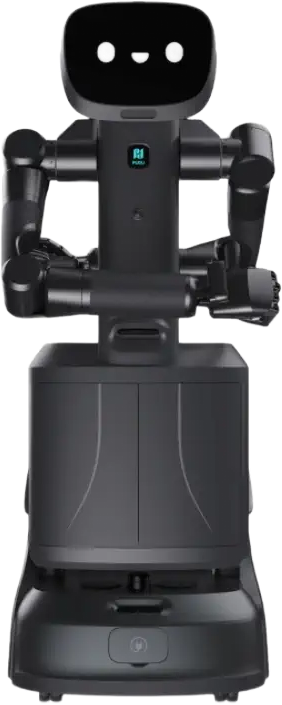
The Pudu FlashBot Arm (stylized as PUDU FlashBot Arm) is a semi-humanoid robot and mobile manipulator developed by Pudu Robotics, a Shenzhen-based Chinese robotics company best known for its commercial service robots such as the BellaBot and KettyBot. Unveiled on March 31, 2025, the FlashBot Arm combines dual 7-degree-of-freedom robotic arms and Pudu's proprietary PUDU DH11 dexterous hands with the proven FlashBot delivery robot platform, creating what Pudu describes as a "semi-humanoid embodied AI service robot" for commercial applications [1][2].
| Pudu FlashBot Arm | |
|---|---|
 | |
| General information | |
| Manufacturer | Pudu Robotics |
| Country of origin | China |
| Year unveiled | 2025 |
| Status | Commercially available |
| Availability | Available (Q1 2026 onward) |
| Website | pudurobotics.com/en/products/flashbot-arm |
Standing 1,440 mm (approximately 4 ft 9 in) tall and weighing just 15 kg (33 lb), the FlashBot Arm is significantly smaller and lighter than Pudu's other humanoid platforms, the Pudu D7 and Pudu D9. Rather than pursuing a full humanoid form, the FlashBot Arm takes a pragmatic approach by adding manipulation capabilities to an already commercially successful delivery robot base. This allows it to perform tasks that traditional wheeled delivery robots cannot handle, such as pressing elevator buttons, swiping access cards, opening doors, and handing objects directly to people, all without requiring costly building infrastructure modifications [1][3].
The FlashBot Arm was developed by Pudu X-Lab, the company's dedicated humanoid robotics R&D division, and represents the fourth product in Pudu's humanoid robotics ecosystem following the D7 semi-humanoid (September 2024), the PUDU DH11 dexterous hand (2024), and the D9 bipedal humanoid (December 2024). Commercial availability began in Q1 2026 [1][4].
How did the FlashBot Arm evolve from Pudu's delivery robots?
Pudu Robotics and the FlashBot lineage
Pudu Robotics (formally Shenzhen Pudu Technology Co., Ltd.) was founded in 2016 by Felix Zhang with the mission of using robots to improve the efficiency of human production and living. The company initially targeted the restaurant industry and released its first delivery robot, PuduBot, before rapidly expanding its product lineup across delivery, cleaning, and building logistics categories [5][6].
The original FlashBot was unveiled in September 2021 as Pudu's first building delivery robot, designed specifically for multi-floor indoor environments such as hotels and office buildings. The FlashBot introduced autonomous elevator riding through IoT integration, enabling it to call elevators, navigate between floors, and deliver items to specific rooms without human intervention. In 2023, Pudu collaborated with Nippon Otis to successfully integrate the FlashBot with Otis elevators in Japan, using the Otis Integrated Dispatch API for cloud-based elevator control [7][8].
The FlashBot Max, an upgraded version unveiled in October 2024, expanded the platform's capabilities to semi-outdoor environments. Weighing 60 kg and measuring 538 x 534 x 1,052 mm, the FlashBot Max features the PUDU VSLAM+ navigation system, modular compartments with independently controlled doors, and compatibility with cloud-based elevator control systems from major brands including KONE and Otis. It offers up to 9 hours of runtime and a cruise speed adjustable from 0.5 to 1.2 m/s [9][10].
The FlashBot Arm builds directly on this delivery robot heritage, using the FlashBot platform as its wheeled base while adding a humanoid upper body with dual robotic arms and dexterous hands. This evolutionary approach allows Pudu to leverage years of real-world deployment experience, established IoT integrations, and proven navigation algorithms rather than designing an entirely new platform from scratch [1][3].
Pudu X-Lab and the humanoid ecosystem
Pudu X-Lab is the company's dedicated research and development division focused on humanoid robotics and embodied intelligence. In 2024, CEO Felix Zhang articulated a three-tier robotic ecosystem consisting of specialized robots for specific tasks (the existing delivery and cleaning product lines), semi-humanoid robots for adaptable applications (the D7 and FlashBot Arm), and fully humanoid robots for complex interactions requiring bipedal locomotion (the Pudu D9) [11].
The FlashBot Arm occupies a unique position within this ecosystem. While the Pudu D7 is a semi-humanoid research platform with 30 degrees of freedom and a 200 TOPS computing platform, the FlashBot Arm is a commercially oriented product that prioritizes immediate deployability over raw capability. It pairs the DH11 dexterous hands (also used on the D9) with a proven delivery platform, allowing hotels and office buildings to adopt semi-humanoid robotic assistance with minimal integration effort [1][4].
As of mid-2026, Pudu Robotics reports having shipped more than 130,000 robots to over 85 countries and regions, with overseas markets contributing more than 80% of its revenue [22]. Frost & Sullivan ranked the company first in the global commercial service robotics market with a 23% share [23]. In April 2026, Pudu raised nearly $150 million at a valuation exceeding $1.5 billion, bringing its cumulative funding to more than $300 million after a reported 100% year-over-year revenue increase in 2025 [21]. Founder and CEO Felix Zhang called the round "a powerful validation of Pudu's industry leadership, product and technological strength, global brand, and commercial infrastructure" [21]. The company operates a 40,000-square-meter factory in Jiangsu Province, China, with a US headquarters in Santa Clara, California, and an East Coast fulfillment center in Hamilton, New Jersey [12][13].
How is the FlashBot Arm designed?
Design philosophy
The FlashBot Arm represents a design philosophy that Pudu describes as adding humanoid capabilities to proven commercial platforms rather than building humanoid robots from scratch. Traditional delivery robots, including Pudu's own FlashBot and FlashBot Max, are limited to transporting items in enclosed compartments. They rely on IoT infrastructure (elevator APIs, automatic doors, building management systems) to navigate multi-floor environments. In many buildings, especially older hotels and office complexes, this IoT infrastructure either does not exist or cannot be retrofitted at a reasonable cost [1][3].
By adding robotic arms and dexterous hands to the delivery platform, the FlashBot Arm can physically interact with the environment in ways that a passive delivery robot cannot. It presses elevator buttons with its fingers, swipes keycards against readers, turns door handles, and hands objects directly to recipients. This eliminates the dependency on building IoT infrastructure that has historically limited where delivery robots can operate [1][2].
The robot's compact form factor (539 x 515 x 1,440 mm) and lightweight construction (15 kg) reflect a deliberate prioritization of deployability. The narrow 539 mm width and minimum 65 cm path width requirement allow it to navigate corridors, elevator cabins, and doorways found in standard commercial buildings without modification [14].
Manipulation system
The FlashBot Arm is equipped with two 7-degree-of-freedom robotic arms mounted on its upper body. When fully extended, the dual-arm system achieves a maximum reach envelope of 1,600 x 2,000 x 1,600 mm (approximately 63 x 79 x 63 inches), with an operational reach of up to 2 meters. This range allows the robot to reach elevator buttons at various heights, retrieve items from shelves, and interact with door handles and access panels [1][14].
Each arm terminates in a PUDU DH11 dexterous hand, Pudu's proprietary five-fingered robotic hand with 11 degrees of freedom per hand (6 active motors and 5 passive DOF). The DH11 hand weighs only 500 grams and uses a cable-driven system with underactuated mechanisms for compact, lightweight design. It features 12 tactile sensing areas with 1,018 tactile sensor pixels for detailed haptic feedback, a maximum palm-finger grip force of 30 N, and a maximum single-hand lifting capacity of 40 kg. The hand can execute diverse manipulation actions including gripping, pinching, twisting, pulling, pushing, pressing, grabbing, and lifting [15]. Its actuators are fast, with a palm-finger bend speed of 150 degrees per second and a thumb bend speed of 191 degrees per second [15].
The total arm-and-hand system provides 36 degrees of freedom across both limbs (14 DOF for the two arms plus 22 DOF for the two DH11 hands), enabling the FlashBot Arm to perform complex bimanual manipulation tasks such as holding a tray with one hand while pressing a button with the other [1][14].
Whole-body coordination
A key engineering feature of the FlashBot Arm is its whole-body control system, which simultaneously coordinates the movements of the wheeled chassis, robotic arms, and dexterous hands. Rather than treating mobility and manipulation as separate sequential actions, the control system integrates them into a unified motion plan. This means the robot can, for example, navigate through a doorway while simultaneously reaching for a handle, or adjust its base position while maintaining a stable grip on an object [1][2].
The whole-body coordination system uses dynamic motion planning algorithms that optimize movements in real time based on sensor feedback. This approach enhances both the efficiency of task execution (reducing the time needed to complete multi-step operations) and the robot's adaptability to unexpected situations (such as a person stepping into its path during a delivery) [1].
Delivery compartment
The FlashBot Arm retains a core feature of its FlashBot heritage: an enclosed delivery compartment housed within its torso. This compartment offers a 15 kg payload capacity and features a dual-door design for secure item transport. The closed compartment keeps delivered items protected and hygienic during transit, while freeing the robotic arms for environmental interaction tasks such as elevator operation and door opening [1][3][14].
This dual-capability design (manipulation plus enclosed delivery) is a distinguishing feature compared to other semi-humanoid robots, which typically carry items in their hands or on trays. By separating the delivery payload from the manipulation system, the FlashBot Arm can transport items securely while still using both hands for navigation-related tasks [3]. As New Atlas described it, "Items are carried in a lidded compartment, leaving the FlashBot Arm's hands free while it's en route" [3].
What are the FlashBot Arm's technical specifications?
Physical dimensions and performance
| Category | Specification | Value |
|---|---|---|
| Physical | Dimensions (L x W x H) | 539 x 515 x 1,440 mm (21.2 x 20.3 x 56.7 in) |
| Physical | Height | 1,440 mm (4 ft 9 in) |
| Physical | Weight | 15 kg (33 lb) |
| Manipulation | Arm DOF | 7 per arm (14 total) |
| Manipulation | Hand DOF (DH11) | 11 per hand (22 total) |
| Manipulation | Total manipulation DOF | 36 (arms + hands) |
| Manipulation | Maximum reach envelope | 1,600 x 2,000 x 1,600 mm |
| Manipulation | Operational reach | Up to 2 m |
| Manipulation | DH11 hand weight | 500 g per hand |
| Manipulation | DH11 grip force | 30 N (palm-finger) |
| Manipulation | DH11 lifting capacity | 40 kg per hand |
| Manipulation | DH11 tactile pixels | 1,018 per hand |
| Delivery | Compartment payload | 15 kg (33 lb) |
| Mobility | Locomotion | Wheeled chassis |
| Mobility | Minimum path width | 65 cm (25.6 in) |
| Navigation | Mapping method | VSLAM + LiDAR SLAM |
| Power | Charging time | 4 hours |
| Power | Working duration | 8 hours (no load) |
| Interface | Display | 10.1-inch touchscreen |
| Sensors | Vision | RGBD cameras, panoramic cameras |
| Sensors | Range | LiDAR (360 degrees) |
| Sensors | Touch | Pressure-sensitive skin |
| Sensors | Audio | Microphone and speaker |
Sensors and perception
The FlashBot Arm integrates a multi-layered sensor suite designed for safe autonomous operation in environments shared with people. The primary sensors include RGBD (color + depth) cameras for object recognition and spatial awareness, a 360-degree LiDAR module for range-based mapping and obstacle detection, panoramic cameras for wide-angle environmental monitoring, and pressure-sensitive skin on the arms and body for detecting contact forces during manipulation and navigation [1][2].
The sensor fusion system feeds into the robot's VSLAM (Visual Simultaneous Localization and Mapping) and laser SLAM navigation stack, generating accurate 3D maps of its surroundings in real time. This dual-SLAM approach, combining visual and laser-based mapping, provides redundancy and improved accuracy compared to single-modality navigation. The technology builds directly on the navigation algorithms that Pudu has refined across years of deploying FlashBot, BellaBot, and other delivery robots in thousands of commercial venues worldwide [1][9].
The pressure-sensitive skin serves a dual purpose: it enables force-controlled manipulation (allowing the robot to detect how firmly it is gripping an object or pressing a button) and provides a safety mechanism that triggers an immediate stop if the robot makes unexpected contact with a person or obstacle. This force control capability, combined with dynamic motion planning algorithms, allows the FlashBot Arm to operate safely in close proximity to hotel guests, office workers, and restaurant patrons [1][2].
Power system
The FlashBot Arm's battery provides up to 8 hours of working duration under no-load conditions and requires approximately 4 hours for a full charge. The robot supports automatic recharging, meaning it can autonomously navigate to its charging station when battery levels are low, recharge, and resume operations without human intervention. Runtime may vary depending on the frequency and intensity of arm manipulation tasks, as robotic arm actuation consumes more power than simple wheeled navigation [14].
How does the FlashBot Arm use AI and software?
Large language model integration
The FlashBot Arm leverages advanced large language models (LLMs) to enable natural conversational interaction with users. Through its microphone, speaker, and 10.1-inch touchscreen display, the robot can receive verbal instructions, answer questions, provide directions, and engage in contextual dialogue with hotel guests, office workers, and other users. The LLM integration enables the robot to understand natural language requests (for example, "Please bring this package to room 1205") and translate them into actionable task plans [1][2].
Embodied AI decision-making
Beyond conversational interaction, the FlashBot Arm's AI system handles task decomposition, planning, and execution. When presented with a high-level request, the system analyzes the task requirements, breaks the request into a sequence of sub-tasks (navigating to the pickup location, picking up the item, riding the elevator, delivering the item), and coordinates the robot's various subsystems to execute each step. The system can adapt to unexpected situations, such as a blocked corridor or an occupied elevator, by replanning in real time [1][2].
The embodied AI architecture also supports multi-robot coordination. In environments where multiple Pudu robots are operating simultaneously (a common scenario in large hotels that may deploy a fleet of BellaBots, FlashBots, and cleaning robots), the FlashBot Arm can communicate with other robots to avoid conflicts, share environmental data, and coordinate task assignments. This fleet management capability builds on Pudu's existing cloud-based robot management platform, which already manages tens of thousands of robots globally [1][9].
Pudu describes the unifying software layer behind its fleet as a "One Brain, Multiple Embodiments" architecture, saying robots of different form factors "share a common cognitive framework for environmental perception, task execution, and multi-agent collaboration"; for the FlashBot Arm, that means it can join the same coordination layer as the delivery and cleaning robots a venue may already run [22].
Multimodal interaction
The FlashBot Arm supports multimodal communication that goes beyond voice. Users can interact through AI-driven voice commands, hand gestures, and facial expressions, creating a more natural and accessible interaction experience. This is particularly valuable in hospitality settings where guests may speak different languages or prefer non-verbal communication. The 10.1-inch touchscreen provides a visual interface for status updates, delivery confirmations, and interactive menus [1][2].
What is the FlashBot Arm used for?
The FlashBot Arm targets commercial service environments where manipulation capabilities are needed alongside autonomous delivery. Pudu has identified several primary application domains [1][2][3]:
Hotel operations
Hotels represent the primary target market for the FlashBot Arm, building directly on Pudu's extensive hospitality relationships (the company counts Marriott, Hilton, and other major hotel chains among its customers). In hotel environments, the robot can perform end-to-end room delivery: picking up items from the front desk or kitchen, riding the elevator (by pressing buttons with its hands rather than relying on IoT integration), navigating to the guest's room, and delivering items directly. This is particularly valuable in older hotels where elevator IoT retrofitting is impractical or prohibitively expensive [1][3].
The robot's ability to swipe access cards and open doors allows it to access secured areas such as room floors, staff-only corridors, and service elevators. Combined with its 8-hour battery life, a single FlashBot Arm can handle dozens of deliveries per shift across multiple floors of a hotel [1][2].
Office buildings
In corporate environments, the FlashBot Arm can deliver packages, documents, and food orders between floors and offices. Its ability to navigate elevators without infrastructure modifications makes it suitable for multi-tenant office buildings where installing elevator APIs across different management systems would be complex and expensive [1].
Restaurants and retail
The robot can serve as a combination delivery and interaction platform in restaurants (bringing food to tables and interacting with diners) and retail spaces (guiding customers, delivering products from stockrooms, and providing information). The LLM-powered conversational capabilities add a guest engagement dimension that pure delivery robots lack [1][2].
Healthcare facilities
In hospitals and care facilities, the FlashBot Arm can transport medications, lab samples, meal trays, and supplies between departments and floors. The enclosed delivery compartment ensures hygienic transport, while the robotic arms enable the robot to access secure medication cabinets, press elevator buttons in clinical areas, and hand items directly to staff [1].
How does the FlashBot Arm compare to the Pudu D7 and D9?
The FlashBot Arm, Pudu D7, and Pudu D9 represent three distinct approaches within Pudu's humanoid robotics strategy, each targeting different use cases and deployment scenarios.
| Feature | FlashBot Arm | Pudu D7 | Pudu D9 |
|---|---|---|---|
| Type | Mobile manipulator (wheeled) | Semi-humanoid (wheeled) | Full bipedal humanoid |
| Unveiled | March 2025 | September 2024 | December 2024 |
| Height | 1,440 mm (4 ft 9 in) | 1,650 mm (5 ft 5 in) | 1,700 mm (5 ft 7 in) |
| Weight | 15 kg (33 lb) | 45 kg (99 lb) | 65 kg (143 lb) |
| Arm DOF | 7 per arm | 7 per arm (5 rotational + 2 linear) | 7 per arm |
| Hand DOF | 11 per hand (DH11) | Optional (DH11 attachment) | 11 per hand (DH11, standard) |
| Total DOF | 36 (arms + hands) | 30 (50 with DH11) | 42 (64 with DH11) |
| Locomotion | Wheeled chassis | Omnidirectional wheeled chassis | Bipedal walking |
| Maximum speed | ~1.2 m/s (est., based on FlashBot platform) | 2 m/s | 2 m/s |
| Arm payload | Not disclosed (DH11: 40 kg lift per hand) | 10 kg per arm | 10 kg per arm (20+ kg combined) |
| Delivery payload | 15 kg (enclosed compartment) | N/A | N/A |
| Battery life | 8 hours (no load) | 8+ hours | Not officially disclosed |
| Computing | Not disclosed | 200 TOPS | 275 TOPS |
| Stair climbing | No | No | Yes |
| Endpoint precision | Not disclosed | 0.1 mm | Not disclosed |
| Primary market | Hotels, offices, restaurants | Commercial/industrial | Warehouses, retail, logistics |
| Status (2026) | Commercially available | Pre-commercialization | Pre-sale |
The FlashBot Arm is the most commercially mature of the three, having entered availability in Q1 2026. Its compact size, low weight, and direct lineage from the proven FlashBot delivery platform make it the most immediately deployable option. However, its manipulation capabilities are more limited than the D7's (which offers 0.1 mm endpoint precision and a larger workspace) and the D9's (which adds bipedal mobility and higher payload capacity) [1][4][16].
The D7 occupies the middle ground as a more capable semi-humanoid platform with a 200 TOPS computing system and omnidirectional mobility, targeting environments that require greater manipulation precision and autonomy. The D9 is the most capable platform in Pudu's lineup, with bipedal locomotion enabling stair climbing and navigation across uneven terrain, at the cost of greater complexity, higher weight, and shorter battery life [16][17].
Pudu's strategy of offering all three platforms reflects the company's recognition that different commercial environments have different requirements. A hotel that needs autonomous cross-floor delivery may find the FlashBot Arm sufficient, while a warehouse that requires heavy-item manipulation and stair navigation may need the D9 [11].
Who are the FlashBot Arm's competitors?
The FlashBot Arm competes in the emerging category of semi-humanoid service robots, where wheeled platforms are augmented with robotic arms for manipulation tasks. This category has gained traction as the robotics industry recognizes that full bipedal humanoid capability is unnecessary for many commercial applications [1]. One design review described the FlashBot Arm as ushering "a new era of service robots that are actually resourceful," reflecting a shift from passive delivery carts toward machines that can act on their surroundings [20].
Direct competitors
Several companies have developed or announced wheeled robots with manipulation capabilities targeting similar commercial service applications:
- Keenon Robotics XMAN-R1: Unveiled in March 2025, the XMAN-R1 is a wheeled humanoid from another major Chinese service robot manufacturer. Like Pudu, Keenon is leveraging its service robot experience (100,000+ robots shipped globally) to enter the humanoid market. The XMAN-R1 features a more human-like appearance and over 30 DOF, targeting commercial service applications [18].
- UBTECH Walker S series: UBTECH's Walker S1 and S2 are bipedal humanoids designed for commercial and industrial applications. While more capable in terms of mobility, they are significantly more complex and expensive than the FlashBot Arm [19].
- Robotis AI Worker: The South Korean company's AI Worker is a Physical AI semi-humanoid aimed at industrial automation rather than hospitality, but it shares the wheeled-base-plus-dual-arm concept. It combines 7-DOF dual arms, high-degree-of-freedom hands (targeting 16 to 20 DOF each), and a swerve-drive omnidirectional base, and it learns tasks from human demonstration through imitation and reinforcement learning [25].
Competitive advantages
The FlashBot Arm's primary competitive advantages stem from Pudu's existing commercial infrastructure. With more than 130,000 robots deployed across 85+ countries [22], the company has established distribution networks, service centers (300+ in the Americas alone), and enterprise relationships that new entrants in the humanoid space must build from scratch. The robot's direct evolution from the commercially proven FlashBot platform also means that much of its navigation software, fleet management system, and building integration capabilities have already been validated in real-world deployments [5][12][13].
The relatively low weight (15 kg) and compact dimensions also differentiate the FlashBot Arm from larger semi-humanoid competitors. A lighter, smaller robot is easier to transport, requires less storage space when not in operation, and poses lower safety risks in environments shared with people [3][14].
Is the FlashBot Arm available, and when was it released?
Pudu Robotics unveiled the FlashBot Arm on March 31, 2025, with commercial availability beginning in Q1 2026. Specific pricing has not been publicly disclosed, though the robot is listed on retail platforms such as RobotShop, suggesting it is available for direct purchase by commercial customers [4][14].
The robot targets the global hospitality, healthcare, office, and retail markets. Pudu's existing distribution network, which spans more than 85 countries with local distributors and service providers, provides the infrastructure for worldwide deployment [22]. The company's US headquarters in Santa Clara, California, and East Coast fulfillment center in Hamilton, New Jersey, support North American customers specifically [12][13].
The global service robotics market, particularly in the hospitality sector, has seen substantial growth. Pudu's existing customer base of major hotel chains, restaurant groups, and healthcare systems provides a ready market for the FlashBot Arm as an upgrade path from passive delivery robots. Hotels that currently operate FlashBot or FlashBot Max units may find the FlashBot Arm especially attractive because it shares the same software ecosystem and building integration approach, reducing the training and deployment overhead associated with adopting an entirely new platform [1][9].
Pudu's broader move into robot-run hospitality shows the kind of setting the FlashBot Arm is built for. On June 1, 2026, Pudu Robotics and Shenzhen CTID Co. Ltd announced what they described as the world's first full-scenario robot-serviced hotel, to be built on the West Artificial Island of the Shenzhen-Zhongshan Link in China, with a trial operation planned by the end of 2026 [24]. The project deploys a coordinated fleet of Pudu machines, including the FlashBot, BellaBot Pro, KettyBot Pro, CC1 Pro, and D5, to handle reception, delivery, cleaning, and guest services. Cong Guo, co-founder and CTO of Pudu Robotics, called the partnership "an important step toward large-scale deployment of embodied intelligence in premium hospitality environments" [24]. At the World Economic Forum's Davos Tech Summit in July 2026, Pudu ran a live "Robot City" that included a FlashBot Max delivering at a Hilton property, a preview of the hospitality deployments the FlashBot Arm is designed to extend [22].
See also
- Humanoid robot
- Pudu Robotics
- Pudu D7
- Pudu D9
- Embodied AI
- Degrees of freedom
- BellaBot
- KettyBot
- LiDAR
- SLAM
- Large language model
References
- ^1 ^2 ^3 ^4 ^5 ^6 ^7 ^8 ^9 ^10 ^11 ^12 ^13 ^14 ^15 ^16 ^17 ^18 ^19 ^20 ^21 ^22 ^23 ^24 ^25 ^26 ^27 ^28"Pudu Robotics Unveils FlashBot Arm: A Semi-Humanoid Embodied AI Service Robot for Commercial Applications." PR Newswire, March 31, 2025.
- ^1 ^2 ^3 ^4 ^5 ^6 ^7 ^8 ^9 ^10 ^11"China's semi-humanoid robot delivers, navigates, and interacts smartly." Interesting Engineering, March 2025.
- ^1 ^2 ^3 ^4 ^5 ^6 ^7 ^8 ^9"Wheeled robotic bellhops will soon be used in hotels, and elsewhere." New Atlas, April 2025.
- ^1 ^2 ^3 ^4"PUDU FlashBot Arm Semi-Humanoid Service Robot." RobotShop.
- ^1 ^2"Pudu Robotics official website: About Us." Pudu Robotics.
- ^"Unicorn Day: Biography of Felix Zhang." Entrepreneurship Center, Hong Kong University of Science and Technology, 2024.
- ^"Pudu Robotics Unveils New Era Building Delivery Robot: FlashBot." PR Newswire, September 30, 2021.
- ^"In collaboration with Nippon Otis, PUDU's delivery robot FlashBot was successfully integrated with an elevator for the first time in Japan." PR Newswire, September 2023.
- ^1 ^2 ^3 ^4"Pudu Robotics Unveils the Latest Version of FlashBot, Elevating Smart Building Delivery to a New Level." PR Newswire, October 2024.
- ^"FlashBot Max: Pudu Robotics' AI-enabled Multi-floor Delivery Robot for Semi-outdoor Hospitality." Pudu Robotics.
- ^1 ^2"Dedicated, Humanoid and Human-Like Comprehensive Layout: Pudu Robotics Solves the Commercialization Challenges of Embodied Intelligence." Oreate AI Blog.
- ^1 ^2 ^3"Pudu Robotics Expands Global Operations with New US Headquarters in California and East Coast Fulfillment Center." PR Newswire, March 2025.
- ^1 ^2 ^3"Pudu Robotics Unveils New Factory, Celebrates Production of 80,000th Robot in Jiangsu, China." Pudu Robotics, 2024.
- ^1 ^2 ^3 ^4 ^5 ^6 ^7"PUDU FlashBot Arm: AI-enabled Assistant Robot with Humanoid Capabilities for Hospitality." Pudu Robotics product page.
- ^1 ^2"Pudu Robotics Unveils the PUDU DH11: An 11-DOF 5-fingered Dexterous Hand to Empower Robotic Performance." Pudu Robotics.
- ^1 ^2"Pudu Robotics Unveils their PUDU D7 Semi-Humanoid Robot, Showcasing Breakthrough Capabilities and Strategic Vision for Humanoid Robotics." PR Newswire, September 19, 2024.
- ^"Pudu Robotics Unveils PUDU D9: A Full-Sized Humanoid Robot Driving Commercially Viable Embodied Intelligence." PR Newswire, December 19, 2024.
- ^"KEENON Robotics Marks a New Milestone with the Unveiling of the Humanoid Robot XMAN-R1." PR Newswire, March 2025.
- ^"UBTECH official website: Walker Series." UBTECH Robotics.
- ^"FlashBot Arm humanoid ushers a new era of service robots that are actually resourceful." Yanko Design, April 2025.
- ^1 ^2"Pudu Robotics Raises Nearly USD 150 Million, Exceeds USD 1.5 Billion Valuation." PR Newswire, April 23, 2026.
- ^1 ^2 ^3 ^4 ^5"Pudu Robotics Brings Physical AI into Everyday Life at Davos Tech Summit's Robot City." PR Newswire, July 3, 2026.
- ^"Pudu Robotics Takes Lead in Global Commercial Service Robotics Market." PR Newswire, August 13, 2024.
- ^1 ^2"Pudu Robotics and Shenzhen CTID Co. Ltd Launch the World's First Full-Scenario Robot-Serviced Hotel Project." PR Newswire, June 1, 2026.
- ^"AI Worker: Actuator for Physical AI." ROBOTIS.
Improve this article
Add missing citations, update stale details, or suggest a clearer explanation. Every suggestion is reviewed for sourcing before it goes live.
6 revisions · v6 · 4,593 words · full history
Fact-checks are independent of edits: a reviewer re-verifies the article against its sources and stamps the date. How we verify
Research and drafting on this wiki are AI-assisted, under named human editorial standards. How AI is used here
Cite this page: AI Wiki. "Pudu FlashBot Arm." aiwiki.ai, updated 11 Jul 2026. CC BY 4.0. https://aiwiki.ai/wiki/pudu_flashbot_arm