

Pudu D7
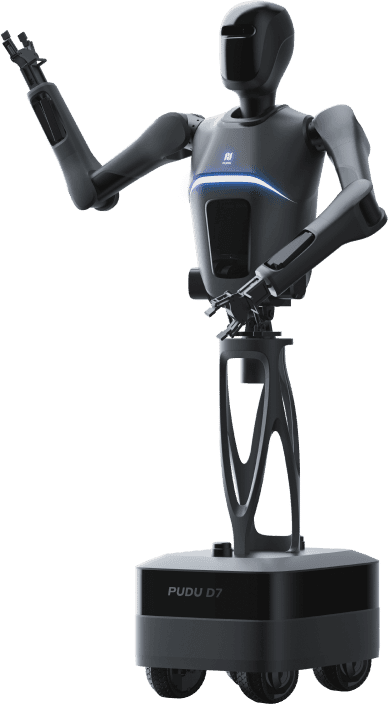
The Pudu D7 (stylized as PUDU D7) is a semi-humanoid robot unveiled on September 19, 2024 by Pudu Robotics, a Shenzhen-based Chinese service robot company best known for commercial robots such as the BellaBot and KettyBot. It is Pudu's first general-purpose embodied-intelligent semi-humanoid robot, pairing a human-like upper body and two bionic arms with a fully omnidirectional wheeled chassis instead of legs [1]. Standing 165 cm tall and weighing 45 kg, the D7 has 30 degrees of freedom (expandable to 50 with a dexterous hand), bionic arms with 65 cm reach, a 10 kg per-arm payload and 0.1 mm endpoint repeatability, a battery exceeding 1 kWh for over 8 hours of runtime, and a top speed of 2 m/s [1][2].
| Pudu D7 | |
|---|---|
 | |
| General information | |
| Manufacturer | Pudu Robotics |
| Country of origin | China |
| Year unveiled | 2024 (September 19) |
| Status | Pre-commercialization |
| Availability | Full commercialization anticipated in 2025 |
| Website | pudurobotics.com |
The D7 represents Pudu Robotics' initial entry into the humanoid robotics sector. By keeping a wheeled base, it targets structured indoor environments such as hotels, hospitals, offices, and logistics facilities, where long runtime and manipulation precision matter more than bipedal locomotion [1][13]. A high-performance onboard computing platform, listed by product specifications at 200 TOPS, supports the robot's multi-layered intelligence system for real-time perception, autonomous navigation, and hierarchical task planning [2][17].
The D7 was the first of three products released by Pudu X-Lab, the company's dedicated humanoid R&D division, in 2024. It was followed by the PUDU DH11 dexterous hand and the fully bipedal Pudu D9 humanoid robot in December 2024 [1][3].
What is the Pudu D7?
The Pudu D7 is a "semi-humanoid" robot: it has the human-like torso, head, and dual articulated arms of a humanoid, but rolls on an omnidirectional wheeled chassis rather than walking on legs. Pudu Robotics positions it as a practical, commercially viable platform for the flat indoor spaces its existing fleet already operates in, combining the manipulation and interaction ability of a humanoid with the energy efficiency, stability, and long runtime of a wheeled service robot [1][13].
At the September 2024 unveiling, founder and CEO Felix Zhang framed the D7 as a milestone in the company's broader robotics roadmap. "Featuring advanced mobility, versatile operational capabilities, and embodied intelligence, this semi-humanoid robot marks a significant milestone in our pursuit of a diverse range of robotic solutions," Zhang said [1].
Who makes the Pudu D7?
Pudu Robotics
Pudu Robotics (formally Shenzhen Pudu Technology Co., Ltd.) was founded in 2016 by Felix Zhang, a serial entrepreneur who studied mechanical engineering as an undergraduate before earning a master's degree in computer science from the Hong Kong University of Science and Technology (HKUST). At the age of 20, Zhang placed first for China at ABU Robocon, a prestigious Asian-Oceanian college robot competition. He founded Pudu with the mission of "using robots to improve the efficiency of human production and living," initially targeting the restaurant industry [4][5].
The company released its first delivery robot, PuduBot, and rapidly expanded its product lineup. Key products include the BellaBot (a cat-themed delivery robot that became the company's flagship), HolaBot (a delivery robot with call-button summoning), KettyBot (a welcome and advertising robot designed for narrow spaces), FlashBot (a multi-floor delivery robot for hotels and office buildings), and a line of commercial cleaning robots including the CC1 scrubber and BG1 series of AI-native scrubber-dryers [5][6].
Pudu Robotics has raised approximately $192 million across at least eight funding rounds, with investors including Meituan, Sequoia Capital China, and Sierra Ventures. The Series C1 and C2 rounds alone raised nearly $155 million combined [7][8]. As of 2025, the company reports having shipped over 120,000 robots to more than 80 countries and regions. Notable customers include Marriott, Hilton, McDonald's, KFC, Walmart, and PizzaHut. Japan's Skylark restaurant group placed a single order for 3,000 BellaBots, setting an industry record for commercial service robots [5][9]. Pudu operates a 40,000-square-meter "super factory" in Jiangsu Province, China, and in March 2025 established a new US headquarters in Santa Clara, California, alongside an East Coast fulfillment center in Hamilton, New Jersey [10][11].
Pudu X-Lab and the move to humanoid robotics
Pudu X-Lab is the company's dedicated research and development division focused on humanoid robotics and embodied intelligence. The lab was established to leverage Pudu's extensive experience in commercial robotics, particularly in navigation, fleet management, and mass manufacturing, toward the development of next-generation humanoid platforms [3].
In May 2024, Pudu Robotics formally introduced the "semi-humanoid robot" concept as part of its long-term strategic vision. CEO Felix Zhang described a three-tier robotic ecosystem consisting of specialized robots for specific tasks (the existing delivery and cleaning product lines), semi-humanoid robots for adaptable applications (the D7), and fully humanoid robots for complex interactions requiring bipedal locomotion and dexterous manipulation (the Pudu D9). Zhang characterized this as a "comprehensive layout" addressing the commercialization challenges of embodied intelligence across different price points and capability tiers [12][13].
In 2024, the X-Lab released three products in rapid succession:
- PUDU D7 (September 2024): A semi-humanoid robot combining a human-like upper body with a wheeled omnidirectional chassis, designed for environments where manipulation matters more than bipedal locomotion [1].
- PUDU DH11 (2024): An 11-DOF dexterous hand with five human-like fingers, 1,018 tactile sensor pixels, and a maximum single-hand lifting capacity of 40 kg [14].
- PUDU D9 (December 2024): The company's first full-sized bipedal humanoid robot, integrating the DH11 hand and targeting heavy-duty commercial applications [3].
In March 2025, Pudu further expanded this ecosystem with the FlashBot Arm, a semi-humanoid service robot that combines dual 7-DOF arms and DH11 hands with the existing FlashBot Max delivery platform, targeting hotels, offices, and restaurants [15].
How is the Pudu D7 designed?
Semi-humanoid design philosophy
The PUDU D7 was designed around the principle that a wheeled base with a humanoid upper body can provide a better balance of flexibility and affordability than either fully specialized robots or fully bipedal humanoids. Pudu's engineering team recognized that many commercial environments, including hotels, hospitals, office buildings, and warehouses, consist of flat indoor surfaces where bipedal locomotion offers little advantage over wheels. By keeping the wheeled chassis, the D7 avoids the engineering complexity, energy consumption, and stability challenges associated with bipedal walking, while gaining manipulation and interaction capabilities through its human-like upper body [13][16].
Pudu's blog on semi-humanoid robot design notes that wheeled semi-humanoids achieve "higher speeds and maintaining better balance due to their wheels' constant contact" with the ground compared to bipedal alternatives. The wheeled platform also provides inherent resilience: the robot can continue operating even if one wheel malfunctions. Energy consumption is significantly lower than bipedal systems that require complex gait control algorithms, which directly translates into the D7's 8+ hour runtime, a figure that would be difficult to achieve with a bipedal platform of similar size [16].
The D7 is designed to operate in "brownfield" environments, meaning existing human-designed spaces rather than purpose-built automation facilities. This orientation reflects Pudu's years of experience deploying delivery and cleaning robots in restaurants, hotels, and commercial buildings where robots must navigate alongside human workers and customers [16].
Bionic arm design
The D7's bionic arms represent a key differentiator from Pudu's existing wheeled robots, which are limited to carrying items on trays or within enclosed compartments. Each arm features 5 rotational joints and 2 linear joints, providing 7 degrees of freedom per arm. This joint configuration delivers precise and powerful actuation, supporting a 10 kg payload per arm with endpoint repeatability of 0.1 mm. The arms extend to 65 cm, enabling the D7 to reach objects at various heights and distances, including elevator buttons, shelf items, and sorting bins [1][2].
The base D7 operates with 30 total degrees of freedom. When paired with a dexterous hand attachment (such as the PUDU DH11), the total DOF expands to 50, significantly enhancing the robot's ability to perform fine manipulation tasks such as grasping irregularly shaped objects, turning handles, and pressing buttons [1][14].
Mobility platform
The D7's omnidirectional wheeled chassis provides 360-degree movement capability, allowing the robot to move in any direction without first reorienting its body (holonomic movement). This is particularly valuable in confined spaces such as elevator cabins, narrow corridors, and crowded service areas. The chassis can climb obstacles up to 50 mm in height and maintains stability on slopes up to 10 degrees, accommodating ramps and slight grade changes found in commercial buildings [1][2].
The maximum travel speed of 2 m/s (7.2 km/h or 4.5 mph) matches a brisk human walking pace, enabling the D7 to keep up with the flow of activity in service environments without outpacing the people around it [1].
What are the Pudu D7's specifications?
Physical dimensions and performance
| Category | Specification | Value |
|---|---|---|
| Physical | Height | 165 cm (5 ft 5 in) |
| Physical | Weight | 45 kg (99 lb) |
| Manipulation | Arm reach | 65 cm |
| Manipulation | Arm joints | 5 rotational + 2 linear per arm |
| Manipulation | Single-arm payload | 10 kg (22 lb) |
| Manipulation | Endpoint repeatability | 0.1 mm |
| Mobility | Total degrees of freedom | 30 (50 with dexterous hand) |
| Mobility | Maximum speed | 2 m/s (7.2 km/h / 4.5 mph) |
| Mobility | Locomotion type | Omnidirectional wheeled chassis |
| Mobility | Obstacle climbing | Up to 50 mm |
| Mobility | Slope stability | Up to 10 degrees |
| Power | Battery capacity | >1 kWh |
| Power | Continuous runtime | 8+ hours |
| Computing | AI computing power | 200 TOPS (per product specifications) |
The height, weight, degrees of freedom, arm reach, payload, endpoint precision, battery, runtime, speed, and slope figures above are stated in Pudu Robotics' official September 19, 2024 announcement [1]. The 200 TOPS computing figure is not given in that announcement; it appears in widely circulated product specifications and third-party listings for the D7, so it is reported here as a product-specification figure rather than an officially confirmed number [2][17].
Sensors and perception
The D7 is equipped with a multimodal sensor suite that supports high-accuracy positioning, obstacle detection, and environmental mapping. The sensor array includes RGB cameras, a depth camera, LiDAR, an inertial measurement unit (IMU), force/torque sensors, a gyroscope, an accelerometer, and joint encoders. These sensors feed into the robot's AI system for real-time perception and autonomous navigation [2][17].
The sensor fusion approach builds on Pudu's extensive experience with SLAM (Simultaneous Localization and Mapping) and path-planning algorithms developed through years of deploying delivery and cleaning robots in complex indoor environments. The D7 uses both visual SLAM (VSLAM) and laser SLAM technologies to generate accurate 3D maps, navigate autonomously, and avoid obstacles in real time [16][17].
Computing platform
The D7 features a high-performance onboard computing platform that, according to product specifications, delivers 200 TOPS (tera operations per second) of AI computing power. This enables complex machine learning inference, real-time computer vision processing, 3D environmental mapping, and autonomous decision-making directly on the robot without relying on cloud computing for time-sensitive operations [2][17].
How does the Pudu D7's AI and software work?
Hierarchical control system
The D7 employs a multi-layered intelligence system that merges data-driven embodied intelligence with advanced AI model strategies. The system uses a hierarchical control architecture consisting of two levels [1][2]:
- High-level planning: Handles abstract, strategic task management, including mission sequencing, route planning, and goal prioritization. This layer interprets high-level commands and breaks them into actionable sub-tasks.
- Low-level planning: Manages real-time, sensory-based actions, including motor control, obstacle avoidance, and manipulation execution. This layer processes sensor data and translates planned actions into precise physical movements.
This layered approach enables the D7 to understand and respond to complex service scenarios while continuously learning and refining its operations over time [1].
Software ecosystem
The D7's software stack is supported by three key components: Pudu OS, AI Studio, and simulation environments. Pudu OS provides the core operating system for robot control and fleet management, building on the same software infrastructure that manages Pudu's fleet of over 120,000 deployed service robots worldwide. AI Studio serves as the development platform for training and deploying AI models. The simulation environments enable continuous learning and optimization of robot behaviors before deployment in real-world settings [2][17].
Pudu has noted that advanced language models and vision systems enhance the D7's capabilities. The company's blog references the integration of large language models (LLMs) in Pudu Robotics' products to "enable robots to better understand and interact with their environments," suggesting that the D7's AI system incorporates natural language understanding for command interpretation [16].
What is the Pudu D7 used for?
The D7 targets a range of commercial and industrial applications that require manipulation capabilities beyond simple delivery but do not demand bipedal locomotion [1][2]:
- Elevator operation: The D7's bionic arms and precise endpoint control allow it to press elevator buttons and navigate between floors autonomously, extending multi-floor delivery capabilities beyond what tray-based delivery robots can achieve.
- Item transport and delivery: Building on Pudu's core competency in delivery robotics, the D7 can pick up, carry, and place items weighing up to 10 kg, handling objects that require active grasping rather than passive tray transport.
- Sorting and logistics: In warehouse and logistics environments, the D7 can sort packages, organize inventory, and transfer items between stations with its 0.1 mm endpoint precision.
- Healthcare: Transporting medical supplies, medications, and equipment within hospitals and care facilities, where the robot's extended runtime and autonomous navigation reduce staff workload.
- Hospitality: Room service delivery, concierge tasks, and guest assistance in hotels, building on Pudu's existing relationships with hotel chains like Marriott and Hilton.
- Retail: Shelf restocking, inventory checks, and customer assistance in stores, where the human-like upper body enables interaction with standard retail fixtures.
Pudu envisions the D7 operating within collaborative workflows alongside other specialized Pudu robots. For example, in a hospital setting, specialized cleaning robots could handle floor maintenance while the D7 manages supply transport and the human staff focuses on patient care [16].
How does the Pudu D7 differ from the Pudu D9?
The Pudu D7 and Pudu D9 represent two complementary approaches to humanoid robotics within Pudu's product strategy. The D7, unveiled in September 2024, is a semi-humanoid that combines a human-like upper body with a wheeled omnidirectional chassis. The D9, unveiled three months later in December 2024, is a full bipedal humanoid standing 170 cm tall and weighing 65 kg. The two platforms are designed for different use cases and operational environments [1][3].
| Feature | Pudu D7 | Pudu D9 |
|---|---|---|
| Type | Semi-humanoid (wheeled) | Full bipedal humanoid |
| Unveiled | September 2024 | December 2024 |
| Height | 165 cm (5 ft 5 in) | 170 cm (5 ft 7 in) |
| Weight | 45 kg (99 lb) | 65 kg (143 lb) |
| Total DOF | 30 (50 with dexterous hand) | 42 (64 with DH11 hands) |
| Locomotion | Omnidirectional wheeled chassis | Bipedal walking |
| Maximum speed | 2 m/s | 2 m/s |
| Arm payload | 10 kg per arm | 20+ kg combined |
| Arm reach | 65 cm | 58 cm (arm) + 22 cm (hand) |
| Endpoint precision | 0.1 mm | Not disclosed |
| Maximum joint torque | Not disclosed | 352 Nm |
| Battery capacity | >1 kWh | 0.72 kWh (15 Ah) |
| Runtime | 8+ hours | Not officially disclosed |
| Computing power | 200 TOPS | 275 TOPS |
| Stair climbing | No (wheeled) | Yes |
| Obstacle climbing | Up to 50 mm | Stairs and slopes |
| Slope stability | Up to 10 degrees | Yes (unspecified limit) |
| Dexterous hand | Optional attachment | PUDU DH11 (11 DOF, standard) |
| Target applications | Hotels, hospitals, offices, logistics | Warehouses, retail, cleaning, logistics |
The D7's wheeled mobility provides several practical advantages for indoor deployments. Its energy efficiency translates into over 8 hours of continuous operation, roughly double what can be expected from similarly sized bipedal platforms. The constant wheel-ground contact ensures inherently stable movement without the computational overhead of gait control. Its 0.1 mm endpoint precision makes it particularly well suited for tasks requiring fine positional accuracy [1][3].
The D9's bipedal design sacrifices the D7's energy efficiency and long runtime in exchange for the ability to navigate stairs, slopes, and uneven terrain. Its higher payload capacity (20+ kg combined versus the D7's 10 kg per arm) and greater number of degrees of freedom make it better suited for heavy-duty manipulation tasks in environments with multi-level access requirements. The D9 also comes standard with the PUDU DH11 dexterous hands, providing 11 DOF per hand with 1,018 tactile sensor pixels for advanced haptic feedback [3][14].
Pudu's strategy of offering both platforms reflects the company's view that no single form factor can optimally address all commercial robotics applications. The D7 targets structured indoor environments where long runtime and precision matter most, while the D9 targets environments where terrain adaptability and heavy payload handling are more critical [12].
Who are the Pudu D7's competitors?
The D7 enters a growing market for semi-humanoid and wheeled humanoid robots, a category that has gained traction as companies recognize that bipedal locomotion is not necessary for many commercial applications. The wheel-drive segment held the largest market share (65.6%) in the broader humanoid robot market as of 2024, reflecting the practical advantages of wheeled platforms in indoor service environments [18].
Direct competitors
Several companies have developed or announced wheeled humanoid platforms that compete in the same market space as the D7:
| Feature | Pudu D7 | Keenon XMAN-R1 | SwitchBot Onero H1 | FlashBot Arm (Pudu) |
|---|---|---|---|---|
| Type | Semi-humanoid (wheeled) | Wheeled humanoid | Wheeled humanoid | Semi-humanoid (wheeled) |
| Height | 165 cm | ~170 cm | 130 cm | Not disclosed |
| DOF | 30 (50 with hand) | 30+ | 22 | 14 (arms) + 22 (DH11 hands) |
| Arm payload | 10 kg | ~20 kg (est.) | Not disclosed | Not disclosed |
| Runtime | 8+ hours | Not disclosed | Not disclosed | ~8 hours |
| Target market | Commercial/industrial | Commercial service | Consumer/home | Commercial service |
| Status (2025) | Pre-commercialization | Prototype | Pre-order ($1,500) | Commercially available |
Keenon Robotics, another major Chinese service robot manufacturer that has shipped over 100,000 robots globally, unveiled the XMAN-R1 wheeled humanoid in March 2025. Like Pudu, Keenon is leveraging its established service robot business and distribution network to enter the humanoid market [19]. The SwitchBot Onero H1, unveiled at CES 2026, takes a consumer-oriented approach with a much smaller form factor and lower price point ($1,500), targeting household tasks rather than commercial applications [20].
Pudu's own FlashBot Arm, released in March 2025, serves as a more commercially ready semi-humanoid that combines dual 7-DOF arms and DH11 dexterous hands with the proven FlashBot Max delivery platform. While less capable than the D7 in terms of total degrees of freedom and endpoint precision, the FlashBot Arm benefits from the FlashBot's existing commercial infrastructure and is already available for deployment [15].
Broader humanoid market context
The D7 also competes indirectly with fully bipedal humanoid robots from companies such as Unitree Robotics (the Unitree G1 starting at $16,000), Tesla (the Optimus), Figure AI (the Figure 02), and Agility Robotics (the Digit). While these bipedal platforms offer greater terrain versatility, the D7's advantages in runtime, stability, and endpoint precision may make it more practical for many indoor commercial deployments [3][21].
Pudu's competitive advantages across its humanoid product line include its established global distribution network spanning 80+ countries, existing customer relationships with major brands, manufacturing scale (120,000+ robots shipped), and service infrastructure with over 300 local distributors and service providers in the Americas alone. These assets could enable faster commercial deployment of the D7 compared to humanoid startups that must build distribution and support networks from scratch [5][10][11].
When will the Pudu D7 be commercially available?
Pudu anticipated full commercialization of the D7 in 2025 [1]. The robot's design for "brownfield" environments, meaning existing human-designed spaces, positions it as a near-term practical solution rather than a research platform. Pudu's existing manufacturing infrastructure, including the 40,000-square-meter Jiangsu factory that has already produced over 80,000 robots, provides the production capacity needed for scaling D7 manufacturing [10].
The global humanoid robot market is projected to grow from approximately $1.5 billion in 2024 to $9.4 billion by 2030, with a compound annual growth rate (CAGR) of 36.2%. Industry analysts note that the most promising short-term commercial applications for humanoid and semi-humanoid robots lie in semi-structured tasks such as item picking, palletizing, and material handling in warehouses and factories, aligning closely with the D7's demonstrated capabilities [16][18].
ELI5: Pudu D7 in simple terms
The Pudu D7 is a robot that looks like the top half of a person, with a head and two arms, but instead of legs it rolls around on wheels that can move in any direction. It was made by a Chinese company called Pudu Robotics that is famous for cute robots that bring food to your table in restaurants. The D7's arms are strong enough to lift about 10 kg (like a big bag of rice) and steady enough to press an elevator button. Because wheels use much less energy than walking on legs, the D7 can keep working for more than 8 hours on one charge. It is built to help out in places like hotels, hospitals, and warehouses by carrying things, sorting packages, and pushing buttons.
See also
- Humanoid robot
- Pudu Robotics
- Pudu D9
- Embodied AI
- Service robot
- Artificial intelligence in China
- Degrees of freedom
- Keenon Robotics
- Unitree G1
References
- ^1 ^2 ^3 ^4 ^5 ^6 ^7 ^8 ^9 ^10 ^11 ^12 ^13 ^14 ^15 ^16 ^17 ^18"Pudu Robotics Unveils their PUDU D7 Semi-Humanoid Robot, Showcasing Breakthrough Capabilities and Strategic Vision for Humanoid Robotics." PR Newswire, September 19, 2024.
- ^1 ^2 ^3 ^4 ^5 ^6 ^7 ^8 ^9 ^10"PUDU D7 - Robot Details, Use Case and Specifications." Aparobot.
- ^1 ^2 ^3 ^4 ^5 ^6 ^7"Pudu Robotics Unveils PUDU D9: A Full-Sized Humanoid Robot Driving Commercially Viable Embodied Intelligence." PR Newswire, December 19, 2024.
- ^"Unicorn Day - Biography - Felix Zhang." Entrepreneurship Center, Hong Kong University of Science and Technology, 2024.
- ^1 ^2 ^3 ^4"Pudu Robotics official website - About Us." Pudu Robotics.
- ^"Pudu Robotics Unveils PUDU BG1 Series: Defining the AI-Native Era of Large-Scale Cleaning." RoboticsTomorrow, March 2026.
- ^"Pudu Robotics Raised over $15M Series B Financing with Meituan as the Exclusive Investor." Business Wire, July 2020.
- ^"Pudu Robotics serves up $155M Series C funding round." The Robot Report, 2021.
- ^"Pudu Robotics Releases Catering and Retail Service Robot, BellaBot Pro." PR Newswire, April 2024.
- ^1 ^2 ^3"Pudu Robotics Unveils New Factory, Celebrates Production of 80,000th Robot in Jiangsu, China." Pudu Robotics, 2024.
- ^1 ^2"Pudu Robotics Expands Global Operations with New US Headquarters in California and East Coast Fulfillment Center." PR Newswire, March 2025.
- ^1 ^2"Dedicated, Humanoid and Human-Like Comprehensive Layout: Pudu Robotics Solves the Commercialization Challenges of Embodied Intelligence." Oreate AI Blog.
- ^1 ^2 ^3 ^4"Pudu debuts D7, a semi-humanoid robot with 8-hour battery power." Interesting Engineering, September 2024.
- ^1 ^2 ^3"Pudu Robotics Unveils the PUDU DH11: An 11-DOF 5-fingered Dexterous Hand to Empower Robotic Performance." Pudu Robotics.
- ^1 ^2"Pudu Robotics Unveils FlashBot Arm: A Semi-Humanoid Embodied AI Service Robot for Commercial Applications." PR Newswire, March 2025.
- ^1 ^2 ^3 ^4 ^5 ^6 ^7"The Evolution of Semi-humanoid Robots: Powering a Human-Robot Collaborative Future." Pudu Robotics Blog.
- ^1 ^2 ^3 ^4 ^5 ^6"Pudu D7 - Humanoid.guide." Humanoid.guide.
- ^1 ^2"Humanoid Robot Market Report 2025-2030." MarketsandMarkets.
- ^"KEENON Robotics Marks a New Milestone with the Unveiling of the Humanoid Robot XMAN-R1." PR Newswire, March 2025.
- ^"SwitchBot Launches Onero H1 Humanoid Robot at CES 2026." TechBuzz.ai, January 2026.
- ^"Pudu unveils a life-size walking humanoid robot for warehouse tasks." New Atlas, December 2024.
Improve this article
Add missing citations, update stale details, or suggest a clearer explanation. Every suggestion is reviewed for sourcing before it goes live.
6 revisions · v6 · 4,030 words · full history
Fact-checks are independent of edits: a reviewer re-verifies the article against its sources and stamps the date. How we verify
Research and drafting on this wiki are AI-assisted, under named human editorial standards. How AI is used here
Cite this page: AI Wiki. "Pudu D7." aiwiki.ai, updated 28 Jun 2026. CC BY 4.0. https://aiwiki.ai/wiki/pudu_robotics_d7