

Pudu D9
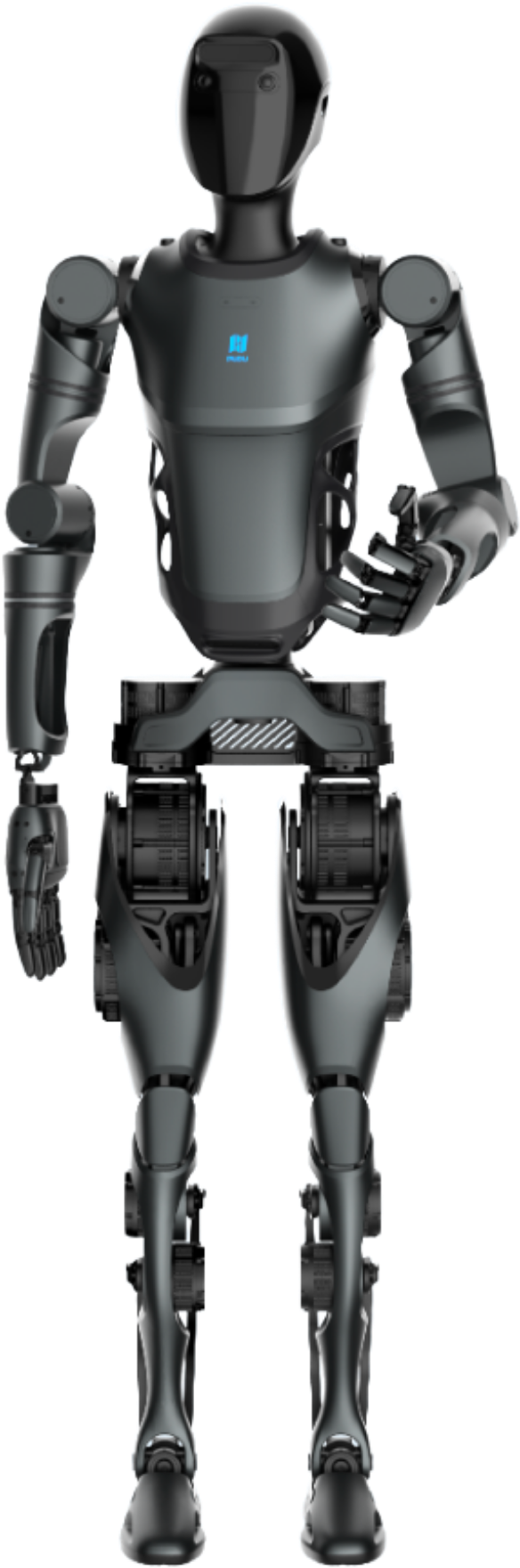
The Pudu D9 (stylized as PUDU D9) is a full-sized bipedal humanoid robot developed by Pudu Robotics and unveiled on December 19, 2024, standing 170 cm (5 ft 7 in) tall, weighing 65 kg (143 lb), and carrying 42 degrees of freedom with a combined dual-arm payload of over 20 kg (44 lb). It is the first fully bipedal humanoid platform from Pudu, a Shenzhen-based Chinese robotics company best known for its commercial service robots such as the BellaBot and KettyBot, marking a significant expansion from the company's core business of wheeled delivery and cleaning robots into the rapidly growing humanoid robotics sector [1].
| Pudu D9 | |
|---|---|
 | |
| General information | |
| Manufacturer | Pudu Robotics |
| Country of origin | China |
| Year unveiled | 2024 |
| Status | Pre-sale |
| Price | Available upon request |
| Availability | Pre-sale (inquiries via official website) |
| Website | pudurobotics.com/en/products/d9 |
The D9 features a maximum joint torque of 352 Nm and dual 7-DOF arms, walks at up to 2 m/s on flat surfaces, and integrates the company's proprietary PUDU DH11 dexterous hand, an 11-DOF five-fingered manipulation system with 1,018 tactile sensor pixels. Pudu positions the D9 as a platform for "commercially viable embodied intelligence," under the product tagline "Born to Serve," targeting applications in warehousing, logistics, cleaning, hospitality, and healthcare [1][2].
The D9 was the third product released by Pudu X-Lab, the company's dedicated humanoid R&D division, in 2024, following the Pudu D7 semi-humanoid robot in September and the PUDU DH11 dexterous hand. The robot entered pre-sale shortly after its unveiling, with pricing available upon request through Pudu's official website [1].
What is Pudu Robotics?
Pudu Robotics (formally Shenzhen Pudu Technology Co., Ltd.) was founded in 2016 by Felix Zhang, who previously studied mechanical engineering as an undergraduate before earning a master's degree in computer science from the Hong Kong University of Science and Technology (HKUST). At the age of 20, Zhang placed first for China at ABU Robocon, a prestigious Asian-Oceanian college robot competition. Before founding Pudu, he launched several ventures, including leiphone.com (a Chinese tech news platform, which he sold in 2012) and Elrobotics (a producer of robotic developer kits and telepresence devices) [3][4].
Zhang identified service roles in restaurants and hospitality as an underdeveloped application for robotics, and Pudu was founded with restaurants as the initial target market. The company released its first delivery robot, PuduBot, and quickly expanded its lineup to include the BellaBot (a cat-themed delivery robot that became the company's flagship product), HolaBot (a delivery robot with call-button summoning), KettyBot (a welcome and advertising robot designed for narrow spaces), and FlashBot (a multi-floor delivery robot for hotels and office buildings). In the cleaning segment, Pudu produces the CC1 scrubber, the MT1 autonomous sweeper, and the BG1 series of large-scale AI-native scrubber-dryers [5][6].
Pudu Robotics has raised a total of approximately $192 million across at least eight funding rounds, with investors including Meituan (which served as the exclusive investor in the Series B round), Sequoia Capital China, Sierra Ventures, Shenzhen Investment Holdings, and the Greater Bay Area Homeland Development Fund. The Series C1 and C2 rounds alone raised nearly $155 million combined [7][8]. As of 2025, Pudu reports having shipped over 120,000 robots to more than 80 countries and regions, with notable customers including Marriott, Hilton, McDonald's, KFC, Walmart, PizzaHut, and Jollibee. Japan's Skylark restaurant group placed a single order for 3,000 BellaBots, setting an industry record [5][9]. The company holds 1,684 global patents (including pending applications) and 1,304 global trademark registrations spanning over 50 countries [10].
Pudu operates manufacturing facilities in China, including a 40,000-square-meter "super factory" in Jiangsu Province (in the Yangtze River Delta region), where the company celebrated the rollout of its 80,000th robot [11]. In March 2025, Pudu expanded its global operations by establishing a new US headquarters in Santa Clara, California, and an East Coast fulfillment center in Hamilton, New Jersey, supported by a network of over 300 local distributors and service providers in the Americas [12].
Why did Pudu move into humanoid robots?
Pudu X-Lab is the company's dedicated research and development division focused on humanoid robotics and embodied intelligence. The lab was established to leverage Pudu's extensive experience in commercial robotics (particularly in navigation, fleet management, and mass manufacturing) toward the development of next-generation humanoid platforms [1].
Pudu's humanoid strategy is organized around three distinct robot categories: specialized robots for specific tasks (the existing delivery and cleaning product lines), semi-humanoid robots for adaptable applications (the Pudu D7), and fully humanoid robots for complex interactions requiring bipedal locomotion and dexterous manipulation (the Pudu D9). CEO Felix Zhang has described this approach as a "comprehensive layout" that addresses the commercialization challenges of embodied intelligence across different price points and capability tiers [13]. Announcing the D9, Zhang framed the strategy around the company's service-robot roots: "Customer centricity has always been at the core of PUDU's values. Our extensive experience in the commercial service sector will help accelerate the maturity of semi-humanoid and humanoid robots, allowing more people to enjoy the convenience of robotic services." [1]
In 2024, the X-Lab released three products in rapid succession:
- PUDU D7 (September 2024): A semi-humanoid robot combining a human-like upper body with a wheeled omnidirectional chassis, designed for environments where manipulation matters more than bipedal locomotion [14].
- PUDU DH11 (2024): An 11-DOF dexterous hand with five human-like fingers, 1,018 tactile sensor pixels, and a maximum single-hand lifting capacity of 40 kg [15].
- PUDU D9 (December 2024): The company's first full-sized bipedal humanoid robot, integrating the DH11 hand and targeting heavy-duty commercial applications [1].
In March 2025, Pudu further expanded this ecosystem with the FlashBot Arm, a semi-humanoid service robot that combines dual 7-DOF arms and DH11 hands with the existing FlashBot Max delivery platform, targeting hotels, offices, and restaurants [16]. In December 2025, the company unveiled the D5 series of industry-grade autonomous quadruped robots, demonstrating the breadth of Pudu's robotics ambitions beyond humanoid form factors [17].
Design and development
The PUDU D9 was developed with the explicit goal of creating a humanoid robot suitable for near-term commercial deployment rather than a pure research platform. Pudu's approach draws on its years of operational experience deploying tens of thousands of service robots in real commercial environments, which informs design priorities around reliability, manufacturability, and practical capability [1][2].
The robot's tagline, "Born to Serve," reflects Pudu's intention to build on its service robotics heritage. While many humanoid robot developers come from academic research backgrounds or are venture-funded startups building their first products, Pudu brings existing manufacturing infrastructure (including the Jiangsu super factory), a global distribution network, and established relationships with enterprise customers in hospitality, retail, and logistics [11][18].
The D9's demonstration videos showcase the robot performing upright walking, obstacle navigation, slope climbing, and cleaning tasks using the PUDU SH1 cleaning unit. These demonstrations emphasize practical service applications rather than acrobatic feats, consistent with Pudu's commercially focused development philosophy [1].
What are the Pudu D9 specifications?
Physical dimensions
The D9 stands 170 cm tall, roughly matching the height of an average adult, and weighs 65 kg. The thigh segment measures 325 mm and the calf segment 383 mm. Each arm extends 580 mm, with the DH11 hand adding 220 mm. This sizing allows the D9 to work in environments designed for humans, including standard-height workbenches, shelves, and doorways [2].
| Specification | Value |
|---|---|
| Height | 170 cm (5 ft 7 in / 66.93 in) |
| Weight | 65 kg (143 lb) |
| Thigh length | 325 mm |
| Calf length | 383 mm |
| Arm length | 580 mm |
| Hand length | 220 mm |
Degrees of freedom and actuation
The D9 provides 42 total degrees of freedom distributed across its body. Each leg has 6 DOF, and each arm has 7 DOF, providing the kinematic flexibility needed for complex manipulation tasks and stable bipedal locomotion. The maximum joint torque reaches 352 Nm, providing the power necessary for heavy payloads and dynamic movements [1][2].
| Joint group | DOF |
|---|---|
| Each leg | 6 |
| Each arm | 7 |
| Each hand (DH11) | 11 (6 active + 5 passive) |
| Total | 42 (body) + 22 (hands) |
How fast does the Pudu D9 walk?
The D9's bipedal structure enables walking at speeds up to 2 m/s (7.2 km/h or 4.5 mph) on flat surfaces, comparable to a brisk adult walking pace. The robot can navigate stairs, slopes, and uneven urban terrain. Pudu describes the locomotion system as using "lightweight gait control" algorithms that optimize for energy efficiency and minimize operational noise, an important consideration for deployment in human-occupied environments such as hotels, hospitals, and retail stores [1].
The visual semantic navigation system uses high-accuracy sensors to generate real-time 3D semantic maps, enabling accurate self-positioning and autonomous route planning. This navigation approach builds on the SLAM and path-planning expertise Pudu developed through years of deploying delivery and cleaning robots in complex indoor environments [1][2].
Manipulation
Each 7-DOF arm provides a single-arm payload capacity of 10 kg, for a combined dual-arm payload exceeding 20 kg (44 lb). The arms are paired with the PUDU DH11 dexterous hands, which provide human-like five-fingered manipulation with 11 degrees of freedom per hand (6 active motors and 5 passive DOF) [1][15].
The DH11 hand weighs just 500 grams and features 12 tactile sensing areas with 1,018 tactile sensor pixels for detailed haptic feedback. It uses a cable-driven system with underactuated mechanisms and multi-strand integrated steel cables for wear resistance and tensile strength. Key performance specifications include a maximum palm-finger grip force of 30 N, a finger bend speed of 150 degrees per second, a thumb bend speed of 191 degrees per second, and a maximum single-hand lifting capacity of 40 kg. The hand can execute diverse manipulation tasks including gripping, pinching, twisting, pulling, pushing, pressing, grabbing, and lifting [15].
| DH11 Hand Specification | Value |
|---|---|
| Degrees of freedom | 11 (6 active, 5 passive) |
| Weight | 500 g |
| Tactile sensing areas | 12 |
| Tactile sensor pixels | 1,018 |
| Maximum grip force | 30 N |
| Finger bend speed | 150 degrees/s |
| Thumb bend speed | 191 degrees/s |
| Maximum lifting capacity | 40 kg |
| Drive mechanism | Cable-driven, underactuated |
Sensors and perception
The D9 integrates a multimodal sensor suite including RGB cameras, RGBD depth cameras, tactile sensors (via the DH11 hands), an inertial measurement unit (IMU), force sensors, and auditory sensors. Through a processing framework that integrates advanced artificial intelligence models, the sensor data is fused to achieve what Pudu describes as "human-level multimodal natural interactions, significantly enhancing the quality and responsiveness of the services it provides," enabling the robot to perceive, interpret, and respond to its environment in real time [1][2].
Computing
The D9 is equipped with 275 TOPS (tera operations per second) of AI computing power, sufficient for on-device machine learning inference, real-time computer vision processing, 3D semantic mapping, and autonomous decision-making [2].
Power system
The robot is powered by a 15 Ah lithium battery with a capacity of 0.72 kWh. Specific runtime figures have not been officially disclosed by Pudu, though the battery capacity is notably smaller than the D7's 1+ kWh battery, which supports over 8 hours of continuous operation. The D9's bipedal locomotion is inherently more energy-intensive than the D7's wheeled mobility, which likely results in a significantly shorter operating time per charge [2].
Summary of specifications
| Category | Specification | Value |
|---|---|---|
| Physical | Height | 170 cm (5 ft 7 in) |
| Physical | Weight | 65 kg (143 lb) |
| Mobility | Total degrees of freedom | 42 |
| Mobility | DOF per leg | 6 |
| Mobility | DOF per arm | 7 |
| Mobility | Maximum walking speed | 2 m/s (7.2 km/h / 4.5 mph) |
| Mobility | Maximum joint torque | 352 Nm |
| Mobility | Stair climbing | Yes |
| Manipulation | Combined arm payload | 20+ kg (44 lb) |
| Manipulation | Single-arm payload | 10 kg |
| Manipulation | Hand DOF (DH11) | 11 per hand |
| Manipulation | Hand grip force | 30 N |
| Sensors | Vision | RGB, RGBD cameras |
| Sensors | Touch | 1,018 tactile pixels per hand |
| Sensors | Other | IMU, force sensors, auditory sensors |
| Computing | AI performance | 275 TOPS |
| Power | Battery capacity | 15 Ah (0.72 kWh) |
AI and software
Reinforcement learning
The D9 leverages proprietary reinforcement learning algorithms that enable the robot to rapidly learn from extensive datasets and execute end-to-end task planning. This approach allows the robot to adapt to various operational demands without requiring explicit programming for every possible scenario. The reinforcement learning system handles both locomotion control (maintaining stable bipedal walking across different terrains) and manipulation planning (sequencing arm and hand movements for complex tasks) [1].
Visual semantic navigation
The visual semantic navigation system goes beyond traditional SLAM (Simultaneous Localization and Mapping) by incorporating semantic understanding of the environment. Rather than simply building a geometric map of obstacles and free space, the D9 creates 3D semantic maps that identify and categorize objects and features in the environment. This enables more intelligent route planning and task execution, as the robot can understand the functional meaning of its surroundings rather than treating everything as abstract geometry [1].
Multimodal interaction
The D9 processes visual, tactile, force, and auditory information through an integrated AI framework to achieve natural human-robot interactions. This multimodal approach allows the robot to interpret spoken commands, recognize objects and people, sense contact forces during manipulation, and respond appropriately to its environment. The system builds on Pudu's experience with customer-facing service robots, where natural interaction capabilities are essential for acceptance in hospitality and retail settings [1].
How does the Pudu D9 differ from the Pudu D7?
The Pudu D7 and Pudu D9 represent two different approaches to humanoid robotics within Pudu's product strategy. The D7, unveiled in September 2024, is a semi-humanoid that combines a human-like upper body (with bionic arms) with a wheeled omnidirectional chassis. The D9, unveiled three months later in December 2024, is a full bipedal humanoid. The two platforms are designed for different use cases and operational environments [1][14].
| Feature | Pudu D7 | Pudu D9 |
|---|---|---|
| Type | Semi-humanoid (wheeled) | Full bipedal humanoid |
| Unveiled | September 2024 | December 2024 |
| Height | 165 cm | 170 cm |
| Weight | 45 kg | 65 kg |
| Total DOF | 30 (50 with dexterous hand) | 42 (64 with DH11 hands) |
| Locomotion | Omnidirectional wheeled chassis | Bipedal walking |
| Maximum speed | 2 m/s | 2 m/s |
| Arm payload | 10 kg | 20+ kg (combined) |
| Arm reach | 65 cm | 58 cm (arm) + 22 cm (hand) |
| Endpoint precision | 0.1 mm | Not disclosed |
| Battery capacity | 1+ kWh | 0.72 kWh |
| Runtime | 8+ hours | Not officially disclosed |
| Stair climbing | No (wheeled) | Yes |
| Obstacle climbing | 50 mm | Stairs and slopes |
| Slope stability | Up to 10 degrees | Yes (unspecified limit) |
| Target commercialization | 2025 | Pre-sale open |
| Target applications | Hotels, hospitals, offices, elevators | Warehouses, retail, cleaning, logistics |
The D7's wheeled mobility provides substantial advantages in terms of energy efficiency, stability, and runtime (over 8 hours versus the D9's shorter battery life). Its endpoint precision of 0.1 mm also makes it well-suited for tasks requiring fine positional accuracy. However, the D7 cannot navigate stairs or overcome significant obstacles, limiting it to single-floor environments with relatively smooth surfaces [14].
The D9's bipedal design sacrifices the D7's energy efficiency and long runtime in exchange for the ability to navigate stairs, slopes, and uneven terrain. Its higher payload capacity (20+ kg combined versus the D7's 10 kg) and greater number of degrees of freedom make it better suited for heavy-duty manipulation tasks in environments with multi-level access requirements [1].
Pudu's strategy of offering both platforms reflects the company's view that no single form factor can optimally address all commercial robotics applications. The D7 targets structured indoor environments where long runtime and precision matter most, while the D9 targets environments where terrain adaptability and heavy payload handling are more important [13].
What is the Pudu D9 used for?
Pudu has identified several primary application domains for the D9, all of which build on the company's existing commercial relationships and market knowledge:
- Warehouse and logistics: Unloading, sorting, and transporting heavy items in distribution centers and warehouses, where the 20+ kg payload and bipedal mobility enable operation across loading docks, ramps, and multi-level facilities [2].
- Commercial cleaning: Operating cleaning equipment such as the PUDU SH1 in commercial spaces, leveraging the robot's manipulation capabilities to handle cleaning tools and navigate diverse floor layouts [1].
- Retail: Shelf stocking, inventory management, and customer assistance in stores, where the robot's human-scale form factor allows it to access standard shelving and interact naturally with shoppers [18].
- Hospitality: Table service, concierge assistance, and room delivery in hotels and restaurants, building directly on Pudu's extensive experience deploying service robots in these environments [2].
- Healthcare: Delivery, assistance, and support tasks in hospitals and care facilities, where the ability to navigate between floors and handle varied objects is valuable [1].
In demonstration videos, the D9 has been shown performing cleaning tasks, navigating obstacles, climbing slopes, and handling objects, emphasizing practical service scenarios rather than research-oriented demonstrations [1].
How does the Pudu D9 compare to other humanoid robots?
The D9 enters a crowded and rapidly growing humanoid robot market, particularly among Chinese manufacturers. As of 2025 and 2026, Chinese companies dominate the humanoid robot space, controlling an estimated 90% of the market by unit volume. Unitree Robotics sold approximately 5,500 humanoid robots in 2025 (primarily the Unitree G1 and Unitree H1), while Shanghai-based Agibot sold 5,168 units [19].
The following table compares the D9 with other prominent humanoid platforms:
| Feature | Pudu D9 | Unitree G1 | Tesla Optimus | Figure 02 | Agility Digit |
|---|---|---|---|---|---|
| Height | 170 cm | 132 cm | 173 cm | 170 cm | 175 cm |
| Weight | 65 kg | 35 kg | 72 kg | ~60 kg | 65 kg |
| Total DOF | 42 | 23-43 | 28+ | 24+ | 16+ |
| Max joint torque | 352 Nm | 120 Nm | Not disclosed | Not disclosed | Not disclosed |
| Max speed | 2 m/s | 2 m/s | ~1.8 m/s | Not disclosed | 1.5 m/s |
| Arm payload | 20+ kg | 2-3 kg | Not disclosed | Not disclosed | 16 kg |
| Dexterous hands | Yes (DH11, 11 DOF) | Optional (Dex3-1/Dex5-1) | Yes (22 DOF claimed) | Yes | No |
| Price | On request | From $16,000 | Not for sale | Enterprise only | Lease only |
| Status | Pre-sale | Commercially available | Internal use | Limited deployment | Limited deployment |
Pudu's competitive advantages include its established global distribution network (80+ countries), existing customer relationships with major brands, manufacturing scale (120,000+ robots shipped), and service infrastructure (600+ service centers worldwide). These assets could enable faster commercial deployment of the D9 compared to humanoid startups that must build distribution and support networks from scratch [11][18].
However, Pudu faces stiff competition from better-funded and more technically mature humanoid programs. Tesla's Optimus benefits from massive capital resources and vertical integration in manufacturing. Figure AI has attracted significant investment and partnerships (including integration with OpenAI's language models). Unitree has already achieved volume production and offers the G1 at a price point ($16,000) that could undercut the D9 significantly, though with lower payload capacity and a smaller form factor [19][20].
Domestic Chinese competitors include UBTECH (known for the Walker series), Keenon Robotics (which, like Pudu, is transitioning from service robots to humanoids), and Gaussian Robotics (specializing in commercial cleaning). International competitors in the service-to-humanoid pipeline include Bear Robotics in California, which raised $60 million in Series C funding led by LG Electronics in 2024 [18].
When can you buy the Pudu D9 and how much does it cost?
The Pudu D9 entered pre-sale in December 2024 following its unveiling. Pudu accepts inquiries through its official website, with pricing available on request. Industry observers have estimated that the D9 may be positioned in the $20,000 to $30,000 range based on competitor pricing (the Unitree G1 starts at $16,000 and Tesla's Optimus has been projected at $20,000 to $30,000), though Pudu has not confirmed a specific price [2][18].
Pudu's existing manufacturing infrastructure, including the 40,000-square-meter Jiangsu factory and the company's experience with mass production of commercial robots, provides a foundation for scaling D9 production once demand materializes [11].
See also
- Humanoid robot
- Pudu Robotics
- Pudu D7
- Embodied AI
- Reinforcement learning
- Degrees of freedom
- Unitree G1
- Tesla Optimus
- Figure AI
- Agility Robotics
References
- ^1 ^2 ^3 ^4 ^5 ^6 ^7 ^8 ^9 ^10 ^11 ^12 ^13 ^14 ^15 ^16 ^17 ^18 ^19 ^20 ^21"Pudu Robotics Unveils PUDU D9: A Full-Sized Humanoid Robot Driving Commercially Viable Embodied Intelligence." PR Newswire, December 19, 2024.
- ^1 ^2 ^3 ^4 ^5 ^6 ^7 ^8 ^9 ^10 ^11"Pudu unveils a life-size walking humanoid robot for warehouse tasks." New Atlas, December 2024.
- ^"Unicorn Day - Biography - Felix Zhang." Entrepreneurship Center, Hong Kong University of Science and Technology, 2024.
- ^"At your service: robot wait staff fit the bill." Nature, 2022.
- ^1 ^2"Pudu Robotics official website - About Us." Pudu Robotics.
- ^"Pudu Robotics Unveils PUDU BG1 Series: Defining the AI-Native Era of Large-Scale Cleaning." RoboticsTomorrow, March 2026.
- ^"Pudu Robotics Raised over $15M Series B Financing with Meituan as the Exclusive Investor." Business Wire, July 2020.
- ^"Pudu Robotics serves up $155M Series C funding round." The Robot Report, 2021.
- ^"Pudu Robotics Releases Catering and Retail Service Robot, BellaBot Pro." PR Newswire, April 2024.
- ^"Pudu Robotics Joins Hong Kong's Strategic Partners to Drive Global Expansion and Innovation." Pudu Robotics, November 2024.
- ^1 ^2 ^3 ^4"Pudu Robotics Unveils New Factory, Celebrates Production of 80,000th Robot in Jiangsu, China." Pudu Robotics, 2024.
- ^"Pudu Robotics Expands Global Operations with New US Headquarters in California and East Coast Fulfillment Center." PR Newswire, March 2025.
- ^1 ^2"Dedicated, Humanoid and Human-Like Comprehensive Layout: Pudu Robotics Solves the Commercialization Challenges of Embodied Intelligence." Oreate AI Blog.
- ^1 ^2 ^3"Pudu Robotics Unveils their PUDU D7 Semi-Humanoid Robot, Showcasing Breakthrough Capabilities and Strategic Vision for Humanoid Robotics." PR Newswire, September 2024.
- ^1 ^2 ^3"Pudu Robotics Unveils the PUDU DH11: An 11-DOF 5-fingered Dexterous Hand to Empower Robotic Performance." Pudu Robotics.
- ^"Pudu Robotics Unveils FlashBot Arm: A Semi-Humanoid Embodied AI Service Robot for Commercial Applications." PR Newswire, March 2025.
- ^"Pudu Robotics Launches Next-generation Quadruped PUDU D5 Series and Showcases Full Lineup at iREX 2025." Pudu Robotics, December 2025.
- ^1 ^2 ^3 ^4 ^5"PUDU D9: The First Bipedal Humanoid from Pudu Robotics." Mike Kalil, December 2024.
- ^1 ^2"China is winning the humanoid robot race while Tesla's Optimus lags." Rest of World, 2026.
- ^"Pudu Robotics launches PUDU D9 humanoid robot." The Robot Report, December 2024.
Improve this article
Add missing citations, update stale details, or suggest a clearer explanation. Every suggestion is reviewed for sourcing before it goes live.
6 revisions · v6 · 3,938 words · full history
Fact-checks are independent of edits: a reviewer re-verifies the article against its sources and stamps the date. How we verify
Research and drafting on this wiki are AI-assisted, under named human editorial standards. How AI is used here
Cite this page: AI Wiki. "Pudu D9." aiwiki.ai, updated 24 Jun 2026. CC BY 4.0. https://aiwiki.ai/wiki/pudu_robotics_d9