

Robotera Star1
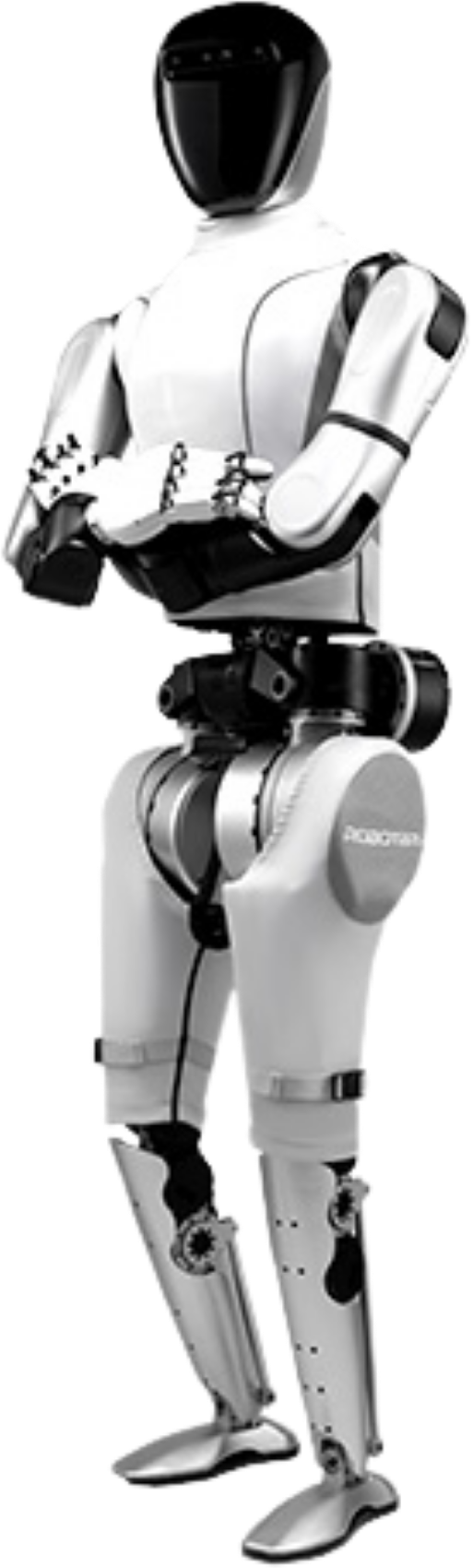
The Robotera Star1 (stylized as STAR1) is a full-size, general-purpose humanoid robot developed by Robotera (Beijing Robot Era Technology Co., Ltd.), a Chinese robotics startup incubated by Tsinghua University. Launched in August 2024, the Star1 stands 171 cm tall, weighs 63 kg, has 55 degrees of freedom, and in October 2024 set a world record as the fastest bipedal humanoid robot at 3.6 m/s (12.9 km/h, 8 mph), running across China's Gobi Desert for 34 continuous minutes.[3][4] It was the company's first product-grade humanoid platform and the first humanoid robot to demonstrate chopstick manipulation.[5]
| Robotera Star1 | |
|---|---|
 | |
| General information | |
| Manufacturer | Robotera |
| Country of origin | China |
| Year unveiled | 2024 |
| Status | In production |
| Price | ~$96,000 USD |
| Availability | Commercially available |
| Website | robotera.com |
The 3.6 m/s record surpassed the previous bipedal mark of 3.3 m/s held by Unitree's H1.[3] During the Gobi demonstration, two Star1 units raced across rocky paths, grassy patches, and winding desert roads, with a sneaker-wearing unit sustaining its peak speed for 34 uninterrupted minutes.[4] The Star1 is powered by Robotera's proprietary ERA-42 vision-language-action (VLA) model and equipped with the company's XHAND1 dexterous hands, which it has used to cook dumplings and pour wine with precision.[5][18]
The Star1 has since been succeeded by the Robotera L7, which further increased the top speed to 4 m/s (14.4 km/h) while building on the Star1's mechanical and AI foundations.
Who makes the Robotera Star1?
Robotera (Robot Era)
Robotera, formally known as Beijing Robot Era Technology Co., Ltd. (Chinese: 星动纪元), was established in August 2023.[2] The company was incubated by the Institute for Interdisciplinary Information Sciences (IIIS) at Tsinghua University and is the sole humanoid robotics company in which Tsinghua University holds equity.[11] Robotera is headquartered in Beijing.
The company was founded by Chen Jianyu, an assistant professor and doctoral supervisor at Tsinghua University's IIIS, where he works within the research team of Academician Yao Qizhi (Andrew Yao), a Turing Award laureate.[12] Chen holds a Ph.D. from UC Berkeley, where he studied under Professor Masayoshi Tomizuka, a member of the U.S. National Academy of Engineering and a pioneer in mechatronics control and model predictive control (MPC) algorithms. Chen has published more than 50 papers in leading robotics and artificial intelligence venues, including NeurIPS, ICML, ICRA, and IROS. He was named to Forbes China's "30 Under 30" list and was a finalist for the Outstanding Paper Award at RSS 2024.
Chen has framed Robotera's strategy of co-developing both robot hardware and AI as central to the company's mission. "A robot without a brain is just scrap metal," he said in an interview. "A brain without a body isn't a robot."[12] This full-stack philosophy directly shapes the Star1, which pairs Robotera's in-house actuators and dexterous hands with the proprietary ERA-42 embodied intelligence model.
Robotera's core team draws from Tsinghua University, Peking University, Beijing Institute of Technology, Harbin Institute of Technology, UC Berkeley, the National University of Singapore, and Fortune 500 companies. Over 80% of the company's employees work in research and development.[2]
Robotera positions itself as a provider of "full-stack technology for humanoid robots," developing proprietary hardware (actuators, dexterous hands, full-body platforms), the ERA-42 foundation model for embodied intelligence, and application software for commercial deployment.[2]
How is Robotera funded?
Robotera has raised a total of approximately $267 million across multiple funding rounds, reaching a valuation exceeding 10 billion RMB (approximately $1.45 billion) by early 2026.[11]
| Round | Date | Amount | Lead Investors | Notable Participants |
|---|---|---|---|---|
| Angel | January 2024 | Undisclosed | Lenovo Capital, Crystal Stream Capital, Tsinghua Holdings | |
| Pre-Series A | October 2024 | Undisclosed | Lenovo Capital, Golden Resources, Jinding Capital | |
| Series A | July 2025 | CDH Investments, Haier Capital | Houxue Capital, Meridian Capital, Crystal Stream Capital | |
| Series A+ | November 2025 | Geely Capital | BAIC Capital, Alibaba, Beijing AI Industry Investment Fund |
The participation of major automotive groups like Geely and BAIC reflects strong interest from China's vehicle manufacturers in humanoid robotics for factory automation.[7][10] At the time of the Series A+ round, Robotera reported approximately $70 million in signed commercial orders for 2025.[10]
How did the Star1 fit into Robotera's product timeline?
Robotera's humanoid robot development progressed through several stages in rapid succession, reflecting the fast pace of China's humanoid robotics sector.
| Timeline | Milestone |
|---|---|
| August 2023 | Company founded; early humanoid prototype "Xiaoxing" debuts at the World Robot Conference in Beijing |
| May 2024 | Xiaoxing Max (also called XBot-L) becomes the first humanoid robot to walk the Great Wall of China, navigating uneven stone steps and dimly lit archways[6] |
| August 2024 | Star1 launched as first product-grade humanoid; XHAND1 dexterous hand also debuts |
| October 2024 | Star1 sets world bipedal speed record at 3.6 m/s during Gobi Desert demonstration[3] |
| Mid-2025 | Star1 demonstrates chopstick manipulation, cooking, and fine motor tasks[5] |
| July 2025 | Q5 "Tiny-Waisted Pro" wheeled service robot launched for commercial deployment |
| August 2025 | L7 (Star1's successor) unveiled with improved speed (4 m/s), enhanced upper-body mobility, and integrated ERA-42 AI |
What are the Star1's specifications?
Physical dimensions and DOF
The Star1 stands 171 cm (5 ft 7 in) tall and weighs 63 kg with its battery installed.[13][14] Its human-like proportions are designed to allow the robot to operate in environments built for people, including standard doorways, corridors, and workstations.
The robot's 55 degrees of freedom are distributed as follows:[14]
| Body region | DOF | Notes |
|---|---|---|
| Legs (total) | 12 | 6 DOF per leg; enables walking, running, jumping, squatting, and backflips |
| Waist | 3 | Provides flexible trunk rotation and bending for terrain adaptation |
| Neck | 2 | Supports head movement for visual tracking |
| Arms (total) | 14 | 7 DOF per arm; allows full-range reaching, lifting, and manipulation |
| Hands (total) | 24 | 12 active DOF per hand via XHAND1 dexterous hands |
| Total | 55 |
This high DOF count places the Star1 among the most articulated commercially available humanoid platforms, enabling simultaneous whole-body locomotion and fine manipulation.
Actuation system
The Star1's joints are driven by proprietary high-torque electric motors with the following performance characteristics:[1][14]
| Parameter | Value |
|---|---|
| Maximum joint torque | 400 Nm |
| Peak rotational speed | 25 rad/s |
| Motor type | Precision planetary reducers with high-precision encoders and integrated drivers |
The 400 Nm torque figure is notably high for an electric humanoid of this weight class. By comparison, Unitree's H1 achieves 360 Nm peak torque at the knee, and Tesla's Optimus targets roughly 200 Nm across its joints. The high torque and fast rotational speeds (25 rad/s) give the Star1 the power needed for dynamic locomotion, including running, jumping, and rapid direction changes, while also supporting heavy-payload manipulation through the arms.[3]
XHAND1 dexterous hand
The Star1's hands are the Robotera XHAND1, a five-fingered dexterous robotic hand that is also sold separately as a standalone research product (available through distributors such as RobotShop).[15]
| XHAND1 specification | Value |
|---|---|
| Active DOF | 12 per hand |
| Finger DOF distribution | 3 (thumb), 3 (index), 2 (middle), 2 (ring), 2 (pinky) |
| Drive type | Full-gear Quasi-Direct Drive; decoupled, locally positioned active joints |
| Single-finger load capacity | >5 kg |
| Four-finger load capacity | >20 kg |
| Full-hand load capacity | >24 kg |
| Tactile sensing | 270-degree three-dimensional encircling tactile array sensors on each fingertip; resolution of 12x10 per fingertip; senses tangential forces (X, Y) and normal force |
| Click speed | 10 clicks per second (comparable to professional esports gamers) |
| Control modes | Position control (low/high damping), current-loop force control, force-position hybrid control |
| Compatibility | Apple Vision Pro teleoperation; MANUS motion-capture gloves |
The XHAND1's laterally moving index finger enables twisting actions, while the thumb's "pinky position" capability improves grip stability for irregularly shaped objects.[16] The hand's back-drivability provides impact resistance, a useful safety feature during physical human-robot interaction. The full direct-drive design, with no cables or tendons, eliminates the maintenance issues common in tendon-driven robotic hands and provides transparent force feedback suitable for reinforcement learning and imitation learning research.
How smart is the Star1? Computing and AI
The Star1 is equipped with an AI computing platform capable of 275 TOPS (trillions of operations per second), based on the NVIDIA Jetson AGX Orin module combined with Intel processors.[13][14] This processing power far exceeds the 45 to 55 TOPS found in typical high-end laptops and allows the robot to run complex neural network models locally, without relying on cloud computing.
The onboard computing supports:
- Real-time visual perception and 3D environment mapping
- Reinforcement learning policy execution for locomotion
- Imitation learning algorithms for dexterous manipulation
- Multimodal sensor fusion (visual, tactile, auditory, proprioceptive)
- Autonomous task planning and execution via ERA-42
ERA-42 AI model
The Star1 is powered by Robotera's proprietary ERA-42, an end-to-end embodied intelligence model that serves as the robot's "embodied brain."[18] ERA-42 is a vision-language-action (VLA) model that merges visual, proprioceptive, and language data streams for autonomous task sequencing.
Key capabilities of ERA-42 include:[18]
- Visual interpretation: The model processes camera and depth sensor data to understand the robot's surroundings, identify objects, and plan manipulation sequences.
- Rapid task learning: ERA-42 can learn new tasks in hours using minimal demonstration data, mastering over 100 complex precision operations (such as tool use, object sorting, and assembly tasks) without explicit pre-programming for every object shape and location.
- Full-body control: The model supports coordinated whole-body motion, blending locomotion with manipulation. It can select and compose task-specific skills on the fly.
- World model integration: An integrated world model enhances the system's ability to execute multi-step tasks with minimal human intervention, making it effective in dynamic and unpredictable environments.
- Teleoperation support: ERA-42 supports both autonomous operation and remote teleoperation using human-generated motion data, allowing operators to guide the robot in real time.
Sensors and perception
The Star1 integrates a multi-sensor perception system for real-time 3D mapping and obstacle avoidance:
- Panoramic cameras for wide-angle visual awareness
- Depth sensors for close-range 3D perception
- Proprioceptive sensors (joint encoders and IMU) for balance and state estimation
- XHAND1 fingertip tactile arrays for contact force sensing during manipulation
The sensor suite provides 360-degree spatial awareness, enabling the robot to operate safely in complex human environments without reliance on external compute infrastructure.
Power and connectivity
| Parameter | Value |
|---|---|
| Battery life | Up to 240 minutes (4 hours) operational time |
| Payload capacity | 20 kg (both arms) |
| WiFi | Dual-band 2.4 GHz and 5 GHz |
| Bluetooth | Supported |
| Wired connectivity | USB and Ethernet ports |
| Software platform | Closed source (proprietary Robotera system) |
The 240-minute battery life is competitive within the humanoid robot market. The Unitree H1 offers approximately 120 minutes, while most comparable platforms fall in the 2 to 4 hour range.
Summary specifications table
| Specification | Star1 | L7 (successor) |
|---|---|---|
| Height | 171 cm | 171 cm |
| Weight | 63 kg | 65 kg |
| Total DOF | 55 | 55 |
| Leg DOF | 12 | 12 |
| Arm DOF | 14 | 14 |
| Hand DOF | 24 (XHAND1) | 24 (XHAND1) |
| Waist DOF | 3 | 3 |
| Neck DOF | 2 | 2 |
| Max speed | 3.6 m/s (12.9 km/h) | 4 m/s (14.4 km/h) |
| Max joint torque | 400 Nm | 400 Nm |
| Payload capacity | 20 kg | 20 kg |
| AI computing | 275 TOPS | 275 TOPS |
| AI model | ERA-42 | ERA-42 |
| Price | ~$96,000 | Not publicly disclosed |
What can the Star1 do? Demonstrations and milestones
How fast is the Star1? The Gobi Desert speed record (October 2024)
In October 2024, Robotera released a video showing two Star1 units racing through the Hexi Corridor region of the Gobi Desert, navigating rocky paths, grassy areas, and winding roads.[3][4] One unit wore sneakers while the other ran barefoot. The sneaker-wearing Star1 started behind its barefoot counterpart but quickly closed the gap and surged ahead, sustaining a peak speed of 3.6 m/s (8 mph) for 34 uninterrupted minutes.[3][4] The run covered diverse terrain types and demonstrated the robot's ability to maintain balance and adapt its gait in real time using its reinforcement-learning-trained locomotion policy.
The company described the demonstration as a proving ground for commercial use, stating that the "test run will pave the way for its robots to be deployed in a number of scenarios."[3] The performance broke the previous bipedal humanoid speed record of 3.3 m/s set by Unitree's H1 in March 2024.[3] The demonstration also highlighted the practical impact of footwear on robotic locomotion: the sneaker-wearing unit consistently outperformed its barefoot counterpart, suggesting that appropriate foot coverings improve traction and energy transfer on natural terrain.[4]
Great Wall of China ascent (June 2024)
Before the Star1's launch, Robotera's earlier prototype, the Xiaoxing Max (also called XBot-L), became the first humanoid robot to successfully climb the Great Wall of China in May/June 2024.[6] The robot navigated rugged, uneven stone steps, winding staircases, and dimly lit archways, demonstrating advanced dynamic balance and terrain adaptation capabilities. This milestone received international media coverage and helped establish Robotera's reputation in the humanoid robotics community.
Chopstick manipulation and cooking (2025)
In mid-2025, the Star1 became the first humanoid robot to demonstrate chopstick manipulation.[5] Videos showed the robot using chopsticks with pinpoint accuracy to pick up and serve dumplings, steam buns, pour wine into glasses without spilling, and clink glasses in a toasting gesture.[5] These demonstrations showcased the XHAND1's fine motor control and the ERA-42 model's ability to coordinate complex multi-step manipulation tasks that require precise force control and visual feedback.
The cooking demonstration was significant because chopstick use demands a level of dexterity that most robotic hands cannot achieve. It requires precise, coordinated finger movements with carefully modulated grip force to hold thin sticks and manipulate small, delicate food items.
Dynamic locomotion capabilities
Beyond straight-line running, the Star1 has demonstrated backflips, 360-degree spins, jumping, squatting, stair climbing, and smooth transitions between postures. These capabilities are trained through sim-to-real transfer, where locomotion policies are first optimized in simulated environments and then deployed on the physical hardware. The robot can walk and run stably on lawns, gravel paths, snow, sand, and paved roads.[2]
What is the Star1 used for? Applications
Manufacturing
Robotera targets automotive assembly and 3C (computer, communication, consumer electronics) manufacturing as primary application domains. On automotive assembly lines, the Star1 can bend and squat to complete precise assembly tasks in spaces designed for human workers. In 3C manufacturing, it performs assembly, quality inspection, packaging, and material handling. Industrial clients include Samsung, Geely, Renault, Lenovo, Haier, and TCL.
Logistics and warehousing
The Star1's autonomous navigation, object recognition, and dexterous manipulation capabilities make it suitable for warehouse operations. The robot can identify item types, perform precise grasping and handling, and navigate complex warehouse environments with obstacle avoidance. Robotera has deployed robotic solutions in logistics facilities in Shenzhen, Huzhou, Hangzhou, Hefei, and Beijing, reporting operational efficiency improvements of up to 70% in some scenarios. A collaboration with SF Express for cross-border logistics inspection has been deployed at customs facilities, with single orders exceeding 50 million RMB.
Service and healthcare
Robotera envisions future deployment in commercial services, domestic care, and elderly assistance. The Q5 service robot (a wheeled humanoid in the same product family) already targets these sectors, while the bipedal Star1 and L7 are positioned for environments where mobility over stairs, uneven floors, and cluttered spaces is required.
Research and development
Robotera reports that nine of the world's ten most valuable technology companies are among its customers, and the XHAND1 dexterous hand is used for research at institutions including MIT and ByteDance's robotics laboratories.[10] The company shipped over 200 humanoid robots in 2025 and reported over 500 total units shipped by the end of that year, with approximately 50% of units going to overseas customers.
How does the Star1 compare to other humanoid robots?
The Star1 entered a rapidly expanding market for humanoid robots, particularly in China, where government policy support and manufacturing demand have driven explosive growth. Chinese companies shipped approximately 20,000 humanoid robots in 2025, with the market projected to grow 94% in 2026.[19]
| Feature | Robotera Star1 | Unitree H1 | Tesla Optimus | Agibot A2 | UBTECH Walker S1 |
|---|---|---|---|---|---|
| Height | 171 cm | 180 cm | 173 cm | ~170 cm | 170 cm |
| Weight | 63 kg | 47 kg | 72 kg | ~65 kg | 77 kg |
| Total DOF | 55 | 19 (H1) / 27 (H1-2) | 28+ | 53 | 41 |
| Max speed | 3.6 m/s | 3.3 m/s | ~1.8 m/s | ~2 m/s | ~1.2 m/s |
| Dexterous hands | XHAND1 (12 DOF/hand) | Optional Dex5-1 | Custom (11 DOF) | Custom | Custom |
| AI computing | 275 TOPS | Variable (i5/i7/Orin NX) | Custom FSD chip | Undisclosed | Undisclosed |
| Price | ~$96,000 | ~$90,000 | Not yet sold | ~$14,500 | ~$99,000 |
| Primary market | Industry + research | Research | Factory automation | Industry | Industry + education |
Robotera's key differentiators include the Star1's high DOF count (55 vs. 19 to 41 for most competitors), its record-setting bipedal speed, the XHAND1's exceptional dexterity and load capacity, and the integrated ERA-42 AI model that supports rapid task learning without extensive re-programming. The company's academic roots at Tsinghua University provide strong ties to fundamental robotics research, while its backing from automotive companies (Geely, BAIC) signals a clear path toward industrial deployment.[10]
However, Robotera faces intense competition. Unitree shipped over 5,500 humanoid units in 2025 and offers the G1 and R1 at much lower price points ($16,000 and $5,900 respectively). Agibot shipped over 5,100 units in 2025 and reached mass production scale, rolling out its 10,000th robot by early 2026.[20] UBTECH has secured orders exceeding 500 units from automotive manufacturers. Tesla's Optimus, while behind on deployment numbers, benefits from the company's vertically integrated manufacturing capabilities.
What other robots does Robotera make?
The Star1 is part of a broader product family that spans bipedal humanoids, wheeled service robots, and standalone dexterous hands.
| Product | Type | Key features |
|---|---|---|
| Star1 | Full-size bipedal humanoid | 55 DOF, 3.6 m/s speed, XHAND1 hands, 275 TOPS AI |
| L7 | Full-size bipedal humanoid (next-gen) | 55 DOF, 4 m/s speed, enhanced upper-body mobility, breakdancing capability |
| Q5 "Tiny-Waisted Pro" | Wheeled service humanoid | 44 DOF, 11-DOF "Fairy Hands," 37-language support, 4+ hour battery |
| M7 | Mid-size humanoid | Details pending |
| XHAND1 | Standalone dexterous hand | 12 active DOF, full direct drive, tactile sensing, sold separately |
What are the Star1's limitations?
Despite its capabilities, the Star1 has several notable limitations:
- Closed software platform: Unlike the Unitree H1, which provides an open SDK with ROS 2 support and published URDF models, the Star1 runs a proprietary closed-source software stack. This limits its appeal to academic researchers who require low-level access to the robot's control systems.
- Price point: At approximately $96,000, the Star1 is significantly more expensive than Unitree's G1 ($16,000) and Agibot's A2 (~$14,500), though it offers more DOF and higher performance.
- Weight: At 63 kg, the Star1 is heavier than the Unitree H1 (47 kg), which can affect portability and the power required for dynamic maneuvers.
- Speed record superseded: The Star1's 3.6 m/s record was surpassed by Robotera's own L7 (4 m/s) and other competitors in 2025, though it remains among the fastest humanoid platforms available.
- Limited third-party ecosystem: As a relatively new product from a young company, the Star1 lacks the third-party accessory ecosystem and community support available for more established platforms.
See also
- Humanoid robot
- Robotera
- Robotera L7
- Unitree H1
- Unitree G1
- Tesla Optimus
- Boston Dynamics
- Atlas (robot)
- Reinforcement learning
- Dexterous hand
- Embodied AI
References
- ^Robotera official website.
- ^1 ^2 ^3 ^4Robotera company profile and milestones.
- ^1 ^2 ^3 ^4 ^5 ^6 ^7 ^8"China's sneaker-clad Star1 humanoid robot outruns barefoot rival." Interesting Engineering, October 2024.
- ^1 ^2 ^3 ^4 ^5"Watch: Sneaker-wearing humanoid beats barefoot bot on Gobi fun run." New Atlas, October 2024.
- ^1 ^2 ^3 ^4 ^5"'World-first' humanoid robot to master chopsticks, cook dumplings." Interesting Engineering, 2025.
- ^1 ^2"Robot Era conducts world's first humanoid robot walking test on Great Wall." RoboticsTomorrow, June 2024.
- ^"Chinese Humanoid Robotics Company Robotera Secures USD $140M in Series A+ Funding." The AI Insider, November 2025.
- "Humanoid Robotics Startup Robot Era Secures $69 Million Series A Funding." Caixin Global, July 2025.
- "Robot Era Raises $42.17 Million in Pre-Series A funding." Humanoid Robotics Technology, 2025.
- ^1 ^2 ^3 ^4"Robotera Secures $140M Series A+ Backed by Automakers Geely and BAIC, Claims $70M in Orders." Humanoids Daily, November 2025.
- ^1 ^2"China Robotics Startup Robotera Raised $145 Million at $1.45 Billion Valuation." Caproasia, March 2026.
- ^1 ^2"More than a hardware play: Robot Era's founder sets the record straight on the company's true ambitions." Robotics Observer (interview with Chen Jianyu, originally 36Kr), 2025.
- ^1 ^2Star1 specifications. Aparobot.
- ^1 ^2 ^3 ^4Star1 product page. Humanoid.guide.
- ^XHAND1 dexterous hand product page. Robotera.
- ^XHAND1 specifications. Humanoid.guide.
- "Robot Era's STAR1 Humanoid Robot Surpasses Performance Of Atlas, Optimus." Electronics For You, 2024.
- ^1 ^2 ^3"Robot Era unveils groundbreaking ERA-42 model, ushering in a new era of general-purpose robotics." RoboticsTomorrow, 2025.
- ^"Chinese Humanoid Robot Market: Shipments Hit 20,000 Units in 2025." CMRA.
- ^"China is winning the humanoid robot race while Tesla's Optimus lags." Rest of World, 2026.
Improve this article
Add missing citations, update stale details, or suggest a clearer explanation. Every suggestion is reviewed for sourcing before it goes live.
8 revisions · v8 · 3,736 words · full history
Fact-checks are independent of edits: a reviewer re-verifies the article against its sources and stamps the date. How we verify
Research and drafting on this wiki are AI-assisted, under named human editorial standards. How AI is used here
Cite this page: AI Wiki. "Robotera Star1." aiwiki.ai, updated 27 Jun 2026. CC BY 4.0. https://aiwiki.ai/wiki/robotera_star1