

Sharpa North
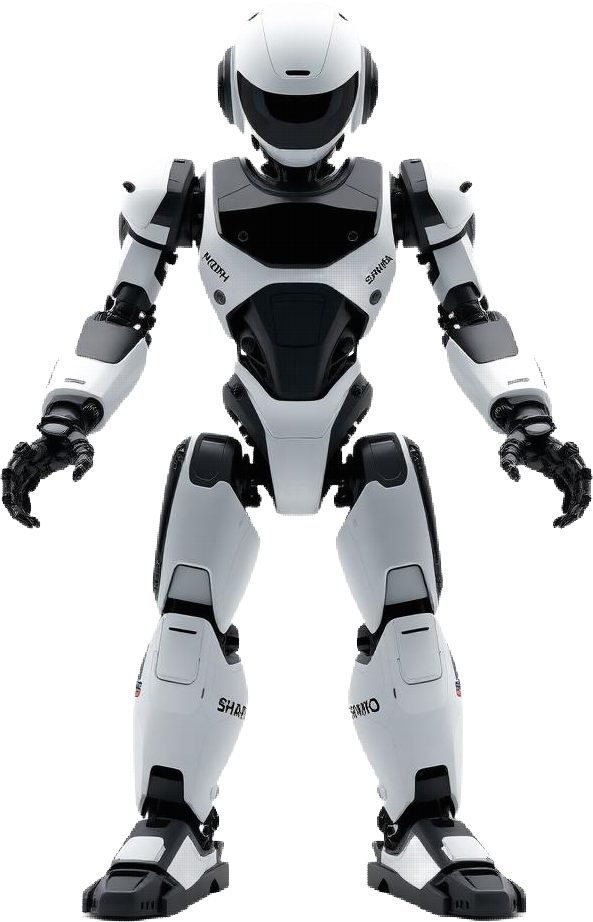
Sharpa North is a general-purpose humanoid robot developed by Sharpa, a Singapore-headquartered artificial intelligence robotics company founded by the three co-founders of Hesai Technology.[5] Unveiled at CES 2026 in Las Vegas, North is Sharpa's first full-body autonomous robot, designed to combine whole-body control with human-level dexterous manipulation.[2] The robot is powered by CraftNet, Sharpa's proprietary Vision-Tactile-Language-Action (VTLA) model,[4] and is equipped with the company's award-winning SharpaWave robotic hands, which feature over 1,000 tactile sensors per fingertip.[7]
| Sharpa North | |
|---|---|
 | |
| General information | |
| Manufacturer | Sharpa |
| Country of origin | Singapore |
| Year unveiled | 2026 |
| Status | In development |
| Locomotion | Wheeled base |
| AI system | CraftNet (VTLA model) |
| Hands | SharpaWave (22 DOF per hand) |
| Target release | Mid-2026 |
| Website | sharpa.com |
North attracted widespread attention at CES 2026 through a series of live autonomous demonstrations,[3] including high-speed ping-pong rallies with a 0.02-second reaction time[9] and a 30-plus-step paper windmill construction sequence. Sharpa expects to release the production version of North by mid-2026.[2]
Company background
Founding and leadership
Sharpa was founded in late 2024 by three co-founders of Hesai Technology,[5] a leading automotive lidar manufacturer listed on NASDAQ (HSAI):
| Name | Role at Sharpa | Background |
|---|---|---|
| Li Yifan (David Li) | CEO | Undergraduate at Tsinghua University in Precision Instruments and Mechanology; Ph.D. from the University of Illinois at Urbana-Champaign focused on robot motion control. Named to MIT Technology Review's Innovators Under 35.[6] |
| Xiang Shaoqing | CTO | Undergraduate at Tsinghua University in Precision Instruments and Mechanology; dual master's degrees in Electrical Engineering and Mechanical Engineering from Stanford University. Former iPhone systems integration engineer at Apple.[6] |
| Sun Kai | Chief Scientist | Undergraduate at Shanghai Jiao Tong University in Mechanical Engineering; Ph.D. in Mechanical Engineering from Stanford University.[6] |
The founders originally met and began their entrepreneurial careers in the San Jose area of Silicon Valley, where they established Hesai Technology in 2014. Hesai grew into the world's largest supplier of automotive lidar by revenue and market capitalization.[6] The company's expertise in precision sensing, optics, and hardware engineering carried directly into Sharpa's development of tactile sensing technology for robotics.
Global operations
Sharpa is headquartered in Singapore, with manufacturing and research and development facilities in Shanghai, China, and business operations in Mountain View, California, in the United States.[5] The company deliberately maintained a low public profile during its first year of operation, generating attention primarily through conference demonstrations rather than marketing campaigns.[6] Industry observers noted that Sharpa's leadership appeared to avoid investor meetings and limited product availability during the early stages, a posture potentially influenced by Hesai Technology's inclusion on the U.S. Department of Defense's list of Chinese military-related companies in January 2024.[6]
By early 2026, Sharpa had achieved unicorn status (a private company valuation exceeding one billion U.S. dollars) and was recognized as a member of NVIDIA's Inception program.[11] The company received both the CES 2026 Innovation Award in the Robotics category and the iF Product Design Award for SharpaWave.[10]
Singapore's robotics ecosystem
Sharpa's choice of Singapore as its global headquarters reflects the city-state's growing prominence as a hub for robotics and deep tech innovation. In March 2025, Singapore's National Robotics Programme launched RoboNexus, an initiative to accelerate robotics startups through global access, mentorship, and industry partnerships.[16] ST Engineering committed S$250 million to AI and robotics in September 2025, with plans to upskill 4,000 engineers.[16] Other notable robotics companies operating out of Singapore include Botsync (autonomous mobile robots for logistics), Venti Technologies (autonomous vehicle technology), and Cortex AI (founded by the former CTO of Carousell).[16] By the end of 2026, Singapore is projected to add nearly 6,000 new startups, many of them focused on deep tech, robotics, sustainability, and AI-driven tools.[16]
Design and hardware
Overall form factor
North follows a wheeled humanoid design, combining an articulated upper body with a wheeled mobile base. The upper body provides a human-like range of motion from the neck through the waist, including full shoulder-to-wrist articulation. This design prioritizes stable and efficient mobility for indoor environments and workspaces while delivering the dexterous manipulation capabilities needed for fine motor tasks. Sharpa has not publicly disclosed North's exact height, weight, or total degrees of freedom for the full body.[15]
SharpaWave dexterous hands
The defining hardware feature of North is its SharpaWave hands, which Sharpa describes as "the world's most advanced human-sized robotic hand."[7] Each hand is built on a unique isomorphic architecture that mirrors the proportions and kinematics of a human hand at a 1:1 scale.[7]
| Specification | Value |
|---|---|
| Degrees of freedom (per hand) | 22 active DOF |
| Hand weight | 1,200 g |
| Hand dimensions | 200 mm x 90 mm x 50 mm |
| Fingertip force | Over 20 N (up to 30 N) |
| Gesture speed | Greater than 4 Hz (4+ open/close cycles per second) |
| Grip cycle durability | Over 1,000,000 cycles |
| Joint design | Back-drivable (impact resistant) |
| Interface | Standard Ethernet |
The SharpaWave entered mass production in October 2025, and early customers include leading global technology companies and top research universities.[7] The hand is priced at approximately $50,000 per unit.[12] It is shipped with SharpaPilot, a proprietary control application, alongside an open-source, developer-friendly software stack compatible with major simulation platforms including NVIDIA Isaac Gym, Isaac Lab, PyBullet, and MuJoCo.[12] High-fidelity simulation models are also provided for ROS platforms.[12]
Dynamic Tactile Array (DTA)
At the core of SharpaWave's sensing capability is Sharpa's proprietary Dynamic Tactile Array (DTA) technology, a visuo-tactile sensing system that combines miniature cameras with dense tactile pixel arrays in each fingertip.[7]
| Tactile sensing specification | Value |
|---|---|
| Tactile pixels per fingertip | Over 1,000 |
| Spatial resolution | Sub-millimeter (less than 1 mm) |
| Pressure sensitivity | 0.005 N across a 0 to 30 N range |
| Force sensing | 6-dimensional (force and torque) |
| Data frame rate | 180 FPS |
| Capabilities | Real-time texture recognition, 6D force detection, slip prevention, adaptive grip control |
Each fingertip integrates a miniature camera alongside the tactile pixel array, enabling a multimodal approach to touch sensing that combines visual and tactile information. The sensors send updated data on pressure, texture, and force readings up to 180 times per second, which the system's artificial intelligence uses to make split-second decisions on how to move or adjust the fingers.[7] Sharpa has described this philosophy with the phrase "tactileless is the new blindness," emphasizing that tactile feedback is as essential to robotic manipulation as vision is to perception.[7]
CraftNet AI system
Architecture overview
North is powered by CraftNet, Sharpa's hierarchical Vision-Tactile-Language-Action (VTLA) model.[4] CraftNet translates high-level, multimodal inputs into continuous, fine-grained actions executed by the robot's dexterous hands, targeting a level of precision and speed that Sharpa claims was previously achievable only by humans. The model addresses what Sharpa calls the "last millimeter" challenge: the final phase of object interaction where precise force control, tactile feedback, and adaptive behavior are critical for successful manipulation.[4]
CraftNet employs a three-system hierarchical architecture with temporal decoupling across distinct operating frequencies:
| System | Name | Function | Operating frequency |
|---|---|---|---|
| System 2 | Reasoning Brain | High-level reasoning, task decomposition, environment perception, and long-horizon planning. Uses a Vision-Language Model (VLM) to break complex tasks into sequential sub-tasks. Open-source interface between robots and operators. | Approximately 1 Hz |
| System 1 | Motion Brain | Motion planning and coarse action control. Optimizes the robot's approach before object contact. Receives semantic intent from System 2 and generates coarse motions and upper-body movements. Trained using domain-specific public or private training data. | Approximately 10 Hz |
| System 0 | Interaction Brain | Super high-frequency fine-motor control for instantaneous interaction. Leverages real-time tactile feedback to continuously readjust hand and finger positions during object contact. Backtracks state vectors to System 1 when execution fails. | Approximately 100 Hz |
The asynchronous design allows each system to operate at its optimal temporal scale. System 2 supplies semantic intent and language instructions to System 1, which generates coarse motions. System 0 receives pre-contact hand poses along with tactile and proprioceptive signals (force, torque) and produces the fine-grained actions needed for successful manipulation.[4]
Training methodology
Sharpa describes CraftNet's data pipeline as a "Midas Touch for Data," referring to its ability to transform various data sources into useful training material across all three systems:
- Real-world data: Collected through teleoperation with human oversight, used to jointly train the systems with high-quality interaction data.
- Simulation data: Used to refine trajectories with realistic post-contact behavior and correct force and compliance patterns.
- Public internet data: System 2 leverages open-source vision-language models, while tactile information is added for System 1 pre-training through a data augmentation process.[4]
Sharpa has announced a phased release plan for CraftNet but has not disclosed the full timeline or detailed benchmarks as of early 2026.[4]
NVIDIA collaboration and TacMap
In March 2026, Sharpa and NVIDIA jointly presented TacMap, a high-fidelity tactile simulation framework designed to bridge the persistent gap between simulation and reality (the "sim-to-real" problem) that has historically slowed progress in dexterous robotics.[11] The core challenge is that highly detailed physical simulations accurately represent contact forces, materials, and tactile feedback but are extremely computationally expensive, while simpler simulations run quickly but fail to capture the subtle physics that manipulation tasks require.
TacMap introduces a shared high-fidelity geometric representation that allows tactile simulation and physical interaction modeling to operate with both accuracy and computational speed.[14] In experiments conducted by NVIDIA's GEAR Lab, researchers successfully transferred policies obtained from pre-training the GR00T model on over 20,000 hours of human video data to robots equipped with Sharpa's Wave hands.[14] The robots completed tasks such as assembling model cars, operating syringes, and sorting cards with a 54% higher success rate compared to policies trained without the TacMap framework.[14]
Sharpa announced that TacMap's simulation assets and code will be released as open source, enabling the broader robotics research community to build on the framework.[11] The collaboration was presented at GTC 2026.[11]
CES 2026 demonstrations
North made its public debut at CES 2026 on January 6, 2026, at the Las Vegas Convention Center (LVCC North Hall, Booth 9251).[8] Across the four-day event, the robot performed four fully autonomous live demonstrations continuously for approximately eight hours per day.[3]
Ping-pong rallies
North played fully autonomous ping-pong rallies against human opponents, demonstrating a reaction time of 0.02 seconds.[9] The robot tracked the ball's trajectory in real time and executed return shots with its SharpaWave hands, combining whole-body coordination with rapid visual processing.[9] This demonstration highlighted the low-latency integration between North's perception system and its motor control.
Instant photography
Acting as an interactive robotic photographer, North captured instant photographs of CES attendees with approximately 2 mm precision in camera positioning.[3] Over the course of the event, the robot took more than 2,000 photos.[3] This demo showcased the robot's ability to combine social interaction (detecting and responding to human subjects) with precise physical manipulation.
Card dealing
North demonstrated card dealing using multimodal reasoning that combined real-time computer vision and natural language processing.[3] The robot could identify individual cards, handle the thin and flexible objects with appropriate grip force, and deal them to specified positions on the table. The task required precise finger dexterity to separate and dispense individual cards from a deck.
Paper windmill construction
The most widely discussed demonstration was North's autonomous assembly of paper windmills. The task required more than 30 consecutive successful manipulation steps, including folding, cutting, and assembling paper components into a complete windmill.[3] Sharpa described this as "one of the longest continuous autonomous manipulation sequences publicly demonstrated by a robot to date."[3] Over the four days of CES 2026, North assembled more than 300 windmills, demonstrating sustained hand-eye-tactile coordination over extended durations without human intervention.[3]
Technical specifications summary
| Category | Specification | Value |
|---|---|---|
| General | Manufacturer | Sharpa |
| General | Country of origin | Singapore |
| General | Year unveiled | 2026 |
| General | Status | In development (production expected mid-2026) |
| General | Type | General-purpose humanoid robot |
| Mobility | Locomotion | Wheeled base |
| Mobility | Upper body | Human-like range of motion (neck to waist) |
| Hands | Model | SharpaWave |
| Hands | DOF per hand | 22 active |
| Hands | Hand weight | 1,200 g |
| Hands | Hand dimensions | 200 mm x 90 mm x 50 mm |
| Hands | Fingertip force | Over 20 N (up to 30 N) |
| Hands | Gesture speed | Greater than 4 Hz |
| Hands | Grip cycle durability | Over 1,000,000 cycles |
| Tactile sensing | Tactile pixels per fingertip | Over 1,000 |
| Tactile sensing | Spatial resolution | Sub-millimeter |
| Tactile sensing | Pressure sensitivity | 0.005 N (range 0 to 30 N) |
| Tactile sensing | Force sensing | 6-dimensional |
| Tactile sensing | Data frame rate | 180 FPS |
| AI system | Model | CraftNet (VTLA) |
| AI system | System 2 (Reasoning Brain) | Approximately 1 Hz |
| AI system | System 1 (Motion Brain) | Approximately 10 Hz |
| AI system | System 0 (Interaction Brain) | Approximately 100 Hz |
| Performance | Reaction time | 0.02 seconds |
| Performance | Photo precision | Approximately 2 mm |
| Performance | Max autonomous task steps | 30+ consecutive steps |
Applications
Sharpa positions North as a general-purpose platform rather than a single-task specialist, with trainable software for diverse applications.[2] The company's stated target markets include:
- Industrial manufacturing: Precision assembly, parts manipulation, and quality inspection tasks that require fine motor control and tactile feedback.
- Research and academia: A platform for robotics researchers studying dexterous manipulation, reinforcement learning, tactile sensing, and human-robot interaction. Early SharpaWave customers already include top research universities.
- Service and hospitality: North's CES demonstrations (photography, card dealing) illustrated potential applications in customer-facing roles that combine social interaction with physical tasks.
- Logistics and warehousing: Object sorting, packaging, and manipulation of irregularly shaped or delicate items.
Sharpa's broader company mission is expressed as "We Manufacture Time by Making Robots Useful," reflecting a philosophy centered on deploying robots to handle repetitive and physically demanding work so that people can pursue more meaningful activities.[3]
Competitive context
North enters a rapidly growing humanoid robot market that saw global shipments exceed 13,317 units in 2025. Several major companies are pursuing humanoid robots with advanced dexterous manipulation:
| Robot | Company | Hand DOF | Notable hand features |
|---|---|---|---|
| Sharpa North | Sharpa | 22 per hand | 1,000+ tactile pixels per fingertip, DTA technology, 180 FPS tactile sensing |
| Optimus Gen 3 | Tesla | 22 per hand | 50 actuators total (25 per forearm/hand), 4.5x increase from Gen 2 |
| Figure 03 | Figure AI | 24+ per hand | Helix AI platform, vision-tactile integration for grip force adjustment |
| Phoenix | Sanctuary AI | Varies | Hydraulic hands, Carbon AI embodied intelligence system |
| Shadow Dexterous Hand | Shadow Robot Company | 24 | Research-grade, priced above $100,000 |
Sharpa differentiates North primarily through its tactile sensing density (1,000+ pixels per fingertip, compared to the more limited tactile capabilities of most competitors), the integrated VTLA AI architecture that fuses vision, touch, and language, and the commercial availability of the SharpaWave hand as a standalone product for third-party integration. The company's approach of selling the hand separately to research labs and robotics companies, while simultaneously developing a full humanoid platform, is relatively unusual in the industry.
Conference and exhibition history
| Date | Event | Location | Presentation |
|---|---|---|---|
| May 2025 | ICRA 2025 | Atlanta, Georgia, USA (Booth #110) | SharpaWave dexterous hand demonstration (egg peeling, scissor cutting, delicate manipulation) |
| October 2025 | IROS 2025 | Hangzhou, China | SharpaWave live manipulation demos (playing cards, fine motor tasks)[13] |
| January 2026 | CES 2026 | Las Vegas, Nevada, USA (LVCC North Hall, Booth 9251) | North full-body humanoid debut with four autonomous demonstrations[8] |
| March 2026 | GTC 2026 | N/A | Joint presentation with NVIDIA on TacMap tactile simulation framework[11] |
Awards and recognition
- CES 2026 Innovation Award (Robotics category) for SharpaWave[10]
- iF Product Design Award for SharpaWave[10]
- Unicorn status achieved by early 2026[11]
- NVIDIA Inception program membership
See also
- Humanoid robots
- Humanoid robot market
- Humanoid robot hands
- Dexterous manipulation
- Sharpa
- SharpaWave
- NVIDIA GR00T
- Figure 03
- Tesla Optimus Gen 3
- Sanctuary AI Phoenix
References
- Sharpa official website
- ^1 ^2 ^3Sharpa Unveils Its First Autonomous Full-Body Robot with Human Dexterity at CES 2026 - Sharpa Blog
- ^1 ^2 ^3 ^4 ^5 ^6 ^7 ^8 ^9Sharpa Aims to "Manufacture Time" via Its CraftNet VTLA Model, and Stuns CES 2026 with Live Autonomous Demos - PR Newswire
- ^1 ^2 ^3 ^4 ^5 ^6Sharpa Announces CraftNet - a Hierarchical VTLA Model for Fine Manipulation - Sharpa Blog
- ^1 ^2 ^3Singapore-based Sharpa surfaces as robotics venture linked to Hesai founders - KrASIA
- ^1 ^2 ^3 ^4 ^5 ^6The Emergence of the Most Mysterious Robotics Company - 36Kr
- ^1 ^2 ^3 ^4 ^5 ^6 ^7AI Robotmaker Sharpa Reaches Key Milestone With Mass Production of World's Most Advanced Human-Sized Robotic Hand - PR Newswire
- ^1 ^2Sharpa Debuts North Humanoid at CES 2026 - Mike Kalil
- ^1 ^2 ^3Robot plays high-speed ping-pong with 0.02-second reaction time - Interesting Engineering
- ^1 ^2 ^3Singapore's Sharpa Wins CES 2026 Innovation Award for Groundbreaking AI Robotic Hand SharpaWave - Sharpa Blog
- ^1 ^2 ^3 ^4 ^5 ^6AI Robotics Unicorn Sharpa and NVIDIA Bridge the Simulation Gap for Dexterous Robot Training - RoboticsTomorrow
- ^1 ^2 ^3Sharpa Robotics Begins Shipping Its SharpaWave Hand - Humanoids Daily
- ^Sharpa's Robotic Hand is Real and Deft at IROS 2025 - RoboHorizon
- ^1 ^2 ^3TacMap: Bridging the Tactile Sim-to-Real Gap via Geometry-Consistent Penetration Depth Map - arXiv
- ^HumanoidSpecs.com - Sharpa North
- ^1 ^2 ^3 ^4Top Robotics Companies in Singapore - 2026 Guide
Improve this article
Add missing citations, update stale details, or suggest a clearer explanation. Every suggestion is reviewed for sourcing before it goes live.
9 revisions · v9 · 3,060 words · full history
Fact-checks are independent of edits: a reviewer re-verifies the article against its sources and stamps the date. How we verify
Research and drafting on this wiki are AI-assisted, under named human editorial standards. How AI is used here
Cite this page: AI Wiki. "Sharpa North." aiwiki.ai, updated 16 Jul 2026. CC BY 4.0. https://aiwiki.ai/wiki/sharpa_north