

Allegro Hand
The Allegro Hand is a low-cost, four-fingered anthropomorphic research hand built by Wonik Robotics of South Korea, and one of the most widely used dexterous hands in academic robot manipulation and robot learning. Its standard configuration has 16 independently actuated joints (four fingers with four joints each), each driven by a small geared brushed DC motor and controlled in real time over a CAN bus [1][2]. Because it sells for a small fraction of the price of the Shadow Robot Dexterous Hand while still offering full anthropomorphic dexterity, the Allegro Hand became the default hardware platform for a decade of machine-learning research on grasping, in-hand manipulation, and sim-to-real transfer [3][11].
| Allegro Hand | |
|---|---|
| Maker | Wonik Robotics (formerly SimLab Co., Ltd.), South Korea |
| Origin | Technology licensed from KITECH (Korea Institute of Industrial Technology) |
| Type | Anthropomorphic research dexterous hand |
| Fingers | 4 (thumb plus three fingers); 3-finger option on V5 |
| Degrees of freedom | 16 active (4 fingers x 4 joints); 9 on the 3-finger V5 |
| Actuation | Brushed DC motors, 1:369 gear reduction, current/torque control |
| Payload | About 5 kg |
| Control interface | CAN bus at 333 Hz (1 Mbps) |
| Joint sensing | Absolute position (potentiometer) at every joint |
| Mass | About 1.1 to 1.2 kg (hand only) |
| First release | 2012 (V1); V4 in 2018; V5 in 2024 |
| List price (V4) | Roughly 15,000 to 30,000 USD |
What the Allegro Hand is
The Allegro Hand is a right- or left-handed, human-scale hand with a thumb and three fingers, giving it 16 degrees of freedom arranged as four fingers times four joints [1][2]. It is important to be precise here: the standard Allegro Hand is a 16-DOF, 4-finger design, not a 5-finger hand, and it has no little finger. Each joint is powered by a brushed DC motor through a spur-gear train with a 1:369 reduction ratio, producing a maximum joint torque of roughly 0.7 Nm [5]. The whole hand weighs about 1.1 to 1.2 kg and can hold objects of up to about 5 kg according to the manufacturer's specification sheet [5].
Sensing and control deserve careful description because secondary sources often state them loosely. Every joint carries an absolute position sensor (a potentiometer) with a nominal resolution near 0.002 degrees; there are no dedicated joint torque sensors [5][6]. Instead, the hand controls torque through motor current: because a DC motor's torque is proportional to current, the low-level firmware regulates current to command a desired joint torque, which is why Wonik's documentation variously describes the joints as "torque-controlled" and "current-controlled" (the two mean the same thing here) [5][6]. A conventional position controller is layered on top for setpoint holding and preset grasps. All of this runs over a CAN bus at a 333 Hz control frequency with a 1 Mbps baud rate, and the hand draws power from a low-voltage DC supply (roughly 7 to 24 V depending on the generation, on the order of 100 W under load) [5][6].
Origins: KITECH, SimLab, and Wonik Robotics
The Allegro Hand's underlying technology came out of the Humanoid Robot Hand Research Group at the Korea Institute of Industrial Technology (KITECH), a South Korean government research institute [2][4]. The commercial hand was developed and sold by SimLab Co., Ltd., a Seoul robotics-software company founded in 2004 that is best known for its RoboticsLab simulation suite [3][4]. In 2012, SimLab received a technology transfer of humanoid-hand technology from KITECH and began producing and selling the first Allegro Hand (V1) that same year [4]. The bundled grasping routines that ship with the hand, historically called the BHand (Basic Hand) library, are a set of grasping algorithms and finger motions authored by KITECH researchers [3].
In 2016, SimLab was incorporated into the Wonik Group, a large South Korean industrial conglomerate whose subsidiaries supply semiconductor and display equipment and materials, and the company was renamed Wonik Robotics [4]. The firm is headquartered in the Pangyo technology cluster in Seongnam-si, Gyeonggi-do [4]. Older ROS driver repositories, brochures, and wikis still carry the SimLab name and logo, which is a frequent source of confusion; SimLab and Wonik Robotics are the same lineage, not two separate makers [3][5].
One point worth correcting: some robotics aggregator articles claim the Allegro Hand was "originally developed at the University of Bologna." That is incorrect and appears to conflate it with the unrelated UB Hand (University of Bologna Hand). The Allegro Hand's origin is KITECH in Korea, commercialized by SimLab/Wonik Robotics [2][4].
Versions
Wonik has iterated the hardware steadily since 2012. The V4 generation, launched in 2018, is the long-standing standard that appears in most published research [4]. In 2024 the company introduced the V5 family, which moved to a fully torque-based controller and added tactile sensing, and it now sells the V5 in several configurations [4][14].
| Version | Year | Fingers | Active DOF | Notable changes |
|---|---|---|---|---|
| V1 | 2012 | 4 | 16 | First commercial hand after the KITECH technology transfer [4] |
| V2 | 2013 | 4 | 16 | Mechanical and firmware refinement [4] |
| V3 | 2014 | 4 | 16 | Further refinement [4] |
| V4 | 2018 | 4 | 16 | The research standard; brushed DC, CAN at 333 Hz, position and current/torque control; no built-in tactile (optional third-party add-ons) [1][5] |
| V5 | 2024 | 3 | 9 | Lighter three-finger configuration; fully torque-controlled; 360-degree tactile fingertips; interchangeable fingertip types [4][14] |
| V5 Plus | 2024 to 2025 | 4 | 16 | Four-finger successor to V4 with omnidirectional tactile fingertips; obtained CE certification in 2025 [4][14] |
| V5 Sense | 2025 | 4 | 16 | Adds 16 pressure-sensing channels for grip that adapts to object stiffness [1][14] |
The V5 line is the most significant change since the original design. Wonik split the product into a slimmer three-finger, 9-DOF base hand (V5) and a four-finger, 16-DOF hand that preserves the classic layout (V5 Plus), then added a tactile-rich variant (V5 Sense) with pressure sensing on each fingertip [1][14]. Note that some early write-ups garbled this by describing the V5 as "a 9-DOF three-finger structure with 16 joints across its four fingers" in a single sentence; those are two different configurations, not one [14]. The V5 also demonstrated an adaptive grip that adjusts force to an object's characteristics, which Wonik publicized in March 2024, and the company showed V5, V5 Plus, and V5 Sense together with a re-grasping and teleoperation demo at CES 2026 [7][8].
Specifications (V4 standard)
| Parameter | Value |
|---|---|
| Fingers | 4 (thumb plus three fingers) [5] |
| Degrees of freedom | 16 (4 fingers x 4 joints) [1][5] |
| Actuator | Brushed DC motor per joint [5] |
| Gear reduction | 1:369 spur gearing [5] |
| Maximum joint torque | About 0.7 Nm (up to roughly 0.9 Nm in overdrive) [5][6] |
| Joint position sensing | Absolute potentiometer, ~0.002 deg nominal resolution [5][6] |
| Torque sensing | None dedicated; torque commanded via motor current [5][6] |
| Communication | CAN bus, 333 Hz, 1 Mbps [5][6] |
| Payload / holding force | About 5 kg [5] |
| Mass | About 1.1 to 1.2 kg (hand only) [5][6] |
| Power | Low-voltage DC (about 7 to 24 V by generation), ~100+ W under load [5][6] |
| Supported OS | Windows and Linux (ROS) [5] |
The hand ships as a right or left unit and mounts to a standard robot-arm flange. Because it uses off-the-shelf brushed DC motors and simple gearing rather than the tendon routing and pneumatic muscles of a Shadow hand, it is comparatively robust, easy to service, and cheap to run, at the cost of somewhat lower fingertip force and no built-in tactile skin in the V4 [1][5].
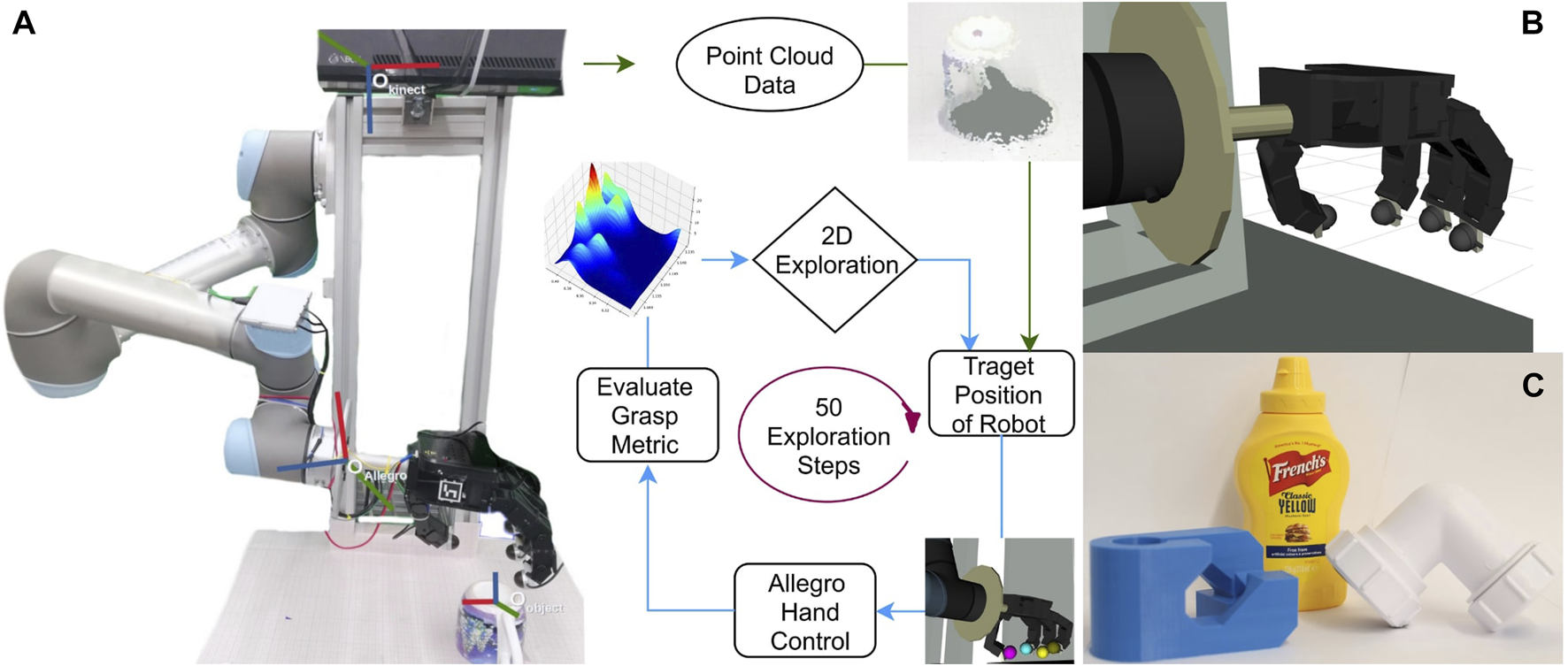
A 2021 Allegro Hand research setup: a UR5 arm and tactile-equipped hand (A), the simulated hand (B), and experimental objects (C).[19] Figure: Muhammad Sami Siddiqui, Claudio Coppola, Gokhan Solak and Lorenzo Jamone. CC BY 4.0.
Research adoption
Alongside the Shadow Robot Dexterous Hand, the Allegro Hand is one of the two canonical multi-fingered hands in academic manipulation research, and it is by far the more common choice for cost-sensitive machine-learning labs [11][14]. The Shadow hand is the more capable and far more expensive platform; it is the hand OpenAI customized for its Dactyl system that solved a Rubik's Cube one-handed in 2019 [15]. The Allegro Hand filled the role of an affordable, anthropomorphic testbed that many groups could actually buy.
Representative published work using the Allegro Hand includes:
- DeXtreme (NVIDIA, 2022), which trained a four-fingered Allegro Hand to reorient a cube to arbitrary target poses. The policy was trained entirely in the Isaac Gym GPU simulator using automatic domain randomization, then transferred to the physical hand, a widely cited demonstration of sim-to-real reinforcement learning [11].
- In-Hand Object Rotation via Rapid Motor Adaptation (Qi et al., CoRL 2022), which rotated objects continuously in the palm of an Allegro Hand using a controller that rapidly adapts to object properties [12].
- AnyRotate (2024), which mounted a 16-DOF Allegro Hand with tactile skin on a UR5 arm to perform gravity-invariant in-hand object rotation from touch, again trained in simulation and transferred to hardware [13].
The hand is also common in imitation learning, teleoperation, and bimanual setups, where two Allegro Hands are mounted on a pair of arms for two-handed manipulation experiments [1][12]. Its long track record means simulation models, grasping datasets, and reference controllers for the Allegro Hand are widely available, which further reinforces its use as a default platform.
Software and integration
Wonik and the research community maintain open drivers for the Robot Operating System. The original allegro_hand_ros stack (published under the SimLab name) supports ROS 1, and Wonik now ships official ROS 1 and ROS 2 packages for the V5 hand; the ROS 2 driver targets ROS 2 Humble on Ubuntu 22.04 and integrates with MoveIt 2 for motion planning [3][18]. On the V5 driver, control is fully torque-based, whereas the V4 exposed both position and current/torque command modes [6][18].
Physically, the hand connects to a host PC through a CAN interface (PEAK PCAN, Kvaser, ESD, NI, and similar adapters have all been used), and it bolts onto common research arms including the Universal Robots UR5e and UR10e and Kinova Gen3 through simple mounting adapters [1][3]. Because the V4 has no built-in tactile sensing, groups that need touch typically add third-party skins: XELA Robotics offers a uSkin integration with curved fingertip sensors and flat pads on the phalanges and palm that streams three-axis tactile data over CAN, and earlier sensor options included SynTouch BioTac fingertips and Weiss Robotics tactile pads [5][10]. The V5 line folds 360-degree pressure sensing directly into the fingertips, reducing the need for aftermarket tactile hardware [1][14].
Comparison with other dexterous hands
The Allegro Hand sits in the middle of the research-hand market: more anthropomorphic and dexterous than a simple parallel gripper, cheaper and more serviceable than a Shadow hand, and more richly actuated than most budget commercial hands such as the Inspire Robots RH56 series.
| Allegro Hand (V4 / V5 Plus) | Shadow Dexterous Hand | Inspire RH56 series | |
|---|---|---|---|
| Maker (country) | Wonik Robotics (South Korea) [4] | Shadow Robot Company (United Kingdom) [14] | Inspire Robots (China) [17] |
| Fingers | 4 (thumb + 3) [5] | 5 (thumb + 4) [14] | 5 (thumb + 4) [17] |
| Active DOF | 16 [1] | About 20 (24 joints) [14] | 6, underactuated (12 joints) [17] |
| Actuation | Geared brushed DC motors in the hand [5] | Tendon-driven from the forearm (DC motors or air muscles) [14] | Linear servo actuators with linkages [17] |
| Position sensing | Absolute potentiometer per joint [5] | Hall-effect sensor per joint [14] | Joint encoders [17] |
| Tactile sensing | Optional add-ons (V4); omnidirectional fingertips (V5) [10][14] | Optional (pressure arrays, BioTac); 100+ sensors [14] | Optional; up to about 260 points on some models [17] |
| Control rate | CAN, 333 Hz [5] | Up to about 1 kHz [14] | Position and force control [17] |
| Rough cost tier | Mid: about 15k to 30k USD [3] | Premium: about 100k to 150k USD [14] | Budget: low thousands to about 20k USD by model and region [17] |
A newer entrant worth noting is the open-source LEAP Hand from Carnegie Mellon University (RSS 2023), a 16-DOF, four-finger hand that can be built from off-the-shelf parts for around 2,000 USD and is explicitly positioned as a cheaper, open alternative to the Allegro Hand [16]. Its existence is a sign of how much the Allegro Hand defined the category: it is the reference point that low-cost hands are measured against.
ELI5
Imagine a robot hand about the size of yours, but with a thumb and only three fingers instead of four. Inside each finger are little motors that bend the joints, so the whole hand has 16 places it can move. A computer sends it commands many hundreds of times a second through a single cable, telling each joint how hard to push. It can grab and hold something as heavy as a big bag of sugar. What makes the Allegro Hand special is not that it is the fanciest hand (a hand called the Shadow hand is fancier) but that it is much cheaper and tough enough to run all day, so university labs bought lots of them and used them to teach robots how to twirl blocks and pick things up. That is why so many robot-learning experiments you read about are done on this exact hand.
See also
- Dexterous hand
- Shadow Robot
- Inspire Robots
- Humanoid robot hands
- Tactile sensing
- Robot manipulation
- Robot learning
- Sim-to-real
- Reinforcement learning
- Dactyl
References
- ^1 ^2 ^3 ^4 ^5 ^6 ^7 ^8 ^9 ^10 ^11Allegro Hand, official site (product lineup: V4, V5, V5 Plus, V5 Sense). allegrohand.com, accessed 2026. allegrohand.com
- ^1 ^2 ^3 ^4Allegro Hand Overview, Wonik Robotics Wiki (four fingers, sixteen independent joints; KITECH-licensed technology). wiki.wonikrobotics.com, accessed 2026. wiki.wonikrobotics.com/...Allegro_Hand_Overview
- ^1 ^2 ^3 ^4 ^5 ^6 ^7simlabrobotics, allegro_hand_ros (ROS stack for SimLab's Allegro Hand; BHand grasping library; RoboticsLab). GitHub. github.com/...allegro_hand_ros
- ^1 ^2 ^3 ^4 ^5 ^6 ^7 ^8 ^9 ^10 ^11 ^12 ^13 ^14Wonik Robotics, "Company History" (SimLab founded 2004; KITECH technology transfer 2012; Allegro Hand V1 2012, V2 2013, V3 2014; renamed Wonik Robotics into Wonik Group 2016; V4 2018; V5 2024; CE certification for V5/V5 Plus 2025). wonikrobotics.com, accessed 2026. wonikrobotics.com/...history
- ^1 ^2 ^3 ^4 ^5 ^6 ^7 ^8 ^9 ^10 ^11 ^12 ^13 ^14 ^15 ^16 ^17 ^18 ^19 ^20 ^21 ^22 ^23 ^24 ^25SimLab / Wonik Robotics, "Allegro Hand Brochure" (4 fingers x 4 = 16 DOF; brushed DC; gear ratio 1:369; max torque 0.7 Nm; absolute potentiometer encoders; CAN 333 Hz; payload 5 kg; mass ~1.09 kg). Product brochure (PDF). alexalspach.com/...AllegroHand_Brochure_SimLab.pdf
- ^1 ^2 ^3 ^4 ^5 ^6 ^7 ^8 ^9 ^10Wonik Robotics, "Allegro Hand User Manual" (current-controlled joints; 0.70 Nm / 0.90 Nm overdrive; potentiometer 0.002 deg; CAN 333 Hz, 1 Mbps; 12 to 24 V, 120 W). ManualsLib. manualslib.com/...Wonik-Robotics-Allegro-Hand
- ^Wonik Robotics, "New Robotic Hand Adjusts Grip Strength Based on Object's Characteristics," press release, 26 March 2024. wonikrobotics.com/...news
- ^Allegro Hand News, "A Sneak Peek at Key Technologies and New Products Unveiling at CES 2026" (V5, V5 Plus, V5 Sense; re-grasp technology; vision and RL-based manipulation; teleoperation). allegrohand.com, 2026. allegrohand.com/...news
- Allegro Hand v4.0, Wonik Robotics Wiki (V4 specifications and setup). wiki.wonikrobotics.com. wiki.wonikrobotics.com/...Allegro_Hand_v4.0
- ^1 ^2XELA Robotics, "For Allegro Hand V4 Curved" (uSkin three-axis tactile integration; curved fingertip sensors plus flat pads; ~70 Hz over CAN). xelarobotics.com. xelarobotics.com/...allegro-hand-curved
- ^1 ^2 ^3A. Handa, A. Allshire, V. Makoviychuk, et al., "DeXtreme: Transfer of Agile In-hand Manipulation from Simulation to Reality," arXiv:2210.13702, 2022 (Allegro Hand cube reorientation in Isaac Gym with automatic domain randomization). arxiv.org/...2210.13702
- ^1 ^2H. Qi, A. Kumar, R. Calandra, Y. Ma, J. Malik, "In-Hand Object Rotation via Rapid Motor Adaptation," Conference on Robot Learning (CoRL) 2022 (Allegro Hand). Project code: github.com/...hora
- ^M. Yang, C. Lu, A. Church, et al., "AnyRotate: Gravity-Invariant In-Hand Object Rotation with Sim-to-Real Touch," arXiv:2405.07391, 2024 (16-DOF Allegro Hand with tactile skin on a UR5). arxiv.org/...2405.07391
- ^1 ^2 ^3 ^4 ^5 ^6 ^7 ^8 ^9 ^10 ^11 ^12 ^13 ^14 ^15 ^16 ^17Shadow Robot Company, "Shadow Dexterous Hand" (5 fingers, ~20 actuated DOF, 24 joints, tendon-driven, Hall-effect joint sensors, 100+ sensors, tactile options); and Wikipedia, "Shadow Hand." shadowrobot.com/dexterous-hand-series and en.wikipedia.org/...Shadow_Hand
- ^OpenAI, "Solving Rubik's Cube with a Robot Hand," arXiv:1910.07113, 2019 (customized Shadow Dexterous Hand, 24 DOF; automatic domain randomization). arxiv.org/...1910.07113
- ^K. Shaw, A. Agarwal, D. Pathak, "LEAP Hand: Low-Cost, Efficient, and Anthropomorphic Hand for Robot Learning," Robotics: Science and Systems (RSS) 2023 (16-DOF, 4-finger, ~2,000 USD open-source alternative to the Allegro Hand). arXiv:2309.06440. arxiv.org/...2309.06440
- ^1 ^2 ^3 ^4 ^5 ^6 ^7 ^8Inspire Robots, "The Dexterous Hands RH56 Series" and RH56 Series User Manual (5 fingers, 6 active DOF, linear servo actuators, tactile options). en.inspire-robots.com. en.inspire-robots.com/...rh56dfx
- ^1 ^2Wonikrobotics-git, "allegro_hand_ros2_v5" (official ROS 2 driver for the Allegro Hand V5, 4-finger; ROS 2 Humble on Ubuntu 22.04; MoveIt 2; fully torque-based control). GitHub. github.com/...allegro_hand_ros2_v5
- ^Muhammad Sami Siddiqui, Claudio Coppola, Gokhan Solak and Lorenzo Jamone. Figure 1, "Grasp Stability Prediction for a Dexterous Robotic Hand Combining Depth Vision and Haptic Bayesian Exploration". Frontiers in Robotics and AI 8:703869, August 12, 2021. CC BY 4.0. Original publisher figure; no changes.
Improve this article
Add missing citations, update stale details, or suggest a clearer explanation. Every suggestion is reviewed for sourcing before it goes live.
3 revisions · v3 · 2,913 words · full history
Fact-checks are independent of edits: a reviewer re-verifies the article against its sources and stamps the date. How we verify
Research and drafting on this wiki are AI-assisted, under named human editorial standards. How AI is used here
Cite this page: AI Wiki. "Allegro Hand." aiwiki.ai, updated 4 Oct 2026. CC BY 4.0. https://aiwiki.ai/wiki/allegro_hand