

Hexagon AEON
Hexagon AEON is an industrial humanoid robot developed by the Robotics Division of Hexagon AB, a Swedish multinational technology company known for precision measurement, sensor technology, and industrial software. Unveiled on June 17, 2025, at the Hexagon LIVE Global conference in Las Vegas, AEON was developed in partnership with NVIDIA, Microsoft, and Swiss actuator manufacturer maxon. The robot is purpose-built for industrial environments, targeting applications in manufacturing, automotive assembly, aerospace, warehousing, and logistics.
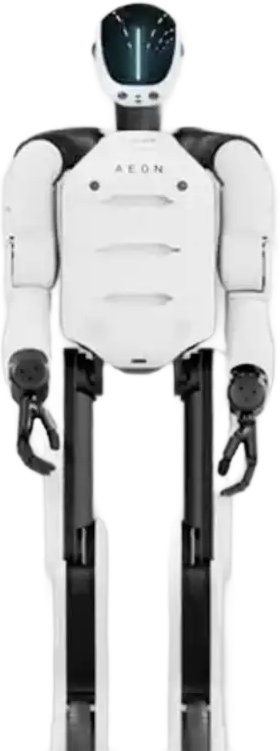 | |
| Developer | Hexagon AB (Robotics Division) |
| Type | Humanoid robot (wheeled) |
| Unveiled | June 17, 2025 |
| Height | 165 cm (5 ft 5 in) |
| Weight | 60 kg (132 lb) |
| Degrees of Freedom | 34 |
| Top Speed | 2.4 m/s (8.6 km/h / 5.4 mph) |
| Payload | 15 kg (short-term); 8 kg (continuous) |
| Battery | Hot-swappable lithium; ~4 hours per pack |
| Sensors | 22+ (RGB, LiDAR, depth, ToF, IR, SLAM, microphones, force/torque) |
| Compute | 2x NVIDIA Jetson Orin; upgrade path to IGX Thor |
| Actuators | maxon next-generation |
| Locomotion | Wheeled bipedal |
| Hands | Five-fingered, interchangeable attachments |
| Headquarters | Zurich, Switzerland (Robotics Division) |
| Website | robotics.hexagon.com |
AEON stands 165 cm tall, weighs 60 kg, and has 34 degrees of freedom. Its most distinctive design feature is a wheeled locomotion system: rather than feet, each leg terminates in a wheel, allowing the robot to roll across flat factory floors at speeds up to 2.4 m/s while retaining the ability to step over obstacles when needed. The robot carries over 22 sensors, including LiDAR, RGB cameras, depth sensors, time-of-flight sensors, infrared cameras, SLAM navigation cameras, microphones, and force/torque sensors, giving it 360-degree spatial awareness. Two NVIDIA Jetson Orin AI computers run motion planning, spatial AI, and edge reasoning entirely onboard.
Hexagon's entry into humanoid robotics draws on its decades of expertise in precision measurement and metrology. The company positions AEON not as a general-purpose walking robot but as a sensor-rich platform capable of performing quality-critical tasks such as part inspection, digital reality capture, and the creation of centimeter-accurate digital twins. As of early 2026, AEON is being piloted at BMW Group's Leipzig plant, Schaeffler Group facilities, and Pilatus Aircraft's operations in Switzerland, with plans for broader commercial availability by the end of 2026.
Background
Hexagon AB
Hexagon AB was founded on August 29, 1970, in Stockholm, Sweden. For its first three decades, the company operated as a diversified conglomerate with investments spanning seafood imports, vehicle hydraulics, and day-care centers. The company's transformation into a precision technology leader began in 1998, when financier Melker Schorling acquired a controlling stake and appointed Ola Rollen as CEO in 2000.[1]
Under Rollen's leadership, Hexagon embarked on an aggressive acquisition strategy focused on precision measurement technology and industrial software. Between 2000 and 2022, the company completed more than 170 acquisitions.[1] Two acquisitions in particular shaped the company's identity. In late 2001, Hexagon acquired Brown and Sharpe, a historic American manufacturer of metrological instruments. In 2005, Hexagon purchased Leica Geosystems, the Swiss maker of surveying, geospatial, and 3D scanning equipment, significantly expanding its capabilities in geospatial measurement and reality capture.[1]
By 2025, Hexagon had grown into a global leader in measurement technology, industrial software, and autonomous solutions. The company employs approximately 24,800 people across 50 countries and reported annual net sales of roughly 5.4 billion euros.[2] Its operations span multiple divisions, including Manufacturing Intelligence (metrology systems, CAD/CAM software), Geosystems (sensors for capturing data from land and air, satellite positioning), Mining, Safety, Infrastructure, and Geospatial, and Autonomy and Positioning.
Ola Rollen stepped down as CEO at the end of 2022 and transitioned to the role of chairman of the board. In September 2025, Cadence Design Systems announced it would acquire Hexagon's design and engineering business for approximately 2.7 billion euros, signaling a restructuring of the company's portfolio.[1]
Hexagon Robotics Division
Hexagon established a dedicated Robotics Division headquartered in Zurich, Switzerland, to develop and commercialize AEON. The division is led by Arnaud Robert, who serves as President of Hexagon Robotics. Robert described the division's mission as "advancing physical AI to tackle real operational challenges, bridging cutting-edge technology with practical industry needs."[2]
The creation of a standalone robotics division reflected Hexagon's strategic bet that its existing strengths in sensor technology, precision measurement, and industrial software gave it a distinctive advantage in the emerging humanoid robotics market. While most humanoid robot developers were building sensor and software capabilities from scratch, Hexagon already had decades of experience in the exact technologies needed for industrial perception and quality assurance.
Development and NVIDIA Collaboration
AEON's development relied heavily on NVIDIA's full-stack robotics and simulation platforms. The collaboration covered AI training, simulation, onboard computing, and deployment.
For training, Hexagon used NVIDIA's Isaac GR00T N1.5, an open foundation model for robot reasoning, and Isaac GR00T-Mimic, which generates synthetic motion data from human demonstrations. These tools allowed AEON to master core locomotion skills in two to three weeks, compared to the five to six months that would typically be required for training from scratch.[3]
Simulation was handled through the NVIDIA Omniverse platform running on OVX servers, along with NVIDIA Isaac Sim for robotic simulation and NVIDIA Isaac Lab for open-source reinforcement learning. Hexagon adopted a simulation-first approach, refining complex robot actions in digital environments before deploying them in the real world.[3]
Hexagon's Reality Cloud Studio (RCS) platform integrates with Omniverse for digital twin visualization, using the OpenUSD framework for high-fidelity digital twin generation. This creates what NVIDIA describes as a "data flywheel": real-world scans captured by AEON continuously improve the simulation environments used for further training.[3]
Deepau Talla, NVIDIA's Vice President of Robotics, said of the partnership: "The age of general-purpose robotics has arrived, due to technological advances in simulation and physical AI." Robert added: "By leveraging NVIDIA's full-stack robotics and simulation platforms, we delivered a best-in-class humanoid."[3]
Unveiling at Hexagon LIVE Global 2025
AEON was unveiled on June 17, 2025, at the Hexagon LIVE Global conference held at the Fontainebleau resort in Las Vegas, Nevada. The event ran from June 16 to 19 and drew more than 3,000 customers, partners, influencers, and employees from 59 countries.[4]
The announcement included the reveal of AEON's initial pilot partnerships with BMW Group, Schaeffler Group, and Pilatus Aircraft. Hexagon stated that it would begin deploying AEON in production environments within six months, with an expanded commercial rollout to follow.[2]
Ola Rollen, Hexagon's chairman, struck a confident tone at the launch: "Hexagon is one of the best-placed companies in the world to lead and shape the field of humanoid robotics."[2] The claim rested on Hexagon's argument that its existing sensor technology, metrology expertise, and established relationships with major manufacturers provided advantages that pure-play robotics startups would struggle to replicate.
The Hexagon LIVE 2025 event also saw the launch of Octave, a new company spun out of Hexagon's divisions, with Mattias Stenberg named as CEO. ETQ and Bricsys became part of the Octave entity.[4]
Technical Specifications
Physical Design
AEON stands 165 cm (5 feet 5 inches) tall and weighs 60 kg (132 pounds), making it roughly the size of an average adult. Its upper body is human-like, with articulated arms and dexterous five-fingered hands. The robot has 34 degrees of freedom distributed across its body, enabling a wide range of manipulation and movement capabilities.
A key design decision distinguishes AEON from most competitors: its legs terminate in wheels rather than feet. This wheeled-bipedal hybrid design allows the robot to roll efficiently across the flat surfaces common in factories and warehouses, reaching speeds of 2.4 m/s (8.6 km/h). The robot can also step over obstacles when rolling is not feasible. This approach trades the ability to climb stairs or navigate highly uneven terrain for significantly faster and more energy-efficient movement on industrial floors.[5]
The robot's body is designed to support flexible attachment of gripping tools and scanning equipment. The hands are interchangeable, meaning AEON can swap between five-fingered dexterous hands, parallel grippers, and specialized scanning tool attachments depending on the task at hand.[6]
Detailed Specifications
| Parameter | Value |
|---|---|
| Height | 165 cm (5 ft 5 in) |
| Weight | 60 kg (132 lb) |
| Degrees of freedom | 34 |
| Top speed | 2.4 m/s (8.6 km/h / 5.4 mph) |
| Short-term payload | 15 kg (33 lb) |
| Continuous carry payload | 8 kg (17.6 lb) |
| Fingers per hand | 5 (interchangeable) |
| Total sensors | 22+ |
| Cameras | 12 (RGB, peripheral, SLAM navigation) |
| LiDAR | Yes |
| Depth sensors | Time-of-flight |
| Infrared sensors | Yes |
| Microphones | Multi-directional |
| Force/torque sensors | Yes |
| Onboard compute | 2x NVIDIA Jetson Orin |
| Planned compute upgrade | NVIDIA IGX Thor (functional safety) |
| Battery type | Hot-swappable lithium |
| Battery life | ~4 hours per pack |
| Battery swap time | ~23 seconds |
| Continuous operation | 24/7 capable (via auto-swap) |
| Connectivity | Wi-Fi 6, Gigabit Ethernet |
| Operating system | Linux |
| Locomotion type | Wheeled bipedal |
Sensor Suite
AEON carries over 22 integrated sensors, making it one of the most sensor-dense humanoid platforms available. The suite includes 12 cameras spanning RGB, peripheral vision, and SLAM (Simultaneous Localization and Mapping) navigation. Additional sensors include a LiDAR system, time-of-flight depth sensors, infrared sensors, multi-directional microphones, and force/torque sensors.[5][7]
This multimodal sensor fusion provides 360-degree real-time spatial awareness. The sensor data is fused onboard to build centimeter-accurate 3D maps of the robot's environment, which can be uploaded directly to Hexagon's Reality Cloud Studio via Wi-Fi 6 or Gigabit Ethernet for digital twin creation.[3]
Hexagon's background in precision measurement is directly reflected in AEON's sensor capabilities. The robot features specialized infrared and autofocus cameras capable of micron-level inspection, drawing on Hexagon's decades of experience with Leica Geosystems scanning equipment and manufacturing metrology tools.[7] This sensor stack goes well beyond what most humanoid competitors offer and represents the core differentiator in Hexagon's market positioning.
Computing and AI
Two NVIDIA Jetson Orin AI computers are housed inside AEON's torso. These handle motion planning, spatial AI processing, and edge-level large language model reasoning entirely onboard, with no dependency on cloud connectivity for real-time operation.[5]
An upgrade path to NVIDIA IGX Thor is planned. The IGX Thor module adds certified functional safety capabilities, which would allow AEON to work alongside human workers without requiring protective cages or safety barriers. This is a critical requirement for deployment in collaborative manufacturing environments.[3]
On the software side, AEON uses NVIDIA Isaac GR00T N1.5 as its foundation model for robot reasoning, supplemented by Isaac GR00T-Mimic for learning from human demonstrations. The robot's AI stack handles autonomous navigation through complex factory environments, real-time object recognition and manipulation planning, defect detection during part inspection, and mission-level task sequencing through an AI-driven mission control system.[3]
Actuators and Locomotion
AEON's locomotion and joint actuation are powered by maxon's next-generation actuators. Maxon, headquartered in Sachseln, Switzerland, is a long-established manufacturer of precision electric motors and drive systems used in aerospace, medical, and industrial applications. The partnership brings proven, high-reliability actuator technology to AEON's 34 degrees of freedom.[2]
The wheeled locomotion system is a deliberate engineering choice for industrial environments. Most factory and warehouse floors are flat, hard surfaces where wheels offer substantial advantages in speed and energy efficiency over bipedal walking. AEON moves at 2.4 m/s, roughly twice the average human walking speed, allowing it to cover large factory footprints efficiently. The robot retains the ability to handle minor obstacles through a stepping motion when wheels alone are insufficient.[5][6]
Power System
AEON uses a hot-swappable lithium battery system. Each battery pack provides approximately four hours of operation. The robot features an automatic battery swap mechanism that can replace a depleted battery in roughly 23 seconds, enabling continuous 24/7 operation without downtime for recharging.[2][5]
This approach contrasts with most competing humanoid robots, which require the robot to dock at a charging station when batteries run low, taking it offline for extended periods. Hexagon's battery swap design is targeted at industrial use cases where uninterrupted operation across multiple shifts is a practical necessity.
Technology Partnerships
NVIDIA
The NVIDIA partnership spans the full technology stack. NVIDIA provides the accelerated computing hardware (Jetson Orin, with IGX Thor planned), the Omniverse simulation platform for development and testing, the Isaac robotics software suite for training and deployment, and the GR00T foundation models for robot reasoning. NVIDIA OVX servers provide the computing infrastructure for simulation workloads during development.[3]
Microsoft
In January 2026, Hexagon Robotics announced a strategic collaboration with Microsoft to advance industrial humanoid robots. The partnership combines AEON's sensor fusion and spatial intelligence with Microsoft Azure's scalable AI and cloud infrastructure. Key areas of collaboration include data management, one-shot imitation learning, training for multimodal AI models, and deployment of Azure-based robotics systems from development through factory integration.[8]
Specific Microsoft technologies involved include Fabric Real-Time Intelligence in Microsoft Fabric, Azure IoT Operations, and Azure App Service. The partnership aims to expand physical AI frameworks, including imitation learning, reinforcement learning, and multimodal vision-language-action models. Through this collaboration, AEON has demonstrated real-time defect detection and operational intelligence capabilities in early testing.[8]
maxon
Maxon provides the next-generation actuators that power AEON's locomotion and joint movement. The company's precision motor and drive technology is used across AEON's 34 degrees of freedom, enabling the combination of smooth wheeled movement and dexterous upper-body manipulation.[2]
Industrial Applications
AEON is designed for four primary categories of industrial work:[2][5]
| Application Category | Description | Example Tasks |
|---|---|---|
| Manipulation | Grasping, moving, and placing parts and materials | Sorting components, loading fixtures, machine tending |
| Part Inspection | Quality checking using precision sensors and AI | Defect detection, dimensional verification, surface analysis |
| Reality Capture | 3D scanning of assets and environments for digital twins | Facility mapping, asset documentation, change tracking |
| Operator Support | Teleoperated tasks and machinery operation | Using high-end scanners, operating specialized equipment |
Hexagon positions AEON for sectors including automotive manufacturing, aerospace production, transportation, general manufacturing, warehousing, and logistics. The company argues that its existing customer relationships in these industries, built through decades of selling metrology and sensor equipment, provide natural deployment channels that pure robotics companies lack.[2]
Reality Capture and Digital Twin Workflow
One of AEON's most distinctive capabilities is its integration into Hexagon's existing digital twin workflow. The robot autonomously scans everything from small parts to full assembly lines using its onboard sensor suite. The captured data (RGB, depth, LiDAR, and force data) is uploaded to Hexagon's Reality Cloud Studio (RCS) via HxDR, where it is processed into high-fidelity 3D models using the OpenUSD framework and NVIDIA Omniverse.[3]
Teams can then collaborate on these 3D models in the cloud, using them for facility planning, quality analysis, and change documentation. This scan-to-digital-twin pipeline is a natural extension of Hexagon's existing business in reality capture technology and represents a use case that few other humanoid robot developers can match.[3]
Deployments and Pilots
BMW Group Plant Leipzig
The most prominent AEON deployment to date is at BMW Group's Plant Leipzig in Germany. Following an initial theoretical evaluation phase and successful laboratory tests, the first test deployment was conducted in December 2025. This made BMW the first company to deploy humanoid robots in production facilities in Germany.[9]
At Leipzig, AEON supports high-voltage battery assembly, energy module manufacturing, and exterior component production. The robot's sensor capabilities are being evaluated for multifunctional deployment across these different production areas.[9]
Michael Nikolaides, BMW's Head of Production Network, explained the motivation: "Our aim is to test and develop Physical AI, AI-supported learning robots, under real industrial conditions." Michael Strobel, BMW's Head of Process Management, added: "We're exploring diverse production applications, emphasizing research into multifunctional robot deployment across battery and component manufacturing."[9]
The BMW pilot follows a phased approach:[9]
| Phase | Timeline | Description |
|---|---|---|
| Laboratory testing | Before December 2025 | Theoretical evaluation and controlled tests |
| First test deployment | December 2025 | Initial deployment at Leipzig plant |
| Second test deployment | April 2026 | Factory floor integration testing |
| Full pilot phase | Summer 2026 | Full integration into production workflows |
Notably, BMW is also separately evaluating Figure AI's Figure 02 humanoid at its Spartanburg, South Carolina plant, where Figure robots contributed to the production of over 30,000 BMW X3 vehicles during an 11-month pilot. BMW's parallel evaluation of multiple humanoid platforms suggests the automaker is taking a measured, comparative approach to humanoid robot adoption.[10]
Schaeffler Group
Schaeffler, the German automotive and industrial component supplier, is piloting AEON across manipulation, machine tending, part inspection, and reality capture use cases. The Schaeffler trials are set to roll out across European facilities in 2026, targeting precision manufacturing challenges in the automotive supply chain.[2][11]
Pilatus Aircraft
Pilatus, the Swiss aircraft manufacturer based in Stans, is piloting AEON for aerospace manufacturing applications. The aerospace sector presents particularly demanding requirements for precision and quality assurance, making it a natural fit for AEON's sensor-heavy approach to humanoid robotics.[2][11]
Fleet Status
As of early 2026, Hexagon operates approximately 10 AEON humanoids in customer pilot programs, with an additional 25 units undergoing internal testing. If the pilots prove successful, Hexagon aims for full-scale commercial availability by the end of 2026.[5]
Competitive Landscape
AEON enters a rapidly expanding humanoid robotics market, but its positioning differs from most competitors. While companies like Figure AI, Tesla, Agility Robotics, and Boston Dynamics have focused primarily on general-purpose mobility and basic manipulation tasks (box lifting, cart pushing, pick-and-place routines), Hexagon has oriented AEON around precision measurement and quality-critical work.[5]
| Company | Robot | Locomotion | DOF | Key Focus | Status (early 2026) |
|---|---|---|---|---|---|
| Hexagon | AEON | Wheeled bipedal | 34 | Precision inspection, reality capture | Enterprise pilots (BMW, Schaeffler, Pilatus) |
| Figure AI | Figure 02 / 03 | Bipedal | 41 | General manufacturing, logistics | Commercial (limited) |
| Tesla | Optimus | Bipedal | ~28 | Factory automation, consumer (long-term) | Prototyping |
| Boston Dynamics | Atlas (electric) | Bipedal | 56 | Heavy manipulation, industrial | Commercial launch 2026 |
| Agility Robotics | Digit | Bipedal | 16 | Warehouse logistics | Commercial (Amazon pilot) |
| Unitree | H1 / H2 | Bipedal | 19-26 | Research, general purpose | Commercial |
Several factors distinguish AEON's competitive position:
Sensor density. With over 22 integrated sensors including industrial-grade LiDAR and precision inspection cameras, AEON carries a substantially richer sensor payload than most competitors. This reflects Hexagon's core competency and enables use cases (micron-level inspection, digital twin creation) that are outside the scope of simpler humanoid platforms.[5]
Wheeled locomotion. The choice to use wheels instead of feet sacrifices stair-climbing ability but gains speed and energy efficiency on factory floors. At 2.4 m/s, AEON moves roughly twice as fast as most bipedal humanoids, which typically walk at 1.0 to 1.5 m/s.[5]
Industrial pedigree. Hexagon's existing customer base across automotive, aerospace, and manufacturing provides established sales and deployment channels. Companies already using Hexagon metrology equipment may find AEON a natural extension of their Hexagon technology stack, particularly for digital twin and inspection workflows.[2]
European manufacturing. AEON represents one of the first European-developed humanoid robots to reach industrial pilot deployments. The robot was described as making "history as Europe's first humanoid robot heading to mass automotive production" through the BMW Leipzig pilot.[9]
However, AEON also faces challenges. The robot has significantly fewer units deployed than some competitors: Figure AI has shipped commercial units and operates a dedicated manufacturing facility (BotQ) capable of producing 12,000 robots per year. AEON's 34 degrees of freedom is fewer than Figure 02's 41 or Atlas's 56, potentially limiting its manipulation versatility. And the wheeled design, while advantageous on flat surfaces, restricts AEON to environments without stairs or significant terrain variation.
Pricing and Availability
Hexagon has not publicly disclosed AEON's pricing. The robot is available only through enterprise pilot partnerships as of early 2026, with BMW Group, Schaeffler Group, and Pilatus Aircraft as the announced pilot customers. Industry estimates suggest early-adopter pricing in the range of $150,000 per unit, though this figure has not been confirmed by Hexagon.[5]
Full-scale commercial availability is targeted for late 2026, contingent on the success of the current pilot programs.
See Also
- Hexagon
- Humanoid robot
- Humanoid robots
- Figure 02
- Tesla Optimus
- Boston Dynamics
- Agility Robotics
- Digital twin
- Embodied AI
- NVIDIA Omniverse
- Industrial robot
References
- ^1 ^2 ^3 ^4"Hexagon AB." Wikipedia. Accessed April 2026. en.wikipedia.org/...Hexagon_AB
- ^1 ^2 ^3 ^4 ^5 ^6 ^7 ^8 ^9 ^10 ^11 ^12"Hexagon launches AEON, a humanoid built for industry." Hexagon AB Press Release / PR Newswire, June 17, 2025. prnewswire.com/...oid-built-for-industry-302482236
- ^1 ^2 ^3 ^4 ^5 ^6 ^7 ^8 ^9 ^10"Hexagon Taps NVIDIA Robotics and AI Software to Build and Deploy AEON, a New Humanoid." NVIDIA Blog, June 2025. blogs.nvidia.com/...tics-ai-software-aeon-humanoid
- ^1 ^2"Hexagon LIVE 2025: Humanoid Robot AEON's Debut, the Launch of Octave, and More." Digital Engineering 24/7, June 2025. digitalengineering247.com/...ch-of-octave-and-more
- ^1 ^2 ^3 ^4 ^5 ^6 ^7 ^8 ^9 ^10 ^11"Hexagon Robotics AEON: Price, Specs & Where to Buy (2026)." BotInfo.ai. Accessed April 2026. botinfo.ai/...hexagon-robotics-aeon-humanoid
- ^1 ^2"AEON by HEXAGON - Humanoid Robot Specs & Details." Humanoid-Robots.io. Accessed April 2026. humanoid-robots.io/...aeon-by-hexagon
- ^1 ^2"Hexagon AEON humanoid robot brings AI-powered automation to factories." Hexagon Robotics, 2025. robotics.hexagon.com/...ed-automation-to-factories
- ^1 ^2"Hexagon Robotics collaborates with Microsoft to advance the field of humanoid robots." Hexagon AB Press Release / PR Newswire, January 2026. prnewswire.com/...eld-of-humanoid-robots-302655012
- ^1 ^2 ^3 ^4 ^5"BMW Group to deploy humanoid robots in production in Germany for the first time." BMW Group Press, February 27, 2026. press.bmwgroup.com/...n-germany-for-the-first-time
- ^"BMW piloting Hexagon's wheeled humanoid in Germany." The Robot Report, 2026. therobotreport.com/...-wheeled-humanoid-in-germany
- ^1 ^2"Hexagon Introduces AEON: A Humanoid Robot Engineered for Industrial Environments." Assembly Magazine, 2025. assemblymag.com/...red-for-industrial-environments
- "Hexagon Robotics Product Page." Hexagon Robotics. Accessed April 2026. robotics.hexagon.com/product
- "AEON by Hexagon AB: Price, Details, Review 2026." OriginOfBots. Accessed April 2026. originofbots.com/...-details-specifications-rating
- "BMW puts humanoid robots to work in Germany." BMWBlog, March 2026. bmwblog.com/...n-aeon-humanoid-robot-leipzig-pilot
- "Europe Vies for Lead in Humanoid Robots Tech Race." The Outpost AI, 2026. theoutpost.ai/...lion-neura-robotics-funding-25092
Improve this article
Add missing citations, update stale details, or suggest a clearer explanation. Every suggestion is reviewed for sourcing before it goes live.
6 revisions · v6 · 3,712 words · full history
Fact-checks are independent of edits: a reviewer re-verifies the article against its sources and stamps the date. How we verify
Research and drafting on this wiki are AI-assisted, under named human editorial standards. How AI is used here
Cite this page: AI Wiki. "Hexagon AEON." aiwiki.ai, updated 11 Apr 2026. CC BY 4.0. https://aiwiki.ai/wiki/hexagon_aeon