

K-Bot
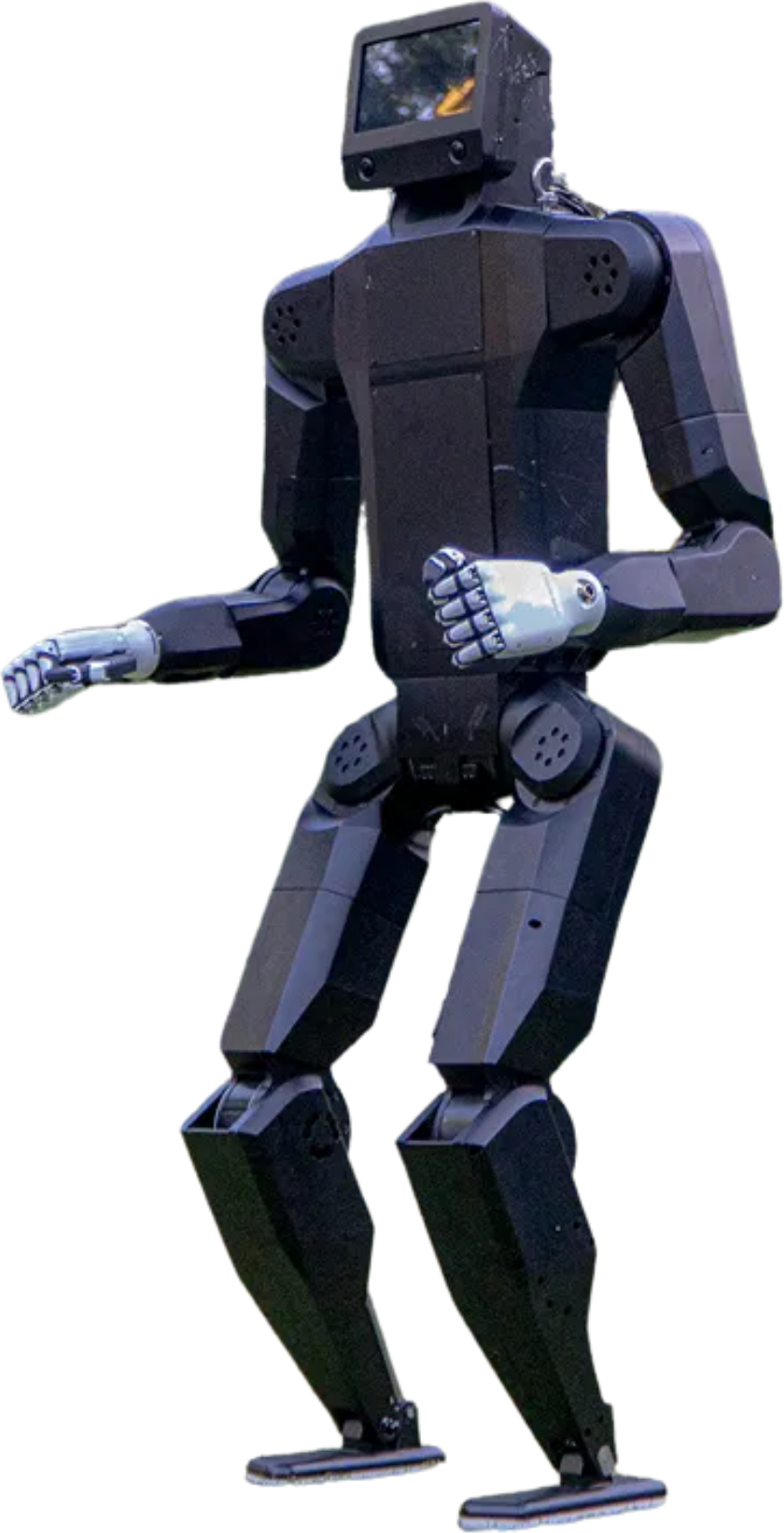
K-Bot is an open-source bipedal humanoid robot developed by K-Scale Labs, a Y Combinator-backed robotics startup based in Palo Alto, California. Marketed as "America's first open-source humanoid robot," K-Bot was designed to be an affordable, hackable platform for developers, researchers, and hobbyists. Standing 1.4 meters (4 feet 7 inches) tall and weighing 34 kilograms (77 pounds), the robot featured a fully open-sourced hardware and software stack, including mechanical CAD files, a custom Rust-based operating system called K-OS, and simulation tools for sim-to-real reinforcement learning.
| K-Bot | |
|---|---|
 | |
| General information | |
| Manufacturer | K-Scale Labs |
| Country of origin | United States |
| Year revealed | 2025 |
| Status | Discontinued (company shut down November 2025) |
| Price | $8,999 USD (Founder's Edition) |
| Website | kscale.dev |
K-Scale Labs began shipping Founder's Edition units of K-Bot in October 2025 at a price of $8,999 for the first 100 units. However, in November 2025, the company announced it was ceasing operations after failing to secure additional funding, having shipped only two units before refunding all remaining preorders.[1][2] K-Scale subsequently released all of its proprietary intellectual property under open-source licenses, preserving the project's designs for the broader robotics community.[3]
Background
K-Scale Labs
K-Scale Labs was founded in 2024 by Benjamin Bolte, a former senior engineer at Tesla and AI researcher at Meta. At Tesla, Bolte wrote the CUDA code behind the voxel occupancy network, which served as the first perception model for the Tesla Optimus humanoid robot. He later joined Meta's AI research team, where he worked on teaching robots and computer systems to learn from their environments.[4] Bolte left Meta in 2024 to start K-Scale Labs, driven by his conviction that "the only way for humanoid robots to achieve mass adoption is by being open-source, auditable, and broadly accessible."[5]
The company's co-founders included Matthew Freed, who had developed advanced robotics systems at Lockheed Martin and General Dynamics, and Pawel Budzianowski, a machine learning researcher with a PhD in dialogue systems from the University of Cambridge.[5] The company's name references the Kardashev Scale, an astrophysics framework that measures a civilization's level of technological advancement. Bolte described K-Scale's work as "building infrastructure to make humanity into a Type I Kardashev civilization."[5]
K-Scale Labs entered Y Combinator's Winter 2024 batch and raised $500,000 in pre-seed funding from Lombardstreet Ventures and Y Combinator.[6] The company subsequently raised a total of approximately $4.75 million across seed rounds from investors including GFT Ventures, Pioneer Fund, AI Grant, and Lux Capital.[7] OpenAI's nonprofit arm donated $250,000 to support K-Scale's open-source efforts, and OpenAI CEO Sam Altman reportedly pre-ordered a K-Bot unit.[8]
Stompy prototype
Before K-Bot, K-Scale Labs developed an early prototype called Stompy (officially designated Zeroth-01). Introduced in February 2024, Stompy was a 122-centimeter (4-foot) tall humanoid robot built with a total bill of materials costing under $10,000. The team designed Stompy from scratch during the YC batch, building five different hardware iterations over three months as they resolved issues with assembly, part reliability, motor torque, and gripper design.[9]
Stompy was designed so that each component fit on a standard 256 x 256 mm 3D printer bed, and its CAD files, assembly guides, and bill of materials were made publicly available. The prototype featured a claw gripper inspired by the Universal Manipulation Interface research paper. Though Stompy served primarily as a proof of concept demonstrating that a functional humanoid could be built at low cost, it helped K-Scale validate its approach and attract early community interest.[5][9]
Design and specifications
Physical design
K-Bot is a full-size bipedal humanoid robot standing 140 cm (4 feet 7 inches) tall and weighing 34 kg (77 pounds). It features two arms, two legs, and a sensor-equipped head. The robot was designed with modularity as a core principle: owners can upgrade sensors, swap end-effectors (such as different gripper hands), and improve the onboard computer over time. The design supports swappable attachments for different manipulation tasks.[10]
The robot has a maximum payload capacity of 10 kg (22 lbs) in its arms and is powered by a swappable battery pack that provides up to 4 hours of runtime. The battery system uses a 12 Ah NCM (nickel cobalt manganese) battery with individual cells rated at 4V, integrated with a battery management system (BMS) providing 50A current protection. The physical dimensions of the battery pack are 135 mm x 180 mm x 65 mm.[11]
Actuators and degrees of freedom
K-Bot features 20 articulated joints providing 20 degrees of freedom (DOF), distributed across the robot's body. The arms account for 10 DOF (5 per arm, covering shoulder pitch, shoulder roll, shoulder yaw, elbow, and wrist), while the legs provide 10 DOF (5 per leg, covering hip pitch, hip roll, hip yaw, knee, and ankle).[11]
The actuators are quasi-direct drive motors with gear reduction ratios between 6:1 and 10:1, making all joints low-inertia and back-drivable. This design choice allows the robot to be compliant and safe during physical interactions. K-Bot uses four different Robstride motor models across its joints:[11]
| Motor model | Quantity | Rated torque | Peak torque | Weight | Gear ratio |
|---|---|---|---|---|---|
| Robstride RS00 | 2 | 5 Nm | 14 Nm | 0.31 kg | 10:1 |
| Robstride RS02 | 6 | 6 Nm | 17 Nm | 0.38 kg | 7.75:1 |
| Robstride RS03 | 8 | 20 Nm | 60 Nm | 0.88 kg | 9:1 |
| Robstride RS04 | 4 | 40 Nm | 120 Nm | 1.42 kg | 9:1 |
The largest actuators (RS04) deliver a peak torque of 120 Nm and are used in the high-load joints such as the hips and knees. The actuators are organized by subassembly, with separate designations for the head (E), legs (D), arms (C), and torso (B).[11]
Joint ranges
Key motion ranges for K-Bot's joints include:[11]
| Joint | Range of motion |
|---|---|
| Shoulder pitch | -60 to 200 degrees |
| Knee | 0 to 155 degrees |
| Hip pitch | -60 to 127 degrees |
| Wrist | +/- 79 degrees |
| Ankle | +/- 65 degrees |
Sensors and perception
K-Bot is equipped with multiple sensor modalities for perceiving its environment. The robot's head houses RGB cameras, stereo vision cameras, and an ultra-wide field-of-view (FOV) camera, providing comprehensive visual coverage. For audio interaction, K-Bot includes far-field microphones and stereo speakers, enabling voice command recognition and spoken responses.[10]
An inertial measurement unit (IMU) is mounted underneath the onboard computer for balance and orientation sensing. The robot also has internet connectivity for cloud-based AI processing and remote updates.[10][12]
Computing
K-Bot uses a Raspberry Pi 5 as its primary onboard computer, running the custom K-OS operating system. The computing platform was designed to be upgradable, allowing users to swap in more powerful boards as needed.[12]
Technical specifications summary
| Category | Specification | Value |
|---|---|---|
| Physical | Height | 140 cm (4 ft 7 in) |
| Physical | Weight | 34 kg (77 lbs) |
| Physical | Degrees of freedom | 20 |
| Manipulation | Payload capacity | 10 kg (22 lbs) |
| Power | Battery type | 12 Ah NCM |
| Power | Battery life | Up to 4 hours |
| Power | BMS protection | 50A |
| Actuators | Motor supplier | Robstride |
| Actuators | Total actuators | 20 |
| Actuators | Peak torque (max) | 120 Nm (RS04) |
| Actuators | Drive type | Quasi-direct drive |
| Computing | Onboard computer | Raspberry Pi 5 |
| Computing | Operating system | K-OS (Rust-based) |
| Sensors | Vision | RGB, stereo, ultra-wide FOV |
| Sensors | Audio | Far-field microphones, stereo speakers |
| Sensors | IMU | Yes |
| Connectivity | Network | Internet-connected |
| Connectivity | API | gRPC (port 50051) |
Software stack
K-Scale Labs developed a comprehensive open-source software ecosystem for K-Bot, which the company described as "the most integrated open-source stack" in robotics.[8]
K-OS (K-Scale Operating System)
K-OS is a custom operating system written in Rust and designed specifically for real-time robotic control. Built for reliability and performance, K-OS provides a hardware abstraction layer that exposes robot functionality through gRPC APIs. This allows developers to interact with motors, sensors, and other hardware components through standardized interfaces rather than dealing with low-level hardware details. K-OS is open-sourced under the MIT license.[8][13]
PyKOS
PyKOS is a Python client library for K-OS that provides a developer-friendly interface for controlling the robot. Through PyKOS, developers can command actuators, read IMU data, manage onboard processes, and build custom behaviors using familiar Python tooling. The library connects to K-OS via gRPC on port 50051.[13]
K-Sim
K-Sim is K-Scale's reinforcement learning training engine, built on the MuJoCo physics simulator and JAX computational framework. K-Sim can generate over 100,000 training samples per second, enabling rapid policy iteration for locomotion and manipulation tasks.[8]
K-Scale also integrated the Genesis-world physics simulation engine for sim-to-real training. This approach allows the robot to learn skills such as grasping objects, navigating obstacles, and maintaining balance in realistic virtual environments before transferring those learned behaviors to the physical hardware.[10]
EdgeVLA
EdgeVLA (Edge Vision-Language-Action) is a multimodal artificial intelligence model developed by K-Scale for on-device execution. It processes voice commands and visual inputs to generate robotic actions, enabling the robot to interpret natural language instructions and respond to its visual environment in real time. Both the model and its training code were open-sourced.[8][14]
URDF and CAD files
K-Scale's software infrastructure includes tools for generating URDF (Unified Robot Description Format) files from CAD models, enabling integration with standard robotics simulation and planning tools. Complete CAD models are available via Onshape, with full feature trees for legs, torso, arms, and head assemblies. Manufacturing tolerances are specified for bearing bore mounts, and standard CNC shop tolerances are documented for other components.[11]
Open-source licensing
K-Bot's open-source approach was central to K-Scale Labs' identity and strategy. The project used a dual-licensing model:[15]
| Component | License |
|---|---|
| Hardware designs | CERN-OHL-S-2.0 (CERN Open Hardware License, Strongly Reciprocal) |
| Software (K-OS) | MIT License |
| Software (other) | GPL v3 |
The CERN-OHL-S license requires that any derivative hardware designs also be shared under the same terms, ensuring that improvements to the robot's mechanical design remain open. The MIT license on K-OS allows more permissive use of the operating system code, while the GPL v3 license on other software components ensures that modifications to those tools remain open-source.[15]
Bolte argued that open-source development was not merely an ideological choice but a practical necessity for robotics. He framed humanoid robots as "decentralized compute at scale," arguing that closed-source approaches made little sense for distributed systems that benefit from community-driven improvement.[8] His strategy relied on creating a compelling open platform that would attract developers, with each additional robot built increasing the data available to improve K-Scale's AI models, creating a virtuous feedback loop.[16]
Capabilities and demonstrations
Locomotion and balance
At its initial release, K-Bot demonstrated basic locomotion capabilities including standing, walking with short rapid steps, and maintaining dynamic balance. In a teleoperation demonstration filmed in K-Scale's Palo Alto garage in October 2025, the robot was shown walking across the floor while being remotely controlled. During the same demo, a stability test was performed in which a person kicked K-Bot's leg; the robot stumbled slightly but quickly adjusted its footing and maintained its balance without falling.[17]
Teleoperation
K-Scale demonstrated low-latency teleoperation of K-Bot using a consumer VR headset. In the demonstration, a human operator wearing the headset controlled the robot in real time, with K-Bot fluidly mimicking the operator's upper-body movements. Arm and torso motions were translated with minimal perceptible delay, while locomotion was directed through the handheld VR controllers. The teleoperation system was documented in K-Scale's official documentation and represents a key capability for collecting training data through human demonstration.[17]
Voice and app control
K-Bot supports voice commands via its far-field microphones and EdgeVLA model, as well as app-based control using pre-defined command sets. These capabilities were included in the initial software release to provide accessible ways for users to interact with the robot without programming.[10]
Product lineup
K-Scale Labs developed a family of robots at different price points and sizes to serve various segments of the robotics community:[5][10]
| Model | Height | Price | Target audience | Status |
|---|---|---|---|---|
| Z-Bot (Zeroth Bot) | 46 cm (1.5 ft) | ~$999 (assembled); $350 (DIY kit) | Students, hobbyists, developers | Kickstarter launched early 2025 |
| M-Bot | 70 cm | Under $3,000 | Early adopters | Announced |
| K-Bot | 140 cm (4 ft 7 in) | $8,999 | Researchers, developers, hobbyists | Shipped 2 units (discontinued) |
The Z-Bot, also known as Zeroth Bot, was an AI-enabled desktop humanoid robot that could be commanded by voice, taught through gestures, or programmed with Python. It launched on Kickstarter in early 2025 and was compatible with MuJoCo, NVIDIA Isaac Sim, and Genesis simulation platforms. The Z-Bot featured modular end-effectors allowing users to swap between different hands and grippers.[18]
Development roadmap
Before the company's closure, K-Scale Labs had published an ambitious development roadmap for K-Bot:[10]
| Timeline | Milestone |
|---|---|
| Late 2025 | First 100 Founder's Edition units ship with basic locomotion, balance, voice commands, and app control |
| 2025 | Integration of advanced vision-language-action AI for complex natural language instruction understanding |
| ~2028 | Full autonomy target: robot capable of general-purpose tasks with fewer than one human intervention per day |
K-Scale committed to providing free software upgrades to early buyers until the full autonomy goal was reached. However, the company's shutdown in November 2025 left this roadmap unrealized.[1]
Competitive context
K-Bot occupied a distinctive position in the humanoid robot market as an open-source, American-made alternative to both proprietary Western humanoids and increasingly dominant Chinese competitors.
Comparison with proprietary humanoids
Most well-funded humanoid robot programs, including those from Figure AI (the Figure 02), Tesla (the Optimus), Apptronik (Apollo), and Agility Robotics (Digit), follow closed-source, vertically integrated development models. K-Scale explicitly positioned itself against this approach. Bolte publicly criticized Figure AI's proprietary, in-house strategy, which led to a public exchange where Figure AI founder Brett Adcock responded dismissively. This exchange highlighted the broader tension in the robotics industry between open and closed development philosophies.[5]
At $8,999, K-Bot was priced significantly below most Western humanoid platforms, which typically cost tens of thousands to hundreds of thousands of dollars and are not sold to individual developers.
Comparison with Chinese competitors
K-Scale also competed with a growing wave of affordable humanoid robots from Chinese manufacturers. Unitree Robotics' G1 humanoid, priced starting at $16,000, gained significant popularity after its May 2024 introduction. Other Chinese competitors such as EngineAI and AgiBot were shipping low-cost humanoids at increasing scale, backed by strong government support and established supply chains.[5]
K-Scale's open-source model was intended to differentiate it from Chinese competitors by enabling a global developer community to contribute improvements. However, the funding and manufacturing challenges that ultimately led to K-Scale's closure highlighted the difficulty of competing on hardware cost with Chinese companies that had access to cheaper labor, established component supply chains, and government subsidies.[1][2]
Shutdown and legacy
Funding failure and closure
On November 4-5, 2025, K-Scale Labs announced it was ceasing operations. CEO Benjamin Bolte cited inability to secure a lead investor for additional funding as the primary cause. At the time of the announcement, the company had less than one month of runway remaining, with approximately $400,000 in cash reserves. Bolte expressed surprise at the fundraising difficulty, noting that he had expected American capital markets to be more receptive to a cost-competitive domestic humanoid robotics company.[1][2]
The company had opened preorders for K-Bot over the summer of 2025 and began shipping its first Founder's Edition units shortly before the shutdown. Only two K-Bot units were delivered before all remaining preorder deposits were refunded and most of the team was laid off.[1]
A post-mortem analysis identified several strategic errors that contributed to K-Scale's failure. The company spent months working on locomotion challenges while competitors shipped demonstrations, causing it to miss fundraising windows. Supply chain management proved more difficult than anticipated, with costs for contract manufacturing in China varying from $800 to $2,400 per unit depending on execution quality. Engineers faced unrealistic weekly timelines that forced corner-cutting and strained manufacturer relationships.[19]
Open-sourcing of intellectual property
In keeping with its open-source mission, K-Scale released all remaining proprietary intellectual property upon shutdown. Hardware designs were released under the CERN-OHL-S-2.0 license, and software was released under the MIT license. This included complete designs for both the K-Bot and Z-Bot projects. Bolte expressed hope that the released work would "lay the foundation for future hackers and dreamers."[3]
The GitHub repositories containing K-Bot's mechanical designs, electrical schematics, K-OS operating system, simulation tools, and inference code remain publicly accessible as of 2026.[15]
Gradient Robotics
Following K-Scale's shutdown, co-founder Jingxiang Mo left the company in September 2025 to establish Gradient Robotics, headquartered in Menlo Park, California. Mo described the new venture as having "inherited the K-Scale spirit, mission, and core engineering team" and stated that Gradient Robotics would be "the open-source Unitree for America." The startup closed a pre-seed funding round in September 2025 and is focused on bringing cost-effective, US-manufacturable humanoid robots to market.[20]
See also
- Humanoid robots
- K-Scale Labs
- Open-source hardware
- Unitree G1
- Tesla Optimus
- Figure 02
- Reinforcement learning
References
- ^1 ^2 ^3 ^4 ^5"Palo Alto Humanoid Startup K-Scale Labs Shuts Down." Mike Kalil, November 2025.
- ^1 ^2 ^3"K-Scale Labs Cancels K-Bot Orders, Open-Sources All IP After Funding Fails." Humanoids Daily, November 2025.
- ^1 ^2"Watch: K-Scale Labs CEO Explains Shutdown." Humanoids Daily, November 2025.
- ^"K-Scale Labs: Open-source humanoid robots." Y Combinator company profile.
- ^1 ^2 ^3 ^4 ^5 ^6 ^7"K-Scale Labs Disrupts Silicon Valley with Open-Source Humanoids." Mike Kalil.
- ^"K-Scale Labs Pre Seed Round." Crunchbase.
- ^"K-Scale Labs Funding, Financials, Valuation & Investors." Crunchbase.
- ^1 ^2 ^3 ^4 ^5 ^6"K-Scale Labs: Betting on Open Source for the Future of Humanoid Robotics." Humanoids Daily.
- ^1 ^2"World's first garage-built humanoid robot open to creators worldwide." Interesting Engineering.
- ^1 ^2 ^3 ^4 ^5 ^6 ^7"K-Scale Labs Launches K-Bot: America's First Open-Source Humanoid Robot." RS DesignSpark.
- ^1 ^2 ^3 ^4 ^5 ^6"Mechanical System." K-Scale Docs.
- ^1 ^2"Quickstart." K-Scale Docs.
- ^1 ^2"kscalelabs/kos: A general-purpose, configurable framework for robot firmware." GitHub.
- ^"kscalelabs/evla: EdgeVLA: An open-source edge vision-language-action model for robotics." GitHub.
- ^1 ^2 ^3"kscalelabs/kbot: The K-Scale Robot." GitHub.
- ^"Why K-Scale Wins." Ben Bolte, March 2024.
- ^1 ^2"K-Scale Labs Demos Low-Latency Humanoid Teleoperation in New Garage Video." Humanoids Daily, October 2025.
- ^"Zeroth Bot: The Programmable Humanoid Robot." Kickstarter.
- ^"Why K-Scale Labs Failed: 6 Hard Lessons from Inside." There's a Robot for That.
- ^"Former K-Scale Team Launches 'Unitree for America'." Mike Kalil.
Improve this article
Add missing citations, update stale details, or suggest a clearer explanation. Every suggestion is reviewed for sourcing before it goes live.
9 revisions · v9 · 3,173 words · full history
Fact-checks are independent of edits: a reviewer re-verifies the article against its sources and stamps the date. How we verify
Research and drafting on this wiki are AI-assisted, under named human editorial standards. How AI is used here
Cite this page: AI Wiki. "K-Bot." aiwiki.ai, updated 12 Apr 2026. CC BY 4.0. https://aiwiki.ai/wiki/k_scale_k_bot