

AgiBot A2
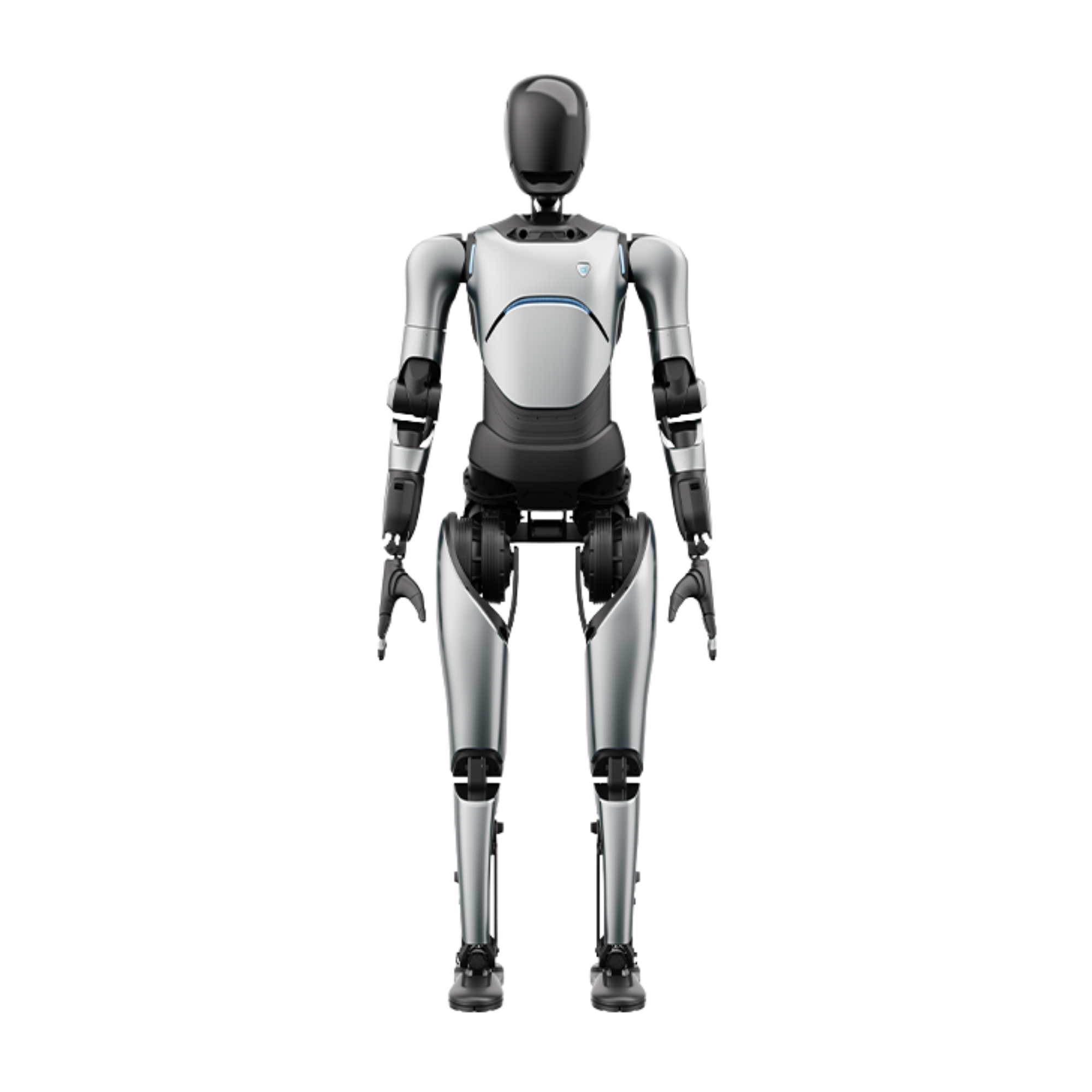
The AgiBot A2 (Chinese: 远征A2, Yuanzheng A2) is a full-size bipedal humanoid robot developed by AgiBot, a Chinese robotics company headquartered in Shanghai. It is the world's first full-size humanoid robot to hold safety and quality certifications from China, the United States, and the European Union at the same time, and in November 2025 it set a Guinness World Record by walking 106.286 kilometers from Suzhou to Shanghai without powering off.[1][2] Introduced in August 2024 alongside the A2 Max and A2-W variants, the A2 serves as AgiBot's flagship general-purpose humanoid platform, designed for commercial service, industrial automation, logistics, healthcare, and research applications.
| AgiBot A2 | |
|---|---|
 | |
| General information | |
| Manufacturer | AgiBot |
| Country of origin | China |
| Year introduced | August 2024 |
| Status | In production |
| Price | $100,000 - $190,000 USD |
| Certifications | CR (China), FCC (US), CE (EU) |
| Website | agibot.com/products/A2 |
The A2 became the first full-size humanoid robot in the world to receive safety and quality certifications from China, the United States, and the European Union simultaneously in May 2025.[1] In November 2025, it set a Guinness World Record for the longest journey walked by a humanoid robot, covering 106.286 kilometers from Suzhou to Shanghai over three days without powering off.[2] The A2 and its variants form a key part of AgiBot's product lineup, which helped the company ship over 5,100 units in 2025 and reach 10,000 cumulative units by March 2026, making AgiBot the world's largest humanoid robot producer by volume.[3] AgiBot is also positioned to become the first embodied-intelligence company to gain a public listing on China's STAR Market through a roughly $290 million acquisition of the Shanghai-listed firm Swancor announced in July 2025.[26]
History
Development and unveiling
AgiBot was founded in February 2023 by former Huawei engineers Peng Zhihui and Deng Taihua. The company's first product, the RAISE A1, debuted in August 2023 as a 175 cm bipedal humanoid with 49 degrees of freedom and a proprietary AI system called WorkGPT.[4] The A1 served primarily as a technology demonstrator for industrial tasks such as bolt tightening and vehicle inspections.
Building on the A1's architecture, AgiBot developed the A2 series as a commercially oriented successor. In August 2024, AgiBot officially introduced five new robot models at a product launch event, including three members of the A2 family: the standard A2, the heavy-duty A2 Max, and the wheeled A2-W. The A2 was positioned as a versatile platform suitable for both service and industrial roles, while each variant targeted specific use cases.[5]
Mass production and scale-up
AgiBot established its manufacturing facility in Shanghai's Lin-gang Special Area in January 2024. In September 2024, the company opened the AIDEA Giga Data Factory, a 3,000-square-meter facility dedicated to large-scale robot interaction data collection using hundreds of tele-operated robots.[6] By December 15, 2024, AgiBot had produced 962 units across its entire product line and publicly announced the start of mass production.[3]
Production accelerated rapidly in 2025. AgiBot produced its 1,000th general-purpose embodied robot in January 2025. By the end of 2025, the company had shipped 5,168 units total, capturing approximately 39% of the global humanoid robot market according to research firm Omdia and ranking first worldwide in humanoid robot shipments.[3] The pace continued to increase in 2026: AgiBot reached 10,000 cumulative units by March 30, 2026, taking roughly three months to go from 5,000 to 10,000 units.[3]
Safety certifications
In May 2025, the AgiBot A2 became the first full-size humanoid robot to receive safety and quality certifications from all three major global markets simultaneously. At the 2025 Zhangjiang Embodied Intelligence Developers Conference, the Shanghai Robot Industrial Technology Research Institute awarded the CR001 certificate to the A2. The robot also holds FCC certification (United States) and CE marking (European Union). CR certification evaluates mechanical and electrical safety, electromagnetic compatibility, functional safety, and intelligent performance.[1]
Guinness World Record
On November 10, 2025, an AgiBot A2 departed from Jinji Lake in Suzhou, Jiangsu Province, and walked to the Bund in Shanghai, arriving on November 13. The robot covered 106.286 kilometers over approximately three days without powering off, using its hot-swappable battery system to maintain continuous operation. Guinness World Records recognized this as the "Longest journey walked by a humanoid robot," making the A2 the first humanoid to hold this title.[2]
The route traversed unstructured real-world terrain, including asphalt roadways, tiled pavements, and tactile paving. According to AgiBot, the A2 accumulated the equivalent of 360 hours of continuous walking during testing, corresponding to approximately 18 months of typical use, with zero falls recorded.[2][7]
CES 2026 debut
In January 2026, AgiBot made its U.S. market debut at CES 2026, showcasing the full A2 Series alongside the X2 Series, G2 Series, and D1 quadruped series. The A2 Series received multiple "Best of CES 2026" awards, including the Netzwelt Innovation Award 2026, recognition from MacStories and Forbes, and a Global Top Brands award for "Global Emerging Brands."[8]
Technical specifications
The AgiBot A2 is a full-size bipedal humanoid designed around ergonomic proportions. The current production model (as listed on AgiBot's official website) stands 169 cm tall and weighs approximately 69 kg, featuring over 40 active degrees of freedom. Some earlier press materials and the Wikipedia article for AgiBot cite dimensions of 175 cm and 55 kg with 49 DOF, which may reflect a pre-production or early prototype configuration.[5][9]
Physical and mobility specifications
| Specification | Value |
|---|---|
| Height | 169 cm (5 ft 7 in) |
| Weight | ~69 kg (152 lb) |
| Active degrees of freedom | 40+ |
| Arm DOF | 7 per arm (14 total) |
| Hand DOF | 6 per hand (dexterous hand variant available with 19 DOF, 12 active + 7 passive) |
| Leg DOF | 6 per leg |
| Neck DOF | 2 |
| Maximum walking speed | Up to 3.3 m/s (11.9 km/h) |
| Turning radius | 60 cm |
| Payload capacity | Up to 15 kg per arm |
| Peak knee torque | 270 N-m |
| Ramp climbing | Up to 10-degree inclines |
| Stair climbing | Yes |
Computing and sensors
| Component | Details |
|---|---|
| AI computing power | 200 TOPS |
| CPU | 16-core high-performance processor |
| GPU | NVIDIA Jetson Orin 64G (high-performance board option) |
| LiDAR | 360-degree, seamless panoramic perception |
| Cameras | Six high-definition cameras (RGB-D, RGB, fisheye) |
| Audio | Microphone array with sound source localization |
| Force sensing | Fingertip sensors, 6D force/torque sensors in manipulators |
| IMU/Gyroscope | Yes |
| Connectivity | Wi-Fi, 4G/5G |
Power
| Specification | Value |
|---|---|
| Battery capacity | 700 Wh |
| Runtime (standing) | ~3 hours |
| Runtime (walking) | ~1.5 to 2 hours |
| Charging time | ~2 hours |
| Power input | 110V - 220V |
| Battery swapping | Supported (hot-swappable) |
Safety systems
The A2 features a three-layer safety monitoring architecture operating at the business, system, and hardware levels. It achieves PLd-level safety protection (Performance Level d, per ISO 13849). The system includes redundant computing, a dedicated safety center backup, and a dual-path control architecture. Six HD cameras and 360-degree LiDAR provide obstacle detection and proximity sensing.[1][9]
AI and software
The A2 runs AgiBot's proprietary software stack, which includes several key components:
- WorkGPT: A multimodal AI engine that processes text, audio, and visual inputs with 96% accuracy even in noisy environments. It supports full-duplex conversation and achieves a 99% face wake-up rate for natural interaction initiation.[9]
- ActionGPT: A motion generation system for natural gesture synthesis during interaction.
- HIMUS 3D-SLAM: A navigation algorithm providing L4-level autonomous mobility.
- RTMOF: A non-linear model predictive control system combined with reinforcement learning for locomotion.
- Large language model integration: Supports retrieval-augmented generation (RAG) for custom knowledge bases, enabling domain-specific conversational AI.
The A2 also supports multi-modal control via handheld remote, smartphone, and computer interfaces, and is compatible with AgiBot's swarm control software for multi-robot coordination.[9]
A2 Series variants
AgiBot offers the A2 in several variants optimized for different applications. The standard A2 targets general service and commercial use, while the Lite, Ultra, Max, and W variants address specific market segments from entertainment to heavy industry.
Variant comparison
| Variant | Height | Weight | Active DOF | Max Speed | Payload | Battery | Key Sensors | Primary Use Cases | Price Range |
|---|---|---|---|---|---|---|---|---|---|
| A2 (Standard) | 169 cm | ~69 kg | 40+ | 3.3 m/s | 15 kg | 700 Wh (~2 hr) | 360-degree LiDAR, RGB-D, 6 HD cameras, mic array | Service, hospitality, retail, healthcare | $100,000 - $130,000 |
| A2 Lite | 169 cm | ~69 kg | 40+ | 3.3 m/s | 15 kg | 700 Wh (~2 hr) | No LiDAR or RGB-D; simplified sensor suite | Entertainment, marketing, front desk, exhibitions | Lower than standard |
| A2 Ultra | 169 cm | ~69 kg | 40 | 1.2 m/s | ~2 kg per arm | 700 Wh (~2 hr) | 3D LiDAR, RGB-D, multiple RGB and fisheye cameras | Advanced service, autonomous navigation, mapping | Quote-based |
| A2 Max | 175 cm | 85 kg | 53 | 1 m/s | 40 kg | ~700 Wh (~2 hr) | LiDAR, depth sensors | Heavy-duty handling, palletizing, material transfer | $130,000 - $160,000 |
| A2-W | 163 cm | 230 kg | 22 | N/A (wheeled) | 5 kg per arm | 2,000 Wh (~5 hr) | 360-degree LiDAR, 4 AI vision sensors, 2x 6D force sensors | Factory automation, flexible manufacturing, logistics | $150,000 - $190,000 |
A2 Lite
The A2 Lite is a cost-reduced variant designed for customer-facing roles where full sensor capability is not required. It strips the LiDAR and RGB-D camera systems found in the standard A2, relying on a simplified perception suite. The Lite targets marketing, exhibition hall presentations, supermarket guidance, front desk reception, and business inquiry scenarios. It retains the same physical frame and locomotion capability as the standard A2, with hot-swap battery support for continuous operation.[10]
A2 Ultra
The A2 Ultra is the perception-enhanced variant, adding 3D LiDAR, an RGB-D camera, and multiple RGB and fisheye cameras on top of the standard sensor suite. This expanded perception stack supports more capable autonomous navigation, environmental mapping, and obstacle awareness. The Ultra is powered by an NVIDIA Jetson Orin 64G GPU and a 16-core CPU, with Wi-Fi and 4G/5G connectivity. It supports OTA (over-the-air) updates and swarm control software. The Ultra targets complex service environments that require higher autonomy, such as guided tours in large facilities and interactive demonstrations.[11]
A2 Max
The A2 Max is a heavy-duty industrial variant standing 175 cm tall and weighing 85 kg. It features 53 active degrees of freedom, including 19-DOF industrial-grade dexterous hands (12 active, 7 passive) and 7-DOF arms. Its dual arms use dual-ratio reduction joint modules to deliver peak torque of 450 N-m, while leg joints produce 8,800 N of thrust through linear actuator motors. The A2 Max can handle objects weighing up to 40 kg across its entire working range, making it suited for material handling, palletizing, and other heavy-duty manufacturing tasks. Its walking speed is limited to 1 m/s, reflecting the trade-off between payload capacity and agility.[12]
A2-W
The A2-W replaces the A2's bipedal legs with a four-wheel-drive base, making it a wheeled dual-arm robot rather than a true bipedal humanoid. Measuring 770 x 620 x 1,630 mm and weighing 230 kg, the A2-W features bionic 7-DOF dual arms that can operate in parallel or asynchronously, enabling tasks like mid-air relay and hand-off operations. The four-wheel-drive system provides zero turning radius and crab-walking capabilities for navigating tight spaces.
The A2-W's defining advantage for factory applications is its 2,000 Wh battery, which provides approximately 5 hours of runtime with hot-swappable support. Its 275 TOPS computing system powers 360-degree LiDAR, four AI vision sensors, and two 6D force sensors. The robot uses embodied AI algorithms including UniGrasp, Uni6DPose, and UniPlug for adaptive task learning, and can adapt to new objects within hours using 3D model synthesis and reinforcement learning. The A2-W is the variant that has seen the most prominent factory deployments, particularly at SAIC-GM.[13][14]
Factory deployments
SAIC-GM
The most detailed public deployment of an A2-series robot in a production environment involves the A2-W at the SAIC General Motors (SAIC-GM) Ultium Center in Shanghai. SAIC-GM and AgiBot jointly developed a robot designated "Nengzai No. 1" (能仔1号), based on the A2-W platform, for the Buick Electra E7 battery production line. Deployed in early 2026, the robot performs battery cell grasping and loading operations, using visual perception and dual-arm coordination to autonomously identify materials and plan grasping paths without fixed programming.[15]
The deployment achieves positioning accuracy of plus or minus 0.1 millimeters and a cycle time of approximately 2 seconds per piece. Its footprint occupies less than 15% of the space required by traditional automated workstations. SAIC-GM tested over 100 workstations before selecting the battery line as the initial deployment site. The companies are also conducting pilot applications of bipedal humanoid robots in production, logistics, and other processes, indicating that legged A2 variants may follow the A2-W into SAIC-GM factories.[15]
This deployment represents one of the first instances in China's automotive industry where an embodied intelligent robot has been integrated into an actual production line, rather than serving in a demonstration or pilot capacity.[15]
BYD
BYD, which is also an early investor in AgiBot, has deployed AgiBot robots for logistics and quality control tasks in its welding workshops. While public details about the specific A2 models used at BYD are limited, the partnership validates the use of humanoid robots in real automotive production environments. BYD separately deploys UBTECH Walker S1 robots in other parts of its manufacturing operations, making its factories a testing ground for multiple humanoid platforms.[3][16]
Other deployments
Beyond automotive manufacturing, the A2 and its variants are deployed across eight commercial application areas as of 2026: customer service and reception, exhibition and marketing, manufacturing, logistics and warehousing, security and inspection, healthcare and elder care, education and research, and data collection. AgiBot's robots are available in China, the United States, Canada, Germany, Japan, and South Korea.[9][8]
AI platform and data infrastructure
AgiBot World dataset
AgiBot World is an open-source, large-scale robot manipulation dataset created in collaboration with OpenDriveLab (associated with the University of Hong Kong and the Shanghai AI Lab). The dataset was collected by over 100 homogeneous robots in a purpose-built 4,000-square-meter data collection facility. It contains 1,001,552 trajectories totaling 2,976.4 hours of interaction data, covering 217 specific tasks, 87 skills, and 106 scenes across five core scenarios: home, dining, industry, supermarket, and office environments.[17]
Compared to Google's Open X-Embodiment dataset, AgiBot World features data at ten times the scale, scene coverage expanded by 100 times, and data quality elevated from laboratory-level to industrial-level standards. The dataset has been described as the "ImageNet moment" for embodied intelligence. It received an IROS 2025 Best Paper Award nomination and was published in IEEE Transactions on Robotics (TRO) in 2026. The dataset is available for non-commercial use on GitHub and Hugging Face.[17][18]
GO-1 and GO-2 foundation models
Genie Operator-1 (GO-1), launched on March 10, 2025, is AgiBot's first generalist embodied foundation model. It introduces the Vision-Language-Latent-Action (ViLLA) framework, combining a Vision-Language Model (VLM) with a Mixture of Experts (MoE) architecture. GO-1 consists of two components: a Latent Planner that learns general action understanding from cross-embodiment and human operation data, and an Action Expert that uses over one million real robot demonstrations for high-frequency dexterous manipulation. Across five evaluated tasks, GO-1 raised the average success rate from 46% to 78%, a 32% absolute improvement over the prior state of the art, with the Latent Planner alone contributing a 12% gain (66% to 78%). Policies pretrained on the AgiBot World dataset achieve an average 30% performance improvement over those trained on Open X-Embodiment.[19][27]
In 2026, AgiBot released GO-2, the next-generation foundation model, on April 9, 2026. GO-2 introduces a dual-system architecture: System 2 (the Semantic Planning Module) operates at lower frequency as the "General Commander," generating high-level action intent sequences, while System 1 (the Action Following Module) operates at high frequency as the "Agile Executor," performing residual refinement to compensate for environmental disturbances in real time. GO-2 achieved a 98.5% average success rate on the LIBERO benchmark, significantly outperforming mainstream models like pi-0.5 and NVIDIA GR00T. AgiBot said GO-2 achieves "a paradigm shift" in behavioral performance by bridging reasoning and action.[20]
Lingqu OS
Released in July 2025, Lingqu OS is AgiBot's embodied intelligent operating system. It consists of three layers: a real-time middleware layer built on AimRT (a custom C++20 runtime that outperforms ROS 2 in benchmarks), a standardized intelligent agent service layer, and a comprehensive toolchain for simulation, training, and deployment. The OS was made available under an open co-development model beginning in Q4 2025.[21]
Corporate developments and STAR Market listing
AgiBot, formally Zhiyuan Robotics (Shanghai Zhiyuan New Creation Technology), has moved toward becoming the first embodied-intelligence company to gain a public listing on mainland China's STAR Market. On July 8, 2025, AgiBot and its affiliate AgiBot Xinchuang agreed to acquire a controlling stake in Swancor Advanced Materials, a Shanghai-listed wind-turbine blade materials maker, in a deal valued at roughly $290 million (about 2.1 billion yuan).[26]
Under the agreement, the AgiBot entities would acquire a minimum of 63.62% of Swancor's shares, taking 29.99% through negotiated transfers and up to an additional 37% via a partial tender offer. Shanghai AgiBot Hengyue Technology Partnership would become the controlling shareholder, and AgiBot founder and CEO Deng Taihua, a former Huawei executive, would become the actual controller of the listed company.[26]
AgiBot characterized the transaction as positioning it to become "the first embodied intelligence robotics company to gain a foothold on China's STAR Market," while stating that "the acquisition is not a backdoor listing under current Chinese capital market regulations."[26] News of the deal sent Swancor's shares to an 11-day limit-up streak, making it one of the year's earliest 10-bagger A-share stocks. Separately, earlier reporting indicated AgiBot had explored a 2026 Hong Kong IPO at a valuation in the range of HK$40 billion to HK$50 billion (approximately $5.1 billion to $6.4 billion).[26]
Pricing and availability
The AgiBot A2 is priced between approximately $100,000 and $190,000 depending on the variant and configuration. The standard A2 falls in the $100,000 to $130,000 range, the A2 Max costs $130,000 to $160,000, and the industrial A2-W ranges from $150,000 to $190,000. Pricing for the A2 Lite and A2 Ultra is typically quote-based and varies by configuration.[9][22]
At these price points, the A2 undercuts competitors like the Agility Robotics Digit (approximately $250,000) while offering broader application versatility. However, it is significantly more expensive than planned future pricing for Tesla Optimus, which Tesla has projected at $20,000 to $30,000 per unit at scale, though Optimus remains in limited factory trials as of early 2026.[9]
AgiBot's robots are available for purchase in China, the United States, Canada, Germany, Japan, and South Korea. They can also be leased through authorized distributors.[8]
Competition
The AgiBot A2 competes in a rapidly growing market for full-size humanoid robots. Its primary competitors include both Chinese and international manufacturers.
How does the AgiBot A2 compare to other humanoid robots?
| Competitor | Model | Type | Approx. Price | Key Differentiator | Status (2026) |
|---|---|---|---|---|---|
| Unitree Robotics | H1 / H2 | Bipedal | ~$90,000 (H1) | Lower price, strong research community | Production (5,500+ shipped in 2025) |
| UBTECH | Walker S1 / S2 | Bipedal | N/A | BYD factory partnerships, industrial focus | Production (~1,000 shipped in 2025) |
| Tesla | Optimus Gen 3 | Bipedal | Target $20K-$30K | Massive scale potential, Tesla ecosystem | Limited factory trials |
| Figure AI | Figure 02 / 03 | Bipedal | ~$50,000 (projected) | BMW partnership, OpenAI collaboration | Early deployment |
| Agility Robotics | Digit | Bipedal | ~$250,000 | Purpose-built for warehouse logistics | Production |
| Apptronik | Apollo | Bipedal | N/A | Mercedes-Benz partnership | Pilot deployment |
| XPeng Robotics | Iron | Bipedal | N/A | Automotive company backing | Prototype |
According to a TrendForce report from April 2026, China's humanoid robot output was projected to surge 94% in 2026, with Unitree and AgiBot expected to capture nearly 80% of global market share combined. The overall humanoid robotics market was valued at $2.92 billion in 2025, growing at a 39.2% compound annual growth rate toward a projected $15.26 billion by 2030. China dominated global sales in 2025, accounting for approximately 90% of total units shipped.[23][24]
AgiBot's competitive advantage lies in its broad product portfolio (spanning the A2 bipedal line, the G2 wheeled industrial line, the compact X series, and the D1 quadruped series), its vertically integrated AI software stack, the open-source AgiBot World dataset, and its established factory deployments with major automotive manufacturers. In its "General-Purpose Embodied Intelligent Robot 2026" report released in January 2026, Omdia ranked AgiBot No. 1 worldwide "across the two key commercial indicators" and awarded it the highest rating, "Advanced Capability," in six of the evaluated dimensions.[28] The company's main domestic rival, Unitree Robotics, shipped approximately 5,500 humanoid robots in 2025, with its CEO Wang Xingxing disputing AgiBot's claim to the top market position.[25]
See also
- Humanoid robots
- Humanoid robot market
- AgiBot
- AgiBot A2 Max
- AgiBot A2 Lite
- AgiBot A2 Ultra
- AgiBot A2-W
- AgiBot G2 Genie
- Embodied AI
References
- ^1 ^2 ^3 ^4Shanghai firm unveils world's first humanoid robot certified in China, U.S., and EU - ECNS
- ^1 ^2 ^3 ^4Chinese humanoid robot sets Guinness World Record with 106-km inter-city walk - Xinhua
- ^1 ^2 ^3 ^4 ^5AGIBOT Reaches 10,000 Units as Real-World Demand for Robots Accelerates - PR Newswire
- ^AgiBot - Wikipedia
- ^1 ^2AgiBot unveils five humanoid robots, commercialization on the horizon - KrASIA
- ^ZhiYuan Robotics Releases AgiBot World Dataset - AI Base
- ^AgiBot's Expedition A2 Completes 106km Trek, Setting New Bar for Humanoid Endurance - Humanoids Daily
- ^1 ^2 ^3AGIBOT Makes Its U.S. Market Debut at CES 2026 with Its Full Humanoid Robot Portfolio - PR Newswire
- ^1 ^2 ^3 ^4 ^5 ^6 ^7AgiBot A2 official product page
- ^AgiBot A2 Lite, Ultra, Max and A2-W specs - Robots Europa
- ^AGIBOT A2 Ultra Full-Size Humanoid Robot - AgiBot
- ^AGIBOT A2-Max official product page
- ^AgiBot A2-W Wheeled General-Purpose Robot: Everything You Need to Know - Bikman Tech
- ^AGIBOT A2-W Flexible Manufacturing Robot - AgiBot
- ^1 ^2 ^3SAIC-GM deploys wheeled humanoid robots on Buick battery assembly line - CnEVPost
- ^BYD's China factory employs Walker S1 humanoid robot for manual work - Interesting Engineering
- ^1 ^2AgiBot World - GitHub (OpenDriveLab)
- ^AgiBot World Colosseo: A Large-scale Manipulation Platform - arXiv
- ^AgiBot GO-1: The Evolution of Generalist Embodied Foundation Model from VLA to ViLLA - GlobeNewsWire
- ^AGIBOT releases GO-2 foundation model for embodied AI - The Robot Report
- ^AgiBot gains lead in world humanoid robot uptrend - China Daily
- ^AGIBOT Humanoid Robots: Price, Specs and Where to Buy (2026) - BotInfo
- ^China's Humanoid Robot Output to Surge 94% in 2026 - TrendForce
- ^A Deep Look Into China's Humanoid Robot Market - DirectIndustry
- ^Unitree ships more than 5,500 humanoid robots in 2025 - South China Morning Post
- ^1 ^2 ^3 ^4 ^5AgiBot Robotics to Take Over Swancor in $290 Million Deal, Eyes First Embodied Intelligence Listing on China's STAR Market - TMTPost
- ^AgiBot Innovates Robotics with the Launch of Genie Operator-1 (GO-1) - Newsfile
- ^Omdia Ranks AGIBOT No.1 Worldwide in Humanoid Robot Shipments in 2025 - PR Newswire
Improve this article
Add missing citations, update stale details, or suggest a clearer explanation. Every suggestion is reviewed for sourcing before it goes live.
6 revisions · v6 · 3,996 words · full history
Fact-checks are independent of edits: a reviewer re-verifies the article against its sources and stamps the date. How we verify
Research and drafting on this wiki are AI-assisted, under named human editorial standards. How AI is used here
Cite this page: AI Wiki. "AgiBot A2." aiwiki.ai, updated 21 Jun 2026. CC BY 4.0. https://aiwiki.ai/wiki/agibot_a2